Saltar al contenido principal
Acceptance of online degrees by
undergraduate Mexican students:
Comparing perceptions a decade later
BRENDA CECILIA PADILLA RODRIGUEZ
UNIVERSIDAD AUTÓNOMA DE NUEVO LEÓN, MEXICO
JONATHAN ADAMS
FLORIDA STATE UNIVERSITY, USA
2
Ed-Media at Vienna in 2008
Why are we still
talking about
acceptance?
ISN’T IT A GIVEN?
3
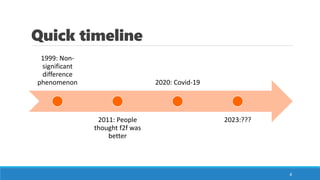
Quick timeline
1999: Non-
significant
difference
phenomenon
2011: People
thought f2f was
better
2020: Covid-19
2023:???
4
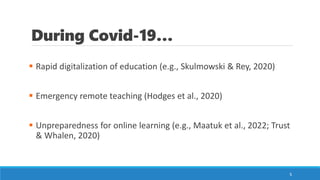
During Covid-19…
▪ Rapid digitalization of education (e.g., Skulmowski & Rey, 2020)
▪ Emergency remote teaching (Hodges et al., 2020)
▪ Unpreparedness for online learning (e.g., Maatuk et al., 2022; Trust
& Whalen, 2020)
5
Skepticism
(AGUILERA-HERMIDA ET AL., 2021; SZOPIŃSKI & BACHNIK, 2022)
6
Objetive
7
Reexamine the perceptions of online
learning in higher education and the
acceptance of online degrees
This is an ongoing study. Preliminary results are presented.
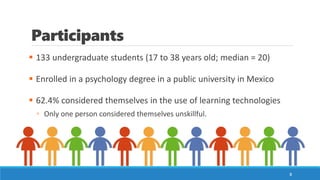
Participants
▪ 133 undergraduate students (17 to 38 years old; median = 20)
▪ Enrolled in a psychology degree in a public university in Mexico
▪ 62.4% considered themselves in the use of learning technologies
▫ Only one person considered themselves unskillful.
8
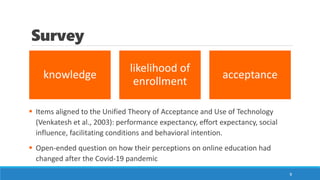
knowledge
likelihood of
enrollment
acceptance
Survey
▪ Items aligned to the Unified Theory of Acceptance and Use of Technology
(Venkatesh et al., 2003): performance expectancy, effort expectancy, social
influence, facilitating conditions and behavioral intention.
▪ Open-ended question on how their perceptions on online education had
changed after the Covid-19 pandemic
9
Covid-19 changed
perceptions
(FOR 90.8% OF PARTICIPANTS)
10
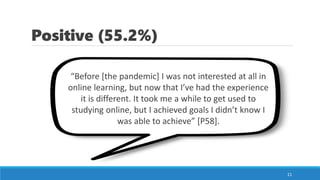
Positive (55.2%)
11
“Before [the pandemic] I was not interested at all in
online learning, but now that I’ve had the experience
it is different. It took me a while to get used to
studying online, but I achieved goals I didn’t know I
was able to achieve” [P58].
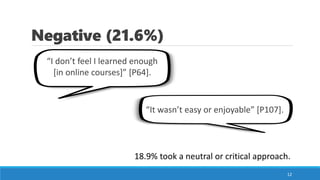
Negative (21.6%)
12
“I don’t feel I learned enough
[in online courses]” [P64].
18.9% took a neutral or critical approach.
“It wasn’t easy or enjoyable” [P107].
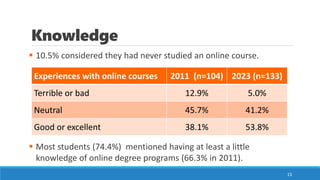
Knowledge
▪ 10.5% considered they had never studied an online course.
▪ Most students (74.4%) mentioned having at least a little
knowledge of online degree programs (66.3% in 2011).
13
Experiences with online courses 2011 (n=104) 2023 (n=133)
Terrible or bad 12.9% 5.0%
Neutral 45.7% 41.2%
Good or excellent 38.1% 53.8%
2011 (n=104) 2023 (n=133)
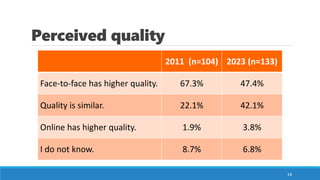
Face-to-face has higher quality. 67.3% 47.4%
Quality is similar. 22.1% 42.1%
Online has higher quality. 1.9% 3.8%
I do not know. 8.7% 6.8%
Perceived quality
14
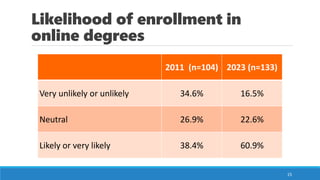
Likelihood of enrollment in
online degrees
15
2011 (n=104) 2023 (n=133)
Very unlikely or unlikely 34.6% 16.5%
Neutral 26.9% 22.6%
Likely or very likely 38.4% 60.9%
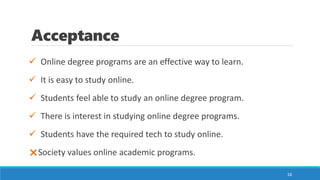
Acceptance
✓ Online degree programs are an effective way to learn.
✓ It is easy to study online.
✓ Students feel able to study an online degree program.
✓ There is interest in studying online degree programs.
✓ Students have the required tech to study online.
Society values online academic programs.
16
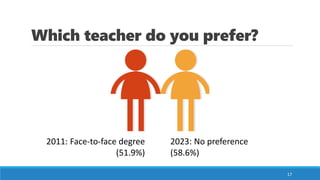
Which teacher do you prefer?
17
2011: Face-to-face degree
(51.9%)
2023: No preference
(58.6%)
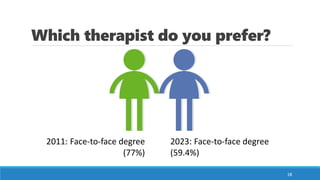
Which therapist do you prefer?
18
2011: Face-to-face degree
(77%)
2023: Face-to-face degree
(59.4%)
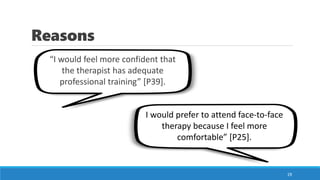
Reasons
19
“I would feel more confident that
the therapist has adequate
professional training” [P39].
I would prefer to attend face-to-face
therapy because I feel more
comfortable” [P25].
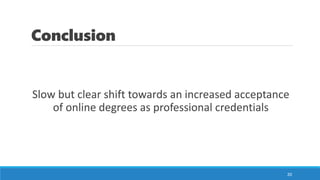
Conclusion
Slow but clear shift towards an increased acceptance
of online degrees as professional credentials
20
Acceptance of online degrees by
undergraduate Mexican students:
Comparing perceptions a decade later
BRENDA CECILIA PADILLA RODRIGUEZ
UNIVERSIDAD AUTÓNOMA DE NUEVO LEÓN, MEXICO
JONATHAN ADAMS
FLORIDA STATE UNIVERSITY, USA