Absolute monarchies were common during the Age of Absolutism from the 1500s to late 1700s. Absolute monarchs possessed total control over their kingdoms and had several advantages, such as efficient decision making and long-term stability. However, they also had weaknesses like being undemocratic and restricting individual rights. Russia in particular was isolated during this period due to Mongol rule and a lack of warm water ports, but Czars like Peter the Great sought to modernize and Westernize the nation through reforms like building the new capital St. Petersburg.
Absolute Monarchy Agovernment run by a king or a queen who possesses absolute, or total control
2.
Age of AbsolutismThe time period when absolute monarchs can be found all over ( from 1500s to late 1700s )
3.
Positives and Strengthsof Absolute Monarchies 1. Efficient - decisions are made quickly and decisively. - Only one person decides policy for the whole country. There is no debating.
4.
Positives and Strengthsof Absolute Monarchies 2. Stability - The ruler stays the same, until he dies. There is a great deal of continuity. -Louis XIV was king for almost 80 years. -The heir is usually the eldest son .
5.
Positives and Strengthsof Absolute Monarchies 3. Wealth one leader with little resistance is able to gain a very large empire with a huge treasury . -With this money he is able to build an army -They often supported the arts - many were called patrons of the arts.
6.
Weaknesses of absoluteMonarchies 1. Very undemocratic - Only one person gets a say 2. Limited individual rights people were forced to agree with the Monarch 3. Too much stability - poor leaders can do great damage to a country because they are in control for so long?
7.
Other Absolute Monarchies 1. Egypt the godlike leaders were called pharaohs 2. China Emperors were considered Godlike
8.
Divine Right Theory The belief that God himself handpicked the king/queen to serve as His lieutenant on Earth -Leader answers to God -Does not answer to his people
9.
Causes of theAge of Absolutism 1. Decline of feudalism in the Middle Ages As the feudal lords lost power, the kings gained it. 2. Decline of the Catholic Church - As the Church’s influence weakened, kings consolidated their power. - Excommunication was no longer a threat. As a result of the Protestant Reformation - kings now had the option of converting to different religions 3. Growth of the middle class- As merchants became a larger class, they pushed for the economic stability that an absolute monarch offered.
10.
Ways that themonarchs increased power 1. Taxes increased their overall wealth and power 2. Strong armies victories often led to riches - Spanish Conquests of the New World - Europeans defeated the Maya Aztecs and the Inca great wealth and new colonies
11.
Ways that themonarchs increased power 3. They also tried to influence or control the church .
12.
Exception to Absolutism - England was not an absolute monarchy because they had the Magna Carta and they also had a Parliament that limited the ruler -The Magna Carta forced the king to get the people’s approval before passing laws - The Glorious Revolution of 1688 further reduced the monarch’s power. England became a Constitutional Monarchy in which the monarch could not rule without the consent of parliament, and parliament could not rule without the consent of the monarchy
13.
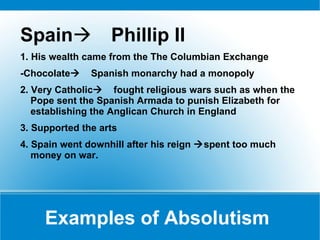
Examples of Absolutism Spain Phillip II 1. His wealth came from the The Columbian Exchange -Chocolate Spanish monarchy had a monopoly 2. Very Catholic fought religious wars such as when the Pope sent the Spanish Armada to punish Elizabeth for establishing the Anglican Church in England 3. Supported the arts 4. Spain went downhill after his reign spent too much money on war.
14.
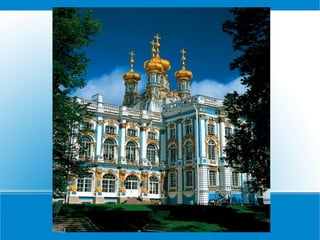
Russia 1.Influence of the Byzantine Empire - The Eastern Orthodox Church - The Cyrillic Alphabet - Pointed Dome architecture
15.
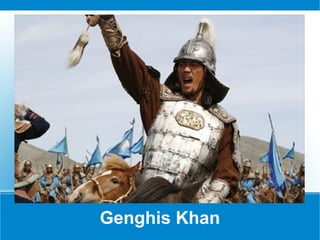
Russia 2. Effectof the Mongols on Russia Kept Russia isolated from Europe . Created a tradition of harsh/authoritarian and absolute rule -The two most famous Mongol rulers were Genghis Khan and Kublai Khan
16.
Absolute Monarchs ofRussia 1. Czar Ivan the Terrible (1533-1584) -Extremely crazy and paranoid -Had a Secret Police to enforce order -Weakened the nobles - Centralized control of Russia
17.
Absolute Monarchs ofRussia 2. Czar Peter the Great 1. Increased his power by making himself the head of the Eastern Orthodox Church 2. Weakened the nobles more 3. Ended Isolation Due to the Mongols, Russia had not had a Renaissance , an Age of Exploration , nor had they been exposed to European advances .
18.
Peter the Great'sWesternization He traveled to Europe disguised as a carpenter and returned with ideas to modernize Russia and make it stronger
19.
Peter the Great'sWesternization 1. He hired Europeans to strengthen the military 2. Introduced the potato this improved the Russian diet
20.
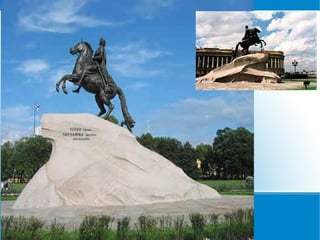
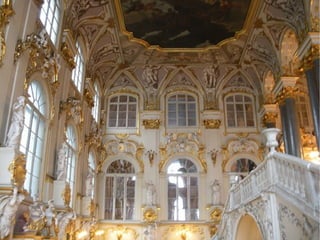
Peter the Great'sCity 3. Created a “Window on the Sea” St. Petersburg Peter literally built this city up from nothing. It used to be a swamp .
21.
22.
23.
24.
The Need forA Warm Water Port Russia was in desperate need of a warm water port because of their climate. -Many of their ports were iced over for 6 months out of the year.
25.
The Isolation ofRussia 1. Powerful Czars Czar is from the Roman word caesar ; also Can be spelled Tsars
26.
The Isolation ofRussia 2. Mongol Customs The Mongols were nomadic horsemen that invaded Asia and ruled Russia for three hundred years see handout of Mongol customs
The Isolation ofRussia 3. The Cyrillic Alphabet In the 800's two missionaries (Cyril and Methodius) from Europe visited Russia and created the cyrillic alphabet in order to convert Russians to Christianity---the Russian Christian Church is the Eastern Orthodox Church
29.
30.
The Isolation ofRussia 4. Peasants Most of the people in Russia were poor peasants, even poorer than the serfs in Europe. They had no knowledge of democracy or natural rights, as they could not read.
31.
The Isolation ofRussia 5. Lack of Warm Water Port The lack of a warm water port was the most important obstacle to Russia's modernization and kept them from access with other modern nations---the search for a warm water port would determine most of the nation's actions in the 1800's and early 1900's.


 Lo más leído
 Lo más leído
 Lo más leído