This slide illustrates a side-by-side comparison between human-written, AI-written, and ambiguous content. It highlights subtle cues that help readers assess authenticity, raising essential questions about the future of communication, trust, and thought leadership in the age of generative AI.
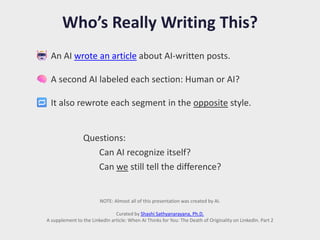
Who’s Really WritingThis?
An AI wrote an article about AI-written posts.
A second AI labeled each section: Human or AI?
It also rewrote each segment in the opposite style.
Questions:
Can AI recognize itself?
Can we still tell the difference?
NOTE: Almost all of this presentation was created by AI.
Curated by Shashi Sathyanarayana, Ph.D.
A supplement to the LinkedIn article: When AI Thinks for You: The Death of Originality on LinkedIn. Part 2
2.
Original Segment
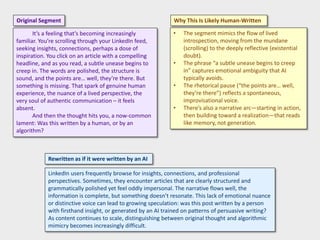
It’s afeeling that’s becoming increasingly
familiar. You’re scrolling through your LinkedIn feed,
seeking insights, connections, perhaps a dose of
inspiration. You click on an article with a compelling
headline, and as you read, a subtle unease begins to
creep in. The words are polished, the structure is
sound, and the points are… well, they’re there. But
something is missing. That spark of genuine human
experience, the nuance of a lived perspective, the
very soul of authentic communication – it feels
absent.
And then the thought hits you, a now-common
lament: Was this written by a human, or by an
algorithm?
Why This Is Likely Human-Written
• The segment mimics the flow of lived
introspection, moving from the mundane
(scrolling) to the deeply reflective (existential
doubt).
• The phrase “a subtle unease begins to creep
in” captures emotional ambiguity that AI
typically avoids.
• The rhetorical pause (“the points are… well,
they’re there”) reflects a spontaneous,
improvisational voice.
• There’s also a narrative arc—starting in action,
then building toward a realization—that reads
like memory, not generation.
LinkedIn users frequently browse for insights, connections, and professional
perspectives. Sometimes, they encounter articles that are clearly structured and
grammatically polished yet feel oddly impersonal. The narrative flows well, the
information is complete, but something doesn’t resonate. This lack of emotional nuance
or distinctive voice can lead to growing speculation: was this post written by a person
with firsthand insight, or generated by an AI trained on patterns of persuasive writing?
As content continues to scale, distinguishing between original thought and algorithmic
mimicry becomes increasingly difficult.
Rewritten as if it were written by an AI
3.
Original Segment
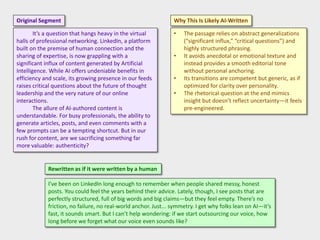
It’s aquestion that hangs heavy in the virtual
halls of professional networking. LinkedIn, a platform
built on the premise of human connection and the
sharing of expertise, is now grappling with a
significant influx of content generated by Artificial
Intelligence. While AI offers undeniable benefits in
efficiency and scale, its growing presence in our feeds
raises critical questions about the future of thought
leadership and the very nature of our online
interactions.
The allure of AI-authored content is
understandable. For busy professionals, the ability to
generate articles, posts, and even comments with a
few prompts can be a tempting shortcut. But in our
rush for content, are we sacrificing something far
more valuable: authenticity?
Why This Is Likely AI-Written
• The passage relies on abstract generalizations
(“significant influx,” “critical questions”) and
highly structured phrasing.
• It avoids anecdotal or emotional texture and
instead provides a smooth editorial tone
without personal anchoring.
• Its transitions are competent but generic, as if
optimized for clarity over personality.
• The rhetorical question at the end mimics
insight but doesn’t reflect uncertainty—it feels
pre-engineered.
I’ve been on LinkedIn long enough to remember when people shared messy, honest
posts. You could feel the years behind their advice. Lately, though, I see posts that are
perfectly structured, full of big words and big claims—but they feel empty. There’s no
friction, no failure, no real-world anchor. Just... symmetry. I get why folks lean on AI—it’s
fast, it sounds smart. But I can’t help wondering: if we start outsourcing our voice, how
long before we forget what our voice even sounds like?
Rewritten as if it were written by a human
4.
Original Segment
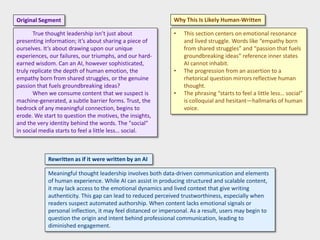
True thoughtleadership isn’t just about
presenting information; it’s about sharing a piece of
ourselves. It’s about drawing upon our unique
experiences, our failures, our triumphs, and our hard-
earned wisdom. Can an AI, however sophisticated,
truly replicate the depth of human emotion, the
empathy born from shared struggles, or the genuine
passion that fuels groundbreaking ideas?
When we consume content that we suspect is
machine-generated, a subtle barrier forms. Trust, the
bedrock of any meaningful connection, begins to
erode. We start to question the motives, the insights,
and the very identity behind the words. The "social"
in social media starts to feel a little less… social.
Why This Is Likely Human-Written
• This section centers on emotional resonance
and lived struggle. Words like “empathy born
from shared struggles” and “passion that fuels
groundbreaking ideas” reference inner states
AI cannot inhabit.
• The progression from an assertion to a
rhetorical question mirrors reflective human
thought.
• The phrasing “starts to feel a little less… social”
is colloquial and hesitant—hallmarks of human
voice.
Meaningful thought leadership involves both data-driven communication and elements
of human experience. While AI can assist in producing structured and scalable content,
it may lack access to the emotional dynamics and lived context that give writing
authenticity. This gap can lead to reduced perceived trustworthiness, especially when
readers suspect automated authorship. When content lacks emotional signals or
personal inflection, it may feel distanced or impersonal. As a result, users may begin to
question the origin and intent behind professional communication, leading to
diminished engagement.
Rewritten as if it were written by an AI
5.
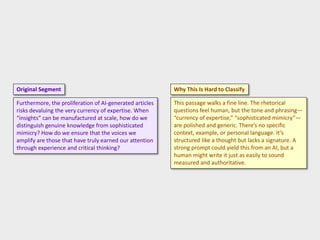
Original Segment
Furthermore, theproliferation of AI-generated articles
risks devaluing the very currency of expertise. When
“insights” can be manufactured at scale, how do we
distinguish genuine knowledge from sophisticated
mimicry? How do we ensure that the voices we
amplify are those that have truly earned our attention
through experience and critical thinking?
Why This Is Hard to Classify
This passage walks a fine line. The rhetorical
questions feel human, but the tone and phrasing—
“currency of expertise,” “sophisticated mimicry”—
are polished and generic. There’s no specific
context, example, or personal language. It’s
structured like a thought but lacks a signature. A
strong prompt could yield this from an AI, but a
human might write it just as easily to sound
measured and authoritative.
6.
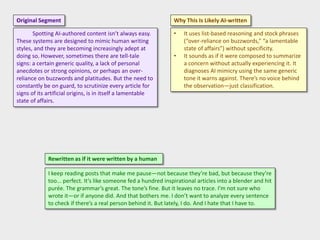
Original Segment
Spotting AI-authoredcontent isn’t always easy.
These systems are designed to mimic human writing
styles, and they are becoming increasingly adept at
doing so. However, sometimes there are tell-tale
signs: a certain generic quality, a lack of personal
anecdotes or strong opinions, or perhaps an over-
reliance on buzzwords and platitudes. But the need to
constantly be on guard, to scrutinize every article for
signs of its artificial origins, is in itself a lamentable
state of affairs.
Why This Is Likely AI-written
• It uses list-based reasoning and stock phrases
(“over-reliance on buzzwords,” “a lamentable
state of affairs”) without specificity.
• It sounds as if it were composed to summarize
a concern without actually experiencing it. It
diagnoses AI mimicry using the same generic
tone it warns against. There’s no voice behind
the observation—just classification.
I keep reading posts that make me pause—not because they’re bad, but because they’re
too... perfect. It’s like someone fed a hundred inspirational articles into a blender and hit
purée. The grammar’s great. The tone’s fine. But it leaves no trace. I’m not sure who
wrote it—or if anyone did. And that bothers me. I don’t want to analyze every sentence
to check if there’s a real person behind it. But lately, I do. And I hate that I have to.
Rewritten as if it were written by a human
7.
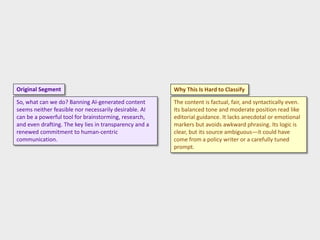
Original Segment
So, whatcan we do? Banning AI-generated content
seems neither feasible nor necessarily desirable. AI
can be a powerful tool for brainstorming, research,
and even drafting. The key lies in transparency and a
renewed commitment to human-centric
communication.
The content is factual, fair, and syntactically even.
Its balanced tone and moderate position read like
editorial guidance. It lacks anecdotal or emotional
markers but avoids awkward phrasing. Its logic is
clear, but its source ambiguous—it could have
come from a policy writer or a carefully tuned
prompt.
Why This Is Hard to Classify
8.
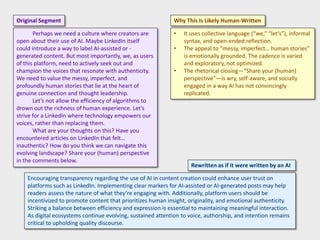
Original Segment
Perhaps weneed a culture where creators are
open about their use of AI. Maybe LinkedIn itself
could introduce a way to label AI-assisted or -
generated content. But most importantly, we, as users
of this platform, need to actively seek out and
champion the voices that resonate with authenticity.
We need to value the messy, imperfect, and
profoundly human stories that lie at the heart of
genuine connection and thought leadership.
Let’s not allow the efficiency of algorithms to
drown out the richness of human experience. Let’s
strive for a LinkedIn where technology empowers our
voices, rather than replacing them.
What are your thoughts on this? Have you
encountered articles on LinkedIn that felt…
inauthentic? How do you think we can navigate this
evolving landscape? Share your (human) perspective
in the comments below.
• It uses collective language (“we,” “let’s”), informal
syntax, and open-ended reflection.
• The appeal to “messy, imperfect… human stories”
is emotionally grounded. The cadence is varied
and exploratory, not optimized.
• The rhetorical closing—“Share your (human)
perspective”—is wry, self-aware, and socially
engaged in a way AI has not convincingly
replicated.
Why This Is Likely Human-Written
Encouraging transparency regarding the use of AI in content creation could enhance user trust on
platforms such as LinkedIn. Implementing clear markers for AI-assisted or AI-generated posts may help
readers assess the nature of what they’re engaging with. Additionally, platform users should be
incentivized to promote content that prioritizes human insight, originality, and emotional authenticity.
Striking a balance between efficiency and expression is essential to maintaining meaningful interaction.
As digital ecosystems continue evolving, sustained attention to voice, authorship, and intention remains
critical to upholding quality discourse.
Rewritten as if it were written by an AI
9.
Thank you!
Let’s strivefor a LinkedIn where technology empowers
our voices, rather than replacing them.
• Have you come across posts that felt… inauthentic?
• How do you think we can navigate this evolving
landscape?
• Share your (human) perspective as the comments in
the original LinkedIn article.