Saltar al contenido principal
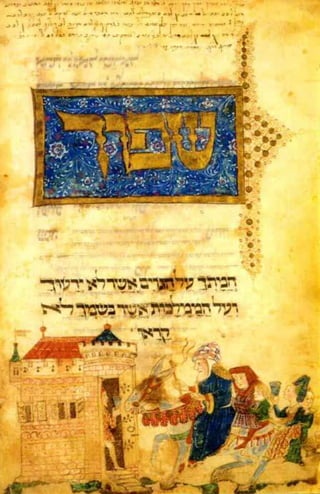
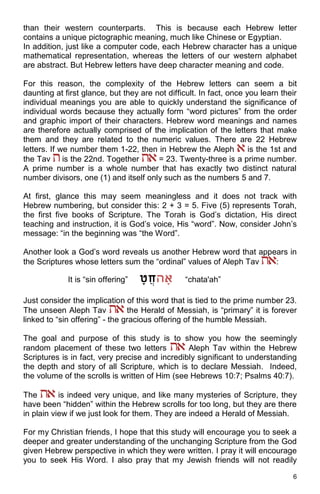
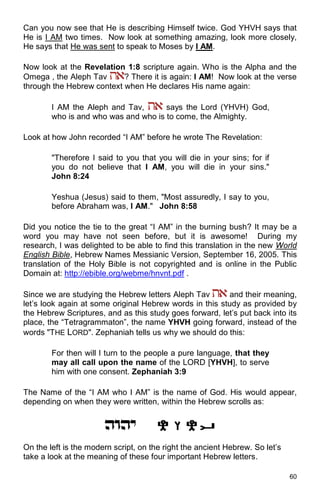
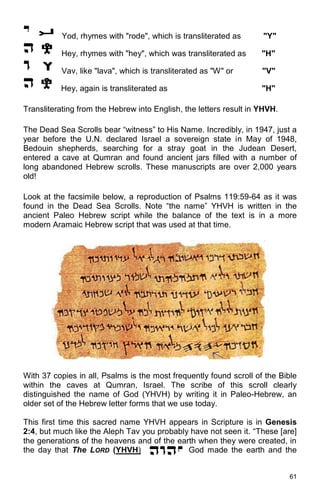
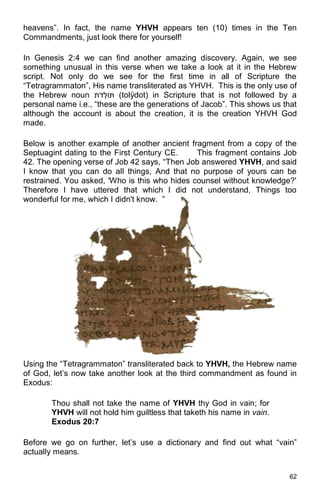
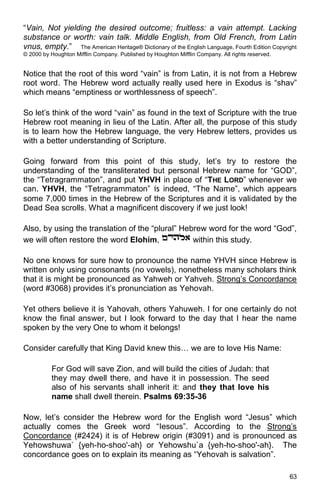
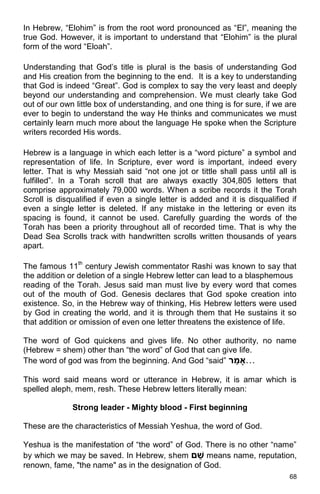
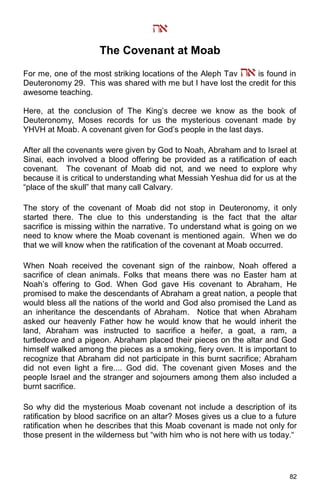
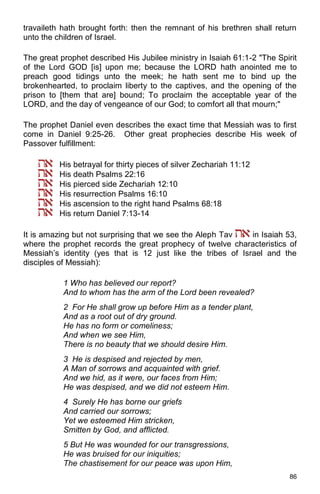
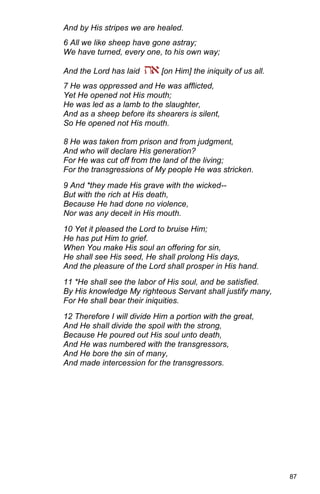
Front and Back Cover: “The Messiah Heralded”. From the Library of
Congress – In the Public Domain from the Washington Haggadah. Ho
Lahma, "This bread of affliction" fashioned by Joel ben Simeon, a
scribe and illuminator of Hebrew manuscripts in the fifteenth century.
3
Aleph Tav
Herald of Messiah
B're'shiyt bara 'Elohiym...
'et Hashamayim v'et ha'aretz.
This is a Study in Progress
For Family and Friends
And all fellow Heirs of Israel
There is neither Jew nor Greek, there is neither bond nor free, there is
neither male nor female: for ye are all one in Messiah Yeshua. And if ye [be]
Messiah's, then are ye Abraham's seed, and heirs according to the promise.
Galatians 3:28-29
Dennis Northington
April 3, 2004
Updated December 18, 2012
4
Table of Contents
Introduction ..........................................................................................................................................................5
Source Code – Hebrew........................................................................................................................................8
In the Beginning ................................................................................................................................................ 13
The Light of the Menorah.................................................................................................................................. 26
Menorah Lights and the Appointed Feasts....................................................................................................... 43
Hebrew is Really Important............................................................................................................................... 59
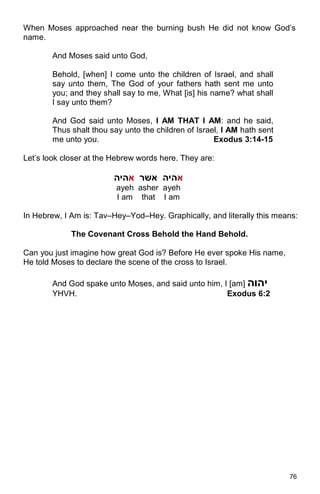
Hebrew Names are Important........................................................................................................................... 74
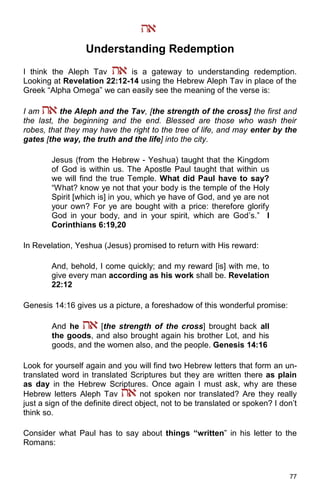
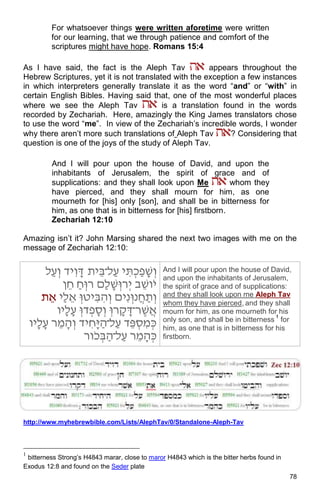
Understanding Redemption .............................................................................................................................. 77
The Covenant at Moab ..................................................................................................................................... 82
Understanding John’s Words............................................................................................................................ 88
Jots and Tittles ................................................................................................................................................ 100
Aleph Tav - In The Beginning ......................................................................................................................... 105
Strength and the Sin Offering ......................................................................................................................... 115
Isaiah Understood........................................................................................................................................... 118
The Bruised Heel ............................................................................................................................................ 123
Prophecy and His Feasts................................................................................................................................ 125
The Red Heifer................................................................................................................................................ 134
The Tzaddik, the “Righteous One”.................................................................................................................. 148
Seek out His Word - All of Scripture ............................................................................................................... 153
Summing Up in The Spirit (Ruach) ................................................................................................................. 160
Exhibits............................................................................................................................................................ 192
The Tabernacle Torah Scroll .......................................................................................................................... 192
"Torah" - It Points to Messiah ......................................................................................................................... 193
The Ancient Hebrew Script ............................................................................................................................. 198
Aleph Tav in the Torah.................................................................................................................................... 199
Aleph Tav in the Prophets............................................................................................................................... 220
The Ancient Hebrew Alphabet Chart .............................................................................................................. 226
Hebrew Consonants ....................................................................................................................................... 228
Reconstruction of the Ancient Hebrew Alphabet............................................................................................ 230
Memra = “The Word” in the Targums ............................................................................................................. 232
The Light Spectrum......................................................................................................................................... 234
The Menorah and the Feasts.......................................................................................................................... 235
The artist is not known. ................................................................................................................................... 235
The Ancient Tav in Gematria .......................................................................................................................... 236
Table of Hebrew Gematria Values.................................................................................................................. 242
Hubble Witnesses the Tav.............................................................................................................................. 243
A Second Witness from Hubble...................................................................................................................... 245
The Cross – The Tav of 9/11 .......................................................................................................................... 247
Hey = Look, Behold......................................................................................................................................... 248
Dead Sea Scrolls ............................................................................................................................................ 249
Email from Holland.......................................................................................................................................... 250
5
Introduction
I am by no means trained in the Hebrew language, but my goal is to share
some unique “findings” within the Hebrew Scriptures. With that in mind, you
will find the Hebrew name Yeshua used for Jesus and the letters YHVH for
“The Lord”. The focus of the study is on the use of first and last letters of the
Hebrew alphabet in Scripture, the Aleph and Tav . These are familiar to
many people as the Greek letters “Alpha and Omega”.
This study also uses the Hebrew Masoretic Text (“MT”) as a source which is
recognized by Judaism as well as Christianity as being an authoritative
resource of the ancient Hebrew scrolls. However, we must keep in mind that
the Masoretic Texts like all Scripture are “copies of copies” and they do not
represent the “original” scrolls, the original manuscripts of Moses nor the
Prophets. In fact, the Masoretic Text is based on the Babylonian Aramaic
script recorded during the Babylonian captivity, which was not the ancient
Paleo graphic script that was used by Moses some 900 years earlier.
The Hebrew letters Aleph Tav ; known in Greek as Alpha Omega and in
English as A - Z form the Hebrew word pronounced as “et” or “eth”. It
appears some 7,000 times in Scripture yet their placement is not known to
over a billion English speaking people. One out of five people on earth
speak English, but we have not “seen” the Aleph Tav in the Scriptures.
Why is this?
Indeed, much of this has to do with the fact that we read English translations
from the Greek Septuagint which was translated from Hebrew manuscripts.
Due to that translation “babel” there is much more to learn.
Like the old saying “lost in the translation”, it is almost as if Aleph Tav is
an infinite sign, “the lost word” that is just waiting to be discovered so that
the Scriptures can be better understood by all people. In this way, the
Messiah [in Hebrew, Mashiach] can be “seen” clearer throughout all the
“Word” of God. Today, it is important to study the original Hebrew alphabet
and look into the Hebrew letter meanings including the Aleph Tav , the
first and last letters of the Hebrew "alefbet". When we do we can see just
“Who” this Aleph Tav represents.
In order to gain a better understanding of Scripture it is critically important to
learn as much as one can about the Hebrew language and the Hebrew
“mindset” which differs greatly from a Greek or western way of thinking.
Hebrew letters combine into words with meaning that is far more intricate
6
than their western counterparts. This is because each Hebrew letter
contains a unique pictographic meaning, much like Chinese or Egyptian.
In addition, just like a computer code, each Hebrew character has a unique
mathematical representation, whereas the letters of our western alphabet
are abstract. But Hebrew letters have deep character meaning and code.
For this reason, the complexity of the Hebrew letters can seem a bit
daunting at first glance, but they are not difficult. In fact, once you learn their
individual meanings you are able to quickly understand the significance of
individual words because they actually form “word pictures” from the order
and graphic import of their characters. Hebrew word meanings and names
are therefore actually comprised of the implication of the letters that make
them and they are related to the numeric values. There are 22 Hebrew
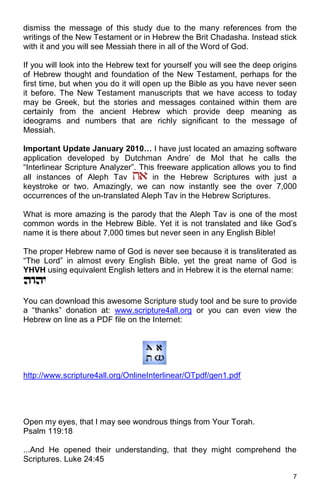
letters. If we number them 1-22, then in Hebrew the Aleph is the 1st and
the Tav is the 22nd. Together = 23. Twenty-three is a prime number.
A prime number is a whole number that has exactly two distinct natural
number divisors, one (1) and itself only such as the numbers 5 and 7.
At first, glance this may seem meaningless and it does not track with
Hebrew numbering, but consider this: 2 + 3 = 5. Five (5) represents Torah,
the first five books of Scripture. The Torah is God’s dictation, His direct
teaching and instruction, it is God’s voice, His “word”. Now, consider John’s
message: “in the beginning was “the Word”.
Another look a God’s word reveals us another Hebrew word that appears in
the Scriptures whose letters sum the “ordinal” values of Aleph Tav :
It is “sin offering” ‫ח‬ֲ‫ט‬ָ‫הָא‬ “chata'ah”
Just consider the implication of this word that is tied to the prime number 23.
The unseen Aleph Tav the Herald of Messiah, is “primary” it is forever
linked to “sin offering” - the gracious offering of the humble Messiah.
The goal and purpose of this study is to show you how the seemingly
random placement of these two letters Aleph Tav within the Hebrew
Scriptures is in fact, very precise and incredibly significant to understanding
the depth and story of all Scripture, which is to declare Messiah. Indeed,
the volume of the scrolls is written of Him (see Hebrews 10:7; Psalms 40:7).
The is indeed very unique, and like many mysteries of Scripture, they
have been “hidden” within the Hebrew scrolls for too long, but they are there
in plain view if we just look for them. They are indeed a Herald of Messiah.
For my Christian friends, I hope that this study will encourage you to seek a
deeper and greater understanding of the unchanging Scripture from the God
given Hebrew perspective in which they were written. I pray it will encourage
you to seek His Word. I also pray that my Jewish friends will not readily
7
dismiss the message of this study due to the many references from the
writings of the New Testament or in Hebrew the Brit Chadasha. Instead stick
with it and you will see Messiah there in all of the Word of God.
If you will look into the Hebrew text for yourself you will see the deep origins
of Hebrew thought and foundation of the New Testament, perhaps for the
first time, but when you do it will open up the Bible as you have never seen
it before. The New Testament manuscripts that we have access to today
may be Greek, but the stories and messages contained within them are
certainly from the ancient Hebrew which provide deep meaning as
ideograms and numbers that are richly significant to the message of
Messiah.
Important Update January 2010… I have just located an amazing software
application developed by Dutchman Andre’ de Mol that he calls the
“Interlinear Scripture Analyzer”. This freeware application allows you to find
all instances of Aleph Tav in the Hebrew Scriptures with just a
keystroke or two. Amazingly, we can now instantly see the over 7,000
occurrences of the un-translated Aleph Tav in the Hebrew Scriptures.
What is more amazing is the parody that the Aleph Tav is one of the most
common words in the Hebrew Bible. Yet it is not translated and like God’s
name it is there about 7,000 times but never seen in any English Bible!
The proper Hebrew name of God is never see because it is transliterated as
“The Lord” in almost every English Bible, yet the great name of God is
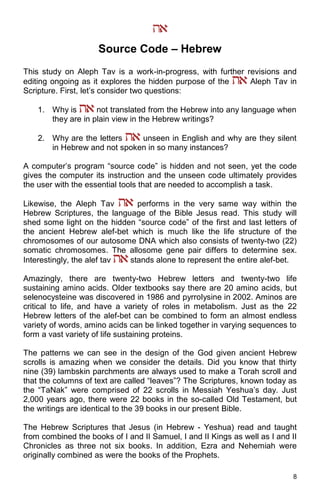
YHVH using equivalent English letters and in Hebrew it is the eternal name:
You can download this awesome Scripture study tool and be sure to provide
a “thanks” donation at: www.scripture4all.org or you can even view the
Hebrew on line as a PDF file on the Internet:
http://www.scripture4all.org/OnlineInterlinear/OTpdf/gen1.pdf
Open my eyes, that I may see wondrous things from Your Torah.
Psalm 119:18
...And He opened their understanding, that they might comprehend the
Scriptures. Luke 24:45
8
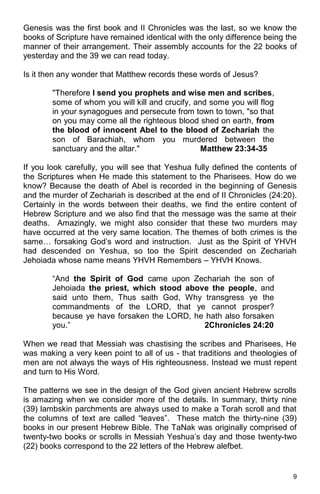
Source Code – Hebrew
This study on Aleph Tav is a work-in-progress, with further revisions and
editing ongoing as it explores the hidden purpose of the Aleph Tav in
Scripture. First, let’s consider two questions:
1. Why is not translated from the Hebrew into any language when
they are in plain view in the Hebrew writings?
2. Why are the letters unseen in English and why are they silent
in Hebrew and not spoken in so many instances?
A computer’s program “source code” is hidden and not seen, yet the code
gives the computer its instruction and the unseen code ultimately provides
the user with the essential tools that are needed to accomplish a task.
Likewise, the Aleph Tav performs in the very same way within the
Hebrew Scriptures, the language of the Bible Jesus read. This study will
shed some light on the hidden “source code” of the first and last letters of
the ancient Hebrew alef-bet which is much like the life structure of the
chromosomes of our autosome DNA which also consists of twenty-two (22)
somatic chromosomes. The allosome gene pair differs to determine sex.
Interestingly, the alef tav stands alone to represent the entire alef-bet.
Amazingly, there are twenty-two Hebrew letters and twenty-two life
sustaining amino acids. Older textbooks say there are 20 amino acids, but
selenocysteine was discovered in 1986 and pyrrolysine in 2002. Aminos are
critical to life, and have a variety of roles in metabolism. Just as the 22
Hebrew letters of the alef-bet can be combined to form an almost endless
variety of words, amino acids can be linked together in varying sequences to
form a vast variety of life sustaining proteins.
The patterns we can see in the design of the God given ancient Hebrew
scrolls is amazing when we consider the details. Did you know that thirty
nine (39) lambskin parchments are always used to make a Torah scroll and
that the columns of text are called “leaves”? The Scriptures, known today as
the “TaNak” were comprised of 22 scrolls in Messiah Yeshua’s day. Just
2,000 years ago, there were 22 books in the so-called Old Testament, but
the writings are identical to the 39 books in our present Bible.
The Hebrew Scriptures that Jesus (in Hebrew - Yeshua) read and taught
from combined the books of I and II Samuel, I and II Kings as well as I and II
Chronicles as three not six books. In addition, Ezra and Nehemiah were
originally combined as were the books of the Prophets.
9
Genesis was the first book and II Chronicles was the last, so we know the
books of Scripture have remained identical with the only difference being the
manner of their arrangement. Their assembly accounts for the 22 books of
yesterday and the 39 we can read today.
Is it then any wonder that Matthew records these words of Jesus?
"Therefore I send you prophets and wise men and scribes,
some of whom you will kill and crucify, and some you will flog
in your synagogues and persecute from town to town, "so that
on you may come all the righteous blood shed on earth, from
the blood of innocent Abel to the blood of Zechariah the
son of Barachiah, whom you murdered between the
sanctuary and the altar." Matthew 23:34-35
If you look carefully, you will see that Yeshua fully defined the contents of
the Scriptures when He made this statement to the Pharisees. How do we
know? Because the death of Abel is recorded in the beginning of Genesis
and the murder of Zechariah is described at the end of II Chronicles (24:20).
Certainly in the words between their deaths, we find the entire content of
Hebrew Scripture and we also find that the message was the same at their
deaths. Amazingly, we might also consider that these two murders may
have occurred at the very same location. The themes of both crimes is the
same… forsaking God’s word and instruction. Just as the Spirit of YHVH
had descended on Yeshua, so too the Spirit descended on Zechariah
Jehoiada whose name means YHVH Remembers – YHVH Knows.
“And the Spirit of God came upon Zechariah the son of
Jehoiada the priest, which stood above the people, and
said unto them, Thus saith God, Why transgress ye the
commandments of the LORD, that ye cannot prosper?
because ye have forsaken the LORD, he hath also forsaken
you.” 2Chronicles 24:20
When we read that Messiah was chastising the scribes and Pharisees, He
was making a very keen point to all of us - that traditions and theologies of
men are not always the ways of His righteousness. Instead we must repent
and turn to His Word.
The patterns we see in the design of the God given ancient Hebrew scrolls
is amazing when we consider more of the details. In summary, thirty nine
(39) lambskin parchments are always used to make a Torah scroll and that
the columns of text are called “leaves”. These match the thirty-nine (39)
books in our present Hebrew Bible. The TaNak was originally comprised of
twenty-two books or scrolls in Messiah Yeshua’s day and those twenty-two
(22) books correspond to the 22 letters of the Hebrew alefbet.
10
The Hebrew Scriptures that Yeshua read and taught from combined the
writings of I and II Samuel, I and II Kings as well as I and II Chronicles. Ezra
and Nehemiah were originally combined as were the books of the Prophets.
Genesis was the first book and II Chronicles was the last so we know the
Scriptures are identical with a key difference being the manner of their
arrangement which accounts for the 22 scrolls of the TaNak of yesteryear
and the 39 books we have today, but consider this:
Amazingly, after Jesus’ brutal suffering, death and resurrection - like a sign
on the road of life, we are reminded that it is by The Lord’s 39 stripes that
we are healed (Isaiah 53:5). We are also reminded (Revelation 22:2) that
the leaves of the Tree of Life are for the healing of the nations. Healing is
restoration, so too the full restoration of "Israel" is a theme recorded
throughout the narratives of the prophets of the Holy Scriptures.
In the book of “Kings” we first learn about the divided house, the families of
“Israel” and of “Judah”. Later, within the book of the “Prophets” including
Ezekiel, Micah, Nehemiah and Jeremiah the Scriptures record a great
promise of restoration and re-gathering. Much like the prophets, the Aleph
Tav appears there in His word to serve as witness to two witnesses, as
a witness to the house of Judah and all the house of Israel as a Herald of
Messiah.
When we look at the ancient script within the scrolls of the Hebrew Bible, we
must keep in mind that Hebrew is the language, the “source code”, the root
of all Scripture. In the Masoretic manuscripts each Hebrew character has a
number designation and each word and line must add up to a certain
original sum or the whole scroll copy was thrown out. This is how we know
that the original Hebrew has been duplicated properly and exactly for
thousands of years.
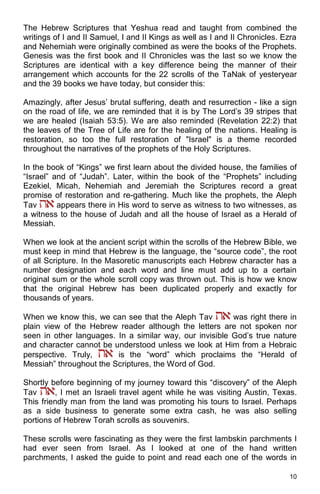
When we know this, we can see that the Aleph Tav was right there in
plain view of the Hebrew reader although the letters are not spoken nor
seen in other languages. In a similar way, our invisible God’s true nature
and character cannot be understood unless we look at Him from a Hebraic
perspective. Truly, is the “word” which proclaims the “Herald of
Messiah” throughout the Scriptures, the Word of God.
Shortly before beginning of my journey toward this “discovery” of the Aleph
Tav , I met an Israeli travel agent while he was visiting Austin, Texas.
This friendly man from the land was promoting his tours to Israel. Perhaps
as a side business to generate some extra cash, he was also selling
portions of Hebrew Torah scrolls as souvenirs.
These scrolls were fascinating as they were the first lambskin parchments I
had ever seen from Israel. As I looked at one of the hand written
parchments, I asked the guide to point and read each one of the words in
11
the scrolls in Hebrew and then translate the meaning of each word as it was
written. As he began to read from the beginning, from right to left, he
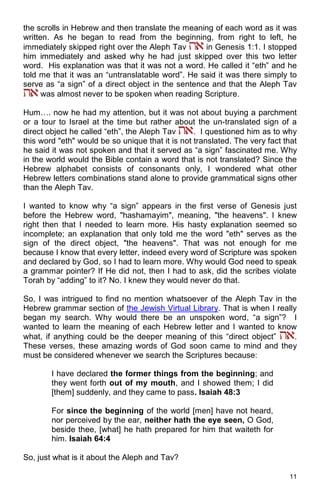
immediately skipped right over the Aleph Tav in Genesis 1:1. I stopped
him immediately and asked why he had just skipped over this two letter
word. His explanation was that it was not a word. He called it “eth” and he
told me that it was an “untranslatable word”. He said it was there simply to
serve as “a sign” of a direct object in the sentence and that the Aleph Tav
was almost never to be spoken when reading Scripture.
Hum…. now he had my attention, but it was not about buying a parchment
or a tour to Israel at the time but rather about the un-translated sign of a
direct object he called “eth”, the Aleph Tav . I questioned him as to why
this word "eth" would be so unique that it is not translated. The very fact that
he said it was not spoken and that it served as “a sign” fascinated me. Why
in the world would the Bible contain a word that is not translated? Since the
Hebrew alphabet consists of consonants only, I wondered what other
Hebrew letters combinations stand alone to provide grammatical signs other
than the Aleph Tav.
I wanted to know why “a sign” appears in the first verse of Genesis just
before the Hebrew word, "hashamayim", meaning, "the heavens". I knew
right then that I needed to learn more. His hasty explanation seemed so
incomplete; an explanation that only told me the word "eth" serves as the
sign of the direct object, "the heavens". That was not enough for me
because I know that every letter, indeed every word of Scripture was spoken
and declared by God, so I had to learn more. Why would God need to speak
a grammar pointer? If He did not, then I had to ask, did the scribes violate
Torah by “adding” to it? No. I knew they would never do that.
So, I was intrigued to find no mention whatsoever of the Aleph Tav in the
Hebrew grammar section of the Jewish Virtual Library. That is when I really
began my search. Why would there be an unspoken word, “a sign”? I
wanted to learn the meaning of each Hebrew letter and I wanted to know
what, if anything could be the deeper meaning of this “direct object” .
These verses, these amazing words of God soon came to mind and they
must be considered whenever we search the Scriptures because:
I have declared the former things from the beginning; and
they went forth out of my mouth, and I showed them; I did
[them] suddenly, and they came to pass. Isaiah 48:3
For since the beginning of the world [men] have not heard,
nor perceived by the ear, neither hath the eye seen, O God,
beside thee, [what] he hath prepared for him that waiteth for
him. Isaiah 64:4
So, just what is it about the Aleph and Tav?
12
The New John Gill's Exposition of the Entire Bible tells us: “Alpha is used by
the Jews for the chief of persons or things; 'Macmas and Mezonicha [names
of places] are "Alpha for fine flour"'; that is, the best fine flour is there, they
are the chief places for it...these letters...being the first and the last in the
alphabet, may stand for the whole; and it seems to be a proverbial
expression taken from the Jews, who use the phrase, from Aleph to Tau, for
the whole of anything...[Jesus] stands in the first verse of Genesis, and in
the last of the Revelation.” The word of God says:
Then said I, Lo, I come: in the volume of the book [it is]
written of me, I delight to do thy will, O my God: yea, thy
law [is] within my heart. Psalms 40:7-8
Here is an amazing example of Messiah’s “herald” in Leviticus:
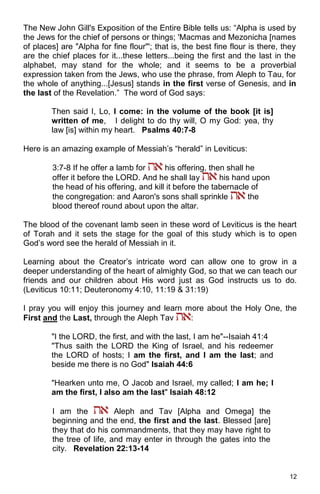
3:7-8 If he offer a lamb for his offering, then shall he
offer it before the LORD. And he shall lay his hand upon
the head of his offering, and kill it before the tabernacle of
the congregation: and Aaron's sons shall sprinkle the
blood thereof round about upon the altar.
The blood of the covenant lamb seen in these word of Leviticus is the heart
of Torah and it sets the stage for the goal of this study which is to open
God’s word see the herald of Messiah in it.
Learning about the Creator’s intricate word can allow one to grow in a
deeper understanding of the heart of almighty God, so that we can teach our
friends and our children about His word just as God instructs us to do.
(Leviticus 10:11; Deuteronomy 4:10, 11:19 & 31:19)
I pray you will enjoy this journey and learn more about the Holy One, the
First and the Last, through the Aleph Tav :
"I the LORD, the first, and with the last, I am he"--Isaiah 41:4
"Thus saith the LORD the King of Israel, and his redeemer
the LORD of hosts; I am the first, and I am the last; and
beside me there is no God" Isaiah 44:6
"Hearken unto me, O Jacob and Israel, my called; I am he; I
am the first, I also am the last" Isaiah 48:12
I am the Aleph and Tav [Alpha and Omega] the
beginning and the end, the first and the last. Blessed [are]
they that do his commandments, that they may have right to
the tree of life, and may enter in through the gates into the
city. Revelation 22:13-14
13
In the Beginning
“I am the Alpha and Omega
The Beginning and the End”
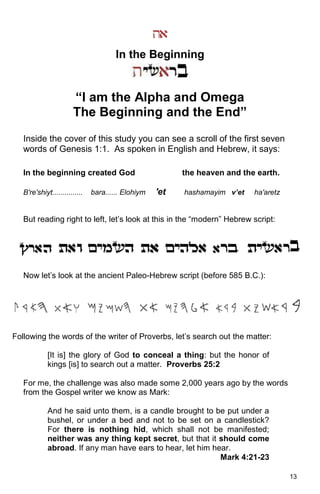
Inside the cover of this study you can see a scroll of the first seven
words of Genesis 1:1. As spoken in English and Hebrew, it says:
In the beginning created God the heaven and the earth.
B're'shiyt............... bara...... Elohiym 'et hashamayim v’et ha'aretz
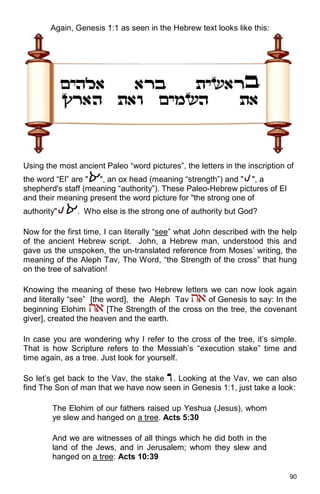
But reading right to left, let’s look at this in the “modern” Hebrew script:
Now let’s look at the ancient Paleo-Hebrew script (before 585 B.C.):
Following the words of the writer of Proverbs, let’s search out the matter:
[It is] the glory of God to conceal a thing: but the honor of
kings [is] to search out a matter. Proverbs 25:2
For me, the challenge was also made some 2,000 years ago by the words
from the Gospel writer we know as Mark:
And he said unto them, is a candle brought to be put under a
bushel, or under a bed and not to be set on a candlestick?
For there is nothing hid, which shall not be manifested;
neither was any thing kept secret, but that it should come
abroad. If any man have ears to hear, let him hear.
Mark 4:21-23
14
I have also taken encouragement from the words of the “letter writer” Paul:
For whatsoever things were written aforetime were written
for our learning, that we through patience and comfort of the
scriptures might have hope. Romans 15:4
If you are like me, you may have spent some time looking for just “the right”
Bible translation, “you know” the one that you can “relate to” and
understand. Well, we are missing something and we can feel it, but all we
need to do is to take a step back to Hebrew, the language of the Bible.
A few years ago, I was given a blessing; I was privileged to “see” a new
thing within the Hebrew Scriptures and I was encouraged by a great friend
to write about it. Because of that I learned new meaning as to the great
precision of the words of our Creator and how he can give us new “insight”
from Genesis to Revelation, from “Beginning to End” within the Hebrew
language, a “picture” language.
What is it? It is the un-translated word comprised of two Hebrew letters,
Aleph Tav . A “word” that Moses and the Prophets penned throughout
the Hebrew Scriptures, yet it is missing in all the modern translations of the
Scriptures we have today! So I decided to record my thoughts and what I
have found within this study. The awesome thing is that you can see this
too. Just look at any Hebrew Bible and you will see everything that I have.
Let’s start by considering, just for a moment, why these words were
recorded by John.
“For had ye believed Moses, ye would have believed me: for
he wrote of me. But if ye believe not his writings, how shall
ye believe my words?” John 5:46-47
Do you know “who” actually spoke these words and why? Do you know
what “writings” of Moses “He” spoke of?
Most scholars concur that the New Testament [in Hebrew: B'rit Chadashah]
was written in a relatively narrow span of time, over less than a century as
estimates place the [B'rit Chadashah] writings to be recorded between 32AD
and 100AD. So think about it and ask yourself, what “Bible”, what “writings”,
did “Jesus” actually read?
After all, the “volume of the book”, the Hebrew scrolls that were recorded by
Moses were written about “Him”. As we see from Psalmist’s words in the
text of the book of Hebrews:
“Then said I, Lo, I come (in the volume of the book it is
written of me,) to do thy will, O God.” Hebrews 10:7
15
Like the apostle Paul, maybe our eyes just need to be opened and the
scales removed so we can “see” and learn about the Hebrew Scriptures
from the Aleph Tav . To do that let’s first consider these words:
And Ananias went his way, and entered into the house; and
putting his hands on him said, Brother Saul, the Lord, [even]
Jesus, that appeared unto thee in the way as thou camest,
hath sent me, that thou might receive thy sight, and be
filled with the Holy Spirit. And immediately there fell from
his eyes as it had been scales: and he received sight
forthwith, and arose, and was baptized. Acts 9:17-18
I council you to buy of Me gold tried in the fire, That you may
be rich; and white raiment, that you may be clothed, and that
the shame of your nakedness does not appear; and anoint
your eyes with eye salve, that you may see.
Revelation 3:18
Now let’s look at some background on the Hebrew letters Aleph Tav .
To gain a better understanding of the ancient Hebrew, I do recommend at
least two books: The Ancient Hebrew Language and Alphabet by Jeff A.
Benner and Hebrew Word Pictures by Dr. Frank T. Seekins.
The first letter of the Hebrew alphabet is Aleph, in its Hebrew root form it
literally means “ox” and its basic understanding is “strength”. In the
ancient Hebrew pictographic script, it was written as:
Tav, the last letter of the Hebrew alphabet, in its root form it means “a
covenant sign”. The sign is a cross, the Tav. It also means truth or
perfection. And in ancient script it was written as or .
With this understanding, now for the first time I can “see” what John wrote
about in his gospel account. We should consider that he was referencing
the unspoken, the un-translated word from the writing of Moses as to the
meaning of the Aleph Tav which is visually “the strength of the
cross .” or in meaning the “strength of the covenant”, the “word” hidden
in Genesis 1:1 and throughout the Scriptures.
Hebrew language experts teach that the Aleph Tav is a sign that
indicates the object of a transitive verb. While this is true, I have learned that
rabbinic tradition expands the Aleph Tav to include a symbolic
meaning. The Jewish Sages taught that a word prefixed by Aleph Tav
signifies the very essence of that thing, everything about it, from beginning
to end, from A to Z, Alpha to Omega and Aleph to Tav .
16
Knowing the pictographic word picture meanings of these two Hebrew
letters, allows us to see the “word” Aleph Tav to say: In the beginning God
(The Strength of the Covenant), created the heaven and the earth.
Indeed, it is Messiah, the strength of the covenant cross is the “direct object”
of the un-translated word Aleph Tav .
Can you see it? The Messiah, “The Strength of the Covenant”, our
Redeemer and Savior, the Hebrew “Mashiach” has been hidden there in the
ancient text of the first verse of Scripture from the very beginning! Yet, The
Messiah has not been seen because of blindness! Consider Paul’s words:
For I would not, brethren, that ye should be ignorant of this
mystery, lest ye should be wise in your own conceits; that
blindness in part is happened to Israel, until the fullness of
the Gentiles be come in. And so all Israel shall be saved: as it
is written, There shall come out of Zion the Deliverer, and
shall turn away ungodliness from Jacob: For this [is] my
covenant unto them, when I shall take away their sins.
Romans 11:25-27
John’s message is very significant. The ancient pictographic Hebrew is one
of the primary keys, a cipher to the message John wants us to see in his
gospel writing. He is returning us to the beginning of the word of God.
Consider:
“In the beginning was [the word] “The Strength of the Covenant” and
[the word], “The Strength of the Covenant” was with God, and
[the word], “The Strength of the Covenant” was God.”
John wants us to see that The Messiah is “The Word” – He is The Torah,
The Living Word of God. The word that gave us His covenant.
The placement of the Aleph Tav in the ancient Hebrew Scriptures is the
message; it is The Herald of Messiah! Perhaps in John’s time, as today,
the letters Aleph Tav were not spoken nor understood as The Herald in
the plain reading of the Hebrew Scriptures. This was due to the fact that the
ancient Semitic “pictograph” Paleo-Hebrew had been “done away with”
during the Babylonian exile when the Aramaic script style was adopted by
all but the Samaritans. They have preserved it. But in ancient Babylon, the
script style was changed. That change actually “closed the veil” to plainly
understanding this herald, the strength of the covenant, the .
In ancient Paleo-Hebrew, every word’s meaning is formed by a picture. This
is done by adding the letter pictures together to "paint" and illustrate the
symbolic meaning of each word. The good news is, like me you don't have
to be able to fluently read Hebrew to begin to understand it, you just have to
17
learn the basic meaning of the letter “pictures”. They do not change! Even if
you are not familiar with ancient pictographic Hebrew letters, these
“pictures” allow you to literally see “inside the words” and they declare the
presence of The Messiah in plain sight.
It is amazing to consider that John’s words reference the ancient word
picture Aleph Tav long before the risen Messiah spoke to him while on
the island of Pathos and confirmed “The Revelation” and Herald of Himself
as the Aleph Tav . After all, during his vision, John never heard Messiah
Yeshua call himself “the Alpha and Omega”, the Messiah’s language was
Hebrew, he said Aleph Tav , “The Strength of the Covenant”, four
times. Like two bookend witnesses, twice in the “beginning” and twice in the
“end” of the book of Revelation.
While John may have recorded his visions in Greek, we need to know Jesus
spoke in the Hebrew language to the one we call John, just as he spoke in
the Hebrew tongue to Paul on the road to Damascus:
And when we were all fallen to the earth, I heard a voice
speaking unto me, and saying in the Hebrew tongue, Saul,
Saul, why persecutest thou me? [it is] hard for thee to kick
against the pricks. Acts 26:14
In Hebrew, He would have only used the words “Aleph and Tav” . So it
is amazing, fantastic really, to “see” the unspoken word Aleph Tav in
the beginning, (Genesis) and again at the end of Scripture (Revelation).
By this we can see that John, with his written record is trying to “lift the veil”
for us to see the Herald of Messiah, “the word”: Aleph Tav .
When we consider that the ancient pictographic Tav was indeed a cross in
the ancient script we can also begin to see how the words of Paul easily
synchronize with John’s. Let’s look at Paul’s words in Colossians 1: 16-17:
“For by him Jesus [in Hebrew, Yeshua] all things were
created: things in heaven and on earth, visible and
invisible, whether thrones or powers or rulers or authorities;
all things were created by him and for him. He is before all
things, and in him all things hold together."
Summary: in Him all things, both the visible and invisible are held together.
Now let’s consider a teaching from Atlanta pastor Louis Giglio. Thanks to
Pastor Giglio, we can literally see the truth of what Paul described.
Incredibly, within the human body as well as the bodies of all animals, the
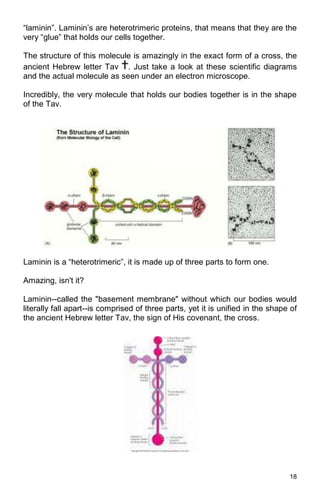
living cell’s are “held together” by an adhesion protein molecule called
18
“laminin”. Laminin’s are heterotrimeric proteins, that means that they are the
very “glue” that holds our cells together.
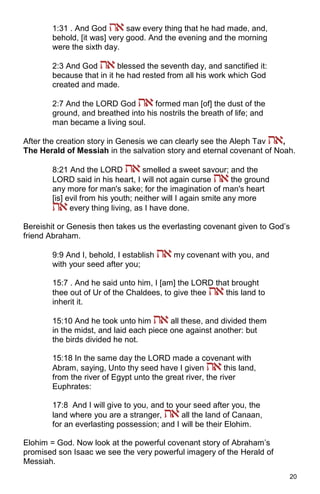
The structure of this molecule is amazingly in the exact form of a cross, the
ancient Hebrew letter Tav . Just take a look at these scientific diagrams
and the actual molecule as seen under an electron microscope.
Incredibly, the very molecule that holds our bodies together is in the shape
of the Tav.
Laminin is a “heterotrimeric”, it is made up of three parts to form one.
Amazing, isn't it?
Laminin--called the "basement membrane" without which our bodies would
literally fall apart--is comprised of three parts, yet it is unified in the shape of
the ancient Hebrew letter Tav, the sign of His covenant, the cross.
19
The first book of the Bible is know by many as Genesis. But in the Hebrew
scrolls we know it as Bereishit ‫ית‬ ִׁ‫אש‬ ֵ‫ְּר‬‫ב‬, literally "In the beginning".
Genesis or rather Bereishit shows the Aleph Tav throughout the story
of creation. Remember the letters literally mean “strength of the covenant”
so the Herald of Messiah has been there all along, just not seen in any
translation other than the Hebrew. Just take a look and you will the Messiah:
1:1 In the beginning God [the strength of the cross]
created the heaven and the earth.
1:4 And God saw the light, that it was good: and God
divided the light from the darkness.
1:7 And God made the firmament, and divided the
waters which [were] under the firmament from the waters
which [were] above the firmament: and it was so.
1:16 And God made two great lights; the greater light
to rule the day, and the lesser light to rule the night: [he
made] the stars also.
1:21 And God created great whales, and every living
creature that moveth, which the waters brought forth
abundantly, after their kind, and every winged fowl after his
kind: and God saw that [it was] good.
1:22 And God ] blessed them, saying, Be fruitful, and
multiply, and fill the waters in the seas, and let fowl multiply
in the earth.
1:25 And God made the beast of the earth after his
kind, and cattle after their kind, and every thing that creepeth
upon the earth after his kind: and God saw that [it was] good.
1:27 So God created man in his [own] image, in the
image of God created he him; male and female created he
them.
1:28 And God blessed them, and God said unto them,
Be fruitful, and multiply, and replenish the earth, and subdue
it: and have dominion over the fish of the sea, and over the
fowl of the air, and over every living thing that moveth upon
the earth.
20
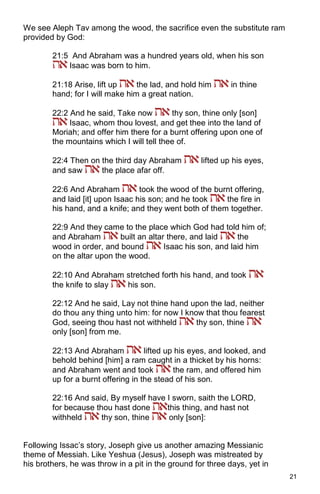
1:31 . And God saw every thing that he had made, and,
behold, [it was] very good. And the evening and the morning
were the sixth day.
2:3 And God blessed the seventh day, and sanctified it:
because that in it he had rested from all his work which God
created and made.
2:7 And the LORD God formed man [of] the dust of the
ground, and breathed into his nostrils the breath of life; and
man became a living soul.
After the creation story in Genesis we can clearly see the Aleph Tav ,
The Herald of Messiah in the salvation story and eternal covenant of Noah.
8:21 And the LORD smelled a sweet savour; and the
LORD said in his heart, I will not again curse the ground
any more for man's sake; for the imagination of man's heart
[is] evil from his youth; neither will I again smite any more
every thing living, as I have done.
Bereishit or Genesis then takes us the everlasting covenant given to God’s
friend Abraham.
9:9 And I, behold, I establish my covenant with you, and
with your seed after you;
15:7 . And he said unto him, I [am] the LORD that brought
thee out of Ur of the Chaldees, to give thee this land to
inherit it.
15:10 And he took unto him all these, and divided them
in the midst, and laid each piece one against another: but
the birds divided he not.
15:18 In the same day the LORD made a covenant with
Abram, saying, Unto thy seed have I given this land,
from the river of Egypt unto the great river, the river
Euphrates:
17:8 And I will give to you, and to your seed after you, the
land where you are a stranger, all the land of Canaan,
for an everlasting possession; and I will be their Elohim.
Elohim = God. Now look at the powerful covenant story of Abraham’s
promised son Isaac we see the very powerful imagery of the Herald of
Messiah.
21
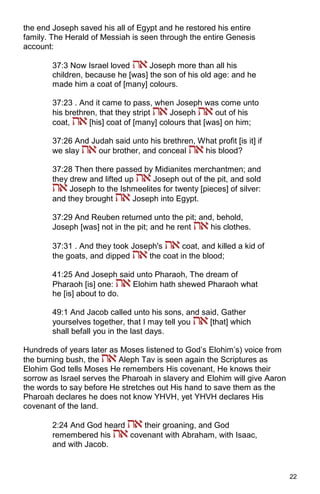
We see Aleph Tav among the wood, the sacrifice even the substitute ram
provided by God:
21:5 And Abraham was a hundred years old, when his son
Isaac was born to him.
21:18 Arise, lift up the lad, and hold him in thine
hand; for I will make him a great nation.
22:2 And he said, Take now thy son, thine only [son]
Isaac, whom thou lovest, and get thee into the land of
Moriah; and offer him there for a burnt offering upon one of
the mountains which I will tell thee of.
22:4 Then on the third day Abraham lifted up his eyes,
and saw the place afar off.
22:6 And Abraham took the wood of the burnt offering,
and laid [it] upon Isaac his son; and he took the fire in
his hand, and a knife; and they went both of them together.
22:9 And they came to the place which God had told him of;
and Abraham built an altar there, and laid the
wood in order, and bound Isaac his son, and laid him
on the altar upon the wood.
22:10 And Abraham stretched forth his hand, and took
the knife to slay his son.
22:12 And he said, Lay not thine hand upon the lad, neither
do thou any thing unto him: for now I know that thou fearest
God, seeing thou hast not withheld thy son, thine
only [son] from me.
22:13 And Abraham lifted up his eyes, and looked, and
behold behind [him] a ram caught in a thicket by his horns:
and Abraham went and took the ram, and offered him
up for a burnt offering in the stead of his son.
22:16 And said, By myself have I sworn, saith the LORD,
for because thou hast done this thing, and hast not
withheld thy son, thine only [son]:
Following Issac’s story, Joseph give us another amazing Messianic
theme of Messiah. Like Yeshua (Jesus), Joseph was mistreated by
his brothers, he was throw in a pit in the ground for three days, yet in
22
the end Joseph saved his all of Egypt and he restored his entire
family. The Herald of Messiah is seen through the entire Genesis
account:
37:3 Now Israel loved Joseph more than all his
children, because he [was] the son of his old age: and he
made him a coat of [many] colours.
37:23 . And it came to pass, when Joseph was come unto
his brethren, that they stript Joseph out of his
coat, [his] coat of [many] colours that [was] on him;
37:26 And Judah said unto his brethren, What profit [is it] if
we slay our brother, and conceal his blood?
37:28 Then there passed by Midianites merchantmen; and
they drew and lifted up Joseph out of the pit, and sold
Joseph to the Ishmeelites for twenty [pieces] of silver:
and they brought Joseph into Egypt.
37:29 And Reuben returned unto the pit; and, behold,
Joseph [was] not in the pit; and he rent his clothes.
37:31 . And they took Joseph's coat, and killed a kid of
the goats, and dipped the coat in the blood;
41:25 And Joseph said unto Pharaoh, The dream of
Pharaoh [is] one: Elohim hath shewed Pharaoh what
he [is] about to do.
49:1 And Jacob called unto his sons, and said, Gather
yourselves together, that I may tell you [that] which
shall befall you in the last days.
Hundreds of years later as Moses listened to God’s Elohim’s) voice from
the burning bush, the Aleph Tav is seen again the Scriptures as
Elohim God tells Moses He remembers His covenant, He knows their
sorrow as Israel serves the Pharoah in slavery and Elohim will give Aaron
the words to say before He stretches out His hand to save them as the
Pharoah declares he does not know YHVH, yet YHVH declares His
covenant of the land.
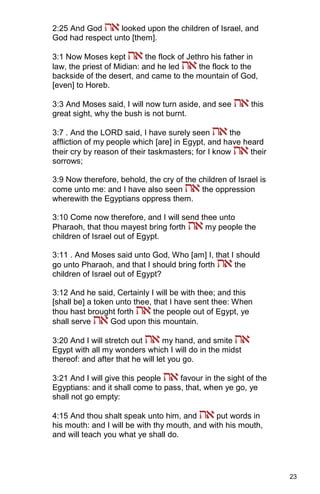
2:24 And God heard their groaning, and God
remembered his covenant with Abraham, with Isaac,
and with Jacob.
23
2:25 And God looked upon the children of Israel, and
God had respect unto [them].
3:1 Now Moses kept the flock of Jethro his father in
law, the priest of Midian: and he led the flock to the
backside of the desert, and came to the mountain of God,
[even] to Horeb.
3:3 And Moses said, I will now turn aside, and see this
great sight, why the bush is not burnt.
3:7 . And the LORD said, I have surely seen the
affliction of my people which [are] in Egypt, and have heard
their cry by reason of their taskmasters; for I know their
sorrows;
3:9 Now therefore, behold, the cry of the children of Israel is
come unto me: and I have also seen the oppression
wherewith the Egyptians oppress them.
3:10 Come now therefore, and I will send thee unto
Pharaoh, that thou mayest bring forth my people the
children of Israel out of Egypt.
3:11 . And Moses said unto God, Who [am] I, that I should
go unto Pharaoh, and that I should bring forth the
children of Israel out of Egypt?
3:12 And he said, Certainly I will be with thee; and this
[shall be] a token unto thee, that I have sent thee: When
thou hast brought forth the people out of Egypt, ye
shall serve God upon this mountain.
3:20 And I will stretch out my hand, and smite
Egypt with all my wonders which I will do in the midst
thereof: and after that he will let you go.
3:21 And I will give this people favour in the sight of the
Egyptians: and it shall come to pass, that, when ye go, ye
shall not go empty:
4:15 And thou shalt speak unto him, and put words in
his mouth: and I will be with thy mouth, and with his mouth,
and will teach you what ye shall do.
24
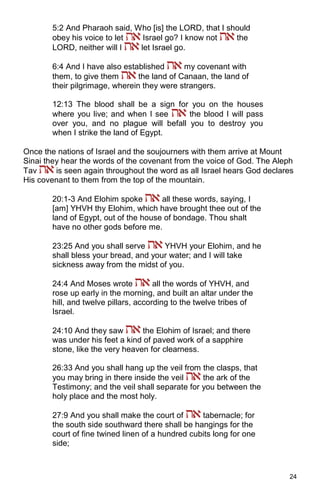
5:2 And Pharaoh said, Who [is] the LORD, that I should
obey his voice to let Israel go? I know not the
LORD, neither will I let Israel go.
6:4 And I have also established my covenant with
them, to give them the land of Canaan, the land of
their pilgrimage, wherein they were strangers.
12:13 The blood shall be a sign for you on the houses
where you live; and when I see the blood I will pass
over you, and no plague will befall you to destroy you
when I strike the land of Egypt.
Once the nations of Israel and the soujourners with them arrive at Mount
Sinai they hear the words of the covenant from the voice of God. The Aleph
Tav is seen again throughout the word as all Israel hears God declares
His covenant to them from the top of the mountain.
20:1-3 And Elohim spoke all these words, saying, I
[am] YHVH thy Elohim, which have brought thee out of the
land of Egypt, out of the house of bondage. Thou shalt
have no other gods before me.
23:25 And you shall serve YHVH your Elohim, and he
shall bless your bread, and your water; and I will take
sickness away from the midst of you.
24:4 And Moses wrote all the words of YHVH, and
rose up early in the morning, and built an altar under the
hill, and twelve pillars, according to the twelve tribes of
Israel.
24:10 And they saw the Elohim of Israel; and there
was under his feet a kind of paved work of a sapphire
stone, like the very heaven for clearness.
26:33 And you shall hang up the veil from the clasps, that
you may bring in there inside the veil the ark of the
Testimony; and the veil shall separate for you between the
holy place and the most holy.
27:9 And you shall make the court of tabernacle; for
the south side southward there shall be hangings for the
court of fine twined linen of a hundred cubits long for one
side;
25
29:19 And you shall take the other ram; and Aaron
and his sons shall put their hands upon the head of the
ram.
33:12 And Moses said to YHVH, See, you say to me, Bring
up this people; and you have not let me know whom
you will send with me. Yet you have said, I know you by
name, and you have also found grace in my sight.
34:28 And he was there with YHVH forty days and forty
nights; he did neither eat bread, nor drink water. And he
wrote upon the tablets the words of the covenant, the
ten commandments.
Now that is quite a beginning to the story of the strength of the
covenant which is the Aleph Tav: Herald of Messiah!
26
The Light of the Menorah
To better understand the Messiah within the Torah we have to recognize
that the covenant God made with Israel at Mount Sinai still exists as a
binding eternal covenant between God and His people Israel. God’s
covenants build upon each other; they never replace or do away with prior
covenants. In 2 Corinthians 3, Paul taught that the Torah could not really be
understood without understanding that it was written and is to be read with
the focus on Messiah. Once that is done the veil is removed. This is a
message that many grapple with and that many reject, but God’s word, His
Torah remains.
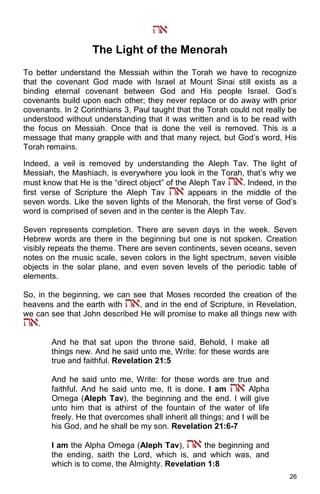
Indeed, a veil is removed by understanding the Aleph Tav. The light of
Messiah, the Mashiach, is everywhere you look in the Torah, that’s why we
must know that He is the “direct object” of the Aleph Tav . Indeed, in the
first verse of Scripture the Aleph Tav appears in the middle of the
seven words. Like the seven lights of the Menorah, the first verse of God’s
word is comprised of seven and in the center is the Aleph Tav.
Seven represents completion. There are seven days in the week. Seven
Hebrew words are there in the beginning but one is not spoken. Creation
visibly repeats the theme. There are seven continents, seven oceans, seven
notes on the music scale, seven colors in the light spectrum, seven visible
objects in the solar plane, and even seven levels of the periodic table of
elements.
So, in the beginning, we can see that Moses recorded the creation of the
heavens and the earth with , and in the end of Scripture, in Revelation,
we can see that John described He will promise to make all things new with
.
And he that sat upon the throne said, Behold, I make all
things new. And he said unto me, Write: for these words are
true and faithful. Revelation 21:5
And he said unto me, Write: for these words are true and
faithful. And he said unto me, It is done. I am Alpha
Omega (Aleph Tav), the beginning and the end. I will give
unto him that is athirst of the fountain of the water of life
freely. He that overcomes shall inherit all things; and I will be
his God, and he shall be my son. Revelation 21:6-7
I am the Alpha Omega (Aleph Tav), the beginning and
the ending, saith the Lord, which is, and which was, and
which is to come, the Almighty. Revelation 1:8
27
Saying, I am Alpha Omega (Aleph Tav), the First and
the Last: Revelation 1:11
So when we see the Hebrew Aleph and Tav is the same as the Greek Alpha
and Omega it's a real eye opener that Revelation tells us that the Alpha and
Omega is the Creator: The one sitting upon the throne says He will make all
things new, and that He is the Aleph and Tav, the beginning and the end
and that He is the God of the overcomers and we are His sons [and
daughters].
In the beginning of Revelation, we see the clear reference to the seven
candlesticks, the “Menorah”. This is also first seen in the beginning of the
Scriptures, and it is now mentioned at the end of the Scriptures. So let’s
start at the beginning where we first see the Menorah.
“And thou shall make a candlestick [of] pure gold: [of]
beaten work shall the candlestick be made: his shaft, and
his branches, his bowls, his knops, and his flowers, shall
be of the same. And six branches shall come out of the
sides of it; three branches of the candlestick out of the one
side, and three branches of the candlestick out of the other
side: Three bowls made like unto almonds, [with] a knop
and a flower in one branch; and three bowls made like
almonds in the other branch, [with] a knop and a flower: so
in the six branches that come out of the candlestick. And in
the candlestick [shall be] four bowls made like unto
almonds, [with] their knops and their flowers. And [there
shall be] a knop under two branches of the same, and a
knop under two branches of the same, and a knop under two
branches of the same, according to the six branches that
proceed out of the candlestick. Their knops and their
branches shall be of the same: all it [shall be] one beaten
work [of] pure gold. And thou shall make the seven lamps
thereof: and they shall light the lamps thereof, that they may
give light over against it. Exodus 25:31-37
The seven branched Menorah, the golden candlesticks gives us the picture
of an almond tree, complete with branches and flowers. Now looking back
to the beginning, we know God planted the tree of life in Eden; and in the
end we see the tree of life once again:
And out of the ground made the LORD God to grow every
tree that is pleasant to the sight, and good for food; the tree
of life also in the midst of the garden, and the tree of
knowledge of good and evil. Genesis 2:9
28
I am Aleph and Tav, the Beginning and the End, the
First and the Last. Blessed [are] they that do his
commandments that they may have right to the tree of life,
and may enter in through the gates into the city. Revelation
22:13-14
He that hath an ear, let him hear what the Spirit saith unto
the churches; To him that overcomes will I give to eat of the
tree of life, which is in the midst of the paradise of God.
Revelation 2:7
The Messiah confirms to John the same words that were given many years
earlier to Isaiah and Jeremiah:
I [am] he that liveth, and was dead; and, behold, I am alive
for evermore, Amen; and have the keys of hell and of
death. Revelation 1:18
Thus saith the LORD the King of Israel, and his redeemer
the LORD of hosts; I [am] the first, and I [am] the last; and
beside me [there is] no God. Isaiah 44:6
Hearken unto me, O Jacob and Israel, my called; I [am] he; I
[am] the first, I also [am] the last. Isaiah 48:12
Look at these verses very carefully. When you “see” the , the sign of
The Messiah, make note that it is placed exactly where it appears within the
Hebrew script. Isaiah gives us the prophecy of the Passover crucifixion as
The Lord stretched out His arms on the cross:
The LORD hath made bare his holy arm in the eyes of all
the nations; and all the ends of the earth shall see the
salvation of our God. Isaiah 52:10
Isaiah knows what he is talking about when he uses the word salvation.
After all, it is Jesus’ real name, his Hebrew name is Yeshua,
literally meaning “salvation". He saves us from the penalty of our iniquity.
All we like sheep have gone astray; we have turned every
one to his own way; and the LORD hath laid on him the
iniquity of us all. Isaiah 53:6
Let’s take a look again at Genesis 1:1 in Hebrew and see what message the
lights of the menorah and the Vav can teach us with the Aleph Tav by
keeping in mind that Hebrew is the original language the Bible that Jesus
Christ – Messiah Yeshua read and taught. It is His “Word”, the words of our
Creator. Look closely at the Hebrew script of Genesis below.
29
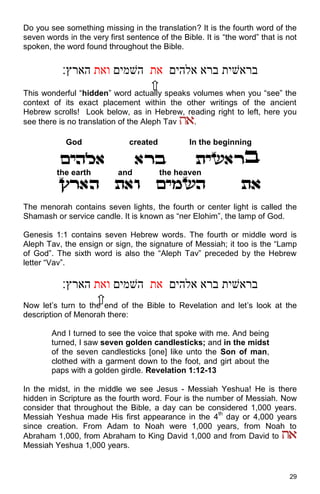
Do you see something missing in the translation? It is the fourth word of the
seven words in the very first sentence of the Bible. It is “the word” that is not
spoken, the word found throughout the Bible.
‫בר‬‫אׁשית‬‫אלהים‬ ‫ברא‬‫את‬‫הׁשמים‬‫ואת‬‫הארץ׃‬
This wonderful “hidden” word actually speaks volumes when you “see” the
context of its exact placement within the other writings of the ancient
Hebrew scrolls! Look below, as in Hebrew, reading right to left, here you
see there is no translation of the Aleph Tav .
God created In the beginning
the earth and the heaven
The menorah contains seven lights, the fourth or center light is called the
Shamash or service candle. It is known as “ner Elohim”, the lamp of God.
Genesis 1:1 contains seven Hebrew words. The fourth or middle word is
Aleph Tav, the ensign or sign, the signature of Messiah; it too is the “Lamp
of God”. The sixth word is also the “Aleph Tav” preceded by the Hebrew
letter “Vav”.
‫בר‬‫אׁשית‬‫אלהים‬ ‫ברא‬‫את‬‫הׁשמים‬‫ואת‬‫הארץ׃‬
Now let’s turn to the end of the Bible to Revelation and let’s look at the
description of Menorah there:
And I turned to see the voice that spoke with me. And being
turned, I saw seven golden candlesticks; and in the midst
of the seven candlesticks [one] like unto the Son of man,
clothed with a garment down to the foot, and girt about the
paps with a golden girdle. Revelation 1:12-13
In the midst, in the middle we see Jesus - Messiah Yeshua! He is there
hidden in Scripture as the fourth word. Four is the number of Messiah. Now
consider that throughout the Bible, a day can be considered 1,000 years.
Messiah Yeshua made His first appearance in the 4
th
day or 4,000 years
since creation. From Adam to Noah were 1,000 years, from Noah to
Abraham 1,000, from Abraham to King David 1,000 and from David to
Messiah Yeshua 1,000 years.
30
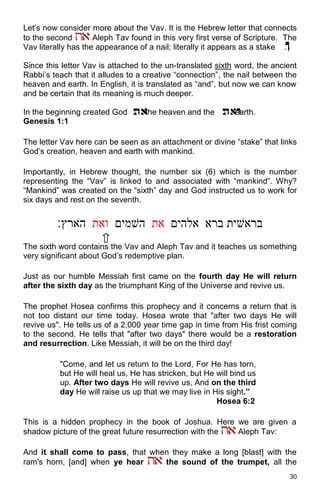
Let’s now consider more about the Vav. It is the Hebrew letter that connects
to the second Aleph Tav found in this very first verse of Scripture. The
Vav literally has the appearance of a nail; literally it appears as a stake .
Since this letter Vav is attached to the un-translated sixth word, the ancient
Rabbi’s teach that it alludes to a creative “connection”, the nail between the
heaven and earth. In English, it is translated as “and”, but now we can know
and be certain that its meaning is much deeper.
In the beginning created God the heaven and the earth.
Genesis 1:1
The letter Vav here can be seen as an attachment or divine “stake” that links
God’s creation, heaven and earth with mankind.
Importantly, in Hebrew thought, the number six (6) which is the number
representing the “Vav” is linked to and associated with “mankind”. Why?
“Mankind” was created on the “sixth” day and God instructed us to work for
six days and rest on the seventh.
‫בר‬‫אׁשית‬‫ברא‬‫אלהים‬‫את‬‫הׁשמים‬‫ואת‬‫הארץ׃‬
The sixth word contains the Vav and Aleph Tav and it teaches us something
very significant about God’s redemptive plan.
Just as our humble Messiah first came on the fourth day He will return
after the sixth day as the triumphant King of the Universe and revive us.
The prophet Hosea confirms this prophecy and it concerns a return that is
not too distant our time today. Hosea wrote that "after two days He will
revive us". He tells us of a 2,000 year time gap in time from His frist coming
to the second. He tells that "after two days" there would be a restoration
and resurrection. Like Messiah, it will be on the third day!
"Come, and let us return to the Lord, For He has torn,
but He will heal us, He has stricken, but He will bind us
up. After two days He will revive us, And on the third
day He will raise us up that we may live in His sight.”
Hosea 6:2
This is a hidden prophecy in the book of Joshua. Here we are given a
shadow picture of the great future resurrection with the Aleph Tav:
And it shall come to pass, that when they make a long [blast] with the
ram's horn, [and] when ye hear the sound of the trumpet, all the
31
people shall shout with a great shout; and the wall of the city shall fall down
flat, and the people shall ascend up every man straight before him.
Joshua 6:5
When you hear the sound of Yeshua’s trumpet all will come before Him.
Now let’s consider the representation of the ancient Vav as the upright
man “the Son of man” hung on the stake. Searching the words “Son of
man”, there are many verses in the “New Testament” that make reference to
“the Son of man”, the One who is our Messiah. Some favorites are:
For the Son of man is Lord even of the Sabbath day.
Matthew 12:8
For the Son of man is come to save that which was lost.
Matthew 18:11
Even as the Son of man came not to be ministered unto,
but to minister, and to give his life a ransom for many.
Matthew 20:28
But that ye may know that the Son of man hath power on
earth to forgive sins Mark 2:10
For he taught his disciples, and said unto them, The Son of
man is delivered into the hands of men, and they shall kill
him; and after that he is killed, he shall rise the third day.
And hath given him authority to execute judgment also,
because he is the Son of man. John 5:27
And he saith unto them, But whom say ye that I am? And
Peter answered and saith unto him, Thou art the Messiah.
And he charged them that they should tell no man of him.
And he began to teach them, that the Son of man must
suffer many things, and be rejected of the elders, and [of]
the chief priests, and scribes, and be killed, and after three
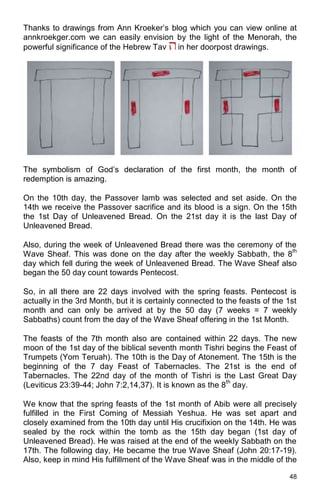
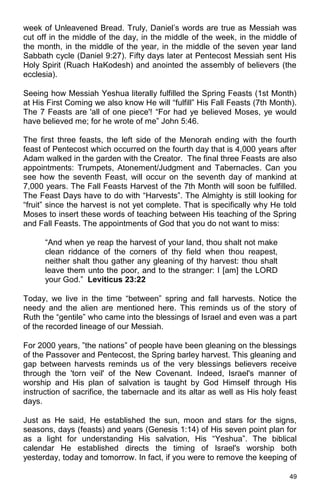
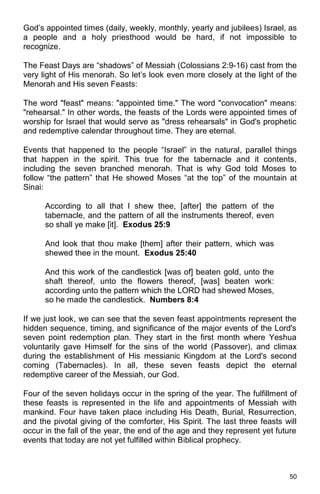
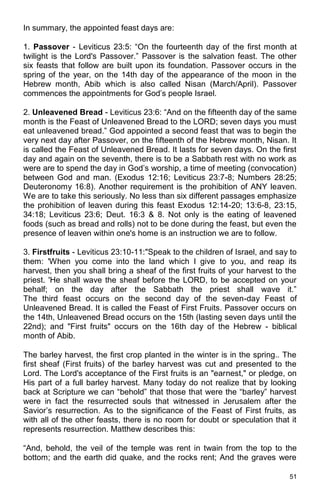
days rise again. Mark 8:29
Proverbs beautifully notes, “the word”, the Aleph-Tav , is confirmed as
the Creator, the one that established the ends of the earth:
Who hath ascended up into heaven, or descended? Who
has gathered the wind in His fists? Who has bound the
waters in a garment? Who has established all the ends of
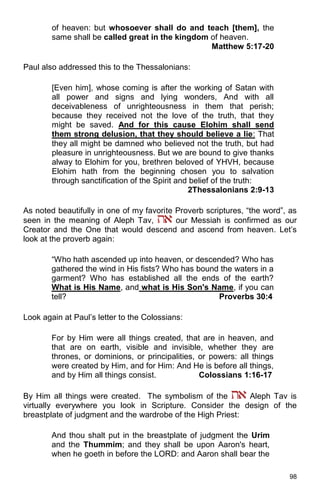
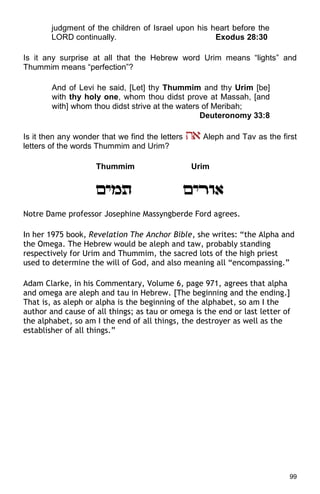
the earth? What is His Name, and what is His Son's
Name, if you can tell? Proverbs 30:4
32
This is confirmed once again in Colossians:
For by Him were all things created, that are in heaven,
and that are on earth, visible and invisible, whether they are
thrones, or dominions, or principalities, or powers: all things
were created by Him, and for Him: And He is before all
things, and by Him all things consist. Colossians 1:16-17
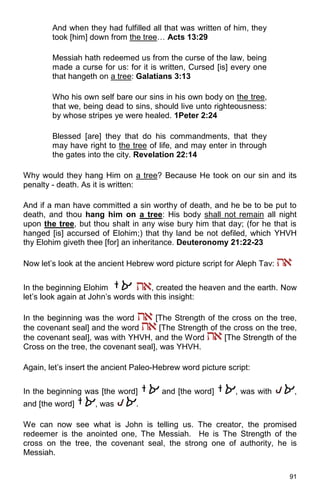
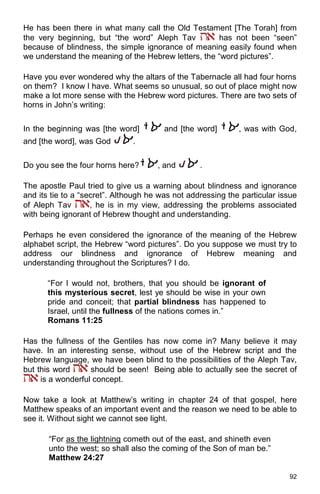
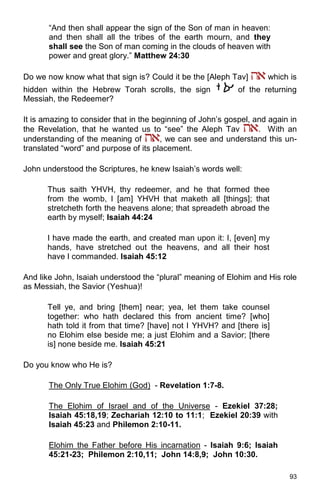
When The Messiah was uplifted on the stake of the tree, his hands and feet
were bound by nails. This is represented by the Vav that is seen with the
Aleph Tav of Genesis 1:1. He was literally hung “between” heaven and
earth! In this way, his death bound all of creation, both heaven and earth.
In this study I have used as primary references, the The Jerusalem Bible,
Koren Publishers, Israel 2000, and J.P. Green’s Interlinear Hebrew-English
Old Testament, 2nd Edition, 1985 as resources. I have also purchased Keys
to the Bible from Computronic Corporation, an Israeli software company to
locate the placements of Aleph Tav throughout the Hebrew Scriptures.
Notably, the Green Interlinear Bible has this to say in its preface:
“Untranslated Words. There are some Hebrew words which are not
translated in this work. For instance, an untranslated sign defining the
direct object of a verb…”
Digging in and using the Strong’s Exhaustive Concordance of the Bible,
from James Strong, we can find that the Aleph Tav is in fact noted as
Strong's Number 0853 and Strong’s says it is recorded to occur as the
Hebrew word 'eth “22 times in 18 verses of Scripture”.
But I must ask why are there some 7,000 other locations in Scripture where
Strong’s and others have not identified the as “eth” and translated it?
This study looks further into this mystery. As has we have seen, incredibly
these two letters are found as two witnesses, the fourth and sixth
“word” in the first book and the very first sentence of the Holy Scriptures.
They are also shown in the last book of Revelation as the Greek letters
“alpha” and “omega” . As we see in Revelation, The Messiah “defines
himself as the alpha omega, the Hebrew Aleph Tav four times! That
is no coincidence. Just look at the four verses:
I am Alpha and Omega, which was, and which is to
come, the Almighty. Revelation 1:8
33
Saying, I am Alpha and Omega, the first and the last:
and, What thou seest, write in a book, and send [it] unto the
seven churches which are in Asia; unto Ephesus, and unto
Smyrna, and unto Pergamos, and unto Thyatira, and unto
Sardis, and unto Philadelphia, and unto Laodicea.
Revelation 1:11
And he said unto me, It is done. I am Alpha and Omega,
the beginning and the end. I will give unto him that is
athirst of the fountain of the water of life freely.
Revelation 21:6
I am Alpha and Omega, the beginning and the end, the
first and the last. Revelation 22:13
“Who” did John see when he looked toward the seven candlesticks, the
lights of the menorah?
And in the midst of the seven candlesticks [one] like unto
the Son of man, clothed with a garment down to the foot,
and girt about the paps with a golden girdle.
Revelation 1:13
Then spoke Jesus (Yeshua) again unto them, saying, I am
the light of the world: he that followeth me shall not walk in
darkness, but shall have the light of life. John 8:12
In Psalms 119, we read the magnificent poetry of David as he used each
Hebrew letter from the beginning “Aleph” to the end “Tav”. Let‘s look at the
portion of Psalms identified as “Nun” which means heir, son or “seed”. But
before we do, let’s remember God’s great covenant promise to Abraham
which spoke of Messiah whose word is our light:
And I, behold, I establish my covenant with you, and with
your seed after you… Genesis 9:9
NUN. Thy word [is] a lamp unto my feet, and a light unto
my path. I have sworn, and I will perform [it], that I will keep
thy righteous judgments. I am afflicted very much: quicken
me, O LORD, according unto thy word. Accept, I beseech
thee, the freewill offerings of my mouth, O LORD, and teach
me thy judgments. My soul [is] continually in my hand: yet
do I not forget thy law. The wicked have laid a snare for
me: yet I erred not from thy precepts. Thy testimonies
have I taken as a heritage for ever: for they [are] the
rejoicing of my heart. I have inclined mine heart to perform
34
thy statutes alway, [even unto] the end. Psalms 119:105-
112
The entrance of thy words gives light; it gives
understanding unto the simple. Psalms 119:130
And God said, Let there be light: and there was light. And
God saw the light, that [it was] good: and God divided the
light from the darkness. Genesis 1:3-4
In these verses from Genesis the Hebrew word for light is 'owr, it is written
with the letters Aleph Vav Resh . The pictographic meaning is
"Strength" "Connection" "Beginning". In the very ancient Hebrew pictograph
we read right to left: .
This "light" is different in the Hebrew text and meaning from the word we
also call "light" as found in Genesis 1:16. Here the word for light is ma'owr
.
Everyone knows that darkness is the absence of any visible light. Isaiah
had something to say about this as well:
To the law and to the testimony: if they speak not
according to this word, it is because there is no light in
them. Isaiah 8:20
Who [is] among you that feareth the LORD, that obeyed the
voice of his servant, that walked [in] darkness, and hath
no light? let him trust in the name of the LORD, and stay
upon his God. Isaiah 50:10
And in Matthew we see:
Ye are the light of the world. A city that is set on a hill
cannot be hid. Neither do men light a candle, and put it
under a bushel, but on a candlestick; and it gives light unto
all that are in the house. Let your light so shine before men,
that they may see your good works, and glorify your
Father which is in heaven.
Matthew 5:14-16
We know that the human eye is sensitive to light, yet we are only able to
detect a very small region of the sun's “electromagnetic spectrum” known
as "visible light".
35
This spectrum of "visible light" corresponds to a wavelength range of 400-
700 nanometers (nm). These are very interesting numbers indeed! Here’s
why:
Just like a computer code, each Hebrew letter has a numeric value just as
each Hebrew letter has a meaning, a symbol. These numeric values are
known as Gematria. The Gematria of the Hebrew letter Tav is 400 and as
we have noted, this Hebrew letter’s symbol is a cross, its meaning is a
covenant. Often given an independent final value of 700 is the Hebrew
letter called the "final" Nun, the Hebrew letter which means a continuation
of new life. That is the nun represents resurrection - eternal life.
Surprised? Tav Nun or "Visible light" corresponds to a wavelength range of
400-700 nanometers. Indeed, “Light is the cross, the covenant
representing “new life”, “eternal life”.
This is supported by the writing of the prophet Daniel; notice his use of the
words shine and brightness:
And many of them that sleep in the dust of the earth shall
awake, some to everlasting life, and some to shame [and]
everlasting contempt. And they that be wise shall shine as
the brightness of the firmament; and they that turn many
to righteousness as the stars for ever and ever.
Daniel 12:2-3
Look at the next verse and I think you will see the light, the testimony of
the Hebrew letter Nun and the Tav in Psalms 119.
Read Psalms 119:105-112. Keep in mind, the Nun speaks of the light of
The Word, the Tav: His statutes, commandments, precepts, law and
judgments. Now let’s look at the Tav of Psalms 119:
TAV. Let my cry come near before thee, O LORD: give me
understanding according to thy word. Let my supplication
come before thee: deliver me according to thy word. My lips
shall utter praise, when thou hast taught me thy statutes.
My tongue shall speak of thy word: for all thy
commandments [are] righteousness. Let thine hand help
me; for I have chosen thy precepts. I have longed for thy
salvation, O LORD; and thy law [is] my delight. Let my soul
live, and it shall praise thee; and let thy judgments help me.
I have gone astray like a lost sheep; seek thy servant; for I
do not forget thy commandments. Psalms 119:169-176
36
When our Creator YHVH made the heavens and the earth, He existed in His
invisible “spirit” form, in an invisible heavenly realm, a real, tangible
dimension that cannot be seen within the spectrum of light existing within
our visible wavelength range of 400 - 700 nanometers. Indeed, before He
created light - the visible did not yet exist, so He could not have been seen!
God calls Himself by the name YHVH in the invisible realm, all
throughout the Scriptures. It is thought to be pronounced as Yahweh. YHVH
designed all of creation of the Universe and He spoke it into existence.
Creation was not made by the “hand” of God, it was made by the sound of
His voice, but don’t believe me read it for yourself from the eight
commands recorded in the account of Genesis chapter one:
1. And God said, Let there be light: and there was light.
2. And God said, Let there be a firmament in the midst of the
waters, and let it divide the waters from the waters.
3. And God said, Let the waters under the heaven be gathered
together unto one place, and let the dry [land] appear… And God
said, Let the earth bring forth grass, the herb yielding seed, the
fruit tree yielding fruit after his kind, whose seed [is] in itself, upon
the earth
4. And God said, Let there be lights in the firmament of the
heaven to divide the day from the night; and let them be for
signs, and for seasons, and for days, and years… And let them
be for lights in the firmament of the heaven to give light upon the
earth
5. And God said, Let the waters bring forth abundantly the
moving creature that hath life, and fowl [that] may fly above the
earth in the open firmament of heaven... And God blessed them,
saying, Be fruitful, and multiply, and fill the waters in the seas,
and let fowl multiply in the earth.
6. And God said, Let the earth bring forth the living creature after
his kind, cattle, and creeping thing, and beast of the earth after
his kind…
7. And God said, Let us make man in our image, after our
likeness: and let them have dominion over the fish of the sea,
and over the fowl of the air, and over the cattle, and over all the
earth, and over every creeping thing that creepeth upon the
earth...
8. And God said, Behold, I have given you every herb bearing
seed, which [is] upon the face of all the earth, and every tree, in
the which [is] the fruit of a tree yielding seed; to you it shall be for
meat. And to every beast of the earth, and to every fowl of the
air, and to every thing that creepeth upon the earth, wherein
[there is] life, [I have given] every green herb for meat.
Thus the heavens and the earth were finished, and all the host of
them. And on the seventh day God ended his work which he
had made; and he rested on the seventh day from all his work
which he had made. And God blessed the seventh day, and
sanctified it: because that in it he had rested from all his work
which God created and made.
37
To gain some understanding of the invisible one YHVH, and His existence,
we have to understand the creation event of light and its visible spectrum.
Just like the invisible spectrum of light we know today as radio waves,
YHVH God exists. Knowing He created all through His voice, is it any
coincidence that we use radio waves or “light” to carry our “voices” around
the world in an instant on our cell phones?
Much like these invisible light wavelengths we call radio waves, our spoken
word as sound cannot be seen either, yet it plainly exists. In a similar
concept, God YHVH cannot be seen as Spirit, yet He most certainly exists!
Our voice is not seen and written words are seen but not heard, unless of
course as soon as they are spoken. When written words are spoken they
come to life through the wind of our voice. In the same way, “wind” in
Scripture is known as “spirit”. Now consider this, in Hebrew, the word
“ruach” means either “spirit” or “wind”!
When God created, He did this though His Spirit, through His invisible
spoken “Word”. Let’s remember again what the disciple John says about
this:
In the beginning was the Word, and the Word was with
God, and the Word was God. The same was in the
beginning with God. All things were made by him; and
without him was not any thing made that was made. In
him was life; and the life was the light of men.
And the Word was made flesh, and dwelt among us…
John is telling us about the unseen realm, where YHVH, the invisible God
willed the architecture and design of the creation of the universe. Within the
invisible spirit realm God reveals Himself as YHVH, within the visible
physical realm of His creation, he revealed himself as Yeshua (Jesus).
Yeshua, the Son of man is the visible form of the invisible YHVH, the “Word”
is His Torah, His teaching and instruction. He spoke His word at Mount Sinai
and Moses recorded it. Then Yeshua lived it, unveiled it and taught it to
others when He came as the Son of man.
It is a great mystery but His life, death and resurrection was the merger of
what was is not able to be seen with what can be seen.
Like sound, whose “waves” never end, the covenant spoken at Mount Sinai
has never ended. Instead it was brought out plainly into the open where it
can be understood as the covenant of God’s love and grace, His instruction
for righteous living. It’s worth repeating: Yeshua is the author of His word,
the Torah. He came to live it which is to fulfill it, expand it and explain it to
us. Luke records the Master’s words:
38
And he said unto them, These [are] the words which I
spoke unto you, while I was yet with you, that all things
must be fulfilled, which were written in the law (Torah)
of Moses, and [in] the prophets, and [in] the psalms,
concerning me. Luke 24:44
So, accept the challenge today and move from passivity and ignorance of
His Word, to accomplishing and doing all that you're purposed to pursue
through His instruction.
Don't allow yourself to continue to be submissive to a doctrine, tradition or
teaching of men. Instead, let the declaration of your mouth and your actions
confirm the covenant of our God who is responsive to and responsible for
His Word. You are to be a light to the world!
For the commandment is a lamp; and the law (Torah) is
light; and reproofs of instruction are the way of life.
Proverbs 6:23
Believers are asked by God to be a light unto the nations and the Menorah
is a wonderful and beautiful symbol of His Light. So what is “light” anyway?
According to the U.S. Department of energy there are several ways to think
of light. "The classical description says light is an electro-magnetic wave.
This means that it is a varying electric and magnetic field, which spreads out
or propagates from one place to another. The modern quantum mechanical
description says that light can also be considered to be particles called
photons. These carry energy and momentum but have no mass. In both
descriptions, the light energy is carried by a very real and observable
mechanism. But it is not a physical substance."
Very Interesting, light exists, but it is not physical, it has no mass yet moves
like a wave, just like sound, I wonder why?
And [his] brightness was as the light; he had horns
[coming] out of his hand: and there [was] the hiding of his
power. Habakkuk 3:4
Here the Hebrew word “qeren” is translated as horns, but it means rays of
light. This description precedes the Aleph Tav of verse 13:
Thou wentest forth for the salvation of thy people, [even]
for salvation with thine anointed {mashiyach}; thou
woundedst the head out of the house of the wicked, by
discovering the foundation unto the neck. Selah.
Habakkuk 3:13
39
Light is related to the Aleph Tav.
From a science perspective, invisible light and visible light are both “light”;
they simply exist within different wavelength spectrums. To be seen, light
must be reflected. To be reflected, it must exist within the visible wavelength
spectrum. When this happens we can “see” it due to the seven colors of
visible light. I hope this gives you a greater understanding of the meaning of
the seven lights of the menorah. Do what Jesus did, live out His Torah and
visibly show Him and others you love Him. When you do His word, He is
seen as the light in you which allows you to participate in a great prophecy
of His own light:
"But [as] truly [as] I live, all the earth shall be filled with the
glory of the LORD." Numbers 14:21
Then spoke Yeshua again unto them, saying, I am the light
of the world: he that followeth me shall not walk in
darkness, but shall have the light of life. John 8:12
As long as I am in the world, I am the light of the world.
John 9:5
The Father gave us His "spectrum" of seven feasts. Likewise, “seven” spirits
are described and prophesied by Isaiah to be resting upon the Messiah.
These are described by John in Revelation as a representation of the seven
branched menorah, the seven lamps of fire which is the spirit of our God!
And out of the throne proceeded lightnings and
thunderings and voices: and [there were] seven lamps of
fire burning before the throne, which are the seven Spirits
of God. Revelation 4:5
Now go back and read Isaiah as he writes in verse 11:2: And the (1) spirit of
the LORD [YHVH] shall rest upon him, the (2) spirit of wisdom and (3)
understanding, the (4) spirit of counsel and (5) might, the (6) spirit of
knowledge and of the (7) fear of the LORD [YHVH]. Look, can you see it? It
is the same "rainbow" John describes in Revelation!! Here are the seven
spirits of the God represented by the symbol of the menorah:
And immediately I was in the spirit: and, behold, a throne
was set in heaven, and [one] sat on the throne. And he
that sat was to look upon like a jasper and a sardine stone:
and [there was] a rainbow round about the throne, in sight
like unto an emerald. And round about the throne [were]
four and twenty seats: and upon the seats I saw four and
twenty elders sitting, clothed in white raiment; and they
had on their heads crowns of gold. And out of the throne
proceeded lightnings and thunderings and voices: and
40
[there were] seven lamps of fire burning before the
throne, which are the seven Spirits of God.
Revelation 4: 2- 5
By now, you should not be surprised to know that sunlight consists of the
entire electromagnetic spectrum including, you guessed it, seven
wavelengths: 1) gamma rays, 2) X rays, 3) ultraviolet radiation, 4) visible
light 5) infrared radiation, 6) microwaves and 7) radio waves. We can now
consider that the order of the seven light spectrum aligns with the stated
order of the seven spirits of God and His menorah:
(1) White = spirit of the LORD (2) Magenta = wisdom
(3) Blue = understanding (4) Cyan = counsel
(5) Green =might (6) Yellow= knowledge
(7) Red = fear
We know that light travels very fast. In fact, the speed of light has been
measured to travel at 186,283 miles per second. But did you know that this
is declared by the Hebrew name of God? Remember, Hebrew character
letters have numeric value. So what does this have to do with light? In his
book The Cryptic Dictionary of Genesis One, author Yacob Rambsel
explains something amazing from the Hebrew word:
“The Name of Jehovah hwhy has a mathematical value of 26,
when you are using the value of each letter independently. But
when you take each independent letter to the second power,
then you must multiply by aleph (la), which means 1,000, and
equals 186,000. The Hebrew word for, the squared is,
ha'rabuah uwbrh (283). Adding the value of ha'rabuah to
186,000 gives you 186,283, which is believed to be the actual
speed of light when God created the stars and galaxies on the
fourth day. The Formula for the Speed of Light: Jehovah;
Yehovah hwhy equals 186.
The yod ( y ) is 10.
The heh ( h ) is 5.
The vav ( w ) is 6.
The heh ( h ) is 5.
The sum = 26.
The yod ( y ) to the second power equals 100.
The heh ( h ) to the second power equals 25.
The vav ( w ) to the second power equals 36.
The heh ( h ) to the second power equals 25.
The sum = 186
41
Calculating them all together gives us 186 X 1,000 + 283 =
186,283, which is the speed of light in miles per second.
To summarize according to Bible code language, the equation
states:
[Jehovah hwhy to the second power (186), times aleph [la
(1000), plus the value of the square ubwrh (283) = 186,283 ]
Special Notes: Leviticus 25:33; Second letter, 14th word, +
seven spells, the speed of light; le'aor mahair rhm rwal. Seven
is unique because it represents the fullness or completion of
something.Genesis 1:29; Third letter, first word, + 49 ( 7 x 7 )
spells, the light rwah.”
I pray you can now see the light in His word and name!
Yet there is one more thing to consider about the Vav that is first seen in
Genesis 1:1. The nail, the stake that binds God’s creation of heaven and
earth, also binds and rest the Torah, the teaching and instruction, the words
of God as recorded by Moses in the first five books of the Bible just as the
stakes bound the Tabernacle to the earth. Every Torah scroll, like the
Tabernacle (Mishkan) that was surrounded by curtains or sheets that were
coupled or hooked together by gold (see Exodus 26) contains a stake or
Vav.
The sheets of the Tabernacle were made of white linen that were bound by
stakes to the ground. Amazingly, the Torah also contains a stake that links
each and every column of God’s Torah except five, it is the Vav, the tent
peg, the nail between heaven and earth.
Is it any wonder that Messiah expounded all things to His disciples before
He was nailed between heaven and earth to the covenant cross:
And beginning at Moses and all the prophets, he expounded
unto them in all the scriptures the things concerning himself.
Luke 24:27
When we consider the Hebrew hook, the Vav we can also see why Yeshua,
the One that calls Himself Alpha Omega - Aleph Tav instructed them:
"Come, follow me," Jesus said, "and I will make you fishers of
men." Matthew 4:19
The following graphic is an example of the Torah where every column (but
five) in all the Torah begins with the Vav (photo courtesy of Congregation
42
Beth Emeth Herndon, Virginia). Truly, the Torah is the word of our Creator
that binds us by His voice.
The Vav Links Every Column of the Torah
Above is a photo of the Torah scroll open to Leviticus 26:18-Leviticus 27:20.
Here we can see the Vav that binds the top and beginning of every Torah
column. This is simply amazing. Check it out for yourself from the scroll
images taken at Congregation Beth Emeth:
http://www.bethemeth.org/torahreadings/
43
Menorah Lights and the Appointed Feasts
Within the ancient Hebrew alef-bet there are twenty two (22) letters from
Aleph to Tav .
Interestingly, there are also 22 days counted within all of the spring feast
days and 22 in the fall feast days. So too, there are 22 knops on the
menorah candlesticks that God described to Moses. The same “lamp” that
we “see” in the beginning of Scripture in Genesis when Abraham was given
the covenant, the same “lamp” we see at the end of Scripture when John
sees the holy one.
Let’s take a look at the beginning:
Genesis 15:17 “And it came to pass, that, when the sun went down, and it
was dark, behold a smoking furnace, and a burning lamp that passed
between those pieces.”
Exodus 25:31-37 And thou shalt make a candlestick [of] pure gold: [of]
beaten work shall the candlestick be made: his shaft, and his branches, his
bowls, his knops, and his flowers, shall be of the same. And six branches
shall come out of the sides of it; three branches of the candlestick out of
the one side, and three branches of the candlestick out of the other side:
Three bowls made like unto almonds, [with] a knop and a flower in one
branch; and three bowls made like almonds in the other branch, [with] a
knop and a flower: so in the six branches that come out of the candlestick.
And in the candlestick [shall be] four bowls made like unto almonds, [with]
their knops and their flowers. And [there shall be] a knop under two
branches of the same, and a knop under two branches of the same, and a
knop under two branches of the same, according to the six branches that
proceed out of the candlestick. Their knops and their branches shall be of
the same: all it [shall be] one beaten work [of] pure gold. And thou shalt
make the seven lamps thereof: and they shall light the lamps thereof,
that they may give light over against it.
Revelation 1:11-13 “Saying, I am Alpha and Omega, [Aleph and Tav ]
the first and the last: and, What thou seest, write in a book, and send [it]
unto the seven churches which are in Asia; unto Ephesus, and unto
Smyrna, and unto Pergamos, and unto Thyatira, and unto Sardis, and unto
Philadelphia, and unto Laodicea. And I turned to see the voice that spoke
with me. And being turned, I saw seven golden candlesticks; And in the
midst of the seven candlesticks [one] like unto the Son of man, clothed
44
with a garment down to the foot, and girt about the paps with a golden
girdle.”
So, how do the feasts synchronize with this light, the menorah?
If we look carefully we can see that His appointed Feast Days of Leviticus
23 are very much of the order and pattern of the lights of the Menorah
(Exodus 25:31-37).
“And God said, Let there be lights in the firmament of the
heaven to divide the day from the night; and let them be for
signs, and for seasons, and for days, and years: And let
them be for lights in the firmament of the heaven to give light
upon the earth: and it was so.” Genesis 1:14
A study of the holy Feast Days of The Lord YHVH shows that there were
three basic harvests in ancient Israel; they were 1) the barley harvest, 2) the
wheat harvest and finally 3) the grape harvest.
Messiah Yeshua’s Passover sacrifice came at the time of the barley harvest
(Unleavened Bread). He is the First Fruits of the barley (and the first fruits of
all three harvests).
The “great harvest” at the very end of the ages is of the 'grapes'. "Then
another angel, the one who has power over fire, came out from the altar;
and he called with a loud voice to him who had the sharp sickle, saying, "Put
in your sharp sickle and gather the clusters from the vine of the earth,
because her grapes are ripe." Revelation 14:14-20
Keep in mind that there are basically three harvests; barley, wheat and
grapes. But related to these, there is also a harvest of trees.
"Then He told them a parable: 'Behold the fig tree and all the
trees; as soon as they put forth leaves, you see it and know for
yourselves that summer is now near" Luke 21:29-30
Trees are associated with the Feast of Tabernacles (see Leviticus 23:39-44
and Nehemiah 8:13-15). Because of the association of God’s timepiece, the
sun, moon and stars with the Mo'ed, the appointed feasts and harvests
(Genesis 1:14) we can know that there are literal heavenly signs connected
with the 'seasons'.
Messiah was crucified at the time of the Passover full moon and the sun
was literally darkened for three hours while He was on the cross in the
middle of “the” great Passover week of Messiah as prophesied by Daniel:
45
"And he shall confirm the covenant with many for one week:
and in the midst of the week he shall cause the sacrifice and
the oblation to cease, and for the overspreading of
abominations he shall make it desolate, even until the
consummation, and that determined shall be poured upon the
desolate." Daniel 9:27
This was His appointed season, His time, not “a” time, but Messiah’s time,
the time of Him and this is shown in the prophetic Aleph Tav placement
of Numbers 9:2-3:
Let the children of Israel also keep the passover at his
appointed season. In the fourteenth day of this month, at even,
ye shall keep it in his appointed season: according to all the
rites of it, and according to all the ceremonies thereof, shall ye
keep it.
The literal word by word translation of Numbers 9:2 from the Hebrew is:
And they shall do, sons of Israel, the passover, in the appoiinted time
of Him.
And they kept the passover on the fourteenth day of the
first month at even in the wilderness of Sinai: according to all
that the LORD commanded Moses, so did the children of
Israel. Numbers 9:5
During Passover, the oblation (grain offering) is more specifically the “wave
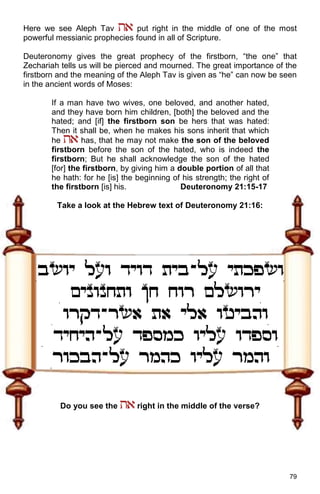
sheaf” offering of the first fruits, here we see the Aleph Tav of Messiah:
"Speak unto the children of Israel, and say unto them, When
ye be come into the land which I give unto you, and shall reap
the harvest thereof, then ye shall bring a sheaf of the
first fruits of your harvest unto the priest: And he shall wave
the sheaf before the LORD, to be accepted for you: on
the morrow after the Sabbath the priest shall wave it"
Leviticus 23:10-11
Messiah fulfilled the lamb’s (blood) offering at the time of Passover
(Leviticus 23:5) and three days later at resurrection after the Sabbath He
fulfilled the (grain) offering of the first fruits wave sheaf in His
resurrection which overcame the abomination of the desolation of death
which was given Adam.
This fulfillment of the offering of the wave sheaf and its acceptance is
spoken of by John:
46
"Yeshua saith unto her, Touch me not; for I am not yet
ascended to my Father: but go to my brethren, and say unto
them, I ascend unto my Father, and your Father; and to my
God, and your God. Mary Magdalene came and told the
disciples that she had seen the Lord, and that he had spoken
these things unto her. Then the same day at evening, being
the first day of the week, when the doors were shut where the
disciples were assembled for fear of the Jews, came Yeshua
and stood in the midst, and saith unto them, Peace be unto
you" John 20:17-19
The veil of the Temple, was torn in two at the time of the fulfillment of the of
the Passover. Not only did Messiah fulfill the symbolic animal
sacrifices but He also fulfilled the grain offerings, and all this He
accomplished in the middle of the week of Unleavened Bread. Just as
Daniel prophesied, Messiah was crucified in the middle of the week and He
arose as the Wave Sheaf at the end of the Week as the “sinless”
Unleavened Bread. Yeshua died and was buried late on the 14th of Abib.
He was in the grave on the first day of Unleavened Bread, and on the 16th,
He was resurrected as the three days and three nights ended. This was the
sign of Jonah that He said He would fulfill.
Abib, in Hebrew means fresh new barley. The Wave Sheaf day is the
beginning of the count towards Pentecost or Shavuot (Leviticus 23:15-16). It
is day “one” of the 50 day (7x7+1) counting to the presentation of the next
harvest, that being the “wheat”. Acts 2:1 details the complete 1st century
fulfillment of Shavuot or Pentecost: "And when the day of Pentecost was
fully come, they were all with one accord in one place."
These great events were first recorded by Moses:
Three times thou shalt keep a feast unto me in the year. Thou
shalt keep the feast of unleavened bread: (thou shalt eat
unleavened bread seven days, as I commanded thee, in the
time appointed of the month Abib; for in it thou camest out
from Egypt: and none shall appear before me empty:) And the
feast of harvest, the firstfruits of thy labours, which thou hast
sown in the field: and the feast of ingathering, [which is] in the
end of the year, when thou hast gathered in thy labours out of
the field Exodus 23:14-16
There is one calendar of yearly Feasts (seven Appointments), it is all of one
'piece', seven Feasts. So too, there are 22 days of the month involved in the
feast period just as there are 22 bowls on the Menorah. The Feast Days
shed light (knowledge) to those who study them. The Feast Days reveal
Messiah Yeshua (Jesus). They are both historical and prophetic. Just as
there are two sides to the Menorah there are two sides to the Feasts; spring
47
and fall. The Feast of Pentecost stands in the center with three Feasts on
either side. Be sure to check the appendix for this picture.
The Feast Days (Appointments) of Leviticus 23 also tell us that the new
moon of Abib was the beginning of the first month (see Exodus 12:1-2).
Exodus 12 gives us a “picture” as it describes the first month as the
redemption of the world!
The Aleph Tav is very significant in Exodus 12. In verse 13 we can see
'The blood shall be a sign for you on the houses where you
live; and when I see the blood I will pass over you, and no
plague will befall you to destroy you when I strike the land of
Egypt. Exodus 12:13
Interpreting the meaning of Aleph Tav we know the verse tells us:
'The blood shall be a sign for you on the houses where you
live; and when I see [the strength of the cross] the
blood I will pass over you, and no plague will befall you to
destroy you when I strike the land of Egypt Exodus 12:13
We also see the witness of the Aleph Tav repeated 10 verses later:
For the LORD will pass through to smite the Egyptians; and
when he seeth the blood upon the lintel, and on the two
side posts, the LORD will pass over the door, and will not
suffer the destroyer to come in unto your houses to smite
[you]. Exodus 12:23
Now, this will really jump off the pages of the Bible when you see the
manner in which it is thought that the blood was applied to the door posts. It
is in the design of the Aleph.
48
Thanks to drawings from Ann Kroeker’s blog which you can view online at
annkroekger.com we can easily envision by the light of the Menorah, the
powerful significance of the Hebrew Tav in her doorpost drawings.
The symbolism of God’s declaration of the first month, the month of
redemption is amazing.
On the 10th day, the Passover lamb was selected and set aside. On the
14th we receive the Passover sacrifice and its blood is a sign. On the 15th
the 1st Day of Unleavened Bread. On the 21st day it is the last Day of
Unleavened Bread.
Also, during the week of Unleavened Bread there was the ceremony of the
Wave Sheaf. This was done on the day after the weekly Sabbath, the 8
th
day which fell during the week of Unleavened Bread. The Wave Sheaf also
began the 50 day count towards Pentecost.
So, in all there are 22 days involved with the spring feasts. Pentecost is
actually in the 3rd Month, but it is certainly connected to the feasts of the 1st
month and can only be arrived at by the 50 day (7 weeks = 7 weekly
Sabbaths) count from the day of the Wave Sheaf offering in the 1st Month.
The feasts of the 7th month also are contained within 22 days. The new
moon of the 1st day of the biblical seventh month Tishri begins the Feast of
Trumpets (Yom Teruah). The 10th is the Day of Atonement. The 15th is the
beginning of the 7 day Feast of Tabernacles. The 21st is the end of
Tabernacles. The 22nd day of the month of Tishri is the Last Great Day
(Leviticus 23:39-44; John 7:2,14,37). It is known as the 8
th
day.
We know that the spring feasts of the 1st month of Abib were all precisely
fulfilled in the First Coming of Messiah Yeshua. He was set apart and
closely examined from the 10th day until His crucifixion on the 14th. He was
sealed by the rock within the tomb as the 15th day began (1st day of
Unleavened Bread). He was raised at the end of the weekly Sabbath on the
17th. The following day, He became the true Wave Sheaf (John 20:17-19).
Also, keep in mind His fulfillment of the Wave Sheaf was in the middle of the
49
week of Unleavened Bread. Truly, Daniel’s words are true as Messiah was
cut off in the middle of the day, in the middle of the week, in the middle of
the month, in the middle of the year, in the middle of the seven year land
Sabbath cycle (Daniel 9:27). Fifty days later at Pentecost Messiah sent His
Holy Spirit (Ruach HaKodesh) and anointed the assembly of believers (the
ecclesia).
Seeing how Messiah Yeshua literally fulfilled the Spring Feasts (1st Month)
at His First Coming we also know He will “fulfill” His Fall Feasts (7th Month).
The 7 Feasts are 'all of one piece'! “For had ye believed Moses, ye would
have believed me; for he wrote of me” John 5:46.
The first three feasts, the left side of the Menorah ending with the fourth
feast of Pentecost which occurred on the fourth day that is 4,000 years after
Adam walked in the garden with the Creator. The final three Feasts are also
appointments: Trumpets, Atonement/Judgment and Tabernacles. Can you
see how the seventh Feast, will occur on the seventh day of mankind at
7,000 years. The Fall Feasts Harvest of the 7th Month will soon be fulfilled.
The Feast Days have to do with “Harvests”. The Almighty is still looking for
“fruit” since the harvest is not yet complete. That is specifically why He told
Moses to insert these words of teaching between His teaching of the Spring
and Fall Feasts. The appointments of God that you do not want to miss:
“And when ye reap the harvest of your land, thou shalt not make
clean riddance of the corners of thy field when thou reapest,
neither shalt thou gather any gleaning of thy harvest: thou shalt
leave them unto the poor, and to the stranger: I [am] the LORD
your God.” Leviticus 23:22
Today, we live in the time “between” spring and fall harvests. Notice the
needy and the alien are mentioned here. This reminds us of the story of
Ruth the “gentile” who came into the blessings of Israel and even was a part
of the recorded lineage of our Messiah.
For 2000 years, ”the nations” of people have been gleaning on the blessings
of the Passover and Pentecost, the Spring barley harvest. This gleaning and
gap between harvests reminds us of the very blessings believers receive
through the 'torn veil' of the New Covenant. Indeed, Israel's manner of
worship and His plan of salvation is taught by God Himself through His
instruction of sacrifice, the tabernacle and its altar as well as His holy feast
days.
Just as He said, He established the sun, moon and stars for the signs,
seasons, days (feasts) and years (Genesis 1:14) of His seven point plan for
as a light for understanding His salvation, His “Yeshua”. The biblical
calendar He established directs the timing of Israel's worship both
yesterday, today and tomorrow. In fact, if you were to remove the keeping of
50
God’s appointed times (daily, weekly, monthly, yearly and jubilees) Israel, as
a people and a holy priesthood would be hard, if not impossible to
recognize.
The Feast Days are “shadows” of Messiah (Colossians 2:9-16) cast from the
very light of His menorah. So let’s look even more closely at the light of the
Menorah and His seven Feasts:
The word "feast" means: "appointed time." The word "convocation" means:
"rehearsal." In other words, the feasts of the Lords were appointed times of
worship for Israel that would serve as "dress rehearsals" in God's prophetic
and redemptive calendar throughout time. They are eternal.
Events that happened to the people “Israel” in the natural, parallel things
that happen in the spirit. This true for the tabernacle and it contents,
including the seven branched menorah. That is why God told Moses to
follow “the pattern” that He showed Moses “at the top” of the mountain at
Sinai:
According to all that I shew thee, [after] the pattern of the
tabernacle, and the pattern of all the instruments thereof, even
so shall ye make [it]. Exodus 25:9
And look that thou make [them] after their pattern, which was
shewed thee in the mount. Exodus 25:40
And this work of the candlestick [was of] beaten gold, unto the
shaft thereof, unto the flowers thereof, [was] beaten work:
according unto the pattern which the LORD had shewed Moses,
so he made the candlestick. Numbers 8:4
If we just look, we can see that the seven feast appointments represent the
hidden sequence, timing, and significance of the major events of the Lord's
seven point redemption plan. They start in the first month where Yeshua
voluntarily gave Himself for the sins of the world (Passover), and climax
during the establishment of His messianic Kingdom at the Lord's second
coming (Tabernacles). In all, these seven feasts depict the eternal
redemptive career of the Messiah, our God.
Four of the seven holidays occur in the spring of the year. The fulfillment of
these feasts is represented in the life and appointments of Messiah with
mankind. Four have taken place including His Death, Burial, Resurrection,
and the pivotal giving of the comforter, His Spirit. The last three feasts will
occur in the fall of the year, the end of the age and they represent yet future
events that today are not yet fulfilled within Biblical prophecy.
51
In summary, the appointed feast days are:
1. Passover - Leviticus 23:5: “On the fourteenth day of the first month at
twilight is the Lord's Passover.” Passover is the salvation feast. The other
six feasts that follow are built upon its foundation. Passover occurs in the
spring of the year, on the 14th day of the appearance of the moon in the
Hebrew month, Abib which is also called Nisan (March/April). Passover
commences the appointments for God’s people Israel.
2. Unleavened Bread - Leviticus 23:6: “And on the fifteenth day of the same
month is the Feast of Unleavened Bread to the LORD; seven days you must
eat unleavened bread.” God appointed a second feast that was to begin the
very next day after Passover, on the fifteenth of the Hebrew month, Nisan. It
is called the Feast of Unleavened Bread. It lasts for seven days. On the first
day and again on the seventh, there is to be a Sabbath rest with no work as
were are to spend the day in God’s worship, a time of meeting (convocation)
between God and man. (Exodus 12:16; Leviticus 23:7-8; Numbers 28:25;
Deuteronomy 16:8). Another requirement is the prohibition of ANY leaven.
We are to take this seriously. No less than six different passages emphasize
the prohibition of leaven during this feast Exodus 12:14-20; 13:6-8, 23:15,
34:18; Leviticus 23:6; Deut. 16:3 & 8. Not only is the eating of leavened
foods (such as bread and rolls) not to be done during the feast, but even the
presence of leaven within one's home is an instruction we are to follow.
3. Firstfruits - Leviticus 23:10-11:"Speak to the children of Israel, and say to
them: 'When you come into the land which I give to you, and reap its
harvest, then you shall bring a sheaf of the first fruits of your harvest to the
priest. 'He shall wave the sheaf before the LORD, to be accepted on your
behalf; on the day after the Sabbath the priest shall wave it.”
The third feast occurs on the second day of the seven-day Feast of
Unleavened Bread. It is called the Feast of First Fruits. Passover occurs on
the 14th, Unleavened Bread occurs on the 15th (lasting seven days until the
22nd); and "First fruits" occurs on the 16th day of the Hebrew - biblical
month of Abib.
The barley harvest, the first crop planted in the winter is in the spring.. The
first sheaf (First fruits) of the barley harvest was cut and presented to the
Lord. The Lord's acceptance of the First fruits is an "earnest," or pledge, on
His part of a full barley harvest. Many today do not realize that by looking
back at Scripture we can “behold” that those that were the “barley” harvest
were in fact the resurrected souls that witnessed in Jerusalem after the
Savior’s resurrection. As to the significance of the Feast of First fruits, as
with all of the other feasts, there is no room for doubt or speculation that it
represents resurrection. Matthew describes this:
“And, behold, the veil of the temple was rent in twain from the top to the
bottom; and the earth did quake, and the rocks rent; And the graves were
52
opened; and many bodies of the saints which slept arose, And came out of
the graves after his resurrection, and went into the holy city, and appeared
unto many.” Matthew 27:51-53
4. Feast of Weeks - Leviticus 23:15-16 “'And you shall count for yourselves
from the day after the Sabbath, from the day that you brought the sheaf of
the wave offering: seven Sabbaths shall be completed. 16 'Count fifty days
to the day after the seventh Sabbath; then you shall offer a new grain
offering to the LORD.”
This, the fourth appointed day (feast) is known in Hebrew as Shavuot. It is
called the Feast of Weeks, because God specifically told the sons of Jacob
that they were to count seven weeks from First fruits, and then the day after
this fourth feast was to be observed:
Seven weeks are 49 days and they equate to a Jubilee. Add one day ("the
day after"), and it brings the total to fifty days. This fourth feast was to occur
precisely fifty days after First fruits (Yeshua's resurrection).
Names are very important in the ancient Hebrew world of the Bible. They
reflect the significant character, history, or meaning of that person to which
they were attached. Three separate names were used by the Hebrew
Scriptures for the feast of Shavuot, which in the Hebrew means: "Weeks".
Each name emphasized a different facet of its observance. The most
common Hebrew designation was Hag Hashavuot, meaning: "The Feast of
Weeks." Shavuot was called the Feast of Weeks, because seven weeks
were counted from the Feast of Firstfruits until the observing of this feast.
The primary meaning of the feast was reflected in the Hebrew name, Yom
Habikkurim, or the "Day of First fruits," since Shavuot was the day on which
the first fruit offerings of the summer wheat crop were brought to the
Temple: “And you shall observe the Feast of Weeks, of the firstfruits of
wheat harvest, and the Feast of Ingathering at the year's end.” Exodus
34:22
So, we can see that Shavuot actually marked the beginning of the summer
wheat harvest even as Israel's earlier Feast of First fruits marked the
beginning of the spring barley harvest. Shavuot is called the season of the
giving of the Torah in Hebrew, because this is the literal day that God
revealed Himself by His trumpet voice within the smoke and fire on the
mountain to the people of Israel and gave them the Ten Commandments as
they stood at the base of Mount Sinai.
Yeshua was resurrected on the Feast of First Fruits. Fifty days after His
resurrection, the promised Spirit of and fire of God arrived:
53
Acts 2:1-4 “When the Day of Pentecost had fully come, they were all with
one accord in one place. And suddenly there came a sound from heaven, as
of a rushing mighty wind, and it filled the whole house where they were
sitting. Then there appeared to them divided tongues, as of fire, and one sat
upon each of them. And they were all filled with the Holy Spirit and began to
speak with other tongues, as the Spirit gave them utterance.”
5. Feast of Trumpets - Leviticus 23:23-25 “Then the LORD spoke to
Moses, saying, ‘Speak to the children of Israel, saying: In the seventh
month, on the first day of the month, you shall have a Sabbath-rest, a
memorial of blowing of trumpets, a holy convocation. You shall do no
customary work on it; and you shall offer an offering made by fire to the
LORD.'"
The first of the fall feasts is the marked by this day. Of the seven feasts, all
are described in some detail, with the exception of this day, the Feast of
Trumpets. The biblical record for the Feast of Trumpets observance is
simple. Israel is simply commanded to memorialize the day by blowing
trumpets and to keep the day as a Sabbath day of rest. This feast is known
in Judaism as Rosh Hashanah, but it is never known by that name in
Scripture. In the Bible, it is referred to as Zikhron Teruah, or the Memorial of
Blowing of Trumpets (Lev. 23:24), and Yom Teruah, the Day of Blowing Of
Trumpets (Num. 29:1). The "Feast of Trumpets" is a day of sounding
trumpets in the Temple and throughout the land of Israel.
In Hebrew, Rosh Hashanah literally means: "Head of the Year." However,
this designation was not applied to this feast until at least the second
century A.D., more than 1,500 years after the holy day (holiday) was
established by God.
Following the A.D. 70 destruction of the Temple, its observance was
radically altered. Continued observance of the Feast of Trumpets was also
threatened due to the absence of the Temple and its sacrificial altar. As a
result, synagogue services were changed and new traditions were set up
and emphasis was shifted in an attempt to preserve and adapt the
observance of this holiday for the people scattered outside the Promised
Land. The timing of the ancient day of appointment coincided with the
beginning of Israel's civil New Year. After the A.D. 70 destruction of the
Temple, the two observances became connected.
The actual observance of the Feast of Trumpets is recorded only once in
Scripture. Ezra, the scribe, related that it was during the Feast of Trumpets
that the Temple altar was rebuilt, and sacrifices were reinstituted by those
who returned from the Babylonian exile from Jerusalem (Ezra 3:1-6).
Nehemiah recorded that sweeping revival also took place in Israel that same
day as Ezra rehearsed God's Torah in the ears of the people (Nehemiah
7:73-8:13).
54
There are several things about this feast which should pique our interest.
First, this feast is to be the only one celebrated on the first day of the month.
A day and hour that is uncertain as the appearance of the first new moon
day is required to be seen to establish it. It is not known until it is seen.
Second, this feast was to be celebrated on the first day of the seventh
month. Third, the feast was marked by a blowing of trumpets. The Hebrew
word here is Teruah, which means: an alarm, a signal, a sound of tempest,
a shout, a shout or blast of war or alarm or joy. Yeshua referred to this day
as the day of His second coming that is why He stated that the “uncertain”
day: Mark 13:32 “But of that day and that hour knoweth no man, no, not the
angels which are in heaven, neither the Son, but the Father.”
6. The Day of Atonement - Leviticus 23:27 “Also the tenth day of this
seventh month shall be the Day of Atonement. It shall be a holy convocation
for you; you shall afflict your souls, and offer an offering made by fire to the
LORD.” Also, Leviticus 16:30-31 “For on that day the priest shall make
atonement for you, to cleanse you, that you may be clean from all your sins
before the Lord. It is a Sabbath of solemn rest for you, and you shall afflict
your souls. It is a statute forever.”
The Day of Atonement is God’s sixth instituted holy appointment day in His
plan of redemption and occurs in the autumn of the year (end of time). On
the Hebrew calendar, it falls on the tenth day of Tishri, the seventh Hebrew
month, which generally corresponds to September or October on the solar
calendar. "The Day of Atonement" is the English equivalent for Yom Kippur
in Hebrew. For many, however, the word atonement is vague and sheds no
light on the meaning of the holiday. Kippur is from the Hebrew word kaphar,
meaning: "to cover." Therefore, the word atonement simply means to make
a covering. The first covering for sin was made for Adam and Eve by God:
“Unto Adam also and to his wife did the LORD God make coats of skins,
and clothed them.” Genesis 3:21
Can you imagine that it was this day that God clothed them? It was also on
Yom Kippur that an atonement (covering) was made for the previous year's
sins. Just as in the days of Adam, the atonement or covering consisted of
the blood sacrifice of an innocent animal. Yom Kippur is the most solemn
day of the year for God’s people - Israel. It is often simply referred to as
"The Day." It was a day that atonement was made for the priest and his
family, the community, the Most Holy Place, the tent of meeting, and the
altar. It is a most solemn day. The Day of Atonement also is known as the
"Great Fast" or "The Day of the Fast". Yom Kippur was designated by the
Lord as a day in which "you shall afflict your souls." This was understood to
mean fasting on this “High” Sabbath day. The book of Hebrews shows us
Messiah Yeshua as the ultimate High Priest: “Seeing then that we have a
great High Priest who has passed through the heavens, Yeshua the Son of
God, let us hold fast our confession.” Hebrews 4:14
55
7. The Feast of Tabernacles - Leviticus 23:34 “Speak to the children of
Israel, saying: 'The fifteenth day of this seventh month shall be the Feast of
Tabernacles for seven days to the LORD.” This is the Seventh and final
feast, which is the seventh feast on the seventh month, and it was to last for
seven days. The number "seven" is IMPORTNANT, the biblical number of
completion. Tabernacles is the final day in God's plan of redemption.
Obviously, the Feast of Tabernacles is the most joyful and festive of all
Gods appointed days, His feasts. It is also the most prominent feast;
mentioned more often in Scripture than any of the other feasts. This feast
also served as the historical backup for the important teachings of Yeshua in
John, chapters 7-9.
The Feast of Tabernacles is known by at least two other names in Scripture.
Most often it is referred to as Sukkot or "Tabernacles." It acquired this name
from the Scriptural instruction for all those that are submitted to God’s
teaching to dwell in tabernacles or temporary shelters during the seven day
holiday. It is to be an annual reminder of God's provision during the 40-year
wilderness sojourn when Israel lived in similar shelters. This final feast of the
year, but importantly it is also known in Scripture also as the "Feast of
Ingathering"; for it was observed after all crops had been harvested and
gathered.
Exodus 23:16 “and the Feast of Harvest, the first fruits of your labors which
you have sown in the field; and the Feast of Ingathering at the end of the
year, when you have gathered in the fruit of your labors from the field.”
Three times a year all your men are to appear before the Sovereign LORD,
the God of Israel.”
Zechariah tells of its future purpose: “Then the survivors from all the nations
that have attacked Jerusalem will go up year after year to worship the King,
the LORD Almighty, and to celebrate the Feast of Tabernacles. If any of the
peoples of the earth do not go up to Jerusalem to worship the King, the
LORD Almighty, they will have no rain. If the Egyptian people do not go up
and take part, they will have no rain. The LORD will bring on them the
plague he inflicts on the nations that do not go up to celebrate the Feast of
Tabernacles. This will be the punishment of Egypt and the punishment of all
the nations that do not go up to celebrate the Feast of Tabernacles.”
Zechariah 14:16-19
When we consider “worship” of the King we must look closer at the word.
Worship is translated from the Hebrew word “shachah” it’s true meaning
may not be what you are thinking. It means “to bow down” to “prostrate” one
self before God “in” worship. Yes, to worship God we are to get on the
ground where we belong before Him in profound reverence. That is what
worship means in every one of the 172 occurrences of the word in the
Tenach and in each of the 65 occurrences of proskyneō in the Brit Hadasha.
It’s not just a frame of mind!
56
The feast is to be celebrated with great joy too!
The joy is twofold, for it commemorated God's past goodness and provision
during their wilderness sojourn, and it commemorated God's present
goodness and provision with the completion of great fall harvest. On the
Biblical Hebrew calendar, it occurs on the 15th day of Tishri, the seventh
month (usually late September to mid-October on today’s calendar); it
begins only five days after the holy solemn Day of Atonement. The Feast of
Tabernacles lasts for seven days. It is the holy day spoken of by Zechariah:
“This is what the LORD says: "I will return to Zion and dwell in
Jerusalem. Then Jerusalem will be called the City of Truth, and
the mountain of the LORD Almighty will be called the Holy
Mountain.” Zechariah 8:3
“This is what the LORD Almighty says: ‘In those days ten men
from all languages and nations will take firm hold of one Jew by
the hem of his robe and say, Let us go with you, because we
have heard that God is with you.' " Zechariah 8:23
Tabernacles is a seven day feast, but it has a prophetic eight day! The last
day and eighth day after Tabernacles (the eighth day, known as Shemini
Atzeret) is a day of sacred assembly, a Sabbath day. As such, no work of
any kind is permitted on this day (Leviticus 23:36, 39). Uniquely,
Tabernacles not only represents the Messiah’s second physical bodily
coming to earth, His return, it represents His first as well: “Then the angel
said to them, "Do not be afraid, for behold, I bring you good tidings of great
joy which will be to all people.” Luke 2:10 Here the birth of Messiah is
announced as a time of great joy. Sukkoth is called the "season of our joy",
which shall be to all people. Sukkoth is also called "the feast of the nations".
So, we can see from this that the words the angel used to announce the
birth of King Yeshua (Jesus) were the very themes and messages
associated with the Feast of Tabernacles.
In Luke 2:12, the child Yeshua was wrapped in swaddling clothes and lying
in a manger. Those swaddling clothes were just any child’s garments, they
were also used as wicks to light the 16 vats of oil within the court of the
women during the festival of Sukkot. So, swaddling cloth is associated with
the festival of Tabernacles through the light of the Menorah. During the
Feast of Tabernacles, God required that all people of Israel come to
Jerusalem for a reason (Deuteronomy 16:16). During this great time of
celebration, the city would be overcrowded with people, and this explains
why Mary and Joseph could not find lodging in and around Jerusalem (Luke
2:7).
Bethlehem which means “house of bread” is the place where the bread of
life, Messiah Yeshua was born and it now holds the distinction as the
57
birthplace of King David and King Messiah. Located only four miles from
Jerusalem, the child Messiah was taken into the Temple Mount on the great
“Eighth Day” Convocation, (Sabbath) of Tabernacles. The baby Yeshua was
circumcised while all of the males of 'Israel' were worshiping at The Temple
in respect for the word of God. Unwittingly, they were a witness to the
covenant sign of Israel’s Messiah fulfilling the sign and instruction given to
Abraham. This re-gathering in Jerusalem will happen once again as all
mankind will worship Him in The Promised Land. As it is declared by Moses:
I trust you can see why we are to "Celebrate the Feast of Weeks with the
first fruits of the wheat harvest, and the Feast of Ingathering at the turn of
the year…” see Exodus 34:22.
In Matthew Henry’s commentary on Leviticus 23:33-44 he indicates that the
birth of Messiah occurred during the Feast of Tabernacles: “It was a typical
feast. It is supposed by many that our blessed Savior was born much about
the time of this feast; then he left his mansions of light above to tabernacle
among us (John. 1:14), and he dwelt in booths. And the worship of God
under the New Testament is prophesied of under the notion of keeping the
feast of tabernacles (Zechariah 14:16). For, the gospel of Christ teaches us
to dwell in tabernacles, to sit loose to this world, as those that have here no
continuing city, but by faith, and hope and holy contempt of present things,
to go out to Christ without the camp, (Hebrews 13:13, 14). It teaches us to
rejoice before the Lord our God. Those are the circumcision, Israelites
indeed, that always rejoice in Christ Jesus (Philemon 3:3). And the more we
are taken off from this world the less liable we are to the interruption of our
joys.”
The biblical number eight indicates a new beginning. The last and great
“Eighth” day was also on the 22nd day of the seventh month, so it also
contains the significance of the letter Tav , the 22nd letter of the alef-bet.
The Last Great Day, the Eighth was not just the last day of Tabernacles; it
was in fact the last great day of all of the holy days of the biblical calendar
from the 1st Hebrew month through the 7th Hebrew month. This day
represents the joyful day of the New Jerusalem, the great day of the Aleph
Tav, the Day of Ingathering. I know you may have not heard that
before, but the Bible declares it from the book of the Revelation:
“And I saw a new heaven and a new earth: for the first heaven
and the first earth were passed away; and there was no more
sea. And I John saw the holy city, new Jerusalem, coming down
from God out of heaven, prepared as a bride adorned for her
husband. And I heard a great voice out of heaven saying,
Behold, the tabernacle of God [is] with men, and he will dwell
with them, and they shall be his people, and God himself shall
be with them, [and be] their God. And God shall wipe away all
tears from their eyes; and there shall be no more death, neither
sorrow, nor crying, neither shall there be any more pain: for the
58
former things are passed away. And he that sat upon the throne
said, Behold, I make all things new. And he said unto me,
Write: for these words are true and faithful. And he said unto
me, It is done. I am Alpha and Omega (I am Aleph Tav ),
the beginning and the end. I will give unto him that is athirst of
the fountain of the water of life freely.” Revelation 21:1-6
Revelation 11:15 “The seventh angel sounded his trumpet, and
there were loud voices in heaven, which said: "’The kingdom
of the world has become the kingdom of our Lord and of
his Messiah, and he will reign forever and ever.’”
How appropriate that the “appointed times” that begin with the humble
Messiah, end with the Messiah King, the Aleph and Tav .
Now we can see that the writing of John is clear as to its true meaning and
its Tabernacle’s Feast timing:
“On the last and greatest day of the Feast, Yeshua stood and
said in a loud voice, ’If anyone is thirsty, let him come to me and
drink. Whoever believes in me, as the Scripture has said,
streams of living water will flow from within him.’ By this he
meant the Spirit, whom those who believed in him were later to
receive. Up to that time the Spirit had not been given, since
Yeshua (Jesus) had not yet been glorified.” John 7:37-38
59
Hebrew is Really Important
And when we were all fallen to the earth, I heard a voice speaking unto
me, and saying in the Hebrew tongue, Saul, Saul, why persecutest
thou me? .... Acts 26:14
Since Paul records for us that The Messiah was speaking to him in the
Hebrew tongue, we can also know that He did not speak “Greek” to John in
Revelation. After all look at the words of John, twice he references the
Hebrew language and he never says a word about the Greek language:
And they had a king over them, [which is] the angel of the
bottomless pit, whose name in the Hebrew tongue [is] Abaddon,
but in the Greek tongue hath [his] name Apollyon.
Revelation 9:11
And he gathered them together into a place called in the Hebrew
tongue Armageddon. Revelation 16:16
So, we need to focus on Hebrew. Hebrew was the original language given
by God to Mankind (Adam). So again by translating Alpha Omega back into
the Hebrew He said, I am the Aleph and Tav . Now take a look at
Revelation which says:
He is the Lord, which is, and which was, and which is to
come, the Almighty. Revelation 1:8
Are you are familiar with the Exodus story where Moses asks the name of
the Eternal One speaking from the burning bush? What is His name?
Let’s take a look. The Hebrew word I AM is “hayah” which is not two words
but “one”. Hayah means to be, to arise, to be, to become, to be finished.
Sounds like beginning and end doesn’t it? I do not think there is any
coincidence.
“And God said unto Moses, I AM THAT I AM: and he said,
Thus shall thou say unto the children of Israel, I AM hath
sent me unto you. And God said moreover unto Moses,
Thus shall thou say unto the children of Israel, YHVH God of
your fathers, the God of Abraham, the God of Isaac, and the
God of Jacob, hath sent me unto you: this [is] my name for
ever, and this [is] my memorial unto all generations.”
Exodus 3:14-15
60
Can you now see that He is describing Himself twice. God YHVH says that
He is I AM two times. Now look at something amazing, look more closely,
He says that He was sent to speak to Moses by I AM.
Now look at the Revelation 1:8 scripture again. Who is the Alpha and the
Omega , the Aleph Tav ? There it is again: I AM! Now look at the verse
through the Hebrew context when He declares His name again:
I AM the Aleph and Tav, says the Lord (YHVH) God,
who is and who was and who is to come, the Almighty.
Look at how John recorded “I AM” before he wrote The Revelation:
"Therefore I said to you that you will die in your sins; for if
you do not believe that I AM, you will die in your sins."
John 8:24
Yeshua (Jesus) said to them, "Most assuredly, I say to you,
before Abraham was, I AM." John 8:58
Did you notice the tie to the great “I AM” in the burning bush? It may be a
word you may have not seen before, but it is awesome! During my
research, I was delighted to be able to find this translation in the new World
English Bible, Hebrew Names Messianic Version, September 16, 2005. This
translation of the Holy Bible is not copyrighted and is online in the Public
Domain at: http://ebible.org/webme/hnvnt.pdf .
Since we are studying the Hebrew letters Aleph Tav and their meaning,
let’s look again at some original Hebrew words in this study as provided by
the Hebrew Scriptures, and as this study goes forward, let’s put back into its
place, the “Tetragrammaton”, the name YHVH going forward, instead of the
words "THE LORD". Zephaniah tells us why we should do this:
For then will I turn to the people a pure language, that they
may all call upon the name of the LORD [YHVH], to serve
him with one consent. Zephaniah 3:9
The Name of the “I AM who I AM” is the name of God. His would appear,
depending on when they were written, within the Hebrew scrolls as:
On the left is the modern script, on the right the ancient Hebrew. So let’s
take a look at the meaning of these four important Hebrew letters.
61
Yod, rhymes with "rode", which is transliterated as "Y"
Hey, rhymes with "hey", which was transliterated as "H"
Vav, like "lava", which is transliterated as "W" or "V"
Hey, again is transliterated as "H"
Transliterating from the Hebrew into English, the letters result in YHVH.
The Dead Sea Scrolls bear “witness” to His Name. Incredibly, in 1947, just a
year before the U.N. declared Israel a sovereign state in May of 1948,
Bedouin shepherds, searching for a stray goat in the Judean Desert,
entered a cave at Qumran and found ancient jars filled with a number of
long abandoned Hebrew scrolls. These manuscripts are over 2,000 years
old!
Look at the facsimile below, a reproduction of Psalms 119:59-64 as it was
found in the Dead Sea Scrolls. Note “the name” YHVH is written in the
ancient Paleo Hebrew script while the balance of the text is in a more
modern Aramaic Hebrew script that was used at that time.
With 37 copies in all, Psalms is the most frequently found scroll of the Bible
within the caves at Qumran, Israel. The scribe of this scroll clearly
distinguished the name of God (YHVH) by writing it in Paleo-Hebrew, an
older set of the Hebrew letter forms that we use today.
This first time this sacred name YHVH appears in Scripture is in Genesis
2:4, but much like the Aleph Tav you probably have not seen it. “These [are]
the generations of the heavens and of the earth when they were created, in
the day that The LORD (YHVH) God made the earth and the
62
heavens”. In fact, the name YHVH appears ten (10) times in the Ten
Commandments, just look there for yourself!
In Genesis 2:4 we can find another amazing discovery. Again, we see
something unusual in this verse when we take a look at it in the Hebrew
script. Not only do we see for the first time in all of Scripture the
“Tetragrammaton”, His name transliterated as YHVH. This is the only use of
the Hebrew noun ‫ֹוּת‬ ‫ְל‬‫ד‬ֹ‫ת‬ (tolÿdot) in Scripture that is not followed by a
personal name i.e., “these are the generations of Jacob”. This shows us that
although the account is about the creation, it is the creation YHVH God
made.
Below is another example of another ancient fragment from a copy of the
Septuagint dating to the First Century CE. This fragment contains Job
42. The opening verse of Job 42 says, “Then Job answered YHVH, and said
I know that you can do all things, And that no purpose of yours can be
restrained. You asked, 'Who is this who hides counsel without knowledge?'
Therefore I have uttered that which I did not understand, Things too
wonderful for me, which I didn't know. ”
Using the “Tetragrammaton” transliterated back to YHVH, the Hebrew name
of God, let’s now take another look at the third commandment as found in
Exodus:
Thou shall not take the name of YHVH thy God in vain; for
YHVH will not hold him guiltless that taketh his name in vain.
Exodus 20:7
Before we go on further, let’s use a dictionary and find out what “vain”
actually means.
63
“Vain, Not yielding the desired outcome; fruitless: a vain attempt. Lacking
substance or worth: vain talk. Middle English, from Old French, from Latin
vnus, empty.” The American Heritage® Dictionary of the English Language, Fourth Edition Copyright
© 2000 by Houghton Mifflin Company. Published by Houghton Mifflin Company. All rights reserved.
Notice that the root of this word “vain” is from Latin, it is not from a Hebrew
root word. The Hebrew word actually really used here in Exodus is “shav”
which means “emptiness or worthlessness of speech”.
So let’s think of the word “vain” as found in the text of Scripture with the true
Hebrew root meaning in lieu of the Latin. After all, the purpose of this study
is to learn how the Hebrew language, the very Hebrew letters, provides us
with a better understanding of Scripture.
Going forward from this point of this study, let’s try to restore the
understanding of the transliterated but personal Hebrew name for “GOD”,
the “Tetragrammaton”, and put YHVH in place of “THE LORD” whenever we
can. YHVH, the “Tetragrammaton” is indeed, “The Name”, which appears
some 7,000 times in the Hebrew of the Scriptures and it is validated by the
Dead Sea scrolls. What a magnificent discovery if we just look!
Also, by using the translation of the “plural” Hebrew word for the word “God”,
we will often restore the word Elohim, within this study.
No one knows for sure how to pronounce the name YHVH since Hebrew is
written only using consonants (no vowels), nonetheless many scholars think
that it is might be pronounced as Yahweh or Yahveh. Strong’s Concordance
(word #3068) provides it’s pronunciation as Yehovah.
Yet others believe it is Yahovah, others Yahuweh. I for one certainly do not
know the final answer, but I look forward to the day that I hear the name
spoken by the very One to whom it belongs!
Consider carefully that King David knew this… we are to love His Name:
For God will save Zion, and will build the cities of Judah: that
they may dwell there, and have it in possession. The seed
also of his servants shall inherit it: and they that love his
name shall dwell therein. Psalms 69:35-36
Now, let’s consider the Hebrew word for the English word “Jesus” which
actually comes the Greek word “Iesous”. According to the Strong’s
Concordance (#2424) it is of Hebrew origin (#3091) and is pronounced as
Yehowshuwa` {yeh-ho-shoo'-ah} or Yehowshu`a {yeh-ho-shoo'-ah}. The
concordance goes on to explain its meaning as “Yehovah is salvation”.
64
In Hebrew, the word Salvation is “Yeshua” and the script is So as
we have already seen in its Hebrew origin, “Jesus” literally means
“Salvation”. Yeshua was the name His mother called out when she spoke
to him.
Near the beginning of Scripture, in the book of Exodus, we are told that
YHVH is become Yeshua. Can you believe that? Let’s look at that Scripture,
as verified by the Dead Sea Scrolls and the Septuagint with these
transliterations:
YHVH [is] my strength and song, and he is become Yeshua:
he [is] my God (Elohim) , and I will prepare him
an habitation; my father's God (Elohim) , and I will
exalt him. Exodus 15:2
Now look at the end of Scripture and these words:
And cried with a loud voice, saying, Salvation
Yeshua to our God (Elohim) which sitteth upon the
throne, and unto the Lamb. Revelation 7:10
Let’s look at another incredible use and witness to the word “Yeshua” a
confirmation given to us in Scripture. Here the Hebrew word pronunciations,
we receive an amazing promise as recorded by the great prophet Isaiah:
Behold, God (Elohim) [is] Yeshua (salvation); I will trust, and
not be afraid: for YHVH (The Lord) [is] my strength and [my]
song; he also is become Yeshua (salvation). Isaiah: 12:2
YHVH is become Yeshua! Let’s shout Hallelujah, that’s HalleluYah !
Now consider the meaning of the Hebrew name Isaiah, which is actually a
transliteration for his Hebrew name Yeshayahu. It is amazing, but Isaiah’s
Hebrew name literally means “God is my salvation”!
Did you know that most of the newer publications of the King James use
translation [bracketed] words to indicate that the translators have added
these words as “interpretation” so what we see is not a literal translation?
Shocked? Check your own Bible’s prefix for the truth.
Generally, since bracketed words are not found in the manuscripts, they
have been inserted by the translators as their own interpretation vs. a literal
translation.
65
So let’s re-read Isaiah’s (God is my Salvation) words without the bracketed,
inserted words from the King James translation of Isaiah 12:2:
Behold Elohim Yeshua I will trust, and not be afraid: for
YHVH my strength and song; He also is become Yeshua.
I hope you can now understand the meaning and the promise behind that
powerful verse and from the fact that Isaiah’s own name declares it. Now,
reading Peter’s (in Hebrew – Kepha’s) words:
And account [that] the longsuffering of our LORD [is]
(Yeshua) salvation; even as our beloved brother Paul also
according to the wisdom given unto him hath written unto
you; 2 Peter 3:15
Without the added words [that] and [is] added by the King James
translators, this verse says: “And account the longsuffering of our Lord
Yeshua”. Now with only the Hebrew name:
And account the longsuffering of Yeshua;
To borrow from the name of an old TV show: “Now That’s Incredible!”
Let’s also consider a modern and scholarly reference to the ancient truth of
the name “Yeshua”. Published in 2002, by Riverhead Books, New York, the
paperback edition of Willis Barnstone’s new translation of the four gospels
and the apocalypse, The New Covenant – Commonly Called the New
Testament reads:
“In this extraordinary new translation of The Four Gospels and
Revelation (Apocalypse), award winning poet, translator, and
scholar Willis Barnstone returns the bedrock of Christianity to its
origins as an outgrowth of Judaism.” (Permission for use requested.)
http://web.whittier.edu/barnstone/newcovenant/index.html
“Willis Barnstone, former O’Conner Professor of Greek at
Colgate University, is distinguished Professor of Comparative
Literature, and a founding member of the Institute of Biblical and
Literary Studies, at Indiana University. A Guggenheim fellow, a
poet, and the author of Poetics of Translation: History, Theory,
Practice, he has received many honors over the years, including
the Emily Dickenson Award of the Poetry Society of America, the
W.H. Auden Award of the New York State Arts Council, a
PEN/Book-of-the-Month Club Special Citation, and the Midland
Authors Award”.
Barnstone taught in Greece at the end of the civil war there
(1949-51), in Buenos Aires during the Dirty War, and during the
66
Cultural Revolution went to China, where he was later a Fulbright
Professor of American Literature at Beijing Foreign Studies
University (1984-1985). His book and translation is a real eye
opener and His footnotes are an incredible resource. I
recommend that you acquire a copy and add it to you own
Scripture reference library. It is valuable and worth quoting here.
As one of the modern world’s foremost Greek scholars, in his
Afterward “How Yeshua Ben Yosef Became Yeshua The
Messiah and Jesus The Christ”, Barnstone provides his scholarly
explanation. Here some excerpts:
“In the Primordial beginnings of the Torah, until Adam gave
names to all the cattle and to the birds of the air and to every
animal of the field, their existence was unfulfilled.” “By noting the
enormous importance of names in the opening passages of
Genesis, we have a model for the significance of new names
designed for The New Covenant.”
“In choosing names for the cast of the New Covenant, the
authors established a semantic code for recognizing Jew,
Christian, and gentile. The code, as with all codes, is often
muddled, self contradictory, and inconsistent, but is has worked
both in Greek and in translations from Greek to other tongues.
Through the naming and renaming of place, people, and
movement, The New Covenant has changed identity and
position for a new cast of actors who pass distinctly as the
messianics (the Christians), and not as another Jewish faction.”
“How were these linguistic feats accomplished? How was time
moved ahead around a hundred years to early in the second
century when indeed Christians were beginning to be distinct
from Jews? Here, with respect to anachronistic bias, it is
important restate that while the gospels read as contemporary
history, Mark, the earliest gospel, was not formulated in Greek
until at least forty or fifty years after Yeshua’s crucifixion (ca. 30
C.E.) and the others up to seventy years after his lifetime.”
“The dissociation of The New Covenant as a Jewish book begins
with the conversion of the Semitic names into Greek names.
When referring to members of the messianic movement, the
New Covenant uses largely Greek or seemingly Greek names.
But the Greek name is usually only a shadow of the original
Hebrew name in sound and connotation. James is the name for
Yeshua’s brother, the son of Miriam, who was later head of the
church in Jerusalem. English James scarcely echoes Greek
Iakobos and Hebrew Yaakov. So James is removed from his
Semitic self in his new British costume. To lead from James back
67
to Yaakov is a stretch, maybe a shocking one to the reader,
because of the coded tradition of distinguishing Christian from
Jew in days when all were Jews. But once having understood
how far one has been led from the Hebrew name, it should be a
pleasure to return and redeem the names that Adam and his
descendants dreamed up.”
“At some point in this process of voyage, the transmission from
the probable Aramaic script or oral witness accounts to the
Greek, the Hebrew biblical names were Hellenized, that is, they
were given to us in a Greek translation or transliteration from the
late Hebrew or Aramaic. So, as we have seen, Yeshua ( )
or, more fully Yehoshua the Messiah, which comes from
(Yehoshua) and (Mashiach), is rendered into Greek as Ieous o
Hristos. Ieous is a transliteration of Yeshua and Hristos (meaning
the “anointed”), being a translation of mashiah. Greek Ieous o
Hristos is in turn translated into English as Jesus [the] Christ”
Barnstone’s words are quite an eye-opener to my western “Greek” mindset!
Now, before we go on with the study, let get an even better understanding of
why we need to understand the importance of the Hebrew title for God,
which is “Elohim”. By now, we already know that it is translated in virtually
every English Bible as the word “God”. But consider this for just one
moment, in English we use the word “God” as a singular word but when we
look into the dictionary, we find the following definition:
“A being conceived as the perfect, omnipotent, omniscient
originator and ruler of the universe, the principal object of faith and
worship in monotheistic religions.
* The force, effect, or a manifestation or aspect of this being.
* A being of supernatural powers or attributes, believed in and
worshiped by a people, especially a male deity thought to control
some part of nature or reality.
* An image of a supernatural being; an idol.
* One that is worshiped, idealized, or followed: Money was their
god.
* A very handsome man. A powerful ruler.
[Middle English, from Old English. See gheu()- in Indo-European Roots.]”
The American Heritage® Dictionary of the English Language, Fourth Edition - Copyright © 2000 by
Houghton Mifflin Company. Published by Houghton Mifflin Company. All rights reserved.
68
In Hebrew, “Elohim” is from the root word pronounced as “El”, meaning the
true God. However, it is important to understand that “Elohim” is the plural
form of the word “Eloah”.
Understanding that God’s title is plural is the basis of understanding God
and His creation from the beginning to the end. It is a key to understanding
that God is indeed “Great”. God is complex to say the very least and deeply
beyond our understanding and comprehension. We must clearly take God
out of our own little box of understanding, and one thing is for sure, if we are
ever to begin to understand the way He thinks and communicates we must
certainly learn much more about the language He spoke when the Scripture
writers recorded His words.
Hebrew is a language in which each letter is a “word picture” a symbol and
representation of life. In Scripture, ever word is important, indeed every
letter. That is why Messiah said “not one jot or tittle shall pass until all is
fulfilled”. In a Torah scroll that are always exactly 304,805 letters that
comprise approximately 79,000 words. When a scribe records it the Torah
Scroll is disqualified if even a single letter is added and it is disqualified if
even a single letter is deleted. If any mistake in the lettering or even its
spacing is found, it cannot be used. Carefully guarding the words of the
Torah has been a priority throughout all of recorded time. That is why the
Dead Sea Scrolls track with handwritten scrolls written thousands of years
apart.
The famous 11
th
century Jewish commentator Rashi was known to say that
the addition or deletion of a single Hebrew letter can lead to a blasphemous
reading of the Torah. Jesus said man must live by every word that comes
out of the mouth of God. Genesis declares that God spoke creation into
existence. So, in the Hebrew way of thinking, His Hebrew letters were used
by God in creating the world, and it is through them that He sustains it so
that addition or omission of even one letter threatens the existence of life.
The word of God quickens and gives life. No other authority, no name
(Hebrew = shem) other than “the word” of God that can give life.
The word of god was from the beginning. And God “said” ‫ָא‬ ‫…רַמ‬
This word said means word or utterance in Hebrew, it is amar which is
spelled aleph, mem, resh. These Hebrew letters literally mean:
Strong leader - Mighty blood - First beginning
These are the characteristics of Messiah Yeshua, the word of God.
Yeshua is the manifestation of “the word” of God. There is no other “name”
by which we may be saved. In Hebrew, shem ‫ש‬ ֵׁ‫ם‬ means name, reputation,
renown, fame, "the name" as in the designation of God.
69
So we must consider the awesome language of the Bible, its Hebrew words
and way of thinking. So, since we are not looking at an Indo-European word
study nor are we talking about an idol or money, let’s begin to use and
restore the Hebrew word “Elohim”, the Tetragrammaton “YHVH” and The
Messiah’s Hebrew name “Yeshua” going forward within this study.
After all, this study is based gaining a better understanding of Hebrew
Scripture. So let’s close this section and consider the One with the Hebrew
name that means “Salvation”. He is the “One” called Yeshua, the one struck
by the spear.
The spear story has great significance that comes from the Aleph Tav.
When we read Leviticus 23:2 in English Bibles it says:
“Speak unto the children of Israel and say unto them Concerning
the feasts of the LORD which ye shall proclaim to be holy
convocations even these are my feasts”
But one of the words there is ‫ש‬ֹ ‫ת‬ ָ֖ ‫ם‬ (Strong’s says it is not translatable by the
way) but the letters are “aleph tav mem”. These letters graphically mean:
(the strength of the blood & water covenant). Remember the soldier’s spear,
in John 19:34? That appointment with the spear happened for a reason!
God’s word is a literal witness but blindness, like Paul’s three days without
sight is there for now. Yet if we know or speak Hebrew we’d know what is
there when we see the “aleph tav mem” in the scroll, and if we do not skip
past them, the meanings are there right in front of us in every Hebrew Bible
but missing in our English “translations”.
With the letters right there in front of us, we can know that God put them
there as a witness for His plan because when we include the “meaning” of
aleph tav and mem and the verse literally has the meaning:
Speak to the sons of Israel say to them the appointed times of
YHVH that proclaim ‫ש‬ָ֖‫ם‬ֹ ‫ת‬ (strength in the covenant blood &
water) a convocation set apart… these are appointed times.
All of these are awesome but perhaps my favorite is Isaiah 49:26… Here the
Hebrew says:
‫ץ‬ ֶ‫י־ָאר‬ֵ‫ס‬ְּ‫פ‬‫ָל־ַא‬‫כ‬ ‫אּו‬ ָ‫ְּר‬‫ו‬ ‫ִׁם‬‫י‬‫ו‬ֹ ‫ג‬ַׂ‫ָל־ה‬‫כ‬ ‫ֵי‬‫נ‬‫י‬ֵ‫ְּע‬‫ל‬ ‫ו‬ֹ‫ש‬ ְּ‫ד‬ ָ‫ק‬ ַׂ‫וע‬ֹ‫ְּר‬‫ז‬‫ת־‬ֶ‫א‬ ‫ָה‬‫ו‬‫ְּה‬‫י‬ ‫ף‬ ַׂ‫ש‬ָ‫ח‬‫ת‬ ֵ‫א‬‫ת‬ַ‫ְׁשּוע‬‫י‬‫ס‬ ‫ֵֽינּו׃‬ ֵ‫ֹלה‬ֱ‫א‬
YHVH bares the holiness of his holy arm in the eyes of all the nations; and
all the ends of the earth shall see Aleph Tav who is the salvation of Elohim.
The Hebrew word for salvation is Yeshua and the word Elohim is based on
the concept of unity.
70
Deuteronomy 6:4 shows us the 'one' is unity: “Listen, Israel: The LORD our
God, the LORD is One ‫ל‬ֶ‫ח‬ָ‫ד‬”.
The Hebrew word for ‘one’ is made of three letters but there are two forms,
yet we do not see them in our English Bibles so we have to dig into the
Hebrew word to see the message God wants to reveal to us about Himself.
The word for the measurement of the number one is always [aleph chet tav]
‫ּת‬‫תחח‬, we need to take notice that this is not the word ‫ל‬ֶ‫ח‬ָ‫ד‬ that is used in “the
shema” based on Deuteronomy 6:4 .
The number one is also seen in Exodus 12:49. Here, Strong's Lexicon
describes the transliteration as ‘echad’ just as it does in Deuteronomy 5:4
but echad is spelled differently. It is ‫ה‬‫חח‬‫דח‬ [aleph chet tav]. Here we can see
the aleph tav is also seen in Biblical number measurements. These include
the aleph tav ‫תה‬ in words such as cubit ‫דח‬ ֶָּ‫ה‬ [aleph mem tav] and ephah
‫ד‬ֶ ָ‫ה‬. The one ‫ה‬‫חח‬‫דח‬ of measure is shown in Exodus 26:2:
“The length of one curtain shall be eight and twenty cubits, and the breadth
of one curtain four cubits: and every one of the curtains shall have one ‫ה‬‫חח‬‫דח‬
measure ‫ּת‬ְ‫ֹו‬ ָָ ‫־‬‫ְה‬ָ‫ֶדִהח‬ ְ‫ד‬.”
But the thing to know is that the 'one' we read about in “the shema” is not a
number, but a concept of 'unity' like Elohim ָ‫הה־‬ִ‫םד‬ just as we might
understand God the Father, the Son and the Spirit.
Check out the 'one' beaten work of pure gold the Menorah was made of in
Exodus 25:36. The word 'one' here is [aleph chet dalet] ‫ל‬ֶ‫ח‬ָ‫ד‬ and it shows us
the unity of the seven branches as one menorah.
The Chet is the 8th letter of the Hebrew aleph-bet, it's the letter of life or
living, new beginning. The word life or chai is [chet vav] ָ‫חח‬. The pictographic
symbols portray a tent wall like the Tabernacle described in Exodus 25-27
held in one place by stakes.
The Tabernacle is God's tent on Earth held up by stakes or nails. The chet
of life and the nail are also seen at the cross.
God's echad unity [aleph chet dalet] ‫ל‬ֶ‫ח‬ָ‫ד‬ is declared in Deuteronomy 6:4
YHVH is one [echad]. God shows us this concept first in Genesis 1:5 when
He speaks of the unity of the light of day and the darkness of night as 'one'
day. This Genesis word [aleph chet dalet] ‫ְל‬ ֶ‫ח‬ָ‫ד‬ and is also seen in Genesis
2:24: 'one' flesh, husband and wife. We also see the concept of unity in
Genesis 3:22 "And the LORD God said, Behold, the man is become as 'one'
‫ְל‬ ֶ‫ח‬ָ‫ד‬ of us..."
71
Zephaniah quotes Elohim as our Creator promises the prophet that He will
restore Hebrew to us: "For then will I turn [transform] to the people a pure
language, that they may all call upon the name of YHVH, to serve him with
'one' consent". This restoration is more than a language, in Zephaniah 3:9
that word consent also means 'shoulder' as with the concept of “one new
man”.
The unity form of 'one' is also seen in Exodus 12:49 as 'one' Torah for the
home born and the stranger unified for the children of the God of Israel.
The plural-singular is unity and we need to see it in the Hebrew word Elohim
vs the word El if we are to comprehend our Creator. As Deuteronomy 6:4
shows us “God is one”, but the Hebrew concept is of unity, it's not a number
because the "one" unity is the [aleph chet dalet]. This Hebrew word concept
has caused mass confusion since the beginning of time.
The concept for one in unity as shown in Deuteronomy 6:4 is the some
concept used when two or more make ‘one’, like man and wife in Genesis
2:24.
This is the ‘unity’ reference and concept that Jesus gave to us in John 10:30
and John 17:5. The 'one' is also seen in the promise of shown in
"But if he will not hear thee, then take with thee 'one' or two more, that in the
mouth of two or three witnesses every word may be established". Matthew
18:16
"For where two or three are gathered together in My name, I AM there
among them.” Matthew 18:20 HCSB
I pray this will help you be a witness.
God is unity, united as one. That is the true meaning of our Elohim, Father,
Son and Spirit.
72
Hebrew – The Pure Language
by John Marsing (revised 6/28/2011)
The following pages demonstrate the promise of God to restore the Hebrew
language. These were provided to put here in this study by John Marsing.
Zephaniah 3:8 is the only verse in the TaNaCh where every Hebrew letter
including the sofits are represented.
“Therefore wait ye upon me, saith the LORD, until the day that I
rise up to the prey: for my determination is to gather the
nations, that I may assemble the kingdoms, to pour upon them
mine indignation, even all my fierce anger: for all the earth shall
be devoured with the fire of my jealousy.”
Zephaniah 3:8 KJV
Figure 1: An e-Sword screen shot of the "Hebrew Old Testament
Interlinear" bible (IHOT+)
Hebrew Aleph Bet
On the first row of this table is the 22 Hebrew letters plus the 5 sofits
(shaded in grey).
The second row is a sequential set of numbers representing each Hebrew
letter. Those letters that have sofits are represented as a real number with a
decimal of one (e.g. mem is 13 and the mem sofit is 13.1).
These numbers are used in the figure above as a way to map all the
Hebrew letters.
73
Now read the very next verse…
Questions.
 In the millennial Kingdom what language will be spoken?
 Is the restoration and use of the Hebrew language prophetic?
 Does this article spark your interest in the Hebrew language?
Proof.
For a detail proof of the claim that Zephaniah 3:8 is the only verse in the
Hebrew bible where every Hebrew letter including the sofits are
represented, see the article Hebrew the pure language of Zephaniah 3:9
- Proof.
Towards the end of this article I show the sample list shown on the right.
This list of verses shows in descending order those verses with the most
Hebrew letters represented. As you can see the list proves a couple of
things unique about Zephaniah 3:8…
1) Zephaniah 3:8 is unique in that it has the most Hebrew letters
represented (27).
2) Zephaniah 3:8 has in it all 22 Hebrew letters + 5 sofit letters = 27) .
This is an amazing teaching that Mr. Marsing is showing us. There can be
no question that God is fulfilling His promise that began in earnest in 1948
when the nation of Israel was established.
As a second witness, Jeremiah also prophesied that God would restore
His pure language just as He promised Zephaniah:
"Thus says the LORD of hosts, the God of Israel, "Once
again they will speak this word in the land of Judah and in
its cities when I restore their fortunes, 'The LORD bless you,
O abode of righteousness, O holy hill!'" Jeremiah 31:23
Eliezer Ben Yehuda immigrated from Lithuania to present day Israel in 1881
and began the movement to restore the ancient Hebrew language in the
Promised Land where he began to his work to publish a Hebrew dictionary.
74
Hebrew Names are Important
To better understand the great depth of the Hebrew language and the
meanings “hidden” in Scripture once the words are read in Hebrew; let’s
take a side trip and consider the importance of some of the Hebraic words,
the names we find in The Scriptures.
They have great importance and we should indeed slow down and consider
them so that we can “see” and “hear” the deeper message that our Creator
wants us to understand within His Word. A great example of this is shown
when we take a close look at the names that He provided to us in the
sequential listing of the names of the first ten generations from Adam to
Noah found in Genesis five. The message of the good news, the glad
tidings of mortal man and the hope of resurrection within the peaceful
kingdom of Messiah for mankind are declared from Seth. This gospel
message is proclaimed within these ten names!
[Adam] ‫אדמָא‬ Mankind’s Genesis 2:19
[Seth] ‫שת‬ compensation Genesis 4:25
[Enos] ‫אנוש‬ is mortal man Genesis 4:26
[Cainan] ‫קינן‬ a possession Genesis 5:9
[Mahalaleel] ‫מָאללאל‬ but the praise of God Genesis 5:12
[Jared] ‫ירד‬ shall descend Genesis 5:15
[Enoch] ‫ָנוך‬ teaching Genesis 5:18
[Methuselah] ‫מתושלח‬ when he dies judgement Genesis 5:21
[Lamech] ‫למך‬ powerful Genesis 5:25
[Noah] ָ‫נ‬ rest Genesis 5:29
Coincidence? No, I don’t think so. The sequential meaning of these names,
these ten generations is amazing and it shows what this study is all about:
gaining a better understanding of the meaning and depth of the Hebrew
language. Consider this: you can’t read Hebrew without reading the .
The two men on the Road to Emmaus “discovered” the hidden truths within
The Scriptures, that all things concerning Himself were there hidden in the
words of the scrolls, the hidden Aleph Tav also teaches of things
concerning Him.
Then beginning with Moses and with all the prophets, He
explained to them the things concerning Himself in all the
Scriptures. Luke 24:27
In the beginning God created the heaven and the earth.
Genesis 1:1
75
In the beginning was the Word, and the Word was with
God, and the Word was God. The same was in the
beginning with God. All things were made by him; and
without him was not any thing made that was made. In him
was life; and the life was the light of men. And the light
shineth in darkness; and the darkness comprehended it
not. John 1:1-5
Then they cry unto the LORD in their trouble, [and] he
saveth them out of their distresses. He sent his word, and
healed them, and delivered [them] from their destructions.
Psalms 107:19-20
THE LORD possessed me in the beginning of his way,
before his works of old. I was set up from everlasting,
from the beginning, or ever the earth was. When [there
were] no depths, I was brought forth; when [there were] no
fountains abounding with water. Before the mountains were
settled, before the hills was I brought forth: While as yet he
had not made the earth, nor the fields, nor the highest part of
the dust of the world. When he prepared the heavens, I
[was] there: when he set a compass upon the face of the
depth: When he established the clouds above: when he
strengthened the fountains of the deep: When he gave to the
sea his decree, that the waters should not pass his
commandment: when he appointed the foundations of
the earth: Then I was by him, [as] one brought up [with him]:
and I was daily [his] delight, rejoicing always before him;
Rejoicing in the habitable part of his earth; and my
delights [were] with the sons of men. Now therefore
hearken unto me, O ye children: for blessed [are they that]
keep my ways. Hear instruction, and be wise, and refuse
it not. Blessed [is] the man that heareth me, watching daily
at my gates, waiting at the posts of my doors. For whoso
findeth me findeth life, and shall obtain favor of THE
LORD. But he that sinneth against me wrongeth his own
soul: all they that hate me love death.
Proverbs 8:22-36
This is why we must seek out every word His Scripture, even the Aleph Tav
, so that our eyes may be opened by the gift of faith to see the light and
encounter the living Messiah, the Mashiach.
He offers us salvation and eternal life with Him, we need to believe in Him,
confess our sin and receive His forgiveness. Following His instruction “from
the beginning” confirms that we are to walk in His paths and receive Him as
King.
76
When Moses approached near the burning bush He did not know God’s
name.
And Moses said unto God,
Behold, [when] I come unto the children of Israel, and shall
say unto them, The God of your fathers hath sent me unto
you; and they shall say to me, What [is] his name? what shall
I say unto them?
And God said unto Moses, I AM THAT I AM: and he said,
Thus shalt thou say unto the children of Israel, I AM hath sent
me unto you. Exodus 3:14-15
Let’s look closer at the Hebrew words here. They are:
‫א‬‫אשר‬ ‫היה‬‫א‬‫היה‬
ayeh asher ayeh
I am that I am
In Hebrew, I Am is: Tav–Hey–Yod–Hey. Graphically, and literally this means:
The Covenant Cross Behold the Hand Behold.
Can you just imagine how great God is? Before He ever spoke His name,
He told Moses to declare the scene of the cross to Israel.
And God spake unto Moses, and said unto him, I [am] ‫יהוה‬
YHVH. Exodus 6:2
77
Understanding Redemption
I think the Aleph Tav is a gateway to understanding redemption.
Looking at Revelation 22:12-14 using the Hebrew Aleph Tav in place of the
Greek “Alpha Omega” we can easily see the meaning of the verse is:
I am the Aleph and the Tav, [the strength of the cross] the first and
the last, the beginning and the end. Blessed are those who wash their
robes, that they may have the right to the tree of life, and may enter by the
gates [the way, the truth and the life] into the city.
Jesus (from the Hebrew - Yeshua) taught that the Kingdom
of God is within us. The Apostle Paul taught that within us
we will find the true Temple. What did Paul have to say?
“What? know ye not that your body is the temple of the Holy
Spirit [which is] in you, which ye have of God, and ye are not
your own? For ye are bought with a price: therefore glorify
God in your body, and in your spirit, which are God’s.” I
Corinthians 6:19,20
In Revelation, Yeshua (Jesus) promised to return with His reward:
And, behold, I come quickly; and my reward [is] with me, to
give every man according as his work shall be. Revelation
22:12
Genesis 14:16 gives us a picture, a foreshadow of this wonderful promise:
And he [the strength of the cross] brought back all
the goods, and also brought again his brother Lot, and his
goods, and the women also, and the people. Genesis 14:16
Look for yourself again and you will find two Hebrew letters that form an un-
translated word in translated Scriptures but they are written there as plain
as day in the Hebrew Scriptures. Once again I must ask, why are these
Hebrew letters Aleph Tav not spoken nor translated? Are they really
just a sign of the definite direct object, not to be translated or spoken? I don’t
think so.
Consider what Paul has to say about things “written” in his letter to the
Romans:
78
For whatsoever things were written aforetime were written
for our learning, that we through patience and comfort of the
scriptures might have hope. Romans 15:4
As I have said, the fact is the Aleph Tav appears throughout the
Hebrew Scriptures, yet it is not translated with the exception a few instances
in which interpreters generally translate it as the word “and” or “with” in
certain English Bibles. Having said that, one of the most wonderful places
where we see the Aleph Tav is a translation found in the words
recorded by Zechariah. Here, amazingly the King James translators chose
to use the word “me”. In view of the Zechariah’s incredible words, I wonder
why there aren’t more such translations of Aleph Tav ? Considering that
question is one of the joys of the study of Aleph Tav.
And I will pour upon the house of David, and upon the
inhabitants of Jerusalem, the spirit of grace and of
supplications: and they shall look upon Me whom they
have pierced, and they shall mourn for him, as one
mourneth for [his] only [son], and shall be in bitterness for
him, as one that is in bitterness for [his] firstborn.
Zechariah 12:10
Amazing isn’t it? John Marsing shared the next two images with me on the
message of Zechariah 12:10:
‫ית‬ֵ‫ל־בּ‬ַ‫ע‬ ‫י‬ ִ‫תּ‬ ְ‫כ‬ַ‫פ‬ ָ‫שׁ‬ ְ‫ו‬‫ל‬ַ‫ע‬ ְ‫ו‬ ‫יד‬ ִ‫ו‬ ָ‫דּ‬
‫ן‬ ֵ‫ח‬ ַ‫ח‬ ְ‫רוּ‬ ‫ם‬ִַ‫ל‬ ָ‫שׁ‬ ְ‫רוּ‬ְ‫י‬ ‫ב‬ ֵ‫ֹושׁ‬‫י‬
‫ַי‬‫ל‬ ֵ‫א‬ ְ‫יטוּ‬ ִ‫בּ‬ ִ‫ה‬ ְ‫ו‬ ‫ִים‬‫נ‬ ְ‫נוּ‬ֲ‫ח‬ ַ‫ת‬ ְ‫ו‬‫ת‬ ֵ‫א‬
‫ָיו‬‫ל‬ָ‫ע‬ ְ‫דוּ‬ ְ‫פ‬ ָ‫ס‬ ְ‫ו‬ ְ‫רוּ‬ ָ‫ק‬ ָ‫ר־דּ‬ ֶ‫שׁ‬ֲ‫א‬
‫ָיו‬‫ל‬ָ‫ע‬ ‫ר‬ ֵ‫מ‬ ָ‫ה‬ ְ‫ו‬ ‫יד‬ ִ‫ָח‬‫יּ‬ ַ‫ל־ה‬ַ‫ע‬ ‫ד‬ֵ‫פּ‬ ְ‫ס‬ ִ‫מ‬ ְ‫כּ‬
ַ‫ל־ה‬ַ‫ע‬ ‫ר‬ ֵ‫מ‬ ָ‫ה‬ ְ‫כּ‬‫ֹור‬‫כ‬ ְ‫בּ‬
And I will pour upon the house of David,
and upon the inhabitants of Jerusalem,
the spirit of grace and of supplications:
and they shall look upon me Aleph Tav
whom they have pierced, and they shall
mourn for him, as one mourneth for his
only son, and shall be in bitterness
1
for
him, as one that is in bitterness for his
firstborn.
http://www.myhebrewbible.com/Lists/AlephTav/0/Standalone-Aleph-Tav
1
bitterness Strong’s H4843 marar, close to maror H4843 which is the bitter herbs found in
Exodus 12:8 and found on the Seder plate
79
Here we see Aleph Tav put right in the middle of one of the most
powerful messianic prophecies found in all of Scripture.
Deuteronomy gives the great prophecy of the firstborn, “the one” that
Zechariah tells us will be pierced and mourned. The great importance of the
firstborn and the meaning of the Aleph Tav is given as “he” can now be seen
in the ancient words of Moses:
If a man have two wives, one beloved, and another hated,
and they have born him children, [both] the beloved and the
hated; and [if] the firstborn son be hers that was hated:
Then it shall be, when he makes his sons inherit that which
he has, that he may not make the son of the beloved
firstborn before the son of the hated, who is indeed the
firstborn; But he shall acknowledge the son of the hated
[for] the firstborn, by giving him a double portion of all that
he hath: for he [is] the beginning of his strength; the right of
the firstborn [is] his. Deuteronomy 21:15-17
Take a look at the Hebrew text of Deuteronomy 21:16:
Do you see the right in the middle of the verse?
80
We can learn a great deal about the importance of the redemption price as
paid by Messiah, when we consider the blessing of the firstborn:
Sanctify to Me every firstborn, the first offspring of every
womb among the sons of Israel, both of man and beast; it
belongs to Me. Exodus 13:2
Now it shall come about when the Lord brings you to the land of
the Canaanite, as He swore to you and to your fathers, and
gives it to you, that you shall devote to the Lord the first
offspring of every womb, and the first offspring of every
beast that you own; the males belong to the Lord. But every
first offspring of a donkey you shall redeem with a lamb, but
if you do not redeem it, then you shall break its neck; and every
firstborn of man among your sons you shall redeem. And it
shall be when your son asks you in time to come, saying, "What
is this?" then you shall say to him, "With a powerful hand the
Lord brought us out of Egypt, from the house of slavery. And it
came about, when Pharaoh was stubborn about letting us go,
that the Lord killed every firstborn in the land of Egypt, both the
firstborn of man and the firstborn of beast. Therefore, I
sacrifice to the Lord the males, the first offspring of every womb,
but every firstborn of my sons I redeem. So it shall serve as
a sign on your hand, and as phylacteries on your forehead, for
with a powerful hand the Lord brought us out of Egypt."
Exodus 13:11-16
The “firstborn” belong to God because He redeemed them! God’s definition
of "redemption" means to purchase for a price. Now what about this price of
our redemption? Let’s look at it from the lens of Scripture when God first
selected the Levites (the priests) that were to serve the Tabernacle:
And I, behold, I have taken the Levites from among the
children of Israel instead of all the firstborn that openeth
the matrix among the children of Israel: therefore the Levites
shall be mine; Because all the firstborn [are] mine; [for] on
the day that I smote all the firstborn in the land of Egypt I
hallowed unto me all the firstborn in Israel, both man and
beast: mine shall they be: I [am] the LORD.
Numbers 3:12-13
Then the Lord instructed Moses to count all of the firstborn of Israel and the
number the children of Levi, the Levites. After the counting, there were 273
firstborn of Israel more than the number of the children of Levi, the Levites.
And for the ransom of the 273 of the firstborn of the sons of
Israel who are in excess beyond the Levites, Numbers 3:46
81
A ransom price was paid for the 273 firstborn of Israel beyond the number of
Levites. Moses records that value as 1,365 shekels. This is important.
From the firstborn of the sons of Israel he took the money in
terms of the shekel of the sanctuary, 1,365. Numbers 3:50
So, what was the price per person, the math is easy. 1,365 divided by 273
equals 5. The answer is five (5), the redemption price for each firstborn of
Israel is five shekels. Earlier, we reviewed the number of mankind is the
number six (6), so when we realize Judas accepted thirty (30) shekels of
silver as the price of the firstborn, The Messiah, we can see a purpose
behind the number, thirty divided by six equals five. Mankind was redeemed
for this price according to the instruction given to Moses at Mt. Sinai. What a
message, thirty pieces of silver, the redemption price of mankind!
In Scripture, silver represents redemption. Five represents grace, six
mankind, so the thirty silver shekel redemption price for mankind was
foretold and given by the grace of God and fulfilled by Messiah.
Redemption is a place of salvation that broadly means the deliverance from
sin, it encompasses the concept the ransom of slaves. It refers to
deliverance from sin and freedom from captivity.
Redemption brings us from exile. Redemption is restoration and it also
represents resurrection.
Exile means to be away from one's true home while being explicitly refused
permission to return or being threatened upon return. Exile is a form of
punishment. In Hebrew:
The word “exile” is galah ‫ָּג‬‫ָּל‬‫ה‬
The word “redemption is “gĕullah” ָּ‫אגל‬‫א‬‫ג‬‫ה‬
Do you see the difference?
This is significant. Redemption includes the first, the mighty One. God is
represented by the Aleph and its number which is “one”. He is the first, the
Almighty, the Creator, the Redeemer, the Firstborn.
82
The Covenant at Moab
For me, one of the most striking locations of the Aleph Tav is found in
Deuteronomy 29. This was shared with me but I have lost the credit for this
awesome teaching.
Here, at the conclusion of The King’s decree we know as the book of
Deuteronomy, Moses records for us the mysterious covenant made by
YHVH at Moab. A covenant given for God’s people in the last days.
After all the covenants were given by God to Noah, Abraham and to Israel at
Sinai, each involved a blood offering be provided as a ratification of each
covenant. The covenant of Moab did not, and we need to explore why
because it is critical to understanding what Messiah Yeshua did for us at the
“place of the skull” that many call Calvary.
The story of the covenant of Moab did not stop in Deuteronomy, it only
started there. The clue to this understanding is the fact that the altar
sacrifice is missing within the narrative. To understand what is going on we
need to know where the Moab covenant is mentioned again. When we do
that we will know when the ratification of the covenant at Moab occurred.
When Noah received the covenant sign of the rainbow, Noah offered a
sacrifice of clean animals. Folks that means there was no Easter ham at
Noah’s offering to God. When God gave His covenant to Abraham, He
promised to make the descendants of Abraham a great nation, a people that
would bless all the nations of the world and God also promised the Land as
an inheritance the descendants of Abraham. Notice that when Abraham
asked our heavenly Father how he would know that he would inherit the
land, Abraham was instructed to sacrifice a heifer, a goat, a ram, a
turtledove and a pigeon. Abraham placed their pieces on the altar and God
himself walked among the pieces as a smoking, fiery oven. It is important to
recognize that Abraham did not participate in this burnt sacrifice; Abraham
did not even light a fire.... God did. The covenant given Moses and the
people Israel and the stranger and sojourners among them also included a
burnt sacrifice.
So why did the mysterious Moab covenant not include a description of its
ratification by blood sacrifice on an altar? Moses gives us a clue to a future
ratification when he describes that this Moab covenant is made not only for
those present in the wilderness but “with him who is not here with us today.“
83
"Yet the Lord has not given you a heart to perceive and eyes to see and
ears to hear..." Moses closes the description of the Moab covenant by
describing it as a mystery - a secret that belongs to The Lord YHVH.
"The secret things belong to YHVH our God, but those things
which are revealed belong to us and to our children forever,
that we may do all the words of this law." Deuteronomy 29:29
Let's read the full text of the covenant given at Moab and look at the
important placements of the Aleph Tav :
“These are the words of the covenant which the Lord
commanded Moses to make with the children of Israel in the
land of Moab, besides the covenant which He made with
them in Horeb.
Now Moses called all Israel and said to them: "You have
seen all that the Lord did before your eyes in the land
of Egypt, to Pharaoh and to all his servants and to all his
land -- the great trials which your eyes have seen, the signs,
and those great wonders. Yet the Lord has not given you a
heart to perceive and eyes to see and ears to hear, to this
very day. And I have led you forty years in the wilderness.
Your clothes have not worn out on you, and your sandals
have not worn out on your feet. You have not eaten bread,
nor have you drunk wine or similar drink, that you may know
that I am the Lord your God. And when you came to this
place, Sihon king of Heshbon and Og king of Bashan came
out against us to battle, and we conquered them. We took
their land and gave it as an inheritance to the Reubenites, to
the Gadites, and to half the tribe of Manasseh.
Therefore keep the words of this covenant, and do them,
that you may prosper in all that you do. "All of you stand
today before the Lord your God: your leaders and your tribes
and your elders and your officers, all the men of Israel, your
little ones and your wives--also the stranger who is in your
camp, from the one who cuts your wood to the one who
draws your water-- that you may enter into covenant with the
Lord your God, and into His oath, which the Lord your God
makes with you today, that He may establish you today as a
people for Himself, and that He may be God to you, just as
He has spoken to you, and just as He has sworn to your
fathers, to Abraham, Isaac, and Jacob.
84
"I make this covenant and this oath, not with you alone, but
with him who stands here with us today before the Lord our
God, as well as with him who is not here with us today for
you know that we dwelt in the land of Egypt and that we
came through the nations which you passed by, and you
saw their abominations and their idols which were among
them--wood and stone and silver and gold); so that there
may not be among you man or woman or family or tribe,
whose heart turns away today from the Lord our God, to go
and serve the gods of these nations, and that there may not
be among you a root bearing bitterness or wormwood; and
so it may not happen, when he hears the words of this curse,
that he blesses himself in his heart, saying, 'I shall have
peace, even though I *follow the dictates of my heart'-- as
though the drunkard could be included with the sober. "The
Lord would not spare him; for then the anger of the Lord and
His jealousy would burn against that man, and every curse
that is written in this book would settle on him, and the Lord
would blot out his name from under heaven. And the Lord
would separate him from all the tribes of Israel for adversity,
according to all the curses of the covenant that are written in
this Book of the Law, so that the coming generation of your
children who rise up after you, and the foreigner who comes
from a far land, would say, when they see the plagues of that
land and the sicknesses which the Lord has laid on it: 'The
whole land is brimstone, salt, and burning; it is not sown, nor
does it bear, nor does any grass grow there, like the
overthrow of Sodom and Gomorrah, Admah, and Zeboiim,
which the Lord overthrew in His anger and His wrath.' All
nations would say, 'Why has the Lord done so to this land?
What does the heat of this great anger mean?' Then people
would say: 'Because they have forsaken the covenant of the
Lord God of their fathers, which He made with them when
He brought them out of the land of Egypt; for they went and
served other gods and worshiped them, gods that they did
not know and that He had not given to them. Then the anger
of the Lord was aroused against this land, to bring on it
every curse that is written in this book. And the Lord
uprooted them from their land in anger, in wrath, and in great
indignation, and cast them into another land, as it is this day.'
"The secret things belong to the Lord our God, but those
things which are revealed belong to us and to our children
forever, that we may do all the words of this law."
Deuteronomy 29 1-29
Where is the Altar offering that ratified this covenant? For the answer, let’s
look in the book of Mark at the story of the Passover meal, there we will see
85
the ratification, the confirmation of the Covenant of Moab that was made by
Messiah Yeshua himself. He gave Himself as the covenant sacrifice the
very next day.
“He said to them, "This is my blood of the new covenant,
which is poured out for many. Most assuredly I tell you, I will
no more drink of the fruit of the vine, until that day when I
drink it anew in the Kingdom of God." When they had sung a
hymn, they went out to the Mount of Olives.” Mark 14:24-26
Think about it, Yeshua’s announcement was the mystery, the secret that
was hidden for thousands of years was now revealed to all forever that we
may do the words of this covenant at Moab:
"The secret things belong to the Lord our God, but those
things which are revealed belong to us and to our children
forever, that we may do all the words of this law."
God himself [the strength of the cross] would be the ultimate offering for
the ratification of the covenant made at Moab. Only He, as God could
provide the great sacrifice for all mankind. The result a new heart for the
believer and salvation.
Did you know that within forty years of Yeshua’s resurrection, all Temple
sacrifices ceased in the Land to this day. The prophets pre-recorded the
events of this great event!
Balaam even foretold of this as seen in Numbers 24:17: "I shall see him, but
not now: I shall behold him, but not nigh: there shall come a Star out of
Jacob, and a Scepter shall rise out of Israel, and shall smite the corners of
Moab, and destroy all the children of Sheth."
Moses records the promise in Deuteronomy 18:18-19 "I will raise them up a
Prophet from among their brethren, like unto thee, and will put my words in
his mouth; and he shall speak unto them all that I shall command him. And it
shall come to pass, [that] whosoever will not hearken unto my words which
he shall speak in my name, I will require [it] of him. "
Hundreds of years before His birth, Micah tells of Messiah’s birthplace in
Micah 5:1-3 "Now gather thyself in troops, O daughter of troops: he hath laid
siege against us: they shall smite the judge of Israel with a rod upon the
cheek. But thou, Bethlehem Ephratah, [though] thou be little among the
thousands of Judah, [yet] out of thee shall he come forth unto me [that is] to
be ruler in Israel; whose goings forth [have been] from of old, from
everlasting. Therefore will he give them up, until the time [that] she which
86
travaileth hath brought forth: then the remnant of his brethren shall return
unto the children of Israel.
The great prophet described His Jubilee ministry in Isaiah 61:1-2 "The Spirit
of the Lord GOD [is] upon me; because the LORD hath anointed me to
preach good tidings unto the meek; he hath sent me to bind up the
brokenhearted, to proclaim liberty to the captives, and the opening of the
prison to [them that are] bound; To proclaim the acceptable year of the
LORD, and the day of vengeance of our God; to comfort all that mourn;"
The prophet Daniel even describes the exact time that Messiah was to first
come in Daniel 9:25-26. Other great prophecies describe His week of
Passover fulfillment:
His betrayal for thirty pieces of silver Zechariah 11:12
His death Psalms 22:16
His pierced side Zechariah 12:10
His resurrection Psalms 16:10
His ascension to the right hand Psalms 68:18
His return Daniel 7:13-14
It is amazing but not surprising that we see the Aleph Tav in Isaiah 53,
where the prophet records the great prophecy of twelve characteristics of
Messiah’s identity (yes that is 12 just like the tribes of Israel and the
disciples of Messiah):
1 Who has believed our report?
And to whom has the arm of the Lord been revealed?
2 For He shall grow up before Him as a tender plant,
And as a root out of dry ground.
He has no form or comeliness;
And when we see Him,
There is no beauty that we should desire Him.
3 He is despised and rejected by men,
A Man of sorrows and acquainted with grief.
And we hid, as it were, our faces from Him;
He was despised, and we did not esteem Him.
4 Surely He has borne our griefs
And carried our sorrows;
Yet we esteemed Him stricken,
Smitten by God, and afflicted.
5 But He was wounded for our transgressions,
He was bruised for our iniquities;
The chastisement for our peace was upon Him,
87
And by His stripes we are healed.
6 All we like sheep have gone astray;
We have turned, every one, to his own way;
And the Lord has laid [on Him] the iniquity of us all.
7 He was oppressed and He was afflicted,
Yet He opened not His mouth;
He was led as a lamb to the slaughter,
And as a sheep before its shearers is silent,
So He opened not His mouth.
8 He was taken from prison and from judgment,
And who will declare His generation?
For He was cut off from the land of the living;
For the transgressions of My people He was stricken.
9 And *they made His grave with the wicked--
But with the rich at His death,
Because He had done no violence,
Nor was any deceit in His mouth.
10 Yet it pleased the Lord to bruise Him;
He has put Him to grief.
When You make His soul an offering for sin,
He shall see His seed, He shall prolong His days,
And the pleasure of the Lord shall prosper in His hand.
11 *He shall see the labor of His soul, and be satisfied.
By His knowledge My righteous Servant shall justify many,
For He shall bear their iniquities.
12 Therefore I will divide Him a portion with the great,
And He shall divide the spoil with the strong,
Because He poured out His soul unto death,
And He was numbered with the transgressors,
And He bore the sin of many,
And made intercession for the transgressors.
88
Understanding John’s Words
Let’s again look at John’s writing from his Hebraic perspective. John
(Yochanan in Hebrew) starts his message with the Hebrew word resheeth,
which means, “in the beginning”. For illustration, let’s “plug in” the Aleph Tav
along side “the word”.
In the beginning [resheeth] was the word and the word
was with YHVH, and the word , was YHVH. John
1:1
And the word was made flesh, and dwelt among us,
(and we beheld his glory, the glory as of the only begotten of
the Father,) full of grace and truth. John 1:14
This verse has always seemed so complex and difficult to grasp. I always
wondered why would John say “the Word” and not just come on out and say
Messiah or Yeshua (Jesus). In the Jewish writings known as the Targums
“the word” is called “memra”, for more on this see the appendix. But now
just suppose that what he was trying to do was to clarify the mystery of the
Hebrew letters Aleph Tav that appear throughout Hebrew Scriptures,
the first five books of the Torah. Just take a look at the placement of the
Aleph Tav in Exodus.
And he was there with YHVH forty days and forty
nights; he did neither eat bread, nor drink water. And he
wrote upon the tablets the words of the covenant, the
Ten Commandments. Exodus 34:28
The Aleph Tav is right there between the tablets and the words. Now, let’s
go back to the beginning and again look at the Aleph Tav in Genesis
while we reconsider what John is saying:
In the beginning [resheeth] was the word [Aleph Tav],
and the word [Aleph Tav], was with YHVH, and the
Word [Aleph Tav], was YHVH. John 1:1
Creation was spoken into being by The Creator with His seven commands
(His words), not with His hands. That after all, is the consideration of this
study, His Word.
So what is symbolic meaning of the Hebrew letters Aleph Tav ?
89
Let’s look more closely at the un-translated Aleph Tav and its origin. As
we have said, unlike the English alphabet, every Hebrew letter, all twenty
two of them have an individual symbolic meaning.
The first letter in the Hebrew alphabet Aleph, symbolically stands for an “ox”
or what many may call a “bull”. The aleph borrows from the hieroglyph for
the "ox." In Exodus 8:26-27, Moses reasoned with Pharaoh that he must let
the Hebrews go a three days journey into the wilderness to sacrifice. Do you
know why?
It is because the animal to be sacrificed on the altar before the Lord was the
ox. The ox was to the ancient Egyptian what petroleum fuel is to modern
civilization. It was their idol of propulsion, the ox was literally nature
harnessed to plow the field, haul stone and build the monumental
architecture of ancient Egypt.
Now scrawled by hand in ancient stone, it pulls the Hebrew alphabet like a
powerful engine.
And Moses said, It is not meet so to do; for we shall
sacrifice the abomination of the Egyptians to the
LORD our God: lo, shall we sacrifice the
abomination of the Egyptians before their eyes, and will
they not stone us? We will go three days' journey into
the wilderness, and sacrifice to the LORD our
God, as he shall command us. Exodus 8:26-27
Have you ever had the opportunity to stand alongside a 2,000 lb. bull? You
have likely watched a rodeo and seen a cowboy on a three second bull ride.
If strength and power comes to mind, then you have the Hebrew imagery,
the picture of the letter Aleph and you now understand the original
Hebrew word picture and its meaning. As to Messiah, He is represented by
several sacrificial animals. In ancient time, the bull is the one who carries a
wooden yoke on its shoulders to labor for others. So too, Yeshua carried the
wooden cross beam on His shoulder to bear the curse of sin for those that
choose to follow Him.
And the Tav the last letter of the Hebrew alphabet is . It literally means
a mark, a cross, sign, a covenant or to seal. In today’s Hebrew script Aleph
Tav is written as . In the ancient Paleo form Aleph Tav was written as
.
We also need to know that the word El, in singular form means God. Using
the Hebrew script in use today El is written as but in ancient Paleo-
Hebrew word pictures, El is written as .
90
Again, Genesis 1:1 as seen in the Hebrew text looks like this:
Using the most ancient Paleo “word pictures”, the letters in the inscription of
the word “El” are " ", an ox head (meaning “strength”) and " ", a
shepherd's staff (meaning “authority”). These Paleo-Hebrew pictures of El
and their meaning present the word picture for "the strong one of
authority" . Who else is the strong one of authority but God?
Now for the first time, I can literally “see” what John described with the help
of the ancient Hebrew script. John, a Hebrew man, understood this and
gave us the unspoken, the un-translated reference from Moses’ writing, the
meaning of the Aleph Tav, The Word, “the Strength of the cross” that hung
on the tree of salvation!
Knowing the meaning of these two Hebrew letters we can now look again
and literally “see” [the word], the Aleph Tav of Genesis to say: In the
beginning Elohim [The Strength of the cross on the tree, the covenant
giver], created the heaven and the earth.
In case you are wondering why I refer to the cross of the tree, it’s simple.
That is how Scripture refers to the Messiah’s “execution stake” time and
time again, as a tree. Just look for yourself.
So let’s get back to the Vav, the stake . Looking at the Vav, we can also
find The Son of man that we have now seen in Genesis 1:1, just take a look:
The Elohim of our fathers raised up Yeshua (Jesus), whom
ye slew and hanged on a tree. Acts 5:30
And we are witnesses of all things which he did both in the
land of the Jews, and in Jerusalem; whom they slew and
hanged on a tree: Acts 10:39
91
And when they had fulfilled all that was written of him, they
took [him] down from the tree… Acts 13:29
Messiah hath redeemed us from the curse of the law, being
made a curse for us: for it is written, Cursed [is] every one
that hangeth on a tree: Galatians 3:13
Who his own self bare our sins in his own body on the tree,
that we, being dead to sins, should live unto righteousness:
by whose stripes ye were healed. 1Peter 2:24
Blessed [are] they that do his commandments, that they
may have right to the tree of life, and may enter in through
the gates into the city. Revelation 22:14
Why would they hang Him on a tree? Because He took on our sin and its
penalty - death. As it is written:
And if a man have committed a sin worthy of death, and he be to be put to
death, and thou hang him on a tree: His body shall not remain all night
upon the tree, but thou shalt in any wise bury him that day; (for he that is
hanged [is] accursed of Elohim;) that thy land be not defiled, which YHVH
thy Elohim giveth thee [for] an inheritance. Deuteronomy 21:22-23
Now let’s look at the ancient Hebrew word picture script for Aleph Tav:
In the beginning Elohim , created the heaven and the earth. Now
let’s look again at John’s words with this insight:
In the beginning was the word [The Strength of the cross on the tree,
the covenant seal] and the word [The Strength of the cross on the tree,
the covenant seal], was with YHVH, and the Word [The Strength of the
Cross on the tree, the covenant seal], was YHVH.
Again, let’s insert the ancient Paleo-Hebrew word picture script:
In the beginning was [the word] and [the word] , was with ,
and [the word] , was .
We can now see what is John is telling us. The creator, the promised
redeemer is the anointed one, The Messiah. He is The Strength of the
cross on the tree, the covenant seal, the strong one of authority, he is
Messiah.
92
He has been there in what many call the Old Testament [The Torah] from
the very beginning, but “the word” Aleph Tav has not been “seen”
because of blindness, the simple ignorance of meaning easily found when
we understand the meaning of the Hebrew letters, the “word pictures”.
Have you ever wondered why the altars of the Tabernacle all had four horns
on them? I know I have. What seems so unusual, so out of place might now
make a lot more sense with the Hebrew word pictures. There are two sets of
horns in John’s writing:
In the beginning was [the word] and [the word] , was with God,
and [the word], was God .
Do you see the four horns here? , and .
The apostle Paul tried to give us a warning about blindness and ignorance
and its tie to a “secret”. Although he was not addressing the particular issue
of Aleph Tav , he is in my view, addressing the problems associated
with being ignorant of Hebrew thought and understanding.
Perhaps he even considered the ignorance of the meaning of the Hebrew
alphabet script, the Hebrew “word pictures”. Do you suppose we must try to
address our blindness and ignorance of Hebrew meaning and
understanding throughout the Scriptures? I do.
“For I would not, brothers, that you should be ignorant of
this mysterious secret, lest ye should be wise in your own
pride and conceit; that partial blindness has happened to
Israel, until the fullness of the nations comes in.”
Romans 11:25
Has the fullness of the Gentiles has now come in? Many believe it may
have. In an interesting sense, without use of the Hebrew script and the
Hebrew language, we have been blind to the possibilities of the Aleph Tav,
but this word should be seen! Being able to actually see the secret of
is a wonderful concept.
Now take a look at Matthew’s writing in chapter 24 of that gospel, here
Matthew speaks of an important event and the reason we need to be able to
see it. Without sight we cannot see light.
“For as the lightning cometh out of the east, and shineth even
unto the west; so shall also the coming of the Son of man be.”
Matthew 24:27
93
“And then shall appear the sign of the Son of man in heaven:
and then shall all the tribes of the earth mourn, and they
shall see the Son of man coming in the clouds of heaven with
power and great glory.” Matthew 24:30
Do we now know what that sign is? Could it be the [Aleph Tav] which is
hidden within the Hebrew Torah scrolls, the sign of the returning
Messiah, the Redeemer?
It is amazing to consider that in the beginning of John’s gospel, and again in
the Revelation, that he wanted us to “see” the Aleph Tav . With an
understanding of the meaning of , we can see and understand this un-
translated “word” and purpose of its placement.
John understood the Scriptures, he knew Isaiah’s words well:
Thus saith YHVH, thy redeemer, and he that formed thee
from the womb, I [am] YHVH that maketh all [things]; that
stretcheth forth the heavens alone; that spreadeth abroad the
earth by myself; Isaiah 44:24
I have made the earth, and created man upon it: I, [even] my
hands, have stretched out the heavens, and all their host
have I commanded. Isaiah 45:12
And like John, Isaiah understood the “plural” meaning of Elohim and His role
as Messiah, the Savior (Yeshua)!
Tell ye, and bring [them] near; yea, let them take counsel
together: who hath declared this from ancient time? [who]
hath told it from that time? [have] not I YHVH? and [there is]
no Elohim else beside me; a just Elohim and a Savior; [there
is] none beside me. Isaiah 45:21
Do you know who He is?
The Only True Elohim (God) - Revelation 1:7-8.
The Elohim of Israel and of the Universe - Ezekiel 37:28;
Isaiah 45:18,19; Zechariah 12:10 to 11:1; Ezekiel 20:39 with
Isaiah 45:23 and Philemon 2:10-11.
Elohim the Father before His incarnation - Isaiah 9:6; Isaiah
45:21-23; Philemon 2:10,11; John 14:8,9; John 10:30.
94
The Holy Spirit in His Omnipresence - John 17:26; John 14:18
& 20; John 14:26 & 17:11.
The Coming King and Judge of the Earth - Zechariah 14:1-9;
Revelation 19:11-17; Psalms 96:13; Ezekiel 20:35-37;
Revelation 20:11; Matthew 16:27.
The Eternal Ruler of the Universe - Revelation 11:15 & 21:1-4.
The Creator - John. 1:1-3; Isaiah. 44:24; 45:12 & 21.
Let’s consider then that this Hebrew man John, knew the [Aleph Tav]
was not spoken and therefore not recognized by those hearing the weekly
Sabbath readings of the Hebrew Torah scrolls. It is really quite amazing that
he wrote about this reference in his gospel account long before he heard the
risen Messiah speak at Pathos and confirm Himself as the Aleph Tav
The Word and the strength of the covenant of the cross on the tree.
John knew that the weekly Torah readings in the synagogues of Israel were
to include discussion and interpretation to explain the significance of the
words. He knew this well, most especially since his teacher was the
Messiah.
Nothing is by chance in Scripture... nothing. There is a reason for every
word and letter, it is important that this message appears twice at the
beginning and twice in the end? It follows His command, His instruction, His
Torah!
One witness shall not rise up against a man for any iniquity,
or for any sin, in any sin that he sinneth: at the mouth of two
witnesses, or at the mouth of three witnesses, shall the matter
be established. Deuteronomy 19:15
Matthew reiterated this instruction, “But if he will not hear
[thee, then] take with thee one or two more, that in the mouth
of two or three witnesses every word may be established.”
Matthew 18:16
We see two witnesses and confirmation of Hebrew understanding in
Revelation chapters nine and sixteen:
And they had a king over them, [which is] the angel of the
bottomless pit, whose name in the Hebrew tongue [is]
Abaddon, but in the Greek tongue hath [his] name
Apollyon. Revelation 9:11
95
And he gathered them together into a place called in the
Hebrew tongue Armageddon. Revelation 16:16
So it is really amazing to see his words Aleph Tav not only in the
beginning, in Genesis but in the end at Revelation. With my interpretation
let’s look at John’s words.
I am Alpha and Omega (I am Aleph Tav) [The Strength
and Perfection of the cross on the tree, the covenant seal],
the beginning and the ending, saith YHVH, which is, and
which was, and which is to come, the Almighty.
Revelation 1:11
When YHVH spoke to Moses He referred to Himself as “I AM”. We see that
again in Revelation:
Saying, I am Alpha and Omega (I am Aleph Tav) [The
Strength and Perfection of the cross on the tree, the
covenant seal], the first and the last: and, What thou seest,
write in a book, and send [it] unto the seven churches
[assemblies] which are in Asia; unto Ephesus, and unto
Smyrna, and unto Pergamos, and unto Thyatira, and unto
Sardis, and unto Philadelphia, and unto Laodicea.
Revelation 1:8
And he said unto me, It is done. I am Alpha and Omega [I
am Aleph Tav] [The Strength and Perfection of the
cross on the tree, the covenant seal], the beginning and the
end. I will give unto him that is athirst of the fountain of the
water of life freely. Revelation 21:6
I am Alpha and Omega (I am Aleph Tav) [The
Strength and Perfection of the cross on the tree, the
covenant seal], the beginning and the end, the first and the
last. Revelation 22:13
Fittingly, a major theme found in the beginning, within the book of Genesis is
the “Tree of Life”. And in the end, a blessing is given:
“Blessed [are] they that do his commandments that they
may have right to the tree of life, and may enter in through
the gates into the city.” Revelation 22:14.
96
This incredible parallel link, this tie to the beginning and to the end is very
important. We must recognize what we are to do to be “blessed” by
Messiah, we are to “do his commandments”.
“And shewing mercy unto thousands of them that love me,
and keep my commandments.” Exodus 20:6
John writes about what the Messiah said as to the importance of His
command to keep His Torah:
And whatsoever we ask, we receive of him, because we
keep his commandments, and do those things that are
pleasing in his sight. 1John 3:22
And he that keepeth his commandments dwelleth in him,
and he in him. And hereby we know that he abideth in us,
by the Spirit which he hath given us. 1John 3:24
Ezekiel gives us the same admonition:
Thou son of man, shew the house to the house of Israel,
that they may be ashamed of their iniquities: and let them
measure the pattern. And if they be ashamed of all that they
have done, shew them the form of the house, and the
fashion thereof, and the goings out thereof, and the
comings in thereof, and all the forms thereof, and all the
ordinances thereof, and all the forms thereof, and all the
laws thereof: and write [it] in their sight, that they may keep
the whole form thereof, and all the ordinances thereof, and
do them. Ezekiel 43:10-11
We have all seen descriptions of the characteristics of love: words like
patience, kindness, longsuffering, but look closely now at the Messiah’s
talks of “love”.
He that hath my commandments, and keepeth them, he it is
that loveth me: and he that loveth me shall be loved of my
Father, and I will love him, and will manifest myself to him.
John 14:21
John repeated this in later writings:
For this is the love of God (Elohim), that we keep his
commandments: and his commandments are not grievous.
1John 5:3
97
And this is love, that we walk after his commandments. This
is the commandment, That, as ye have heard from the
beginning, ye should walk in it. 2John 1:6
And the dragon was wroth with the woman, and went to
make war with the remnant of her seed, which keep the
commandments of YHVH, and have the testimony of Jesus
Christ [Yeshua HaMashiach]. Revelation 12:17
Why keep the commandments? Because we love Him and by grace He
saves us! Now look from a second witness on this definition of love. The
disciple Mark also recorded Yeshua’s (Jesus’) instruction to show our love
and thanksgiving of His grace by keeping His commandments and avoiding
the traditions of man:
Howbeit in vain do they worship me, teaching [for] doctrines
the commandments of men. For laying aside the
commandment of Elohim, ye hold the tradition of men, [as]
the washing of pots and cups: and many other such like
things ye do. And he said unto them, Full well ye reject the
commandment of Elohim, that ye may keep your own
tradition. Mark 7:7-9
Making the word of Elohim (God) of none effect through your
tradition, which ye have delivered: and many such like things
do ye. And when he had called all the people [unto him], he
said unto them, Hearken unto me every one [of you], and
understand: There is nothing from without a man, that
entering into him can defile him: but the things which come
out of him, those are they that defile the man. If any man have
ears to hear, let him hear. What does this say to me? Follow
the commandments found in the Word of Elohim, do not make
them of no effect by the traditions of man which comes out of
you. Mark 7:13-16
What does “keeping His commands”, His instruction or Torah have to do
with the jot and tittle of the Aleph Tav ? This is VERY important!
Matthew records the Master’s words:
Think not that I am come to destroy the law, or the prophets:
I am not come to destroy, but to fulfill. For verily I say unto
you, till heaven and earth pass, one jot or one tittle shall in
no wise pass from the law, till all be fulfilled. Whosoever
therefore shall break one of these least commandments, and
shall teach men so, he shall be called the least in the kingdom
98
of heaven: but whosoever shall do and teach [them], the
same shall be called great in the kingdom of heaven.
Matthew 5:17-20
Paul also addressed this to the Thessalonians:
[Even him], whose coming is after the working of Satan with
all power and signs and lying wonders, And with all
deceivableness of unrighteousness in them that perish;
because they received not the love of the truth, that they
might be saved. And for this cause Elohim shall send
them strong delusion, that they should believe a lie: That
they all might be damned who believed not the truth, but had
pleasure in unrighteousness. But we are bound to give thanks
alway to Elohim for you, brethren beloved of YHVH, because
Elohim hath from the beginning chosen you to salvation
through sanctification of the Spirit and belief of the truth:
2Thessalonians 2:9-13
As noted beautifully in one of my favorite Proverb scriptures, “the word”, as
seen in the meaning of Aleph Tav, our Messiah is confirmed as our
Creator and the One that would descend and ascend from heaven. Let’s
look at the proverb again:
“Who hath ascended up into heaven, or descended? Who has
gathered the wind in His fists? Who has bound the waters in a
garment? Who has established all the ends of the earth?
What is His Name, and what is His Son's Name, if you can
tell? Proverbs 30:4
Look again at Paul’s letter to the Colossians:
For by Him were all things created, that are in heaven, and
that are on earth, visible and invisible, whether they are
thrones, or dominions, or principalities, or powers: all things
were created by Him, and for Him: And He is before all things,
and by Him all things consist. Colossians 1:16-17
By Him all things were created. The symbolism of the Aleph Tav is
virtually everywhere you look in Scripture. Consider the design of the
breastplate of judgment and the wardrobe of the High Priest:
And thou shalt put in the breastplate of judgment the Urim
and the Thummim; and they shall be upon Aaron's heart,
when he goeth in before the LORD: and Aaron shall bear the
99
judgment of the children of Israel upon his heart before the
LORD continually. Exodus 28:30
Is it any surprise at all that the Hebrew word Urim means “lights” and
Thummim means “perfection”?
And of Levi he said, [Let] thy Thummim and thy Urim [be]
with thy holy one, whom thou didst prove at Massah, [and
with] whom thou didst strive at the waters of Meribah;
Deuteronomy 33:8
Is it then any wonder that we find the letters Aleph and Tav as the first
letters of the words Thummim and Urim?
Thummim Urim
Notre Dame professor Josephine Massyngberde Ford agrees.
In her 1975 book, Revelation The Anchor Bible, she writes: “the Alpha and
the Omega. The Hebrew would be aleph and taw, probably standing
respectively for Urim and Thummim, the sacred lots of the high priest
used to determine the will of God, and also meaning all “encompassing.”
Adam Clarke, in his Commentary, Volume 6, page 971, agrees that alpha
and omega are aleph and tau in Hebrew. [The beginning and the ending.]
That is, as aleph or alpha is the beginning of the alphabet, so am I the
author and cause of all things; as tau or omega is the end or last letter of
the alphabet, so am I the end of all things, the destroyer as well as the
establisher of all things.”
100
Jots and Tittles
One day I hope to complete this study and locate all of the Aleph Tav
locations throughout Genesis, Exodus, Leviticus Numbers and
Deuteronomy as well as the other books and writings of the prophets.
It can be time consuming to locate the Aleph Tav, without reading
Hebrew. Yet understanding the Aleph Tav locations and their
relationship to the promise of the Messiah is exciting. Once more look again
at the great prophecy and Aleph Tav of Zechariah:
And I will pour upon the house of David, and upon the
inhabitants of Jerusalem, the spirit of grace and of
supplications: and they shall look upon me whom they have
pierced, and they shall mourn for him, as one
mourneth for [his] only [son], and shall be in bitterness for
him, as one that is in bitterness for [his] firstborn.
Zechariah 12:10
My Jewish friends say this prophecy is only about the suffering Jewish
people and I can almost understand that thought, but the placement of the
Aleph Tav can be seen as a Hebrew witness of Messiah. If this is not
talking about the pierced Messiah, I do not know what is!
Seeing the Aleph Tav in the Hebrew script is exciting and it is really
amazing that the un-translated Aleph Tav, relates in one way or
another to the promise and plan of Messiah. Here are some more locations
of the that are found in Genesis:
Genesis 1:3 And God (Elohim) said, Let there be light: and there was light.
Genesis 1:4 And Elohim saw the light, that [it was] good: and Elohim
divided the light from the darkness.
The Messiah… He is The Light and He is separated from darkness. Look
again at John’s words:
In Him was life, and the life was the light of men. And the
light shines in the darkness, and the darkness did not
comprehend it… John 1:4-5