Saltar al contenido principal
CAPM INTENSIVE CAMP
Toe Myint Naing
Curtin University Student
CAPM Eligibility Requirements
CAPM Certification Fees
CAPM Examination Information
Breaks are not allowed during the online proctored test for
any reason and leaving your desk will terminate the exam.
Eating, drinking, smoking and chewing gum are also prohibited
during the exam.
CAPM Examination Blueprint
CAPM Eligibility Requirements
Week One: 1-7
 Preparing to Pass the CAPM
 Get the Most from this Course
 Review the CAPM Exam Domains
 PMBOK Guide, Sixth Edition Overview
 Define Project Management Foundations
 Related Areas of Project Management
 Introducing the Project Management Components
Week Two: 8-14
 Project Environments
 Role of the Project Manager
 Project Integration Management
 Managing the Project Scope
 Project Schedule Management
 Project Cost Management
Week Three: Sections 15-22
 Project Quality Management
 Project Resource Management
 Project Communications Management
 Project Risk Management
 Project Procurement Management
 Project Stakeholder Management
 PMI Code of Ethics and Professional Conduct
 CAPM Blitz Review
 Wrapping Up the Course
Week Four: Put it all together
 Take all practice exams until you can score
100 percent
 Review flashcards until perfect every time
 Practice exam memory sheets
9%-10%
7%
6%
4%
8%
Define Project Management Foundations
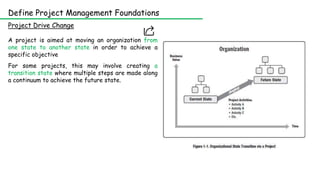
Project Drive Change
A project is aimed at moving an organization from
one state to another state in order to achieve a
specific objective
For some projects, this may involve creating a
transition state where multiple steps are made along
a continuum to achieve the future state.
Define Project Management Foundations
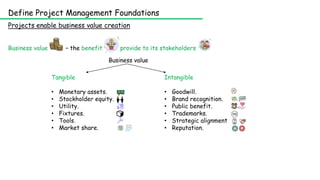
Projects enable business value creation
Business value – the benefit provide to its stakeholders
Business value
Tangible
• Monetary assets.
• Stockholder equity.
• Utility.
• Fixtures.
• Tools.
• Market share.
Intangible
• Goodwill.
• Brand recognition.
• Public benefit.
• Trademarks.
• Strategic alignment
• Reputation.
Define Project Management Foundations
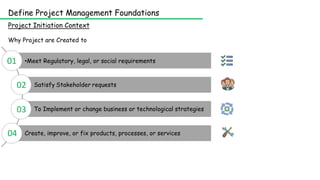
Project Initiation Context
Why Project are Created to
•Meet Regulatory, legal, or social requirements
Satisfy Stakeholder requests
To Implement or change business or technological strategies
Create, improve, or fix products, processes, or services
01
02
03
04
Related Areas of Project Management
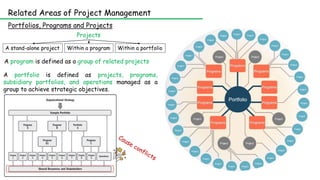
Portfolios, Programs and Projects
Projects
A stand-alone project Within a program Within a portfolio
A program is defined as a group of related projects
A portfolio is defined as projects, programs,
subsidiary portfolios, and operations managed as a
group to achieve strategic objectives.
Project Management Office
Related Areas of Project Management
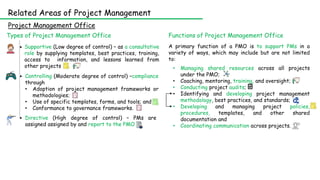
Types of Project Management Office
Supportive (Low degree of control) – as a consultative
role by supplying templates, best practices, training,
access to information, and lessons learned from
other projects
Controlling (Moderate degree of control) –compliance
through
• Adoption of project management frameworks or
methodologies;
• Use of specific templates, forms, and tools; and
• Conformance to governance frameworks.
Directive (High degree of control) – PMs are
assigned assigned by and report to the PMO
Functions of Project Management Office
A primary function of a PMO is to support PMs in a
variety of ways, which may include but are not limited
to:
• Managing shared resources across all projects
under the PMO;
• Coaching, mentoring, training, and oversight;
• Conducting project audits;
• Identifying and developing project management
methodology, best practices, and standards;
• Developing and managing project policies,
procedures, templates, and other shared
documentation and
• Coordinating communication across projects.
Introducing the Project
Management Components
Toe Myint Naing
Curtin University Student
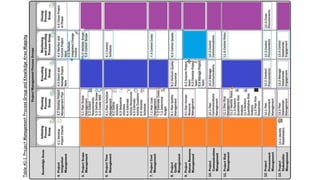
Table
A1-1.
Project
Management
Process
Group
and
Knowledge
Area
Mapping
Project Management Data And Information
Introducing the Project Management Components
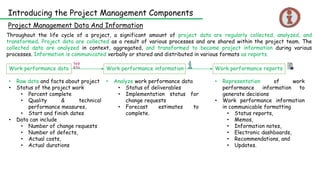
Throughout the life cycle of a project, a significant amount of project data are regularly collected, analyzed, and
transformed. Project data are collected as a result of various processes and are shared within the project team. The
collected data are analyzed in context, aggregated, and transformed to become project information during various
processes. Information is communicated verbally or stored and distributed in various formats as reports.
Work performance data
• Raw data and facts about project
• Status of the project work
• Percent complete
• Quality & technical
performance measures,
• Start and finish dates
• Data can include
• Number of change requests
• Number of defects,
• Actual costs,
• Actual durations
Work performance information
• Analyze work performance data
• Status of deliverables
• Implementation status for
change requests
• Forecast estimates to
complete.
Work performance reports
• Representation of work
performance information to
generate decisions
• Work performance information
in communicable formatting
• Status reports,
• Memos,
• Information notes,
• Electronic dashboards,
• Recommendations, and
• Updates.
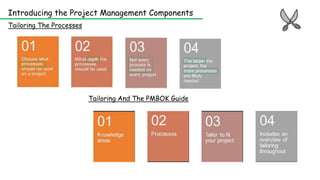
Tailoring The Processes
Introducing the Project Management Components
Tailoring And The PMBOK Guide
Project And Development Life Cycles
Introducing the Project Management Components
P&D
Project Lifecycle
Predictive Project Lifecycle Adaptive Project Lifecycle
Development Lifecycle
Iterative Incremental Hybrid
Adaptive
Predictive
• Waterfall life cycles
• Scope, time, and
cost in the early
phases
• Changes to the
scope are carefully
managed
• Scope in the early
phases but time and
cost estimates are
routinely modified
• Iterations develop
the product through
a series of repeated
cycles
• Scope change
expected
• Increments
successively add to
the functionality of
the product
• Considered complete
only after the final
iteration
• Scope change
expected
• Agile or change-
driven life cycles.
• Agile, iterative, or
incremental
• Scope change
expected
• A combination
of a predictive
and an
adaptive life
cycle
Introducing the Project Management Components
The phases in a life cycle can be described by a variety of attributes.
• Name (e.g., Phase A, Phase 1, proposal phase),
• Number (e.g., three phases in the project),
• Duration (e.g., 1 week, 1 month, 1 quarter),
• Resource requirements (e.g., people, buildings, equipment),
• Entrance criteria for a project to move into that phase (e.g., specified approvals documented), and
• Exit criteria for a project to complete a phase (e.g., documented approvals).
Project Phase
Phase Gate
A phase gate, is held at the end of a phase.
The project’s performance and progress are
compared to project and business documents
including but not limited to:
• Project business case,
• Project charter,
• Project management plan and
• Benefits management plan.
A decision (e.g., go/no-go decision) is made as a result
of this comparison to:
• Continue to the next phase,
• Continue to the next phase with modification,
• End the project,
• Remain in the phase, or
• Repeat the phase or elements of it.
Project Management Business Documents
Introducing the Project Management Components
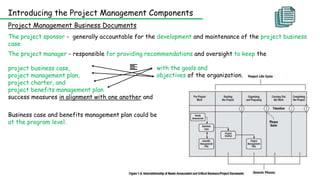
The project sponsor - generally accountable for the development and maintenance of the project business
case
The project manager - responsible for providing recommendations and oversight to keep the
project business case,
project management plan,
project charter, and
project benefits management plan
success measures in alignment with one another and
with the goals and
objectives of the organization.
Business case and benefits management plan could be
at the program level.
Introducing the Project Management Components
Project Business Case
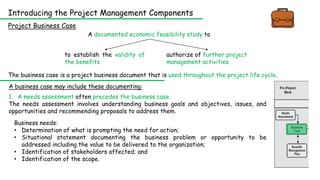
A documented economic feasibility study to
to establish the validity of
the benefits
authorize of further project
management activities.
The business case is a project business document that is used throughout the project life cycle.
Business needs:
• Determination of what is prompting the need for action;
• Situational statement documenting the business problem or opportunity to be
addressed including the value to be delivered to the organization;
• Identification of stakeholders affected; and
• Identification of the scope.
1. A needs assessment often precedes the business case.
The needs assessment involves understanding business goals and objectives, issues, and
opportunities and recommending proposals to address them.
A business case may include these documenting:
Introducing the Project Management Components
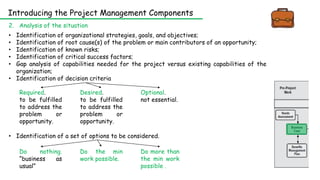
2. Analysis of the situation
• Identification of organizational strategies, goals, and objectives;
• Identification of root cause(s) of the problem or main contributors of an opportunity;
• Identification of known risks;
• Identification of critical success factors;
• Gap analysis of capabilities needed for the project versus existing capabilities of the
organization;
• Identification of decision criteria
• Identification of a set of options to be considered.
Required.
to be fulfilled
to address the
problem or
opportunity.
Optional.
not essential.
Desired.
to be fulfilled
to address the
problem or
opportunity.
Do nothing.
“business as
usual”
Do more than
the min work
possible .
Do the min
work possible.
Project Environments
Toe Myint Naing
Curtin University Student
Project Environments
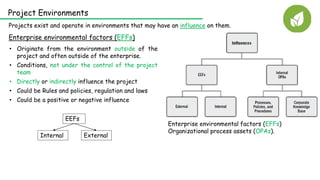
Projects exist and operate in environments that may have an influence on them.
Enterprise environmental factors (EFFs)
• Originate from the environment outside of the
project and often outside of the enterprise.
• Conditions, not under the control of the project
team
• Directly or indirectly influence the project
• Could be Rules and policies, regulation and laws
• Could be a positive or negative influence
EEFs
External
Internal
Enterprise environmental factors (EFFs)
Organizational process assets (OPAs).
Project Environments
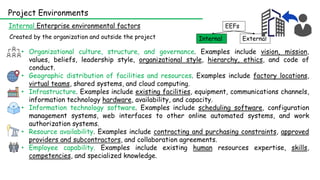
Internal Enterprise environmental factors EEFs
External
Internal
Created by the organization and outside the project
• Organizational culture, structure, and governance. Examples include vision, mission,
values, beliefs, leadership style, organizational style, hierarchy, ethics, and code of
conduct.
• Geographic distribution of facilities and resources. Examples include factory locations,
virtual teams, shared systems, and cloud computing.
• Infrastructure. Examples include existing facilities, equipment, communications channels,
information technology hardware, availability, and capacity.
• Information technology software. Examples include scheduling software, configuration
management systems, web interfaces to other online automated systems, and work
authorization systems.
• Resource availability. Examples include contracting and purchasing constraints, approved
providers and subcontractors, and collaboration agreements.
• Employee capability. Examples include existing human resources expertise, skills,
competencies, and specialized knowledge.
Project Environments
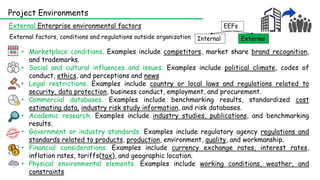
External Enterprise environmental factors EEFs
External
Internal
External factors, conditions and regulations outside organization
• Marketplace conditions. Examples include competitors, market share brand recognition,
and trademarks.
• Social and cultural influences and issues. Examples include political climate, codes of
conduct, ethics, and perceptions and news
• Legal restrictions. Examples include country or local laws and regulations related to
security, data protection, business conduct, employment, and procurement.
• Commercial databases. Examples include benchmarking results, standardized cost
estimating data, industry risk study information, and risk databases.
• Academic research. Examples include industry studies, publications, and benchmarking
results.
• Government or industry standards. Examples include regulatory agency regulations and
standards related to products, production, environment, quality, and workmanship.
• Financial considerations. Examples include currency exchange rates, interest rates,
inflation rates, tariffs(tax), and geographic location.
• Physical environmental elements. Examples include working conditions, weather, and
constraints
Project Environments
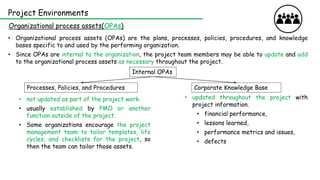
Organizational process assets(OPAs)
• Organizational process assets (OPAs) are the plans, processes, policies, procedures, and knowledge
bases specific to and used by the performing organization.
• Since OPAs are internal to the organization, the project team members may be able to update and add
to the organizational process assets as necessary throughout the project.
Internal OPAs
Corporate Knowledge Base
Processes, Policies, and Procedures
• updated throughout the project with
project information.
• financial performance,
• lessons learned,
• performance metrics and issues,
• defects
• not updated as part of the project work.
• usually established by PMO or another
function outside of the project.
• Some organizations encourage the project
management team to tailor templates, life
cycles, and checklists for the project, so
then the team can tailor those assets.
Internal OPAs
Corporate Knowledge
Base
Processes, Policies,
and Procedures
Processes, Policies, and Procedures
Project Environments
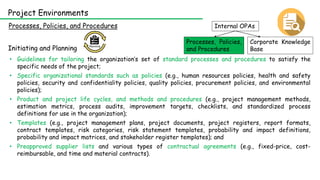
Initiating and Planning
• Guidelines for tailoring the organization’s set of standard processes and procedures to satisfy the
specific needs of the project;
• Specific organizational standards such as policies (e.g., human resources policies, health and safety
policies, security and confidentiality policies, quality policies, procurement policies, and environmental
policies);
• Product and project life cycles, and methods and procedures (e.g., project management methods,
estimation metrics, process audits, improvement targets, checklists, and standardized process
definitions for use in the organization);
• Templates (e.g., project management plans, project documents, project registers, report formats,
contract templates, risk categories, risk statement templates, probability and impact definitions,
probability and impact matrices, and stakeholder register templates); and
• Preapproved supplier lists and various types of contractual agreements (e.g., fixed-price, cost-
reimbursable, and time and material contracts).
Internal OPAs
Corporate Knowledge
Base
Processes, Policies,
and Procedures
Processes, Policies, and Procedures
Project Environments
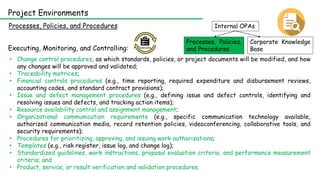
Executing, Monitoring, and Controlling:
• Change control procedures, as which standards, policies, or project documents will be modified, and how
any changes will be approved and validated;
• Traceability matrices;
• Financial controls procedures (e.g., time reporting, required expenditure and disbursement reviews,
accounting codes, and standard contract provisions);
• Issue and defect management procedures (e.g., defining issue and defect controls, identifying and
resolving issues and defects, and tracking action items);
• Resource availability control and assignment management;
• Organizational communication requirements (e.g., specific communication technology available,
authorized communication media, record retention policies, videoconferencing, collaborative tools, and
security requirements);
• Procedures for prioritizing, approving, and issuing work authorizations;
• Templates (e.g., risk register, issue log, and change log);
• Standardized guidelines, work instructions, proposal evaluation criteria, and performance measurement
criteria; and
• Product, service, or result verification and validation procedures.
Internal OPAs
Corporate Knowledge
Base
Processes, Policies,
and Procedures
Processes, Policies, and Procedures
Project Environments
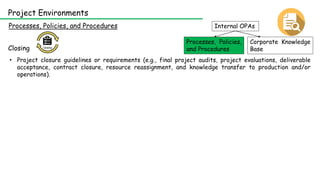
Closing
• Project closure guidelines or requirements (e.g., final project audits, project evaluations, deliverable
acceptance, contract closure, resource reassignment, and knowledge transfer to production and/or
operations).
Internal OPAs
Corporate Knowledge
Base
Processes, Policies,
and Procedures
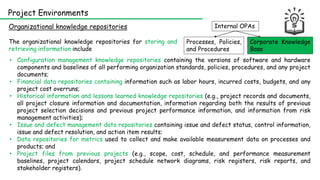
Organizational knowledge repositories
Project Environments
• Configuration management knowledge repositories containing the versions of software and hardware
components and baselines of all performing organization standards, policies, procedures, and any project
documents;
• Financial data repositories containing information such as labor hours, incurred costs, budgets, and any
project cost overruns;
• Historical information and lessons learned knowledge repositories (e.g., project records and documents,
all project closure information and documentation, information regarding both the results of previous
project selection decisions and previous project performance information, and information from risk
management activities);
• Issue and defect management data repositories containing issue and defect status, control information,
issue and defect resolution, and action item results;
• Data repositories for metrics used to collect and make available measurement data on processes and
products; and
• Project files from previous projects (e.g., scope, cost, schedule, and performance measurement
baselines, project calendars, project schedule network diagrams, risk registers, risk reports, and
stakeholder registers).
The organizational knowledge repositories for storing and
retrieving information include