Citations in the Age of AI_ Are We Losing Our Academic Integrity.
1.
ARTIFICIAL INTELLIGENCE (AI)
ARTIFICIALINTELLIGENCE (AI)
ARTIFICIAL INTELLIGENCE (AI)
ARTIFICIAL INTELLIGENCE (AI)
Citations in the Age of
AI: Are We Losing Our
Academic Integrity?
Presented by : Riya Bhatt
Department of English
2.
ARTIFICIAL INTELLIGENCE (AI)
PersonalInformation
Name :- Riya Mehulbhai Bhatt
Enrollment No. :- 5108230005
Roll No. :- 24
Semester :- 4
Paper No. :- 209
Paper Code :- 22416
Paper Name :-Research Methodology
Topic Name :-Citations in the Age of AI: Are We Losing Our
Academic Integrity?
Email ID :- riyabhatt6900@gmail.com
3.
ARTIFICIAL INTELLIGENCE (AI)
Introduction
Inthe age of artificial intelligence, the landscape of academic research
and writing is undergoing a profound transformation. AI tools like
ChatGPT, Bard, and Copilot are increasingly being used to generate
content, summarize research, and even suggest citations. While these
advancements offer convenience, they also pose significant ethical
challenges, particularly in maintaining academic integrity. The risk of
fabricated references, over-reliance on AI-generated information, and
unintentional plagiarism raises critical questions about the future of
citations in scholarly work. This presentation explores the impact of AI on
academic integrity, the challenges it presents, and the best practices for
ensuring ethical and responsible citation in the digital era.
4.
ARTIFICIAL INTELLIGENCE (AI)
ResearchQuestion & Hypothesis
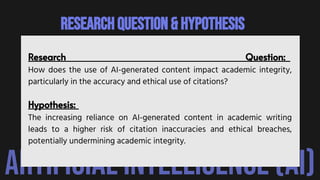
Research Question:
How does the use of AI-generated content impact academic integrity,
particularly in the accuracy and ethical use of citations?
Hypothesis:
The increasing reliance on AI-generated content in academic writing
leads to a higher risk of citation inaccuracies and ethical breaches,
potentially undermining academic integrity.
5.
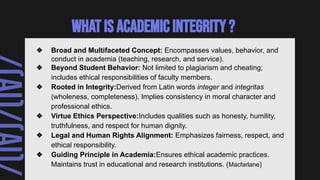
❖ Broad andMultifaceted Concept: Encompasses values, behavior, and
conduct in academia (teaching, research, and service).
❖ Beyond Student Behavior: Not limited to plagiarism and cheating;
includes ethical responsibilities of faculty members.
❖ Rooted in Integrity:Derived from Latin words integer and integritas
(wholeness, completeness). Implies consistency in moral character and
professional ethics.
❖ Virtue Ethics Perspective:Includes qualities such as honesty, humility,
truthfulness, and respect for human dignity.
❖ Legal and Human Rights Alignment: Emphasizes fairness, respect, and
ethical responsibility.
❖ Guiding Principle in Academia:Ensures ethical academic practices.
Maintains trust in educational and research institutions. (Macfarlane)
What Is Academic Integrity ?
6.
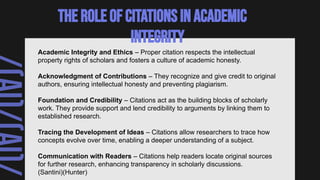
The Role ofCitations in Academic
Integrity
Academic Integrity and Ethics – Proper citation respects the intellectual
property rights of scholars and fosters a culture of academic honesty.
Acknowledgment of Contributions – They recognize and give credit to original
authors, ensuring intellectual honesty and preventing plagiarism.
Foundation and Credibility – Citations act as the building blocks of scholarly
work. They provide support and lend credibility to arguments by linking them to
established research.
Tracing the Development of Ideas – Citations allow researchers to trace how
concepts evolve over time, enabling a deeper understanding of a subject.
Communication with Readers – Citations help readers locate original sources
for further research, enhancing transparency in scholarly discussions.
(Santini)(Hunter)
7.
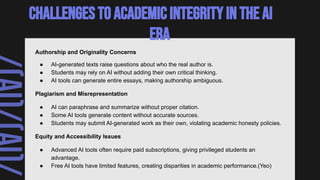
Authorship and OriginalityConcerns
● AI-generated texts raise questions about who the real author is.
● Students may rely on AI without adding their own critical thinking.
● AI tools can generate entire essays, making authorship ambiguous.
Plagiarism and Misrepresentation
● AI can paraphrase and summarize without proper citation.
● Some AI tools generate content without accurate sources.
● Students may submit AI-generated work as their own, violating academic honesty policies.
Equity and Accessibility Issues
● Advanced AI tools often require paid subscriptions, giving privileged students an
advantage.
● Free AI tools have limited features, creating disparities in academic performance.(Yeo)
Challenges to Academic Integrity in the AI
Era
8.
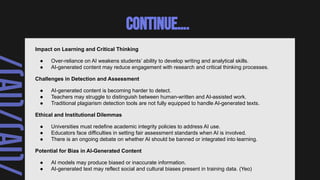
Impact on Learningand Critical Thinking
● Over-reliance on AI weakens students’ ability to develop writing and analytical skills.
● AI-generated content may reduce engagement with research and critical thinking processes.
Challenges in Detection and Assessment
● AI-generated content is becoming harder to detect.
● Teachers may struggle to distinguish between human-written and AI-assisted work.
● Traditional plagiarism detection tools are not fully equipped to handle AI-generated texts.
Ethical and Institutional Dilemmas
● Universities must redefine academic integrity policies to address AI use.
● Educators face difficulties in setting fair assessment standards when AI is involved.
● There is an ongoing debate on whether AI should be banned or integrated into learning.
Potential for Bias in AI-Generated Content
● AI models may produce biased or inaccurate information.
● AI-generated text may reflect social and cultural biases present in training data. (Yeo)
Continue….
9.
1. AI-Assisted Plagiarism
●Students may use AI tools like GPT-based generators, Wordtune, and Quillbot to
paraphrase, summarize, or generate entire essays without proper attribution.
● AI writing assistants rephrase existing content, making plagiarism detection more
difficult.
● Some tools provide auto-citation features, but these references are sometimes
inaccurate or non-existent.
2. Challenges in Plagiarism Detection
● Traditional plagiarism checker like Turnitin may not detect AI-generated content.
● AI-written essays often pass plagiarism tests but lack originality and critical thinking.
● Institutions must develop new AI-detection strategies to maintain academic
honesty. (Yeo)
AI & Plagiarism – The New Academic Black
Market?
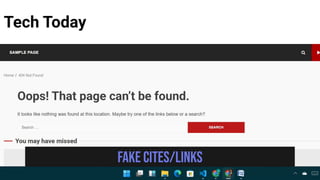
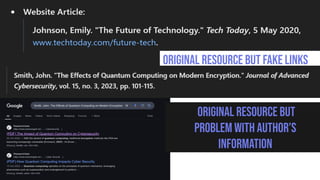
Original resource butFake links
Original resource but
problem with Author’s
information
12.
1. Ethical andAcademic Integrity Concerns
● The rise of "ghostwriting by AI" challenges assessment fairness.
● Over-reliance on AI undermines student learning, critical thinking, and creativity.
● Ethical dilemmas arise when students do not disclose AI assistance in academic
work.
2. Possible Solutions to AI-Related Plagiarism
● Transparent AI usage policies: Universities should require students to disclose AI
assistance.
● Improving AI literacy: Teach students ethical AI usage and citation practices.
● AI-aware assessment models: Use process-based writing assessments to
evaluate students' independent work.
● Advanced detection tools: Invest in AI-detection software that differentiates
human and AI-generated writing. (Yeo)
How to Maintain Academic Integrity ?
13.
As artificial intelligencecontinues to reshape academic research and
writing, it is crucial to strike a balance between leveraging AI tools
and upholding academic integrity. While AI offers efficiency and
accessibility, its potential risks—such as fabricated citations,
plagiarism, and diminished critical thinking—must be addressed
through ethical guidelines, transparency, and proper education on
responsible AI usage. Maintaining academic integrity in the digital
age requires a collaborative effort from students, educators, and
institutions to ensure that technology enhances scholarship without
compromising ethical standards. The future of citations in academia
will depend on how effectively we integrate AI while preserving the
fundamental values of honesty, originality, and intellectual rigor.
Conclusion
14.
● Understand theRole of Citations in Academic Integrity
● Analyze the Impact of AI on Citation Practices
● Recognize Ethical and Integrity Concerns
● Evaluate the Challenges in AI Detection
● Explore Best Practices for Ethical AI Use
● Reflect on the Future of Academic Integrity
Learning Outcomes
15.
➢ "ChatGPT response."OpenAI, ChatGPT, 12 Mar. 2025.
➢ Hunter, Judy. “The Importance of Citation.” PDF, web.grinnell.edu/Dean/Tutorial/EUS/IC.pdf. Accessed 09 Mar.
2025.
➢ Macfarlane, Bruce. “Academic Integrity: A Review of the Literature.” Taylor & Francis Online: Peer-Reviewed
Journals, 2 Aug. 2012, www.tandfonline.com/doi/full/10.1080/03075079.2019.1628201. Accessed 10 Mar. 2025.
➢ Sankaran, Neeraja. “6 Reasons Why Citation of Sources Is Important When Writing.” Editing of Scientific Papers,
Translation from Russian to English, Formatting and Illustration of Manuscripts by Scientists for Scientists, 17 Nov.
2017, falconediting.com/en/blog/6-reasons-why-citation-of-sources-is-important-when-writing/. Accessed 09
Mar. 2025.
➢ Santini, Ario. “The Importance of Referencing.” Journal of critical care medicine (Universitatea de Medicina si
Farmacie din Targu-Mures) vol. 4,1 3-4. 9 Feb. 2018, https://pmc.ncbi.nlm.nih.gov/articles/PMC5953266/ .
Accessed 10 Mar. 2025.
➢ The Modern Language Association of America. MLA Handbook for Writers of Research Papers (Seventh Edition). Modern
Language Association of America, 2009.
➢ Yeo, Marie. “Academic Integrity in the Age of Artificial Intelligence (AI) Authoring Apps.” Researchgate ,
Researchgate | Find and Share Research, Mar. 2023,
www.researchgate.net/publication/369561675_Academic_integrity_in_the_age_of_Artificial_Intelligence
_AI_authoring_apps. Accessed 10 Mar. 2025.
References
16.
ARTI
CIAL
INTE
IGEN
CREDITS: This presentationtemplate was created by
Slidesgo, including icons by Flaticon and infographics &
images by Freepik
THANK you
Do you have any questions?
riyabhatt6900@gmail.com