Saltar al contenido principal
External Environment Analysis
and Stakeholder Development
Sergio Pinzon
1
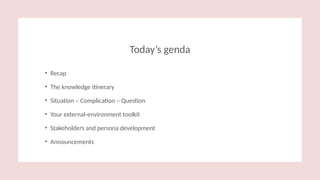
Today’s genda
• Recap
• The knowledge itinerary
• Situation – Complication – Question
• Your external-environment toolkit
• Stakeholders and persona development
• Announcements
Recap
3
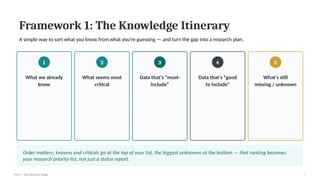
Framework 1: The Knowledge Itinerary
A simple way to sort what you know from what you're guessing — and turn the gap into a research plan.
1
What we already
know
2
What seems most
critical
3
Data that's “must-
include”
4
Data that's “good
to include”
5
What's still
missing / unknown
Order matters: knowns and criticals go at the top of your list, the biggest unknowns at the bottom — that ranking becomes
your research priority list, not just a status report.
Part 1 · The Discovery Stage 7
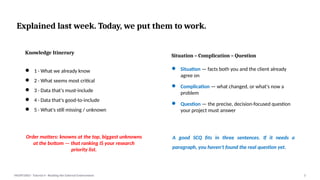
Explained last week. Today, we put them to work.
Knowledge Itinerary
● 1 · What we already know
● 2 · What seems most critical
● 3 · Data that's must-include
● 4 · Data that's good-to-include
● 5 · What's still missing / unknown
Order matters: knowns at the top, biggest unknowns
at the bottom — that ranking IS your research
priority list.
Situation – Complication – Question
● Situation — facts both you and the client already
agree on
● Complication — what changed, or what's now a
problem
● Question — the precise, decision-focused question
your project must answer
A good SCQ fits in three sentences. If it needs a
paragraph, you haven't found the real question yet.
MGMT3003 · Tutorial 4 · Reading the External Environment 3
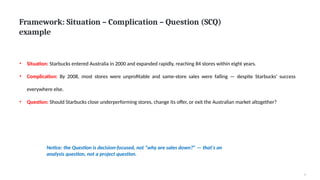
Framework: Situation – Complication – Question (SCQ)
example
Notice: the Question is decision-focused, not “why are sales down?” — that's an
analysis question, not a project question.
5
• Situation: Starbucks entered Australia in 2000 and expanded rapidly, reaching 84 stores within eight years.
• Complication: By 2008, most stores were unprofitable and same-store sales were falling — despite Starbucks' success
everywhere else.
• Question: Should Starbucks close underperforming stores, change its offer, or exit the Australian market altogether?
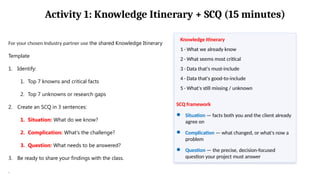
Activity 1: Knowledge Itinerary + SCQ (15 minutes)
For your chosen Industry partner use the shared Knowledge Itinerary
Template
1. Identify:
1. Top 7 knowns and critical facts
2. Top 7 unknowns or research gaps
2. Create an SCQ in 3 sentences:
1. Situation: What do we know?
2. Complication: What's the challenge?
3. Question: What needs to be answered?
3. Be ready to share your findings with the class.
.
SCQ framework
● Situation — facts both you and the client already
agree on
● Complication — what changed, or what's now a
problem
● Question — the precise, decision-focused
question your project must answer
Knowledge Itinerary
1 · What we already know
2 · What seems most critical
3 · Data that's must-include
4 · Data that's good-to-include
5 · What's still missing / unknown
Let’s debrief (10 minutes)
1. Share your
• Top 7 knowns and critical facts and
• Top 7 unknowns or research gaps
2. Create an SCQ in 3 sentences:
• Situation: What do we know?
• Complication: What's the challenge?
• Question: What needs to be answered?
3. Be ready to share your findings with the class.
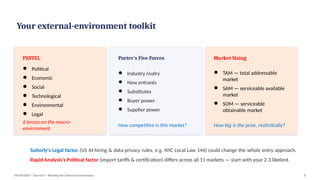
Your external-environment toolkit
PESTEL
● Political
● Economic
● Social
● Technological
● Environmental
● Legal
6 lenses on the macro-
environment
Porter's Five Forces
● Industry rivalry
● New entrants
● Substitutes
● Buyer power
● Supplier power
How competitive is this market?
Market Sizing
● TAM — total addressable
market
● SAM — serviceable available
market
● SOM — serviceable
obtainable market
How big is the prize, realistically?
Suitorly's Legal factor (US AI-hiring & data-privacy rules, e.g. NYC Local Law 144) could change the whole entry approach.
Rapid Analysis's Political factor (import tariffs & certification) differs across all 11 markets — start with your 2-3 likeliest.
MGMT3003 · Tutorial 4 · Reading the External Environment 8
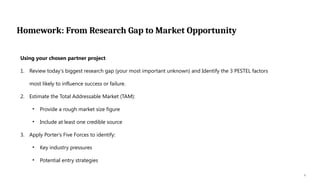
Homework: From Research Gap to Market Opportunity
9
Using your chosen partner project
1. Review today's biggest research gap (your most important unknown) and Identify the 3 PESTEL factors
most likely to influence success or failure.
2. Estimate the Total Addressable Market (TAM):
• Provide a rough market size figure
• Include at least one credible source
3. Apply Porter's Five Forces to identify:
• Key industry pressures
• Potential entry strategies
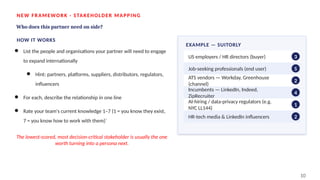
NEW FRAMEWORK · STAKEHOLDER MAPPING
Who does this partner need on side?
HOW IT WORKS
● List the people and organisations your partner will need to engage
to expand internationally
● Hint: partners, platforms, suppliers, distributors, regulators,
influencers
● For each, describe the relationship in one line
● Rate your team's current knowledge 1–7 (1 = you know they exist,
7 = you know how to work with them)`
The lowest-scored, most decision-critical stakeholder is usually the one
worth turning into a persona next.
EXAMPLE — SUITORLY
US employers / HR directors (buyer) 3
Job-seeking professionals (end user) 5
ATS vendors — Workday, Greenhouse
(channel)
2
Incumbents — LinkedIn, Indeed,
ZipRecruiter
4
AI-hiring / data-privacy regulators (e.g.
NYC LL144)
1
HR-tech media & LinkedIn influencers 2
10
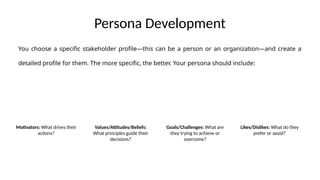
Persona Development
Motivators: What drives their
actions?
Values/Attitudes/Beliefs:
What principles guide their
decisions?
Goals/Challenges: What are
they trying to achieve or
overcome?
Likes/Dislikes: What do they
prefer or avoid?
You choose a specific stakeholder profile—this can be a person or an organization—and create a
detailed profile for them. The more specific, the better. Your persona should include:
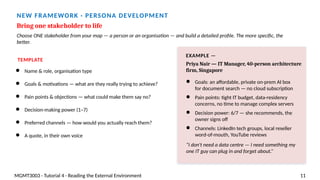
NEW FRAMEWORK · PERSONA DEVELOPMENT
Bring one stakeholder to life
Choose ONE stakeholder from your map — a person or an organisation — and build a detailed profile. The more specific, the
better.
TEMPLATE
● Name & role, organisation type
● Goals & motivations — what are they really trying to achieve?
● Pain points & objections — what could make them say no?
● Decision-making power (1–7)
● Preferred channels — how would you actually reach them?
● A quote, in their own voice
EXAMPLE —
Priya Nair — IT Manager, 40-person architecture
firm, Singapore
● Goals: an affordable, private on-prem AI box
for document search — no cloud subscription
● Pain points: tight IT budget, data-residency
concerns, no time to manage complex servers
● Decision power: 6/7 — she recommends, the
owner signs off
● Channels: LinkedIn tech groups, local reseller
word-of-mouth, YouTube reviews
“I don't need a data centre — I need something my
one IT guy can plug in and forget about.”
MGMT3003 · Tutorial 4 · Reading the External Environment 11
Activity 2: Map your partner's
stakeholders, then bring one
to life (12 minutes)
• For your chosen Industry partner (same one as
Activity 1): list 7 relevant stakeholders,
describe each relationship in one line, and rate
your knowledge 1–7.
• Pick the lowest-scored, most decision-critical
stakeholder from your map and build a full
persona using today's template.
Let’s debrief (10 minutes)
1. Using your industry partner, complete your Knowledge Itinerary + SCQ Pass. One-page
2. For your lead partner, complete:
• Top 3 relevant PESTEL factors
• Full TAM-SAM-SOM analysis and calculations
• TAM (Total Addressable Market)SAM (Serviceable Available Market)
• SOM (Serviceable Obtainable Market)
3. Refine today's 7-stakeholder map and customer persona
4. Come prepared to discuss and defend your assumptions, calculations, and stakeholder choices.
Three things to progress
External Environment Analysis and Stakeholder Development.