Saltar al contenido principal
Frauds in the Indian Retail Industry
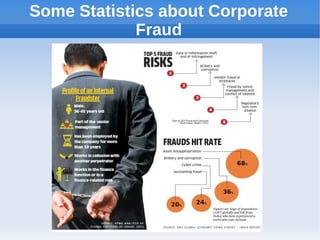
Some Statistics about Corporate
             Fraud
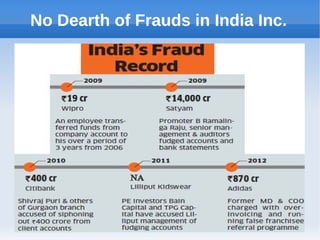
No Dearth of Frauds in India Inc.
Perpetrated by customers

   Shoplifting
   Shoplifting (also known as five-finger discount,
    or shrinkage within the retail industry) is theft of
    goods from a retail establishment.
   It is one of the most common property crimes
    dealt with by police and courts
Perpetrated by Employees

   Shop assistant manipulates the computer program so that a
    portion of the sales proceeds are credited to another
    account.
   This is a difficult activity to detect as the individual amount
    siphoned off from each transaction is extremely low.
   Selling perishable goods/expired goods at discount and
    showing them as damaged goods in the books.
   Excess billing on certain items specially, groceries
   Under-billing to friends of employees.
Perpetrated by Top-Management

   Duping audit firms
       Misreporting inventory values to the Board/Parent body and the
        bankers using cooked books
       Creating a complex trail of stocks in the warehouses/distribution
        centers, stocks in transit, stocks on consignment, under-reported
        shrinkage levels, stocks sold outright, shelf stocks, damaged
        stocks, customer returns, fresh goods, marked-down goods, RTV
        goods (Return to Vendor)
       Diverting damaged goods, excess fixtures and millions of rupees
        worth of scrap to undeclared warehouses owned by friends or
        relatives of an employee close to the CEO
       Auditors struggle to get to the real numbers and generally endorse
        the books they are presented.
Perpetrated by Top-Management                           (contd.)


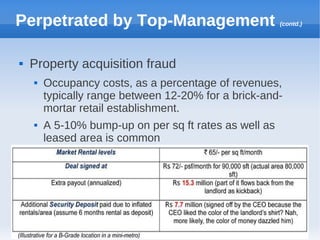
   Property acquisition fraud
       Occupancy costs, as a percentage of revenues,
        typically range between 12-20% for a brick-and-
        mortar retail establishment.
       A 5-10% bump-up on per sq ft rates as well as
        leased area is common
Perpetrated by Top-Management                            (contd.)


   In the name of 'Third Party Vendors'
       Retail entities frequently outsource activities such
        as Housekeeping, Security, Parking Management
        and Manpower Recruitment.
       Contracts signed at inflated commercial terms,
        fudging the man-hours and head-count are
        common forms of fraud.
       Payments are made to manpower agencies for
        supplying fictitious staff or floor-staff who are no
        longer on the rolls of the company (on paper they
        continue to exist).
Perpetrated by Top-Management                                 (contd.)


   Projects & Capital Expenditure Decisions
       A typical retail store needs an investment of
        approximately 2000-4000/- psf (per sq foot),
        excluding cost of real estate.
       Multiple bids are avoided on high-ticket items.
        Favored vendors or suppliers are quietly selected,
        at uncompetitive rates.
       Parent bodies sitting on their derrieres in far off
        Europe or US (or even within India) are
        misinformed.
       Communication links between other key members
        of the Management team & the Board are shut
        down.
Perpetrated by Top-Management                            (contd.)


   Merchandise Procurement
       Nepotism, favoritism, inflated sourcing costs,
        mismatch between physical receipts and the GRN
        quantity (Goods Received Note) at the warehouse,
        part-deliveries against a PO are used.
       The entire situation is very fluid and concepts of
        “transit goods”, “price under re-negotiation”,
        “RGRN” (Reverse GRN) are used to misguide
        auditors.
Indian Examples

   Following entities have been victims of fraud by
    top management, in the form of accounting
    fraud, misguiding the board/parent company,
    etc.
Subhiksha
Subhiksha

   Subhiksha opened its first store in Thiruvanmiyur in Chennai in
    March, 1997 with an investment of about Rs. 50 Lakh.
   It was started and managed by R. Subramaniam, an IIM-A
    alumnus.
   Trouble for Subhiksha began in late 2008 when the company
    ran out of cash, bringing its operations to a standstill.
   Eventually the company closed its nationwide network of 1,600
    supermarket stores, and defaulted on loans, vendor payments
    and staff salaries.
   In March,2010, Azim Premzi said,”Subhiksha was a retail
    equivalent of Satyam.”
   He said, "There was an overstatement of accounts, fake
    inventory, fake bills, fake companies that money was
    transferred to.”
Lilliput Kidswear
Lilliput

   Lilliput Kidswear Limited was founded in 2003
    and is based in New Delhi.
   Bain Capital and TPG, PE investors in Lilliput,
    have accused India’s largest kids’ wear
    company of fudging accounts, in a case filed
    with the Delhi High Court.
   Bain invested $60 million and TPG put up $26
    million for the 45 percent Lilliput stake.
Vishal Retail
Vishal Retail

   Opened in 2001 in New Delhi by Ram Chandra Agarwal
   In 2007 Vishal Retail Ltd, made an initial public offer
    valued at Rs 2,000 crore.
   By 2008, Vishal Retail had 2,50,000 square feet of retail
    space and five factories, rapid expansion plans and huge
    short term loans.
   The economy nosedived in 2008 and sales fell, debts
    started piling up, and real estate maintenance became a
    financial burden.
   In 2011, US-based private equity firm TPG Capital and the
    Shriram Group bought Vishal Retail for Rs 70 crore.
   There are reports that the company had indulged in
    cooking books.
Reebok India
Reebok India

   The Corporate Affairs Ministry has ordered a scrutiny of
    the books of accounts of sportswear maker Reebok's
    Indian arm over complaints of an alleged Rs 870-crore
    fraud.
   Earlier this month, Adidas group, the owners of Reebok
    had announced that it had uncovered commercial
    irregularities to the tune of 125 million euros in its
    subsidiary Reebok India.
   It had also announced plans to close one- third of around
    900 Reebok stores as part of a restructuring strategy.
   Reebok lodged an FIR with the Gurgaon police alleging
    that Prem and Bhagat, top management at the Indian arm,
    had ‘stolen’ products by setting up ‘secret warehouses’,
    fudged accounts and indulged in fictitious sales.
Thank You