How Buy Verified Robinhood Accounts Relate to Privacy and Security
Learn about potential concerns related to Buy Verified Robinhood Accounts, including questionable account sources, verification, privacy, security, and ownership.
How Buy Verified Robinhood Accounts Relate to Privacy and Security
1.
How Buy VerifiedRobinhood Accounts
Relate to Privacy and Security
Introduction
Digital financial services have changed the way people manage investments and financial
information. Instead of depending on physical branches, customers can now use online
platforms to access financial services from computers and smartphones.
➤Telegram: @smmkycmart
➤WhatsApp:+1(236) 314-8705
Visit Website : www.smmkycmart.com
This convenience also introduces new security responsibilities. Personal information, login
credentials, identity documents, and authentication methods must all be protected carefully.
Robinhood customers may encounter identity verification during account opening or when
accessing particular products or services. These procedures can involve providing accurate
personal information and, when legitimately requested, additional documentation.
2.
At the sametime, criminals frequently imitate financial companies. Fake verification emails,
fraudulent websites, text messages, and impersonation attempts can make an unsafe
request look legitimate.
This guide takes a practical approach to safe verification in 2026. It focuses on
understanding legitimate identity checks, recognizing suspicious requests, protecting private
information, and maintaining long-term financial-account security.
1. Verification Starts With Identity
The basic purpose of financial verification is to establish that the person associated with an
account is the legitimate customer.
A verification process may involve information such as:
● Legal name
● Date of birth
● Residential details
● Contact information
● Tax-related information
● Identity documentation
Requirements can differ according to the account, product, customer circumstances, and
applicable rules.
The important principle is simple: use accurate information belonging to the legitimate
account holder.
2. Verification Is Not the Same as Account Ownership
A person may see advertisements for “verified accounts” online and assume that verification
can be transferred from one individual to another.
That is an unsafe assumption.
Financial-account verification is intended to establish a relationship between the customer
and the account. An account created or verified using someone else's identity does not
become legitimately yours simply because you receive the login credentials.
For safe and responsible financial management, customers should create and maintain their
own accounts.
3.
3. What KYCMeans
KYC stands for Know Your Customer.
It describes procedures used in the financial industry to identify customers and support
regulatory compliance.
Depending on circumstances, KYC processes may involve:
● Customer identification
● Identity verification
● Recordkeeping
● Additional information requests
● Risk-based reviews
The existence of KYC does not mean every message containing the word “KYC” is
legitimate.
Scammers often use technical financial terminology to make fraudulent messages appear
credible.
4. The Official-Channel Rule
A useful security principle is the official-channel rule:
When dealing with financial information, start from the official platform rather
than from a message.
For example, if you receive an unexpected email saying your account needs verification, do
not automatically click the email's button.
Instead:
1. Close or ignore the message.
2. Open the official application independently.
3. Visit the official website directly.
4. Check whether the same notification appears there.
5. Use official support if clarification is needed.
This simple habit can prevent many phishing attacks.
5. How Phishing Works
Phishing is designed to exploit trust.
4.
A scammer maycreate a message that looks like it comes from a legitimate financial
company. The message may contain a convincing logo and professional wording.
The real objective may be to collect:
● Username
● Password
● Authentication code
● Identity information
● Financial information
Some phishing pages are visually convincing enough that users may not immediately notice
anything unusual.
That is why verifying the source is more reliable than judging appearance alone.
6. The Psychology of Verification Scams
Many scams follow a similar psychological pattern.
Step One: Create Fear
The scammer claims that something is wrong.
Step Two: Create Urgency
The victim is told to act immediately.
Step Three: Offer a Solution
The scammer provides a link or contact method.
Step Four: Request Information
The victim is asked to enter sensitive credentials.
Understanding this pattern makes suspicious requests easier to recognize.
7. Common Warning Signs
A verification request deserves extra attention if it:
● Arrives unexpectedly
● Demands immediate action
5.
● Contains anunfamiliar link
● Requests a password
● Requests a one-time code
● Requests payment
● Threatens account closure
● Comes from an unknown person
● Claims to bypass normal verification
Any single warning sign may justify independently checking the request.
8. Password Security
A strong password is one of the basic defenses for any financial account.
Good password practices include:
● Use a unique password.
● Avoid predictable information.
● Do not reuse passwords across important services.
● Store credentials securely.
● Change compromised credentials promptly.
A password used on several websites creates unnecessary risk.
9. Multi-Factor Authentication
Multi-factor authentication provides additional protection beyond a password.
When supported, it can help reduce the impact of stolen credentials.
However, MFA is not a reason to share authentication codes.
If someone unexpectedly contacts you and asks for a code you just received, treat the
request as suspicious.
10. Email Security
Email is often connected to financial accounts.
Protect your email account with:
● A strong unique password
6.
● Available multi-factorauthentication
● Updated recovery information
● Security notifications
A compromised email account can potentially create additional risks for other services
connected to it.
11. Identity Documents Require Special Care
Documents used for identity verification can contain highly sensitive information.
Before uploading a document, confirm:
● The platform is legitimate.
● The request is expected.
● The upload process is official.
● The information requested makes sense.
Never send identity documents to an unknown person simply because they claim to be a
verification specialist.
12. Protecting Your Phone Number
Phone numbers can be useful to attackers during impersonation attempts.
Avoid publishing unnecessary contact information publicly.
Be cautious if an unexpected caller claims to be financial support and asks for:
● Passwords
● Authentication codes
● Personal information
● Remote access to your device
When in doubt, end the conversation and contact the company independently.
13. Device Protection
Account security depends partly on the device used to access the account.
Recommended practices include:
7.
● Update youroperating system.
● Keep your browser current.
● Remove unknown applications.
● Review browser extensions.
● Use a screen lock.
● Avoid suspicious downloads.
Security updates should not be postponed unnecessarily.
14. Public Computers and Networks
Financial accounts should preferably be accessed from trusted personal devices.
Shared computers can contain unwanted software or saved information.
Similarly, public networks may provide less control over your connection.
When handling sensitive financial information, convenience should not override security.
15. Privacy Beyond Passwords
Financial privacy involves more than login credentials.
Customers should consider protecting:
● Identity numbers
● Tax information
● Financial statements
● Residential information
● Account details
● Personal correspondence
Avoid sharing sensitive financial information publicly, even if the information appears
harmless in isolation.
Multiple pieces of public information can sometimes be combined to create a more
convincing impersonation.
16. Monitor Your Account
Security should continue after verification.
8.
Regularly review:
● Loginnotifications
● Security alerts
● Personal information
● Account activity
● Transactions
Unexpected changes deserve attention.
Early detection can make it easier to respond to suspicious activity.
17. What If Verification Gets Delayed?
Verification may occasionally take longer than expected.
Possible reasons can include:
● Incomplete information
● Inconsistent information
● Additional review
● Technical problems
● Documentation that needs clarification
Customers should not attempt to bypass a legitimate review by purchasing another person's
account or using inaccurate information.
Instead, follow the platform's official instructions.
18. What If Someone Offers a “Verified” Account?
Treat such offers cautiously.
A third party may claim that an account is:
● Fully verified
● Ready to use
● Identity checked
● Guaranteed
● Risk-free
These claims do not establish legitimate ownership.
Financial accounts should be created through official processes and controlled by the person
whose identity is associated with them.
9.
19. What toDo After a Suspicious Message
If you receive a suspicious verification request:
Do not click.
Do not reply with credentials.
Do not provide authentication codes.
Do not send identity documents.
Instead, independently access the official platform and determine whether any action is
actually required.
If necessary, use official customer-support resources.
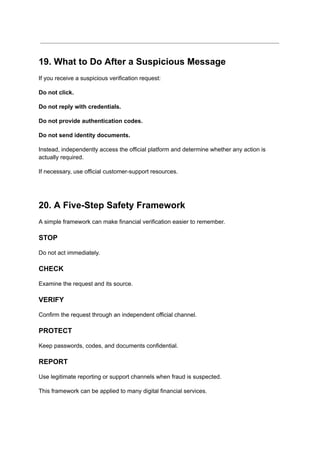
20. A Five-Step Safety Framework
A simple framework can make financial verification easier to remember.
STOP
Do not act immediately.
CHECK
Examine the request and its source.
VERIFY
Confirm the request through an independent official channel.
PROTECT
Keep passwords, codes, and documents confidential.
REPORT
Use legitimate reporting or support channels when fraud is suspected.
This framework can be applied to many digital financial services.
10.
Frequently Asked Questions
Whymight a financial platform request identity information?
Identity checks can support customer identification, fraud prevention, security, and regulatory
requirements.
Should I purchase an already-verified financial account?
No. Using another person's financial account can create ownership, security, and
compliance problems.
What should I do if someone says they are Robinhood support?
Do not provide confidential information based solely on their claim. Independently access the
official support channel.
Are verification codes private?
Yes. Authentication codes should be treated as confidential and should not be shared with
unexpected callers or messages.
Can I trust a verification link sent by text message?
Do not assume that an unexpected link is legitimate. Access the official platform
independently instead.
Conclusion
Safe Robinhood account verification in 2026 requires a combination of identity awareness,
cybersecurity, privacy protection, and good judgment.
The safest approach is to complete verification directly through official channels using your
own accurate information. Avoid shortcuts involving purchased or shared financial accounts,
and never provide passwords, authentication codes, or sensitive identity information to
unknown individuals.
Most importantly, learn to recognize the warning signs of phishing. Unexpected urgency,
suspicious links, requests for confidential credentials, and promises of instant verification
should all encourage you to stop and investigate.
Digital financial security is an ongoing process. By protecting your identity, securing your
devices, monitoring account activity, and independently verifying unusual requests, you can
create stronger security habits and use online financial services more responsibly throughout
2026.