How to Make AI-Assisted Writing More Authentic: A Practical Guide to Originality and Responsible Use By Adeel Ali
Learn strategies for authentic AI-assisted writing, including maintaining voice, adding specificity, fact-checking, and responsible AI use to ensure credibility and originality in your work.
How to Make AI-Assisted Writing More Authentic: A Practical Guide to Originality and Responsible Use By Adeel Ali
1.
How to MakeAI-Assisted Writing More Authentic
A practical guide to originality, voice, credibility, and responsible AI use
SlideShare-ready presentation • 2026
2.
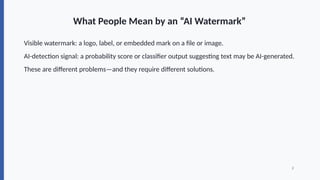
What People Meanby an “AI Watermark”
Visible watermark: a logo, label, or embedded mark on a file or image.
AI-detection signal: a probability score or classifier output suggesting text may be AI-generated.
These are different problems—and they require different solutions.
2
3.
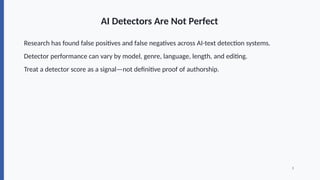
AI Detectors AreNot Perfect
Research has found false positives and false negatives across AI-text detection systems.
Detector performance can vary by model, genre, language, length, and editing.
Treat a detector score as a signal—not definitive proof of authorship.
3
4.
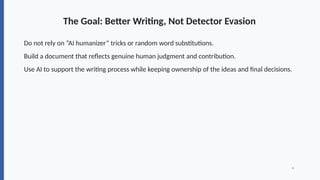
The Goal: BetterWriting, Not Detector Evasion
Do not rely on “AI humanizer” tricks or random word substitutions.
Build a document that reflects genuine human judgment and contribution.
Use AI to support the writing process while keeping ownership of the ideas and final decisions.
4
5.
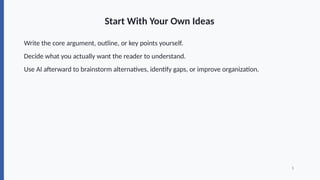
Start With YourOwn Ideas
Write the core argument, outline, or key points yourself.
Decide what you actually want the reader to understand.
Use AI afterward to brainstorm alternatives, identify gaps, or improve organization.
5
6.
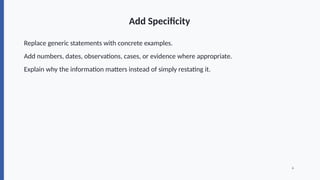
Add Specificity
Replace genericstatements with concrete examples.
Add numbers, dates, observations, cases, or evidence where appropriate.
Explain why the information matters instead of simply restating it.
6
7.
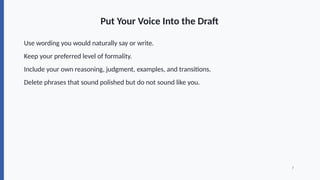
Put Your VoiceInto the Draft
Use wording you would naturally say or write.
Keep your preferred level of formality.
Include your own reasoning, judgment, examples, and transitions.
Delete phrases that sound polished but do not sound like you.
7
8.
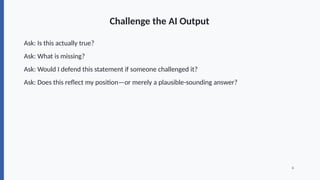
Challenge the AIOutput
Ask: Is this actually true?
Ask: What is missing?
Ask: Would I defend this statement if someone challenged it?
Ask: Does this reflect my position—or merely a plausible-sounding answer?
8
9.
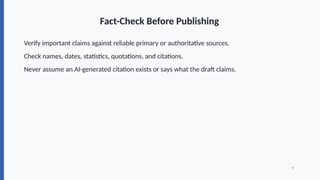
Fact-Check Before Publishing
Verifyimportant claims against reliable primary or authoritative sources.
Check names, dates, statistics, quotations, and citations.
Never assume an AI-generated citation exists or says what the draft claims.
9
10.
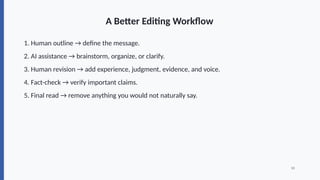
A Better EditingWorkflow
1. Human outline → define the message.
2. AI assistance → brainstorm, organize, or clarify.
3. Human revision → add experience, judgment, evidence, and voice.
4. Fact-check → verify important claims.
5. Final read → remove anything you would not naturally say.
10
11.
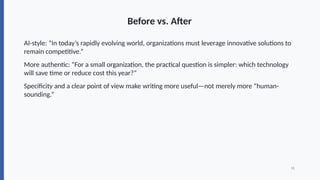
Before vs. After
AI-style:“In today’s rapidly evolving world, organizations must leverage innovative solutions to
remain competitive.”
More authentic: “For a small organization, the practical question is simpler: which technology
will save time or reduce cost this year?”
Specificity and a clear point of view make writing more useful—not merely more “human-
sounding.”
11
12.
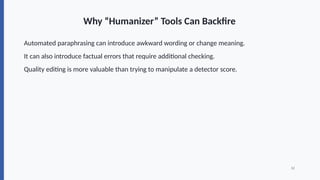
Why “Humanizer” ToolsCan Backfire
Automated paraphrasing can introduce awkward wording or change meaning.
It can also introduce factual errors that require additional checking.
Quality editing is more valuable than trying to manipulate a detector score.
12
13.
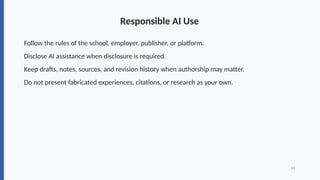
Responsible AI Use
Followthe rules of the school, employer, publisher, or platform.
Disclose AI assistance when disclosure is required.
Keep drafts, notes, sources, and revision history when authorship may matter.
Do not present fabricated experiences, citations, or research as your own.
13
14.
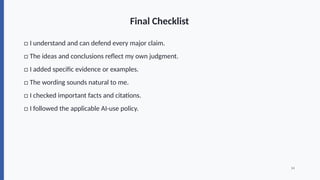
Final Checklist
□ Iunderstand and can defend every major claim.
□ The ideas and conclusions reflect my own judgment.
□ I added specific evidence or examples.
□ The wording sounds natural to me.
□ I checked important facts and citations.
□ I followed the applicable AI-use policy.
14
15.
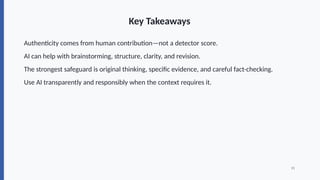
Key Takeaways
Authenticity comesfrom human contribution—not a detector score.
AI can help with brainstorming, structure, clarity, and revision.
The strongest safeguard is original thinking, specific evidence, and careful fact-checking.
Use AI transparently and responsibly when the context requires it.
15
16.
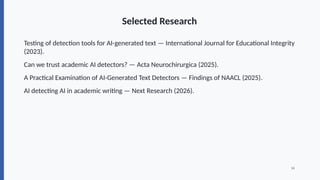
Selected Research
Testing ofdetection tools for AI-generated text — International Journal for Educational Integrity
(2023).
Can we trust academic AI detectors? — Acta Neurochirurgica (2025).
A Practical Examination of AI-Generated Text Detectors — Findings of NAACL (2025).
AI detecting AI in academic writing — Next Research (2026).
16