Saltar al contenido principal
MANUAL FOR ADAPTING TOURISM DESTINATIONS TO
CLIMATE CHANGE
2
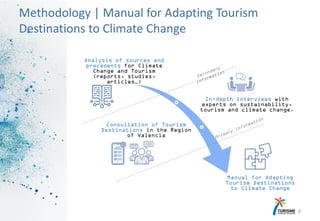
Methodology | Manual for Adapting Tourism
Destinations to Climate Change
Analysis of sources and
precedents for Climate
Change and Tourism
(reports, studies,
articles…)
In-depth interviews with
experts on sustainability,
tourism and climate change.
Consultation of Tourism
Destinations in the Region
of Valencia
Manual for Adapting
Tourism Destinations
to Climate Change
3
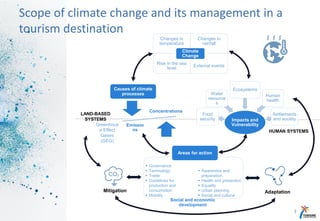
Scope of climate change and its management in a
tourism destination
Changes in
temperature
Changes in
rainfall
Rise in the sea
level
External events
Climate
Change
Causes of climate
processes
Concentrations
Emissio
ns
Greenhous
e Effect
Gases
(GEG)
LAND-BASED
SYSTEMS Impacts and
Vulnerability
Food
security
Water
resource
s
Ecosystems
Human
health
Settlements
and society
 Governance
 Technology
 Trade
 Guidelines for
production and
consumption
 Mobility
 Awareness and
preparation
 Health and prevention
 Equality
 Urban planning
 Social and cultural
customs
Social and economic
development
Areas for action
Mitigation Adaptation
HUMAN SYSTEMS
CLIMATE CHANGE AND THE DESTINATIONS OF
THE DTI-CV NETWORK STARTING DIAGNOSIS
4
5
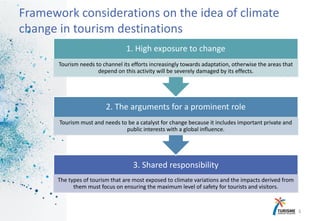
Framework considerations on the idea of climate
change in tourism destinations
3. Shared responsibility
The types of tourism that are most exposed to climate variations and the impacts derived from
them must focus on ensuring the maximum level of safety for tourists and visitors.
2. The arguments for a prominent role
Tourism must and needs to be a catalyst for change because it includes important private and
public interests with a global influence.
1. High exposure to change
Tourism needs to channel its efforts increasingly towards adaptation, otherwise the areas that
depend on this activity will be severely damaged by its effects.
6
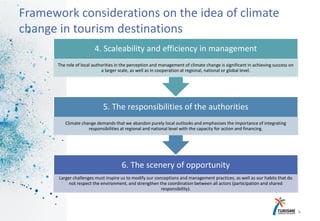
Framework considerations on the idea of climate
change in tourism destinations
6. The scenery of opportunity
Larger challenges must inspire us to modify our conceptions and management practices, as well as our habits that do
not respect the environment, and strengthen the coordination between all actors (participation and shared
responsibility).
5. The responsibilities of the authorities
Climate change demands that we abandon purely local outlooks and emphasises the importance of integrating
responsibilities at regional and national level with the capacity for action and financing.
4. Scaleability and efficiency in management
The role of local authorities in the perception and management of climate change is significant in achieving success on
a larger scale, as well as in cooperation at regional, national or global level.
7
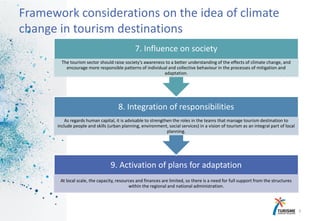
Framework considerations on the idea of climate
change in tourism destinations
9. Activation of plans for adaptation
At local scale, the capacity, resources and finances are limited, so there is a need for full support from the structures
within the regional and national administration.
8. Integration of responsibilities
As regards human capital, it is advisable to strengthen the roles in the teams that manage tourism destination to
include people and skills (urban planning, environment, social services) in a vision of tourism as an integral part of local
planning.
7. Influence on society
The tourism sector should raise society’s awareness to a better understanding of the effects of climate change, and
encourage more responsible patterns of individual and collective behaviour in the processes of mitigation and
adaptation.
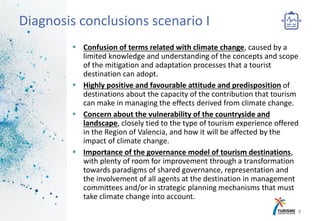
 Confusion of terms related with climate change, caused by a
limited knowledge and understanding of the concepts and scope
of the mitigation and adaptation processes that a tourist
destination can adopt.
 Highly positive and favourable attitude and predisposition of
destinations about the capacity of the contribution that tourism
can make in managing the effects derived from climate change.
 Concern about the vulnerability of the countryside and
landscape, closely tied to the type of tourism experience offered
in the Region of Valencia, and how it will be affected by the
impact of climate change.
 Importance of the governance model of tourism destinations,
with plenty of room for improvement through a transformation
towards paradigms of shared governance, representation and
the involvement of all agents at the destination in management
committees and/or in strategic planning mechanisms that must
take climate change into account.
8
Diagnosis conclusions scenario I
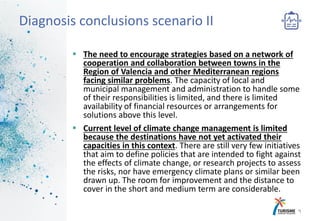
 The need to encourage strategies based on a network of
cooperation and collaboration between towns in the
Region of Valencia and other Mediterranean regions
facing similar problems. The capacity of local and
municipal management and administration to handle some
of their responsibilities is limited, and there is limited
availability of financial resources or arrangements for
solutions above this level.
 Current level of climate change management is limited
because the destinations have not yet activated their
capacities in this context. There are still very few initiatives
that aim to define policies that are intended to fight against
the effects of climate change, or research projects to assess
the risks, nor have emergency climate plans or similar been
drawn up. The room for improvement and the distance to
cover in the short and medium term are considerable.
9
Diagnosis conclusions scenario II
THE MANUAL: AXES AND RECOMMENDATIONS
FOR ADAPTING TOURISM DESTINATIONS TO
CLIMATE CHANGE
10
 The model is intended to
enable the tourist
destinations to understand
the order in the process of
implementation , and to
provide a resource offering
help and gradual
improvements in the
organization of the tourism
areas of the Region of
Valencia with the aim of
adopting mechanisms,
measures and best practices
that help to mitigate and
adapt to the effects of
climate change.
11
The manual for adapting tourism destinations to
climate change
Link to the complete study: https://bit.ly/3eJ89pG
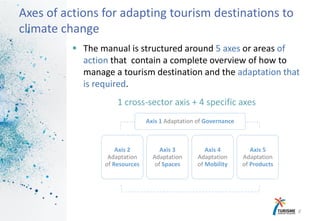
 The manual is structured around 5 axes or areas of
action that contain a complete overview of how to
manage a tourism destination and the adaptation that
is required.
1 cross-sector axis + 4 specific axes
12
Axes of actions for adapting tourism destinations to
climate change
Axis 1 Adaptation of Governance
Axis 2
Adaptation
of Resources
Axis 3
Adaptation
of Spaces
Axis 4
Adaptation
of Mobility
Axis 5
Adaptation
of Products
13
Axes for action and recommendations
Axis 1 Adaptation of governance
• Recommendations for strategic management, awareness
and preparation of the agents at the destination,
measures and communication with other aspects.
Axis 2 Adaptation of resources
• Recommendations that aim to align consumption habits
and the handling of natural and energy resources in the
destination with best practices that consider efficiency
and optimization, to help towards mitigation and to
support adaptation.
14
Axes for action and recommendations
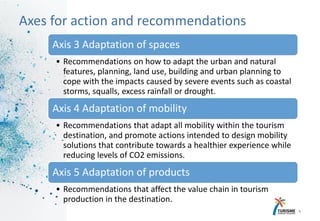
Axis 3 Adaptation of spaces
• Recommendations on how to adapt the urban and natural
features, planning, land use, building and urban planning to
cope with the impacts caused by severe events such as coastal
storms, squalls, excess rainfall or drought.
Axis 4 Adaptation of mobility
• Recommendations that adapt all mobility within the tourism
destination, and promote actions intended to design mobility
solutions that contribute towards a healthier experience while
reducing levels of CO2 emissions.
Axis 5 Adaptation of products
• Recommendations that affect the value chain in tourism
production in the destination.
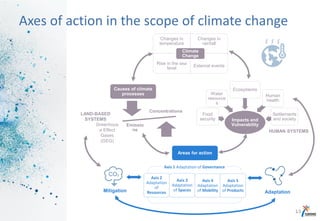
Axes of action in the scope of climate change
15
Changes in
temperature
Changes in
rainfall
Rise in the sea
level
External events
Climate
Change
Causes of climate
processes
Concentrations
Emissio
ns
Greenhous
e Effect
Gases
(GEG)
LAND-BASED
SYSTEMS Impacts and
Vulnerability
Food
security
Water
resource
s
Ecosystems
Human
health
Settlements
and society
Areas for action
Mitigation Adaptation
HUMAN SYSTEMS
Axis 1 Adaptation of Governance
Axis 2
Adaptation
of
Resources
Axis 3
Adaptation
of Spaces
Axis 4
Adaptation
of Mobility
Axis 5
Adaptation
of Products
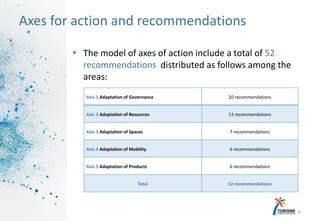
 The model of axes of action include a total of 52
recommendations distributed as follows among the
areas:
16
Axes for action and recommendations
Axis 1 Adaptation of Governance 20 recommendations
Axis 2 Adaptation of Resources 13 recommendations
Axis 3 Adaptation of Spaces 7 recommendations
Axis 4 Adaptation of Mobility 6 recommendations
Axis 5 Adaptation of Products 6 recommendations
Total 52 recommendations
17
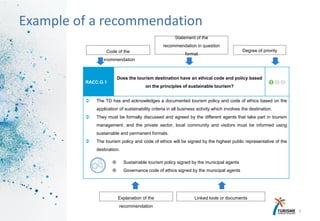
Example of a recommendation
RACC.G.1
Does the tourism destination have an ethical code and policy based
on the principles of sustainable tourism?

 The TD has and acknowledges a documented tourism policy and code of ethics based on the
application of sustainability criteria in all business activity which involves the destination.
 They must be formally discussed and agreed by the different agents that take part in tourism
management, and the private sector, local community and visitors must be informed using
sustainable and permanent formats.
 The tourism policy and code of ethics will be signed by the highest public representative of the
destination.
 Sustainable tourism policy signed by the municipal agents
 Governance code of ethics signed by the municipal agents
Explanation of the
recommendation
Linked tools or documents
Code of the
recommendation
Statement of the
recommendation in question
format
Degree of priority
18
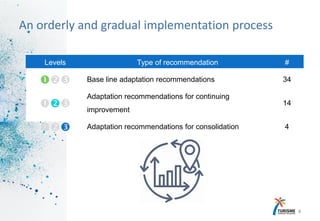
An orderly and gradual implementation process
Levels Type of recommendation #
 Base line adaptation recommendations 34

Adaptation recommendations for continuing
improvement
14
 Adaptation recommendations for consolidation 4
©2020 – Turisme Comunitat Valenciana | Invat·tur
dti_turisme@gva.es
www.invattur.es | www.turisme.gva.es