A Literature Overview:AI,
OER, and Implications for
Scaling Innovation
Rebecca McNulty, Lily Dubach, Sarah Norris, Amanda Major
University of Central Florida
October 8, 2024 | Open Education Conference, Rhode Island
2.
Agenda
● Introduction
● Methods
●Results and Themes
● Future Expectations
● Q&A
Slides and Literature Overview Matrix
https://opened24.sched.com/event/1gu1p/a-literature-o
verview-ai-oer-and-implications-for-scaling-innovation
3.
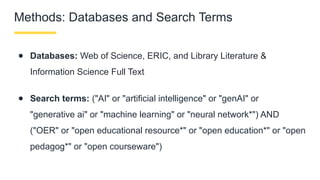
Methods: Databases andSearch Terms
● Databases: Web of Science, ERIC, and Library Literature &
Information Science Full Text
● Search terms: ("AI" or "artificial intelligence" or "genAI" or
"generative ai" or "machine learning" or "neural network*") AND
("OER" or "open educational resource*" or "open education*" or "open
pedagog*" or "open courseware")
4.
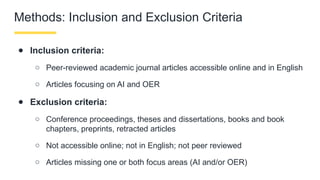
Methods: Inclusion andExclusion Criteria
● Inclusion criteria:
○ Peer-reviewed academic journal articles accessible online and in English
○ Articles focusing on AI and OER
● Exclusion criteria:
○ Conference proceedings, theses and dissertations, books and book
chapters, preprints, retracted articles
○ Not accessible online; not in English; not peer reviewed
○ Articles missing one or both focus areas (AI and/or OER)
5.
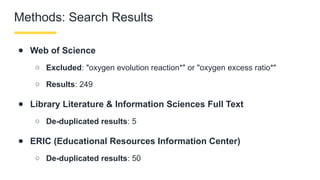
Methods: Search Results
●Web of Science
○ Excluded: "oxygen evolution reaction*" or "oxygen excess ratio*"
○ Results: 249
● Library Literature & Information Sciences Full Text
○ De-duplicated results: 5
● ERIC (Educational Resources Information Center)
○ De-duplicated results: 50
6.
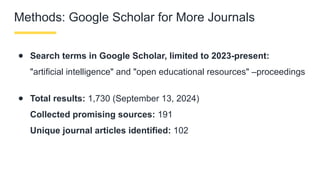
Methods: Google Scholarfor More Journals
● Search terms in Google Scholar, limited to 2023-present:
"artificial intelligence" and "open educational resources" –proceedings
● Total results: 1,730 (September 13, 2024)
Collected promising sources: 191
Unique journal articles identified: 102
7.
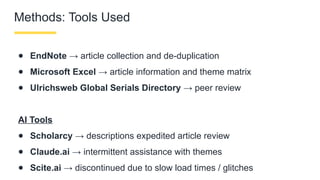
Methods: Tools Used
●EndNote → article collection and de-duplication
● Microsoft Excel → article information and theme matrix
● Ulrichsweb Global Serials Directory → peer review
AI Tools
● Scholarcy → descriptions expedited article review
● Claude.ai → intermittent assistance with themes
● Scite.ai → discontinued due to slow load times / glitches
8.
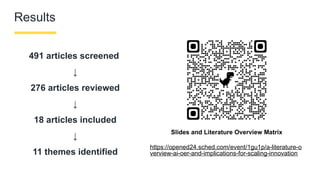
Results
491 articles screened
↓
276articles reviewed
↓
18 articles included
↓
11 themes identified
Slides and Literature Overview Matrix
https://opened24.sched.com/event/1gu1p/a-literature-o
verview-ai-oer-and-implications-for-scaling-innovation
9.
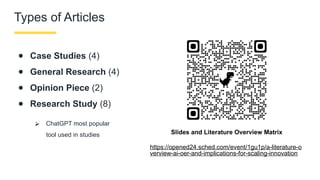
Types of Articles
●Case Studies (4)
● General Research (4)
● Opinion Piece (2)
● Research Study (8)
⮚ ChatGPT most popular
tool used in studies Slides and Literature Overview Matrix
https://opened24.sched.com/event/1gu1p/a-literature-o
verview-ai-oer-and-implications-for-scaling-innovation
10.
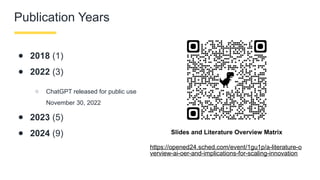
Publication Years
● 2018(1)
● 2022 (3)
○ ChatGPT released for public use
November 30, 2022
● 2023 (5)
● 2024 (9) Slides and Literature Overview Matrix
https://opened24.sched.com/event/1gu1p/a-literature-o
verview-ai-oer-and-implications-for-scaling-innovation
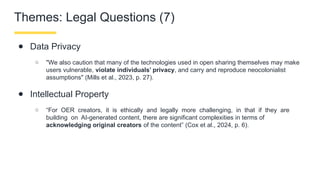
Themes: Legal Questions(7)
● Data Privacy
○ "We also caution that many of the technologies used in open sharing themselves may make
users vulnerable, violate individuals’ privacy, and carry and reproduce neocolonialist
assumptions" (Mills et al., 2023, p. 27).
● Intellectual Property
○ “For OER creators, it is ethically and legally more challenging, in that if they are
building on AI-generated content, there are significant complexities in terms of
acknowledging original creators of the content” (Cox et al., 2024, p. 6).
13.
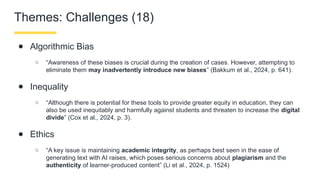
Themes: Challenges (18)
●Algorithmic Bias
○ “Awareness of these biases is crucial during the creation of cases. However, attempting to
eliminate them may inadvertently introduce new biases” (Bakkum et al., 2024, p. 641).
● Inequality
○ “Although there is potential for these tools to provide greater equity in education, they can
also be used inequitably and harmfully against students and threaten to increase the digital
divide” (Cox et al., 2024, p. 3).
● Ethics
○ “A key issue is maintaining academic integrity, as perhaps best seen in the ease of
generating text with AI raises, which poses serious concerns about plagiarism and the
authenticity of learner-produced content” (Li et al., 2024, p. 1524)
14.
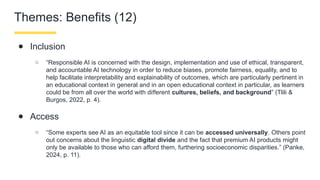
Themes: Benefits (12)
●Inclusion
○ “Responsible AI is concerned with the design, implementation and use of ethical, transparent,
and accountable AI technology in order to reduce biases, promote fairness, equality, and to
help facilitate interpretability and explainability of outcomes, which are particularly pertinent in
an educational context in general and in an open educational context in particular, as learners
could be from all over the world with di erent
ff cultures, beliefs, and background” (Tlili &
Burgos, 2022, p. 4).
● Access
○ “Some experts see AI as an equitable tool since it can be accessed universally. Others point
out concerns about the linguistic digital divide and the fact that premium AI products might
only be available to those who can afford them, furthering socioeconomic disparities.” (Panke,
2024, p. 11).
15.
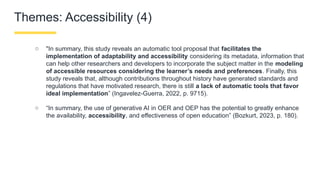
Themes: Accessibility (4)
○"In summary, this study reveals an automatic tool proposal that facilitates the
implementation of adaptability and accessibility considering its metadata, information that
can help other researchers and developers to incorporate the subject matter in the modeling
of accessible resources considering the learner’s needs and preferences. Finally, this
study reveals that, although contributions throughout history have generated standards and
regulations that have motivated research, there is still a lack of automatic tools that favor
ideal implementation” (Ingavelez-Guerra, 2022, p. 9715).
○ “In summary, the use of generative AI in OER and OEP has the potential to greatly enhance
the availability, accessibility, and effectiveness of open education” (Bozkurt, 2023, p. 180).
16.
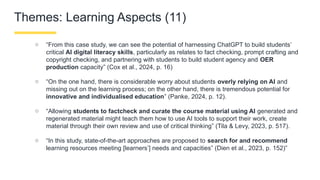
Themes: Learning Aspects(11)
○ “From this case study, we can see the potential of harnessing ChatGPT to build students’
critical AI digital literacy skills, particularly as relates to fact checking, prompt crafting and
copyright checking, and partnering with students to build student agency and OER
production capacity” (Cox et al., 2024, p. 16)
○ “On the one hand, there is considerable worry about students overly relying on AI and
missing out on the learning process; on the other hand, there is tremendous potential for
innovative and individualised education” (Panke, 2024, p. 12).
○ “Allowing students to factcheck and curate the course material using AI generated and
regenerated material might teach them how to use AI tools to support their work, create
material through their own review and use of critical thinking” (Tila & Levy, 2023, p. 517).
○ “In this study, state-of-the-art approaches are proposed to search for and recommend
learning resources meeting [learners’] needs and capacities” (Dien et al., 2023, p. 152)”
17.
Themes: Future Implications(11)
● Scaling/Impact
○ “The true potential of OERs is only starting to show tangibility, with OER collections
accumulating more than 100,000 materials, with these having been curated, translated to
multiple languages using AI, as well as transcribed and annotated using AI technologies”
(Bulathwela et al., 2024, p. 9).
○ “These LLM capabilities, if adequately implemented, could empower educators to tailor
educational resources to specific topics or course requirements and enable faculty to
devote more time to other relevant tasks” (Alfirevic et al., 2024, p. 3)
● United Nations Sustainable Development Goals (UNSDGs)
○ “As the primary goal, this work identifies several key pillars for building and maintaining a
sustainable, large-scale and inclusive AI in the Education ecosystem that facilitates equitable,
high-quality lifelong learning opportunities for all” (Bulathwela et al., 2024, p. 3).
18.
Future Expectations
● OngoingConversations
○ Public discussions
● Copyright Implications
○ Legal precedent
○ Landmark cases
● AI Advances
○ Changes in functionality
19.
Potential for ScalingInnovation
● Scaling Inclusive Materials
○ Student involvement and engagement
● Scaling Access to Materials
○ Increased awareness and engagement
○ Targeted communication and distribution
● Scaling Accessibility of Materials
○ Automated implementation
20.
Questions?
Slides and LiteratureOverview Matrix
https://opened24.sched.com/event/1gu1p/a-literature-o
verview-ai-oer-and-implications-for-scaling-innovation
Contact Us
Rebecca McNulty:
● rebecca.mcnulty@ucf.edu
Lily Dubach:
● lily@ucf.edu
Sarah Norris:
● sarah.norris@ucf.edu
Amanda Major
● amanda.major@ucf.edu
21.
References (A-C)
Alfirevic, N.,Pranicevic, D., & Mabic, M. (2024). Custom-Trained Large Language Models as Open Educational Resources: An
exploratory research of a business management educational chatbot in Croatia and Bosnia and Herzegovina. Sustainability, 16,
Article 4929. https://doi.org/10.3390/su16124929
Bakkum, M. J., Hartjes, M. G., Piët, J. D., Donker, E. M., Likic, R., Sanz, E., Ponti, F., Verdonk, P., Richir, M. C., Agtmael, M. A.,
& Tichelaar, J. (2024). Using artificial intelligence to create diverse and inclusive medical case vignettes for education. British
Journal of Clinical Pharmacology, 90(3), 640–648. https://doi.org/10.1111/bcp.15977
Bozkurt, A. (2023). Generative AI, synthetic contents, open educational resources (OER), and open educational practices (OEP):
A new front in the openness landscape. Open Praxis, 15(3), 178-184. https://doi.org/10.55982/openpraxis.15.3.579
Bulathwela, S., Pérez-Ortiz, M., Holloway, C., Cukurova, M., & Shawe-Taylor, J. (2024). Artificial intelligence alone will not
cemocratise education: On educational inequality, techno-solutionism and inclusive tools. Sustainability, 16(2), Article 781.
https://doi.org/10.3390/su16020781
Cox, G., Brown, R., Willmers, M., & Held, M. (2024). Learning along the way: A case study on a pedagogically innovative
approach to engage medical students in the creation of open educational resources using ChatGPT. Mousaion, 42(1), 1-21.
https://doi.org/10.25159/2663-659x/15331
22.
References (D-K)
Dien, T.,Hai, N., & Thai-Nghe, N. (2023). Novel approaches for searching and recommending learning resources. Cybernetics
and Information Technologies, 23(2), 151-169. https://doi.org/10.2478/cait-2023-0019
DuBose, J. T., Scott, S. B., & Moss, B. (2024). Physical chemistry education and research in an open-sourced future. ACS
Physical Chemistry Au, 4(4), 292-301. https://doi.org/10.1021/acsphyschemau.3c00078
Ingavelez-Guerra, P., Robles-Bykbaev, V. E., Perez-Munoz, A., Hilera-Gonzalez, J., & Oton-Tortosa, S. (2022). Automatic
adaptation of open educational resources: An approach from a multilevel methodology based on students’ preferences,
educational special needs, artificial intelligence and accessibility metadata. IEEE Access, 10, 9703–9716.
https://doi.org/10.1109/ACCESS.2021.3139537
Ingavélez-Guerra, P., Robles-Bykbaev, V., Teixeira, A., Otón-Tortosa, S., & Hilera, J. R. (2022). Accessibility challenges in OER
and MOOC: MLR analysis considering the pandemic years. Sustainability, 14(6), Article 3340.
https://doi.org/10.3390/su14063340
Kannan, J., & Munday, P. (2018). New trends in second language learning and teaching through the lens of ICT, Networked
Learning, and artificial intelligence. Circulo De Linguistica Aplicada a La Comunicacion(76), 13-30.
https://doi.org/10.5209/clac.62495
23.
References (L-O)
Li, B.,Bonk, C. J., Wang, C., & Kou, X. (2024). Reconceptualizing self-directed learning in the era of generative AI: An
exploratory analysis of language learning. IEEE Transactions on Learning Technologies 17, 1515–1529.
https://doi.org/10.1109/TLT.2024.3386098
Madunić, J., & Sovulj, M. (2024). Application of ChatGPT in information literacy instructional design. Publications (Basel), 12(2).
https://doi.org/10.3390/publications12020011
McInnis Dominguez, M. (2024). Enhancing Hispanic literature courses with large language models: The power of AI tools. Middle
Atlantic Review of Latin American Studies, 8(1), 37–41. https://doi.org/10.23870/marlas.469
Mills, A., Bali, M., & Eaton, L. (2023). How do we respond to generative AI in education? Open educational practices give us a
framework for an ongoing process. Journal of Applied Learning and Teaching, 6(1), 16-30.
https://bpb-us-w2.wpmucdn.com/hawksites.newpaltz.edu/dist/7/800/files/2023/07/How-Do-We-Respond-to-Generative-AI-in-Edu
cation-Open-Educational-Practices-Give-Us-a-Framework-for-an-Ongoing-Process.pdf
Ossiannilsson, E., Ulloa Cazarez, R. L., Goode, C., Mansour, C., & Martins gomes de gusmão, C. (2024). Artificial intelligence
use to empower the implementation of OER and the UNESCO OER recommendation. Open Praxis, 16(2), 237–257.
https://doi.org/10.55982/openpraxis.16.2.650
24.
References (P-T)
Panke, S.(2024). Open educational resources and artificial intelligence for future open education. Mousaion, 42(1), 1-23.
https://doi.org/10.25159/2663-659x/15106
Tila, D., & Levy, D. (2023). Curating OER Content through AI and ChatGPT. Open Journal of Social Sciences, 11(12), 510–527.
https://doi.org/10.4236/jss.2023.1112035
Tlili, A., & Burgos, D. (2022). Unleashing the power of open educational practices (OEP) through artificial intelligence (AI): where
to begin? Interactive Learning Environments (ahead-of-print), 1–8. https://doi.org/10.1080/10494820.2022.2101595