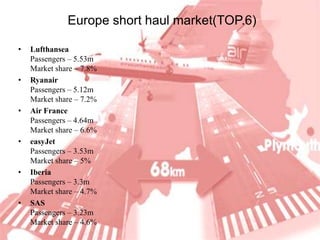
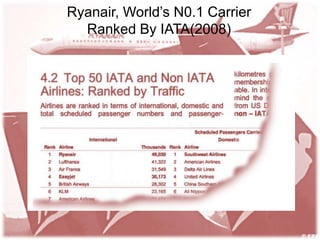
Ryanair has grown rapidly since the 1990s by pioneering the European low-cost carrier business model. It focuses on lowering costs through measures like direct online booking, point-to-point routes, secondary airports, and eliminating extras. This allows Ryanair to offer low fares that have driven huge passenger growth. Currently the largest European carrier, Ryanair aims to further cut costs and find new revenue streams like in-flight entertainment to maintain its low-cost advantage.
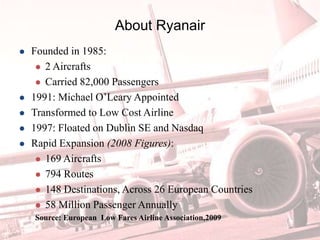
About Ryanair Foundedin 1985: 2 Aircrafts Carried 82,000 Passengers 1991: Michael O’Leary Appointed Transformed to Low Cost Airline 1997: Floated on Dublin SE and Nasdaq Rapid Expansion (2008 Figures) : 169 Aircrafts 794 Routes 148 Destinations, Across 26 European Countries 58 Million Passenger Annually Source: European Low Fares Airline Association,2009
3.
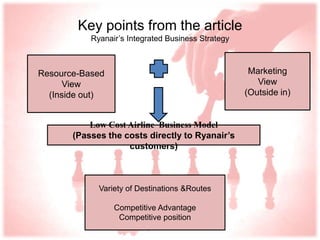
Ryanair’s Integrated BusinessStrategy Resource-Based View (Inside out) Marketing View (Outside in) Variety of Destinations &Routes Competitive Advantage Competitive position Low Cost Airline Business Model (Passes the costs directly to Ryanair’s customers)
4.
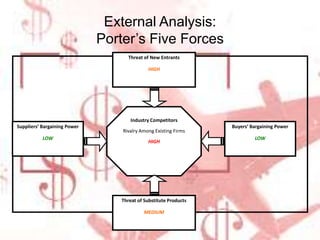
External Analysis: Porter’sFive Forces Threat of New Entrants HIGH Threat of Substitute Products MEDIUM Buyers’ Bargaining Power LOW Suppliers’ Bargaining Power LOW Industry Competitors Rivalry Among Existing Firms HIGH
5.
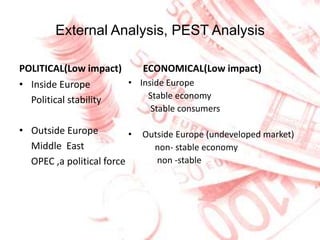
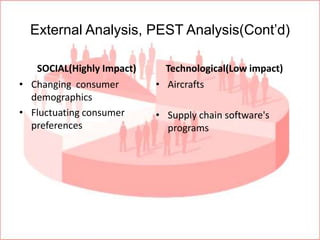
External Analysis, PESTAnalysis POLITICAL(Low impact) Inside Europe Political stability Outside Europe Middle East OPEC ,a political force ECONOMICAL(Low impact) Inside Europe Stable economy Stable consumers Outside Europe (undeveloped market) non- stable economy non -stable
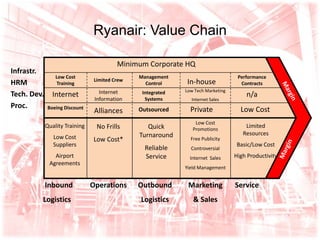
Ryanair: Value ChainInfrastr. HRM Tech. Dev. Proc. Margin Margin Minimum Corporate HQ Low Cost Training Internet Boeing Discount Quality Training Low Cost Suppliers Airport Agreements No Frills Low Cost* Quick Turnaround Reliable Service Low Cost Promotions Free Publicity Controversial Internet Sales Yield Management Limited Resources Basic/Low Cost High Productivity Inbound Logistics Operations Outbound Logistics Marketing & Sales Service Limited Crew Internet Information Alliances Management Control Integrated Systems Outsourced In-house Low Tech Marketing Internet Sales Private Performance Contracts n/a Low Cost
8.
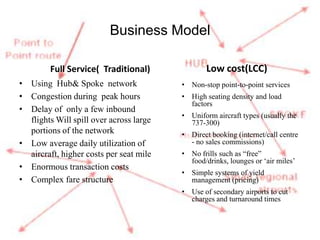
Business Model FullService( Traditional) Using Hub& Spoke network Congestion during peak hours Delay of only a few inbound flights Will spill over across large portions of the network Low average daily utilization of aircraft, higher costs per seat mile Enormous transaction costs Complex fare structure Low cost(LCC) Non-stop point-to-point services High seating density and load factors Uniform aircraft types (usually the 737-300) Direct booking (internet/call centre - no sales commissions) No frills such as “free” food/drinks, lounges or ‘air miles’ Simple systems of yield management (pricing) Use of secondary airports to cut charges and turnaround times
9.
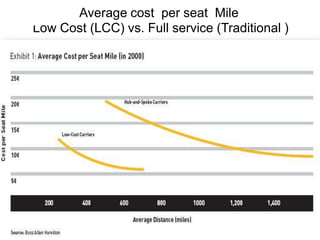
Average cost per seat Mile Low Cost (LCC) vs. Full service (Traditional )
10.
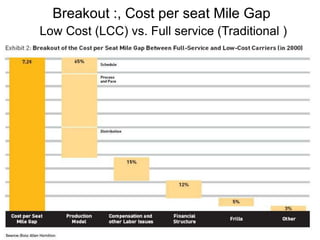
Breakout :, Costper seat Mile Gap Low Cost (LCC) vs. Full service (Traditional )
11.
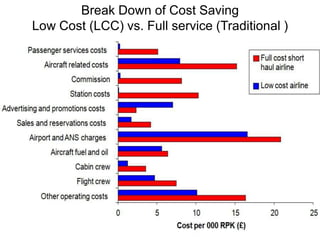
Break Down ofCost Saving Low Cost (LCC) vs. Full service (Traditional )
12.
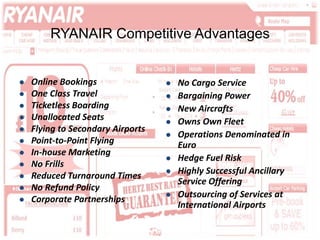
RYANAIR Competitive AdvantagesOnline Bookings One Class Travel Ticketless Boarding Unallocated Seats Flying to Secondary Airports Point-to-Point Flying In-house Marketing No Frills Reduced Turnaround Times No Refund Policy Corporate Partnerships No Cargo Service Bargaining Power New Aircrafts Owns Own Fleet Operations Denominated in Euro Hedge Fuel Risk Highly Successful Ancillary Service Offering Outsourcing of Services at International Airports
13.
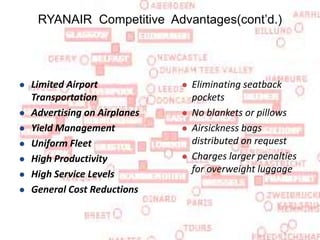
Limited Airport Transportation Advertising on Airplanes Yield Management Uniform Fleet High Productivity High Service Levels General Cost Reductions Eliminating seatback pockets No blankets or pillows Airsickness bags distributed on request Charges larger penalties for overweight luggage RYANAIR Competitive Advantages(cont’d.)
14.
Cutting costs:“Race tobottom” Ryanair, the World’s favourite airline, today (9 th July) launched an online poll to ask if passengers would ‘stand’ on short flights if it meant they could travel for FREE, or pay 50% less than seated passengers. Ryanair is gauging passenger demand for its ‘vertical seating’ which will allow passengers to travel – for free – in a secure upright position on short flights of approximately one hour. Source: http://www.ryanair.com/site/EN/news.php?yr=09&month=jul&story=gen-en-090709
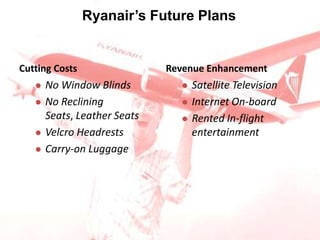
Ryanair’s Future Plans Cutting Costs No Window Blinds No Reclining Seats , Leather Seats Velcro Headrests Carry-on Luggage Revenue Enhancement Satellite Television Internet On-board Rented In-flight entertainment
18.
Ryanair’s Future Plans(cont.) “ Free tickets. In a decade or so, airlines will pay travellers to distribute people around Europe. The airline industry is Tesco, is Ikea, is network TV in the way viewers watch for free and advertisers Pay for access to them, is the internet in the same way that websites earn money for delivering click-through traffic or other sites.” Michael O'Leary ,Chief Executive Officer of the Irish airline Ryanair
19.
Conclusion Ryanair rapid growth is due to: Low cost Airline Business Model that restructured European Aviation Industry Pioneer innovative cost reduction methods Creative alternative revenue generation &free flights goal in next phase evolution
 Lo más leído
 Lo más leído
 Lo más leído