Saltar al contenido principal
Optimizing write
intensive DB workloads
WELCOME
MASTERCLASS
Optimizing Write-Intensive Database Workloads 2
AGENDA
TIME
8:30am PT WELCOME + EVENT PREVIEW
8:35am PT SESSION 1: Why is Scaling Writes so Hard? | FELIPE MENDES
9:05am PT
SESSION 2: Optimizing Write Performance | GUILHERME NOGUEIRA
9:35am PT
SESSION 3: Troubleshooting Write-Path Bottlenecks | FELIPE & GUILHERME
10:05am PT WRAP-UP + HOW TO WIN
Optimizing Write-Intensive Database Workloads 3
All content is here on the STAGE
LOUNGE is open now
Need help? Visit RECEPTION
Ask the best 5 questions
in chat and win a copy of
Database Performance
at Scale
All Things Performance
A ScyllaDB
Community
Virtual Event | OCTOBER 21 +
22, 2026
Register now at
p99conf.io
Pass the exam
and win a certificate and
swag pack!
Why Scaling Writes is so
Hard?
MASTERCLASS
Felipe Cardeneti Mendes
Optimizing Write-Intensive Database Workloads
Reads!
Optimizing Write-Intensive Database Workloads
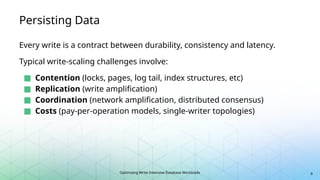
Persisting Data
Every write is a contract between durability, consistency and latency.
Typical write-scaling challenges involve:
■ Contention (locks, pages, log tail, index structures, etc)
■ Replication (write amplification)
■ Coordination (network amplification, distributed consensus)
■ Costs (pay-per-operation models, single-writer topologies)
9
Optimizing Write-Intensive Database Workloads
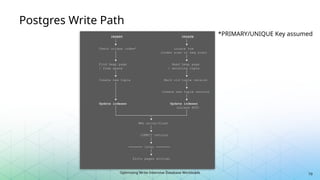
Postgres Write Path
*PRIMARY/UNIQUE Key assumed
10
INSERT UPDATE
│ │
▼ ▼
Check unique index* Locate row
│ (index scan or seq scan)
│ │
▼ ▼
Find heap page Read heap page
/ free space / existing tuple
│ │
▼ ▼
Create new tuple Mark old tuple version
│ │
│ ▼
│ Create new tuple version
│ │
▼ ▼
Update indexes Update indexes
│ (unless HOT)
│ │
└─────────────────┬─────────────────┘
▼
WAL write/flush
│
▼
COMMIT returns
│
▼
─────── later ───────
│
▼
Dirty pages written
Optimizing Write-Intensive Database Workloads
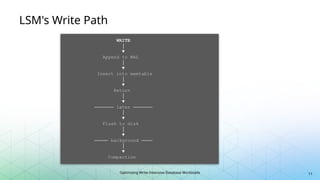
LSM's Write Path
11
WRITE
│
▼
Append to WAL
│
▼
Insert into memtable
│
▼
Return
│
▼
─────── later ───────
│
▼
Flush to disk
│
▼
───── background ────
│
▼
Compaction
Optimizing Write-Intensive Database Workloads
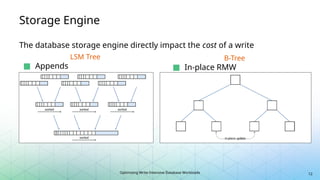
Storage Engine
The database storage engine directly impact the cost of a write
12
LSM Tree
■ Appends
B-Tree
■ In-place RMW
Optimizing Write-Intensive Database Workloads
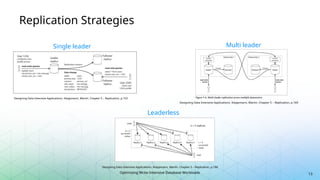
Replication Strategies
13
Single leader
Designing Data Intensive Applications. Kleppmann, Martin. Chapter 5 – Replication, p.153
Designing Data Intensive Applications. Kleppmann, Martin. Chapter 5 – Replication, p.169
Designing Data Intensive Applications. Kleppmann, Martin. Chapter 5 – Replication, p.180
Multi leader
Leaderless
Optimizing Write-Intensive Database Workloads
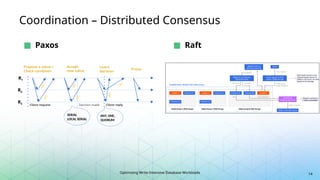
Coordination – Distributed Consensus
14
R1
Propose a value /
Check condition
Accept
new value
R2
R3
Learn
decision
Prune
Decision made
o
k
!
o
k
!
o
k
!
o
k
o
k
!
ok!
Client reply
Client request
SERIAL
LOCAL SERIAL
ANY, ONE,
QUORUM
■ Paxos ■ Raft
Optimizing Write-Intensive Database Workloads
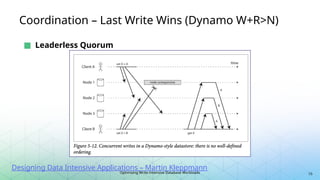
Coordination – Last Write Wins (Dynamo W+R>N)
15
■ Leaderless Quorum
Designing Data Intensive Applications – Martin Kleppmann
Optimizing Write-Intensive Database Workloads
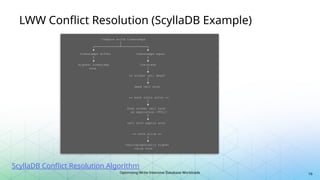
LWW Conflict Resolution (ScyllaDB Example)
16
Compare write timestamps
│
┌──────────────┴──────────────┐
▼ ▼
timestamps differ timestamps equal
│ │
▼ ▼
Highest timestamp Tie-break
wins │
▼
Is either cell dead?
│
▼
dead cell wins
── both cells alive ──
│
▼
Does either cell have
an expiration (TTL)?
│
▼
cell with expiry wins
── both alive ──
│
▼
lexicographically higher
value wins
ScyllaDB Conflict Resolution Algorithm
Optimizing Write-Intensive Database Workloads
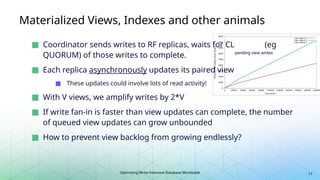
pending view writes
Materialized Views, Indexes and other animals
■ Coordinator sends writes to RF replicas, waits for CL (eg
QUORUM) of those writes to complete.
■ Each replica asynchronously updates its paired view
■ These updates could involve lots of read activity!
■ With V views, we amplify writes by 2*V
■ If write fan-in is faster than view updates can complete, the number
of queued view updates can grow unbounded
■ How to prevent view backlog from growing endlessly?
17
Optimizing Write-Intensive Database Workloads
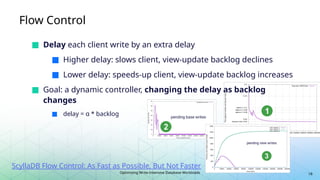
Flow Control
pending base writes
pending view writes
■ Delay each client write by an extra delay
■ Higher delay: slows client, view-update backlog declines
■ Lower delay: speeds-up client, view-update backlog increases
■ Goal: a dynamic controller, changing the delay as backlog
changes
■ delay = α * backlog
18
ScyllaDB Flow Control: As Fast as Possible, But Not Faster
Optimizing Write-Intensive Database Workloads
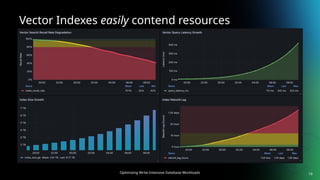
Vector Indexes easily contend resources
19
Optimizing Write-Intensive Database Workloads
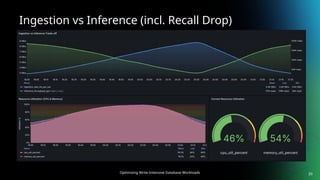
Ingestion vs Inference (incl. Recall Drop)
20
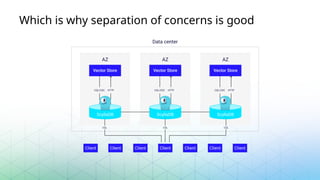
Which is why separation of concerns is good
Optimizing Write-Intensive Database Workloads
Global Scale Trade-offs
22
■ Don'ts:
○ Block on remote region ack
○ Replicate unnecessary data
○ Route queries to remote
○ Replicate yourself
■ Do's:
○ Bring data closer to users
○ Let the DB handle it
○ Use LOCAL_* consistency
○ Beware of conflict resolution
App
App
App
App
App
App
Active/Active, replicated, auto-sharded
Optimizing Write-Intensive Database Workloads
Write-Intensive Use Cases
23
Optimizing Write-Intensive Database Workloads
Commonly Seen
24
■ 📟 Internet of Things
■ Often time-series workloads
■ Small (but frequent!) append-only writes
■ Rate determined by number of ingestion endpoints
■ 📶 Logging and Monitoring
■ Similar to IOT, but…
■ Doesn't have a fixed ingestion rate
■ Prone to hotspots
■ 🎮 Online Gaming
■ Real-time user interactions (state, actions,
messaging)
■ Often spiky
■ Very latency dependant
■ 🚚 E-commerce & Retail
■ Update-heavy and Batch-y
■ Inventory updates, reviews, order status &
placement
■ Shopping carts inherently require a read-before-
write
■ 🔔 Ad Tech and Real-time Bidding
■ Bid Processing (Impressions, Auction outcomes)
■ User Interaction (Clicks, Conversions, Fraud
Detection)
■ Audience Segmentation
■ 📈 Real-time Stock exchange
■ High-frequency trading (HFT)
■ Stock prices updates
■ Order matching
Optimizing Write-Intensive Database Workloads
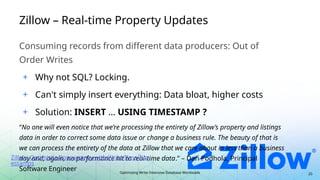
Zillow – Real-time Property Updates
Consuming records from different data producers: Out of
Order Writes
+ Why not SQL? Locking.
+ Can't simply insert everything: Data bloat, higher costs
+ Solution: INSERT … USING TIMESTAMP ?
“No one will even notice that we’re processing the entirety of Zillow’s property and listings
data in order to correct some data issue or change a business rule. The beauty of that is
we can process the entirety of the data at Zillow that we care about in less than a business
day and, again, no performance hit to real-time data.” – Dan Podhola, Principal
Software Engineer
Zillow: Optimistic Concurrency with Write-Time Tim
estamps
25
Optimizing Write-Intensive Database Workloads
Unleashing the Power of Data wit
h Scylla
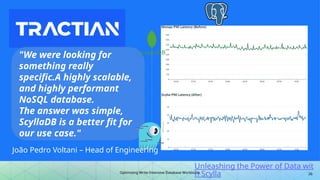
"We were looking for
something really
specific.A highly scalable,
and highly performant
NoSQL database.
The answer was simple,
ScyllaDB is a better fit for
our use case."
João Pedro Voltani – Head of Engineering
26
Optimizing Write-Intensive Database Workloads
Fanatics – Retail Operations
Use cases:
+ Order capture
+ Product Catalog
+ Shopping Carts
+ Promotions, …
“During a recent peak minute, we saw nearly 280,000 IOPs for a solid minute. With a
3-node ScyllaDB cluster, we registered zero timeouts. Because of this we had happier
customers and application teams.” – Niraj Kothari, Director of Platforms Engineering
Read the Case St
27
Optimizing Write-Intensive Database Workloads
Application Best Practices
28
Optimizing Write-Intensive Database Workloads
Food For Thought
■ In an app, users must register with a valid email
● 1:1 id:email relationship
● Every email is unique
■ Prevent:
● Concurrent sign ups for same e-mail
● Later updates to the same e-mail
■ How?
Optimizing Write-Intensive Database Workloads
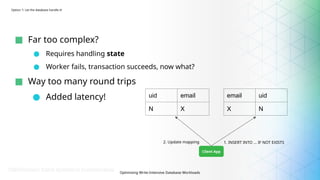
■ Far too complex?
● Requires handling state
● Worker fails, transaction succeeds, now what?
■ Way too many round trips
● Added latency!
Option 1: Let the database handle it!
Client App
uid email
N X
email uid
X N
1. INSERT INTO … IF NOT EXISTS
2. Update mapping
Optimizing Write-Intensive Database Workloads
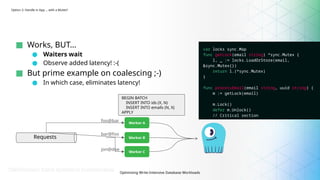
Option 2: Handle in App … with a Mutex?
■ Works, BUT…
● Waiters wait
● Observe added latency! :-(
■ But prime example on coalescing ;-)
● In which case, eliminates latency!
Worker A
Worker B
Worker C
Requests
foo@bar
bar@foo
jon@doe
var locks sync.Map
func getLock(email string) *sync.Mutex {
l, _ := locks.LoadOrStore(email,
&sync.Mutex{})
return l.(*sync.Mutex)
}
func processEmail(email string, uuid string) {
m := getLock(email)
m.Lock()
defer m.Unlock()
// Critical section
}
BEGIN BATCH
INSERT INTO ids (X, N)
INSERT INTO emails (N, X)
APPLY
Optimizing Write-Intensive Database Workloads
Option 3: Handle in App, Fail-fast
■ Little sense to Mutex on such a thing
● First one arriving is the winner anyway
■ Fail-fast, allow the client to retry
● Careful with concurrency
■ Simpler, faster and lock-free!
Worker A
Worker B
Worker C
Requests
foo@bar
bar@foo
jon@doe
var inflight sync.Map
func processEmail(email string, uuid string) {
_, n := inflight.LoadOrStore(email,
struct{}{})
if n { return false }
defer n.Delete(email)
// Critical section
}
BEGIN BATCH
INSERT INTO ids (X, N)
INSERT INTO emails (N, X)
APPLY
Optimizing Write-Intensive Database Workloads
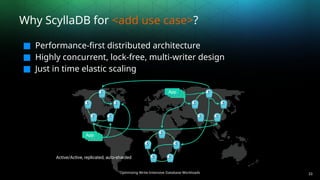
Why ScyllaDB for <add use case>?
33
■ Performance-first distributed architecture
■ Highly concurrent, lock-free, multi-writer design
■ Just in time elastic scaling
App
App
App
App
App
App
Active/Active, replicated, auto-sharded
Optimizing Write-Intensive Database Workloads
Keep in touch!
Felipe Mendes
Technical Director
ScyllaDB
felipe@scylladb.com
Find me on LinkedIn!
Optimizing Write-Intensive Database Workloads
35
EXAM TIME
bit.ly/3SMfL1Y
Optimizing Write-Intensive Database Workloads
Key Point
36
Optimizing Write-Intensive Database Workloads
Slide Title Top Gradient 2
Pellentesque habitant morbi tristique senectus et netus et malesuada
fames ac turpis egestas. Morbi ultrices sed nulla non pellentesque. Ut ac
tortor facilisis neque ultricies egestas quis tempus erat. Aenean a finibus
leo, sit amet congue nibh.
37
Optimizing Write-Intensive Database Workloads
Slide Title
Lorem ipsum dolor sit amet, consectetur adipiscing elit. Praesent
consectetur ipsum eu mauris finibus gravida. In lacinia volutpat lectus sed
sollicitudin.
■ Morbi pellentesque purus quam, vel feugiat ipsum pharetra eu. Fusce
viverra nibh sed egestas faucibus.
■ Nunc bibendum eget metus eget gravida.
■ Cras ultrices tortor mauris, nec porta sapien placerat ut.
38
Optimizing Write-Intensive Database Workloads
All Blank Slide Title Goes Here
39
Optimizing Write-Intensive Database Workloads
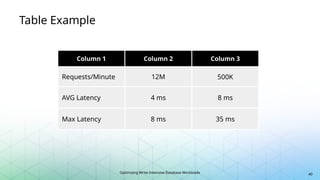
Table Example
Column 1 Column 2 Column 3
Requests/Minute 12M 500K
AVG Latency 4 ms 8 ms
Max Latency 8 ms 35 ms
40
Optimizing Write-Intensive Database Workloads 41
42
Submit an accepted
review of ScyllaDB on G2
and win a $50 gift card!*
*While supplies last.
Earn $50!