PepsiCo is a multinational beverage and snack company headquartered in New York. It produces Pepsi soft drinks and Frito-Lay snacks. The document discusses PepsiCo's history, brands, revenues, locations, CEO, and target demographics. It also analyzes Pepsi's marketing strategies through advertising campaigns and celebrity endorsements aimed at younger consumers. Porter's Five Forces model is applied to examine competitive pressures in PepsiCo's industry.
Profile…
Pepsi isa soft drink produced and manufactured by PepsiCo. It is sold in
many places such as retail stores, restaurants, schools, cinemas and from
vending machines. The drink was first made in the 1890s by pharmacist
Caleb Bradham in New Bern, North Carolina. The brand was trademarked
on June 16, 1903. There have been many Pepsi variants produced over the
years since 1898.
PepsiCo brands are available in nearly 200 countries and territories. Many
of PepsiCo's brand names are over 100-years-old, but the corporation is
relatively young. PepsiCo was founded in 1965 through the merger of Pepsi-
Cola and Frito-Lay. Tropicana was acquired in 1998 and PepsiCo merged
with The Quaker Oats Company, including Gatorade, in 2001.
PepsiCo (symbol: PEP) shares are traded principally on the New York Stock
Exchange in the United States. The company is also listed on the
Amsterdam, Chicago, Swiss and Tokyo stock exchanges. PepsiCo has
consistently paid cash dividends since the corporation was founded.
PepsiCo World Headquarters is located in Purchase, New York,
approximately 45 minutes from New York City.
3.
Cont…
Revenues in2007 is more than $39 billion.
37 bottling plants in India, of which 16 are company owned and 21 are
franchisee owned.
PepsiCo’s Frito Lay snack division has 3 state of the art plants.
It has more than 185,000 employees across the world.
In India, PepsiCo provides direct employment to 4,000 people and indirect
employment to 60,000 people including suppliers and distributors.
CEO : Ms. Indra K Nooyi
India Headquarters : Gurgaon.
4.
Brand Image ofPepsi
Pepsi is a brand that every youngster relates to.
But this definitely doesn’t mean that other age groups are not it’s user’s.
Thus Pepsi’s brand image is it’s hip, cool, lively and refreshing attitude.
5.
Advertising Strategy ofPepsi
Pepsi’s target audience are mostly teens and young adults and their
advertising reflects this in every possible way.
The company changes its advertising strategy and image to reflect the target's
interests.
Pepsi makes sure that the advertisements reflect to the target audience’s
interests and nostalgia.
The advertising strategy includes cool, hip promos to attract more of the target
audience.
The advertising is mostly creative and has different elements like music and
sports other than bollywood.
Pepsi.com also plays an important role in advertising and attracts target
audience by giving access to options like downloads, gaming, music mixing
applications etc..
6.
Advertising History
Pepsihas continuously focused on the current teen generation.
How Pepsi has used humor, music, sex appeal in advertising.
Ad expenditures for 2001 is $ 1,800,000,000
7.
Slogans
1939 -“Twice as Much for a Nickel”
1950 - “More Bounce to the Ounce”
1958 - “Be Sociable, Have a Pepsi”
1961 - “Now It’s Pepsi for Those Who Think Young”
1963 - “Come Alive, You’re in the Pepsi Generation”
1967 - “(Taste that beats the others cold) Pepsi Pours It On”
1969 - “You’ve Got a Lot to Live, Pepsi’s Got a Lot to Give”
1984 - “Pepsi. The Choice of a New Generation”
1985 - “New Generation” advertising continues
1992 - “Gotta Have It”
1993 - “Be Young, Have Fun, Drink Pepsi”
1997 - “Generation Next”
2000 - “Joy of Cola”
Generation Y- MarketInfluence
Huge market – 80 million people
Spending power – 600 million annually
Many Geb Yers do household grocery shopping
90% parents say kids influence what they buy
Many work and have their own money to spend
They have proven to be brand loyal
11.
How to reachGeneration Y
Creates promotion tailored to their needs and interests.
Gen Yers like entertainment and music
They like to laugh, but not at another's expense
To attract the teen market radio and television should be used
They are internet savvy
12.
What does GenerationY like?
Free stuffs and discounts
Contests/drawings
Music
Club cards
Team sporting events
They are into clothes and the latest styles
Teen friendly retail stores and internet site
13.
Pepsi and GenerationY
Pepsi targets Generation Y specifically
Current campaigns use of effective techniques
By targeting 12 to 21 year olds, Pepsi is attempting to establish a loyal;
pepsi drinker for life and the largest group of soft drink consumer.
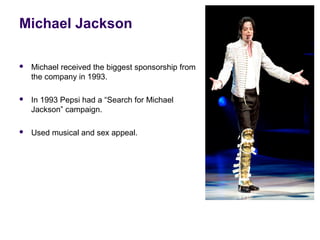
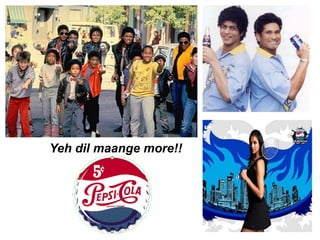
Michael Jackson
Michaelreceived the biggest sponsorship from
the company in 1993.
In 1993 Pepsi had a “Search for Michael
Jackson” campaign.
Used musical and sex appeal.
16.
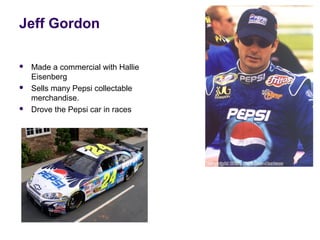
Jeff Gordon
Madea commercial with Hallie
Eisenberg
Sells many Pepsi collectable
merchandise.
Drove the Pepsi car in races
17.
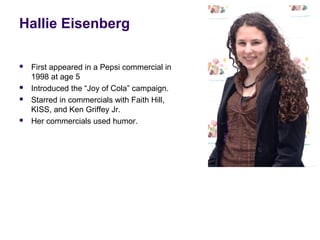
Hallie Eisenberg
Firstappeared in a Pepsi commercial in
1998 at age 5
Introduced the “Joy of Cola” campaign.
Starred in commercials with Faith Hill,
KISS, and Ken Griffey Jr.
Her commercials used humor.
18.
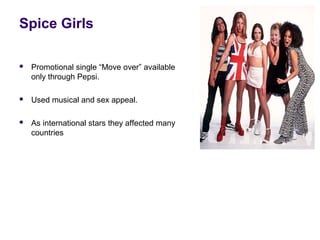
Spice Girls
Promotionalsingle “Move over” available
only through Pepsi.
Used musical and sex appeal.
As international stars they affected many
countries
19.
Type A &B celebrities
Type A celebrity = one that is well known and well liked by their target
market.
Type B celebrity = one that is known by their market
20.
Issues
Hard todifferentiate product in terms of taste as product
variety is very limited within cola based beverages.
Coca-cola has such a strong base of loyal customers, who
identify with the cola brand.
Consumer tastes are changing, away from carbonated drinks
towards functional soft drinks. (Mintel, et al. 2009)
SWOT analysis
Strength:
Pepsihas a broader product line and outstanding reputation.
Merger of Quaker Oats produced synergy across the board.
Record revenues and increasing market share.
Lack of capital constraints (availability of large cash flow).
Great brands, strong distribution, innovative capabilities.
Number of maker of snacks, such as corn chips and potato chips.
PepsiCo sells three products through the same distribution channel.
Weakness:
Pepsi hard to inspire vision and direction for large global company.
Not all PepsiCo products bears the company name.
PepsiCo is far away from leader Coca-cola in the international market –
demand is highly elastic.
23.
Cont…
Opportunity:
Food divisionshould expand internationally.
Noncarbonated drinks are the fastest-growing part of the industry.
There are increasing trend towards healthy foods.
Focus on most important customer trend – “Convenience”
Threats:
F&B industry is mature.
Pepsi is blamed for pesticide residues in their products in one of their
promising emerging market e.g. in India.
PepsiCo now competes with Cadbury Schweppes, Coca-cola, and Kraft
foods (because of their broader product line) which are well-run and
financially sound competitors.
Size of company will demand a varied marketing program; Social, cultural,
economic, political and governmental constraints.
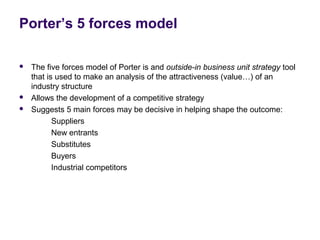
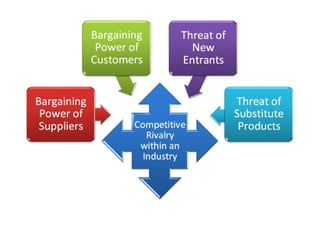
Porter’s 5 forcesmodel
The five forces model of Porter is and outside-in business unit strategy tool
that is used to make an analysis of the attractiveness (value…) of an
industry structure
Allows the development of a competitive strategy
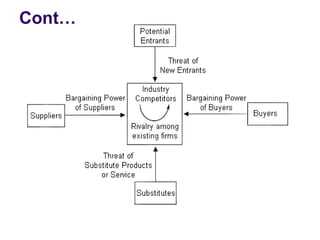
Suggests 5 main forces may be decisive in helping shape the outcome:
Suppliers
New entrants
Substitutes
Buyers
Industrial competitors
Threats of newentrants
New entrants bring increased capacity to the industry and are often backed
by substantial resources.
New entrants can be deterred by “barriers to entry”
28.
Threat of newentrant
The main barriers are…….
Economies of scale
Patents
Product differentiation
Capital requirements (financial & specialist equipment)
Skills
Reaction/strategic decisions of incumbents (ex-all undercut new entrant)
Government policy (ex-de-regulation)
29.
The bargaining powerof suppliers
Supplier exert power in the industry by threatening to raise prices or reduce
quality.
Powerful suppliers can squeeze industry profitability if firms are unable to
recover cost increases.
30.
The bargaining powerof suppliers
Suppliers are likely to be powerful if:
Supplier industry is dominated by a new firms.
Suppliers products have few substitutes.
Buyer is not an important input to buyers product.
Suppliers products have high switching cost.
31.
The bargaining powerof buyers
Buyers compete with the supplying industry by:
Bargaining down prices
Forcing higher quality
Playing firms off of one another
32.
The threat ofsubstitute products
Products with similar function limit the prices firms can charge
Keys to evaluate substitute products:
Products with improving price/performance tradeoffs relative to present
industry products
33.
The threat ofsubstitute
products…..Questions?
How many substitute products/services have appeared in your industry in
the last 5 years?
What are they? How different are they?
Were they introduced by your organization or others?
Which organization in your industry does the most Research and
Development?
What happens to price, profits and market share when substitutes are
introduced?
34.
Rivalry among existingcompetitors
Intensive rivalry often plays out in the following ways:
Price competition
Advertising battles
Increasing consumer warranties and service
New product roll-outs
Price competition often leaves the entire industry worse off
35.
Porter’s 5 model– PepsiCo
Traditional competition:
Prices of Coca Cola, local brands
Market share
Promotional actions of competition
New entrants:
New “look-alike” manufacturers
Substitute products:
Fashionable new drinks, milk drinks, coffee, beer, water, smoothies…
36.
Porter’s 5 model– PepsiCo
Suppliers:
Price and availability of ingredients on world market.
Quality, speed, safety, traceability, flexibility of supply chain.
Buyers/consumers:
High as a result of intense competition both among branded and unbranded
products.
Combined purchase power of shops, bars, supermarkets
38.
Pepsi’s Successes andFailures in
Brazil and Germany
PesiCo has been operating in Brazil since 1953
“Pepsi’s heavy new investment in Brazil, which actually started early this
year, is funneled through a joint venture with Baesa, a bottler based in
Buenos Aires that operates in Argentina, Chile, Costa Rica and Puerto
Rico.”
PepsiCo in Germany made a smarter move by acquiring Punica, Germany’s
premiere juice provider.
PepsiCo is one of the world’s largest manufacturer, seller and distributor of
beverages
Pepsi has very limited brands in Germany.
Their struggles in Germany include Coca-cola and a rash of suicidal
commercials for Pepsi Max that depicts a single lonely calorie committing
suicide.
39.
Marketing Products andServices
Taste testing
Television, Billboard and Print Media
Interactive/Web-based marketing
Cost-Leadership Strategy
Advertisingand innovative promotion.
Optimal outsourcing for production and vertical integration.
Improving production efficiencies through Kaizen.
42.
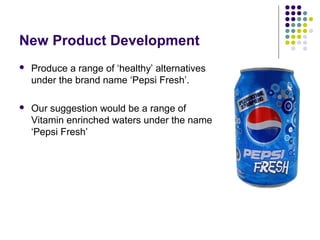
New Product Development
Produce a range of ‘healthy’ alternatives
under the brand name ‘Pepsi Fresh’.
Our suggestion would be a range of
Vitamin enrinched waters under the name
‘Pepsi Fresh’
43.
Conclusion
It canbe seen then that differences do exist between Coca-Cola and Pepsi
Cola.
This can be seen in the marketing variables which are the basis for
segmentation such as age and geographic variables.
In a competitive market, both companies must identify and target different
market segments in order to remain at the cutting edge.
Differences between the companies are evident with respect to product,
pricing, place and promotion.
Coca-cola relies heavily on value: quality is more than something we see or
taste. (http://www.coca-cola.com).
Pepsi, on the other hand, relies on its success resulting from superior
products and high standards of performance (http://www.pepsico.com).