Saltar al contenido principal
Maximizing A School’s Potential
Through Teacher Empowerment
Ken Cooper & Joe Salah
• Download Materials at www.ascd.org/achandouts
Session #1101
Two Main Concepts
1. Why the nature of the leadership system in a
school is the key determinant of that school’s
success
2. Why generating intrinsic motivation
throughout the school results in maximizing a
school’s performance
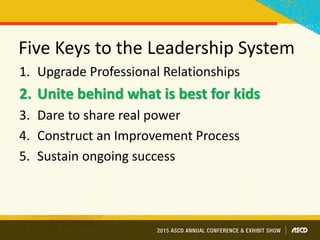
Five Keys to the Leadership System
1. How well the staff works together
2. How focused the staff is on what is best for kids
3. Whether real power is shared as part of
collaboration
4. How planning and improvement processes are used
to turn ideas into reality
5. How to build a self-renewing improvement system
Two Questions
• How many here have been part of a
dysfunctional group, team or workplace
where everything seemed to work at cross
purposes
• On the other hand, how many have been part
of a workplace where you felt supported and
where everything worked well
Turn and Talk Topic
• What are the origins of a top-down
hierarchical leadership system?
• Where does it come from?
• For whom was it designed?
Top-Down Leadership
is
“Tell and Sell” Leadership
Flawed Leadership
Failure to involve staff in formulation of a policy
they will be called upon to implement is:
– wasteful in that it fails to utilize all the staff has to
offer and
– is discouraging because it is disempowering
95% of the time the
cause of underperformance
is the system,
not the people
W. Edwards Deming
It’s the Leadership System
Intrinsic Motivation
• A great leadership system is meant to
provide widespread intrinsic motivation
Turn and Talk Topic
• Is it more important that:
– decisions get made quickly or,
– that decisions once made are enthusiastically
implemented?
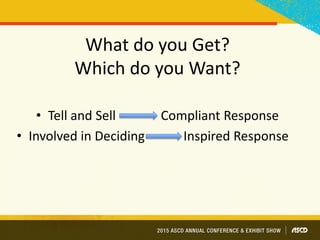
What do you Get?
Which do you Want?
• Tell and Sell Compliant Response
• Involved in Deciding Inspired Response
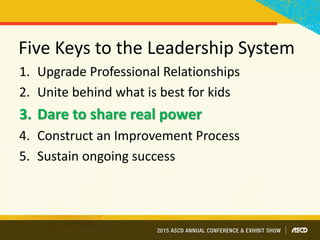
Five Keys to the Leadership System
1. Upgrade Professional Relationships
2. Unite behind what is best for kids
3. Dare to share real power
4. Construct an Improvement Process
5. Sustain ongoing success
Turn and Talk Topic
• Can the faculty in a school change and
improve what they are doing on behalf of
the kids if they can’t work together?
• Is outstanding teamwork optional when
striving to have an outstanding school?
Upgrading Professional Relationships:
Helpful Hints
• The Working Values
– Create your own set of working values
– Whatever values you keep on the list must have
the commitment of all
– Before engaging in a difficult discussion begin with
a reading of the working values
www.ascd.org/achandouts
Five Keys to the Leadership System
1. Upgrade Professional Relationships
2. Unite behind what is best for kids
3. Dare to share real power
4. Construct an Improvement Process
5. Sustain ongoing success
Before making decisions it is important to
discuss the criteria you will use to evaluate
the options
Discuss Criteria for Decision Making
Turn and Talk Topic
• Is there ANY factor other than what is
best for kids that can truly unite a school
on a long-term basis?
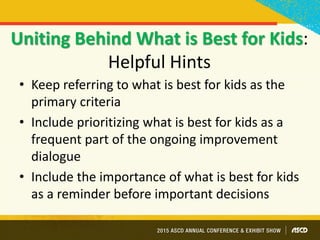
Uniting Behind What is Best for Kids:
Helpful Hints
• Keep referring to what is best for kids as the
primary criteria
• Include prioritizing what is best for kids as a
frequent part of the ongoing improvement
dialogue
• Include the importance of what is best for kids
as a reminder before important decisions
Five Keys to the Leadership System
1. Upgrade Professional Relationships
2. Unite behind what is best for kids
3. Dare to share real power
4. Construct an Improvement Process
5. Sustain ongoing success
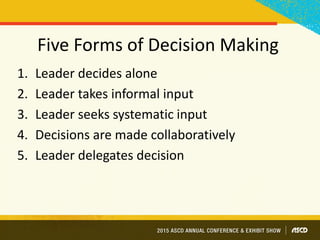
Five Forms of Decision Making
1. Leader decides alone
2. Leader takes informal input
3. Leader seeks systematic input
4. Decisions are made collaboratively
5. Leader delegates decision
Shared Authority in One Area…
Identifying, prioritizing, and planning school
improvement initiatives
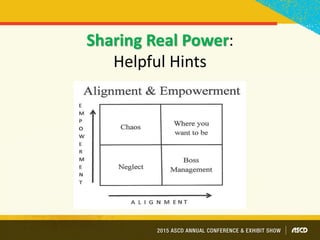
Sharing Real Power:
Helpful Hints
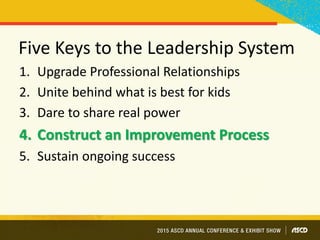
Five Keys to the Leadership System
1. Upgrade Professional Relationships
2. Unite behind what is best for kids
3. Dare to share real power
4. Construct an Improvement Process
5. Sustain ongoing success
Process Leadership
• The Principal becomes a process leader,
skilled at working with individuals, groups,
and teams, to develop the elements of the
improvement process
• He or she leads people through a series of
steps without a preconceived idea as to the
outcome
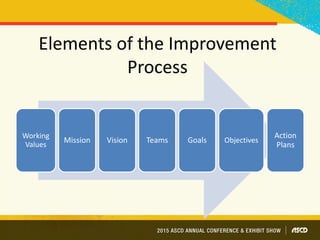
Elements of the Improvement
Process
Working
Values
Mission Vision Teams Goals Objectives
Action
Plans
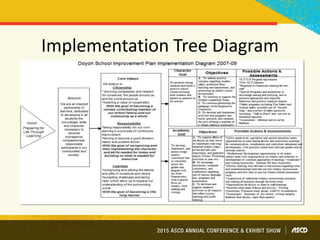
Implementation Tree Diagram
Construct an Improvement Process:
Helpful Hints
• Keep looking forward
• Evaluate by “Pros” and “Cons”
• Use small teams to draft and research and the
full group for making decisions
Five Keys to the Leadership System
1. Upgrade Professional Relationships
2. Unite behind what is best for kids
3. Dare to share real power
4. Construct an Improvement Process
5. Sustain ongoing success
Questions that Drove the Discussion
1. How have we been doing?
2. Is the rate of progress satisfactory?
3. Are we working together?
4. Do present goals need to be tweaked or
changed?
5. Have present goals been sufficiently
integrated into regular operations for us to
move on to new goals?
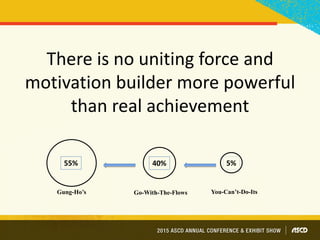
There is no uniting force and
motivation builder more powerful
than real achievement
A
Gung-Ho’s
40%55%
Go-With-The-Flows You-Can’t-Do-Its
5%
Sustain Ongoing Success:
Helpful Hints
• Time is the “coin of the realm”
• Focus on just a few goals at any one time
• “Consistency” and “Continuity” are excellent
goals for any instructional area
• Dedicate resources to supporting the group’s
improvement goals
Closing Thoughts
Trying to change a school’s culture, curriculum
and instructional program without changing the
leadership system is to put the cart before the
horse.
Instead, change the leadership system to one
that produces widespread ownership and
intrinsic motivation and everything else will fall
into place.
Realizing a School’s Potential
A Great
Leadership
System
Widespread
Intrinsic
Motivation
Maximized
School
Potential
It’s the Leadership System!
Questions