Saltar al contenido principal
GRADUATE PROGRAM
        IN
   BIOMEDICAL
    SCIENCES


      University of Puerto Rico
        School of Medicine


 Nivia L. Pérez-Acevedo, Ph.D.
     Graduate Program Coordinator
         nivia.perez@upr.edu
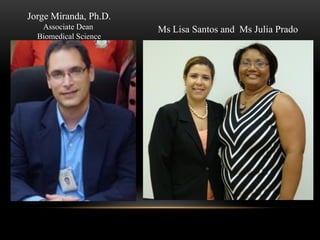
Jorge Miranda, Ph.D.
   Associate Dean      Ms Lisa Santos and Ms Julia Prado
  Biomedical Science
Graduate Program in Biomedical Science

                  What?

                  Why?

                  How?

                  When?

                  Where?
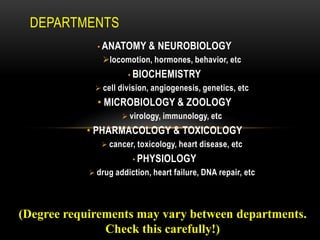
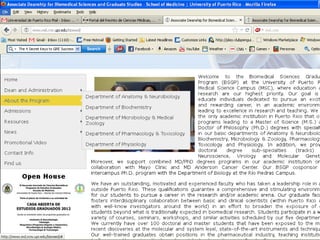
DEPARTMENTS
              • ANATOMY      & NEUROBIOLOGY
               locomotion, hormones, behavior, etc
                       • BIOCHEMISTRY
              cell division, angiogenesis, genetics, etc
              • MICROBIOLOGY & ZOOLOGY
                      virology, immunology, etc
           • PHARMACOLOGY & TOXICOLOGY
                cancer, toxicology, heart disease, etc
                        • PHYSIOLOGY
             drug addiction, heart failure, DNA repair, etc


(Degree requirements may vary between departments.
               Check this carefully!)
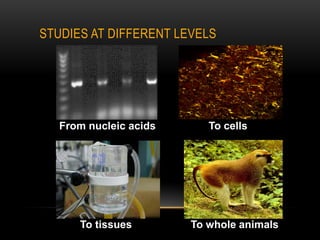
STUDIES AT DIFFERENT LEVELS


   From nucleic acids      To cells


      To tissues        To whole animals
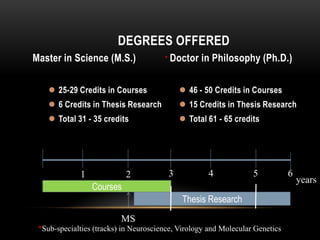
DEGREES OFFERED
Master in Science (M.S.)               * Doctor   in Philosophy (Ph.D.)

     25-29 Credits in Courses               46 - 50 Credits in Courses
     6 Credits in Thesis Research           15 Credits in Thesis Research
     Total 31 - 35 credits                  Total 61 - 65 credits


             1             2            3           4             5           6
                                                                                  years
                 Courses
                                            Thesis Research
                          MS
 *Sub-specialties (tracks) in Neuroscience, Virology and Molecular Genetics
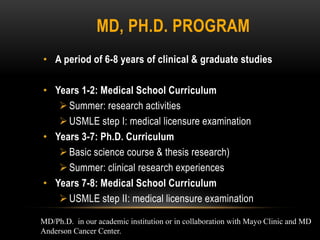
MD, PH.D. PROGRAM
• A period of 6-8 years of clinical & graduate studies

• Years 1-2: Medical School Curriculum
    Summer: research activities
    USMLE step I: medical licensure examination
• Years 3-7: Ph.D. Curriculum
    Basic science course & thesis research)
    Summer: clinical research experiences
• Years 7-8: Medical School Curriculum
    USMLE step II: medical licensure examination

MD/Ph.D. in our academic institution or in collaboration with Mayo Clinic and MD
Anderson Cancer Center.
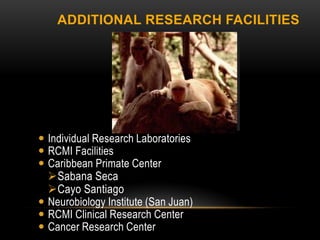
ADDITIONAL RESEARCH FACILITIES


 Individual Research Laboratories
 RCMI Facilities
 Caribbean Primate Center
  Sabana Seca
  Cayo Santiago
 Neurobiology Institute (San Juan)
 RCMI Clinical Research Center
 Cancer Research Center
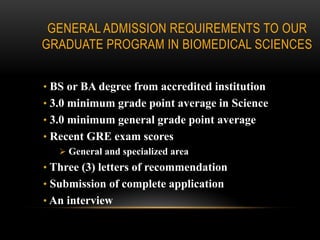
GENERAL ADMISSION REQUIREMENTS TO OUR
GRADUATE PROGRAM IN BIOMEDICAL SCIENCES


• BS or BA degree from accredited institution
• 3.0 minimum grade point average in Science
• 3.0 minimum general grade point average
• Recent GRE exam scores
    General and specialized area
• Three (3) letters of recommendation
• Submission of complete application
• An interview
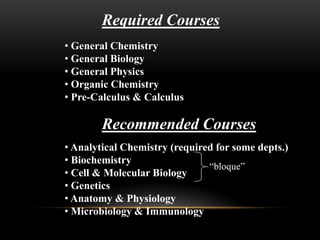
Required Courses
• General Chemistry
• General Biology
• General Physics
• Organic Chemistry
• Pre-Calculus & Calculus

        Recommended Courses
• Analytical Chemistry (required for some depts.)
• Biochemistry
                               “bloque”
• Cell & Molecular Biology
• Genetics
• Anatomy & Physiology
• Microbiology & Immunology
DEADLINES FOR APPLICATION

• February 15th for admission in August 2013


             OPEN HOUSE

    • January 2013 (Specific date TBA)
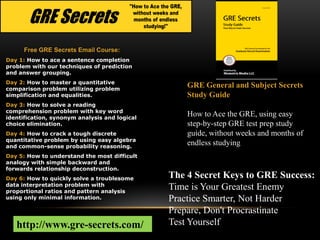
Free GRE Secrets Email Course:
Day 1: How to ace a sentence completion
problem with our techniques of prediction
and answer grouping.
Day 2: How to master a quantitative
comparison problem utilizing problem
                                                   GRE General and Subject Secrets
simplification and equalities.                     Study Guide
Day 3: How to solve a reading
comprehension problem with key word
identification, synonym analysis and logical
                                                   How to Ace the GRE, using easy
choice elimination.                                step-by-step GRE test prep study
Day 4: How to crack a tough discrete               guide, without weeks and months of
quantitative problem by using easy algebra
and common-sense probability reasoning.
                                                   endless studying
Day 5: How to understand the most difficult
analogy with simple backward and
forwards relationship deconstruction.
Day 6: How to quickly solve a troublesome      The 4 Secret Keys to GRE Success:
data interpretation problem with
proportional ratios and pattern analysis
                                               Time is Your Greatest Enemy
using only minimal information.                Practice Smarter, Not Harder
                                               Prepare, Don't Procrastinate
   http://www.gre-secrets.com/                 Test Yourself
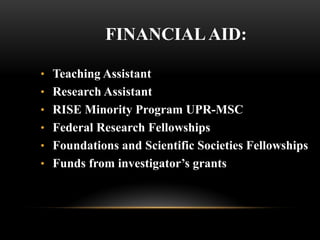
FINANCIAL AID:

• Teaching Assistant
• Research Assistant
• RISE Minority Program UPR-MSC
• Federal Research Fellowships
• Foundations and Scientific Societies Fellowships
• Funds from investigator’s grants
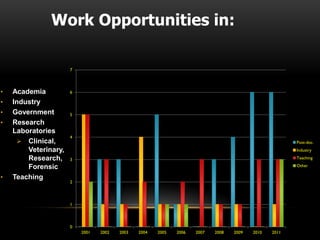
Work Opportunities in:

                      7


•   Academia          6

•   Industry
•   Government        5
•   Research
    Laboratories
                      4
      Clinical,                                                                                       Post-doc.
        Veterinary,                                                                                    Industry

        Research,     3                                                                                Teaching

        Forensic                                                                                       Other

•   Teaching
                      2


                      1


                      0
                          2001   2002   2003   2004   2005   2006   2007   2008   2009   2010   2011
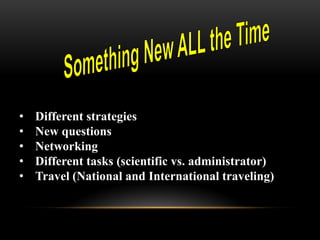
•   Different strategies
•   New questions
•   Networking
•   Different tasks (scientific vs. administrator)
•   Travel (National and International traveling)
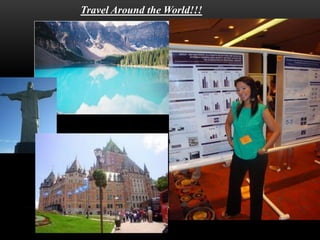
Travel Around the World!!!
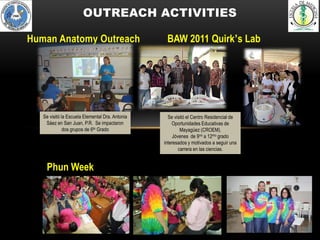
OUTREACH ACTIVITIES

Human Anatomy Outreach                            BAW 2011 Quirk’s Lab


   Se visitó la Escuela Elemental Dra. Antonia     Se visitó el Centro Residencial de
    Sáez en San Juan, P.R. Se impactaron             Oportunidades Educativas de
              dos grupos de 6to Grado                     Mayagüez (CROEM).
                                                      Jóvenes de 9no a 12mo grado
                                                 interesados y motivados a seguir una
                                                         carrera en las ciencias.


    Phun Week
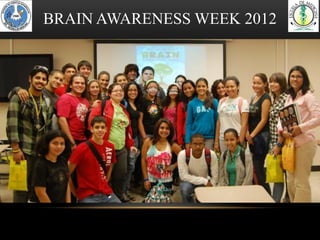
BRAIN AWARENESS WEEK 2012
Questions?


Hope to see you soon in our program
CONTACT US


Nivia L. Pérez-Acevedo, Ph.D.
   • nivia.perez@upr.edu
   • Exts 1512, 1879


   • 787-758-2525