Saltar al contenido principal
“STUDY OF DISTRIBUTION CHANNEL STRATEGY
OF PEPSICO FOR THE POSITIONING OF THE
PRODUCT IN VARANASI”
A DISSERTATION REPORT

MANGALMAY INSTITUTE OF MANAGEMENT & TECHNOLOGY
GREATER NOIDA,

MBA BATCH- 2009-2011

SUBMITTEDTO: NEERAJ KUMAR SINGH

SUBMITTED BY:ANIL KUMAR MISHRA
(CUSTOMER EXECUTIVE)

DECLARATION
I hereby declare that the project
entitled ‚STUDY OF DISTRIBUTION
CHANNEL STRATEGY OF THE PEPSICO FOR
THE POSITIONING OF THE PRODUCT‛ was
done by me under the guidance of Miss
JAYA JAIN, faculty MANGALMAY INSTITUTE OF
MANAGEMENT & TECHNOLOGY,GREATER NOIDA,, in

partial fulfillment of the requirement
for the award of the degree of Post
Graduate Program in Master Of
Business Administration.
I assure that the work is original and
has not been submitted earlier to this
Institute or to any other institution.

ANIL KUMAR MISHRA
ACKNOWLEDGEMENT

There is always a sense of gratitude
one

expresses

to

others

for

the

helpful and needy service they render
during

all

phases

of

life.

I

have

completed this Project with the help
of different personalities. I wish to
express my gratitude towards all of
them.

I am highly indebted to NEERAJ SINGH
(Customer Executive) for providing me an
opportunity to work for the dissertation on
wonderful topic “STUDY OF DISTRIBUTION
CHANNEL
STRATEGY
OF
PEPSICO
FOR
THE
POSITIONING OF THE PRODUCT ”
Lastly I would like to thank my parents
and friends for their constant support
during the duration of my Dissertation.

Table of Content
Research Title

1

Declaration

2

Acknowledgement

3

Literature Review
Objective

1-2
3
Summary about the company
Marketing overview of PepsiCo in India

4-20
21-31

Sales and Distribution network of PepsiCo

31-34

Sales and Marketing Hierarchy of PepsiCo

35-40

Five forces effecting the environment

41-43

Research Methodology

44-63

Limitation
SWOT Analysis

64
65-67

Observations

68

Findings

69

Recommendations

70-71

Conclusion

72

Bibliography

73

Questionnaire

74-75
LITERATURE REVIEW

PepsiCo is one of the oldest, largest
and

most

snack

successful

food

companies

beverage
in

the

and

world.

PepsiCo was founded by Caleb Bradham
in 1902 in USA. Today PepsiCo and its
affiliates

operate

in

more

than

140

countries in the world and generate
revenues in excess of $ 40 Billion. In
its pursuit of never ending growth and
expansion, PepsiCo entered India in 1989
in

a

joint

Government.
very

soon

venture
However,
started

with

Punjab

PepsiCo
its

India

beverage

operations in collaboration with the R
K Jaipuria group.
Soon

after

segment

entering

PepsiCo

the

beverage

Established

its

dominance in the market owing to its
expertise

in

operations

and

sales,
local

marketing,

collaboration.

PepsiCo maintained its market dominance
for many more years to come. However,
this advantage slipped and PepsiCo had
to concede the market leadership to
Coca Cola India. Several actors were
responsible for this development. But,
the most important are;

Distribution

channel

important

role

in

product

because

is

having

positioning
we

of

know

an
the
that

distribution channel is tool by which we
can

make

reach

our

product

of

slums

to

the

final consumers

Discontinuation
distribution

network

by

in

PepsiCo.

the
This

move by PepsiCo adversely affected its
position of a market leader because
while PepsiCo discontinued the use of
Slums in its distribution network, Coke
continued it and within one year, it was
able

to

snatch

considerable

market

share from PepsiCo.

Acquisition
favored

of

well-established

brands

Limca by

Coca

like

Thumps

and

Up

and

Cola India. These

two

brands still constitute a bulk of sales
for Coca Cola India.

To explore the reasons behind these
developments this study will analyze
the marketing initiatives and policies of
PepsiCo India in detail with particular
focus

on

management.

its

partner

relationship
The above-mentioned objectives can be
achieved
planned

by

carrying

research

a

proper

involving

and

different

types and methods. The data collected
for laid the foundations for the study
and gave a platform for the analysis
and

findings

which

lead

to

the

fulfillment of the objectives.

The

data

collected

for

research

is

primary and secondary. Primary data is
collected
and

by

observation,

questionnaires.

interviews

The

data

collection and analysis paves way for
the recommendation ad conclusion of
the study that reveals some important
findings

regarding

the

strategy

and

corporate structure and strategy of
PepsiCo India.
OBJECTIVE OF PROJECT

1.

To

know

distribution

channel

Strategy of PepsiCo.

1.

To

know

the

Distribution

importance

channel

strategy

of
in

Positioning of the product.

Sub Objective:

1.

To

know

towards
strategy.

the
the

PepsiCo

distribution

planning
channel
1.

How

strong

has

with

relationship

the

PepsiCo

distributors

and

retailers.

1.

Perception

of

consumer

towards

the PepsiCo product.

1.

Perception of retailers towards the
distribution channel of the PepsiCo.

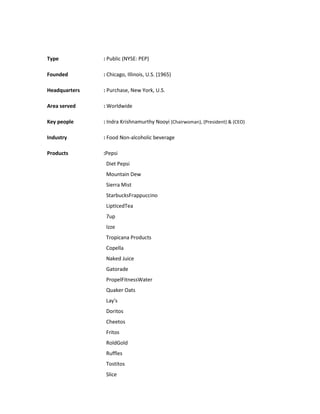
Summary about the company
Type

: Public (NYSE: PEP)

Founded

: Chicago, Illinois, U.S. (1965)

Headquarters

: Purchase, New York, U.S.

Area served

: Worldwide

Key people

: Indra Krishnamurthy Nooyi (Chairwoman), (President) & (CEO)

Industry

: Food Non-alcoholic beverage

Products

:Pepsi
Diet Pepsi
Mountain Dew
Sierra Mist
StarbucksFrappuccino
LiptIcedTea
7up
Izze
Tropicana Products
Copella
Naked Juice
Gatorade
PropelFitnessWater
Quaker Oats
Lay's
Doritos
Cheetos
Fritos
RoldGold
Ruffles
Tostitos
Slice
Nimbooz
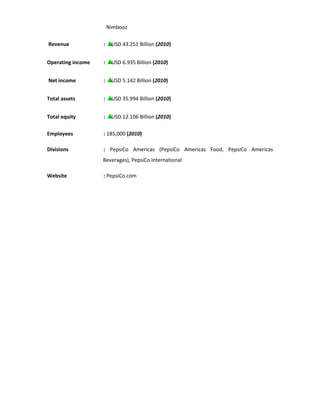
Revenue

:▲
USD 43.251 Billion (2010)

Operating income

:▲
USD 6.935 Billion (2010)

Net income

:▲
USD 5.142 Billion (2010)

Total assets

:▲
USD 35.994 Billion (2010)

Total equity

:▲
USD 12.106 Billion (2010)

Employees

: 185,000 (2010)

Divisions

: PepsiCo Americas (PepsiCo Americas Food, PepsiCo Americas
Beverages), PepsiCo International

Website

: PepsiCo.com
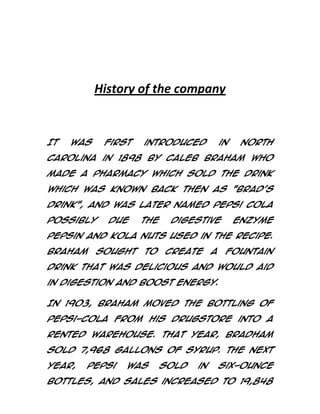
History of the company

It

was

first

introduced

in

North

Carolina in 1898 by Caleb Braham who
made a pharmacy which sold the drink
which was known back then as "Brad's
Drink", and was later named Pepsi Cola
possibly

due

the

digestive

enzyme

pepsin and kola nuts used in the recipe.
Braham

sought

to

create

a

fountain

drink that was delicious and would aid
in digestion and boost energy.
In 1903, Braham moved the bottling of
Pepsi-Cola from his drugstore into a
rented warehouse. That year, Bradham
sold 7,968 gallons of syrup. The next
year,

Pepsi

was

sold

in

six-ounce

bottles, and sales increased to 19,848
gallons. In 1926, Pepsi received its first
logo redesign since the original design
of 1905. In 1929, the logo was changed
again. In 1929, automobile race pioneer
Barney Oldfield endorsed Pepsi-Cola in
newspaper

ads

drink...refreshing,

as

"A

invigorating,

bully
a

fine

bracer before a race".
In

1931,

the

Pepsi-Cola

Company

went

bankrupt during the Great Depressionin large part due to financial losses
incurred

by

speculating

on

wildly

fluctuating sugar prices as a result of
World War I. Assets were sold and Roy
C.

Megargel

trademark.
company

bought

Eight

went

years

bankrupt

the

Pepsi

later,
again.

the

Pepsi's

assets were then purchased by Charles
Guth; the President of Loft Inc. Loft
was a candy manufacturer with retail
stores that contained soda fountains.
He sought to replace Coca-Cola at his
stores' fountains after Coke refused
to give him a discount on syrup. Guth
then had Loft's chemists reformulate
the Pepsi-Cola syrup formula.
During

the

gained

Great

popularity

introduction
bottle.

Depression,

in

following

1936

Initially

Pepsi

of

priced

a
at

the

12-ounce
10

cents,

sales were slow, but when the price
was

slashed

increased
advertising

to

five

cents,
With

substantially.
campaign

sales
radio

a

featuring

the

jingle "Pepsi cola hits the spot Twelve
full ounces, that's a lot / Twice as
much for a nickel, too Pepsi-Cola is the
drink for you," arranged in such a way
that

the

jingle

never

ends.

Pepsi

encouraged price-watching consumers
to switch, obliquely referring to the
Coca-Cola standard of six ounces per
bottle for the price of five cents (a
nickel), instead of the 12 ounces Pepsi
sold at the same price. Coming at a time
of

economic

crisis,

the

campaign
succeeded in boosting Pepsi's status.
In 1936 alone 500,000,000 bottles of
Pepsi were consumed. From 1936 to 1938,
Pepsi-Cola's profits doubled.

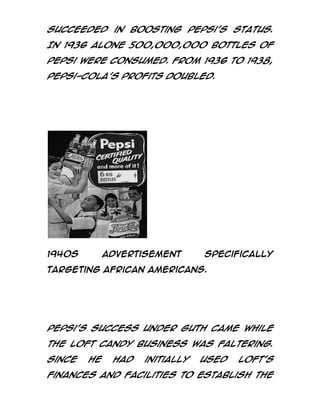
1940s

advertisement

specifically

targeting African Americans.

Pepsi's success under Guth came while
the Loft Candy business was faltering.
Since

he

had

initially

used

Loft's

finances and facilities to establish the
new Pepsi success, the near-bankrupt
Loft

Company

sued

Guth

for

possession of the Pepsi-Cola company.
A long legal battle, Guth v. Loft, then
ensued,

with

the

case

reaching

the

Delaware Supreme Court and ultimately
ending in a loss for Guth.
Pepsico in India
PepsiCo gained entry to India in 1988 by
creating a joint venture with the Punjab
government-owned
Industrial

Punjab

Corporation

(PAIC)

Agro
and

Voltas India Limited. This joint venture
marketed

and

sold

Lehar

Pepsi

until

1991, when the use of foreign brands
was allowed; PepsiCo bought out its
partners and ended the joint venture in
1994. Others claim that firstly Pepsi was
banned from import in India, in 1970, for
having refused to release the list of
its ingredients and in 1993, the ban was
lifted, with Pepsi arriving on the market
shortly

afterwards.

controversies
"India's

companies."

have

a

reminder

sometimes

relationship

PepsiCo

are

with

and

The

"been

multinational

some

argue

Coca-Cola

major

of

acrimonious

huge

Indeed,

These

that

Company

targets

in

part

because they are well-known foreign
companies

that

draw

plenty

of

attention."
In 2003, the Centre for Science and
Environment (CSE), a non-governmental
organization in New Delhi, said aerated
waters

produced

manufacturers
multinational

by

in

soft

India,

giants

PepsiCo

drinks

including
and

The

Coca-Cola Company, contained toxins,
including lindane,
chlorpyrifos

—

DDT,

malathion and

pesticides

that

can

contribute to cancer, a breakdown of
the

immune

system

and

cause

birth
defects.

Tested

products

included

Coke, Pepsi, 7 Up, Mirinda, Fanta, Thums
Up, Limca, and Sprite. CSE found that the
Indian-produced
products

had

pesticide

Pepsi's

36

times

residues

European

Union

soft
the

drink

level

permitted

of

under

regulations;

Coca

Cola's 30 times. CSE said it had tested
the same products in the US and found
no such residues. However, this was the
European standard for water, not for
other drinks. No law bans the presence
of pesticides in drinks in India.
The

Coca-Cola

Company

and

PepsiCo

angrily denied allegations that their
products

manufactured

in

India

contained toxin levels far above the
norms

permitted

world.

But

committee,
findings

an
in

and

in

Indian

2004,
a

the

developed

parliamentary

backed

up

CSE's

government-appointed

committee, is now trying to develop the
world's first pesticides standards for
soft drinks. Coke and PepsiCo opposed
the move, arguing that lab tests aren't
reliable

enough

to

detect

minute

traces of pesticides in complex drinks.
On December 7, 2004, India's Supreme
Court

ruled

competitor

that
The

both

PepsiCo

Coca-Cola

and

Company

must label all cans and bottles of the
respective soft drinks with a consumer
warning

after

unacceptable

tests

levels

showed

of

residual

pesticides.
Both

companies

that

their

continue

products

to

maintain

meet

all

international safety standards without
yet

implementing

ruling.

As

of

the

2005,

Supreme
The

Court

Coca-Cola

Company and PepsiCo together hold 95%
market share of soft-drink sales in
India.
by

the

PepsiCo has also been accused
Puthussery

panchayat

in

the

Palakkad district in Kerala, India, of
practicing "water piracy" due to its role
in

exploitation

resources
drinking

the

ground

resulting

water

residents,

of

in

for

who

scarcity

the

of

panchayat's

have

government

water

been

to

pressuring

close

down

the

PepsiCo unit in the village.
In 2006, the CSE again found that soda
drinks, including both Pepsi and CocaCola, had high levels of pesticides in
their drinks. Both PepsiCo and The CocaCola Company maintain that their drinks
are

safe

for

consumption

published

newspaper

that

pesticide

say

and

have

advertisements
levels

in

their

products are less than those in other
foods

such

as

tea,

fruit

and

dairy

products. In the Indian state of Kerala,
sale

and

along

with

banned
2006,

production
other

by
but

the
this

of

soft

state
was

Pepsi-Cola,
drinks,

was

government

reversed

by

in
the

Kerala High Court merely a month later.
Five

other

Indian

states

have
announced partial bans on the drinks in
schools, colleges and hospitals.
Marketing Strategy of Pepsi

In

1975,

Pepsi

Challenge

introduced

marketing

the

campaign

Pepsi
where

PepsiCo set up a blind tasting between
Pepsi-Cola and rival Coca-Cola. During
these blind taste tests the majority of
participants picked Pepsi as the better
tasting of the two soft drinks. PepsiCo
took great advantage of the campaign
with television commercials reporting
the test results to the public.
In 1976 Pepsi, RKO Bottlers in Toledo,
Ohio

hired

the

first

female

Pepsi

salesperson, Denise Muck, to coincide
with

the

United

States

bicentennial

celebration.

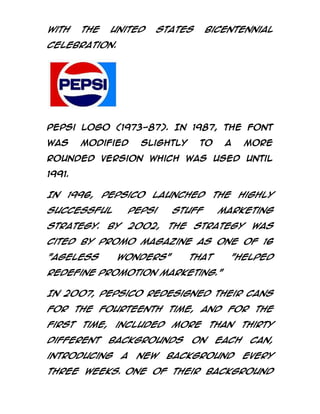
Pepsi logo (1973-87). In 1987, the font
was

modified

slightly

to

a

more

rounded version which was used until
1991.

In

1996,

PepsiCo

launched

successful

Pepsi

strategy.

2002,

By

the

Stuff
the

highly

marketing

strategy

was

cited by Promo Magazine as one of 16
"Ageless

Wonders"

that

"helped

redefine promotion marketing."
In 2007, PepsiCo redesigned their cans
for the fourteenth time, and for the
first

time,

different

included

more

backgrounds

introducing

a

new

on

than
each

background

thirty
can,
every

three weeks. One of their background
designs includes a string of repetitive
numbers

73774.

This

is

a

numerical

expression from a telephone keypad of
the word "Pepsi."

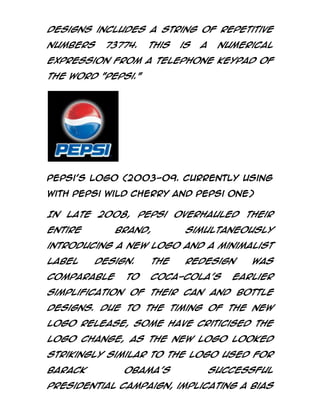
Pepsi’s logo (2003-09. Currently using
with Pepsi Wild Cherry and Pepsi ONE)

In late 2008, Pepsi overhauled their
entire

brand,

simultaneously

introducing a new logo and a minimalist
label

design.

comparable

to

The

redesign

Coca-Cola's

was

earlier

simplification of their can and bottle
designs. Due to the timing of the new
logo release, some have criticised the
logo change, as the new logo looked
strikingly similar to the logo used for
Barack

Obama's

successful

presidential campaign, implicating a bias
towards

the

President.

Also

in

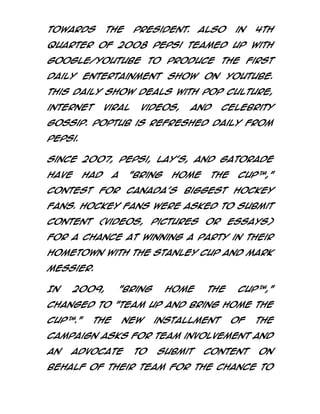
4th

quarter of 2008 Pepsi teamed up with
Google/Youtube to produce the first
daily entertainment show on Youtube.
This daily show deals with pop culture,
internet

viral

videos,

and

celebrity

gossip. Poptub is refreshed daily from
Pepsi.
Since 2007, Pepsi, Lay's, and Gatorade
have

had

a

"Bring

Home

the

Cup™,"

contest for Canada's biggest hockey
fans. Hockey fans were asked to submit
content (videos, pictures or essays)
for a chance at winning a party in their
hometown with The Stanley Cup and Mark
Messier.
In

2009,

"Bring

Home

the

Cup™,"

changed to "Team Up and Bring Home the
Cup™."

The

new

installment

of

the

campaign asks for team involvement and
an

advocate

to

submit

content

on

behalf of their team for the chance to
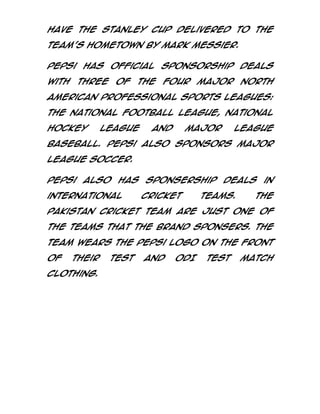
have the Stanley Cup delivered to the
team's hometown by Mark Messier.
Pepsi has official sponsorship deals
with

three of the

four major North

American professional sports leagues:
the National Football League, National
Hockey

League

and

Major

League

Baseball. Pepsi also sponsors Major
League Soccer.
Pepsi also has sponsership deals in
international

cricket

teams.

The

Pakistan cricket team are just one of
the teams that the brand sponsers. The
team wears the Pepsi logo on the front
of

their

clothing.

test

and

ODI

test

match
Slogans of Pepsi
1.

1939-1950: "Twice as Much for a
Nickel"

2.

1950: "More Bounce to the Ounce"

3.

1950-1957: "Any Weather is Pepsi
Weather"

4.

1957-1958: "Say Pepsi, Please"

5.

1958-1961: "Be Sociable, Have a Pepsi"

6.

1961-1963: "Now It's Pepsi for Those
Who Think Young"
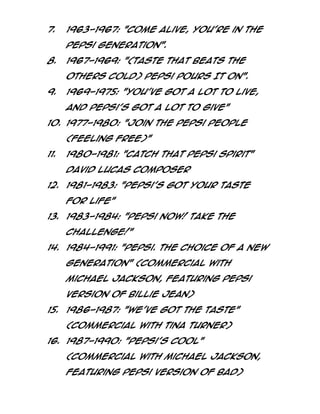
7.

1963-1967: "Come Alive, You're in the
Pepsi Generation".

8.

1967-1969: "(Taste that beats the
others cold) Pepsi Pours It On".

9.

1969-1975: "You've Got a Lot to Live,
and Pepsi's Got a Lot to Give"

10. 1977-1980: "Join the Pepsi People
(Feeling Free)"
11.

1980-1981: "Catch That Pepsi Spirit"
David Lucas composer

12. 1981-1983: "Pepsi's got your taste
for life"
13. 1983-1984: "Pepsi Now! Take the
Challenge!"
14. 1984-1991: "Pepsi. The Choice of a New
Generation" (commercial with
Michael Jackson, featuring Pepsi
version of Billie Jean)
15. 1986-1987: "We've Got The Taste"
(commercial with Tina Turner)
16. 1987-1990: "Pepsi's Cool"
(commercial with Michael Jackson,
featuring Pepsi version of Bad)
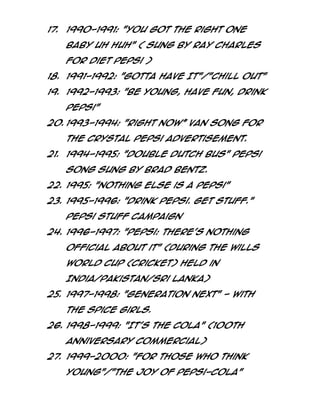
17. 1990-1991: "You got the right one
Baby UH HUH" ( sung by Ray Charles
for Diet Pepsi )
18. 1991-1992: "Gotta Have It"/"Chill Out"
19. 1992-1993: "Be Young, Have Fun, Drink
Pepsi"
20. 1993-1994: "Right Now‛ Van song for
the Crystal Pepsi advertisement.
21. 1994-1995: "Double Dutch Bus" Pepsi
song sung by Brad Bentz.
22. 1995: "Nothing Else is a Pepsi"
23. 1995-1996: "Drink Pepsi. Get Stuff."
Pepsi Stuff campaign
24. 1996-1997: "Pepsi: There’s nothing
official about it" (During the Wills
World Cup (cricket) held in
India/Pakistan/Sri Lanka)
25. 1997-1998: "Generation Next" - with
the Spice Girls.
26. 1998-1999: "It's the cola" (100th
anniversary commercial)
27. 1999-2000: "For Those Who Think
Young"/"The Joy of Pepsi-Cola"
(commercial with Britney
Spears/commercial with Mary J.
Blige)
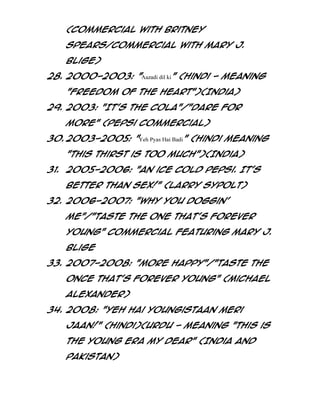
28. 2000-2003: "

" (Hindi - meaning

"Freedom of the Heart")(India)
29. 2003: "It's the Cola"/"Dare for
More" (Pepsi Commercial)
30. 2003-2005: "

" (Hindi meaning

"This thirst is too much")(India)
31. 2005-2006: "An ice cold Pepsi. It's
better than sex!" (Larry Sypolt)
32. 2006-2007: "Why You Doggin'
Me"/"Taste the one that's forever
young" Commercial featuring Mary J.
Blige
33. 2007-2008: "More Happy"/"Taste the
once that's forever young" (Michael
Alexander)
34. 2008: "Yeh hai Youngistaan Meri
Jaan!" (Hindi)(Urdu - meaning "This is
the Young era my dear" (India and
Pakistan)
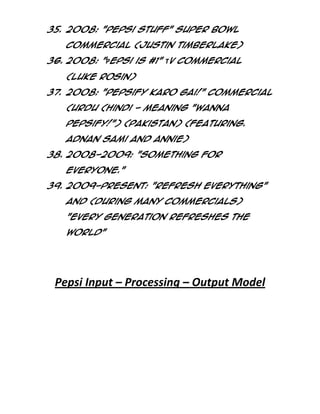
35. 2008: "Pepsi Stuff" Super Bowl
Commercial (Justin Timberlake)
36. 2008: "Рepsi is #1" Тv commercial
(Luke Rosin)
37. 2008: "Pepsify karo gai!" Commercial
(Urdu (Hindi - meaning "Wanna
Pepsify!") (Pakistan) (Featuring.
Adnan Sami and Annie)
38. 2008-2009: "Something for
Everyone."
39. 2009-present: "Refresh Everything"
and (during many commercials)
"Every Generation Refreshes The
World"

Pepsi Input – Processing – Output Model
Input
Supply
1.

Manage

ensure

supply
availability

ingredients
to

to

produce

products.
2.

Maintain purified water supply for
quality and availability to produce
products.

Manufacturing
1.
to

Ensure best technology is available
produce

ingredients.

products

and

mix
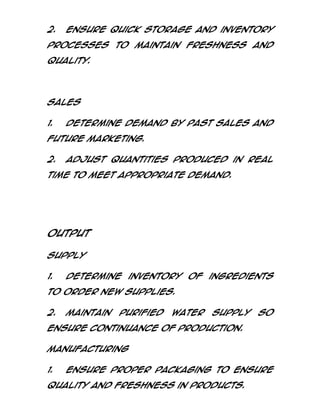
2.

Ensure quick storage and inventory

processes to maintain freshness and
quality.

Sales
1.

Determine demand by past sales and

future marketing.
2.

Adjust quantities produced in real

time to meet appropriate demand.

Output
Supply
1.

Determine inventory of ingredients

to order new supplies.
2.

Maintain

purified

water

supply

so

ensure continuance of production.
Manufacturing
1.

Ensure proper packaging to ensure

quality and freshness in products.
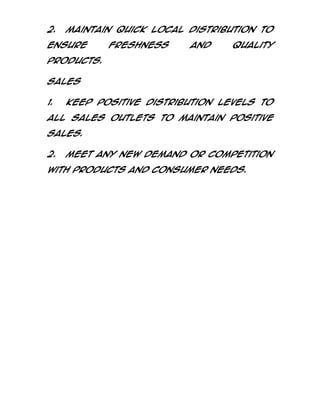
2.

Maintain quick local distribution to

ensure

freshness

and

quality

products.
Sales
1.

Keep positive distribution levels to

all sales outlets to maintain positive
sales.
2.

Meet any new demand or competition

with products and consumer needs.
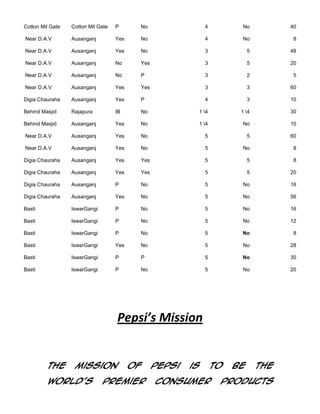
EVERY DELAR SURVEY {EDS}
OF SRI LUXMI SUB-DISTRIBUTER OF PEPSICO
SUB LOCALITY

LOCALITY

PCI VISI CCX VISI VEHICLE PCI VEHICLE CCX

TOTAL SALE

Near D.A.V

Ausanganj

Yes

Yes

6

5

90

Near D.A.V

Ausanganj

Yes

No

6

No

40

Near D.A.V

Ausanganj

Yes

No

6

No

35

Digia Chauraha

Ausanganj

P

No

6

No

30

Digia Chauraha

Ausanganj

Yes

Yes

6

5

10

Digia Chauraha

Jaitpura

P

Yes

6

5

10

Digia Chauraha

Jaitpura

No

Yes

2

2

10

Digia Chauraha

Jaitpura

Yes

Yes

3

3

40

Digia Chauraha

Jaitpura

No

Yes

3

3

10

Thana Jaitpura

Jaitpura

Yes

Yes

3

3

10

Thana Jaitpura

Jaitpura

P

Yes

3

3

10

Thana Jaitpura

Jaitpura

No

Yes

3

3

20

Thana Jaitpura

Jaitpura

P

Yes

3

3

10

Thana Jaitpura

Jaitpura

P

No

3

3

5

Nagkua, Jaitpura

Jaitpura

Yes

No

3

3

5

Nagkua, Jaitpura

Jaitpura

Yes

No

None

3

20

Kajipura

Badi Bazar

Yes

No

4

No

40

Kajipura

Badi Bazar

Yes

No

4

No

20

Kajipura

Badi Bazar

Yes

No

4

No

40

Bismila Katra

Badi Bazar

Yes

No

3

No

50

Badi Bajar

Badi Bazar

Yes

No

3

No

120

Chavi Mahal

Chavi Mahal

Yes

Yes

4

No

30

Chavi Mahal

Chavi Mahal

Yes

Yes

4

No

40

Cotton Mil Gate

Cotton Mil Gate

Yes

No

4

No

60
Cotton Mil Gate

Cotton Mil Gate

P

No

4

No

40

Near D.A.V

Ausanganj

Yes

No

4

No

8

Near D.A.V

Ausanganj

Yes

No

3

5

48

Near D.A.V

Ausanganj

No

Yes

3

5

20

Near D.A.V

Ausanganj

No

P

3

2

5

Near D.A.V

Ausanganj

Yes

Yes

3

3

60

Digia Chauraha

Ausanganj

Yes

P

4

3

10

Behind Masjid

Rajapura

IB

No

1 4

1 4

30

Behind Masjid

Ausanganj

Yes

No

1 4

No

10

Near D.A.V

Ausanganj

Yes

No

5

5

60

Near D.A.V

Ausanganj

Yes

No

5

No

8

Digia Chauraha

Ausanganj

Yes

Yes

5

5

8

Digia Chauraha

Ausanganj

Yes

Yes

5

5

20

Digia Chauraha

Ausanganj

P

No

5

No

16

Digia Chauraha

Ausanganj

Yes

No

5

No

56

Basti

IswarGangi

P

No

5

No

16

Basti

IswarGangi

P

No

5

No

12

Basti

IswarGangi

P

No

5

No

8

Basti

IswarGangi

Yes

No

5

No

28

Basti

IswarGangi

P

P

5

No

30

Basti

IswarGangi

P

No

5

No

20

Pepsi’s Mission

The

mission

world's

of

premier

Pepsi

is

to

consumer

be

the

Products
Company focused on convenient foods
and

beverages.

We

seek

to

produce

healthy financial rewards to investors
as we provide opportunities for growth
and enrichment to our employees, our
business partners and the communities
in which we operate.

And in everything

we do, we strive for honesty, fairness
and integrity.
than

both

industry
years.
Their

Pepsi has grown faster

the

group

S&P

500

and

their

over

the

past

four

2003 alone was a strong year.
overall

volume

grew

by

5%.

Division net revenue grew by 8%. Division
operating profit grew by 10%.
return

to

shareholders

Total

was

12%.

Earnings per share grew by 22%.

They

have six of the fifteen largest-selling
brands

in

around

the

brands

sell

U.S

Supermarkets.

world,
more

sixteen
than

dollars each at retail.

of

one

And,
their

billion
Pepsi is also very concerned about the
environment and has a separate set of
goals. Our goal is to have the least
possible impact on the environment and
so far we have been very successful.
For

example,

in

1992

Pepsi-Cola

replaced its can holders with plastic
ring connectors. Using a break-apart
concept, these rings snap when cans
are

removed

greatly

from

reducing

the

connectors,

the

risk

of

entanglement for wildlife. In addition,
photo-degradable additives break down
these connectors into small particles
when

they

are

exposed

to

sunlight,

further reducing the likelihood of any
negative environmental impact. In 1995,
Pepsi was one of only 20 companies
honored

by

the

U.S.

Protection

Agency

Administrator

Carol

Environmental
(EPA).

Browner

EPA
called

the efforts of Pepsi to reduce solid
waste "a notable achievement."
A third goal of Pepsi is to achieve a
diverse workforce.

Pepsi knows that

understanding different cultures is a
major advantage. They view diversity as
a key to their future.

They see that

offering a workplace where diversity is
valued helps them build the top-quality
workforce so crucial to their success
by enabling them to attract and retain
great people from a wide spectrum of
backgrounds.
quote,

Their

‚PepsiCo

dedicated

to

CEO

has

instilling

offers
long

the

this
been

broadest

possible base of diversity within our
own company and among the companies
who serve us, and is a strong advocate
of

diversity

within

our

communities.‛

This intense dedication to diversity has
led to many awards that include being
named a top 50 company for diversity by
DiversityInc.

Fortune magazine ranked

Pepsi number nine for best companies
for minorities.
Business Views
These are the three different views to
explain

Pepsi

accuracy,

in

terms

timeliness,

of

relevance,

exclusiveness,

and accessibility.
MARKETING VIEW-: The marketing view is
the backbone of business dimension in
case study of Pepsi. In order to make a
firm successful in the marketplace this
view must penetrate all the other views
together.

Introducing

new

ways

to

approach the market or launching a new
product needs good understanding of
the

target population, which

through
forecasts

the

is

done

marketing

and

view.

plans

different

the

It

components in the business dimension
that are going to affect the future of
the

company.

Through

the

marketing

view Pepsi tries to reach to its existing
as

well

competent

as

future

market

customers.

strategy

is

A

very

important in today’s competitive market;
especially for a multinational company
like,

Pepsi.

Narrowing

down

its

different products towards different
type of population, for example, Sprite
among

buyers

for

various

products

within the company. Advertising is a very
vital part in the marketing view because
it

brings

the

consumers

and

Pepsi

together which determines the demand.

PRODUCT
Pepsi

VIEW-:

The

reflects

products
among

the

every
these

six

product
launch

of

months.

globally

view

As

of
new

seen

operating

beverage companies, Pepsi and Coke, in
order to stay competent in the market
they invent new products to
attract more customers and please the
existing ones.
hard

in

If Pepsi

experimenting

does not
new

try

products

they know someone else could steal
the market with similar ideas. If there is
no

product,

Therefore,

in

there

is

no

business.

order

to

dominant

the

market globally as well as in the U.S.,
Pepsi comes with different flavors or
even

changes

the

looks

of

bottles.

Pepsi has wide variety of beverages like
soft drinks, juices, water, and energy
drinks. This company started with just
plain

soda

trying

to

and

add

since

more

then

has

products

been

to

its

existing line. If you look according to
the accessibility view you can also see
those vending machines everywhere for
your

conveniences.

LOGISTIC VIEW-:
very

important

The logistic view is a
part

of

the

globally

operating companies. For Pepsi, to have
bottling

plants

in

all

the

countries

they sell the products is necessary. By
doing

this,

established

there

exists

connection

a

well-

between

the

suppliers, producers, distributors and
consumers.

Pepsi

Company’s

organization is divided into four areas
covering
America.

Asia,
These

Africa,
four

Europe

and

subdivisions

are

further narrowed among the countries
in

these

continents.

The

inter-

organization structure of the company
has

different

divisions.

The

manufacturing plant makes and bottles
the product, the distributors deliver to
the suppliers, and the suppliers sell it
to

the

retailers

consumers.

and

These

finally

to

supply–chains

the
in

different countries are controlled by
one main headquarter.

In the Market
1.

2.
3.

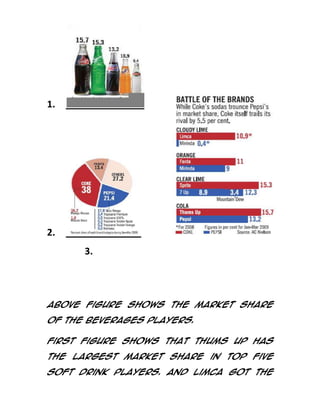
Above figure shows the market share
of the beverages players.
First figure shows that thums up has
the largest market share in top five
soft drink players. And limca got the
fifth rank. Pepsi is on the 3rd rank with
13.2% market share.

Second figure shows the market share
covered

by

beverage

players.

In

the

market coke is on 1st rank with the 38%
of market share and Pepsi has 21.4%
market share.

Third figure shows the battle between
the

product

of

different

brand

but

same flavor. In this war of soft drink in
between Pepsi and thums up thums up
has won this war by 15.7% of market
share, Pepsi has only 13.2% of market
share in cola market.
PEPSICO INDIA WITH RKJ GROUP:
Vision
Being the best in everything we touch
and handle.
Mission
Continuously
maintain
chosen

excel

to

leadership

achieve

position

businesses;

and

and

in

the

delight

all

stakeholders by making economic value
additions in all corporate functions.

It can be said with absolute certainty
that the RKJ Group has carved out a
special niche for itself. Our services
touch different aspects of commercial
and

civilian

domains

like

those

of

Bottling, Food Chain and Education. Headed

by Mr. R. K. Jaipuria, the group as on
today can lay claim to expertise and
leadership in the fields of education,
food and beverages.

The

business

of

the

company

was

started in 1991 with a tie-up with Pepsi
Foods

Limited

to

manufacture

and
market

Pepsi

brand

of

beverages

in

geographically pre-defined territories
in which brand and technical support
was

provided

by

the

Principals

viz.,

Pepsi Foods Limited. The manufacturing
facilities were restricted at Agra Plant
only.
Varun

Beverages

Ltd.

is

the

flagship

company of the group.The group also
became the

first

Restaurants

franchisee

International

PepsiCo

Restaurants

Limited]

in

franchise

India.
rights

for Yum

[formerly

(India)

It

has

for

Private

exclusive

Northern

&

Eastern India. It has total 46 Pizza Hut
Restaurants & 1 KFC Restaurant under
its company.

The group added another feather to its
cap

when

the

‚International
award
Jaipuria

was
for

prestigious

PepsiCo

Bottler

of

the

Year‛

presented

to

Mr.

R.

K.

at

a

the

year

1998
glittering award ceremony at PepsiCo’s
centennial year celebrations at Hawaii,
USA. The award was presented by Mr.
Donald M. Kendall, founder of PepsiCo
Inc. in the presence of Mr. George Bush,
the 41st President of USA, Mr. Roger A.
Enrico, Chairman of the Board & C.E.O.,
PepsiCo Inc. and Mr. Craig Weatherup,
President of Pepsi Cola Company.

Strategic Divisions:

PepsiCo

India

consists

of

different

divisions that include Beverage division,
Snack food division and the Restaurant
division

(Yum

Restaurants

India

Pvt.

Ltd.). These divisions work as separate
SBU’s

and

management.

have

their

separate
PepsiCo

India

division

into

divided

its

different

beverage
operating

divisions. The heads of these divisions
report directly to the CEO. The heads
of

these

their

divisions

respective

are

in

areas

charge
and

of
are

accountable for the proper functioning
of all the regions. The FOBO’s also
report

to

the

from the COBO’s.

regional

heads

apart
MARKETING OVERVIEW OF PEPSICO INDIA

Marketing Environment:
Marketing environment
environment
operates.

in

This

is

the

which
consists

a

overall
Company

of

the

Task

Environment and the Broad Environment.

Task Environment
Task Environment includes the immediate
players

involved

distributing
offering.

The

company,
dealers

producing,

promoting

main

players

suppliers,
and

Suppliers
service

and

in

the

suppliers

research

the

distributors,

target

include

are

the

the
such

customers.

material
as

agencies,

agencies,

banking

and

companies,

transportation

and

marketing
advertising
insurance
companies,

and telecommunications companies. The
dealers

and

agents,

distributors

brokers,

representatives
facilitate

manufacturer

and

finding

include

others

and

selling

who
to

customers.

The suppliers for PepsiCo India include
the

bottle

suppliers

for

the

soft

drinks. These include the Pet bottles
and the Glass bottles. One of the most
vital

products

operation
does

is
not

refrigerators,

required

in

Refrigerator.

PepsiCo

manufacture
instead

the

they

the
are

supplied by different vendors who get
time

bound

contracts

from

the

company.
The distributors and dealers are part
of the sales and distribution network.
This will be explained later under the
section of ‘Place’, in the 4 P’s segment.
The

target

primarily

customer

the

increasing
PepsiCo

youth.

people

who

PepsiCo

PepsiCo
because

from

expanded

base

beverages

But,

competition

has

customer

for

which
are

beyond

has

target
includes

prospects
the

started

CSD

of

Coke

its

now

is

for

category.

targeting

this

segment by offering products in the
Non- CSD category, these include fruit
based

non-carbonated

based

drinks,

drinks,

snack

energy
food

drinks,
drinks,

(from

juice
sports

the

snack

food division i.e. ‘Frito Lay’).

Broad Environment:
This contains forces that can have a
major impact on the players in the task
environment.

This

includes

six

components: demographic environment,
economic
environment,

environment,

physical

technological
environment,

political

environment,

and

environment.
close

socio

Companies

attention

developments

to

in

cultural

–

need

to

pay

trends

the

these

legal

–

and

environments

and make timely adjustments to their
marketing strategies in order survive
and succeed in the market. This will be
explained

in

detail

in

the

strategic

marketing segment.

Value Delivery Process:
The value delivery process consists of
the

value

creation

and

delivery

sequence. This is done in three phases.
The

first

phase,

choosing

the

value,

represents the homework done by the
marketing

department

before

the

product exists. Marketing is required to
segment

the

appropriate
develop

the
the

market,
target

select

the

market,

and

offering’s

value
proposition.

This

is

known

as

Segmentation, Targeting and Positioning
and

is

the

essence

of

strategic

marketing.

Once the business unit has chosen the
value, the second phase is providing the
value.

Marketers

need

to

determine

specific product features, prices and
distribution.

The

task

in

the

third

phase

is

communicating the value by utilizing the
sales

force,

advertising,
tools

to

and

sales
other

announce

and

promotion,
communication
promote

the

product. Each of these value phases
has different cost implications.
Choose the Value (Strategic Marketing)
Customer
Segmentation

Market
Selection /
Focus

Value
Positioning

Provide the Value (Tactical Marketing)
Distributio
n/
Servicing

Sourcing /

Pricing

Making

Service
Developm
ent

Product
Developm
ent

Communicate the Value (Tactical Marketing)
Sales Force

Value Creation and Delivery Sequence

Sales
Promotion

Advertising
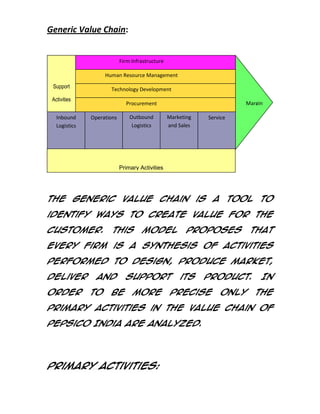
Generic Value Chain:

Firm Infrastructure
Human Resource Management
Support

Technology Development

Activities
Inbound
Logistics

Margin

Procurement
Outbound
Logistics

Operations

Marketing
and Sales

Service

Primary Activities

The generic value chain is a tool to
identify ways to create value for the
customer.

This

model

proposes

that

every firm is a synthesis of activities
performed to design, produce market,
deliver
order

and
to

be

support
more

its

product.

precise

only

In
the

primary activities in the value chain of
PepsiCo India are analyzed.

Primary Activities:
Inbound

Logistics

–

This

involves

bringing and procuring raw materials
for the business. For the carbonated
drinks industry only two raw materials
are required, they are water and the
concentrated
produce

salt

the

final

that

is

product.

used
For

to
this

purpose water is extracted from the
ground and the concentrated salt is
provided by PepsiCo India to all the
plants in the country.

Operations
includes

all

Currently
planting

–

Operations
the

there
in

India

bottling

primarily
plants.

are

32

bottling

that

operate

for

PepsiCo. Of the 32 plants, 15 are owned
by PepsiCo and the rest 17 are (FOBO),
owned by R K Jaipuria Group.

Outbound Logistics – The Outbound
logistics of Pepsi can be divided into
three stages. First the finished product
from the bottling plants is sent to the
depot or the territorial office, from
where it is sent to the C & F centers and
the

Distributor

Points

according

to

their demand. From the C & F centers
and Distributor Points the product is
sent out for sale in the market to the
retailers.

Marketing and Sales – The sales and
distribution network of Pepsi is very
strong

and

comprises

of

different

layers and a dedicated sales force.
This is one of the important factors
for the success of Pepsi. To keep the
company abreast with competition and
to

provide

support

partners and
PepsiCo

puts

marketing

to

to

its

increase

lot

of

activities.

channel

the

effort
This

sales,
in

its

includes

maintaining excellent relations with its
channel

partners,

making

huge
investments in Advertising, signing of
Megastars as its brand ambassadors,
sponsoring various events, launching
promotional

for

any

launch

or

re

launch of a product.

Service – In this industry after sales
service is generally not required. The
only

exception

being

leak

or

burst

bottles. In that case, the shopkeeper
gets replacement for plastic bottles
from the salesmen instantly, while the
replacement

for

glass

bottles

is

provided between 25th and 30th of every
month. They are required to collect all
the damaged glass bottles and give to
the respective salesperson who gives
them the replacement within the next
few days after getting it approved from
the CE or ADC.

Marketing Mix / 4 P’s:
Marketing Mix has been defined as the
set of marketing tools that a firm uses
to

pursue

its

marketing

objectives.

These tools are classified into four
broad groups, namely, Product, Price,
Place and Promotion.

Marketing mix decisions should be made
to influence trade channels as well as
final consumers. A firm can alter any
of the four P’s accordingly, including
changes in the product and distribution
channel as well.

The four P’s represent the seller’s view
of the marketing tools available for
influencing

buyers.

Whereas,

from

a

buyers point of view, each marketing
tool is designed to deliver a customer
specific benefits according to his or
her requirements.
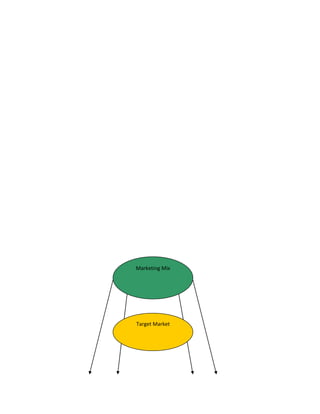
Marketing Mix

Target Market
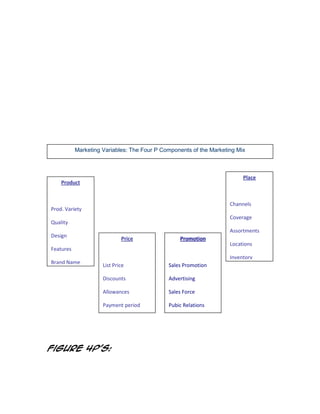
Marketing Variables: The Four P Components of the Marketing Mix

Place

Product

Product

Prod. Variety
Quality
Prod. Variety
Design
Features
Brand Name
Quality
Packaging
Sizes
Design
Services
Warranties
Features
Returns

Brand Name
Packaging
Sizes
Services
Warranties

Channels
Coverage
Assortments
Price

Promotion

Locations
Inventory

List Price

Sales Promotion

Discounts

Advertising

Allowances

Sales Force

Payment period

Pubic Relations

Credit Payments

Direct Marketing

Returns

Figure 4p’s:

Transport
Product:
variety

Pepsi

of

offers

products

carbonated

to

Non

different

ranging

from

Carbonated

Soft

Drinks. These include –
Pepsi Cola,Mirinda ( Lemon and Orange
),7

Up,Dew,Slice

,Tropicana,Aquafina

(Mineral Water)
These Products come in different size –
200 ml, 300 ml, 600 ml, 1200 ml, 2 lt.
there are nearly 42 SKU’s which are
monitored

and

regulated

on

daily

basis.

Product Quality:
This

is

one

of

the

most

important

aspects that any Co. needs to address.
Specially in the case of Pepsi this is
even

more

important

controversies

and

because

claims

of

the

regarding

the CSE report on Pesticides in Pepsi.
Therefore

pepsi

has

to

maintain

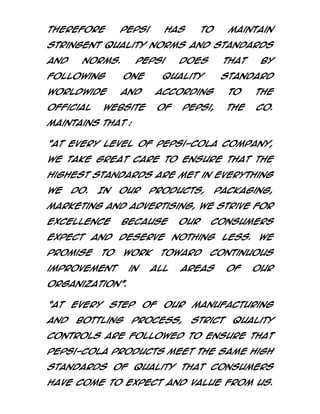
stringent quality norms and standards
and

norms.

Pepsi

following

one

worldwide

and

official

does

that

quality

by

standard

according

to

the

of

the

Co.

website

pepsi,

maintains that :
‚At every level of Pepsi-Cola Company,
we take great care to ensure that the
highest standards are met in everything
we

do.

In

our

products,

packaging,

marketing and advertising, we strive for
excellence

because

our

consumers

expect and deserve nothing less. We
promise

to

work

improvement

in

toward

all

continuous

areas

of

our

organization‛.
‚At
and

every

step

bottling

of

our

process,

manufacturing
strict

quality

controls are followed to ensure that
Pepsi-Cola products meet the same high
standards of quality that consumers
have come to expect and value from us.
We also follow strict quality control
procedures
and

during

filling

of

the

our

manufacturing

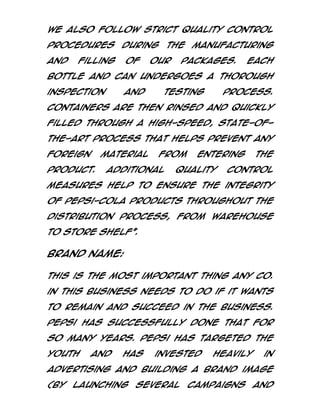
packages.

Each

bottle and can undergoes a thorough
inspection

and

testing

process.

Containers are then rinsed and quickly
filled through a high-speed, state-ofthe-art process that helps prevent any
foreign

material

product.

from

Additional

entering

quality

the

control

measures help to ensure the integrity
of Pepsi-Cola products throughout the
distribution process, from warehouse
to store shelf‛.

Brand Name:
This is the most important thing any Co.
in this Business needs to do if it wants
to remain and succeed in the Business.
Pepsi has successfully done that for
so many years. Pepsi has targeted the
youth

and

has

invested

heavily

in

advertising and building a brand image
(by

launching

several

campaigns

and
roping in mega stars such as Shahrukh,
Sachin,

ganguly,

Dravid

etc.)

that

attracts to the youth and this is one of
the main reason for the success of
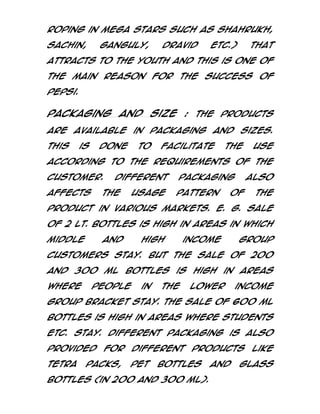
Pepsi.

Packaging and Size : The products
are available in packaging and sizes.
This

is

done

to

facilitate

the

use

according to the requirements of the
Customer.
affects

Different

the

usage

packaging
pattern

also

of

the

product in various markets. e. g. sale
of 2 lt. bottles is high in areas in which
middle

and

high

income

group

customers stay. But the sale of 200
and 300 ml bottles is high in areas
where

people

in

the

lower

income

group bracket stay. The sale of 600 ml
bottles is high in areas where students
etc. stay. Different packaging is also
provided
Tetra

for

Packs,

different
Pet

products

Bottles

Bottles (in 200 and 300 ml).

and

like

Glass
Services,

Warranties,

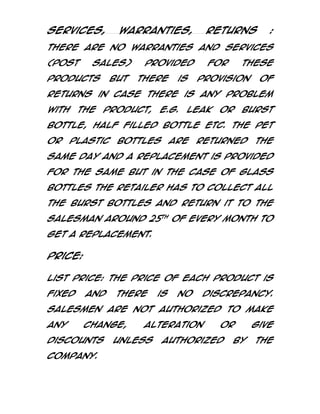
Returns

:

There are no warranties and services
(post

sales)

products

but

provided
there

is

for

these

provision

of

returns in case there is any problem
with

the

product,

e.g.

leak

or

burst

bottle, half filled bottle etc. The pet
or

plastic

bottles

are

returned

the

same day and a replacement is provided
for the same but in the case of glass
bottles the retailer has to collect all
the burst bottles and return it to the
salesman around 25th of every month to
get a replacement.

Price:
List Price: The Price of each product is
fixed

and

there

is

no

discrepancy.

Salesmen are not authorized to make
any

change,

discounts
Company.

alteration

unless

or

authorized

by

give
the
Discounts: Discounts are provided to
Wholesalers and Slums but there is no
discount for retailers. The discounts
are

negotiated

directly

with

the

Company and the C&F or the Distributor
point

is

not

involved

in

the

price

negotiation.
Allowances: Allowances are given to
salesmen

on

achieving

their

daily

targets. This target is given to every
Salesman everyday before he goes on
his

designated

route.

The

Depot

In

charge (Sr. C E / C E) gives the target
to every salesman in consultation with
the TDM.
Payment

period

credit

is

procedure

and

Credit

provided.
is

not

terms:

The

flexible

No

payment
as

the

retailers are required to make on the
spot payments. At times, they defer the
payment and in that case, the Salesman
either shows a shortage or pays the
rest

of

the

amount

by

himself.

The
wholesalers

are

also

required

to

make in advance but at times they also
defer the payment and make the payment
at a later date.

Place:
Channels:

‘Channels

are

independent

organizations involved in the process
of

making

available
There

a

for

are

product
use

or

different

or

service

consumption’.

intermediaries

in

channels that facilitate the availability
of goods to the consumer.
Coverage:
market

Two

things

coverage.

These

come
are

under
Market

Reach and Market Penetration.
Market

Reach

accessibility

can

and

be

termed

Market

can be termed as Frequency.

Promotion:

as

Penetration
Sales

Promotion:

frequently

is

form

used

This

the

of

most

promotion

which is used to increase the sale of
the

selected

product.

These

promotions are used from time to time
depending

upon

the

sale

of

the

products. If the sale of any particular
product declines or shows a declining
trend then a suitable Sales Promotion
Campaign is launched to increase the
sale of that product.
Advertising:

Advertising

is

done

by

PepsiCo. COBO (Company owned Bottling
Operations)
owned

and

Bottling

FOBO

(Franchisee

Operations)

have

no

say in the advertising campaigns and
their planning. The advertising account
of Pepsi is handled by JWT (J Walter
Thomson)

in

association

with

the

Corporate office of PepsiCo India.
Sales Force: There is a dedicated sales
force
point.

at

every

Every

C&F

Salesman

and
is

Distributor
assigned

a
specific

route

that

he

has

to

cover

every day. The Salesman has to take
care

of

all

designated

the

route

Shops

the

address

and

on

and

inform (to the Sr. CE / CE) about any
issue any retailer has on the route. The
Salesmen are also assigned the task
of providing all the information to the
retailers regarding the daily schemes
and the details of all the promotion
schemes launched from time to time.
These

include

about

informing

the

the

promotional

retailer
scheme,

registration for the scheme, terms and
conditions

of

the

scheme

etc.

The

Salesman is also assigned the task of
registering

maximum possible outlets

on his assigned route.

Public
important

Relations:
aspects

success

of

believes

in

PepsiCo

This
related
in

maintaining

is
to

India.
good

one
the
Pepsi
and

healthy relations with all its Channel
partners and every other person in the
value chain. This has helped Pepsi in
maintaining

an

extremely

competitive

position in the market in spite of the
continuous onslaught from Coca Cola.

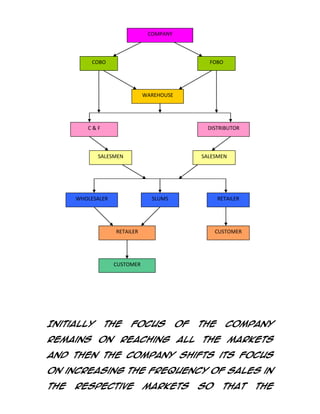
SALES AND DISTRIBUTION NETWORK OF
PEPSICO INDIA.
COMPANY

COBO

FOBO

WAREHOUSE

C&F

DISTRIBUTOR

SALESMEN

SALESMEN

WHOLESALER

SLUMS

RETAILER

RETAILER

CUSTOMER

CUSTOMER

Initially

the

focus

of

the

Company

remains on reaching all the markets
and then the Company shifts its focus
on increasing the frequency of sales in
the

respective

markets

so

that

the
sales and profitability of the Company
can be increased.
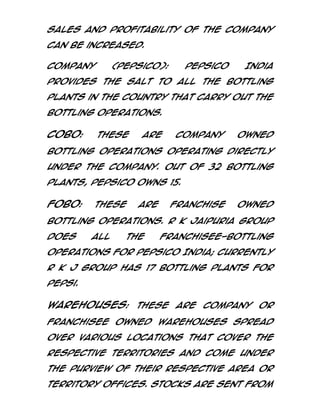
Company

(PepsiCo):

PepsiCo

India

provides the salt to all the bottling
plants in the Country that carry out the
bottling operations.

COBO:

These

are

Company

owned

bottling operations operating directly
under the Company. Out of 32 bottling
plants, PepsiCo owns 15.

FOBO:

These

are

Franchise

owned

bottling operations. R K Jaipuria group
does

all

the

franchisee-bottling

operations for PepsiCo India; currently
R K J Group has 17 bottling plants for
Pepsi.

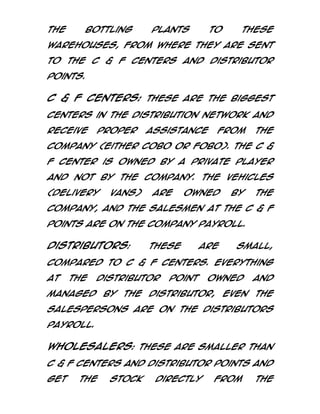
Warehouses: These are Company or
franchisee owned warehouses spread
over various locations that cover the
respective territories and come under
the purview of their respective Area or
Territory Offices. Stocks are sent from
the

bottling

plants

to

these

warehouses, from where they are sent
to the C & F centers and Distributor
Points.

C & F Centers: These are the biggest
centers in the distribution network and
receive

proper

assistance

from

the

Company (either COBO or FOBO). The C &
F center is owned by a private player
and not by the Company. The vehicles
(Delivery

Vans)

are

owned

by

the

Company, and the Salesmen at the C & F
points are on the Company Payroll.

Distributors:

These

are

small,

compared to C & F centers. Everything
at

the

Distributor

point

owned

and

managed by the distributor, even the
salespersons are on the Distributors
payroll.

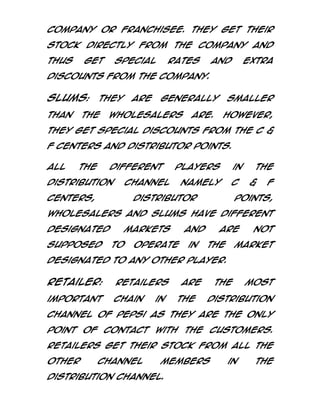
Wholesalers: These are smaller than
C & F centers and Distributor points and
get

the

stock

directly

from

the
Company or Franchisee. They get their
stock directly from the Company and
thus

get

special

rates

and

extra

discounts from the Company.

Slums:
than

They

the

are

generally

Wholesalers

smaller

are.

However,

they get special discounts from the C &
F centers and Distributor points.
All

the

different

distribution

players

channel

centers,

namely

in
C

Distributor

the
&

F

points,

Wholesalers and Slums have different
designated
supposed

markets
to

and

operate

in

are
the

not

market

designated to any other player.

Retailer:

Retailers

important

chain

in

are
the

the

most

distribution

channel of Pepsi as they are the only
point of contact with the customers.
Retailers get their stock from all the
other

channel

members

distribution channel.

in

the
SALES AND MARKETING HIERARCHY OF
PEPSICO INDIA.
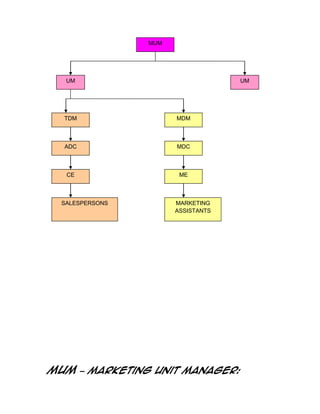
MUM

UM

UM

TDM

MDM

ADC

MDC

CE

ME

SALESPERSONS

MARKETING
ASSISTANTS

MUM – Marketing Unit Manager:
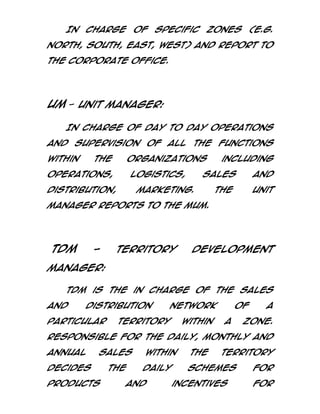
In

charge

of

specific

zones (e.g.

north, south, east, west) and report to
the corporate office.

UM - Unit Manager:
In charge of day to day operations
and supervision of all the functions
within

the

organizations

operations,

logistics,

distribution,

including

sales

marketing.

and

The

Unit

Manager reports to the MUM.

TDM

-

Territory

Development

Manager:
TDM is the in charge of the sales
and

distribution

particular

network

territory

within

of
a

a

zone.

Responsible for the daily, monthly and
annual

sales

decides
products

the

within

the

daily

schemes

and

territory

incentives

for
for
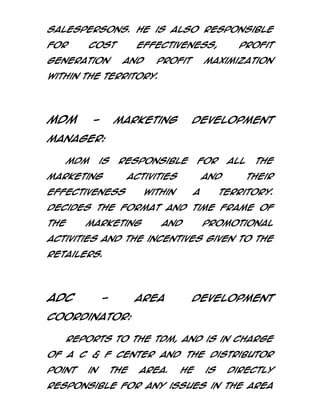
salespersons. He is also responsible
for

cost

generation

effectiveness,
and

profit

profit

maximization

within the territory.

MDM

-

Marketing

Development

Manager:
MDM

is

responsible

marketing

for

activities

effectiveness

all

and

within

a

the
their

territory.

Decides the format and time frame of
the

marketing

and

promotional

activities and the incentives given to the
retailers.

ADC

-

Area

Development

Coordinator:
Reports to the TDM, and is in charge
of a C & F center and the distributor
point

in

the

area.

He

is

directly

responsible for any issues in the area
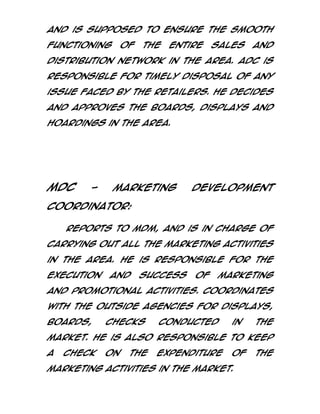
and is supposed to ensure the smooth
functioning

of

the

entire

sales

and

distribution network in the area. ADC is
responsible for timely disposal of any
issue faced by the retailers. He decides
and approves the boards, displays and
hoardings in the area.

MDC

-

Marketing

Development

Coordinator:
Reports to MDM, and is in charge of
carrying out all the marketing activities
in the area. He is responsible for the
execution

and

success

of

marketing

and promotional activities. Coordinates
with the outside agencies for displays,
boards,

checks

conducted

in

the

market. He is also responsible to keep
a

check

on

the

expenditure

of

marketing activities in the market.

the
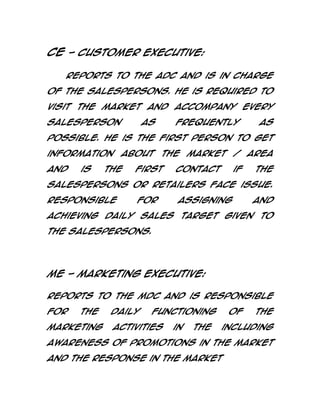
CE - Customer Executive:
Reports to the ADC and is in charge
of the salespersons. He is required to
visit the market and accompany every
salesperson

as

frequently

as

possible. He is the first person to get
information
and

is

about

the

the

first

market

/

contact

if

area
the

salespersons or retailers face issue.
Responsible

for

assigning

and

achieving daily sales target given to
the salespersons.

ME - Marketing Executive:
Reports to the MDC and is responsible
for

the

marketing

daily

functioning

activities

in

the

of

the

including

awareness of promotions in the market
and the response in the market
Salesperson:
They are the most important asset
for the company as they are the ones
who sell the products, are responsible
for

acquiring

new

customers,

and

retain the old ones. Their work also
includes informing the retailers about
the

promotions

and

any

new

scheme

launched. They are also required to
push for the sale of any new product
launched in the market and make sure
that the retailers are following the
company
launch

guidelines
and

the

regarding
maintenance

Vicioolers. They report to the CE.

Marketing Assistant:

the
of
Reports to the ME and is responsible
for the distribution and usage of the
displays and boards in the area. Also
has

to

check

whether

following

the

company

regarding

retailers

guidelines

of

are
the

promotional

displays, other displays and displays
in the Vigicoolers. They report to the
ME.
Pepsi is one of the most well known
brands in the world today available in
over 160 countries. The company has an
extremely positive outlook for India.
"Outside

North

largest

and

America

two

fastest

of

our

growing

businesses are in India and China, which
include

more

than

a

third

of

the

world’s population." (PepsiCo’s annual
report, 1999)
This reflects that India holds a central
position in Pepsi’s corporate strategy.
India is a key market for Pepsico, and at
the same time the company has added
value

to

Indian

agriculture

and

industry. PepsiCo entered India in 1989
and

is

concentrating

in

three

focus

areas – Soft drink concentrate, snack
foods

and

vegetable

and

food

processing.
Faced

with

framework

at

the
the

existing
time,

the

policy
company

entered the Indian market through a
joint venture with Voltas and Punjab
Agro Industries. With the introduction
of the liberalisation policies since 1991,
Pepsi

took

complete

operations.

The

control

of

government

its
has

approved more than US$ 400 million
worth of investments of which over US$
330 million have already flown in.
One of PepsiCo’s key strategies was to
develop

a

completely

local

management team. Pepsi has 15 company
owned

factories

while

their

Indian
bottling partners own 28. The company
has

set

up

8

greenfield

sites

in

backward regions of different states.
PepsiCo

intends

operations
investment

and
of

to

expand

is

its

planning

approximately

US$

an
500

million in the next three years.

Sustainable

Competitive

Advantage:

Competitive

advantage

is

a

company’s

ability to perform in one or more ways
that its competitors cannot or will not
match.

When

a

company

is

able

to

maintain that advantage a long period
of time that gives it an edge over its
competitors
termed

as

advantage.
must

be

then,

this

advantage

sustainable
Any

seen

competitive
by

is

competitive
advantage

customers

as

a
customer

advantage.

competitive
transformed

Then

advantage
into

a

only
can

that
be

sustainable

competitive advantage.

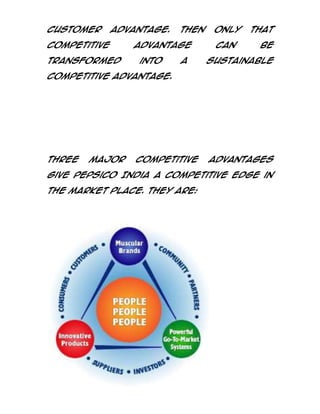
Three

major

competitive

advantages

give PepsiCo India a competitive edge in
the market place. They are:
1.

Big Muscular Brands built through
better market positioning and heavy
investment

in

advertising

and

promotions;
2.

Proven

ability

create

to

innovate

differentiated

and

products

through superior operating base;
3.

Powerful go to market system built
with

the

help

of

superior

relationship base and an impeccable
sales and distribution network.
Making

it

all

work

are

the

extraordinarily talented and dedicated
people

who

are

an

integral

part

of

PepsiCo India.

Communicating with the Customer:
Marketing Communication is the means
by

which

firms

attempt

to

inform,

pursued and remind consumers directly
and indirectly about the products and
brands

they

sell.

Marketing

Communication is the central instrument
of

making

brand

equity.

Marketing

Communication consists of six major
modes

of

communications

called

the

marketing communication mix.

1.

Advertising.

2.

Sales promotion.

3.

Events and Experiences.

4.

Public Relations and Publicity.

5.

Direct Marketing.

6.

Personal Selling.

Although PepsiCo uses all the modes in
some form or the other, but this study
will

examine

communication

various
with

aspects
the

of

internal

customers.

FIVE FORCES EFFECTING THE ENVIROMENT
Threat of New
Entrants
1. Cost Advantage.
2. Proprietary
Products
3. Access to Inputs.
4. Government Policy.
Bargaining Power of
Suppliers
1. Supplier Concentration
2. Importance of Volume
to Supplier
3. Differenciation of
Inputs
4. Impact of Inputs on

5. Economies of Scale.
6. Capital
Requirement
7. Brand Identity.
8. Switching Cost.
Existing
Rivalry
9. Distrbution Access.
Among
10.Retaliation.
Firms

Cost

Firms
in the Industry
6. Presence of Substitute
Inputs
7. Threat of Forward
Integration
8.Cost Relative to Total
Purchase in Industry

1. Bargaining
Leverage.
2. Buyer Volume.
3. Buyer Information.
4. Brand Identity.
5. Price Sensitivity.
6. Treat of Backward

of Differentiation
5. Switching Cost of

Bargaining Power of
Buyers

Integration.
Threat of Substitutes
1. Switching Costs.
2. Buyer inclination to
Substitute.
3. Price performance
trade off of
Substitutes.

7. Product
Degree of Rivalry
differentiation.
1. Exit Barriers
8. Buyer Concentration
2. Industry
Vs Industry.
Concentration
9. Substitutes Available.
3. Fixed costs / Value
10. Buyers Incentive.
added.
4. Industry Growth.
5. Overcapacity.
6. Product difference.

Threat of new entrantsSwitching Costs.
7. :
8. Brand Identity.

9. Diversity of Rivals.
10. Corporate Stakes.
Pepsi’s

product

differentiation

caused by their marketing strategy has
limited the threat of new entrants. Also
the

heavy

start

manufacturing

up

and

costs

packaging

of

plants

would be a deterrent. But, the biggest
deterrent

is

reputation;

a

brand
new

image

company

and

would

be

very hard pressed to take market share
away

from

established

players

like

Pepsi, Coke etc. More importantly, the
access

to

distribution

channels

is

currently one of the biggest barriers
to

entry,

and

this

barrier

remains

because both Coke and Pepsi maintain
very strong relation with their channel
partners.

Bargaining power of buyers:
The

level

of

bargaining

power

differs among groups of buyers. The
bottlers,

retailers

and

distributors
have

significantly

power
Large

than

the

retailer

greater

end

bargaining

consumer

such

as

does.

Reliance,

Big

Bazaar, Subhiksha are able to extract
profits

from

the

Company

incentives

such

purchases,

promotions

This

is

as

particularly

through

volume-based
and

displays.

true

for

pet

bottles. But, this can also be harmful
for

the

retailers

and

they

losing

customers if they refuse to stock a
particular brand.

The bargaining power of the consumer
is low. They are a fragmented group
and

no

one

individual’s

purchase

accounts for a significant portion of
manufacturer’s

profit.

Although

the

presence of substitutes does serve to
increase buyer power for consumers,
but

a

high

degree

of

brand

loyalty

mitigates this loyalty. In short, we can
say that the end consumer has medium
bargaining power.

Bargaining power of suppliers:
There are very few suppliers for the
entire

soft

product

drink

is

ingredients,

industry.

comprised
which

The
of

are

end
few

largely

commodities. In addition, it is safe to
assume that Pepsi accounts for a large
percentage

of

the

suppliers

total

revenues. Thus, it is important for the
suppliers

to

contain

whatever

bargaining power they have. The overall
bargaining power of the suppliers is
considered low.

Threat of Substitutes:
There

are

sweetened
Specially

many

substitutes

carbonated
in

substitutes

India
that

there
pose

to

beverages.
are
a

several

threat

to