Saltar al contenido principal
THE CULTURAL
GEOGRAPHY OF THE
U.S. AND CANADA
I. POPULATION PATTERNS
A. Human Characteristics
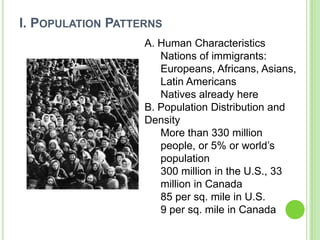
Nations of immigrants:
Europeans, Africans, Asians,
Latin Americans
Natives already here
B. Population Distribution and
Density
More than 330 million
people, or 5% or world’s
population
300 million in the U.S., 33
million in Canada
85 per sq. mile in U.S.
9 per sq. mile in Canada
•Most Americans live in the Northeast, Great
Lakes Region, and the West Coast
•Near transportation routes, commerce, and
manufacturing
1970s: many moved to the Sunbelt, the South
and West for jobs
Sparsely populated areas include the Great
Basin and Alaska
•Most Canadians live near the Great Lakes/ St.
Lawrence River
•Some spots in the plains and west coast
90% of Canadians live within 100 miles of the
U.S.
2/3 of Canada is unpopulated.
URBANIZATION
•¾ of the people live in cities or
suburbs: Metropolitan area
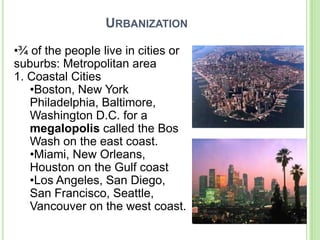
1. Coastal Cities
•Boston, New York
Philadelphia, Baltimore,
Washington D.C. for a
megalopolis called the Bos
Wash on the east coast.
•Miami, New Orleans,
Houston on the Gulf coast
•Los Angeles, San Diego,
San Francisco, Seattle,
Vancouver on the west coast.
 2.







Inland Cities
Often located near inland waterways
Toronto, Montreal, Quebec City, Chicago,
Milwaukee, Cleveland, Buffalo near the Great
Lakes/ St. Lawrence
Pittsburgh and St. Louis near major rivers
Others include: Atlanta, Dallas, San Antonio,
Denver, Memphis, Minneapolis, Kansas City,
Salt Lake City, Winnipeg, Calgary, Edmonton
They are transportation and business
centers for the surrounding areas.
II. HISTORY AND GOVERNMENT
 A.

History
 1st people crossed the land bridge
 Bering Strait from Asia
 Started about 30,000 years ago
 By 10,000 years ago, people living
almost everywhere in N. America
 1. Early Americans
 Adapted to survive in different
climates
 Changed their cultures.
2.EUROPEAN COLONIZATION





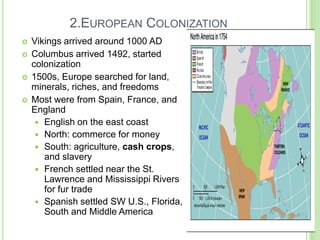
Vikings arrived around 1000 AD
Columbus arrived 1492, started
colonization
1500s, Europe searched for land,
minerals, riches, and freedoms
Most were from Spain, France, and
England
 English on the east coast
 North: commerce for money
 South: agriculture, cash crops,
and slavery
 French settled near the St.
Lawrence and Mississippi Rivers
for fur trade
 Spanish settled SW U.S., Florida,
South and Middle America
3. TWO NATIONS
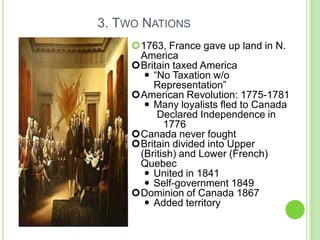
1763, France gave up land in N.
America
Britain taxed America
 “No Taxation w/o
Representation”
American Revolution: 1775-1781
 Many loyalists fled to Canada
Declared Independence in
1776
Canada never fought
Britain divided into Upper
(British) and Lower (French)
Quebec
 United in 1841
 Self-government 1849
Dominion of Canada 1867
 Added territory
4. INDUSTRY AND EXPANSION










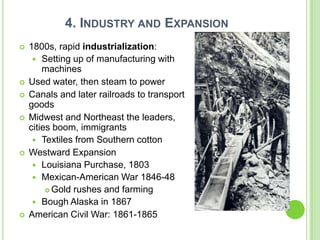
1800s, rapid industrialization:
 Setting up of manufacturing with
machines
Used water, then steam to power
Canals and later railroads to transport
goods
Midwest and Northeast the leaders,
cities boom, immigrants
 Textiles from Southern cotton
Westward Expansion
 Louisiana Purchase, 1803
 Mexican-American War 1846-48
 Gold rushes and farming
 Bough Alaska in 1867
American Civil War: 1861-1865
5. TECHNOLOGY AND GROWTH
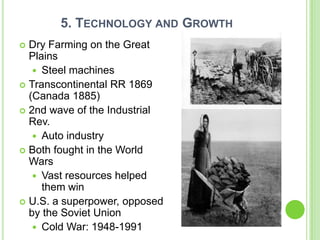
Dry Farming on the Great
Plains
 Steel machines
 Transcontinental RR 1869
(Canada 1885)
 2nd wave of the Industrial
Rev.
 Auto industry
 Both fought in the World
Wars
 Vast resources helped
them win
 U.S. a superpower, opposed
by the Soviet Union
 Cold War: 1948-1991

6. U.S. GOVERNMENT
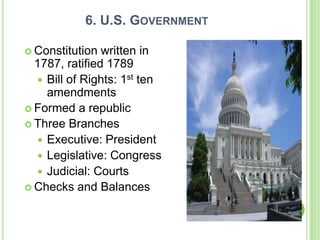
 Constitution

written in
1787, ratified 1789
 Bill of Rights: 1st ten
amendments
 Formed a republic
 Three Branches
 Executive: President
 Legislative: Congress
 Judicial: Courts
 Checks and Balances
7. CANADA’S GOVERNMENT









Canada independent by 1867
 Needed English approval to
change the govt. until 1982
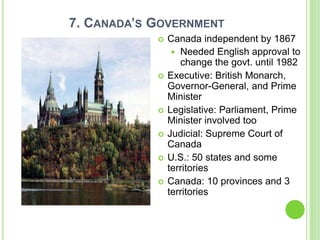
Executive: British Monarch,
Governor-General, and Prime
Minister
Legislative: Parliament, Prime
Minister involved too
Judicial: Supreme Court of
Canada
U.S.: 50 states and some
territories
Canada: 10 provinces and 3
territories
III. CULTURES AND LIFESTYLES


A. A Region’s Cultures
 Multicultural
 Melting pot vs. mosaic
 1. Religious Freedom
 Protected by law
 Mainly Protestant Christians
 Canada: mainly Catholics
 2. Languages
 U.S.: English mainly, no official language
 Canada: bilingual
 French and English
A. THE ARTS
No true American style for a
while
 Heavily influenced by Europe
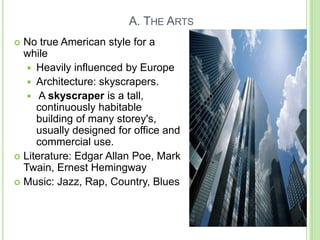
 Architecture: skyscrapers.
 A skyscraper is a tall,
continuously habitable
building of many storey's,
usually designed for office and
commercial use.
 Literature: Edgar Allan Poe, Mark
Twain, Ernest Hemingway
 Music: Jazz, Rap, Country, Blues

B. LIFESTYLES
1. A Mobile Society
 Cars, planes, etc.
 2. Standard of Living:
 Very high, good housing
 3. Health Care
 Among the healthiest in the world
 4. Education
 Very high literacy rates
 U.S. 98%, Canada: 97%
 5. Sports and Recreation
 Football, basketball, baseball, hockey…
 Lots of national parks in both countries:
Yellowstone, Wood Buffalo Park: huge
 6. Celebrations
 Christmas, Easter, Thanksgiving, Independence
Days

REPORTED BY:
JESSICA D. ADOFINA
BSED II-A

THANK YOU

!!! 