Saltar al contenido principal
•Age of Enlightenment
•The French Revolution
•The Republic
The History of the Democracy in France
Age of Enlightenment
1) Ideas and Callas Affair
2) Freedom of thought and expression
3) Separation of the 3 powers imagined
and claimed by Montesquieu
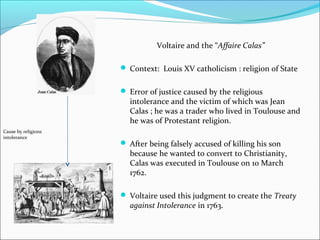
Voltaire and the “Affaire Calas”
 Context: Louis XV catholicism : religion of State
 Error of justice caused by the religious
intolerance and the victim of which was Jean
Calas ; he was a trader who lived in Toulouse and
he was of Protestant religion.
 After being falsely accused of killing his son
because he wanted to convert to Christianity,
Calas was executed in Toulouse on 10 March
1762.
 Voltaire used this judgment to create the Treaty
against Intolerance in 1763.
Cause by religions
intolerance
Principles defended by the French
philosophers of the Enlightenment
-Denounced intolerance, life at the court and injustice
-Freedom of conscience
-Educate people (creation of the Encyclopedia)
-3 powers must be separated
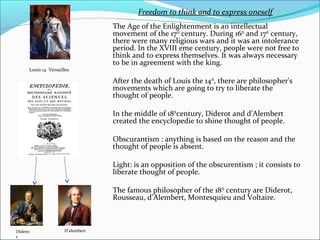
The Age of the Enlightenment is an intellectual
movement of the 17th
century. During 16th
and 17th
century,
there were many religious wars and it was an intolerance
period. In the XVIII eme century, people were not free to
think and to express themselves. It was always necessary
to be in agreement with the king.
After the death of Louis the 14th
, there are philosopher's
movements which are going to try to liberate the
thought of people.
In the middle of 18th
century, Diderot and d’Alembert
created the encyclopedie to shine thought of people.
Obscurantism : anything is based on the reason and the
thought of people is absent.
Light: is an opposition of the obscurentism ; it consists to
liberate thought of people.
The famous philosopher of the 18th
century are Diderot,
Rousseau, d’Alembert, Montesquieu and Voltaire.
Louis 14 Versailles
Didero
t
D’alembert
Freedom to think and to express oneself
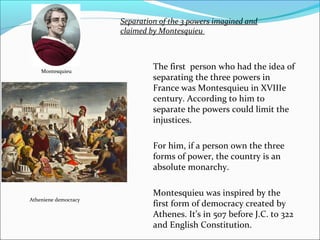
The first person who had the idea of
separating the three powers in
France was Montesquieu in XVIIIe
century. According to him to
separate the powers could limit the
injustices.
For him, if a person own the three
forms of power, the country is an
absolute monarchy.
Montesquieu was inspired by the
first form of democracy created by
Athenes. It’s in 507 before J.C. to 322
and English Constitution.
Separation of the 3 powers imagined and
claimed by Montesquieu
Montesquieu
Atheniene democracy
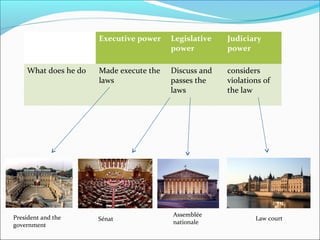
Executive power Legislative
power
Judiciary
power
What does he do Made execute the
laws
Discuss and
passes the
laws
considers
violations of
the law
Law courtPresident and the
government
Sénat
Assemblée
nationale
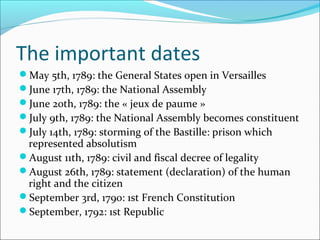
• The important dates
• The Constitution
• The Statement (declaration) of Human Rights and of the Citizen
The important dates
May 5th, 1789: the General States open in Versailles
June 17th, 1789: the National Assembly
June 20th, 1789: the « jeux de paume »
July 9th, 1789: the National Assembly becomes constituent
July 14th, 1789: storming of the Bastille: prison which
represented absolutism
August 11th, 1789: civil and fiscal decree of legality
August 26th, 1789: statement (declaration) of the human
right and the citizen
September 3rd, 1790: 1st French Constitution
September, 1792: 1st Republic
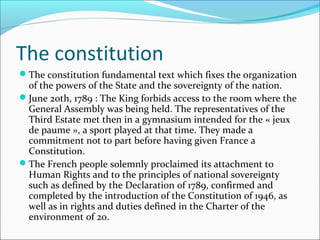
The constitution
The constitution fundamental text which fixes the organization
of the powers of the State and the sovereignty of the nation.
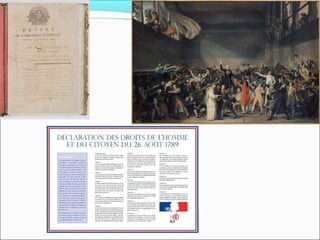
June 20th, 1789 : The King forbids access to the room where the
General Assembly was being held. The representatives of the
Third Estate met then in a gymnasium intended for the « jeux
de paume », a sport played at that time. They made a
commitment not to part before having given France a
Constitution.
The French people solemnly proclaimed its attachment to
Human Rights and to the principles of national sovereignty
such as defined by the Declaration of 1789, confirmed and
completed by the introduction of the Constitution of 1946, as
well as in rights and duties defined in the Charter of the
environment of 20.
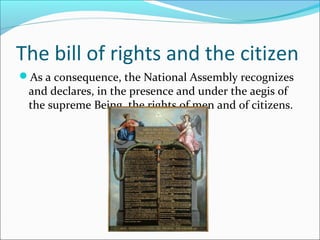
The bill of rights and the citizen
As a consequence, the National Assembly recognizes
and declares, in the presence and under the aegis of
the supreme Being, the rights of men and of citizens.
Some articles
Art. 1st. People are born and remain free and equal.
Social distinctions can only be based on the common
utility.
Art. 2. The purpose of any political association is the
protection of men’s natural and imprescriptible
rights. These rights are: freedom, property, safety, and
the resistance to oppression.
Art. 3. The principle of any Sovereignty lies essentially
in the Nation. No body, no individual can practice
authority which does not emanate from the Nation.
Its legacy
The legacy of the Declaration of the Rights of Men
and Citizens are:
The first constitution and all those that followed
And, lately, the word democracy!
Federation Party
It was celebrated in Paris, on July 14th, 1790, one year
after the storming of the Bastille. In a climate of
national union, a big crowd gathered around the king
and members of parliament. Louis XVI attended this
party, and took an oath to the Nation and to the law.
Since 1880, this event has been celebrated, every July
14th, as the French National holiday.
First Republic
The First Republic, officially named French Republic,
refers to all the republican systems of France between
September, 1792 and May, 1804. Brought by the French
Revolution, the First Republic followed the Constitutional
monarchy which disappeared on August 10th, 1792 with
the storming of the Palace of the Tuileries by the « sans
culottes ».
It announced a new era of exercise of power in Europe.
September 21st, 1792, members of parliament of the
Convention gathered for the first time and decided
unanimously on the abolition of the constitutional
monarchy in France.
On September 25th, 1792, the Republic was declared " one
and inseparable »
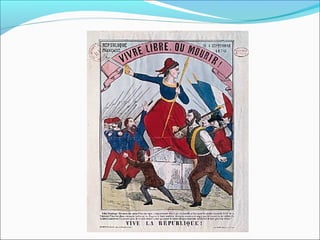
The third Republic reinforced the main
symbols and principles of the French
republican model: the tricolour flag,
Marianne, the national anthem: La
Marseillaise , the motto « Liberté, Egalité,
Fraternité ».
All of these things are a revolutionary
legacy.
The Third Republic of France
  The Third Republic began in 1870 and ended in 
1940.
The President was elected for 7 years.
 The State didn’t want the young French to attend 
catholic schools anymore. 
So the State created the public instruction which 
was free, compulsory and secular (non 
religious) in 1882.
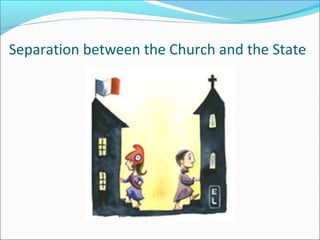
In 1905, there was the separation between the
Church and the State.
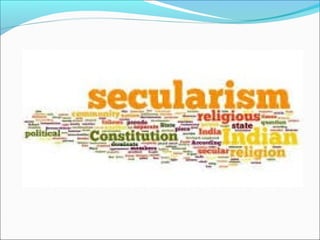
It created secularism, which is one of the most 
important values of the Republic of France.
Liberty of conscience and of cult
Separation between the Church and the State
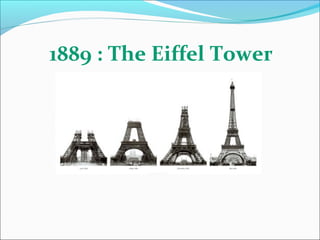
1889 : The Eiffel Tower
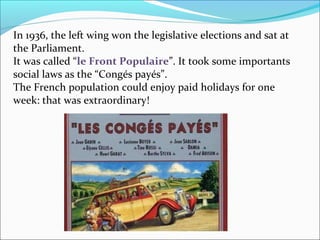
In 1936, the left wing won the legislative elections and sat at 
the Parliament.
It was called “le Front Populaire”. It took some importants 
social laws as the “Congés payés”.
The French population could enjoy paid holidays for one 
week: that was extraordinary!
 It also limited the number of hours of work: the French 
could only work 40 hours per week!
Nowadays, the time of work is 35 hours per week.
The population was happy but these laws were very 
expensive and this government had to leave.
 
The third Republic ended because of world war II. The 
system of Vichy other throws the Republic and floot the 
democracy for 4 years (1940 - 1944).
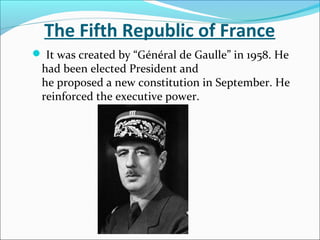
The Fifth Republic of France
 It was created by “Général de Gaulle” in 1958. He 
had been elected President and
he proposed a new constitution in September. He 
reinforced the executive power.
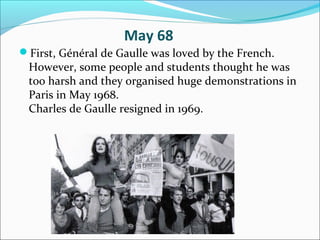
May 68
First, Général de Gaulle was loved by the French.
However, some people and students thought he was
too harsh and they organised huge demonstrations in
Paris in May 1968.
Charles de Gaulle resigned in 1969.
In 1981, François Mitterand became the first socialist
President of the fifth Republic. He promulgated some
social laws such as the abolition of the death penalty
in 1981.
In 1995, Jacques Chirac, who was from the right wing,
was elected. He decided to reduce the presidential
mandate from 7 to 5 years.
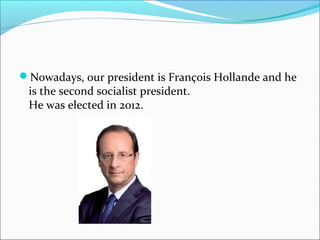
Nowadays, our president is François Hollande and he
is the second socialist president.
He was elected in 2012.
The political organisation of the 5th
Republic in France
art.2 : The Republic is
“indivisible, secular, democratic and social”
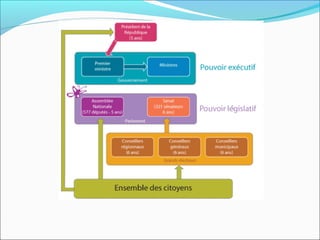
As we told you before, there are 3 important powers in
France:
 The executive power (President and ministers)
The legislative power (the Parliament: Assemblée
Nationale + Sénat).
The judicial power (magistrates :judges+prosecutors).
It has to sanction people when they break rules/disobey
to a law.
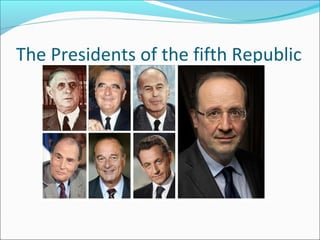
The Presidents of the fifth Republic