Saltar al contenido principal
The Training System What is VET? Vocational Education & Training is ‘education and training for work’ and part of a broader educational network in Australia The Australian VET system is one of the most sophisticated in the world because it is: Industry-led  National Client focused
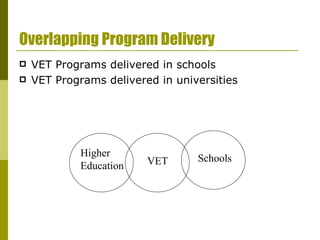
What is VET? Cont … Three identifiable sectors in Australian education system: HE (higher education) VET (vocational education and training) Schools Some dual sector VET/HE institutions but each sector has its own: Institutions Administrative arrangements Sets of qualifications
Overlapping Program Delivery VET Programs delivered in schools VET Programs delivered in universities Higher Education VET Schools
VET policies & frameworks The National Training Framework (NTF) Training packages The Australian Quality Training Framework (AQTF)  The Australian Qualifications Framework (AQF) User choice Traineeship and apprenticeship arrangements The National Reporting System (NRS)
National Training Framework (NTF) The National Training Framework (NTF) is made up of the Australian Quality Training Framework (AQTF) and Training Packages The NTF is a nationally consistent, industry-led system designed to: provide high-quality skill outcomes to maintain individuals’ employability and increase their productivity  provide for nationally recognised qualifications, and  improve the competitiveness of enterprises and the nation
National Training Strategies Towards a Skilled Australia (1994-1998) A Bridge to the Future (1998-2003) Shaping Our Future (2004-2010) National training strategies Builds on achievements of the two previous national VET strategies, with the vision: VET works for Australian businesses – making them internationally competitive VET works for people – giving Australians world-class skills and knowledge VET works for communities – making them inclusive and sustainable
Other strategies that affect training From January 2010 all Victorian students have been required to complete Year 10 and be in education, training or employment until the age of 17. Government joins industry with $50 million for more training places-11,000 extra training places for existing workers The Apprentice  Kickstart program will be extended from May 12 to 12 November 2010 Incentives of $4000 to train existing workers as trainees
Directions for VET On 29 November 2008 the Council of Australian Governments (COAG) agreed that $6.7 billion be provided for National Skills and Workforce Development Agreement to increase the skills levels of Australians The 2010 Victorian Budget is investing $32.3 million over four years for the  Apprentice and Trainee Support Package
Skilling in Victoria Skills for Victoria-State Government is standing up for local jobs by investing  $91.2 million  to help Victorians secure the job they want- Skills Victoria Skills for Growth- specialists assess the skills of the existing workforce and identify opportunities for skills development and training.
National Goals & Objectives Industry will have a highly skilled workforce to support strong performance in the global economy Employers and individuals will be at the centre of VET Communities and regions will be strengthened economically and socially through learning and employment Indigenous Australians will have skills for viable jobs and their learning culture will be shared
National Priorities Improving the system’s responsiveness to rapid changes in demand for skills development and addressing skills shortages, especially in traditional trades and in emerging industries Delivering improved outcomes for employers, individuals and communities Improving quality Increasing participation and up-skilling mature age workers Encouraging greater re-engagement in training by Australians who are not fully participating in the labour market