Saltar al contenido principal
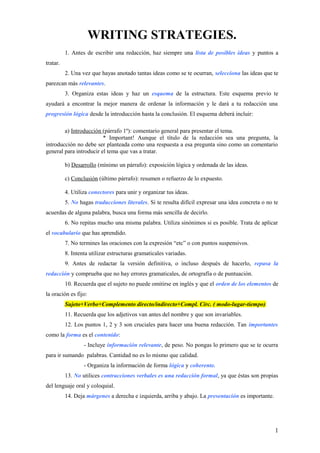
WRITING STRATEGIES.
1. Antes de escribir una redacción, haz siempre una lista de posibles ideas y puntos a
tratar.
2. Una vez que hayas anotado tantas ideas como se te ocurran, selecciona las ideas que te
parezcan más relevantes.
3. Organiza estas ideas y haz un esquema de la estructura. Este esquema previo te
ayudará a encontrar la mejor manera de ordenar la información y le dará a tu redacción una
progresión lógica desde la introducción hasta la conclusión. El esquema deberá incluir:
a) Introducción (párrafo 1º): comentario general para presentar el tema.
* Important! Aunque el título de la redacción sea una pregunta, la
introducción no debe ser planteada como una respuesta a esa pregunta sino como un comentario
general para introducir el tema que vas a tratar.
b) Desarrollo (mínimo un párrafo): exposición lógica y ordenada de las ideas.
c) Conclusión (último párrafo): resumen o refuerzo de lo expuesto.
4. Utiliza conectores para unir y organizar tus ideas.
5. No hagas traducciones literales. Si te resulta difícil expresar una idea concreta o no te
acuerdas de alguna palabra, busca una forma más sencilla de decirlo.
6. No repitas mucho una misma palabra. Utiliza sinónimos si es posible. Trata de aplicar
el vocabulario que has aprendido.
7. No termines las oraciones con la expresión “etc” o con puntos suspensivos.
8. Intenta utilizar estructuras gramaticales variadas.
9. Antes de redactar la versión definitiva, o incluso después de hacerlo, repasa la
redacción y comprueba que no hay errores gramaticales, de ortografía o de puntuación.
10. Recuerda que el sujeto no puede omitirse en inglés y que el orden de los elementos de
la oración es fijo:
Sujeto+Verbo+Complemento directo/indirecto+Compl. Circ. ( modo-lugar-tiempo)
11. Recuerda que los adjetivos van antes del nombre y que son invariables.
12. Los puntos 1, 2 y 3 son cruciales para hacer una buena redacción. Tan importantes
como la forma es el contenido:
- Incluye información relevante, de peso. No pongas lo primero que se te ocurra
para ir sumando palabras. Cantidad no es lo mismo que calidad.
- Organiza la información de forma lógica y coherente.
13. No utilices contracciones verbales es una redacción formal, ya que éstas son propias
del lenguaje oral y coloquial.
14. Deja márgenes a derecha e izquierda, arriba y abajo. La presentación es importante.
1
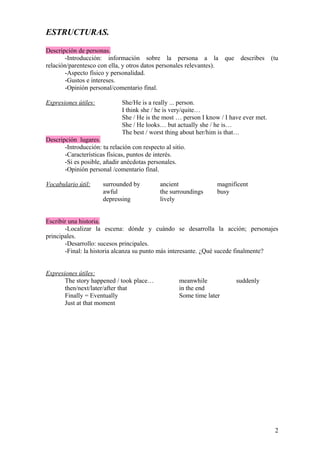
ESTRUCTURAS.
Descripción de personas.
-Introducción: información sobre la persona a la que describes (tu
relación/parentesco con ella, y otros datos personales relevantes).
-Aspecto físico y personalidad.
-Gustos e intereses.
-Opinión personal/comentario final.
Expresiones útiles: She/He is a really ... person.
I think she / he is very/quite…
She / He is the most … person I know / I have ever met.
She / He looks… but actually she / he is…
The best / worst thing about her/him is that…
Descripción lugares.
-Introducción: tu relación con respecto al sitio.
-Características físicas, puntos de interés.
-Si es posible, añadir anécdotas personales.
-Opinión personal /comentario final.
Vocabulario útil: surrounded by ancient magnificent
awful the surroundings busy
depressing lively
Escribir una historia.
-Localizar la escena: dónde y cuándo se desarrolla la acción; personajes
principales.
-Desarrollo: sucesos principales.
-Final: la historia alcanza su punto más interesante. ¿Qué sucede finalmente?
Expresiones útiles:
The story happened / took place… meanwhile suddenly
then/next/later/after that in the end
Finally = Eventually Some time later
Just at that moment
2
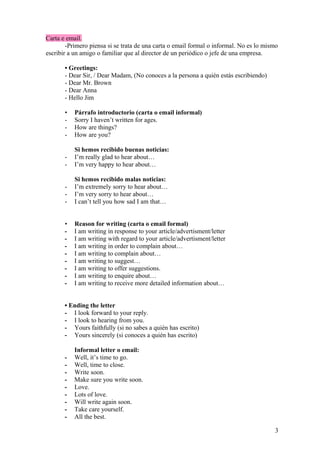
Carta e email.
-Primero piensa si se trata de una carta o email formal o informal. No es lo mismo
escribir a un amigo o familiar que al director de un periódico o jefe de una empresa.
• Greetings:
- Dear Sir, / Dear Madam, (No conoces a la persona a quién estás escribiendo)
- Dear Mr. Brown
- Dear Anna
- Hello Jim
• Párrafo introductorio (carta o email informal)
- Sorry I haven’t written for ages.
- How are things?
- How are you?
Si hemos recibido buenas noticias:
- I’m really glad to hear about…
- I’m very happy to hear about…
Si hemos recibido malas noticias:
- I’m extremely sorry to hear about…
- I’m very sorry to hear about…
- I can’t tell you how sad I am that…
• Reason for writing (carta o email formal)
- I am writing in response to your article/advertisment/letter
- I am writing with regard to your article/advertisment/letter
- I am writing in order to complain about…
- I am writing to complain about…
- I am writing to suggest…
- I am writing to offer suggestions.
- I am writing to enquire about…
- I am writing to receive more detailed information about…
• Ending the letter
- I look forward to your reply.
- I look to hearing from you.
- Yours faithfully (si no sabes a quién has escrito)
- Yours sincerely (si conoces a quién has escrito)
Informal letter o email:
- Well, it’s time to go.
- Well, time to close.
- Write soon.
- Make sure you write soon.
- Love.
- Lots of love.
- Will write again soon.
- Take care yourself.
- All the best.
3
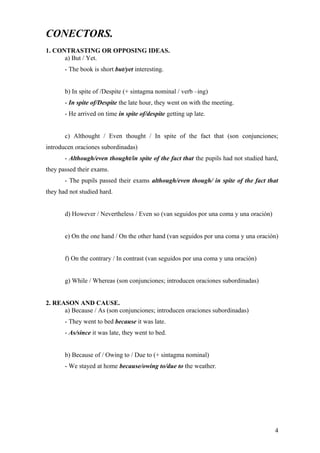
CONECTORS.
1. CONTRASTING OR OPPOSING IDEAS.
a) But / Yet.
- The book is short but/yet interesting.
b) In spite of /Despite (+ sintagma nominal / verb –ing)
- In spite of/Despite the late hour, they went on with the meeting.
- He arrived on time in spite of/despite getting up late.
c) Althought / Even thought / In spite of the fact that (son conjunciones;
introducen oraciones subordinadas)
- Although/even thought/in spite of the fact that the pupils had not studied hard,
they passed their exams.
- The pupils passed their exams although/even though/ in spite of the fact that
they had not studied hard.
d) However / Nevertheless / Even so (van seguidos por una coma y una oración)
e) On the one hand / On the other hand (van seguidos por una coma y una oración)
f) On the contrary / In contrast (van seguidos por una coma y una oración)
g) While / Whereas (son conjunciones; introducen oraciones subordinadas)
2. REASON AND CAUSE.
a) Because / As (son conjunciones; introducen oraciones subordinadas)
- They went to bed because it was late.
- As/since it was late, they went to bed.
b) Because of / Owing to / Due to (+ sintagma nominal)
- We stayed at home because/owing to/due to the weather.
4
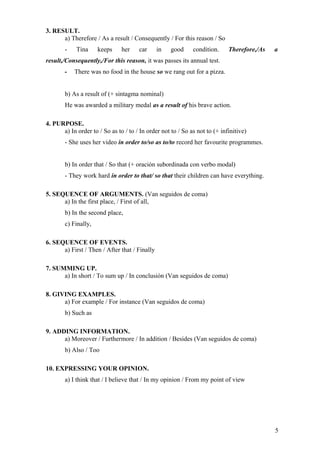
3. RESULT.
a) Therefore / As a result / Consequently / For this reason / So
- Tina keeps her car in good condition. Therefore,/As a
result,/Consequently,/For this reason, it was passes its annual test.
- There was no food in the house so we rang out for a pizza.
b) As a result of (+ sintagma nominal)
He was awarded a military medal as a result of his brave action.
4. PURPOSE.
a) In order to / So as to / to / In order not to / So as not to (+ infinitive)
- She uses her video in order to/so as to/to record her favourite programmes.
b) In order that / So that (+ oración subordinada con verbo modal)
- They work hard in order to that/ so that their children can have everything.
5. SEQUENCE OF ARGUMENTS. (Van seguidos de coma)
a) In the first place, / First of all,
b) In the second place,
c) Finally,
6. SEQUENCE OF EVENTS.
a) First / Then / After that / Finally
7. SUMMING UP.
a) In short / To sum up / In conclusión (Van seguidos de coma)
8. GIVING EXAMPLES.
a) For example / For instance (Van seguidos de coma)
b) Such as
9. ADDING INFORMATION.
a) Moreover / Furthermore / In addition / Besides (Van seguidos de coma)
b) Also / Too
10. EXPRESSING YOUR OPINION.
a) I think that / I believe that / In my opinion / From my point of view
5
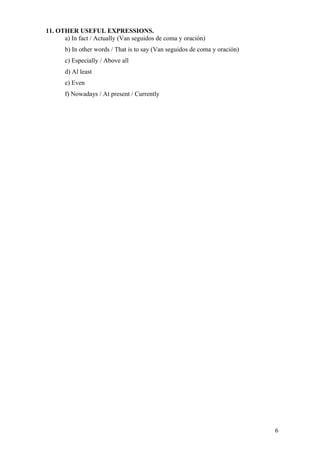
11. OTHER USEFUL EXPRESSIONS.
a) In fact / Actually (Van seguidos de coma y oración)
b) In other words / That is to say (Van seguidos de coma y oración)
c) Especially / Above all
d) Al least
e) Even
f) Nowadays / At present / Currently
6
11. OTHER USEFUL EXPRESSIONS.
a) In fact / Actually (Van seguidos de coma y oración)
b) In other words / That is to say (Van seguidos de coma y oración)
c) Especially / Above all
d) Al least
e) Even
f) Nowadays / At present / Currently
6