 Define what voices of verb are.
 Differentiate active voice from passive voice.
 Convert an active voice sentence to passive
  voice sentence.
 Convert a passive voice sentence to an active
  voice sentence.
In traditional grammar, voices of verb is
defined as the quality of verb that indicates
  whether its subject acts or is acted upon.

It has two types: the active voice and the
               passive voice.
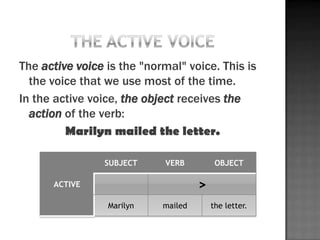
The active voice is the "normal" voice. This is
  the voice that we use most of the time.
In the active voice, the object receives the
  action of the verb:
         Marilyn mailed the letter.

                SUBJECT     VERB          OBJECT

      ACTIVE                         >
                 Marilyn    mailed       the letter.
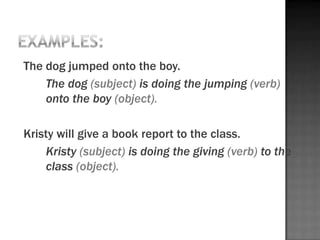
The dog jumped onto the boy.
    The dog (subject) is doing the jumping (verb)
    onto the boy (object).

Kristy will give a book report to the class.
    Kristy (subject) is doing the giving (verb) to the
    class (object).
1.   Move the active sentence's direct object
     into the sentence's subject slot.
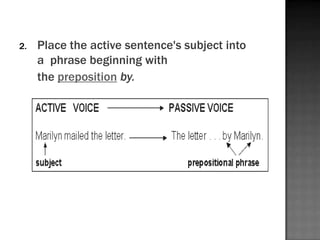
2.   Place the active sentence's subject into
     a phrase beginning with
     the preposition by.
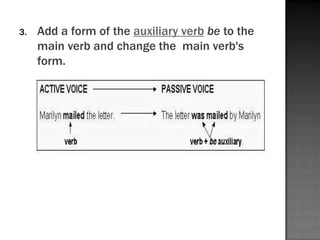
3.   Add a form of the auxiliary verb be to the
     main verb and change the main verb's
     form.
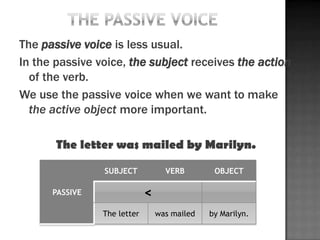
The passive voice is less usual.
In the passive voice, the subject receives the action
  of the verb.
We use the passive voice when we want to make
  the active object more important.

       The letter was mailed by Marilyn.

                SUBJECT            VERB        OBJECT

      PASSIVE                <
                The letter       was mailed   by Marilyn.
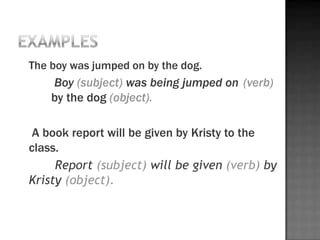
The boy was jumped on by the dog.
    Boy (subject) was being jumped on (verb)
    by the dog (object).

 A book report will be given by Kristy to the
class.
     Report (subject) will be given (verb) by
Kristy (object).
1.   Move the passive sentence's subject into
     the active sentence's direct object slot.
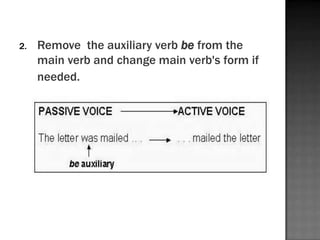
2.   Remove the auxiliary verb be from the
     main verb and change main verb's form if
     needed.
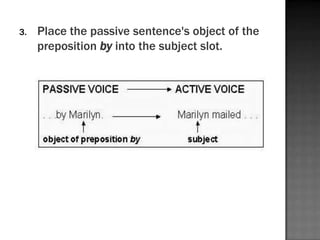
3.   Place the passive sentence's object of the
     preposition by into the subject slot.
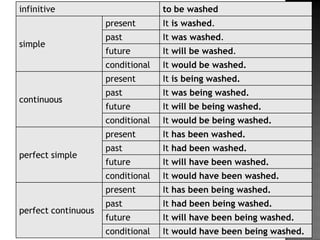
infinitive                         to be washed
                     present       It is washed.
                     past          It was washed.
simple
                     future        It will be washed.
                     conditional   It would be washed.
                     present       It is being washed.
                     past          It was being washed.
continuous
                     future        It will be being washed.
                     conditional   It would be being washed.
                     present       It has been washed.
                     past          It had been washed.
perfect simple
                     future        It will have been washed.
                     conditional   It would have been washed.
                     present       It has been being washed.
                     past          It had been being washed.
perfect continuous
                     future        It will have been being washed.
                     conditional   It would have been being washed.
Prepared by:
    Group III

Active and Passive Voice

  • 2.
     Define whatvoices of verb are.  Differentiate active voice from passive voice.  Convert an active voice sentence to passive voice sentence.  Convert a passive voice sentence to an active voice sentence.
  • 4.
    In traditional grammar,voices of verb is defined as the quality of verb that indicates whether its subject acts or is acted upon. It has two types: the active voice and the passive voice.
  • 6.
    The active voiceis the "normal" voice. This is the voice that we use most of the time. In the active voice, the object receives the action of the verb: Marilyn mailed the letter. SUBJECT VERB OBJECT ACTIVE > Marilyn mailed the letter.
  • 7.
    The dog jumpedonto the boy. The dog (subject) is doing the jumping (verb) onto the boy (object). Kristy will give a book report to the class. Kristy (subject) is doing the giving (verb) to the class (object).
  • 9.
    1. Move the active sentence's direct object into the sentence's subject slot.
  • 10.
    2. Place the active sentence's subject into a phrase beginning with the preposition by.
  • 11.
    3. Add a form of the auxiliary verb be to the main verb and change the main verb's form.
  • 13.
    The passive voiceis less usual. In the passive voice, the subject receives the action of the verb. We use the passive voice when we want to make the active object more important. The letter was mailed by Marilyn. SUBJECT VERB OBJECT PASSIVE < The letter was mailed by Marilyn.
  • 14.
    The boy wasjumped on by the dog. Boy (subject) was being jumped on (verb) by the dog (object). A book report will be given by Kristy to the class. Report (subject) will be given (verb) by Kristy (object).
  • 16.
    1. Move the passive sentence's subject into the active sentence's direct object slot.
  • 17.
    2. Remove the auxiliary verb be from the main verb and change main verb's form if needed.
  • 18.
    3. Place the passive sentence's object of the preposition by into the subject slot.
  • 19.
    infinitive to be washed present It is washed. past It was washed. simple future It will be washed. conditional It would be washed. present It is being washed. past It was being washed. continuous future It will be being washed. conditional It would be being washed. present It has been washed. past It had been washed. perfect simple future It will have been washed. conditional It would have been washed. present It has been being washed. past It had been being washed. perfect continuous future It will have been being washed. conditional It would have been being washed.
  • 20.
    Prepared by: Group III