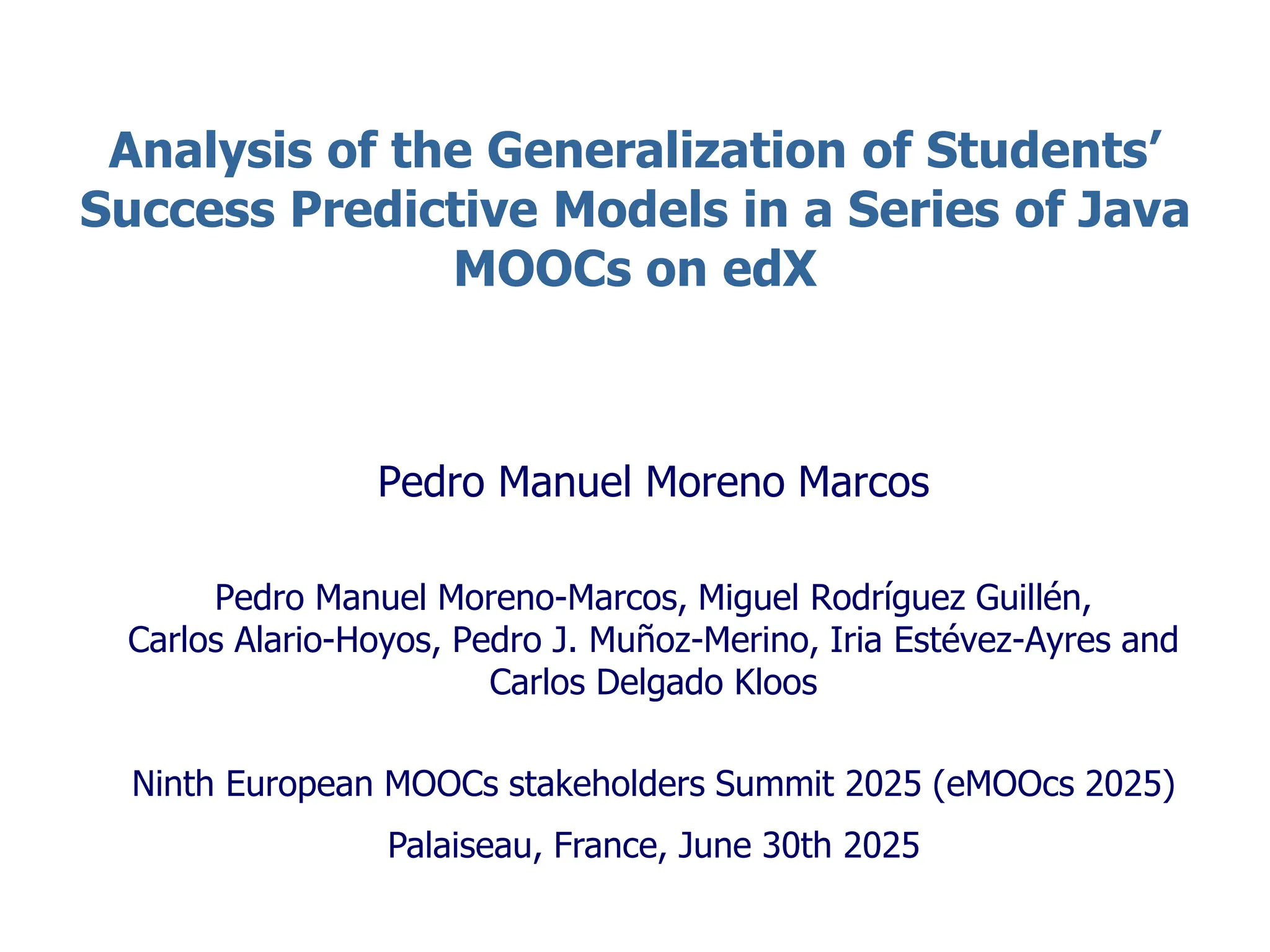
Presentation of the paper "Analysis of the Generalization of Students’ Success Predictive Models in a Series of Java MOOCs on edX".
This paper was presented at the Ninth European MOOCs stakeholders Summit 2025 (eMOOCs 2025).
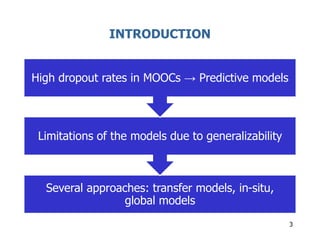
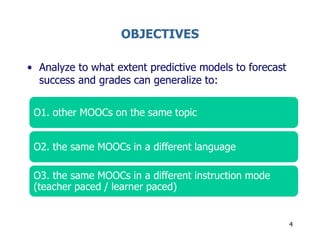
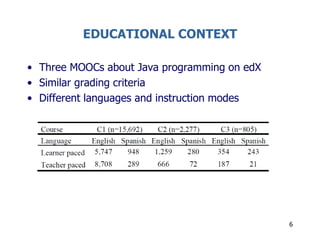
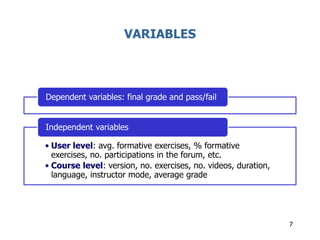
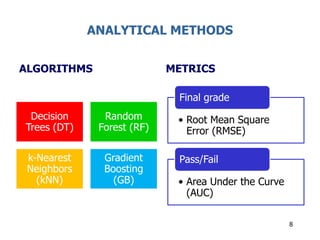
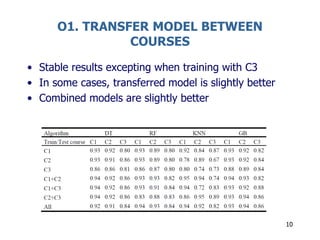
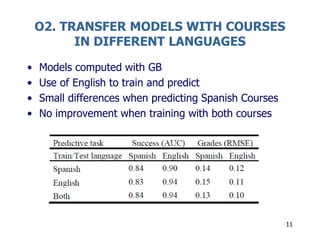
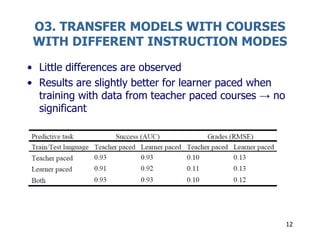
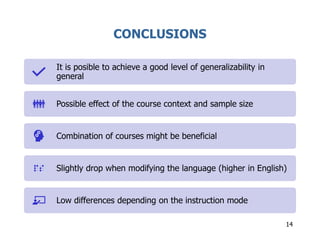
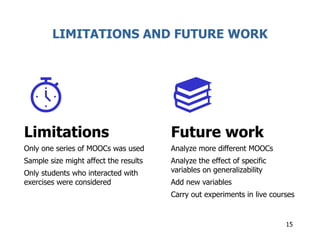
Abstract: One of the key challenges in Massive Open Online Courses (MOOCs) is the high attrition rate. While researchers have worked on predictive models to detect students at risk, one problem is that these models are often trained us-ing data from one course. However, these models face difficulties when generalizing to other contexts. In this line, this work aims to analyze how predictive models can generalize to other similar courses. Particularly, anal-yses are conducted using a series of three courses about Java programming, with several editions in English and in Spanish, and in teacher-paced and learner-paced modes, and using variables at learner and course level. This way, it is possible to analyze the generalizability considering different com-binations of predictive models to forecast MOOC grades and whether or not students pass the course. Results show that it is possible to achieve proper transferability between models in this context, although the predictive power decreases considerably in specific combinations of courses. Moreover, trans-ferability improves when combining two courses. In addition, it is possible to achieve accurate results regardless of the language although significant dif-ferences are observed in some cases when transferring models to the courses in a different language. In contrast, there are barely differences when train-ing and predicting using teacher-paced and learner-paced MOOCs, and accu-rate results are obtained in both cases. These results entail that it is possible to achieve transferable models in MOOCs when using related MOOCs alt-hough a drop in the predictive power may appear depending on the course and language.
Presenter: Pedro Manuel Moreno Marcos
Authors: Pedro Manuel Moreno-Marcos, Miguel Rodríguez Guillén, Carlos Alario-Hoyos, Pedro J. Muñoz-Merino, Iria Estévez-Ayres and Carlos Delgado Kloos
This work was supported by Universidad Carlos III de Madrid (UC3M) through the Grants for the Research Activity of Young Doctors of the UC3M’s Own Research and Transfer Program (ASESOR-IA project). Moreover, it was supported by FEDER / Ministerio de Cien-cia, Innovación y Universidades - Agencia Estatal de Investigación through the grant PID2023-146692OB-C31 (GENIE Learn project) funded by MICIU/AEI/10.13039/501100011033 and by ERDF/UE, by the UNESCO Chair of “Scala-ble Digital Education for All” at UC3M and by the grant RED2022-134284-T funded by MICIU/AEI/10.13039/501100011033.