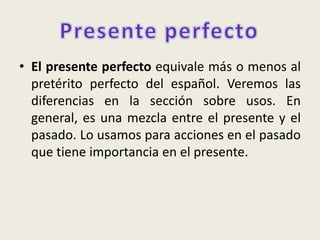
• El presente perfecto equivale más o menos al
  pretérito perfecto del español. Veremos las
  diferencias en la sección sobre usos. En
  general, es una mezcla entre el presente y el
  pasado. Lo usamos para acciones en el pasado
  que tiene importancia en el presente.
Present perfect
• The perfect present is roughly equivalent to
  the Spanish preterite. We will see the
  differences in the section on applications.
  Overall, it's a mix between the present and
  the past. We use it for actions in the past that
  is important in the present.
• Affirmative Sentences: Estructura Sujeto +
  verbo auxiliar ("to have") + participio pasado.
• Negative Sentences: Estructura Sujeto + verbo
  auxiliar ("to have") + "not" + participio
  pasado.
• Interrogative Sentences: Estructura Verbo
  auxiliar ("to have") + sujeto + participio
  pasado?
• Ejemplos:
• I have [I've] talked to Peter. (He hablado con
  Peter.)
• She has [She's] gone to work. (Ha ido a su
  trabajo.)
• We have [We've] been to London. (Hemos ido a
  Londres.)
• They have [They've] learned English. (Han
  aprendido inglés.)
• Ejemplos:
• I haven't talked to Peter. (No he hablado con
  Peter.)
• She hasn't gone to work. (No ha ido a su
  trabajo.)
• We haven't been to London. (No hemos ido a
  Londres.)
• They haven't learned English. (No han
  aprendido inglés.)
• Ejemplos:
• Have you talked to Peter? (¿Has hablado con
  Peter?)
• Has she gone to work? (¿Ha ido a su trabajo?)
• Have you been to London? (¿Has ido a
  Londres?)
• Have they learned English? (¿Han aprendido
  ingles?)

present perfect

  • 2.
    • El presenteperfecto equivale más o menos al pretérito perfecto del español. Veremos las diferencias en la sección sobre usos. En general, es una mezcla entre el presente y el pasado. Lo usamos para acciones en el pasado que tiene importancia en el presente.
  • 3.
    Present perfect • Theperfect present is roughly equivalent to the Spanish preterite. We will see the differences in the section on applications. Overall, it's a mix between the present and the past. We use it for actions in the past that is important in the present.
  • 4.
    • Affirmative Sentences:Estructura Sujeto + verbo auxiliar ("to have") + participio pasado. • Negative Sentences: Estructura Sujeto + verbo auxiliar ("to have") + "not" + participio pasado. • Interrogative Sentences: Estructura Verbo auxiliar ("to have") + sujeto + participio pasado?
  • 5.
    • Ejemplos: • Ihave [I've] talked to Peter. (He hablado con Peter.) • She has [She's] gone to work. (Ha ido a su trabajo.) • We have [We've] been to London. (Hemos ido a Londres.) • They have [They've] learned English. (Han aprendido inglés.)
  • 6.
    • Ejemplos: • Ihaven't talked to Peter. (No he hablado con Peter.) • She hasn't gone to work. (No ha ido a su trabajo.) • We haven't been to London. (No hemos ido a Londres.) • They haven't learned English. (No han aprendido inglés.)
  • 7.
    • Ejemplos: • Haveyou talked to Peter? (¿Has hablado con Peter?) • Has she gone to work? (¿Ha ido a su trabajo?) • Have you been to London? (¿Has ido a Londres?) • Have they learned English? (¿Han aprendido ingles?)