THERE IS /
THERE ARE
QUANTIFIERS
INSTRUCTIONS
FOR THIS WEEK, WE WILL STUDY TWO TOPICS:
1. THERE IS / THERE ARE
2. QUANTIFIERS: A/AN - SOME - ANY
THEN, PLEASE, DO THE LEARNING ACTIVITY AND
THE
ASSESSMENT ACTIVITY
4
FIRST WEEK
PART 1: THERE IS / THERE
ARE
PART 2: QUANTIFIERS (A/A
– SOME - ANY)
5
THERE IS / THERE
ARE
THERE IS / THERE ARE
✘ There is / There are: significan “HAY”.
✘ Se usan para describir la existencia de algo.
Por ejemplo:
• Hay tres casas
• Hay un avión
6
7
There is: se usa para hablar de un
objeto (SINGULAR)
Example:
There is an apple
There’s an apple
there is = there’s
8
There are: se usa para hablar de
objetos en (PLURAL)
Example:
There are two bedrooms
There are four kids
9
NEGATIVE
FORM
10
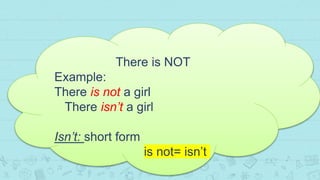
There is NOT
Example:
There is not a girl
There isn’t a girl
Isn’t: short form
is not= isn’t
11
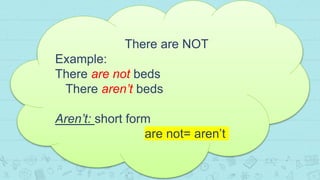
There are NOT
Example:
There are not beds
There aren’t beds
Aren’t: short form
are not= aren’t
12
QUESTION
FORM
13
Question: “there is”
Example:
There is a cat
QUESTION: is there a cat?
14
Question: “there are”
Example:
There are two books
QUESTION: are there two books?
15
SHORT ANSWER
16
EXAMPLE – ANSWERS SHORT FORM
✘ Is there a girl in the classroom?
Yes, there is
✘ Are there two kids in the bedroom?
No, there aren’t
17
CONGRATULATIONS
!!!
NOW, LET’S CONTINUE WITH PART 2
19
QUANTIFIERS:
A/AN - SOME - ANY
QUANTIFIERS
✘ Los usamos para hablar de la cantidad o el número de un
objeto.
✘ Para usarlos, es muy importante siempre prestar atención
a si el objeto es singular o plural y si es contable o
incontable
✘ Los cuantificadores que veremos son A/AN – SOME –
ANY.
20
COUNTABLE NOUNS
Antes de pasar a A/AN – SOME - ANY, hablaremos de la
definición de los sustantivos CONTABLES E INCONTABLES.
✘ Los sustantivos CONTABLES, también llamados
sustantivos DEFINIDOS, son todos aquellos que se
pueden contar o definir un número exacto:
Por ejemplo: las personas, los animales, las casas.
21
UNCOUNTABLE NOUNS
✘ Por otra parte están los sustantivos INCONTABLES o
NO DEFINIDOS, los cuales son, como sus nombres lo
indican, todos aquellos que generalmente no se cuentan
o se define la cantidad exacta.
✘ Normalmente se considera que los sustantivos
incontables no tienen plural.
22
EXAMPLE – UNCOUNTABLE NOUNS
Por ejemplo: la lluvia, el agua, el arroz.
Nota: En el caso del agua y del arroz, se podría definir la cantidad en
tasas o litros, sin embargo, normalmente se consideran incontables
porque se habla de ellos de forma general. Por ejemplo: hay arroz en la
cocina : en este caso no defino la cantidad y el arroz de esta forma no se
puede contar por lo que se hace incontable
23
24
A / AN
✘ A y AN significan UN o UNA, por tanto, usamos A/AN para
hablar de objetos SINGULARES y que además sean
CONTABLES.
✘ Usamos A/AN para oraciones negativas, afirmativas e
interrogativas.
✘ There is an apple
• There isn’t an apple
• Is there an apple?
✘ There is a house
• There isn’t a house
• Is there a house?
Tanto la manzana como la casa son objetos contables y en esta
oración están en SINGULAR
A: UN / UNA
AN: UN / UNA
DIFFERENCE BETWEEN A AND AN
Vamos a usar AN si la palabra que sigue empieza por vocal
y A si la palabra que sigue empieza por consonante.
SOME - ANY
✘ SOME y ANY se usan para expresar una cantidad
indefinida de algo. Estos objetos pueden ser
contables (PLURAL) o incontables (recordemos que los
incontables no tienen plural)
✘ Vamos a usar SOME en oraciones afirmativas
✘ Vamos a usar ANY en oraciones interrogativas y
oraciones negativas
27
SOME - EXAMPLES
✘ Affirmative sentences
• There is some dust on the floor (Hay algo de polvo en el piso)
• There is some cheese in the fridge. (Hay queso en el
refrigerador)
• There are some children in the kitchen (hay niños en la cocina).
28
ANY – EXAMPLES
Negative and interrogative sentences
✘ There isn’t any milk in the fridge (No hay “ninguna” leche en el
refrigerador)
✘ There aren’t any children (No hay niños)
✘ Is there any bread on the table? (Hay pan en la mesa)
SOME - ANY
Mira el siguiente vídeo para ver la comparación de SOME y ANY
con el español
https://www.youtube.com/watch?v=E9A1Y0piP44
Usamos THERE IS para objetos INCONTABLES,
puesto que recuerda que THERE IS es para singular y
los incontables no suelen tener plural.
For example: There is some rice in the kitchen.
There isn´t any water in the bottle
Is there any water in the bottle?
RESUMEN
32
ACTIVITIES
33
34
LEARNING ACTIVITY
✘ En la plataforma, en el espacio “learning activity”
encontrarás los ejercicios correspondientes para practicar
estos temas
Have fun!!
35
ASSESSMENT ACTIVITY
La actividad numero 2 será un taller que
encontrarás en la plataforma en la sección
de “Assessment activity” con el nombre de
“there is/there are and quantifiers
workshop.” No olvides subirlo a la
plataforma en el espacio correspondiente.
GOOD JOB FRIEND, you have
finished the first week activities!
37
THANKS!
Any questions?
You can find me at jeraldinballesteros@unimayor.edu.co
BIBLIOGRAPHY
✘ Woodwardenglish. (2016). Recuperado de:
https://www.grammar.cl/Notes/Some_Any_A_An
.htm
38

There is and there plus quantifiers

  • 2.
    THERE IS / THEREARE QUANTIFIERS
  • 3.
    INSTRUCTIONS FOR THIS WEEK,WE WILL STUDY TWO TOPICS: 1. THERE IS / THERE ARE 2. QUANTIFIERS: A/AN - SOME - ANY THEN, PLEASE, DO THE LEARNING ACTIVITY AND THE ASSESSMENT ACTIVITY
  • 4.
    4 FIRST WEEK PART 1:THERE IS / THERE ARE PART 2: QUANTIFIERS (A/A – SOME - ANY)
  • 5.
    5 THERE IS /THERE ARE
  • 6.
    THERE IS /THERE ARE ✘ There is / There are: significan “HAY”. ✘ Se usan para describir la existencia de algo. Por ejemplo: • Hay tres casas • Hay un avión 6
  • 7.
    7 There is: seusa para hablar de un objeto (SINGULAR) Example: There is an apple There’s an apple there is = there’s
  • 8.
    8 There are: seusa para hablar de objetos en (PLURAL) Example: There are two bedrooms There are four kids
  • 9.
  • 10.
    10 There is NOT Example: Thereis not a girl There isn’t a girl Isn’t: short form is not= isn’t
  • 11.
    11 There are NOT Example: Thereare not beds There aren’t beds Aren’t: short form are not= aren’t
  • 12.
  • 13.
    13 Question: “there is” Example: Thereis a cat QUESTION: is there a cat?
  • 14.
    14 Question: “there are” Example: Thereare two books QUESTION: are there two books?
  • 15.
  • 16.
  • 17.
    EXAMPLE – ANSWERSSHORT FORM ✘ Is there a girl in the classroom? Yes, there is ✘ Are there two kids in the bedroom? No, there aren’t 17
  • 18.
  • 19.
  • 20.
    QUANTIFIERS ✘ Los usamospara hablar de la cantidad o el número de un objeto. ✘ Para usarlos, es muy importante siempre prestar atención a si el objeto es singular o plural y si es contable o incontable ✘ Los cuantificadores que veremos son A/AN – SOME – ANY. 20
  • 21.
    COUNTABLE NOUNS Antes depasar a A/AN – SOME - ANY, hablaremos de la definición de los sustantivos CONTABLES E INCONTABLES. ✘ Los sustantivos CONTABLES, también llamados sustantivos DEFINIDOS, son todos aquellos que se pueden contar o definir un número exacto: Por ejemplo: las personas, los animales, las casas. 21
  • 22.
    UNCOUNTABLE NOUNS ✘ Porotra parte están los sustantivos INCONTABLES o NO DEFINIDOS, los cuales son, como sus nombres lo indican, todos aquellos que generalmente no se cuentan o se define la cantidad exacta. ✘ Normalmente se considera que los sustantivos incontables no tienen plural. 22
  • 23.
    EXAMPLE – UNCOUNTABLENOUNS Por ejemplo: la lluvia, el agua, el arroz. Nota: En el caso del agua y del arroz, se podría definir la cantidad en tasas o litros, sin embargo, normalmente se consideran incontables porque se habla de ellos de forma general. Por ejemplo: hay arroz en la cocina : en este caso no defino la cantidad y el arroz de esta forma no se puede contar por lo que se hace incontable 23
  • 24.
  • 25.
    A / AN ✘A y AN significan UN o UNA, por tanto, usamos A/AN para hablar de objetos SINGULARES y que además sean CONTABLES. ✘ Usamos A/AN para oraciones negativas, afirmativas e interrogativas. ✘ There is an apple • There isn’t an apple • Is there an apple? ✘ There is a house • There isn’t a house • Is there a house? Tanto la manzana como la casa son objetos contables y en esta oración están en SINGULAR
  • 26.
    A: UN /UNA AN: UN / UNA DIFFERENCE BETWEEN A AND AN Vamos a usar AN si la palabra que sigue empieza por vocal y A si la palabra que sigue empieza por consonante.
  • 27.
    SOME - ANY ✘SOME y ANY se usan para expresar una cantidad indefinida de algo. Estos objetos pueden ser contables (PLURAL) o incontables (recordemos que los incontables no tienen plural) ✘ Vamos a usar SOME en oraciones afirmativas ✘ Vamos a usar ANY en oraciones interrogativas y oraciones negativas 27
  • 28.
    SOME - EXAMPLES ✘Affirmative sentences • There is some dust on the floor (Hay algo de polvo en el piso) • There is some cheese in the fridge. (Hay queso en el refrigerador) • There are some children in the kitchen (hay niños en la cocina). 28
  • 29.
    ANY – EXAMPLES Negativeand interrogative sentences ✘ There isn’t any milk in the fridge (No hay “ninguna” leche en el refrigerador) ✘ There aren’t any children (No hay niños) ✘ Is there any bread on the table? (Hay pan en la mesa)
  • 30.
    SOME - ANY Mirael siguiente vídeo para ver la comparación de SOME y ANY con el español https://www.youtube.com/watch?v=E9A1Y0piP44
  • 31.
    Usamos THERE ISpara objetos INCONTABLES, puesto que recuerda que THERE IS es para singular y los incontables no suelen tener plural. For example: There is some rice in the kitchen. There isn´t any water in the bottle Is there any water in the bottle?
  • 32.
  • 33.
  • 34.
    34 LEARNING ACTIVITY ✘ Enla plataforma, en el espacio “learning activity” encontrarás los ejercicios correspondientes para practicar estos temas Have fun!!
  • 35.
    35 ASSESSMENT ACTIVITY La actividadnumero 2 será un taller que encontrarás en la plataforma en la sección de “Assessment activity” con el nombre de “there is/there are and quantifiers workshop.” No olvides subirlo a la plataforma en el espacio correspondiente.
  • 36.
    GOOD JOB FRIEND,you have finished the first week activities!
  • 37.
    37 THANKS! Any questions? You canfind me at jeraldinballesteros@unimayor.edu.co
  • 38.
    BIBLIOGRAPHY ✘ Woodwardenglish. (2016).Recuperado de: https://www.grammar.cl/Notes/Some_Any_A_An .htm 38