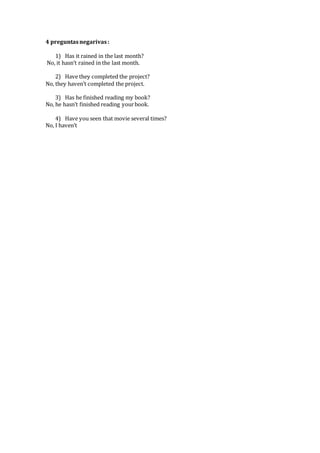
El presente perfecto se usa para acciones en el pasado que tienen importancia en el presente. Se forma con el verbo auxiliar "to have" y el participio pasado del verbo principal. Se usa para acciones que ocurrieron en un tiempo no específico antes del presente. La estructura básica incluye frases afirmativas, negativas e interrogativas con el verbo auxiliar y el participio pasado. El documento también proporciona ejemplos de preguntas afirmativas y negativas en el presente perfecto.
![Presenteperfecto
En general, es una mezcla entre el presente y el pasado. Lo usamos para accionesen el
pasado que tienen importancia en el presente. Se usa el presente perfectopara acciones
que ocurrieron en un tiempo no concreto antes de ahora. El tiempo específicono es
importante. Porlo tanto, no solemos usar expresiones de tiempo específicas (“this
morning”, “yesterday”,“last year”…) con el presente perfecto. Se puede usar el presente
perfectocon expresiones de tiempo no concretas (“never”,“ever”,“many times”, “for”,
“since”,“already”, “yet”…).
Estructura:
1. AffirmativeSentences (Frases afirmativas)
Sujeto + verbo auxiliar (to have) + participio pasado
Ejemplos:
I have [I’ve] talked to Peter.(Hehablado conPeter.)
She has [She’s] gone to work.(Haido asu trabajo.)
We have [We’ve] been to London.(Hemos ido aLondres.)
2.NegativeSentences(Frasesnegativas)
Sujeto + verbo auxiliar (to have) + “not” + participio pasado…
Ejemplos:
I haven’t talked to Peter.(Nohe hablado con Peter.)
She hasn’t gone to work.(Noha ido a su trabajo.)
We haven’t been to London.(No hemos ido a Londres.)
3.InterrogativeSentences(Frasesinterrogativas)
Verbo auxiliar (to have) + sujeto + participio pasado…?
Ejemplos:
Have you talked to Peter?(¿Has hablado con Peter?)
Has she gone to work?(¿Ha ido a su trabajo?)
Have you been to London?(¿Has ido a Londres?)
4 pregutasafirmativas:
1. Has he read the book that you gave me yesterday?
Yes, he has.
2. Has she spoken with him several times?
Yes, she has
3. Have they lent money to you many times?
Yes, they have
4. Have they lost my book?
Yes, they have.](https://image.slidesharecdn.com/ingles-luisfernando-220717223925-d484acc7/85/INGLES-LUIS-FERNANDO-docx-1-320.jpg)