Las vacaciones
4.13.17
viajar
estar de vacaciones
ir de vacaciones
¿Qué tiempo hace?
¿Cuál es la
fecha de
hoy?
Hoy es el…
de…
la estación
el mes
el año
la primavera el verano el otoño el invierno
¿Cuál es la fecha de
hoy?
¿Qué estación
prefieres?
Cuando vas de
vacaciones, ¿qué haces?
el tiempo
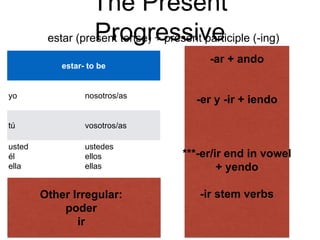
The Present
Progressiveestar (present tense) + present participle (-ing)
estar- to be
yo nosotros/as
tú vosotros/as
usted
él
ella
ustedes
ellos
ellas
-ar + ando
-er y -ir + iendo
***-er/ir end in vowel
+ yendo
-ir stem verbsOther Irregular:
poder
ir
Estar with Emotions
Recuerda…
• emotions are adjectives must agree in number and
gender with the noun they modify
estar- to be
estoy estamos
estás estáis
está están
Ser vs. Estar
Ser vs. Estar
ser estar
Nationality and origin
Profession or occupation
Characteristics/ phyiscal or personality
description
Generalizations
Possession
What something is made of
Time and date
Where or when an event occurs
Location
Health
Emotions
Physical state and conditions
Some weather
Ongoing Actions (Present Progressive
Tense)
Ser- inherent qualities vs. Estar- temporary and changeable
conditions
•listo/a
•malo/a
•aburrido/a
•verde
•vivo/a
•seguro/a
ne at an airport in Spain. Tell what these people look like, how the
Direct Object Pronouns
(DOP)
• a direct object receives the action of the verb
• who or what receives the action of the verb
• We eat cookies.
• They throw the ball.
• direct object pronouns REPLACE direct objects
• We eat ___.
• They throw ___.
Direct Object Pronouns
(DOP)
me nos
te os
lo/la los/las
DOP are placed directly BEFORE the conjugated verb
OR
If there is any infinitive, they can be attached to the infinitive.
Ella tiene la mochila.
Nosotros practicamos deportes.
Mi familia visita a mí.
4.13.17 vacaciones,ser,estar

4.13.17 vacaciones,ser,estar