Clases de Envoltorio
o wrapper
Andrés Guzmán F
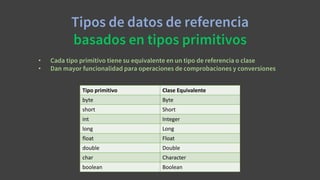
Tipos de datos de referencia
basados en tipos primitivos
• Cada tipo primitivo tiene su equivalente en un tipo de referencia o clase
• Dan mayor funcionalidad para operaciones de comprobaciones y conversiones
Tipo primitivo Clase Equivalente
byte Byte
short Short
int Integer
long Long
float Float
double Double
char Character
boolean Boolean
La Clase
Integer
• Cada tipo numérico tiene su propia clase de objetos.
• Así el tipo int tiene la clase Integer .
• Se implementan varios métodos útiles dentro de la clase envoltorio Integer
Integer i = Integer.valueOf(1234567);
String s = i.toString();
int j = i.intValue();
long l = i.longValue();
float f = i.floatValue();
double d = i.doubleValue();
int k = Integer.parseInt("2147483647");
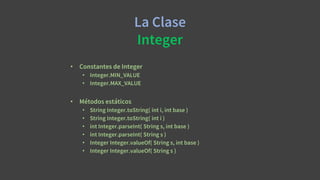
La Clase
Integer
• Constantes de Integer
• Integer.MIN_VALUE
• Integer.MAX_VALUE
• Métodos estáticos
• String Integer.toString( int i, int base )
• String Integer.toString( int i )
• int Integer.parseInt( String s, int base )
• int Integer.parseInt( String s )
• Integer Integer.valueOf( String s, int base )
• Integer Integer.valueOf( String s )
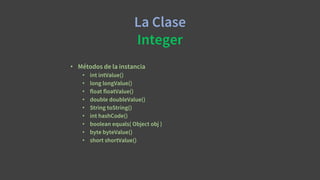
La Clase
Integer
• Métodos de la instancia
• int intValue()
• long longValue()
• float floatValue()
• double doubleValue()
• String toString()
• int hashCode()
• boolean equals( Object obj )
• byte byteValue()
• short shortValue()
La Clase
Long
• Cada tipo numérico tiene su propia clase de objetos, así el tipo long tiene la clase Long .
• De la misma forma que con la clase Integer, se implementan muchas funciones útiles dentro
de los métodos de la clase Long .
Long l = Long.valueOf(2147483648L);
String s = l.toString();
int i = l.intValue();
long j = l.longValue();
float f = l.floatValue();
double d = l.doubleValue();
long k = Long.parseLong("9223372036854775807");
La Clase
Long
• Constantes de Long
• Long.MIN_VALUE
• Long.MAX_VALUE
• Métodos estáticos
• String Long.toString( long l, int base )
• String Long.toString( long l )
• long L.parseLong( String s, int base )
• long L.parseLong( String s )
• Long Long.valueOf( String s, int base )
• Long Long.valueOf( String s )
La Clase
Long
• Métodos de la instancia
• int intValue()
• long longValue()
• float floatValue()
• double doubleValue()
• String toString()
• int hashCode()
• boolean equals( Object obj )
• byte byteValue()
• short shortValue();
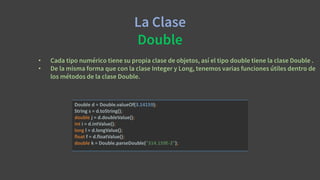
La Clase
Double
• Cada tipo numérico tiene su propia clase de objetos, así el tipo double tiene la clase Double .
• De la misma forma que con la clase Integer y Long, tenemos varias funciones útiles dentro de
los métodos de la clase Double.
Double d = Double.valueOf(3.14159);
String s = d.toString();
double j = d.doubleValue();
int i = d.intValue();
long l = d.longValue();
float f = d.floatValue();
double k = Double.parseDouble("314.159E-2");
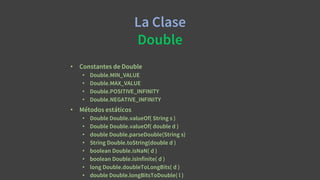
La Clase
Double
• Constantes de Double
• Double.MIN_VALUE
• Double.MAX_VALUE
• Double.POSITIVE_INFINITY
• Double.NEGATIVE_INFINITY
• Métodos estáticos
• Double Double.valueOf( String s )
• Double Double.valueOf( double d )
• double Double.parseDouble(String s)
• String Double.toString(double d )
• boolean Double.isNaN( d )
• boolean Double.isInfinite( d )
• long Double.doubleToLongBits( d )
• double Double.longBitsToDouble( l )
La Clase
Double
• Métodos de la instancia
• boolean equals(Object o)
• String toString()
• int intValue()
• long longValue()
• float floatValue()
• double doubleValue()
• boolean isNaN()
• boolean isInfinite()
• byte byteValue()
• short shortValue()
La Clase
Float
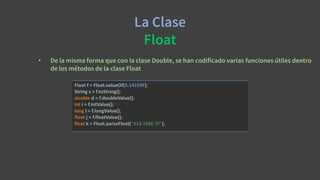
• De la misma forma que con la clase Double, se han codificado varias funciones útiles dentro
de los métodos de la clase Float
Float f = Float.valueOf(3.14159F);
String s = f.toString();
double d = f.doubleValue();
int i = f.intValue();
long l = f.longValue();
float j = f.floatValue();
float k = Float.parseFloat("314.159E-2f");
La Clase
Character
• La clase Character también tiene métodos para comprobaciones y conversiones
Character c = Character.valueOf('A');
String s = c.toString();
char c2 = c.charValue();
char c3 = Character.toLowerCase(c);
boolean b = Character.isDigit(c);
boolean b2 = Character.isAlphabetic(c);
boolean b3 = Character.isUpperCase(c);
boolean b4 = Character.isLowerCase(c);
boolean b5 = Character.isLetter(c);
boolean b6 = Character.isSpaceChar(c);
boolean b7 = Character.isSpaceChar(' ');
boolean b8 = Character.isDigit('7');
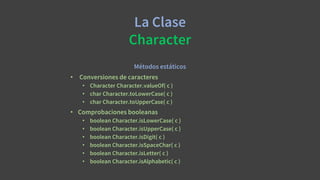
La Clase
Character
Métodos estáticos
• Conversiones de caracteres
• Character Character.valueOf( c )
• char Character.toLowerCase( c )
• char Character.toUpperCase( c )
• Comprobaciones booleanas
• boolean Character.isLowerCase( c )
• boolean Character.isUpperCase( c )
• boolean Character.isDigit( c )
• boolean Character.isSpaceChar( c )
• boolean Character.isLetter( c )
• boolean Character.isAlphabetic( c )
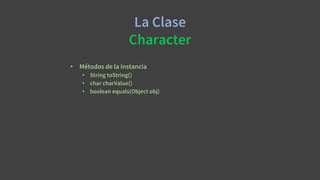
La Clase
Character
• Métodos de la instancia
• String toString()
• char charValue()
• boolean equals(Object obj)
La Clase
Boolean
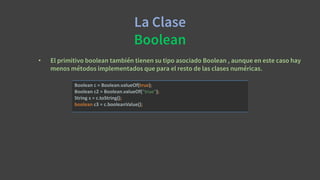
• El primitivo boolean también tienen su tipo asociado Boolean , aunque en este caso hay
menos métodos implementados que para el resto de las clases numéricas.
Boolean c = Boolean.valueOf(true);
Boolean c2 = Boolean.valueOf("true");
String s = c.toString();
boolean c3 = c.booleanValue();
La Clase
Boolean
• Constantes de Boolean
• Boolean.TRUE
• Boolean.FALSE
• Métodos de la instancia
• boolean booleanValue()
• String toString()
• boolean equals( Object obj )

6_clases_wrapper.pdf para trabajar con Java

  • 1.
    Clases de Envoltorio owrapper Andrés Guzmán F
  • 2.
    Tipos de datosde referencia basados en tipos primitivos • Cada tipo primitivo tiene su equivalente en un tipo de referencia o clase • Dan mayor funcionalidad para operaciones de comprobaciones y conversiones Tipo primitivo Clase Equivalente byte Byte short Short int Integer long Long float Float double Double char Character boolean Boolean
  • 3.
    La Clase Integer • Cadatipo numérico tiene su propia clase de objetos. • Así el tipo int tiene la clase Integer . • Se implementan varios métodos útiles dentro de la clase envoltorio Integer Integer i = Integer.valueOf(1234567); String s = i.toString(); int j = i.intValue(); long l = i.longValue(); float f = i.floatValue(); double d = i.doubleValue(); int k = Integer.parseInt("2147483647");
  • 4.
    La Clase Integer • Constantesde Integer • Integer.MIN_VALUE • Integer.MAX_VALUE • Métodos estáticos • String Integer.toString( int i, int base ) • String Integer.toString( int i ) • int Integer.parseInt( String s, int base ) • int Integer.parseInt( String s ) • Integer Integer.valueOf( String s, int base ) • Integer Integer.valueOf( String s )
  • 5.
    La Clase Integer • Métodosde la instancia • int intValue() • long longValue() • float floatValue() • double doubleValue() • String toString() • int hashCode() • boolean equals( Object obj ) • byte byteValue() • short shortValue()
  • 6.
    La Clase Long • Cadatipo numérico tiene su propia clase de objetos, así el tipo long tiene la clase Long . • De la misma forma que con la clase Integer, se implementan muchas funciones útiles dentro de los métodos de la clase Long . Long l = Long.valueOf(2147483648L); String s = l.toString(); int i = l.intValue(); long j = l.longValue(); float f = l.floatValue(); double d = l.doubleValue(); long k = Long.parseLong("9223372036854775807");
  • 7.
    La Clase Long • Constantesde Long • Long.MIN_VALUE • Long.MAX_VALUE • Métodos estáticos • String Long.toString( long l, int base ) • String Long.toString( long l ) • long L.parseLong( String s, int base ) • long L.parseLong( String s ) • Long Long.valueOf( String s, int base ) • Long Long.valueOf( String s )
  • 8.
    La Clase Long • Métodosde la instancia • int intValue() • long longValue() • float floatValue() • double doubleValue() • String toString() • int hashCode() • boolean equals( Object obj ) • byte byteValue() • short shortValue();
  • 9.
    La Clase Double • Cadatipo numérico tiene su propia clase de objetos, así el tipo double tiene la clase Double . • De la misma forma que con la clase Integer y Long, tenemos varias funciones útiles dentro de los métodos de la clase Double. Double d = Double.valueOf(3.14159); String s = d.toString(); double j = d.doubleValue(); int i = d.intValue(); long l = d.longValue(); float f = d.floatValue(); double k = Double.parseDouble("314.159E-2");
  • 10.
    La Clase Double • Constantesde Double • Double.MIN_VALUE • Double.MAX_VALUE • Double.POSITIVE_INFINITY • Double.NEGATIVE_INFINITY • Métodos estáticos • Double Double.valueOf( String s ) • Double Double.valueOf( double d ) • double Double.parseDouble(String s) • String Double.toString(double d ) • boolean Double.isNaN( d ) • boolean Double.isInfinite( d ) • long Double.doubleToLongBits( d ) • double Double.longBitsToDouble( l )
  • 11.
    La Clase Double • Métodosde la instancia • boolean equals(Object o) • String toString() • int intValue() • long longValue() • float floatValue() • double doubleValue() • boolean isNaN() • boolean isInfinite() • byte byteValue() • short shortValue()
  • 12.
    La Clase Float • Dela misma forma que con la clase Double, se han codificado varias funciones útiles dentro de los métodos de la clase Float Float f = Float.valueOf(3.14159F); String s = f.toString(); double d = f.doubleValue(); int i = f.intValue(); long l = f.longValue(); float j = f.floatValue(); float k = Float.parseFloat("314.159E-2f");
  • 13.
    La Clase Character • Laclase Character también tiene métodos para comprobaciones y conversiones Character c = Character.valueOf('A'); String s = c.toString(); char c2 = c.charValue(); char c3 = Character.toLowerCase(c); boolean b = Character.isDigit(c); boolean b2 = Character.isAlphabetic(c); boolean b3 = Character.isUpperCase(c); boolean b4 = Character.isLowerCase(c); boolean b5 = Character.isLetter(c); boolean b6 = Character.isSpaceChar(c); boolean b7 = Character.isSpaceChar(' '); boolean b8 = Character.isDigit('7');
  • 14.
    La Clase Character Métodos estáticos •Conversiones de caracteres • Character Character.valueOf( c ) • char Character.toLowerCase( c ) • char Character.toUpperCase( c ) • Comprobaciones booleanas • boolean Character.isLowerCase( c ) • boolean Character.isUpperCase( c ) • boolean Character.isDigit( c ) • boolean Character.isSpaceChar( c ) • boolean Character.isLetter( c ) • boolean Character.isAlphabetic( c )
  • 15.
    La Clase Character • Métodosde la instancia • String toString() • char charValue() • boolean equals(Object obj)
  • 16.
    La Clase Boolean • Elprimitivo boolean también tienen su tipo asociado Boolean , aunque en este caso hay menos métodos implementados que para el resto de las clases numéricas. Boolean c = Boolean.valueOf(true); Boolean c2 = Boolean.valueOf("true"); String s = c.toString(); boolean c3 = c.booleanValue();
  • 17.
    La Clase Boolean • Constantesde Boolean • Boolean.TRUE • Boolean.FALSE • Métodos de la instancia • boolean booleanValue() • String toString() • boolean equals( Object obj )