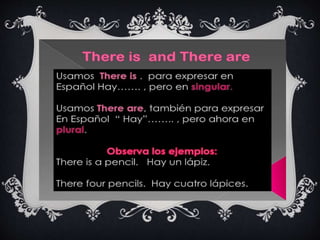
Estas expresiones se utilizan para expresar la cantidad
de objetos o personas que se encuentran en un
determinado lugar.Ambas formas significan "Hay". La
diferencia es que la primera se utiliza para elsingular y
la segunda para el plural.
THERE IS AND THERE ARE
Positive Sentences
We use there is for singular and there
are for plural.
There is one table in the classroom.
There are three chairs in the classroom.
There is a spider in the bath.
There are many people at the bus stop.
.
En Contracciones
EnContractions
The contraction of there is is there's.
There's a good song on the radio.
There's only one chocolate left in the box.
You cannot contract there are.
There are nine cats on the roof.
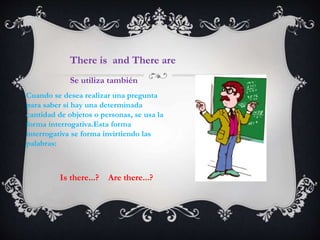
Cuando se desea realizar una pregunta
para saber si hay una determinada
cantidad de objetos o personas, se usa la
forma interrogativa.Esta forma
interrogativa se forma invirtiendo las
palabras:
There is and There are
Se utiliza también
Is there...? Are there...?
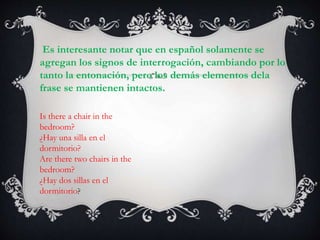
Es interesante notar que en español solamente se
agregan los signos de interrogación, cambiando por lo
tanto la entonación, pero los demás elementos dela
frase se mantienen intactos.
Is there a chair in the
bedroom?
¿Hay una silla en el
dormitorio?
Are there two chairs in the
bedroom?
¿Hay dos sillas en el
dormitorio?
 Cuando se desea realizar una negación acerca de la
cantidad de objetos o personas, se usa la forma negativa.
Esta forma negativa se forma agregando la palabra
 not
There is nota... There are
not...
Como ya hemos visto, en
lenguaje informal, se
pueden contraer las
formas verbales:
There isn't... There aren't...
There isn't a chair in the bedroom.
No hay una silla en el dormitorio.
There aren't two chairs in the bedroom.
No hay dos sillas en el dormitorio.
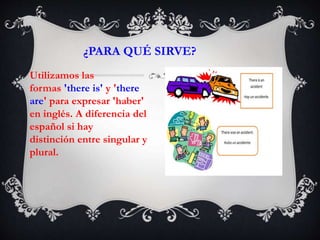
¿PARA QUÉ SIRVE?
Utilizamos las
formas 'there is' y 'there
are' para expresar 'haber'
en inglés. A diferencia del
español si hay
distinción entre singular y
plural.
¿CÓMO SE FORMA?
Lo único que debemos tener en cuenta para usar esta
estructura es si estamos hablando de singular o plural.
AFIRMATIVA:
Utilizamos ‘there is’ con
cuando hablamos en
singular. Sin embargo, si
hablamos en plural
utilizamos ‘there are’.
THERE + IS/ARE + RESTO DE FRASE
Hay una mujer en el parque.
There is a woman in the park.
Hay dos mujeres en una
cafetería.
There are two women in a café.
* Recuerda que la forma
en singular puede
contraerse (I.e. There's a
woman in the park). La
forma plural no se puede
contraer.

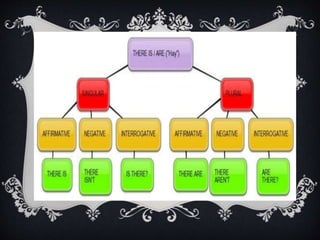
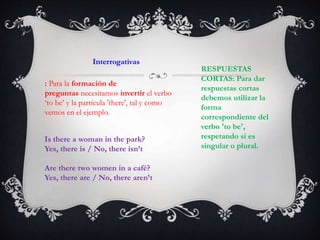
Interrogativas
: Para la formación de
preguntas necesitamos invertir el verbo
‘to be’ y la partícula 'there', tal y como
vemos en el ejemplo.
RESPUESTAS
CORTAS: Para dar
respuestas cortas
debemos utilizar la
forma
correspondiente del
verbo 'to be',
respetando si es
singular o plural.
Is there a woman in the park?
Yes, there is / No, there isn’t
Are there two women in a café?
Yes, there are / No, there aren’t
Diapositivas de vero

Diapositivas de vero

  • 2.
    Estas expresiones seutilizan para expresar la cantidad de objetos o personas que se encuentran en un determinado lugar.Ambas formas significan "Hay". La diferencia es que la primera se utiliza para elsingular y la segunda para el plural. THERE IS AND THERE ARE
  • 3.
    Positive Sentences We usethere is for singular and there are for plural. There is one table in the classroom. There are three chairs in the classroom. There is a spider in the bath. There are many people at the bus stop. .
  • 4.
    En Contracciones EnContractions The contractionof there is is there's. There's a good song on the radio. There's only one chocolate left in the box. You cannot contract there are. There are nine cats on the roof.
  • 5.
    Cuando se desearealizar una pregunta para saber si hay una determinada cantidad de objetos o personas, se usa la forma interrogativa.Esta forma interrogativa se forma invirtiendo las palabras: There is and There are Se utiliza también Is there...? Are there...?
  • 6.
    Es interesante notarque en español solamente se agregan los signos de interrogación, cambiando por lo tanto la entonación, pero los demás elementos dela frase se mantienen intactos. Is there a chair in the bedroom? ¿Hay una silla en el dormitorio? Are there two chairs in the bedroom? ¿Hay dos sillas en el dormitorio?
  • 7.
     Cuando sedesea realizar una negación acerca de la cantidad de objetos o personas, se usa la forma negativa. Esta forma negativa se forma agregando la palabra  not There is nota... There are not... Como ya hemos visto, en lenguaje informal, se pueden contraer las formas verbales:
  • 8.
    There isn't... Therearen't... There isn't a chair in the bedroom. No hay una silla en el dormitorio. There aren't two chairs in the bedroom. No hay dos sillas en el dormitorio.
  • 9.
    ¿PARA QUÉ SIRVE? Utilizamoslas formas 'there is' y 'there are' para expresar 'haber' en inglés. A diferencia del español si hay distinción entre singular y plural.
  • 10.
    ¿CÓMO SE FORMA? Loúnico que debemos tener en cuenta para usar esta estructura es si estamos hablando de singular o plural. AFIRMATIVA: Utilizamos ‘there is’ con cuando hablamos en singular. Sin embargo, si hablamos en plural utilizamos ‘there are’.
  • 11.
    THERE + IS/ARE+ RESTO DE FRASE Hay una mujer en el parque. There is a woman in the park. Hay dos mujeres en una cafetería. There are two women in a café. * Recuerda que la forma en singular puede contraerse (I.e. There's a woman in the park). La forma plural no se puede contraer.

  • 14.
    Interrogativas : Para laformación de preguntas necesitamos invertir el verbo ‘to be’ y la partícula 'there', tal y como vemos en el ejemplo. RESPUESTAS CORTAS: Para dar respuestas cortas debemos utilizar la forma correspondiente del verbo 'to be', respetando si es singular o plural. Is there a woman in the park? Yes, there is / No, there isn’t Are there two women in a café? Yes, there are / No, there aren’t