FECHAS


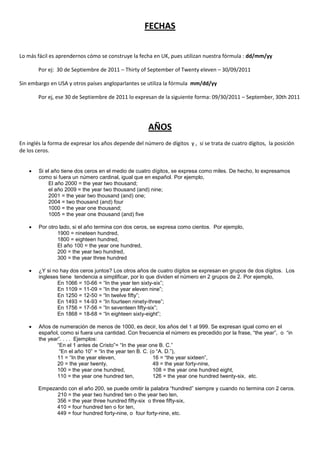
Lo más fácil es aprendernos cómo se construye la fecha en UK, pues utilizan nuestra fórmula : dd/mm/yy

        Por ej: 30 de Septiembre de 2011 – Thirty of September of Twenty eleven – 30/09/2011

Sin embargo en USA y otros países angloparlantes se utiliza la fórmula mm/dd/yy

        Por ej, ese 30 de Septiembre de 2011 lo expresan de la siguiente forma: 09/30/2011 – September, 30th 2011


                                                      AÑOS
En inglés la forma de expresar los años depende del número de dígitos y , si se trata de cuatro dígitos, la posición
de los ceros.


       Si el año tiene dos ceros en el medio de cuatro dígitos, se expresa como miles. De hecho, lo expresamos
        como si fuera un número cardinal, igual que en español. Por ejemplo,
            El año 2000 = the year two thousand;
            el año 2009 = the year two thousand (and) nine;
            2001 = the year two thousand (and) one;
            2004 = two thousand (and) four
            1000 = the year one thousand;
            1005 = the year one thousand (and) five

       Por otro lado, si el año termina con dos ceros, se expresa como cientos. Por ejemplo,
                1900 = nineteen hundred,
                1800 = eighteen hundred,
                El año 100 = the year one hundred,
                200 = the year two hundred,
                300 = the year three hundred

       ¿Y si no hay dos ceros juntos? Los otros años de cuatro dígitos se expresan en grupos de dos dígitos. Los
        ingleses tiene tendencia a simplificar, por lo que dividen el número en 2 grupos de 2. Por ejemplo,
                En 1066 = 10-66 = “In the year ten sixty-six”;
                En 1109 = 11-09 = “In the year eleven nine”;
                En 1250 = 12-50 = “In twelve fifty”;
                En 1493 = 14-93 = “In fourteen ninety-three”;
                En 1756 = 17-56 = “In seventeen fifty-six”;
                En 1868 = 18-68 = “In eighteen sixty-eight”;

       Años de numeración de menos de 1000, es decir, los años del 1 al 999. Se expresan igual como en el
        español, como si fuera una cantidad. Con frecuencia el número es precedido por la frase, “the year”, o “in
        the year”. . . . Ejemplos:
                “En el 1 antes de Cristo”= “In the year one B. C.”
                 “En el año 10” = “In the year ten B. C. (o “A. D.”),
                11 = “In the year eleven,                 16 = “the year sixteen”,
                20 = the year twenty,                     49 = the year forty-nine,
                100 = the year one hundred,               108 = the year one hundred eight,
                110 = the year one hundred ten,           126 = the year one hundred twenty-six, etc.

        Empezando con el año 200, se puede omitir la palabra “hundred” siempre y cuando no termina con 2 ceros.
              210 = the year two hundred ten o the year two ten,
              356 = the year three hundred fifty-six o three fifty-six,
              410 = four hundred ten o for ten,
              449 = four hundred forty-nine, o four forty-nine, etc.
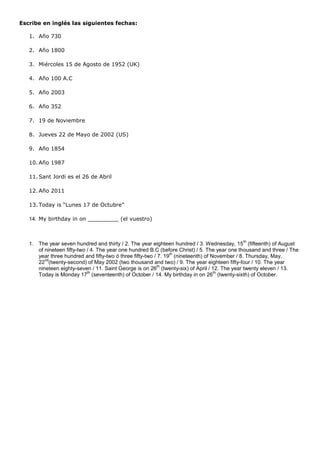
Escribe en inglés las siguientes fechas:

   1. Año 730

   2. Año 1800

   3. Miércoles 15 de Agosto de 1952 (UK)

   4. Año 100 A.C

   5. Año 2003

   6. Año 352

   7. 19 de Noviembre

   8. Jueves 22 de Mayo de 2002 (US)

   9. Año 1854

   10. Año 1987

   11. Sant Jordi es el 26 de Abril

   12. Año 2011

   13. Today is “Lunes 17 de Octubre”

   14. My birthday in on _________ (el vuestro)


                                                                                            th
   1. The year seven hundred and thirty / 2. The year eighteen hundred / 3. Wednesday, 15 (fifteenth) of August
      of nineteen fifty-two / 4. The year one hundred B.C (before Christ) / 5. The year one thousand and three / The
                                                                th
      year three hundred and fifty-two ó three fifty-two / 7. 19 (nineteenth) of November / 8. Thursday, May,
         nd
      22 (twenty-second) of May 2002 (two thousand and two) / 9. The year eighteen fifty-four / 10. The year
                                                           th
      nineteen eighty-seven / 11. Saint George is on 26 (twenty-six) of April / 12. The year twenty eleven / 13.
                            th                                                    th
      Today is Monday 17 (seventeenth) of October / 14. My birthday in on 26 (twenty-sixth) of October.

Fechas

  • 1.
    FECHAS Lo más fáciles aprendernos cómo se construye la fecha en UK, pues utilizan nuestra fórmula : dd/mm/yy Por ej: 30 de Septiembre de 2011 – Thirty of September of Twenty eleven – 30/09/2011 Sin embargo en USA y otros países angloparlantes se utiliza la fórmula mm/dd/yy Por ej, ese 30 de Septiembre de 2011 lo expresan de la siguiente forma: 09/30/2011 – September, 30th 2011 AÑOS En inglés la forma de expresar los años depende del número de dígitos y , si se trata de cuatro dígitos, la posición de los ceros.  Si el año tiene dos ceros en el medio de cuatro dígitos, se expresa como miles. De hecho, lo expresamos como si fuera un número cardinal, igual que en español. Por ejemplo, El año 2000 = the year two thousand; el año 2009 = the year two thousand (and) nine; 2001 = the year two thousand (and) one; 2004 = two thousand (and) four 1000 = the year one thousand; 1005 = the year one thousand (and) five  Por otro lado, si el año termina con dos ceros, se expresa como cientos. Por ejemplo, 1900 = nineteen hundred, 1800 = eighteen hundred, El año 100 = the year one hundred, 200 = the year two hundred, 300 = the year three hundred  ¿Y si no hay dos ceros juntos? Los otros años de cuatro dígitos se expresan en grupos de dos dígitos. Los ingleses tiene tendencia a simplificar, por lo que dividen el número en 2 grupos de 2. Por ejemplo, En 1066 = 10-66 = “In the year ten sixty-six”; En 1109 = 11-09 = “In the year eleven nine”; En 1250 = 12-50 = “In twelve fifty”; En 1493 = 14-93 = “In fourteen ninety-three”; En 1756 = 17-56 = “In seventeen fifty-six”; En 1868 = 18-68 = “In eighteen sixty-eight”;  Años de numeración de menos de 1000, es decir, los años del 1 al 999. Se expresan igual como en el español, como si fuera una cantidad. Con frecuencia el número es precedido por la frase, “the year”, o “in the year”. . . . Ejemplos: “En el 1 antes de Cristo”= “In the year one B. C.” “En el año 10” = “In the year ten B. C. (o “A. D.”), 11 = “In the year eleven, 16 = “the year sixteen”, 20 = the year twenty, 49 = the year forty-nine, 100 = the year one hundred, 108 = the year one hundred eight, 110 = the year one hundred ten, 126 = the year one hundred twenty-six, etc. Empezando con el año 200, se puede omitir la palabra “hundred” siempre y cuando no termina con 2 ceros. 210 = the year two hundred ten o the year two ten, 356 = the year three hundred fifty-six o three fifty-six, 410 = four hundred ten o for ten, 449 = four hundred forty-nine, o four forty-nine, etc.
  • 2.
    Escribe en ingléslas siguientes fechas: 1. Año 730 2. Año 1800 3. Miércoles 15 de Agosto de 1952 (UK) 4. Año 100 A.C 5. Año 2003 6. Año 352 7. 19 de Noviembre 8. Jueves 22 de Mayo de 2002 (US) 9. Año 1854 10. Año 1987 11. Sant Jordi es el 26 de Abril 12. Año 2011 13. Today is “Lunes 17 de Octubre” 14. My birthday in on _________ (el vuestro) th 1. The year seven hundred and thirty / 2. The year eighteen hundred / 3. Wednesday, 15 (fifteenth) of August of nineteen fifty-two / 4. The year one hundred B.C (before Christ) / 5. The year one thousand and three / The th year three hundred and fifty-two ó three fifty-two / 7. 19 (nineteenth) of November / 8. Thursday, May, nd 22 (twenty-second) of May 2002 (two thousand and two) / 9. The year eighteen fifty-four / 10. The year th nineteen eighty-seven / 11. Saint George is on 26 (twenty-six) of April / 12. The year twenty eleven / 13. th th Today is Monday 17 (seventeenth) of October / 14. My birthday in on 26 (twenty-sixth) of October.