FOREIGN LANGUAGE
Srto. Joshua A. Apolonio
TOPICOS CUBIERTOS:
• El Alfabeto Español
• Expressiones Comunes
• Vocabularios, Nombres, Numeros
• Articulos, Nombres y Adjetivos
• Genero y Numero de Nombres
• Adjetivos Descriptivos
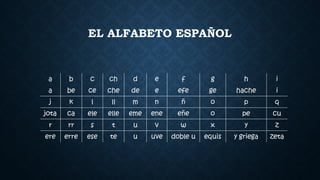
EL ALFABETO ESPAÑOL
a b c ch d e f g h i
a be ce che de e efe ge hache i
j k l ll m n ñ o p q
jota ca ele elle eme ene eñe o pe cu
r rr s t u v w x y z
ere erre ese te u uve doble u equis y griega zeta
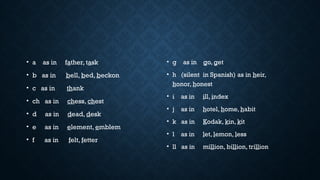
• a as in father, task
• b as in bell, bed, beckon
• c as in thank
• ch as in chess, chest
• d as in dead, desk
• e as in element, emblem
• f as in felt, fetter
• g as in go, get
• h (silent in Spanish) as in heir,
honor, honest
• i as in ill, index
• j as in hotel, home, habit
• k as in Kodak, kin, kit
• l as in let, lemon, less
• ll as in million, billion, trillion
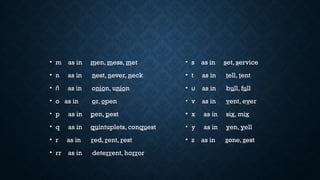
• m as in men, mess, met
• n as in nest, never, neck
• ñ as in onion, union
• o as in or, open
• p as in pen, pest
• q as in quintuplets, conquest
• r as in red, rent, rest
• rr as in deterrent, horror
• s as in set, service
• t as in tell, tent
• u as in bull, full
• v as in vent, ever
• x as in six, mix
• y as in yen, yell
• z as in zone, zest
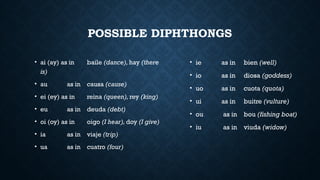
POSSIBLE DIPHTHONGS
• ai (ay) as in baile (dance), hay (there
is)
• au as in causa (cause)
• ei (ey) as in reina (queen), rey (king)
• eu as in deuda (debt)
• oi (oy) as in oigo (I hear), doy (I give)
• ia as in viaje (trip)
• ua as in cuatro (four)
• ie as in bien (well)
• io as in diosa (goddess)
• uo as in cuota (quota)
• ui as in buitre (vulture)
• ou as in bou (fishing boat)
• iu as in viuda (widow)
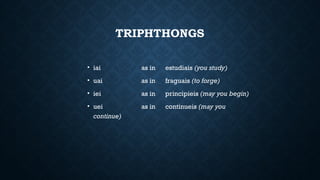
TRIPHTHONGS
• iai as in estudiais (you study)
• uai as in fraguais (to forge)
• iei as in principieis (may you begin)
• uei as in continueis (may you
continue)
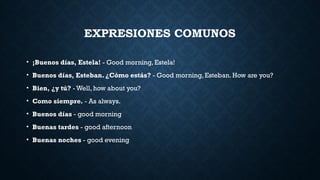
EXPRESIONES COMUNOS
• ¡Buenos días, Estela! - Good morning, Estela!
• Buenos días, Esteban. ¿Cómo estás? - Good morning, Esteban. How are you?
• Bien, ¿y tú? - Well, how about you?
• Como siempre. - As always.

• Buenos días - good morning
• Buenas tardes - good afternoon
• Buenas noches - good evening
• Hola - hello
• ¿Cómo estás? - How are you? (used with friends or family)
• ¿Cómo está usted? - How are you? (more formal; used with strangers, more senior persons,
etc.)
• Gracias – Thank you
• De nada o – Don’t Mention it
• Enhorabuena - Congratulations!
• Felicidades – Congratulations. greetings
• ¿Cómo se llama usted? – What is your name?
• ¿Cuantos anos tiene usted? – How old are you?
• Usted dispense – Excuse me
• Pase usted – Come in
• Recuerdos – Regards
• Adios – Goodbye
• Buen Viaje – Happy trip
• ¿Que dia es hoy? – What day is today?
• Hoy es Lunes – Today is Monday
• ¿Que hora es? – What time is it?
• Son las dos – It is two o’clock
• ¿Donde vive usted? – Where do you live?
• Yo vivo en la calle Espana – I live in Espana Street.
• ¿Que le pasa a Ud.? (Usted) – What is the matter with you?
• No me pasa nada – Nothing is the mater with me.
• ¿Que quiere usted? – What do you want?
• - No quiero nada. – I do not want anything.
• Sientese, haga el favor – Take a sit, please.
• Levantese usted, haga el favor – Stand up, please
• Vengan Uds. a la pizzara (ustedes) Come to the blackboard.
• Busquen Uds. en el dicccionario estas palabras – Look up for these words in the
dictionary
• Repartan Uds. estos papeles – Distribute these papers
• Recojan Uds. los papeles – Collect the papers
• Mueja usted du silla – Move your chair
• Acerquese un poco mas – Get nearer
• Estudien Uds. estas paginas – Study these pages
• Trigan Uds. esta leccion – Bring this lesson
• Repita Ud. la oracion – Repeat the sentence.
• Recite Ud. bien – Recite well
• Salgan Uds. de la clase silenciosamenta (en silencio) – Leave the class quietly.
• Vuelva Ud. a su asiento (Singular)/ Vuelvan Uds. a sus asientos (Plural) – Go back to
your seats.
• Pida Ud. permiso antes de salir de la clase – Ask permission before leaving the class.
• Repasen Uds. bien la leccion de “Expresiones Comunes” para un examen corto –
Review the lesson of “Common Expressions” well for a short test (examination).
PREGUNTAS; CONVERSACION
• Para empezar:
a. Esto es un lapiz. (This is a pencil)
b. Esto es un cuaderno. (This is a notebook)
c. Esto es un libro. (This is a book)
d. Esto es un anillo. (This is a ring)
e. Esto es un cortaplumas. (This is a knife)
• Preguntas
a. ¿Que es esto? (What is this?)
b. ¿Que es esto? (What is this?)
c. ¿Que es esto? (What is this?)
d. ¿Que es esto? (What is this?)
e. ¿Que es esto? (What is this?)
f. ¿Que es esto? (What is this?)
• Respuestas
a. Eso es un retrato. (That is a picture.)
b. (lapiz)
c. (cuaderno)
d. (libro)
e. (anillo)
f. (cortaplumas)
• Pre
• Preguntas
a. ¿Es esto un retrato? (Is this your picture)
b. ¿Es esto un lapiz? (Is this your…)
c. ¿Es esto un cuaderno?
d. ¿Es esto un libro?
e. ¿Es esto un anillo?
f. ¿Es esto un cortaplumas?
• Respuestas afirmativas
a. Si, eso es un retrato.
b. (lapiz)
c. (cuaderno)
d. (libro)
e. (anillo)
f. (cortaplumas)
Note: The word “No” is placed before the verb.
• Preguntas
a. ¿Es esto un retrato? (Is this your picture)
b. ¿Es esto un lapiz? (Is this your…)
c. ¿Es esto un cuaderno?
d. ¿Es esto un libro?
e. ¿Es esto un anillo?
f. ¿Es esto un cortaplumas?
• Respuestas negativas
a. No, eso no es un retrato.
b. (lapiz)
c. (cuaderno)
d. (libro)
e. (anillo)
f. (cortaplumas)
ARTICULOS, NOMBRES Y ADJECTIVOS
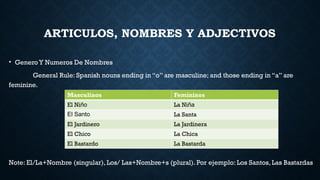
• GeneroY Numeros De Nombres
General Rule: Spanish nouns ending in “o” are masculine; and those ending in “a” are
feminine.
Note: El/La+Nombre (singular), Los/ Las+Nombre+s (plural). Por ejemplo: Los Santos, Las Bastardas
Masculinos Femininos
El Niño La Niña
El Santo La Santa
El Jardinero La Jardinera
El Chico La Chica
El Bastardo La Bastarda
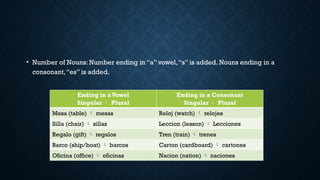
• Number of Nouns: Number ending in “a” vowel,“s” is added. Nouns ending in a
consonant,“es” is added.
Ending in aVowel
Singular  Plural
Ending in a Consonant
Singular  Plural
Mesa (table)  mesas Reloj (watch)  relojes
Silla (chair)  sillas Leccion (lesson)  Lecciones
Regalo (gift)  regalos Tren (train)  trenes
Barco (ship/boat)  barcos Carton (cardboard)  cartones
Oficina (office)  oficinas Nacion (nation)  naciones
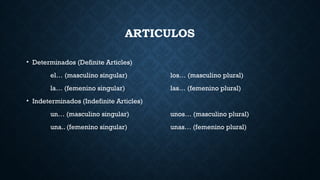
ARTICULOS
• Determinados (Definite Articles)
el… (masculino singular) los… (masculino plural)
la… (femenino singular) las… (femenino plural)
• Indeterminados (Indefinite Articles)
un… (masculino singular) unos… (masculino plural)
una.. (femenino singular) unas… (femenino plural)
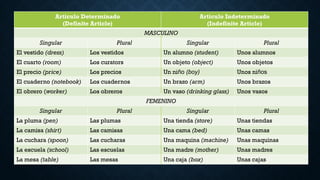
Articulo Determinado
(Definite Article)
Articulo Indeterminado
(Indefinite Article)
MASCULINO
Singular Plural Singular Plural
El vestido (dress) Los vestidos Un alumno (student) Unos alumnos
El cuarto (room) Los curators Un objeto (object) Unos objetos
El precio (price) Los precios Un niño (boy) Unos niños
El cuaderno (notebook) Los cuadernos Un brazo (arm) Unos brazos
El obrero (worker) Los obreros Un vaso (drinking glass) Unos vasos
FEMENINO
Singular Plural Singular Plural
La pluma (pen) Las plumas Una tienda (store) Unas tiendas
La camisa (shirt) Las camisas Una cama (bed) Unas camas
La cuchara (spoon) Las cucharas Una maquina (machine) Unas maquinas
La escuela (school) Las escuelas Una madre (mother) Unas madres
La mesa (table) Las mesas Una caja (box) Unas cajas
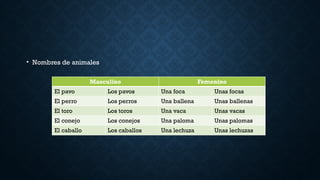
• Nombres de animales
Masculino Femenino
El pavo Los pavos Una foca Unas focas
El perro Los perros Una ballena Unas ballenas
El toro Los toros Una vaca Unas vacas
El conejo Los conejos Una paloma Unas palomas
El caballo Los caballos Una lechuza Unas lechuzas
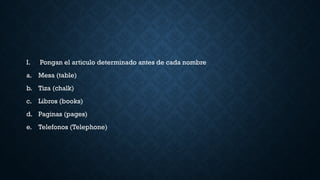
I. Pongan el articulo determinado antes de cada nombre
a. Mesa (table)
b. Tiza (chalk)
c. Libros (books)
d. Paginas (pages)
e. Telefonos (Telephone)
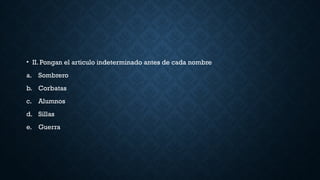
• II. Pongan el articulo indeterminado antes de cada nombre
a. Sombrero
b. Corbatas
c. Alumnos
d. Sillas
e. Guerra
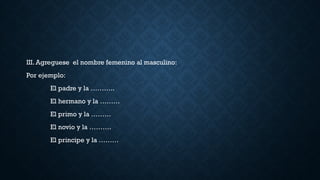
III. Agreguese el nombre femenino al masculino:
Por ejemplo:
El padre y la ………..
El hermano y la ………
El primo y la ………
El novio y la ……….
El principe y la ………
IV. Escriban:
a. Cinco nombres de animales con el articulo “el”
b. Cinco nombres de animales con el articulo “la”
c. Cinco nombres de objetos con el articulo “el”
d. Cinco nombres de objetos con el articulo “la”
V. Indiquen el nombre de significacion contraria:
a. El dia y la ……..
b. El cielo y la ……..
c. El norte y el……..
d. El oriente y el ………
VI. Respondan:
Por ejemplo: En las jarras se pone agua.
en las jarras?
en los floreros?
en los ceniceros?
en las jaulas?
en los tinteros?
VOCABULARIO
• Padre - Father
• Hermano - Brother
• Tio -Uncle
• Primo - Cousin
• Novio - Fiance
• Principe - Prince
• Esposo - Husband
• Perro - Dog
• Gato - cat
• Sobrino - nephew
• Esposa - wife
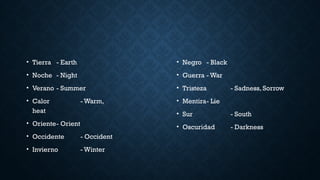
• Tierra - Earth
• Noche - Night
• Verano - Summer
• Calor - Warm,
heat
• Oriente- Orient
• Occidente - Occident
• Invierno - Winter
• Negro - Black
• Guerra - War
• Tristeza - Sadness, Sorrow
• Mentira- Lie
• Sur - South
• Oscuridad - Darkness
• Los Dias De La Semana
lunes - Monday
martes - Tuesday
miercoles - Wednesday
jueves - Thursday
viernes - Friday
sabado - Saturday
domingo - Sunday
• Las Estaciones Del Año
El invierno - Winter
La primavera - Spring
El verano - Summer
El otoño - Autumn
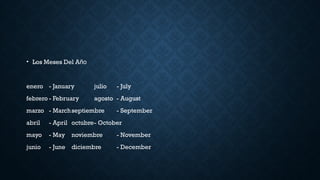
• Los Meses Del Año
enero - January julio - July
febrero - February agosto - August
marzo - Marchseptiembre - September
abril - April octubre- October
mayo - May noviembre - November
junio - June diciembre - December
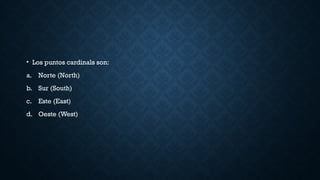
• Los puntos cardinals son:
a. Norte (North)
b. Sur (South)
c. Este (East)
d. Oeste (West)
ADJECTIVOS DESCRIPTIVOS
• Descriptive adjectives must agree in gender and in number with the noun modified.
Generally, the adjective follows the noun being modified.
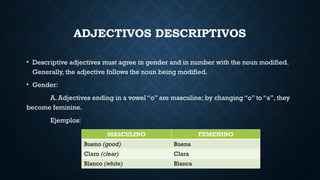
• Gender:
A. Adjectives ending in a vowel “o” are masculine; by changing “o” to “a”, they
become feminine.
Ejemplos:
MASCULINO FEMENINO
Bueno (good) Buena
Claro (clear) Clara
Blanco (white) Blanca
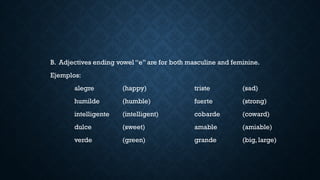
B. Adjectives ending vowel “e” are for both masculine and feminine.
Ejemplos:
alegre (happy) triste (sad)
humilde (humble) fuerte (strong)
intelligente (intelligent) cobarde (coward)
dulce (sweet) amable (amiable)
verde (green) grande (big, large)
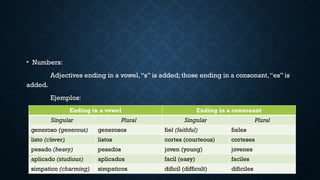
• Numbers:
Adjectives ending in a vowel,“s” is added; those ending in a consonant,“es” is
added.
Ejemplos:
Ending in a vowel Ending in a consonant
Singular Plural Singular Plural
generoso (generous) generosos fiel (faithful) fieles
listo (clever) listos cortes (courteous) corteses
pesado (heavy) pesados joven (young) jovenes
aplicado (studious) aplicados facil (easy) faciles
simpatico (charming) simpaticos dificil (difficult) dificiles
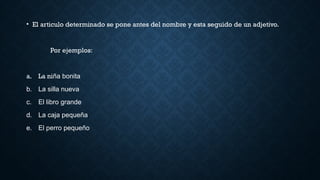
• El articulo determinado se pone antes del nombre y esta seguido de un adjetivo.
Por ejemplos:
a. La niña bonita
b. La silla nueva
c. El libro grande
d. La caja pequeña
e. El perro pequeño
• Formacion Del Plural
a. Las niñas bonitas
b. Las sillas nuevas
c. Los libros grandes
d. Las cajas pequeñas
e. Los perros pequeños
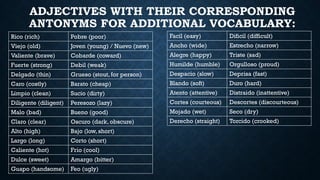
ADJECTIVES WITH THEIR CORRESPONDING
ANTONYMS FOR ADDITIONAL VOCABULARY:
Rico (rich) Pobre (poor)
Viejo (old) Joven (young) / Nuevo (new)
Valiente (brave) Cobarde (coward)
Fuerte (strong) Debil (weak)
Delgado (thin) Grueso (stout, for person)
Caro (costly) Barato (cheap)
Limpio (clean) Sucio (dirty)
Diligente (diligent) Peresozo (lazy)
Malo (bad) Bueno (good)
Claro (clear) Oscuro (dark, obscure)
Alto (high) Bajo (low, short)
Largo (long) Corto (short)
Caliente (hot) Frio (cool)
Dulce (sweet) Amargo (bitter)
Guapo (handsome) Feo (ugly)
Facil (easy) Dificil (difficult)
Ancho (wide) Estrecho (narrow)
Alegre (happy) Triste (sad)
Humilde (humble) Orgulloso (proud)
Despacio (slow) Deprisa (fast)
Blando (soft) Duro (hard)
Atento (attentive) Distraido (inattentive)
Cortes (courteous) Descortes (discourteous)
Mojado (wet) Seco (dry)
Derecho (straight) Torcido (crooked)
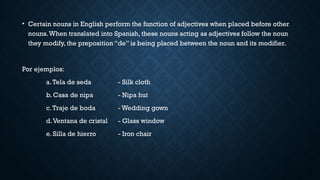
• Certain nouns in English perform the function of adjectives when placed before other
nouns.When translated into Spanish, these nouns acting as adjectives follow the noun
they modify, the preposition “de” is being placed between the noun and its modifier.
Por ejemplos:
a.Tela de seda - Silk cloth
b. Casa de nipa - Nipa hut
c.Traje de boda - Wedding gown
d.Ventana de cristal - Glass window
e. Silla de hierro - Iron chair
EJERCICIOS
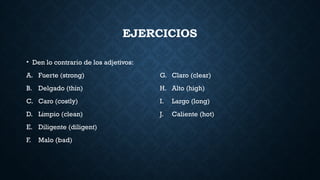
• Den lo contrario de los adjetivos:
A. Fuerte (strong)
B. Delgado (thin)
C. Caro (costly)
D. Limpio (clean)
E. Diligente (diligent)
F. Malo (bad)
G. Claro (clear)
H. Alto (high)
I. Largo (long)
J. Caliente (hot)
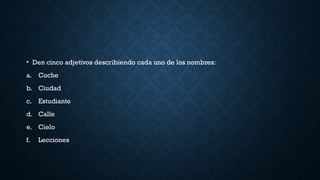
• Den cinco adjetivos describiendo cada uno de los nombres:
a. Coche
b. Ciudad
c. Estudiante
d. Calle
e. Cielo
f. Lecciones
GRACIAS SEÑORAS Y SEÑORITAS!
PREPARADO POR:
SRTO. JOSHUA ASINAS APOLONIO

Foreign Language spanish in Englisg.pptx

  • 1.
  • 2.
    TOPICOS CUBIERTOS: • ElAlfabeto Español • Expressiones Comunes • Vocabularios, Nombres, Numeros • Articulos, Nombres y Adjetivos • Genero y Numero de Nombres • Adjetivos Descriptivos
  • 3.
    EL ALFABETO ESPAÑOL ab c ch d e f g h i a be ce che de e efe ge hache i j k l ll m n ñ o p q jota ca ele elle eme ene eñe o pe cu r rr s t u v w x y z ere erre ese te u uve doble u equis y griega zeta
  • 4.
    • a asin father, task • b as in bell, bed, beckon • c as in thank • ch as in chess, chest • d as in dead, desk • e as in element, emblem • f as in felt, fetter • g as in go, get • h (silent in Spanish) as in heir, honor, honest • i as in ill, index • j as in hotel, home, habit • k as in Kodak, kin, kit • l as in let, lemon, less • ll as in million, billion, trillion
  • 5.
    • m asin men, mess, met • n as in nest, never, neck • ñ as in onion, union • o as in or, open • p as in pen, pest • q as in quintuplets, conquest • r as in red, rent, rest • rr as in deterrent, horror • s as in set, service • t as in tell, tent • u as in bull, full • v as in vent, ever • x as in six, mix • y as in yen, yell • z as in zone, zest
  • 6.
    POSSIBLE DIPHTHONGS • ai(ay) as in baile (dance), hay (there is) • au as in causa (cause) • ei (ey) as in reina (queen), rey (king) • eu as in deuda (debt) • oi (oy) as in oigo (I hear), doy (I give) • ia as in viaje (trip) • ua as in cuatro (four) • ie as in bien (well) • io as in diosa (goddess) • uo as in cuota (quota) • ui as in buitre (vulture) • ou as in bou (fishing boat) • iu as in viuda (widow)
  • 7.
    TRIPHTHONGS • iai asin estudiais (you study) • uai as in fraguais (to forge) • iei as in principieis (may you begin) • uei as in continueis (may you continue)
  • 8.
    EXPRESIONES COMUNOS • ¡Buenosdías, Estela! - Good morning, Estela! • Buenos días, Esteban. ¿Cómo estás? - Good morning, Esteban. How are you? • Bien, ¿y tú? - Well, how about you? • Como siempre. - As always. • Buenos días - good morning • Buenas tardes - good afternoon • Buenas noches - good evening
  • 9.
    • Hola -hello • ¿Cómo estás? - How are you? (used with friends or family) • ¿Cómo está usted? - How are you? (more formal; used with strangers, more senior persons, etc.) • Gracias – Thank you • De nada o – Don’t Mention it • Enhorabuena - Congratulations! • Felicidades – Congratulations. greetings • ¿Cómo se llama usted? – What is your name? • ¿Cuantos anos tiene usted? – How old are you?
  • 10.
    • Usted dispense– Excuse me • Pase usted – Come in • Recuerdos – Regards • Adios – Goodbye • Buen Viaje – Happy trip • ¿Que dia es hoy? – What day is today? • Hoy es Lunes – Today is Monday • ¿Que hora es? – What time is it? • Son las dos – It is two o’clock • ¿Donde vive usted? – Where do you live? • Yo vivo en la calle Espana – I live in Espana Street.
  • 11.
    • ¿Que lepasa a Ud.? (Usted) – What is the matter with you? • No me pasa nada – Nothing is the mater with me. • ¿Que quiere usted? – What do you want? • - No quiero nada. – I do not want anything. • Sientese, haga el favor – Take a sit, please. • Levantese usted, haga el favor – Stand up, please • Vengan Uds. a la pizzara (ustedes) Come to the blackboard. • Busquen Uds. en el dicccionario estas palabras – Look up for these words in the dictionary • Repartan Uds. estos papeles – Distribute these papers • Recojan Uds. los papeles – Collect the papers
  • 12.
    • Mueja usteddu silla – Move your chair • Acerquese un poco mas – Get nearer • Estudien Uds. estas paginas – Study these pages • Trigan Uds. esta leccion – Bring this lesson • Repita Ud. la oracion – Repeat the sentence. • Recite Ud. bien – Recite well • Salgan Uds. de la clase silenciosamenta (en silencio) – Leave the class quietly. • Vuelva Ud. a su asiento (Singular)/ Vuelvan Uds. a sus asientos (Plural) – Go back to your seats. • Pida Ud. permiso antes de salir de la clase – Ask permission before leaving the class. • Repasen Uds. bien la leccion de “Expresiones Comunes” para un examen corto – Review the lesson of “Common Expressions” well for a short test (examination).
  • 13.
    PREGUNTAS; CONVERSACION • Paraempezar: a. Esto es un lapiz. (This is a pencil) b. Esto es un cuaderno. (This is a notebook) c. Esto es un libro. (This is a book) d. Esto es un anillo. (This is a ring) e. Esto es un cortaplumas. (This is a knife)
  • 14.
    • Preguntas a. ¿Quees esto? (What is this?) b. ¿Que es esto? (What is this?) c. ¿Que es esto? (What is this?) d. ¿Que es esto? (What is this?) e. ¿Que es esto? (What is this?) f. ¿Que es esto? (What is this?) • Respuestas a. Eso es un retrato. (That is a picture.) b. (lapiz) c. (cuaderno) d. (libro) e. (anillo) f. (cortaplumas)
  • 15.
    • Pre • Preguntas a.¿Es esto un retrato? (Is this your picture) b. ¿Es esto un lapiz? (Is this your…) c. ¿Es esto un cuaderno? d. ¿Es esto un libro? e. ¿Es esto un anillo? f. ¿Es esto un cortaplumas? • Respuestas afirmativas a. Si, eso es un retrato. b. (lapiz) c. (cuaderno) d. (libro) e. (anillo) f. (cortaplumas)
  • 16.
    Note: The word“No” is placed before the verb. • Preguntas a. ¿Es esto un retrato? (Is this your picture) b. ¿Es esto un lapiz? (Is this your…) c. ¿Es esto un cuaderno? d. ¿Es esto un libro? e. ¿Es esto un anillo? f. ¿Es esto un cortaplumas? • Respuestas negativas a. No, eso no es un retrato. b. (lapiz) c. (cuaderno) d. (libro) e. (anillo) f. (cortaplumas)
  • 17.
    ARTICULOS, NOMBRES YADJECTIVOS • GeneroY Numeros De Nombres General Rule: Spanish nouns ending in “o” are masculine; and those ending in “a” are feminine. Note: El/La+Nombre (singular), Los/ Las+Nombre+s (plural). Por ejemplo: Los Santos, Las Bastardas Masculinos Femininos El Niño La Niña El Santo La Santa El Jardinero La Jardinera El Chico La Chica El Bastardo La Bastarda
  • 18.
    • Number ofNouns: Number ending in “a” vowel,“s” is added. Nouns ending in a consonant,“es” is added. Ending in aVowel Singular  Plural Ending in a Consonant Singular  Plural Mesa (table)  mesas Reloj (watch)  relojes Silla (chair)  sillas Leccion (lesson)  Lecciones Regalo (gift)  regalos Tren (train)  trenes Barco (ship/boat)  barcos Carton (cardboard)  cartones Oficina (office)  oficinas Nacion (nation)  naciones
  • 19.
    ARTICULOS • Determinados (DefiniteArticles) el… (masculino singular) los… (masculino plural) la… (femenino singular) las… (femenino plural) • Indeterminados (Indefinite Articles) un… (masculino singular) unos… (masculino plural) una.. (femenino singular) unas… (femenino plural)
  • 20.
    Articulo Determinado (Definite Article) ArticuloIndeterminado (Indefinite Article) MASCULINO Singular Plural Singular Plural El vestido (dress) Los vestidos Un alumno (student) Unos alumnos El cuarto (room) Los curators Un objeto (object) Unos objetos El precio (price) Los precios Un niño (boy) Unos niños El cuaderno (notebook) Los cuadernos Un brazo (arm) Unos brazos El obrero (worker) Los obreros Un vaso (drinking glass) Unos vasos FEMENINO Singular Plural Singular Plural La pluma (pen) Las plumas Una tienda (store) Unas tiendas La camisa (shirt) Las camisas Una cama (bed) Unas camas La cuchara (spoon) Las cucharas Una maquina (machine) Unas maquinas La escuela (school) Las escuelas Una madre (mother) Unas madres La mesa (table) Las mesas Una caja (box) Unas cajas
  • 21.
    • Nombres deanimales Masculino Femenino El pavo Los pavos Una foca Unas focas El perro Los perros Una ballena Unas ballenas El toro Los toros Una vaca Unas vacas El conejo Los conejos Una paloma Unas palomas El caballo Los caballos Una lechuza Unas lechuzas
  • 22.
    I. Pongan elarticulo determinado antes de cada nombre a. Mesa (table) b. Tiza (chalk) c. Libros (books) d. Paginas (pages) e. Telefonos (Telephone)
  • 23.
    • II. Ponganel articulo indeterminado antes de cada nombre a. Sombrero b. Corbatas c. Alumnos d. Sillas e. Guerra
  • 24.
    III. Agreguese elnombre femenino al masculino: Por ejemplo: El padre y la ……….. El hermano y la ……… El primo y la ……… El novio y la ………. El principe y la ………
  • 25.
    IV. Escriban: a. Cinconombres de animales con el articulo “el” b. Cinco nombres de animales con el articulo “la” c. Cinco nombres de objetos con el articulo “el” d. Cinco nombres de objetos con el articulo “la”
  • 26.
    V. Indiquen elnombre de significacion contraria: a. El dia y la …….. b. El cielo y la …….. c. El norte y el…….. d. El oriente y el ………
  • 27.
    VI. Respondan: Por ejemplo:En las jarras se pone agua. en las jarras? en los floreros? en los ceniceros? en las jaulas? en los tinteros?
  • 28.
    VOCABULARIO • Padre -Father • Hermano - Brother • Tio -Uncle • Primo - Cousin • Novio - Fiance • Principe - Prince • Esposo - Husband • Perro - Dog • Gato - cat • Sobrino - nephew • Esposa - wife
  • 29.
    • Tierra -Earth • Noche - Night • Verano - Summer • Calor - Warm, heat • Oriente- Orient • Occidente - Occident • Invierno - Winter • Negro - Black • Guerra - War • Tristeza - Sadness, Sorrow • Mentira- Lie • Sur - South • Oscuridad - Darkness
  • 30.
    • Los DiasDe La Semana lunes - Monday martes - Tuesday miercoles - Wednesday jueves - Thursday viernes - Friday sabado - Saturday domingo - Sunday
  • 31.
    • Las EstacionesDel Año El invierno - Winter La primavera - Spring El verano - Summer El otoño - Autumn
  • 32.
    • Los MesesDel Año enero - January julio - July febrero - February agosto - August marzo - Marchseptiembre - September abril - April octubre- October mayo - May noviembre - November junio - June diciembre - December
  • 33.
    • Los puntoscardinals son: a. Norte (North) b. Sur (South) c. Este (East) d. Oeste (West)
  • 34.
    ADJECTIVOS DESCRIPTIVOS • Descriptiveadjectives must agree in gender and in number with the noun modified. Generally, the adjective follows the noun being modified. • Gender: A. Adjectives ending in a vowel “o” are masculine; by changing “o” to “a”, they become feminine. Ejemplos: MASCULINO FEMENINO Bueno (good) Buena Claro (clear) Clara Blanco (white) Blanca
  • 35.
    B. Adjectives endingvowel “e” are for both masculine and feminine. Ejemplos: alegre (happy) triste (sad) humilde (humble) fuerte (strong) intelligente (intelligent) cobarde (coward) dulce (sweet) amable (amiable) verde (green) grande (big, large)
  • 36.
    • Numbers: Adjectives endingin a vowel,“s” is added; those ending in a consonant,“es” is added. Ejemplos: Ending in a vowel Ending in a consonant Singular Plural Singular Plural generoso (generous) generosos fiel (faithful) fieles listo (clever) listos cortes (courteous) corteses pesado (heavy) pesados joven (young) jovenes aplicado (studious) aplicados facil (easy) faciles simpatico (charming) simpaticos dificil (difficult) dificiles
  • 37.
    • El articulodeterminado se pone antes del nombre y esta seguido de un adjetivo. Por ejemplos: a. La niña bonita b. La silla nueva c. El libro grande d. La caja pequeña e. El perro pequeño
  • 38.
    • Formacion DelPlural a. Las niñas bonitas b. Las sillas nuevas c. Los libros grandes d. Las cajas pequeñas e. Los perros pequeños
  • 39.
    ADJECTIVES WITH THEIRCORRESPONDING ANTONYMS FOR ADDITIONAL VOCABULARY: Rico (rich) Pobre (poor) Viejo (old) Joven (young) / Nuevo (new) Valiente (brave) Cobarde (coward) Fuerte (strong) Debil (weak) Delgado (thin) Grueso (stout, for person) Caro (costly) Barato (cheap) Limpio (clean) Sucio (dirty) Diligente (diligent) Peresozo (lazy) Malo (bad) Bueno (good) Claro (clear) Oscuro (dark, obscure) Alto (high) Bajo (low, short) Largo (long) Corto (short) Caliente (hot) Frio (cool) Dulce (sweet) Amargo (bitter) Guapo (handsome) Feo (ugly) Facil (easy) Dificil (difficult) Ancho (wide) Estrecho (narrow) Alegre (happy) Triste (sad) Humilde (humble) Orgulloso (proud) Despacio (slow) Deprisa (fast) Blando (soft) Duro (hard) Atento (attentive) Distraido (inattentive) Cortes (courteous) Descortes (discourteous) Mojado (wet) Seco (dry) Derecho (straight) Torcido (crooked)
  • 40.
    • Certain nounsin English perform the function of adjectives when placed before other nouns.When translated into Spanish, these nouns acting as adjectives follow the noun they modify, the preposition “de” is being placed between the noun and its modifier. Por ejemplos: a.Tela de seda - Silk cloth b. Casa de nipa - Nipa hut c.Traje de boda - Wedding gown d.Ventana de cristal - Glass window e. Silla de hierro - Iron chair
  • 41.
    EJERCICIOS • Den locontrario de los adjetivos: A. Fuerte (strong) B. Delgado (thin) C. Caro (costly) D. Limpio (clean) E. Diligente (diligent) F. Malo (bad) G. Claro (clear) H. Alto (high) I. Largo (long) J. Caliente (hot)
  • 42.
    • Den cincoadjetivos describiendo cada uno de los nombres: a. Coche b. Ciudad c. Estudiante d. Calle e. Cielo f. Lecciones
  • 43.
    GRACIAS SEÑORAS YSEÑORITAS! PREPARADO POR: SRTO. JOSHUA ASINAS APOLONIO

Notas del editor

  • #1 Buenos dias Senoras y Senoritas… Mi nombre es Senorito Joshua Apolonio
  • #2 Voy a enseñar los temas tratados: Alfabetos Español Expressiones Comunes Vocabularios, Nombres, Numeros El Articulos, Nombres y Adjetivos Genero y Numero de Nombres Adjetivos Descriptivos
  • #4 The letters of the alphabet are pronounced in Spanish approximately as follows:
  • #6 There are approximately 13 possible diphthongs in Spanish and this include
  • #7 A triphthong consists of a stressed strong vowel between two weak vowels. There are but four but four possible combinations all of which end in “I” (written “y” in the final position)
  • #8 Whether you're traveling to Spain, Mexico or another Spanish-speaking country on business or vacation, or you need to speak in a Spanish language environment closer to home, you'll need to know these commonly used Spanish expressions and sentences to communicate with those around you.
  • #11 Abbreviation of Usted (formal) is Ud. For the plural of Ustedes (Uds.)
  • #13 To start with..
  • #14 Esto = this Eso = that
  • #16 Es = linking verb
  • #19 Nouns are generally preceded by articles and they must agree in gender and in number with the noun
  • #22 I. Put the definite article before each name
  • #23 Put the indefinite article before each name
  • #24 This is how you add the female name to the male.
  • #25 When written: Five animal names with the article “el/ la” Five object names with the article “el/ la”
  • #26 Indicate the opposite meaning of the name
  • #27 En las jarras se pone agua.  Water is put in the jars en las jarras? – in the jars? en los floreros? – in the vases? en los ceniceros? In the ashtray? en las jaulas? In the cages? en los tinteros? In the inkwells?
  • #30 The days of the week
  • #32 The months of the year and the days of the week are not capitalized
  • #37 The definite article is placed before the noun and is followed by a descriptive adjective, La niña bonita – the pretty girl La silla nueva - the new chair El libro grande – the big book La caja pequeña – the small box El perro pequeño the small dog
  • #38 Forming the formal numbers
  • #41 Give the opposites of these adjectives. Debil (weak) Grueso (stout, for person) Barato (cheap) Sucio (dirty) Peresozo (lazy) Bueno (good) Oscuro (dark, obscure) Bajo (low, short) Corto (short) Frio (cool)
  • #42 Give five adjectives describing each of the names