Curs 2017-18
www.cinemaperaestudiants.cat
Nivells: 3er i 4art d’ESO, batxillerat, cicles formatius,
centres formació adults. Àrees: Llengua anglesa /
Matemàtiques / Ciències socials, geografia i història /
Educació per a la ciutadania i els drets humans / Educació
ètica cívica / Tecnologies / Història. Temes: Educació en
valors / Dones. Violència de gènere / Conflictes polítics i
armats / Biografies / El món del treball. Relacions laborals
/ Relacions humanes. Psicologia. Sociologia / Drets
Humans / Adaptació cinematogràfica d’obra literària /
Política. Sistemes polítics.
.
TRÀILER
Hidden Figures (Figures ocultes)
11
Suggeriments per al professorat
El dossier que us fem arribar conté un
seguit d’activitats per treballar amb
l’alumnat dins l’aula abans o després
de la projecció. Aquestes activitats
són opcionals, deixant al vostre criteri,
a partir del coneixement real que
teniu del vostre alumnat, la manera
de treballar el film.
Direcció i concepció gràfica
Cinema per a estudiants
Activitats i adaptació de textos
Abel Gálvez i José Pica
ÍNDEX
Fitxa tècnica i artística. Sinopsi ….....................................................................…....
PÀGINES
2
ENGLISH
The plot of the film (Reading Comprehension) ………………….…...….………..……………… 3
Who is who in the film? ……………………………...…………………….…...…..……………………… 4
Hidden figures photo album ……………………………..…………….…...……….…………………… 5
First conditional sentences. Successful women in STEM …...................................... 7
Idioms about problems and difficulties ….........................................................….... 8
The song “Running” by Pharell Williams ….....................................................….... 9
MATEMÀTIQUES
Les matemàtiques a la pel·lícula. Activitats de Matemàtiques …......................….... 10
CIÈNCIES SOCIALS
El moviment pels drets civils als Estats Units …................................................….... 13
22
FITXA TÈCNICA I ARTÍSTICA
Direcció: Theodore Melfi. Interpretació: Taraji P. Henson, Octavia Spencer, Janelle Monáe,
Kevin Costner, Jim Parsons, Mahershala Ali, Kirsten Dunst, Glen Powell, Rhoda Griffis. Guió:
Allison Schroeder, basat en el llibre de Margot Lee Shetterly. Gènere: drama, biogràfic. País:
EUA. Any: 2016. Durada: 127 min.
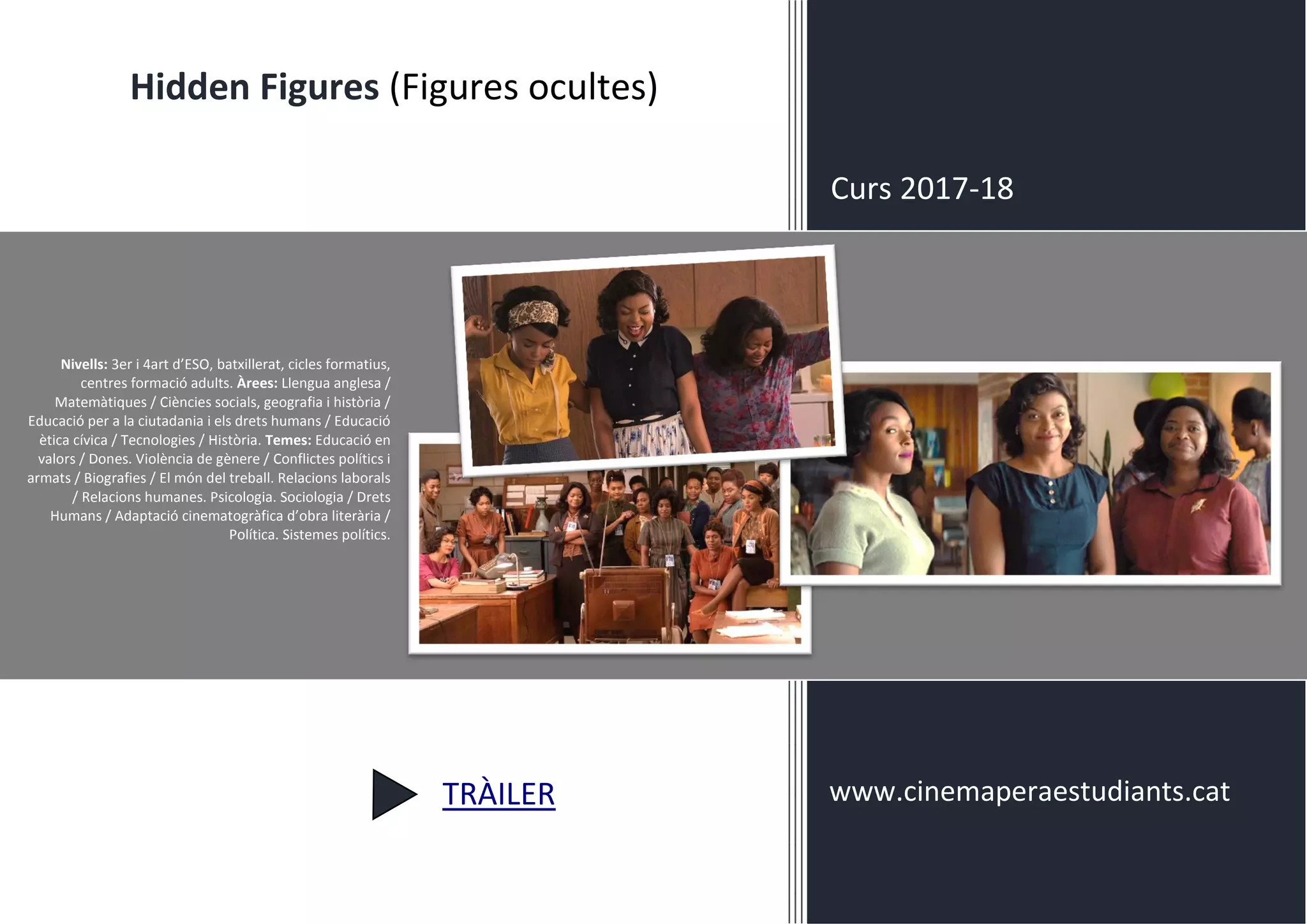
SINOPSI
Mentre Estats Units competia contra Rússia per portar l'home a l'espai, la NASA va descobrir
el talent ocult d'un grup de dones matemàtiques afroamericanes, que van ser els autèntics
cervells d'aquella operació. Basada en la increïble història real de tres d'aquestes persones,
conegudes com les "ordinadors vivents", la pel·lícula segueix aquestes dones tan bon punt
comencen a ascendir al costat de les grans ments pensants de la NASA amb la tasca de
calcular el llançament de l'astronauta John Glenn i garantir el seu retorn. Dorothy Vaughn,
Mary Jackson i Katherine Johnson van superar qualsevol limitació professional, de raça o de
gènere, mentre el seu talent i desig per assolir els seus somnis les va catapultar com a
veritables heroïnes en la història dels Estats Units.
33
ACTIVITY ONE - THE PLOT OF THE FILM
Read the plot of the film and then say if these
sentences are TRUE, FALSE or NOT MENTIONED
IN THE TEXT.
1- Katherine has a special ability for numbers.
2- Black people have the same conditions as
white people in the 60’s.
3- Katherine, Dorothy and Mary work as
human computers.
4- Katherine’s husband died in a car crash.
5- Al Harrison leads the Space Task Group.
6- Mary Jackson can’t find a solution to the
problem of the space capsule.
7- Astronaut John Glenn doesn’t want to talk
to the black mathematicians.
8- Vivian Mitchell is jealous of the black
women’s succés.
9- Dorothy Vaughan will get fired when the
IBM computer is installed at NASA.
10- Dorothy will learn FORTRAN* and teach all
the members of her team.
.
Young Katherine lives in a town of Virgina in 1926. She comes from a black American family and life isn’t
easy for them in the South of the United States. Katherine has an innate talent for maths so her parents will
have to move to a different town to give Katherine the opportunity to start a course for gifted students.
Katherine becomes a brilliant mathematician and will find a job at NASA in the Langley Research Group. In
1961, she and her colleagues Dorothy Vaughan and Mary Jackson work as human computers. They do all the
math calculations of the complex space operations. However, being a black woman in the 60’s means that
they will have to fight really hard to be taken into consideration: they must use a different toilet, drink from
separate water fountains or eat in “coloured” restaurants.
Following the successful Soviet launch of Yuri Gagarin, pressure to send American astronauts into space
increases. Supervisor Vivian Mitchell assigns Katherine to assist Al Harrison's Space Task Group. She
becomes the first black woman on the team and in the building, which has no bathrooms for non-white
people.
Her colleagues don’t treat her fairly, especially head engineer Paul Stafford, who will give Karethine
enormous load of work to do. Even going to the toilet will be a nightmare if you have to walk for 20 minutes.
Dorothy Vaughan won’t have better opportunities either: she won’t be promoted to a supervisor in spite of
her brilliant experience. Mary Jackson has better luck working with Holocaust survivor Karl Zielinsky, who is
the engineer building the space capsule of a rocket. Mary’s suggestions to improve the capsule will earn the
acceptance of her colleagues, and she even will get encouraged to try to get into the engineer college
program, reserved for white men only. Her husband, Levi Jackson, finds it unusual, but he will support his
wife pursuing her dream.
One day, at a church barbeque, Mary and Dorothy will introduce Katherine to Colonel Jim Johnson.
Katherine is a widow with three daughters, and she will find good help with the company of the Colonel at
home.
Al Harrison will also be impressed with Katherine’s solution of a complex mathematical equation. After that,
the three women will meet the astronauts of the Mercury 7 mission, and astronaut John Glenn will be
particularly kind to the mathematicians.
Meanwhile, IBM computers will be introduced in NASA and will replace a lot of the women who do the
calculations. Dorothy learns about this and will teach herself how to use the computer. She will also go to
the library and will steal a book from the white-only area of the library. This FORTRAN book is about the
programming language of the IBM computer. If Dorothy succeeds in mastering the use of the equipment she
will be able to teach her team of West Area co-workers.
* FORTRAN is a programming language initially developed by IBM in the 1950s for scientific and engineering
applications.
44
ACTIVITY TWO - WHO IS WHO IN THE FILM
After watching the film, reread the plot
and try to write the correct names of the
protagonists.
 Katherine Johnson, mathematician
 Dorothy Vaughan, mathematician, and
supervisor
 Mary Jackson, engineer
 Paul Stafford, head engineer
 Colonel Jim Johnson, military officer
 Levi Jackson, Mary’s husband
 Al Harrison, director of the Space Task
Group
 Vivian Mitchell, supervisor
 John Glenn, astronaut
 Young Katherine
1. 2. 3.
4.
5.
6.
7.
8.
9.
10.
55
ACTIVITY THREE - HIDDEN FIGURES PHOTO ALBUM
Here you can see different pictures of the film. Look at them and read the various captions carefully. Then,
choose the correct caption for every image.
 Katherine is the first woman to earn the right to attend the meetings of the engineering team at
NASA.
 You can be smart and hardworking, but people of colour suffer segregation at NASA. Drinking coffee
can be a sad situation if you are black.
 Katherine Johnson, who has a talent for mathematics, is explaining the problematic equation to her
classmates at the primary school.
 Dorothy Vaughan teaches herself FORTRAN with a stolen book from the library. She even reads it to
her son on the bus.
 Katherine works hard at NASA, but she always finds time for her children.
 When director Al Harrison learns about the unfair segregation of toilets for black people he will find a
solution to the problem.
 Life can be a nightmare if you are black in Virginia, and the police don’t make it easy for you.
 John Glenn, the astronaut who will orbit the Moon, talks to the three black mathematicians in a
friendly and polite way.
 Mary Jackson has proudly earned a place in the Engineering Course reserved for white men only.
 Dorothy will learn how to program the newest and large computer before she is asked to do it.
 Katherine Johnson is doing the math for the complicated operations of the NASA mission.
1.
2.
3. 4. 5.
66
6.
7.
8. 9.
10. 11.
77
Katherine Johnson was crucial in... at 14 and graduated college at 18.
Her family relocated 120 miles because... flight of the first American in space, as well as the
1961 mercury mission.
She graduated high school... John Glenn’s orbit around the earth, NASA still had
Johnson double check the results.
Katherine was a teacher until she applied to
be...
a “computer”, or a woman who performed
calculations for the engineers at the precursor to
NASA.
She calculated the trajectory for the... doing the math responsible for putting men on the
moon.
Even when Machine computers were first
used in 1962 to determine...
high school wasn’t offered to blacks in their
hometown.
ACTIVITY FOUR - FIRST CONDITIONAL SENTENCES
Black American people had a difficult time in the 60’s in
the USA. Your life was very conditioned because of the
colour of your skin.
In English, you can use the FIRST CONDITIONAL to talk
about the results you will get under certain conditions.
You must use the PRESENT SIMPLE TENSE in the IF
clause, and the future WILL in the result clause.
Have a look at the example: If you ARE black in the
USA, your life WON’T BE easy.
Write first conditional sentences with the hints given
below.
1 - If you (be).......... black, you (have to use)
..........................a different bathroom
2 - If you (want) ...... ...to go to the toilet, you (have to
walk) ........................will for a long time.
3 - If you (not sit) ................. at the back of the bus you
(be arrested)..........................
4 - If you (be)..... a black woman, you (not be able)
..................... won’t be able to study
5 - If you (want) .............. to study, you (have to)
............. to ask the judge
6 - If you (be) ...................... black, you (not
go).................. to the white-only area of the library
7 - If you (work) .................. at NASA and you (be)
............... a person of colour, you (drink)
...............coffee from a different coffee pot.
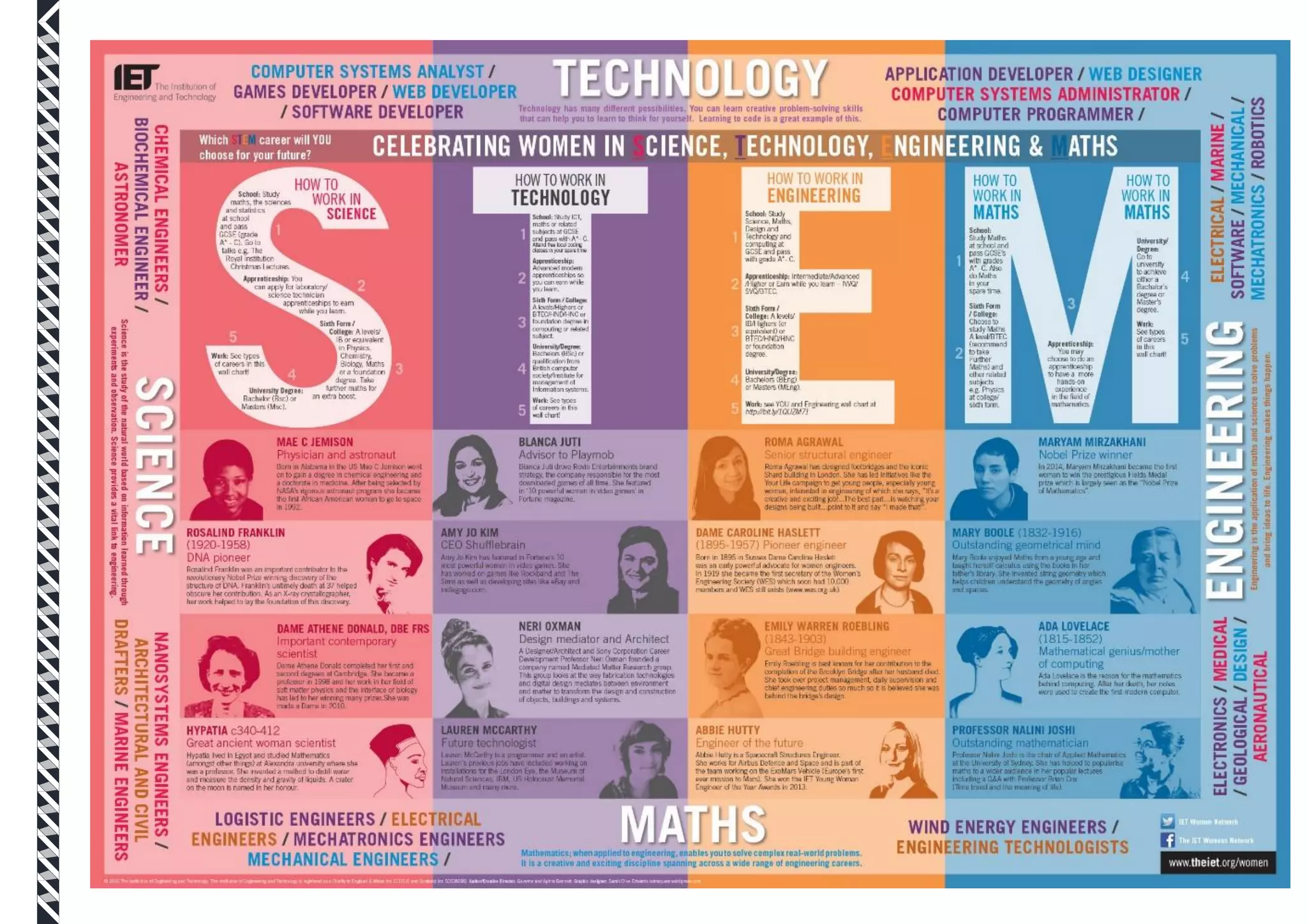
ACTIVITY FIVE - SUCCESSFUL WOMEN IN STEM *
The film Hidden Figures is based upon the real stories of three black American woman. Katherine Johnson
is the central figure in the movie and she has become an influential person in the world of mathematics
and science women. Connect the beginnings and endings of the sentences below to create full sentences
about her achievements.
* STEM: Science, Technology, Engineering or Math fields
88
ACTIVITY SEVEN - IDIOMS ABOUT PROBLEMS AND DIFFICULTIES
Katherine, Dorothy and Mary work at NASA solving the math problems to send the rockets into
space.
Rocket science must be a challenging job. However, when you say that something is not rocket
science you mean it’s not complicated, the opposite thing. That is called an idiom, an expression
that has a different meaning from the literal words.
Read these idioms in this list and the examples, and try to match them to the correct explanations.
A piece of cake - Jane is smart. For her, taking exams is a piece of cake.
Saved by the bell - Saved by the bell! A friend arrived just when I realized I had no money for the
parking meter.
The tip of the iceberg - Journalists say that the report on corruption only examines the tip of the
iceberg.
Take the bull by the horns - When the argument turned into a fight, the bar owner took the bull by
the horns and called the police.
Take the easy way out - The weather conditions were so severe that Mary took the easy way out
and cancelled her appointment.
See the light at the end of the tunnel - Sales dropped heavily last year, but we're beginning to see
the light at the end of the tunnel.
The elephant in the room - Let's face it, his work is unsatisfactory. It's the elephant in the room
that we need to discuss.
1 - The ...................... is the part that is known of a problem
or situation which is thought to be much more severe.
2 - To ...................... means that a person decides to act
decisively to deal with a difficult situation or problem.
3 - If you ...................... , you choose the easiest way to deal
with a difficult situation, even if it is not the best solution.
4 - A problem that no one wants to discuss, but is so evident
that it cannot be ignored, is called ......................
5 - If you ...................... , you see signs of hope for the future
after an extended period of difficulty.
6 - If you are ...................... , something happens at the last
minute to rescue you from a difficult situation.
7 - If you think that something is ...................... you do not
believe that it is very complicated to do or to understand.
99
Summertime in Virginia was an oven (oven)
All the kids 1 ....... ice cream with their cousins (cousins)
I was studyin' while you was 2 ....... the dozens (dozens)
Don't act like you was there when you wasn't
3 ....... ' from the man (man) 4 ....... from the badge
(badge)
Don't act like you was there when you wasn't
5 ....... toward our plans (plans) and the judges hands
(hands)
Don't act like you was there when you wasn't
I know they say you 6 ....... 'fore you 7 .......
But in my mind I already 8 .......
If I 9 ....... still I cannot get far
They want the Moon, I'm on Mars
Sometime my mind 10 ....... deep
When I'm 11 .......
I don't want no free ride
I'm just sick and tired of 12 .......
Some nights I cry
Cause I can see the day 13 .......
Together we'll 14 .......
Oh, but no more 15 .......
You and I are not different from each other (other)
16 ....... our eyes, when we slumber I see numbers
(numbers)
Black and white, we're computers, I am colored (colored)
Don't act like you was there when you wasn't
From 17 ....... to exams (exams) to jobs for a man
(man)
Don't act like you was there when you wasn't
In the law of the land (land) the women were
often banned (banned)
Don't act like you was there when you wasn't
I know they say you 18 ....... 'fore you 19 .......
But in my mind I already 20 .......
If I 21 ....... still I cannot get far
They want the Moon, I'm on Mars
Sometime my mind 22 ....... deep
When I'm 23 .......
I don't want no free ride
I'm just sick and tired of 24 .......
Some nights I cry
Cause I can see the day 25 .......
Together we 26 .......
Oh, but no more 27 .......
I know they say you 28 ....... 'fore you 29 .......
But in my mind I already 30 .......
If I 31 .......still I cannot get far
They want the Moon, I'm on Mars
Sometime my mind 32 ....... deep
When I'm 33 .......
I don't want no free ride
I'm just sick and tired of 34 .......
Some nights I cry
Cause I can see the day 35 .......
Together we 36 .......
Oh, but no more 37 .......
When Katherine Johnson is promoted to the Space
Task Group, she has to run half a mile whenever
she wants to go to the toilet.
This song included in the soundtrack is called
Running, by Pharell Williams. All the verbs related
to the movement have been blanked out from the
lyrics. So, it’s your turn to listen to the song and
complete it with the verbs from the list.
RUNNING
runnin' - runnin' - walk - fly - runnin' - runnin' -
runnin’ - eating - stand - playing - crawl - walk - jog
- dives - runnin' - runnin' - comin' - runnin' - shut -
runnin’ - crawl - jog - stand - dives - comin' - fly -
runnin' - crawl - walk - jog - stand - dives - runnin' -
runnin' - comin' - fly - runnin'
ACTIVITY EIGHT- THE SONG “RUNNING”
1010
1111
ECUACIONES
Con nueve años, Katherine asombra a todos en la
escuela por sus capacidades matemáticas al resolver
esta ecuación, por lo que el centro aconseja a sus padres
promocionarla a cursos superiores.
¿Sabrías resolver tú la ecuación, razonando la respuesta?
(x2
+ 6x -7) · (2x2
- 5x - 3) = 0
RAZONAMIENTO NUMÉRICO
La película comienza con Katherine niña que camina mientras va contando sus pasos, señalando cada
vez que pasa por un número primo:
"...16, primo (por el 17), 18, primo (por el 19), 20..., etc".
Como sabemos que tú los números primos ya los dominas, te vamos a retar con algo un poco más
complicado: un ejercicio de razonamiento numérico.
La siguiente serie de círculos está formada por grupos numéricos que, con una secuencia concreta de
operaciones, dan como resultado el número situado en el centro. Según tú, ¿qué número falta en el
centro del último círculo, teniendo en cuenta los otros resultados?
FORMAS GEOMÉTRICAS
El precoz talento matemático de Katherine se escenifica
también en el film cuando le vemos identificar figuras
geométricas a su alrededor: "isósceles, escaleno,
trapezoide, tetraedro, dodecaedro...".
Hemos pensado que tú esas formas ya las conoces y que
te podríamos pedir algo más complejo. Este ejercicio
consiste en encajar las 7 piezas en el cuadrado para
reconstruir la forma original. Tanto el recuadro como las
piezas están cuadriculados, para facilitarte la tarea.
Eh! Sólo se permite utilizar el lápiz
LAS MATEMÁTICAS EN LA PELÍCULA
1212
- El jefe Harrison dice: "Necesito un matemático, alguien que tenga conocimientos de geometría analítica". Esa
demanda abre a Katherine las puertas de la División de Investigación de vuelo. En este punto el trabajo de
Katherine resulta algo confuso, pues si bien se le ordena realizar cálculos prolijos, también le vemos encarar
problemas teóricos. Pudo ser así porque Katherine tuviera ese doble talento, como calculista y como matemática
propiamente dicha, en la solución de problemas. Pero esa coincidencia de talentos, que no tiene por qué darse
necesariamente (hay grandes matemáticos que no son grandes calculistas y viceversa), de cara al gran público
afianza el malentendido de que "el matemático es alguien que hace cuentas".
- A su llegada, Katherine es puesta a prueba por Harrison, quien le pregunta por el triedro de Frenet (dada una
curva parametrizada se define dicho triedro en cada punto con los vectores tangente, normal y binormal,
constituyendo un sistema de referencia móvil) y el algoritmo de ortogonalización (algoritmo para construir, a
partir de un conjunto de vectores linealmente independientes otro conjunto ortonormal de vectores que genere
el mismo subespacio vectorial).
- Se enuncia varias veces el problema que plantea la secuencia de retorno a la Tierra de John Glenn: "Pasar de
una trayectoria elíptica a otra parabólica". Katherine lo resuelve: "No se trata de una solución teórica, sino
numérica". Menciona el método de Euler (procedimiento de integración numérica para resolver ecuaciones
diferenciales a partir de un valor inicial dado).
Si es habitual que en el cine con matemáticas haya pizarras, en este caso adquieren la categoría de campo de
batalla en la carrera espacial, donde Katherine resuelve los problemas y todos los ingenieros fijan sus miradas.
http://matematicasmundo.ftp.catedu.es/CINE/cine_Figuras%20ocultas.htm
1313
Desde mediados de los años cincuenta la segregación racial en Estados Unidos se volvió
intolerable por una serie de causas, tanto internas como externas. Desde el punto de vista
interno, millones de negros habían emigrado del sur a las ciudades del norte durante y después
de la Segunda Guerra Mundial. Se calcula que entre 1940 y 1970, cuatro millones de
afroamericanos emigraron del sur. Ese fenómeno migratorio urbanizó y modernizó a un sector
muy grande de la población negra que en el sur había vivido en el aislamiento de la vida rural, lo
cual aumentó su conciencia política.
Miles de afroamericanos habían participado, además, en una guerra en la que se combatía en
nombre de la democracia en Europa y en el Pacífico, y en la que los prisioneros de guerra
alemanes eran mejor tratados que los propios soldados norteamericanos negros, quienes al
regresar muertos a Estados Unidos no podían encontrar siquiera un pedazo de tierra en los
cementerios.
Desde el punto de vista internacional, muchas colonias europeas de África habían obtenido su
independencia y diversas luchas nacionalistas y revolucionarias se libraban en distintos países del
Tercer Mundo, lo cual era un ejemplo para la población afroamericana y una vergüenza para el
gobierno estadounidense, que ya no podía eludir la enorme brecha que existía entre sus ideales
igualitarios y la realidad terrible de la segregación racial.
No obstante esos factores, la hora del racismo sonó realmente en Estados Unidos cuando los
negros del sur lograron participar en la lucha por sus derechos. La población afroamericana del
sur era la más vulnerable, pues no sólo había sido víctima del racismo sureño amargado por la
derrota en la Guerra Civil, sino que cuando a fines del siglo XIX las élites blancas del norte y del
sur llegan a un acuerdo político, dejaron a la población negra en el limbo social y legal; además,
una parte de esa población estaba aislada en el campo y sus posibilidades educativas eran muy
escasas.
Esa lucha fue encabezada por Martin Luther King. El doctor King nació en Atlanta, Georgia, en
1929. Sus estudios de teología y del pensamiento de Gandhi lo condujeron a desarrollar una
estrategia de lucha para una minoría cuyas condiciones de opresión la hacían particularmente
vulnerable. Para King, la resistencia no violenta era el único método moral y prácticamente válido.
EL MOVIMIENTO POR LOS DERECHOS CIVILES EN LOS ESTADOS UNIDOS
1414
Si bien la autoridad y el liderazgo político de Martin L. King tuvieron un peso decisivo en el
desarrollo de la lucha por los derechos Civiles, ésta constituyó un complejo movimiento que tuvo
varios líderes importantes y corrientes diversas e incluso contradictorias en su interior...
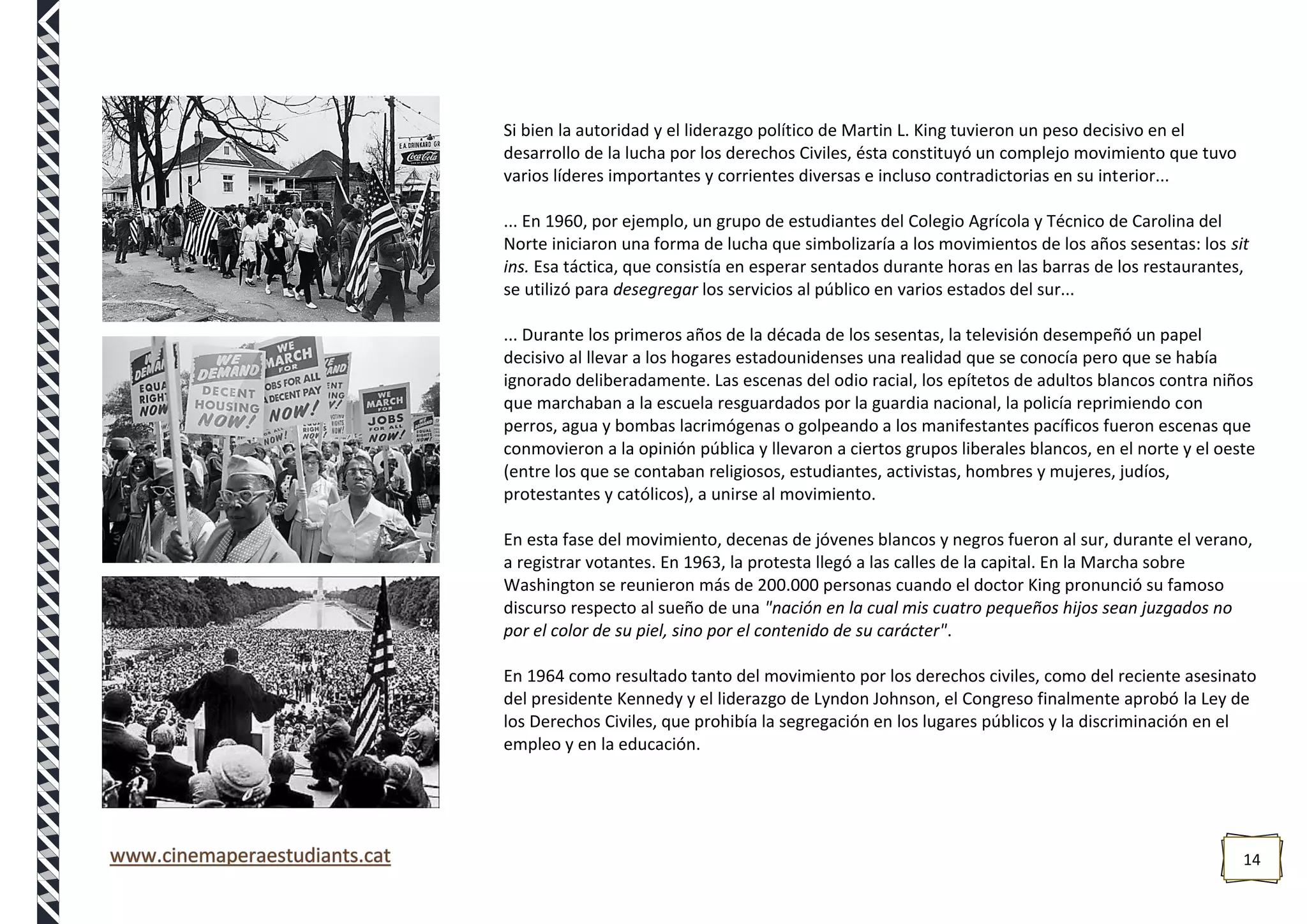
... En 1960, por ejemplo, un grupo de estudiantes del Colegio Agrícola y Técnico de Carolina del
Norte iniciaron una forma de lucha que simbolizaría a los movimientos de los años sesentas: los sit
ins. Esa táctica, que consistía en esperar sentados durante horas en las barras de los restaurantes,
se utilizó para desegregar los servicios al público en varios estados del sur...
... Durante los primeros años de la década de los sesentas, la televisión desempeñó un papel
decisivo al llevar a los hogares estadounidenses una realidad que se conocía pero que se había
ignorado deliberadamente. Las escenas del odio racial, los epítetos de adultos blancos contra niños
que marchaban a la escuela resguardados por la guardia nacional, la policía reprimiendo con
perros, agua y bombas lacrimógenas o golpeando a los manifestantes pacíficos fueron escenas que
conmovieron a la opinión pública y llevaron a ciertos grupos liberales blancos, en el norte y el oeste
(entre los que se contaban religiosos, estudiantes, activistas, hombres y mujeres, judíos,
protestantes y católicos), a unirse al movimiento.
En esta fase del movimiento, decenas de jóvenes blancos y negros fueron al sur, durante el verano,
a registrar votantes. En 1963, la protesta llegó a las calles de la capital. En la Marcha sobre
Washington se reunieron más de 200.000 personas cuando el doctor King pronunció su famoso
discurso respecto al sueño de una "nación en la cual mis cuatro pequeños hijos sean juzgados no
por el color de su piel, sino por el contenido de su carácter".
En 1964 como resultado tanto del movimiento por los derechos civiles, como del reciente asesinato
del presidente Kennedy y el liderazgo de Lyndon Johnson, el Congreso finalmente aprobó la Ley de
los Derechos Civiles, que prohibía la segregación en los lugares públicos y la discriminación en el
empleo y en la educación.
1515
info@cinemaperaestudiants.cat

HIDDEN FIGURES ACTIVITY PACK

  • 1.
    Curs 2017-18 www.cinemaperaestudiants.cat Nivells: 3eri 4art d’ESO, batxillerat, cicles formatius, centres formació adults. Àrees: Llengua anglesa / Matemàtiques / Ciències socials, geografia i història / Educació per a la ciutadania i els drets humans / Educació ètica cívica / Tecnologies / Història. Temes: Educació en valors / Dones. Violència de gènere / Conflictes polítics i armats / Biografies / El món del treball. Relacions laborals / Relacions humanes. Psicologia. Sociologia / Drets Humans / Adaptació cinematogràfica d’obra literària / Política. Sistemes polítics. . TRÀILER Hidden Figures (Figures ocultes)
  • 2.
    11 Suggeriments per alprofessorat El dossier que us fem arribar conté un seguit d’activitats per treballar amb l’alumnat dins l’aula abans o després de la projecció. Aquestes activitats són opcionals, deixant al vostre criteri, a partir del coneixement real que teniu del vostre alumnat, la manera de treballar el film. Direcció i concepció gràfica Cinema per a estudiants Activitats i adaptació de textos Abel Gálvez i José Pica ÍNDEX Fitxa tècnica i artística. Sinopsi ….....................................................................….... PÀGINES 2 ENGLISH The plot of the film (Reading Comprehension) ………………….…...….………..……………… 3 Who is who in the film? ……………………………...…………………….…...…..……………………… 4 Hidden figures photo album ……………………………..…………….…...……….…………………… 5 First conditional sentences. Successful women in STEM …...................................... 7 Idioms about problems and difficulties ….........................................................….... 8 The song “Running” by Pharell Williams ….....................................................….... 9 MATEMÀTIQUES Les matemàtiques a la pel·lícula. Activitats de Matemàtiques …......................….... 10 CIÈNCIES SOCIALS El moviment pels drets civils als Estats Units …................................................….... 13
  • 3.
    22 FITXA TÈCNICA IARTÍSTICA Direcció: Theodore Melfi. Interpretació: Taraji P. Henson, Octavia Spencer, Janelle Monáe, Kevin Costner, Jim Parsons, Mahershala Ali, Kirsten Dunst, Glen Powell, Rhoda Griffis. Guió: Allison Schroeder, basat en el llibre de Margot Lee Shetterly. Gènere: drama, biogràfic. País: EUA. Any: 2016. Durada: 127 min. SINOPSI Mentre Estats Units competia contra Rússia per portar l'home a l'espai, la NASA va descobrir el talent ocult d'un grup de dones matemàtiques afroamericanes, que van ser els autèntics cervells d'aquella operació. Basada en la increïble història real de tres d'aquestes persones, conegudes com les "ordinadors vivents", la pel·lícula segueix aquestes dones tan bon punt comencen a ascendir al costat de les grans ments pensants de la NASA amb la tasca de calcular el llançament de l'astronauta John Glenn i garantir el seu retorn. Dorothy Vaughn, Mary Jackson i Katherine Johnson van superar qualsevol limitació professional, de raça o de gènere, mentre el seu talent i desig per assolir els seus somnis les va catapultar com a veritables heroïnes en la història dels Estats Units.
  • 4.
    33 ACTIVITY ONE -THE PLOT OF THE FILM Read the plot of the film and then say if these sentences are TRUE, FALSE or NOT MENTIONED IN THE TEXT. 1- Katherine has a special ability for numbers. 2- Black people have the same conditions as white people in the 60’s. 3- Katherine, Dorothy and Mary work as human computers. 4- Katherine’s husband died in a car crash. 5- Al Harrison leads the Space Task Group. 6- Mary Jackson can’t find a solution to the problem of the space capsule. 7- Astronaut John Glenn doesn’t want to talk to the black mathematicians. 8- Vivian Mitchell is jealous of the black women’s succés. 9- Dorothy Vaughan will get fired when the IBM computer is installed at NASA. 10- Dorothy will learn FORTRAN* and teach all the members of her team. . Young Katherine lives in a town of Virgina in 1926. She comes from a black American family and life isn’t easy for them in the South of the United States. Katherine has an innate talent for maths so her parents will have to move to a different town to give Katherine the opportunity to start a course for gifted students. Katherine becomes a brilliant mathematician and will find a job at NASA in the Langley Research Group. In 1961, she and her colleagues Dorothy Vaughan and Mary Jackson work as human computers. They do all the math calculations of the complex space operations. However, being a black woman in the 60’s means that they will have to fight really hard to be taken into consideration: they must use a different toilet, drink from separate water fountains or eat in “coloured” restaurants. Following the successful Soviet launch of Yuri Gagarin, pressure to send American astronauts into space increases. Supervisor Vivian Mitchell assigns Katherine to assist Al Harrison's Space Task Group. She becomes the first black woman on the team and in the building, which has no bathrooms for non-white people. Her colleagues don’t treat her fairly, especially head engineer Paul Stafford, who will give Karethine enormous load of work to do. Even going to the toilet will be a nightmare if you have to walk for 20 minutes. Dorothy Vaughan won’t have better opportunities either: she won’t be promoted to a supervisor in spite of her brilliant experience. Mary Jackson has better luck working with Holocaust survivor Karl Zielinsky, who is the engineer building the space capsule of a rocket. Mary’s suggestions to improve the capsule will earn the acceptance of her colleagues, and she even will get encouraged to try to get into the engineer college program, reserved for white men only. Her husband, Levi Jackson, finds it unusual, but he will support his wife pursuing her dream. One day, at a church barbeque, Mary and Dorothy will introduce Katherine to Colonel Jim Johnson. Katherine is a widow with three daughters, and she will find good help with the company of the Colonel at home. Al Harrison will also be impressed with Katherine’s solution of a complex mathematical equation. After that, the three women will meet the astronauts of the Mercury 7 mission, and astronaut John Glenn will be particularly kind to the mathematicians. Meanwhile, IBM computers will be introduced in NASA and will replace a lot of the women who do the calculations. Dorothy learns about this and will teach herself how to use the computer. She will also go to the library and will steal a book from the white-only area of the library. This FORTRAN book is about the programming language of the IBM computer. If Dorothy succeeds in mastering the use of the equipment she will be able to teach her team of West Area co-workers. * FORTRAN is a programming language initially developed by IBM in the 1950s for scientific and engineering applications.
  • 5.
    44 ACTIVITY TWO -WHO IS WHO IN THE FILM After watching the film, reread the plot and try to write the correct names of the protagonists.  Katherine Johnson, mathematician  Dorothy Vaughan, mathematician, and supervisor  Mary Jackson, engineer  Paul Stafford, head engineer  Colonel Jim Johnson, military officer  Levi Jackson, Mary’s husband  Al Harrison, director of the Space Task Group  Vivian Mitchell, supervisor  John Glenn, astronaut  Young Katherine 1. 2. 3. 4. 5. 6. 7. 8. 9. 10.
  • 6.
    55 ACTIVITY THREE -HIDDEN FIGURES PHOTO ALBUM Here you can see different pictures of the film. Look at them and read the various captions carefully. Then, choose the correct caption for every image.  Katherine is the first woman to earn the right to attend the meetings of the engineering team at NASA.  You can be smart and hardworking, but people of colour suffer segregation at NASA. Drinking coffee can be a sad situation if you are black.  Katherine Johnson, who has a talent for mathematics, is explaining the problematic equation to her classmates at the primary school.  Dorothy Vaughan teaches herself FORTRAN with a stolen book from the library. She even reads it to her son on the bus.  Katherine works hard at NASA, but she always finds time for her children.  When director Al Harrison learns about the unfair segregation of toilets for black people he will find a solution to the problem.  Life can be a nightmare if you are black in Virginia, and the police don’t make it easy for you.  John Glenn, the astronaut who will orbit the Moon, talks to the three black mathematicians in a friendly and polite way.  Mary Jackson has proudly earned a place in the Engineering Course reserved for white men only.  Dorothy will learn how to program the newest and large computer before she is asked to do it.  Katherine Johnson is doing the math for the complicated operations of the NASA mission. 1. 2. 3. 4. 5.
  • 7.
  • 8.
    77 Katherine Johnson wascrucial in... at 14 and graduated college at 18. Her family relocated 120 miles because... flight of the first American in space, as well as the 1961 mercury mission. She graduated high school... John Glenn’s orbit around the earth, NASA still had Johnson double check the results. Katherine was a teacher until she applied to be... a “computer”, or a woman who performed calculations for the engineers at the precursor to NASA. She calculated the trajectory for the... doing the math responsible for putting men on the moon. Even when Machine computers were first used in 1962 to determine... high school wasn’t offered to blacks in their hometown. ACTIVITY FOUR - FIRST CONDITIONAL SENTENCES Black American people had a difficult time in the 60’s in the USA. Your life was very conditioned because of the colour of your skin. In English, you can use the FIRST CONDITIONAL to talk about the results you will get under certain conditions. You must use the PRESENT SIMPLE TENSE in the IF clause, and the future WILL in the result clause. Have a look at the example: If you ARE black in the USA, your life WON’T BE easy. Write first conditional sentences with the hints given below. 1 - If you (be).......... black, you (have to use) ..........................a different bathroom 2 - If you (want) ...... ...to go to the toilet, you (have to walk) ........................will for a long time. 3 - If you (not sit) ................. at the back of the bus you (be arrested).......................... 4 - If you (be)..... a black woman, you (not be able) ..................... won’t be able to study 5 - If you (want) .............. to study, you (have to) ............. to ask the judge 6 - If you (be) ...................... black, you (not go).................. to the white-only area of the library 7 - If you (work) .................. at NASA and you (be) ............... a person of colour, you (drink) ...............coffee from a different coffee pot. ACTIVITY FIVE - SUCCESSFUL WOMEN IN STEM * The film Hidden Figures is based upon the real stories of three black American woman. Katherine Johnson is the central figure in the movie and she has become an influential person in the world of mathematics and science women. Connect the beginnings and endings of the sentences below to create full sentences about her achievements. * STEM: Science, Technology, Engineering or Math fields
  • 9.
    88 ACTIVITY SEVEN -IDIOMS ABOUT PROBLEMS AND DIFFICULTIES Katherine, Dorothy and Mary work at NASA solving the math problems to send the rockets into space. Rocket science must be a challenging job. However, when you say that something is not rocket science you mean it’s not complicated, the opposite thing. That is called an idiom, an expression that has a different meaning from the literal words. Read these idioms in this list and the examples, and try to match them to the correct explanations. A piece of cake - Jane is smart. For her, taking exams is a piece of cake. Saved by the bell - Saved by the bell! A friend arrived just when I realized I had no money for the parking meter. The tip of the iceberg - Journalists say that the report on corruption only examines the tip of the iceberg. Take the bull by the horns - When the argument turned into a fight, the bar owner took the bull by the horns and called the police. Take the easy way out - The weather conditions were so severe that Mary took the easy way out and cancelled her appointment. See the light at the end of the tunnel - Sales dropped heavily last year, but we're beginning to see the light at the end of the tunnel. The elephant in the room - Let's face it, his work is unsatisfactory. It's the elephant in the room that we need to discuss. 1 - The ...................... is the part that is known of a problem or situation which is thought to be much more severe. 2 - To ...................... means that a person decides to act decisively to deal with a difficult situation or problem. 3 - If you ...................... , you choose the easiest way to deal with a difficult situation, even if it is not the best solution. 4 - A problem that no one wants to discuss, but is so evident that it cannot be ignored, is called ...................... 5 - If you ...................... , you see signs of hope for the future after an extended period of difficulty. 6 - If you are ...................... , something happens at the last minute to rescue you from a difficult situation. 7 - If you think that something is ...................... you do not believe that it is very complicated to do or to understand.
  • 10.
    99 Summertime in Virginiawas an oven (oven) All the kids 1 ....... ice cream with their cousins (cousins) I was studyin' while you was 2 ....... the dozens (dozens) Don't act like you was there when you wasn't 3 ....... ' from the man (man) 4 ....... from the badge (badge) Don't act like you was there when you wasn't 5 ....... toward our plans (plans) and the judges hands (hands) Don't act like you was there when you wasn't I know they say you 6 ....... 'fore you 7 ....... But in my mind I already 8 ....... If I 9 ....... still I cannot get far They want the Moon, I'm on Mars Sometime my mind 10 ....... deep When I'm 11 ....... I don't want no free ride I'm just sick and tired of 12 ....... Some nights I cry Cause I can see the day 13 ....... Together we'll 14 ....... Oh, but no more 15 ....... You and I are not different from each other (other) 16 ....... our eyes, when we slumber I see numbers (numbers) Black and white, we're computers, I am colored (colored) Don't act like you was there when you wasn't From 17 ....... to exams (exams) to jobs for a man (man) Don't act like you was there when you wasn't In the law of the land (land) the women were often banned (banned) Don't act like you was there when you wasn't I know they say you 18 ....... 'fore you 19 ....... But in my mind I already 20 ....... If I 21 ....... still I cannot get far They want the Moon, I'm on Mars Sometime my mind 22 ....... deep When I'm 23 ....... I don't want no free ride I'm just sick and tired of 24 ....... Some nights I cry Cause I can see the day 25 ....... Together we 26 ....... Oh, but no more 27 ....... I know they say you 28 ....... 'fore you 29 ....... But in my mind I already 30 ....... If I 31 .......still I cannot get far They want the Moon, I'm on Mars Sometime my mind 32 ....... deep When I'm 33 ....... I don't want no free ride I'm just sick and tired of 34 ....... Some nights I cry Cause I can see the day 35 ....... Together we 36 ....... Oh, but no more 37 ....... When Katherine Johnson is promoted to the Space Task Group, she has to run half a mile whenever she wants to go to the toilet. This song included in the soundtrack is called Running, by Pharell Williams. All the verbs related to the movement have been blanked out from the lyrics. So, it’s your turn to listen to the song and complete it with the verbs from the list. RUNNING runnin' - runnin' - walk - fly - runnin' - runnin' - runnin’ - eating - stand - playing - crawl - walk - jog - dives - runnin' - runnin' - comin' - runnin' - shut - runnin’ - crawl - jog - stand - dives - comin' - fly - runnin' - crawl - walk - jog - stand - dives - runnin' - runnin' - comin' - fly - runnin' ACTIVITY EIGHT- THE SONG “RUNNING”
  • 11.
  • 12.
    1111 ECUACIONES Con nueve años,Katherine asombra a todos en la escuela por sus capacidades matemáticas al resolver esta ecuación, por lo que el centro aconseja a sus padres promocionarla a cursos superiores. ¿Sabrías resolver tú la ecuación, razonando la respuesta? (x2 + 6x -7) · (2x2 - 5x - 3) = 0 RAZONAMIENTO NUMÉRICO La película comienza con Katherine niña que camina mientras va contando sus pasos, señalando cada vez que pasa por un número primo: "...16, primo (por el 17), 18, primo (por el 19), 20..., etc". Como sabemos que tú los números primos ya los dominas, te vamos a retar con algo un poco más complicado: un ejercicio de razonamiento numérico. La siguiente serie de círculos está formada por grupos numéricos que, con una secuencia concreta de operaciones, dan como resultado el número situado en el centro. Según tú, ¿qué número falta en el centro del último círculo, teniendo en cuenta los otros resultados? FORMAS GEOMÉTRICAS El precoz talento matemático de Katherine se escenifica también en el film cuando le vemos identificar figuras geométricas a su alrededor: "isósceles, escaleno, trapezoide, tetraedro, dodecaedro...". Hemos pensado que tú esas formas ya las conoces y que te podríamos pedir algo más complejo. Este ejercicio consiste en encajar las 7 piezas en el cuadrado para reconstruir la forma original. Tanto el recuadro como las piezas están cuadriculados, para facilitarte la tarea. Eh! Sólo se permite utilizar el lápiz LAS MATEMÁTICAS EN LA PELÍCULA
  • 13.
    1212 - El jefeHarrison dice: "Necesito un matemático, alguien que tenga conocimientos de geometría analítica". Esa demanda abre a Katherine las puertas de la División de Investigación de vuelo. En este punto el trabajo de Katherine resulta algo confuso, pues si bien se le ordena realizar cálculos prolijos, también le vemos encarar problemas teóricos. Pudo ser así porque Katherine tuviera ese doble talento, como calculista y como matemática propiamente dicha, en la solución de problemas. Pero esa coincidencia de talentos, que no tiene por qué darse necesariamente (hay grandes matemáticos que no son grandes calculistas y viceversa), de cara al gran público afianza el malentendido de que "el matemático es alguien que hace cuentas". - A su llegada, Katherine es puesta a prueba por Harrison, quien le pregunta por el triedro de Frenet (dada una curva parametrizada se define dicho triedro en cada punto con los vectores tangente, normal y binormal, constituyendo un sistema de referencia móvil) y el algoritmo de ortogonalización (algoritmo para construir, a partir de un conjunto de vectores linealmente independientes otro conjunto ortonormal de vectores que genere el mismo subespacio vectorial). - Se enuncia varias veces el problema que plantea la secuencia de retorno a la Tierra de John Glenn: "Pasar de una trayectoria elíptica a otra parabólica". Katherine lo resuelve: "No se trata de una solución teórica, sino numérica". Menciona el método de Euler (procedimiento de integración numérica para resolver ecuaciones diferenciales a partir de un valor inicial dado). Si es habitual que en el cine con matemáticas haya pizarras, en este caso adquieren la categoría de campo de batalla en la carrera espacial, donde Katherine resuelve los problemas y todos los ingenieros fijan sus miradas. http://matematicasmundo.ftp.catedu.es/CINE/cine_Figuras%20ocultas.htm
  • 14.
    1313 Desde mediados delos años cincuenta la segregación racial en Estados Unidos se volvió intolerable por una serie de causas, tanto internas como externas. Desde el punto de vista interno, millones de negros habían emigrado del sur a las ciudades del norte durante y después de la Segunda Guerra Mundial. Se calcula que entre 1940 y 1970, cuatro millones de afroamericanos emigraron del sur. Ese fenómeno migratorio urbanizó y modernizó a un sector muy grande de la población negra que en el sur había vivido en el aislamiento de la vida rural, lo cual aumentó su conciencia política. Miles de afroamericanos habían participado, además, en una guerra en la que se combatía en nombre de la democracia en Europa y en el Pacífico, y en la que los prisioneros de guerra alemanes eran mejor tratados que los propios soldados norteamericanos negros, quienes al regresar muertos a Estados Unidos no podían encontrar siquiera un pedazo de tierra en los cementerios. Desde el punto de vista internacional, muchas colonias europeas de África habían obtenido su independencia y diversas luchas nacionalistas y revolucionarias se libraban en distintos países del Tercer Mundo, lo cual era un ejemplo para la población afroamericana y una vergüenza para el gobierno estadounidense, que ya no podía eludir la enorme brecha que existía entre sus ideales igualitarios y la realidad terrible de la segregación racial. No obstante esos factores, la hora del racismo sonó realmente en Estados Unidos cuando los negros del sur lograron participar en la lucha por sus derechos. La población afroamericana del sur era la más vulnerable, pues no sólo había sido víctima del racismo sureño amargado por la derrota en la Guerra Civil, sino que cuando a fines del siglo XIX las élites blancas del norte y del sur llegan a un acuerdo político, dejaron a la población negra en el limbo social y legal; además, una parte de esa población estaba aislada en el campo y sus posibilidades educativas eran muy escasas. Esa lucha fue encabezada por Martin Luther King. El doctor King nació en Atlanta, Georgia, en 1929. Sus estudios de teología y del pensamiento de Gandhi lo condujeron a desarrollar una estrategia de lucha para una minoría cuyas condiciones de opresión la hacían particularmente vulnerable. Para King, la resistencia no violenta era el único método moral y prácticamente válido. EL MOVIMIENTO POR LOS DERECHOS CIVILES EN LOS ESTADOS UNIDOS
  • 15.
    1414 Si bien laautoridad y el liderazgo político de Martin L. King tuvieron un peso decisivo en el desarrollo de la lucha por los derechos Civiles, ésta constituyó un complejo movimiento que tuvo varios líderes importantes y corrientes diversas e incluso contradictorias en su interior... ... En 1960, por ejemplo, un grupo de estudiantes del Colegio Agrícola y Técnico de Carolina del Norte iniciaron una forma de lucha que simbolizaría a los movimientos de los años sesentas: los sit ins. Esa táctica, que consistía en esperar sentados durante horas en las barras de los restaurantes, se utilizó para desegregar los servicios al público en varios estados del sur... ... Durante los primeros años de la década de los sesentas, la televisión desempeñó un papel decisivo al llevar a los hogares estadounidenses una realidad que se conocía pero que se había ignorado deliberadamente. Las escenas del odio racial, los epítetos de adultos blancos contra niños que marchaban a la escuela resguardados por la guardia nacional, la policía reprimiendo con perros, agua y bombas lacrimógenas o golpeando a los manifestantes pacíficos fueron escenas que conmovieron a la opinión pública y llevaron a ciertos grupos liberales blancos, en el norte y el oeste (entre los que se contaban religiosos, estudiantes, activistas, hombres y mujeres, judíos, protestantes y católicos), a unirse al movimiento. En esta fase del movimiento, decenas de jóvenes blancos y negros fueron al sur, durante el verano, a registrar votantes. En 1963, la protesta llegó a las calles de la capital. En la Marcha sobre Washington se reunieron más de 200.000 personas cuando el doctor King pronunció su famoso discurso respecto al sueño de una "nación en la cual mis cuatro pequeños hijos sean juzgados no por el color de su piel, sino por el contenido de su carácter". En 1964 como resultado tanto del movimiento por los derechos civiles, como del reciente asesinato del presidente Kennedy y el liderazgo de Lyndon Johnson, el Congreso finalmente aprobó la Ley de los Derechos Civiles, que prohibía la segregación en los lugares públicos y la discriminación en el empleo y en la educación.
  • 16.