Introducción al NoSQL
     y MongoDB
   13 de septiembre, 2012


                      Robert Stam
                                    1
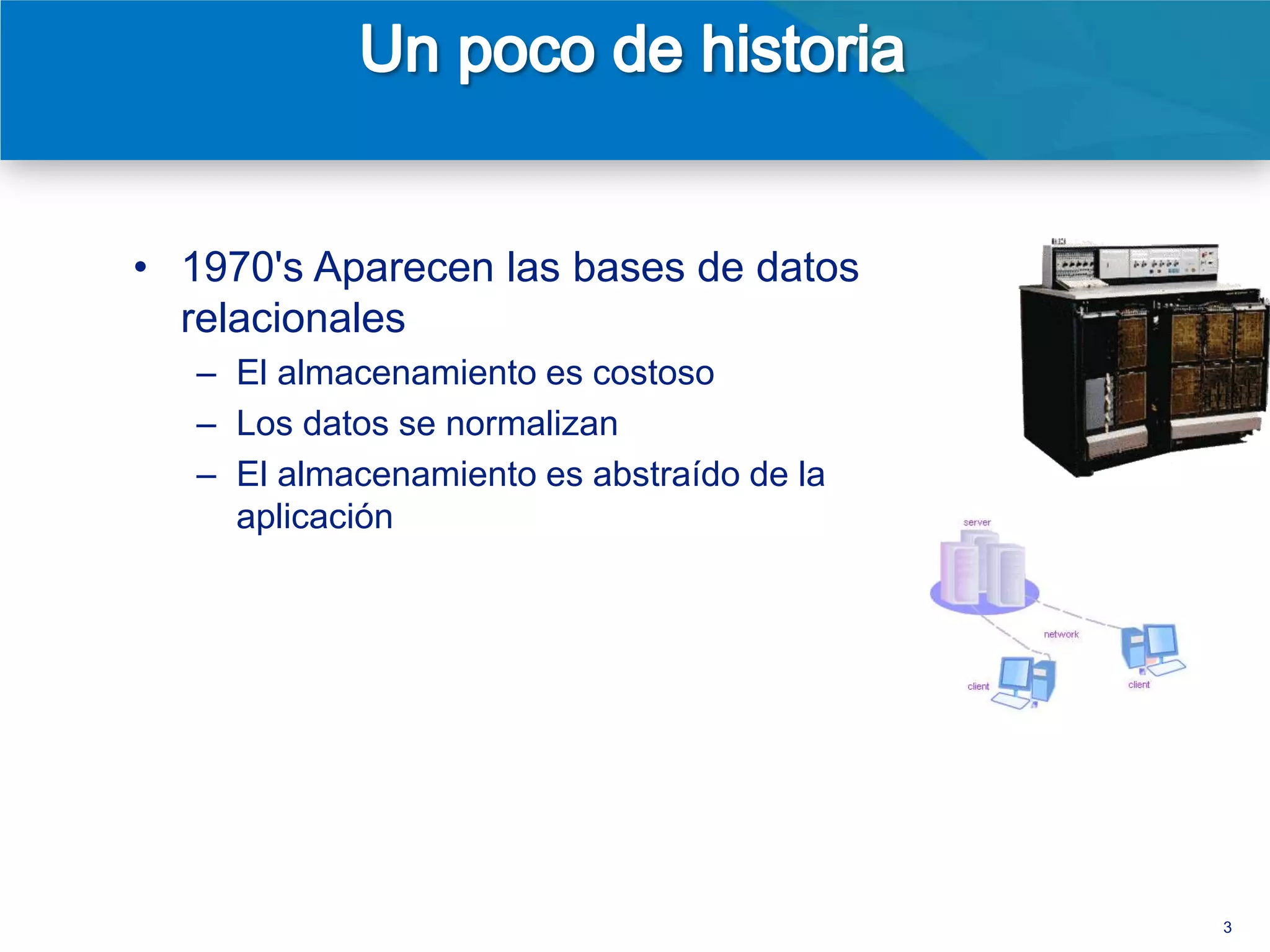
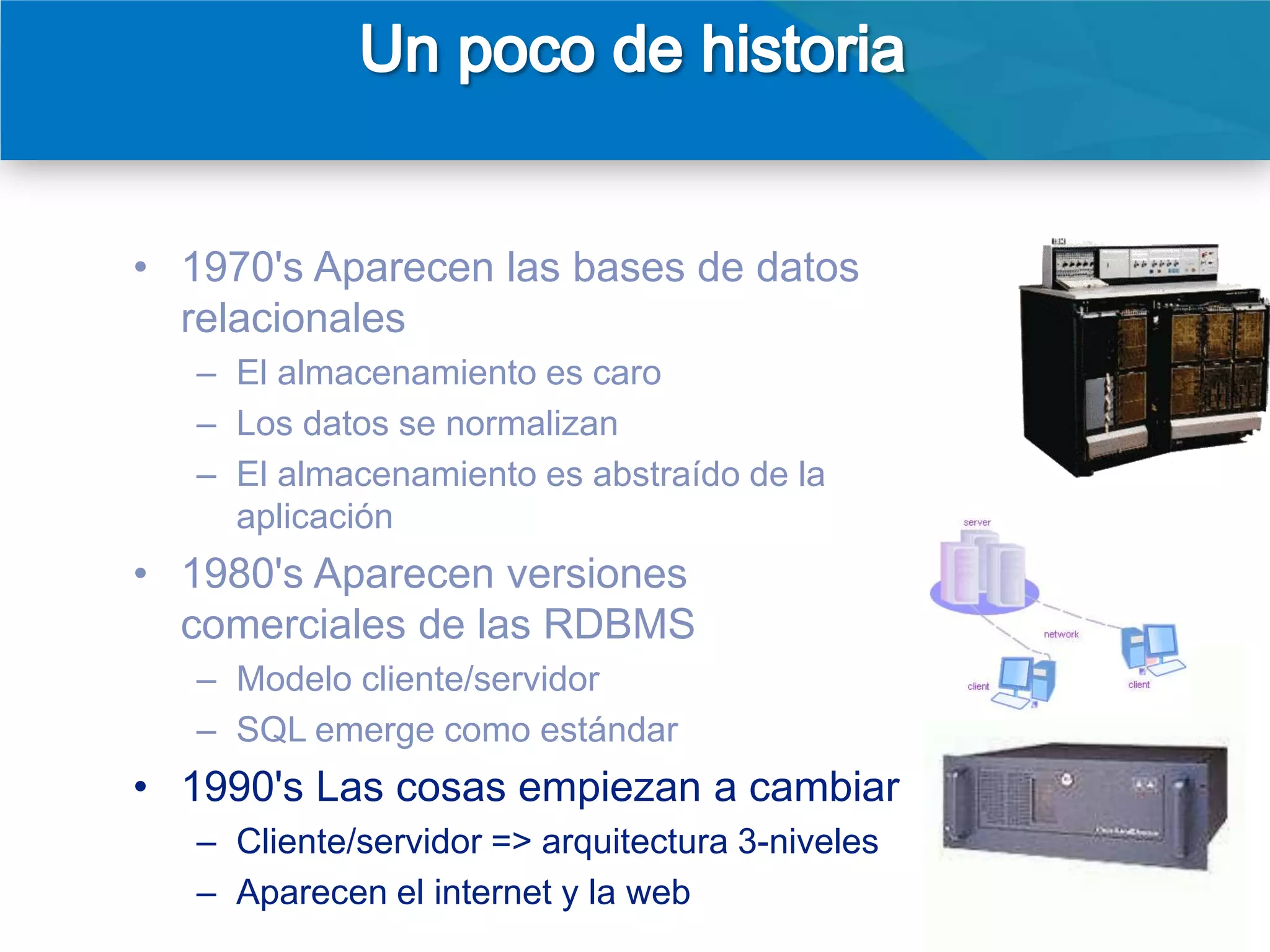
• 1970's Aparecen las bases de datos
  relacionales
   – El almacenamiento es costoso
   – Los datos se normalizan
   – El almacenamiento es abstraído de la
     aplicación


                                            2
• 1970's Aparecen las bases de datos
  relacionales
   – El almacenamiento es caro
   – Los datos se normalizan
   – El almacenamiento es abstraído de la
     aplicación
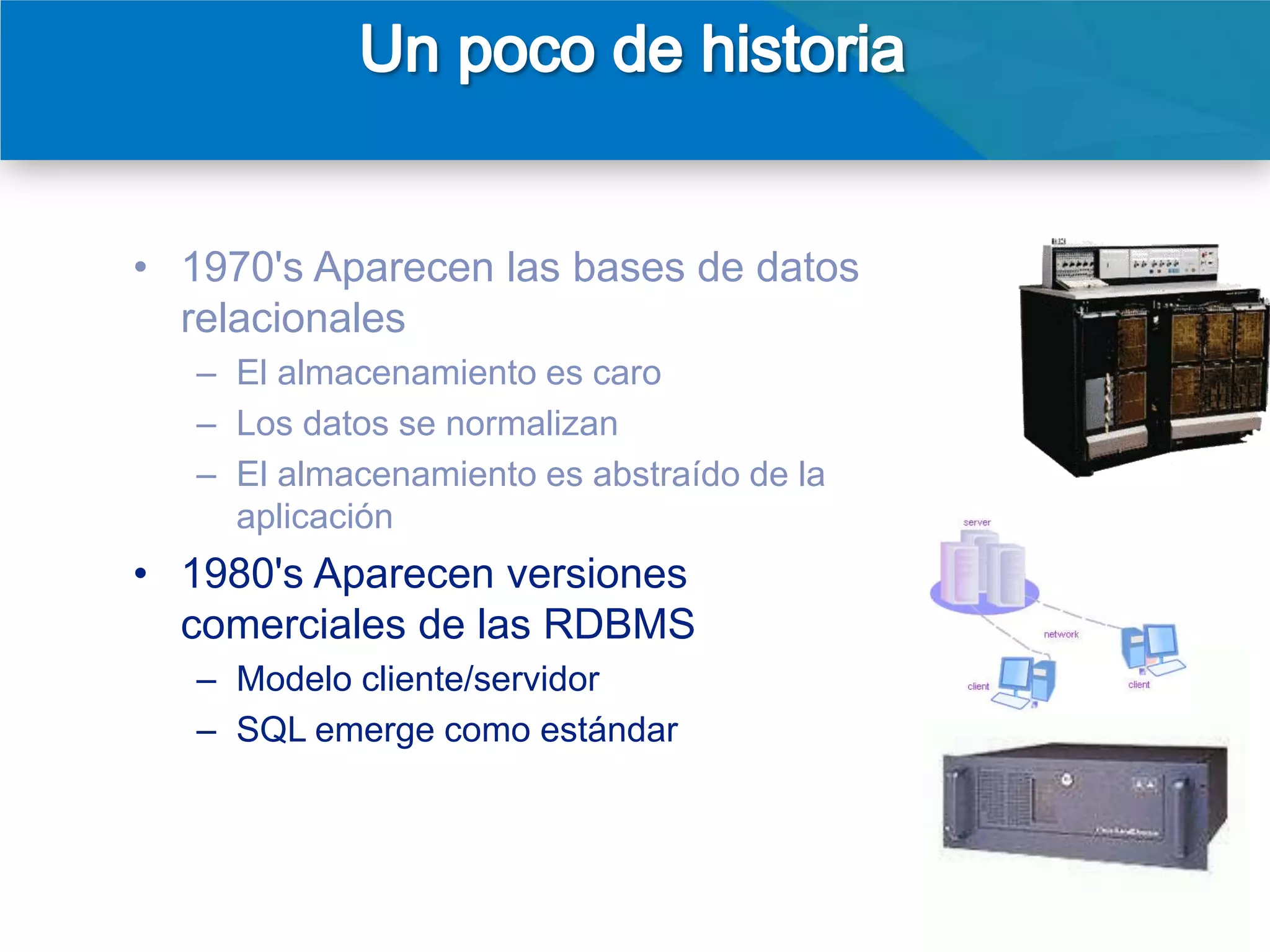
• 1980's Aparecen versiones
  comerciales de las RDBMS
   – Modelo cliente/servidor
   – SQL emerge como estándar


                                            3
• 1970's Aparecen las bases de datos
  relacionales
   – El almacenamiento es caro
   – Los datos se normalizan
   – El almacenamiento es abstraído de la
     aplicación
• 1980's Aparecen versiones
  comerciales de las RDBMS
   – Modelo cliente/servidor
   – SQL emerge como estándar
• 1990's Las cosas empiezan a cambiar
   – Cliente/servidor => arquitectura 3-niveles
   – Aparecen el internet y la web
                                                  4
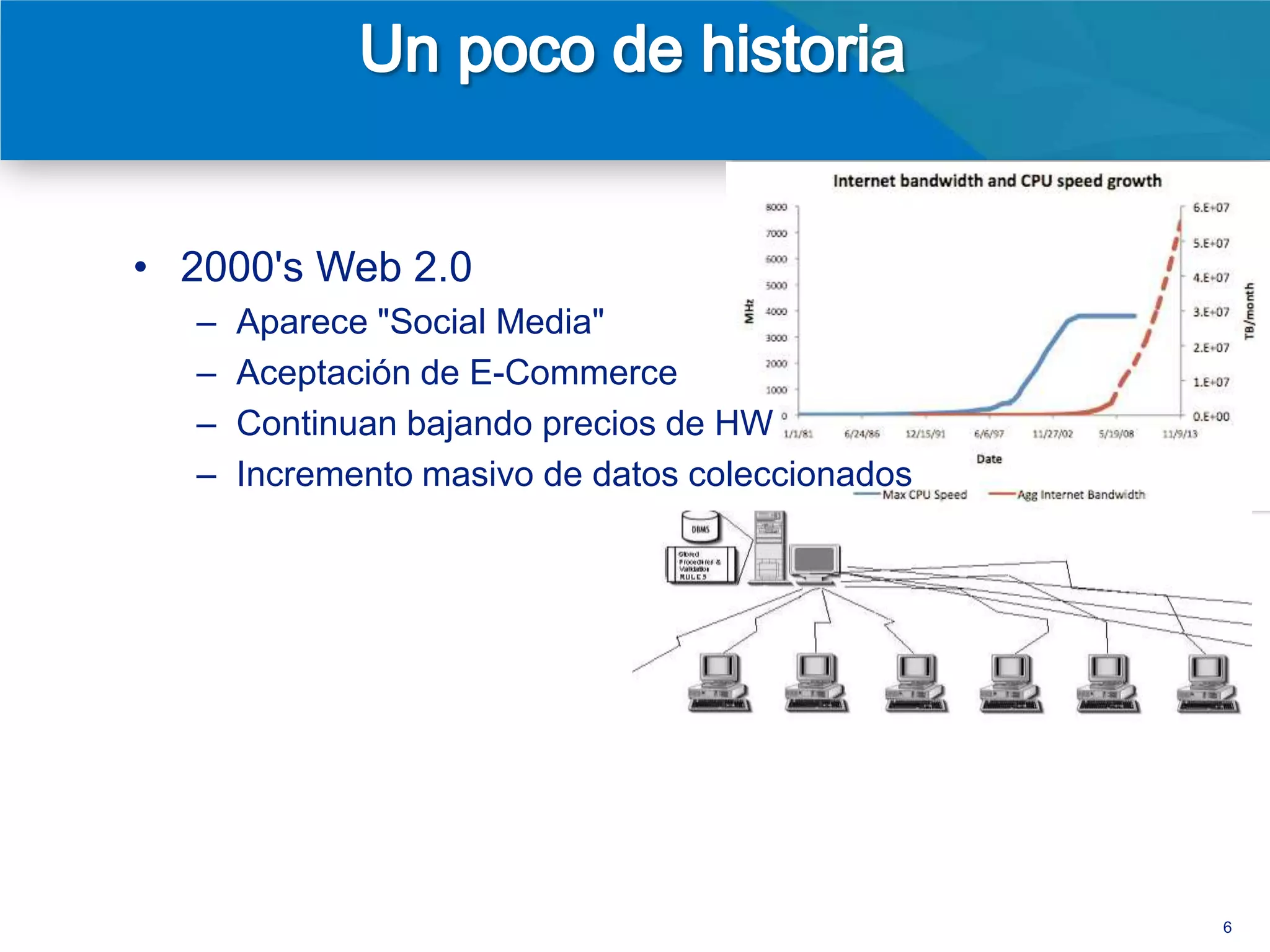
• 2000's Web 2.0
  –   Aparece "Social Media"
  –   Aceptación de E-Commerce
  –   Continuan bajando precios de HW
  –   Incremento masivo de datos coleccionados


                                                 5
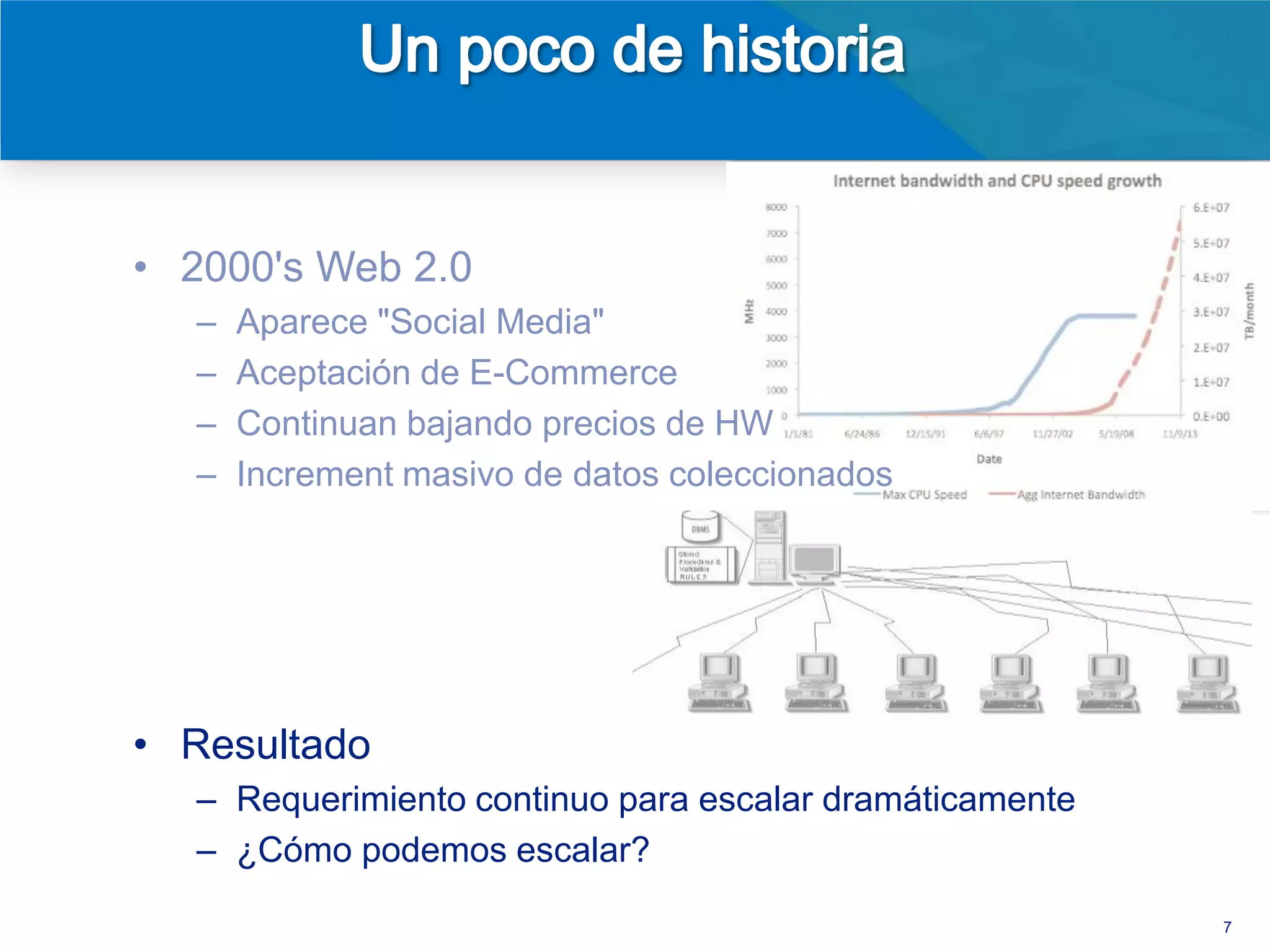
• 2000's Web 2.0
  –   Aparece "Social Media"
  –   Aceptación de E-Commerce
  –   Continuan bajando precios de HW
  –   Increment masivo de datos coleccionados


• Resultado
  – Requerimiento continuo para escalar dramáticamente
  – ¿Cómo podemos escalar?

                                                         6
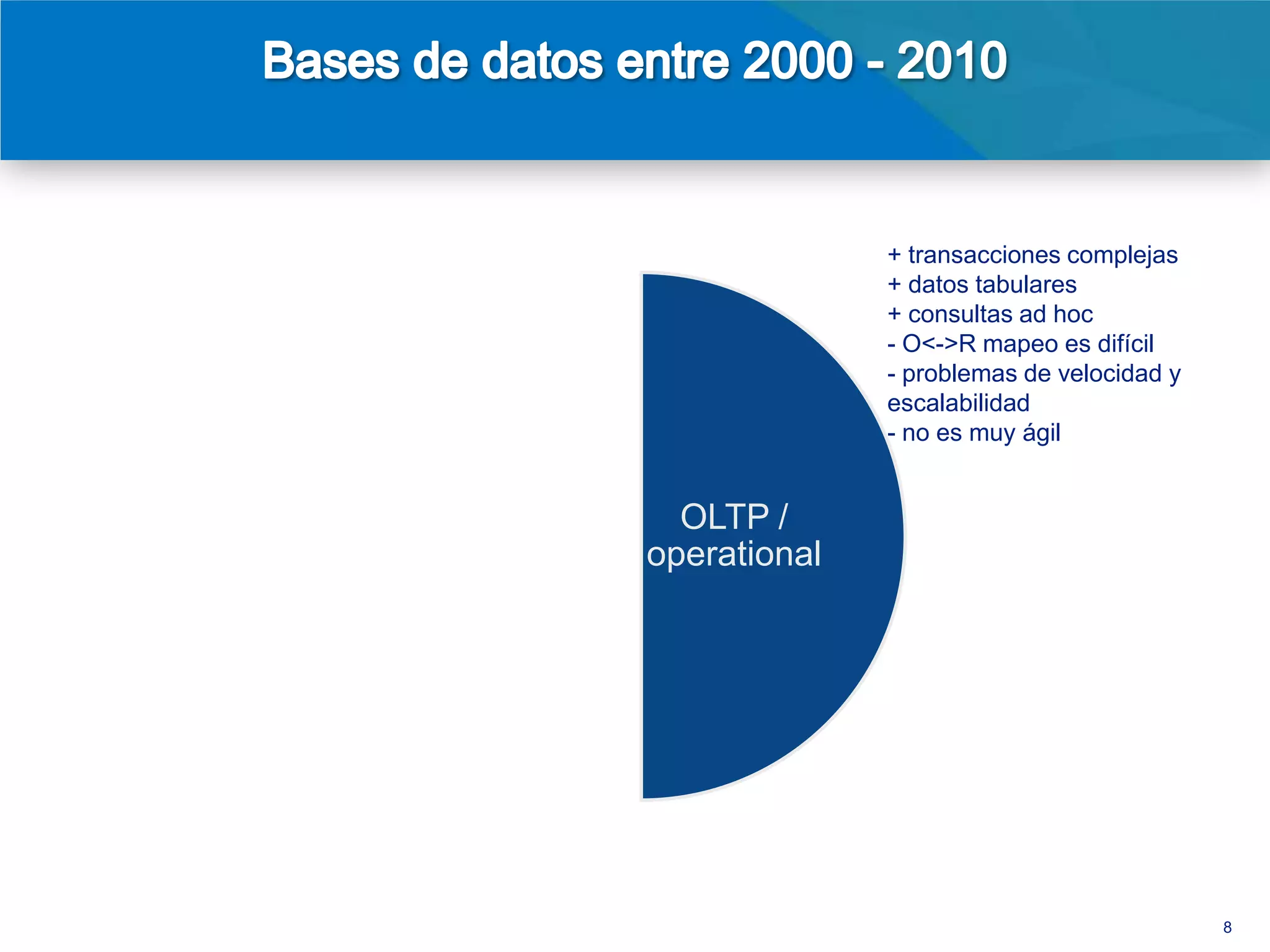
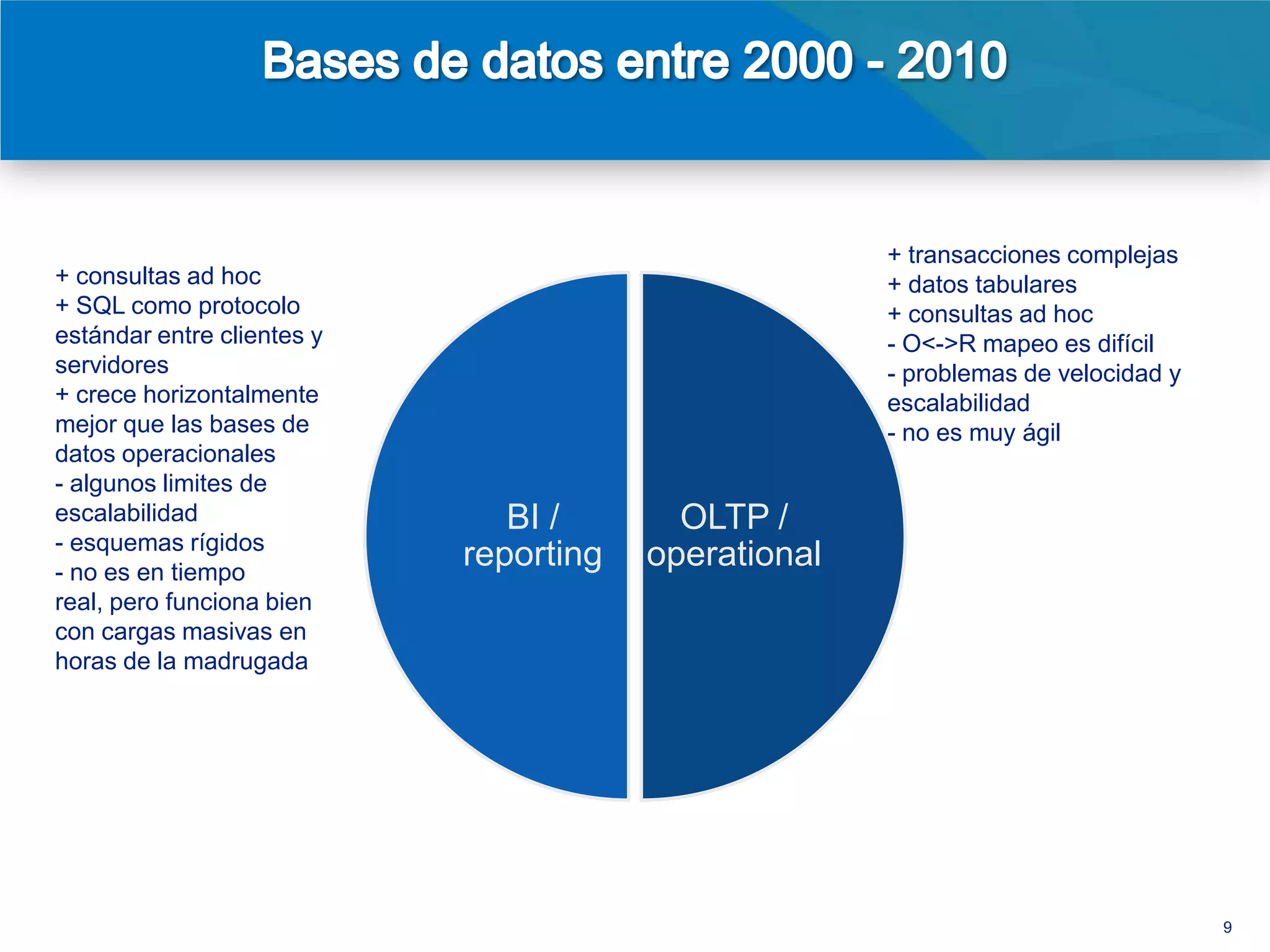
+ transacciones complejas
                          + datos tabulares
                          + consultas ad hoc
                          - O<->R mapeo es difícil
                          - problemas de velocidad y
                          escalabilidad
                          - no es muy ágil


   BI /       OLTP /
reporting   operational


                                                       7
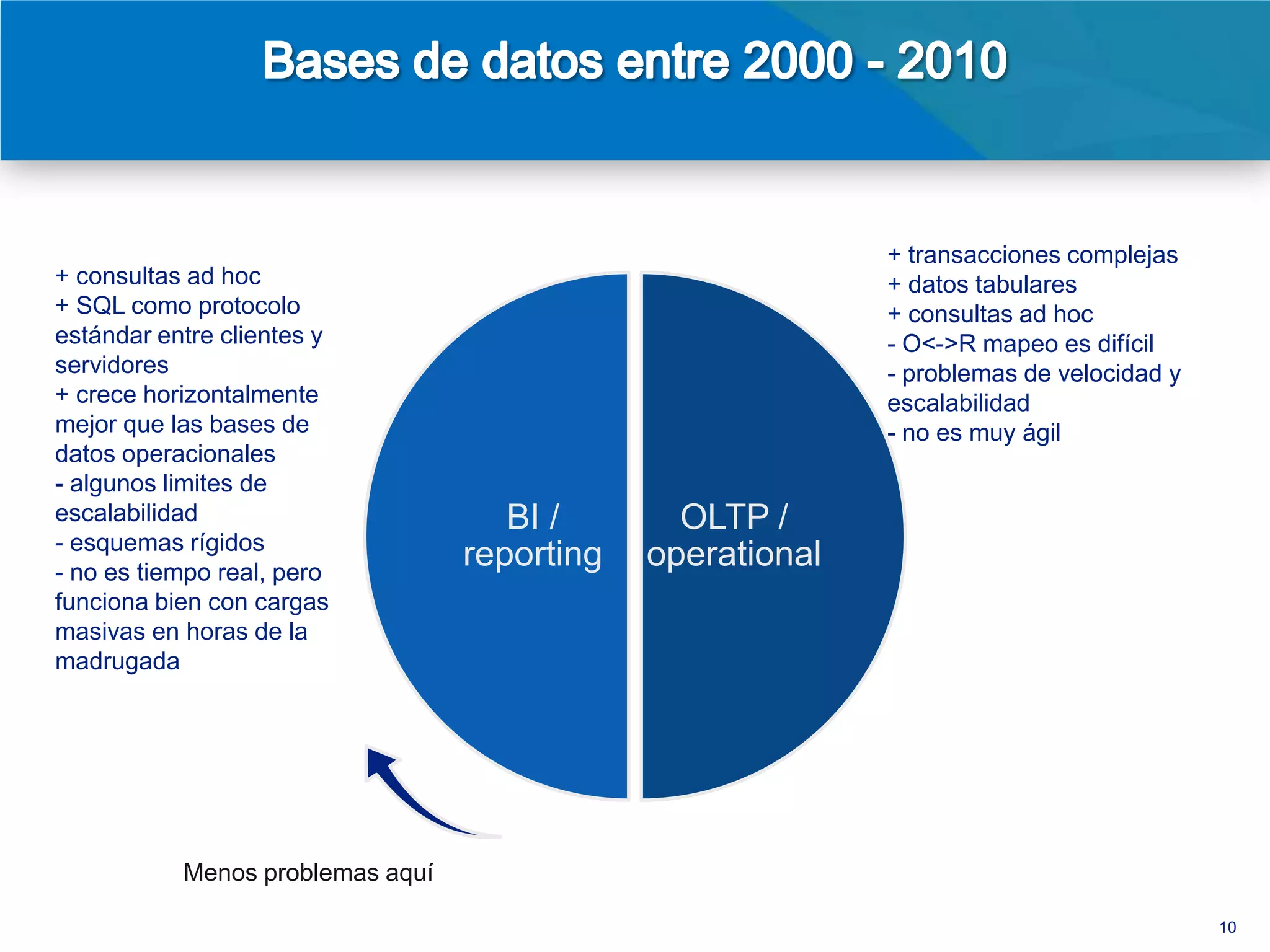
+ transacciones complejas
+ consultas ad hoc                                    + datos tabulares
+ SQL como protocolo                                  + consultas ad hoc
estándar entre clientes y                             - O<->R mapeo es difícil
servidores                                            - problemas de velocidad y
+ crece horizontalmente                               escalabilidad
mejor que las bases de                                - no es muy ágil
datos operacionales
- algunos limites de
escalabilidad                  BI /       OLTP /
- esquemas rígidos
- no es en tiempo
                            reporting   operational
real, pero funciona bien
con cargas masivas en
horas de la madrugada


                                                                                   8
+ transacciones complejas
+ consultas ad hoc                                          + datos tabulares
+ SQL como protocolo                                        + consultas ad hoc
estándar entre clientes y                                   - O<->R mapeo es difícil
servidores                                                  - problemas de velocidad y
+ crece horizontalmente                                     escalabilidad
mejor que las bases de                                      - no es muy ágil
datos operacionales
- algunos limites de
escalabilidad                        BI /       OLTP /
- esquemas rígidos
- no es tiempo real, pero
                                  reporting   operational
funciona bien con cargas
masivas en horas de la
madrugada


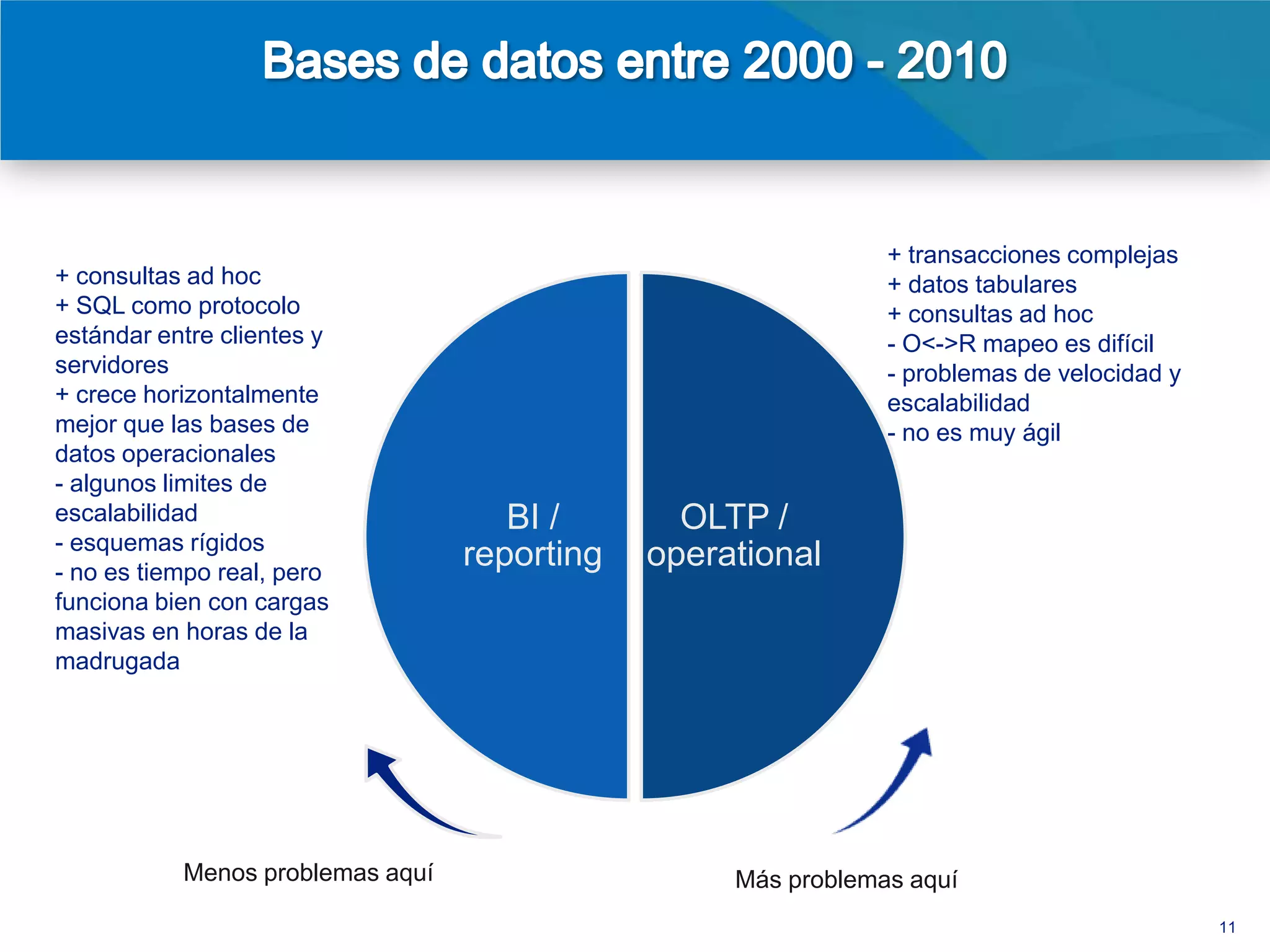
           Menos problemas aquí

                                                                                         9
+ transacciones complejas
+ consultas ad hoc                                             + datos tabulares
+ SQL como protocolo                                           + consultas ad hoc
estándar entre clientes y                                      - O<->R mapeo es difícil
servidores                                                     - problemas de velocidad y
+ crece horizontalmente                                        escalabilidad
mejor que las bases de                                         - no es muy ágil
datos operacionales
- algunos limites de
escalabilidad                        BI /       OLTP /
- esquemas rígidos
- no es tiempo real, pero
                                  reporting   operational
funciona bien con cargas
masivas en horas de la
madrugada


           Menos problemas aquí                    Más problemas aquí
                                                                                            10
+ transacciones complejas
+ consultas ad hoc                                               + datos tabulares
+ SQL como protocolo                                             + consultas ad hoc
estándar entre clientes y                                        - O<->R mapeo es difícil
servidores                                                       - problemas de velocidad y
+ crece horizontalmente                                          escalabilidad
mejor que las bases de                                           - no es muy ágil
datos operacionales
- algunos limites de
escalabilidad                      BI /       OLTP /
- esquemas rígidos
- no es tiempo real, pero
                                reporting   operational
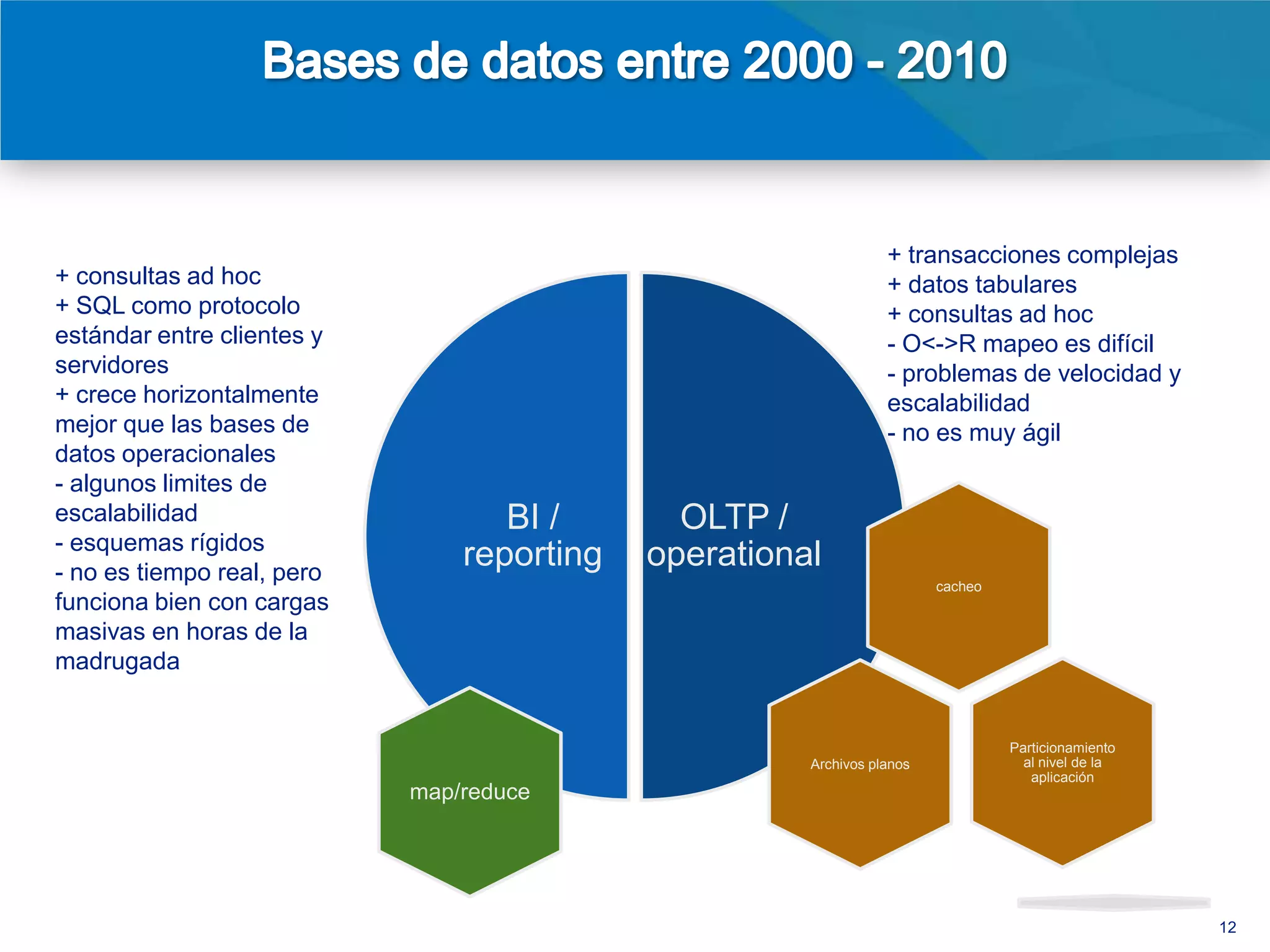
                                                                        cacheo
funciona bien con cargas
masivas en horas de la
madrugada


                                                                                 Particionamiento
                                                      Archivos planos              al nivel de la
                                                                                    aplicación
                            map/reduce


                                                                                                    11
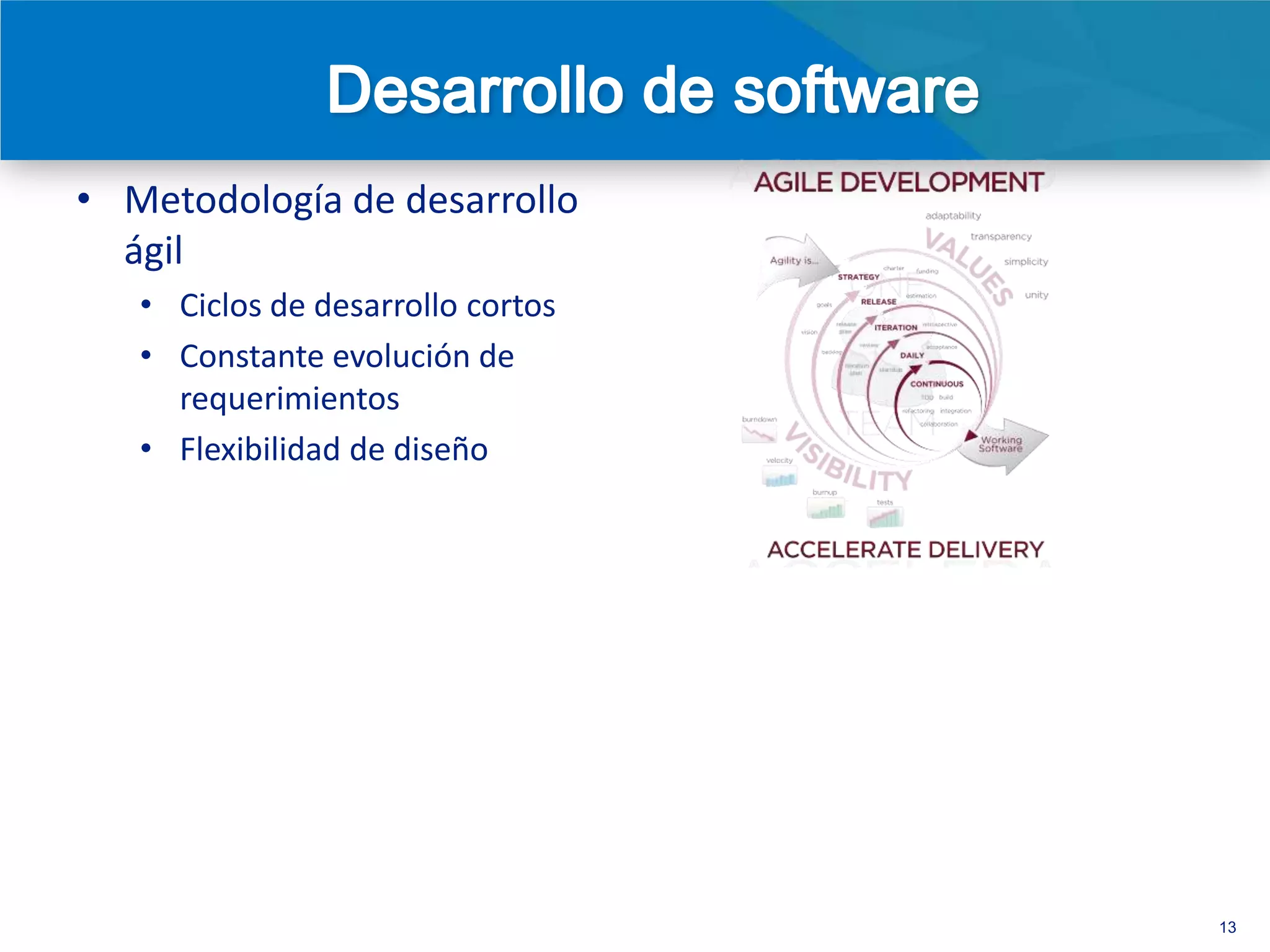
• Metodología de desarrollo
  ágil
   • Ciclos de desarrollo cortos
   • Constante evolución de
     requerimientos
   • Flexibilidad de diseño


                                   12
• Metodología de desarrollo
  ágil
   • Ciclos de desarrollo cortos
   • Constante evolución de
     requerimientos
   • Flexibilidad de diseño


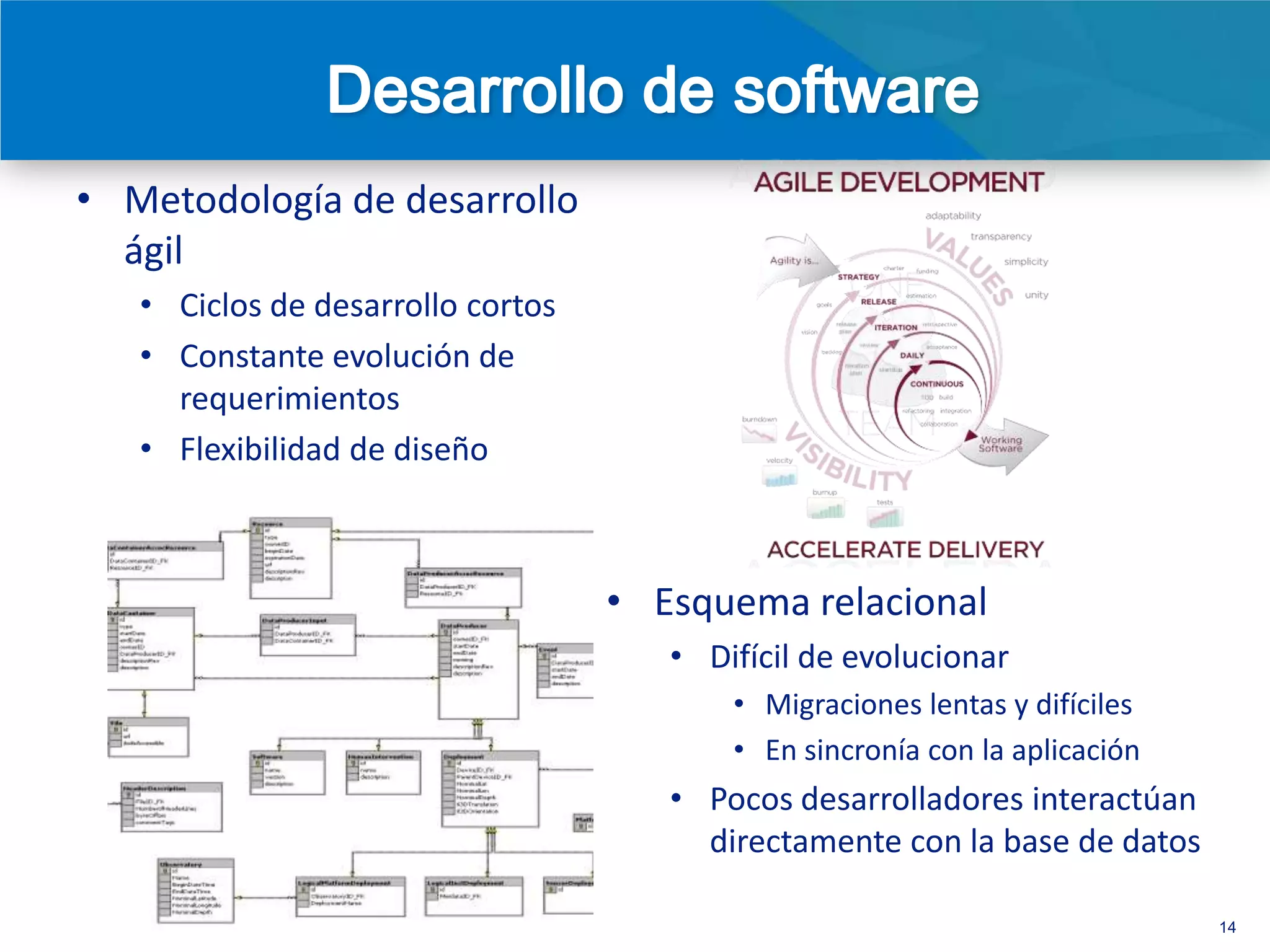
                                   • Esquema relacional
                                      • Difícil de evolucionar
                                          • Migraciones lentas y difíciles
                                          • En sincronía con la aplicación
                                      • Pocos desarrolladores interactúan
                                        directamente con la base de datos

                                                                             13
14
15
•   Escalabilidad horizontal
•   Más resultados en tiempo real
•   Desarrollo más veloz
•   Modelo de datos flexible
•   Bajo costo inicial
•   Bajo costo de operación


                                    16
¿Qué es NoSQL?


           Relacional
                    vs
         No-relacional
                         17
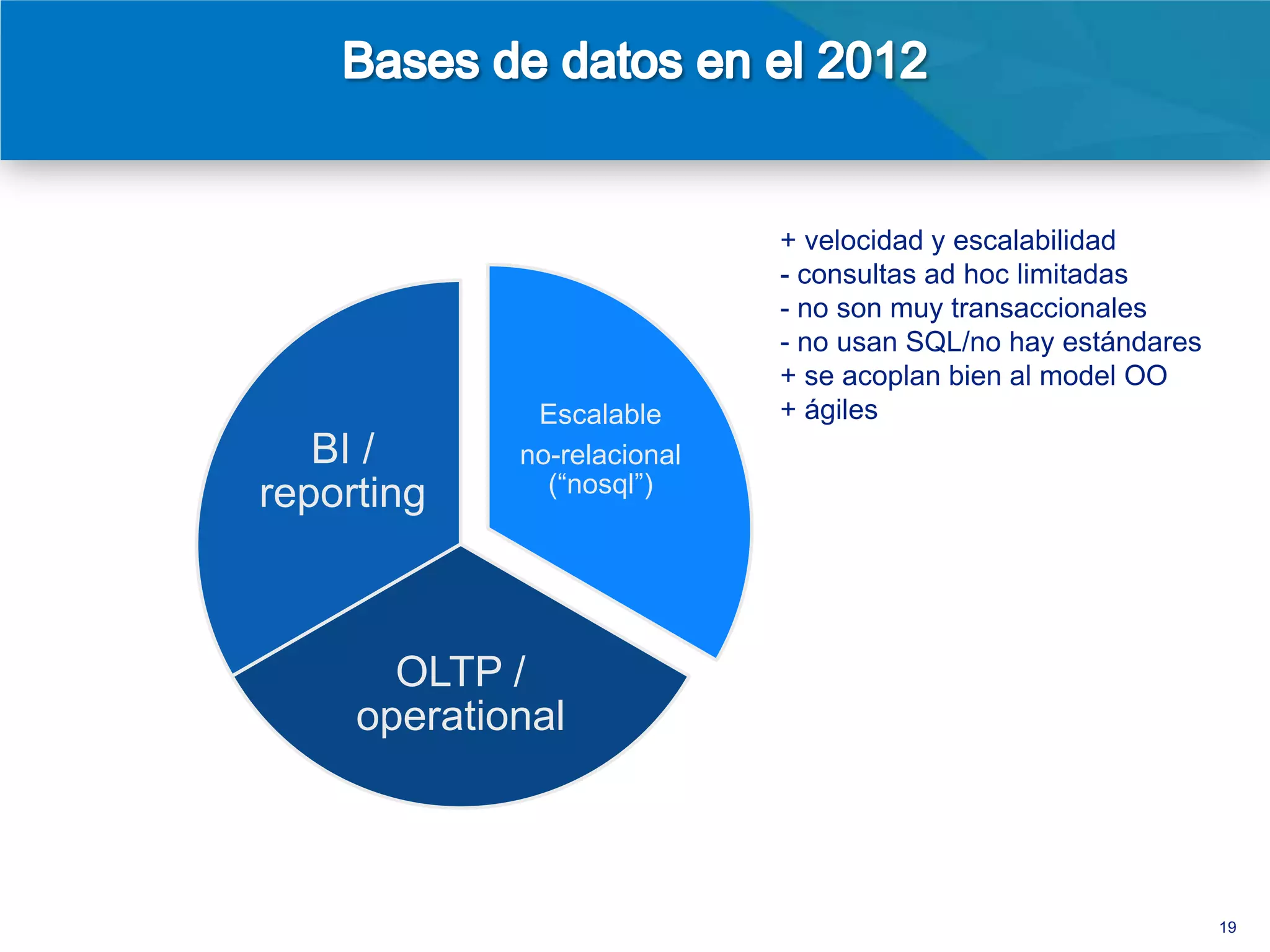
+ velocidad y escalabilidad
                             - consultas ad hoc limitadas
                             - no son muy transaccionales
                             - no usan SQL/no hay estándares
                             + se acoplan bien al model OO
              Escalable      + ágiles
   BI /      no-relacional
reporting      (“nosql”)


       OLTP /
     operational


                                                               18
La próxima generación de bases de
    datos no-relacionales

Una colección de productos muy diferentes
•   Diferentes modelos de datos (no-relacionales)
•   La mayoría no usan SQL para las consultas
•   No requieren un esquema predefinido
•   Algunos permiten estructuras de datos flexibles

                                                  19
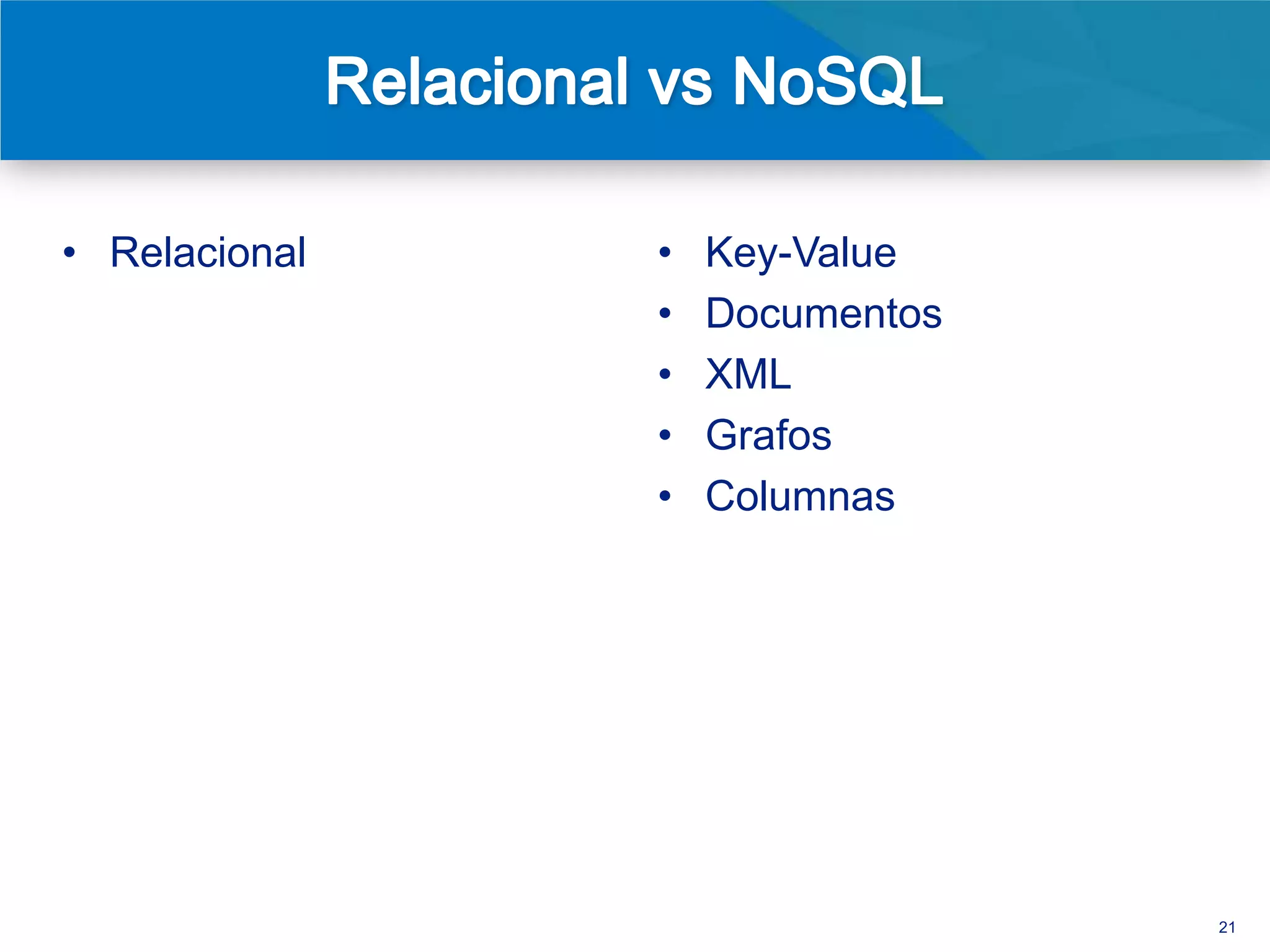
• Relacional   •   Key-Value
               •   Documentos
               •   XML
               •   Grafos
               •   Columnas


                                20
• Relacional                         •   Key-Value
                                     •   Documentos
                                     •   XML
                                     •   Grafos
                                     •   Columnas

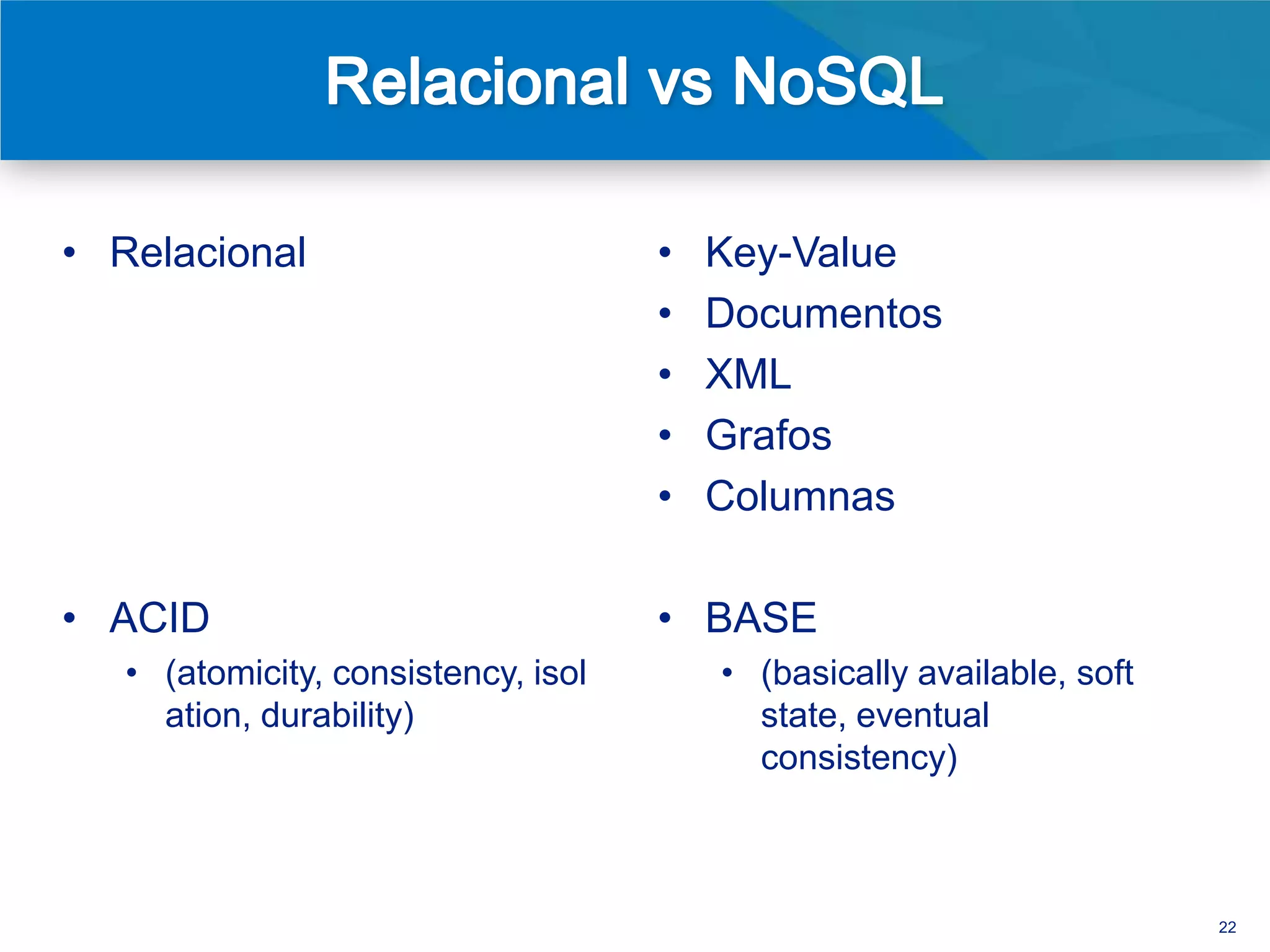
• ACID                               • BASE
   • (atomicity, consistency, isol       • (basically available, soft
     ation, durability)                    state, eventual
                                           consistency)


                                                                        21
• Relacional                •   Key-Value
                            •   Documentos
                            •   XML
                            •   Grafos
                            •   Columnas

• ACID                      • BASE

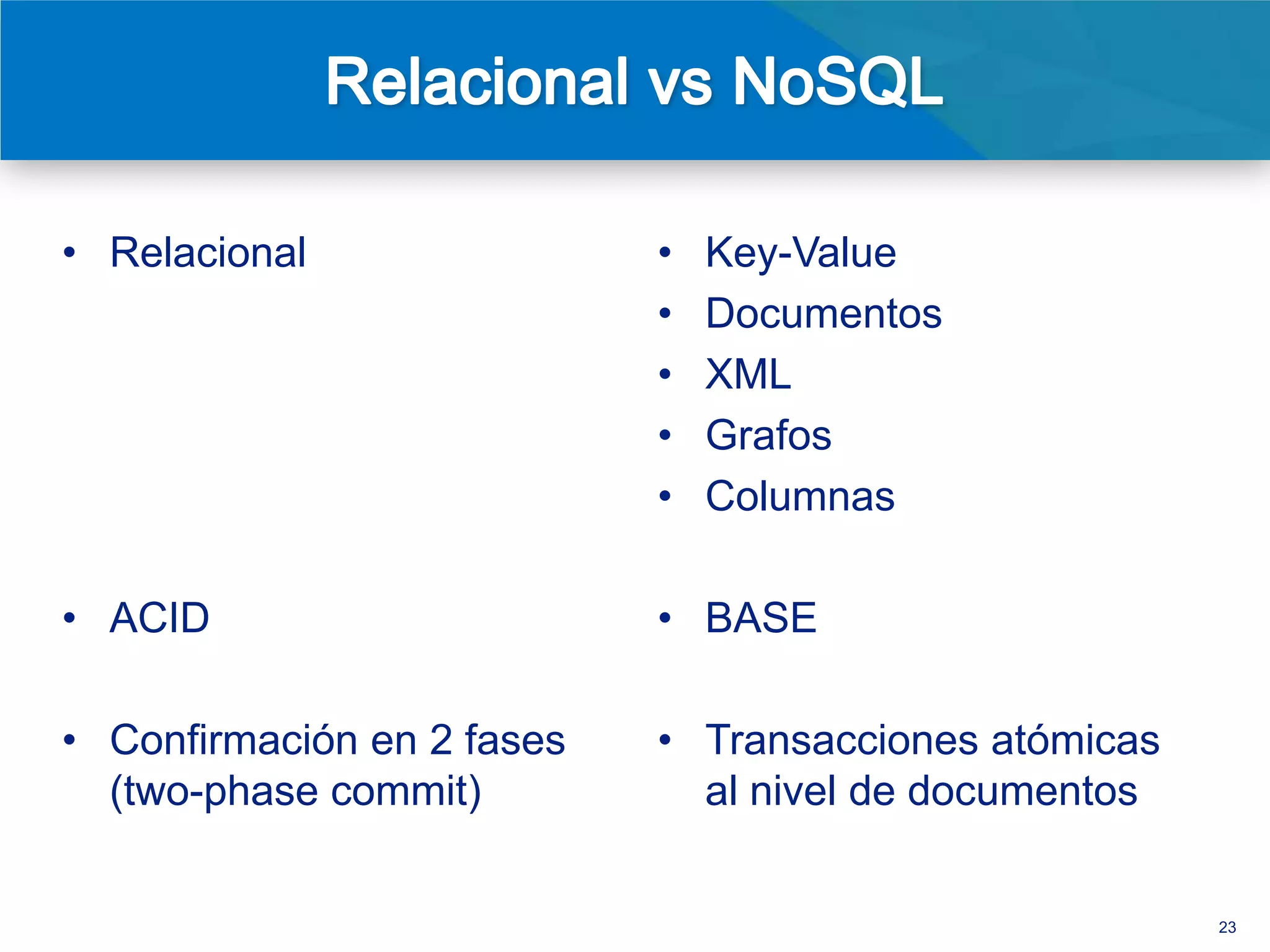
• Confirmación en 2 fases   • Transacciones atómicas
  (two-phase commit)          al nivel de documentos


                                                       22
• Relacional                •   Key-Value
                            •   Documentos
                            •   XML
                            •   Grafos
                            •   Columnas

• ACID                      • BASE

• Confirmación en 2 fases   • Transacciones atómicas
  (two-phase commit)          al nivel de documentos
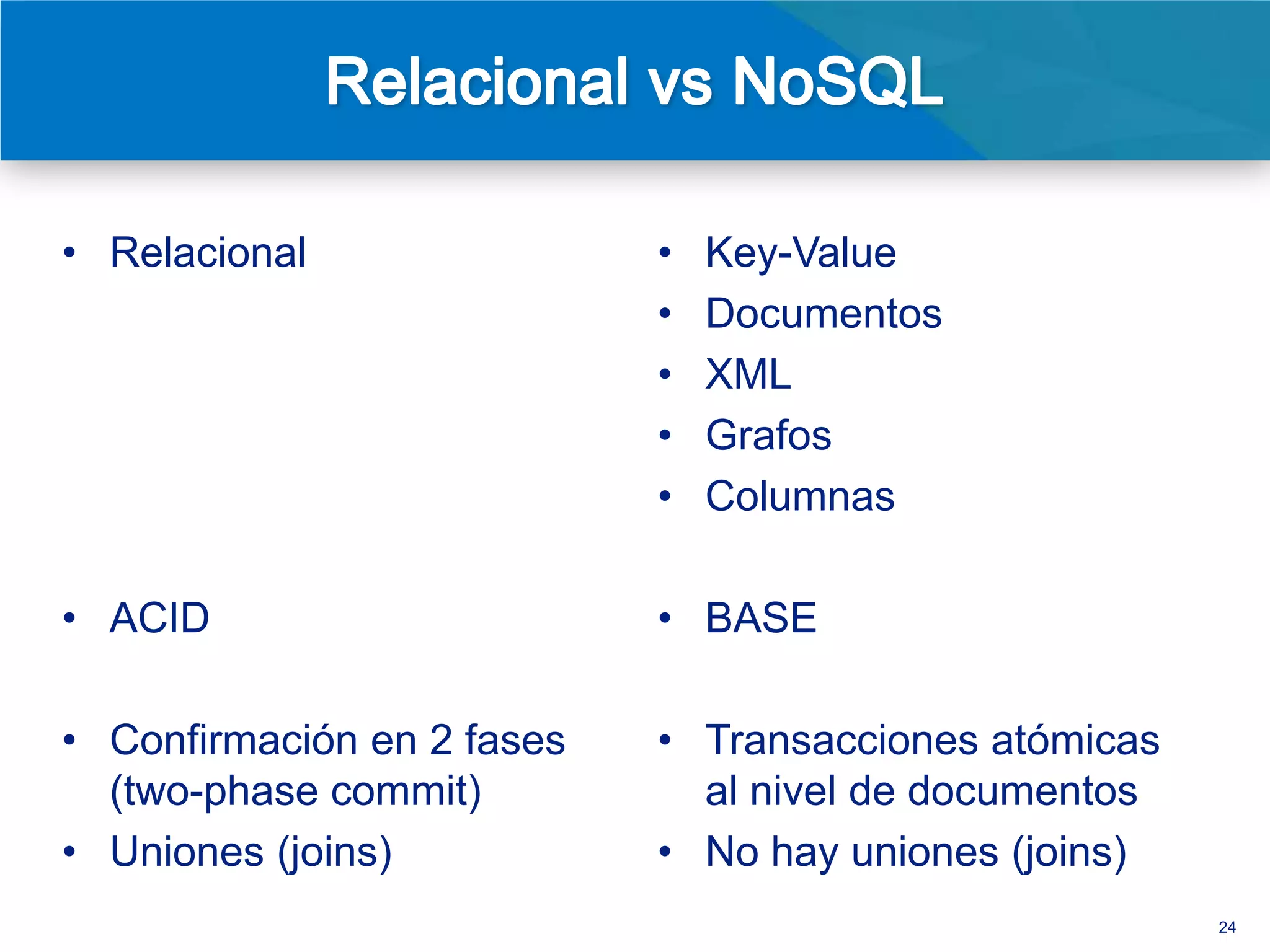
• Uniones (joins)           • No hay uniones (joins)
                                                       23
24
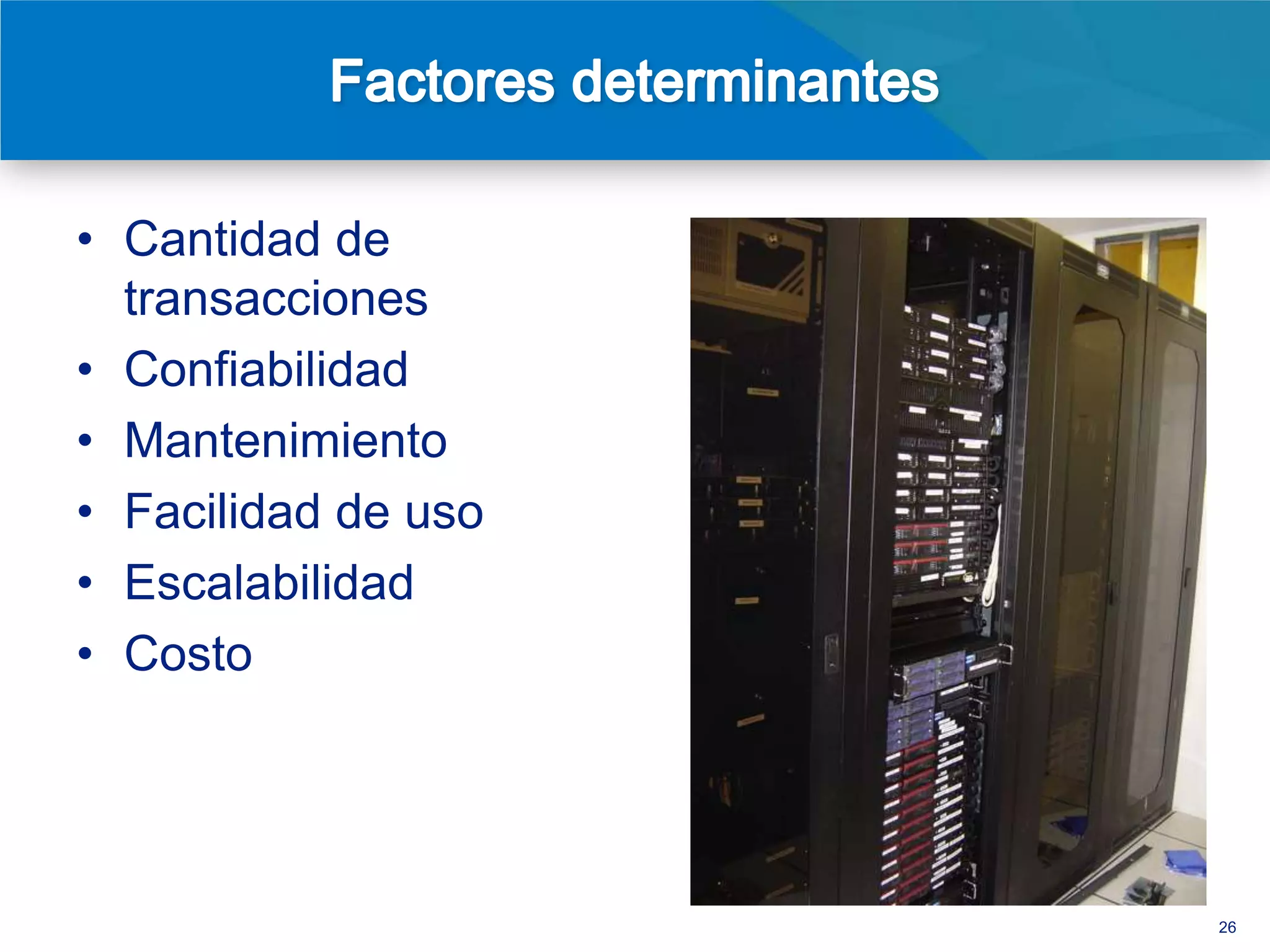
• Cantidad de
  transacciones
• Confiabilidad
• Mantenimiento
• Facilidad de uso
• Escalabilidad
• Costo


                     25
MongoDB: Introducción


                        26
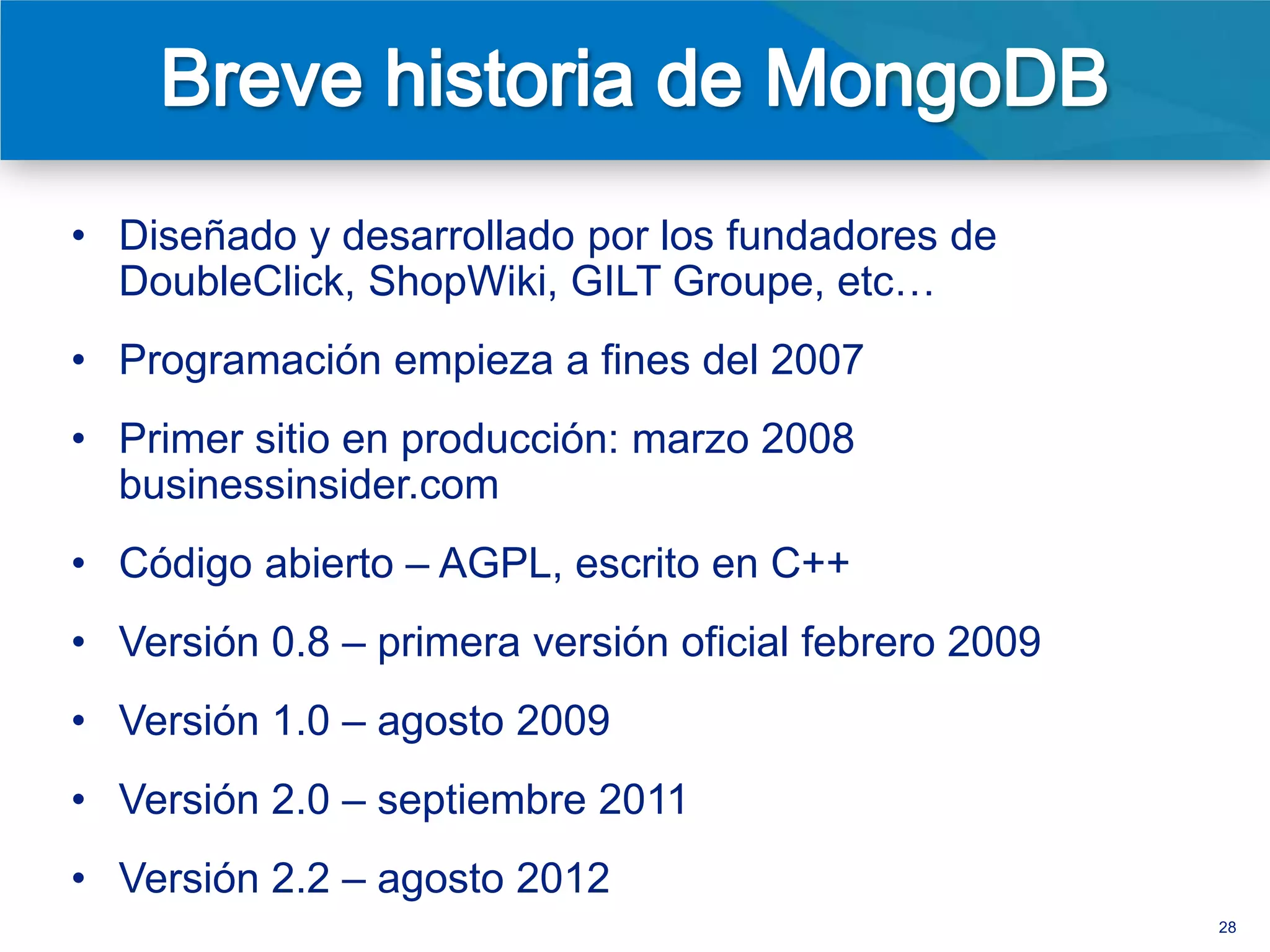
• Diseñado y desarrollado por los fundadores de
  DoubleClick, ShopWiki, GILT Groupe, etc…
• Programación empieza a fines del 2007
• Primer sitio en producción: marzo 2008
  businessinsider.com
• Código abierto – AGPL, escrito en C++
• Versión 0.8 – primera versión oficial febrero 2009
• Versión 1.0 – agosto 2009
• Versión 2.0 – septiembre 2011
• Versión 2.2 – agosto 2012
                                                       27
MongoDB
Objetivos de diseño
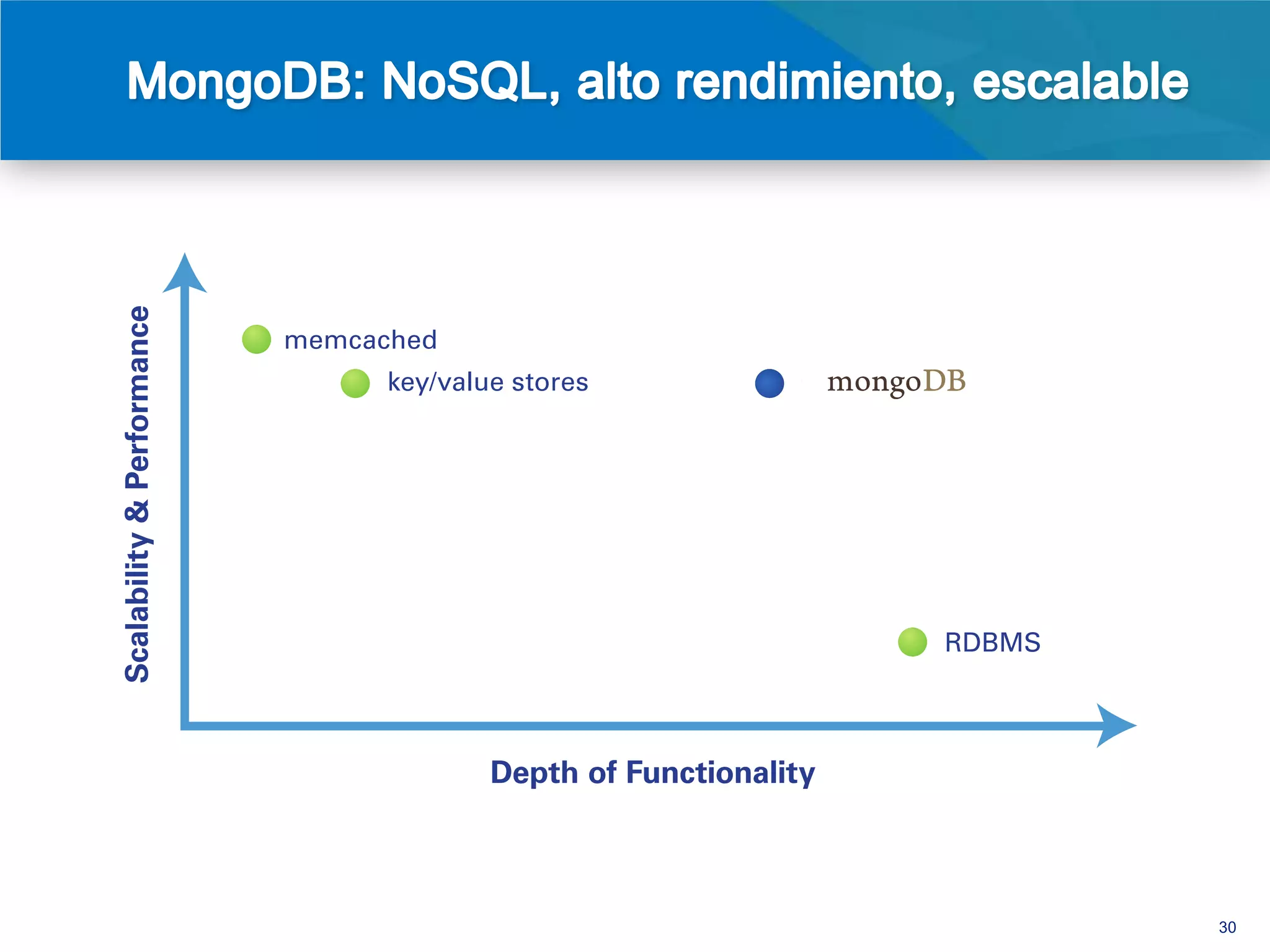
                      28
29
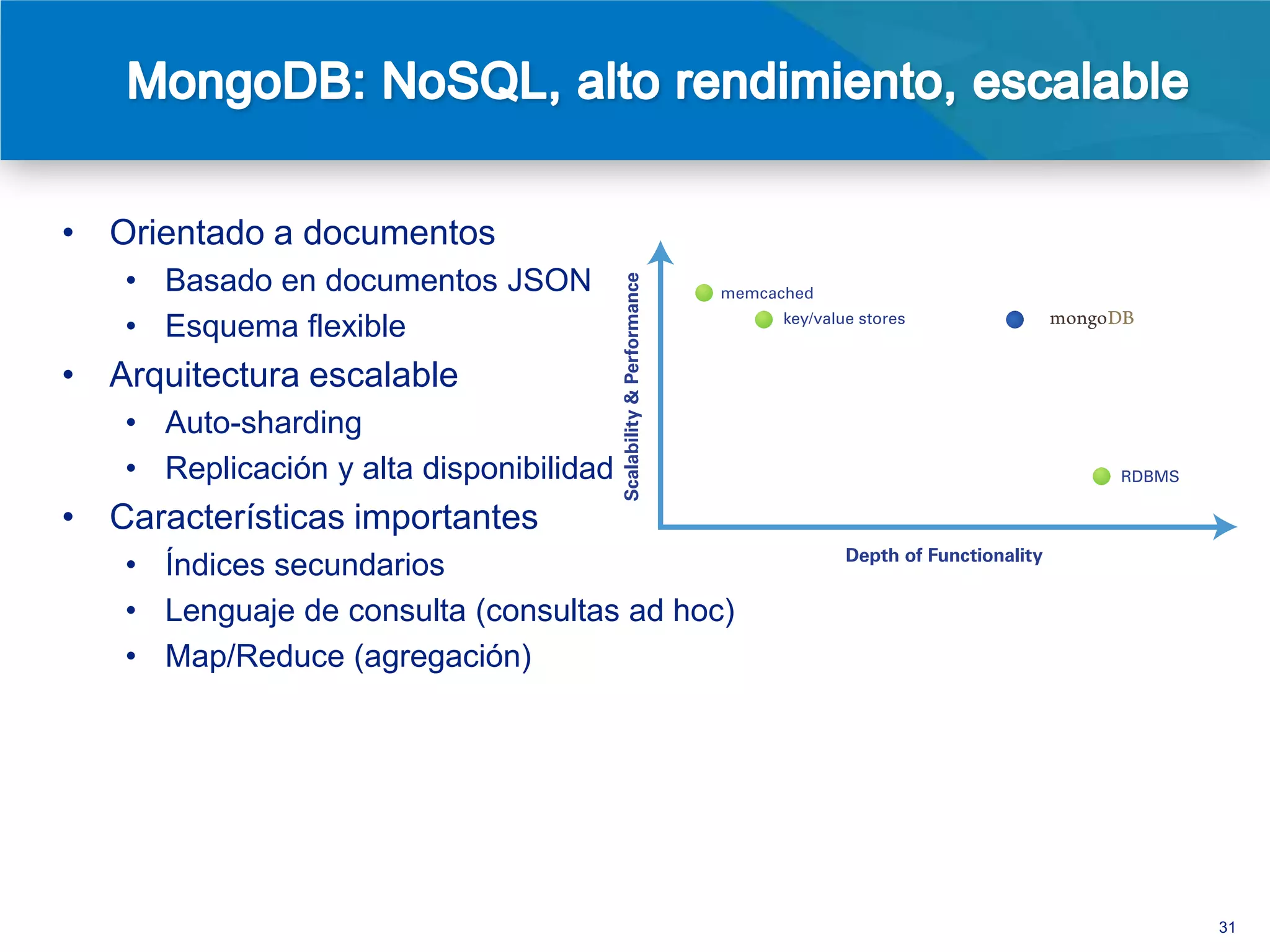
• Orientado a documentos
   • Basado en documentos JSON
   • Esquema flexible
• Arquitectura escalable
   • Auto-sharding
   • Replicación y alta disponibilidad
• Características importantes
   • Índices secundarios
   • Lenguaje de consulta (consultas ad hoc)
   • Map/Reduce (agregación)


                                               30
• Modelo de datos poderoso y flexible
• Conversión transparente de objetos en la
  aplicación (OO) a documentos JSON
• Flexibilidad para datos dinámicos
• Mejor localidad de datos


                                             31
32
{
    _id : ObjectId("4e2e3f92268cdda473b628f6"),
    title : “Too Big to Fail”,
    when : Date(“2011-07-26”),
    author : “joe”,
    text : “blah”
}


                                                  33
{
    _id : ObjectId("4e2e3f92268cdda473b628f6"),
    title : “Too Big to Fail”,
    when : Date(“2011-07-26”),
    author : “joe”,
    text : “blah”,
    tags : [“business”, “news”, “north america”]
}


> db.posts.find( { tags : “news” } )


                                                   34
{
    _id : ObjectId("4e2e3f92268cdda473b628f6"),
    title : “Too Big to Fail”,
    when : Date(“2011-07-26”),
    author : “joe”,
    text : “blah”,
    tags : [“business”, “news”, “north america”],
    votes : 3,
    voters : [“dmerr”, “sj”, “jane” ]
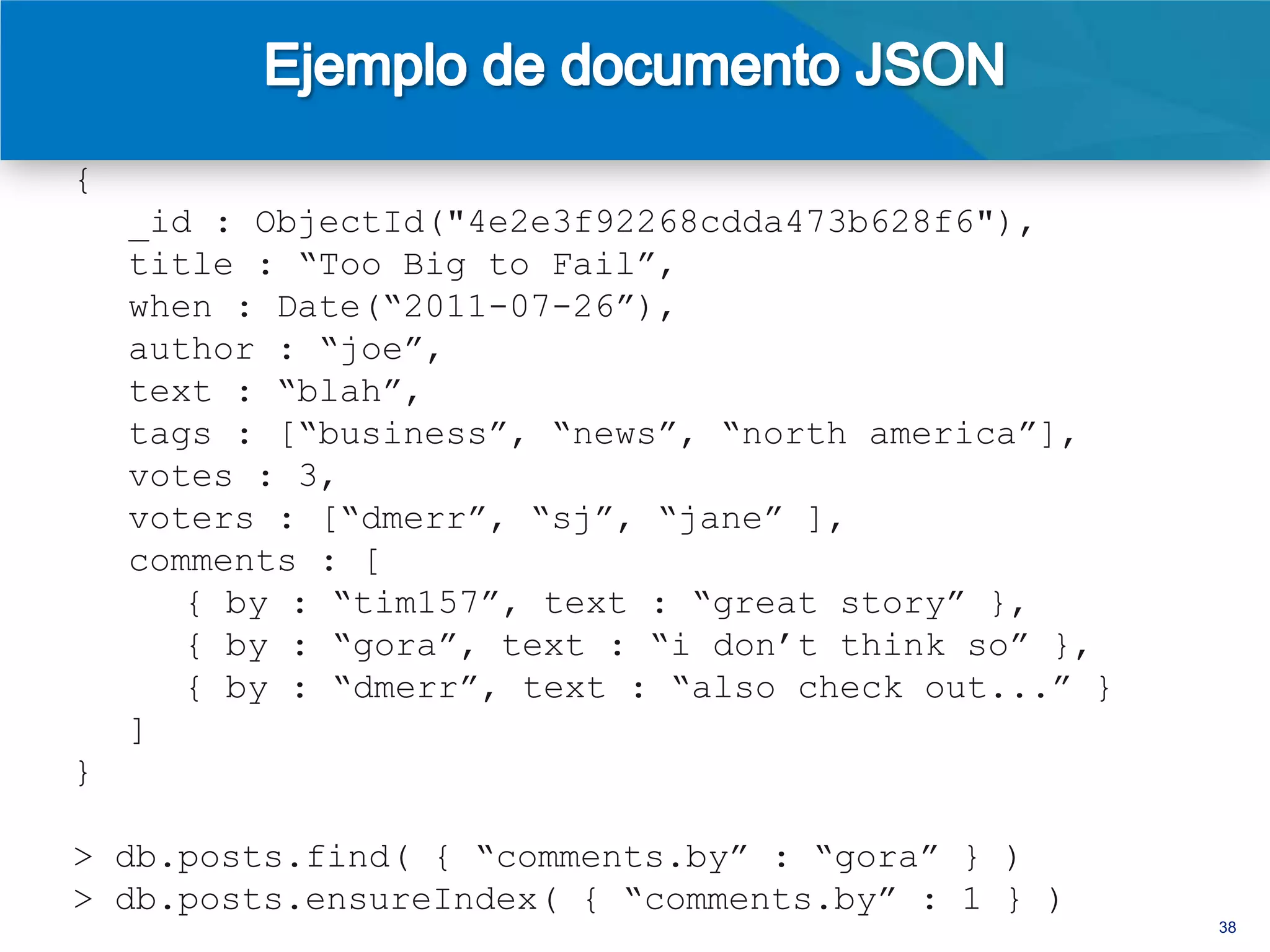
}


                                                    35
{
    _id : ObjectId("4e2e3f92268cdda473b628f6"),
    title : “Too Big to Fail”,
    when : Date(“2011-07-26”),
    author : “joe”,
    text : “blah”,
    tags : [“business”, “news”, “north america”],
    votes : 3,
    voters : [“dmerr”, “sj”, “jane” ],
    comments : [
       { by : “tim157”, text : “great story” },
       { by : “gora”, text : “i don’t think so” },
       { by : “dmerr”, text : “also check out...” }
    ]
}

                                                      36
{
    _id : ObjectId("4e2e3f92268cdda473b628f6"),
    title : “Too Big to Fail”,
    when : Date(“2011-07-26”),
    author : “joe”,
    text : “blah”,
    tags : [“business”, “news”, “north america”],
    votes : 3,
    voters : [“dmerr”, “sj”, “jane” ],
    comments : [
       { by : “tim157”, text : “great story” },
       { by : “gora”, text : “i don’t think so” },
       { by : “dmerr”, text : “also check out...” }
    ]
}

> db.posts.find( { “comments.by” : “gora” } )
> db.posts.ensureIndex( { “comments.by” : 1 } )
                                                      37
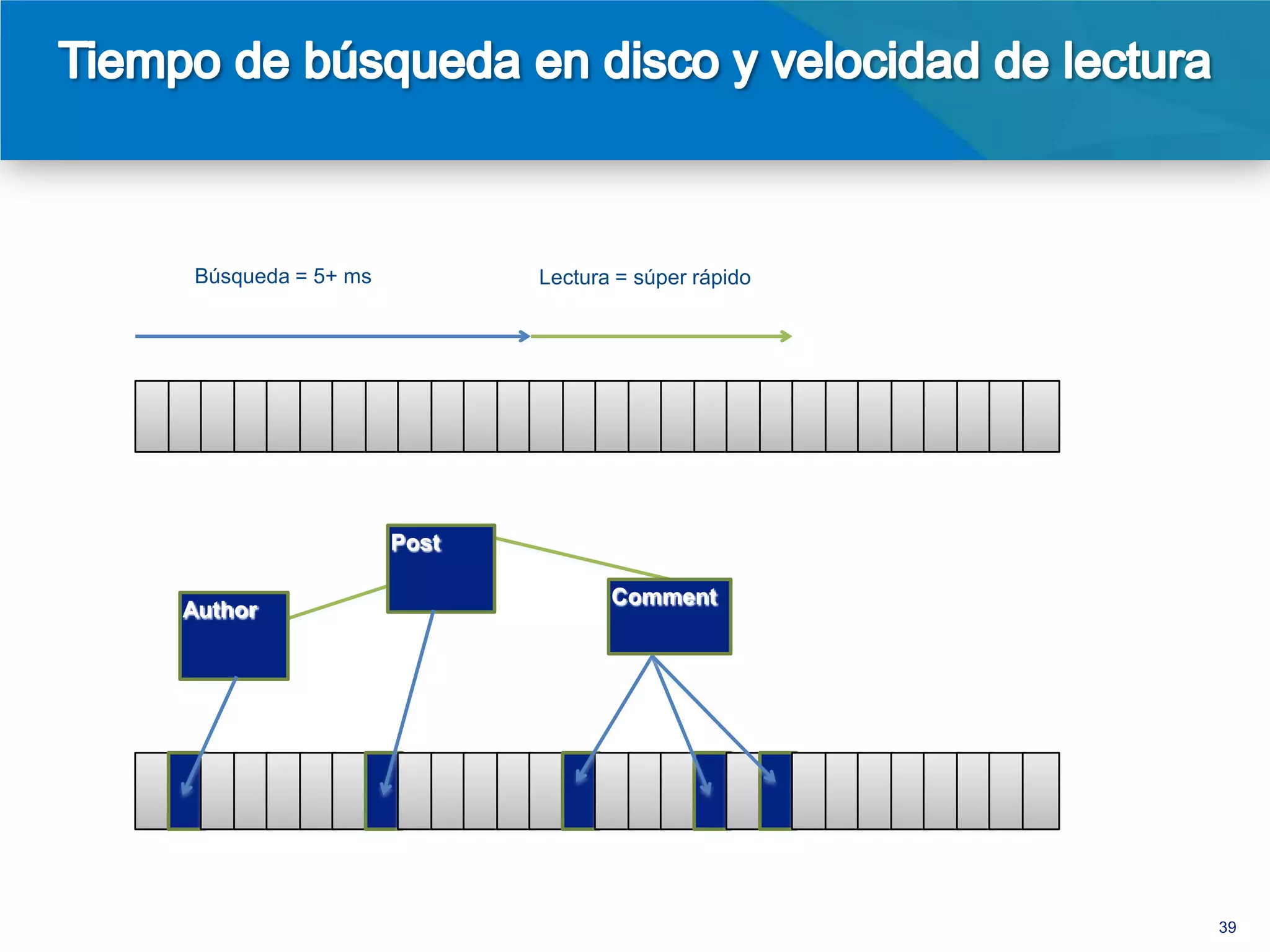
Búsqueda = 5+ ms          Lectura = súper rápido


                   Post

                                 Comment
Author


                                                   38
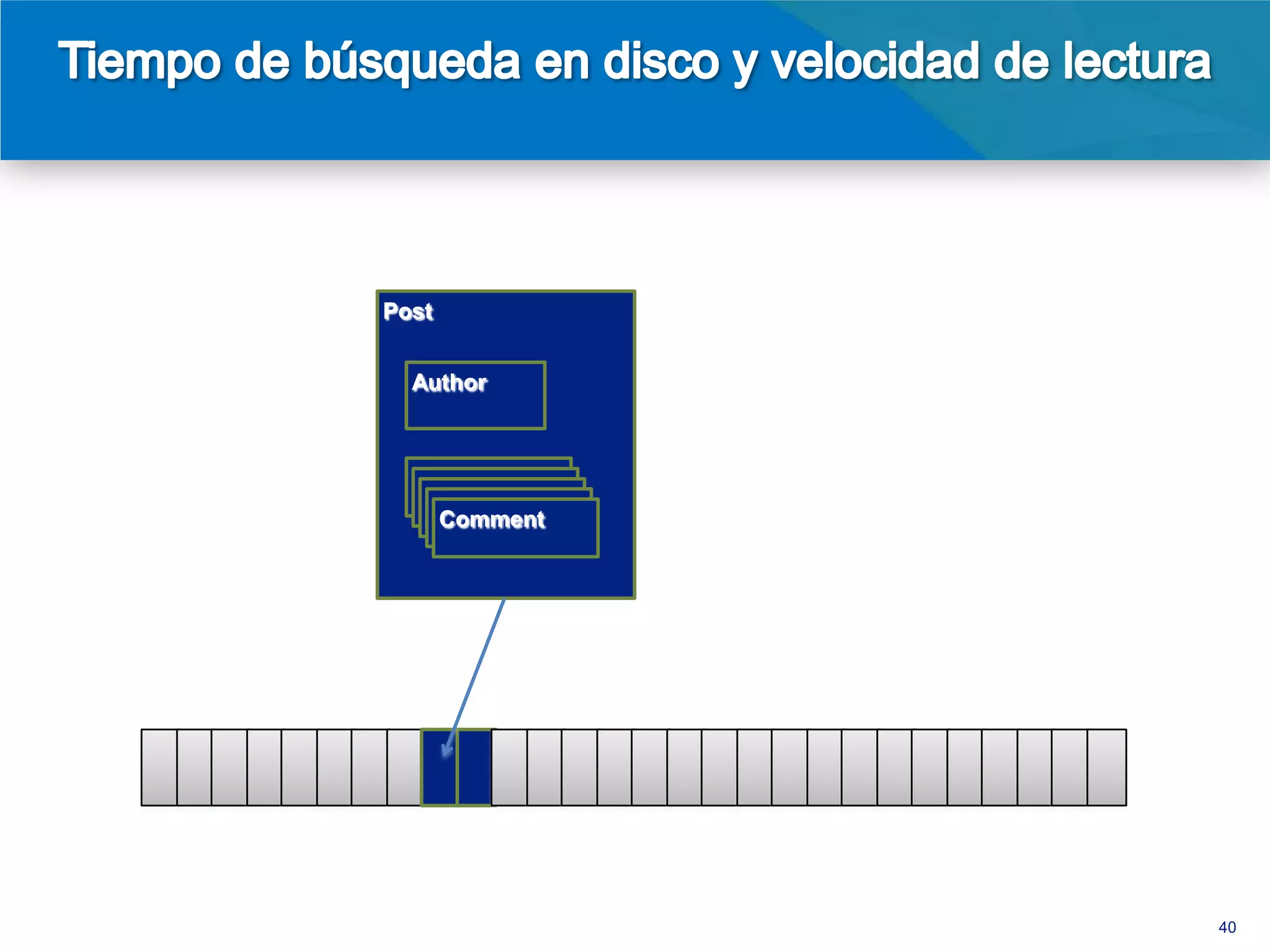
Post


  Author


  Comment
   Comment
    Comment
     Comment
       Comment


                 39
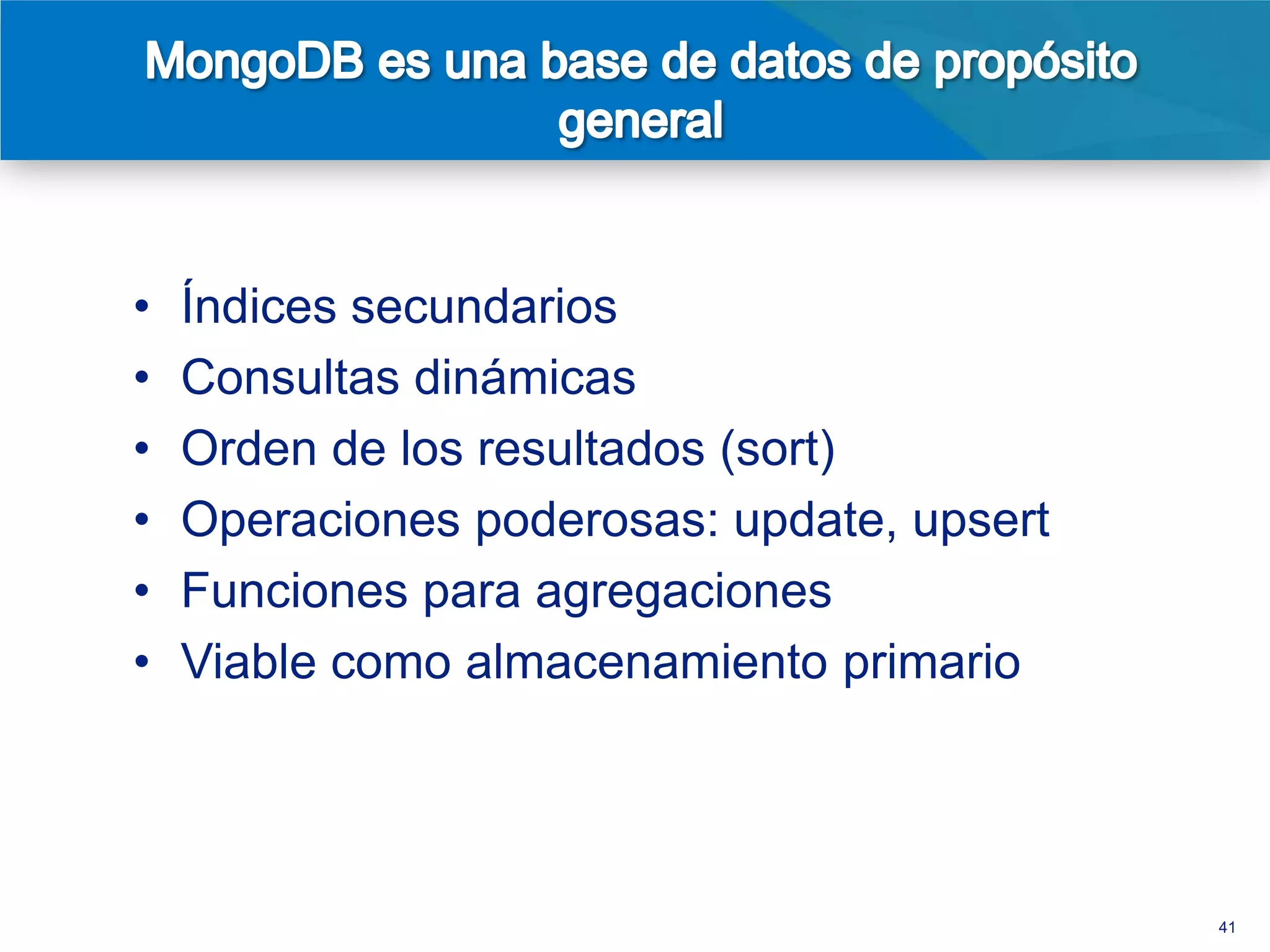
•   Índices secundarios
•   Consultas dinámicas
•   Orden de los resultados (sort)
•   Operaciones poderosas: update, upsert
•   Funciones para agregaciones
•   Viable como almacenamiento primario


                                            40
• Escalabilidad lineal
• Alta disponibilidad
• Incrementar capacidad sin sacar la
  aplicación de servicio
• Transparente a la aplicación


                                       41
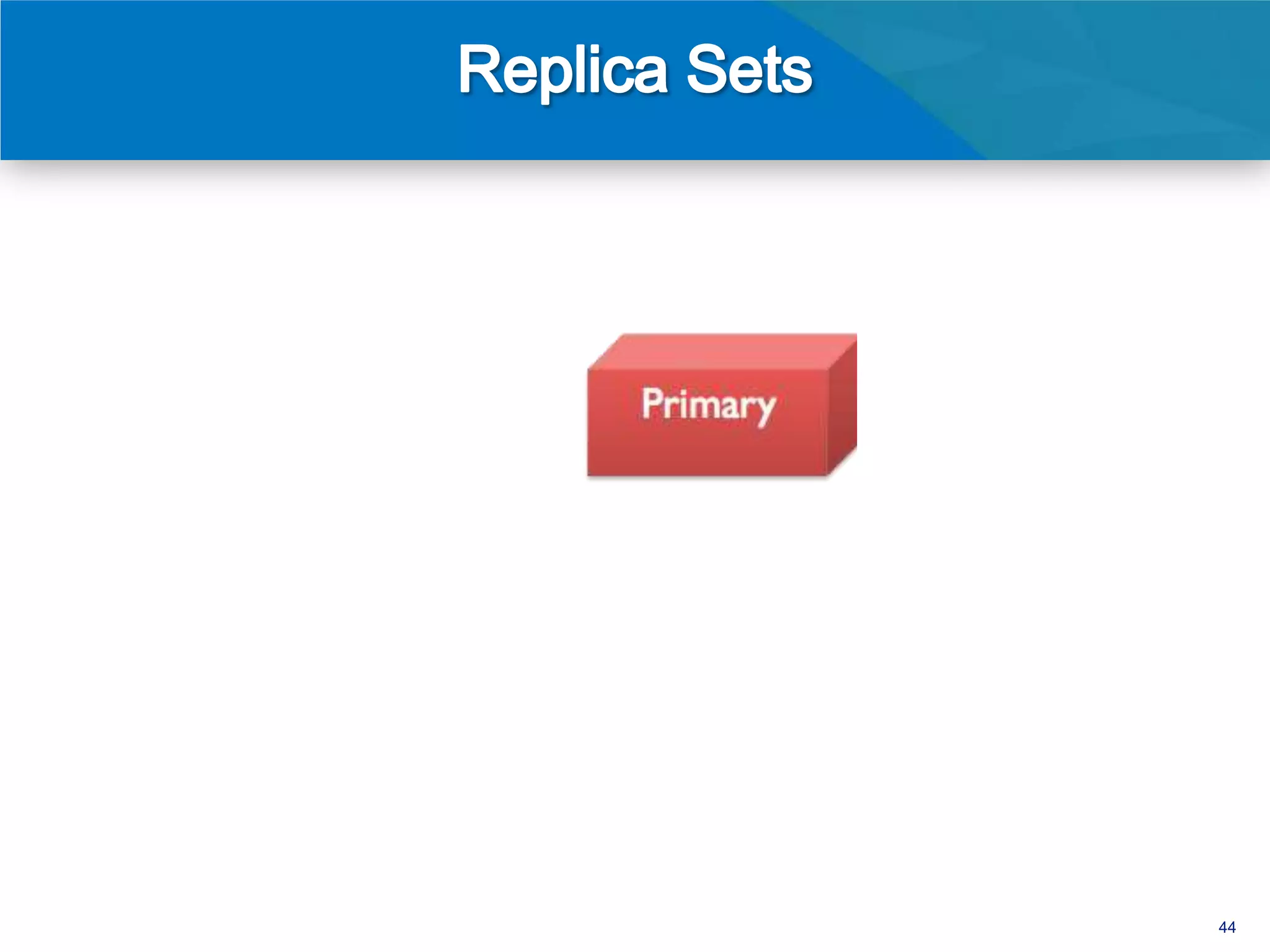
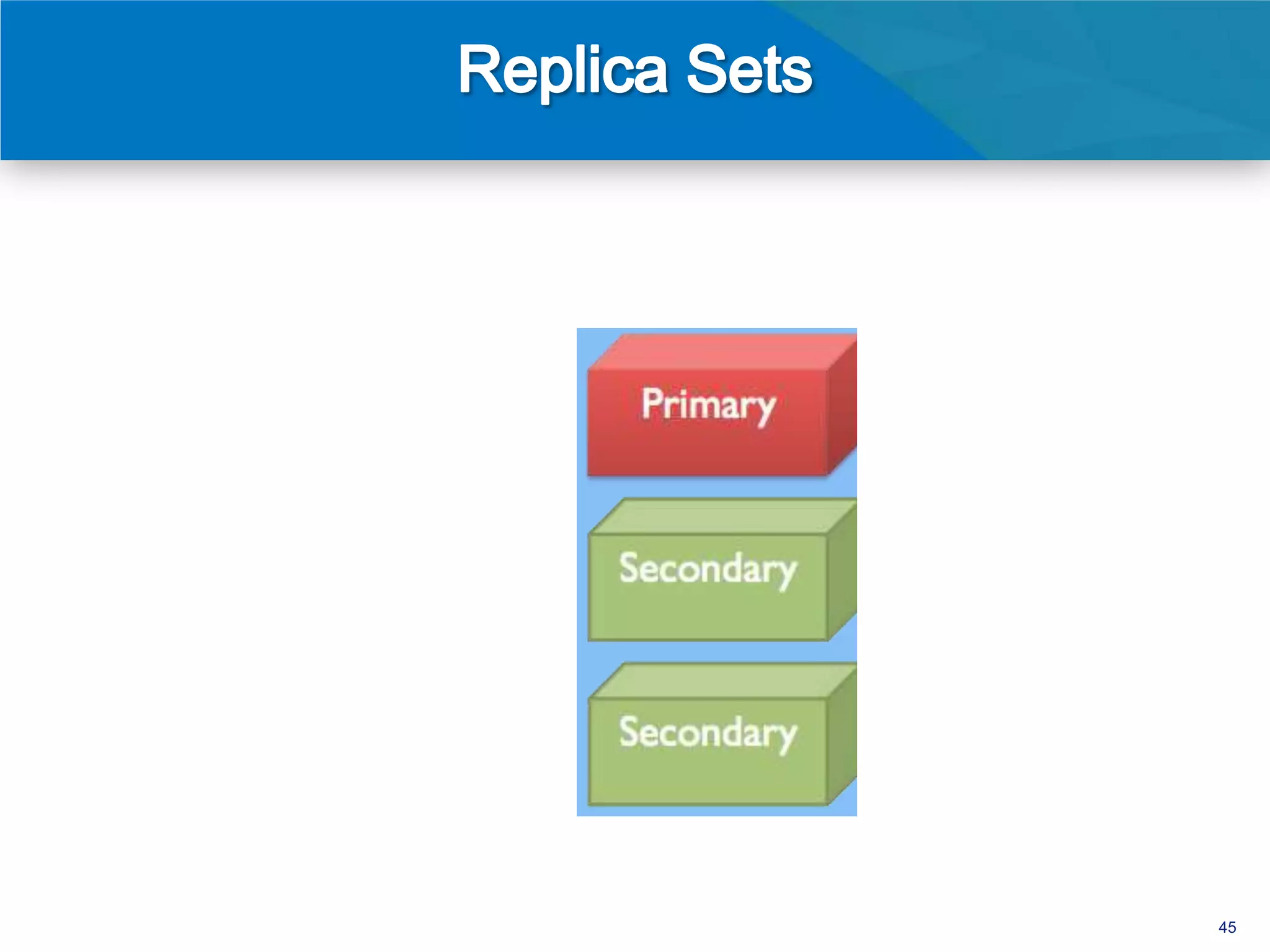
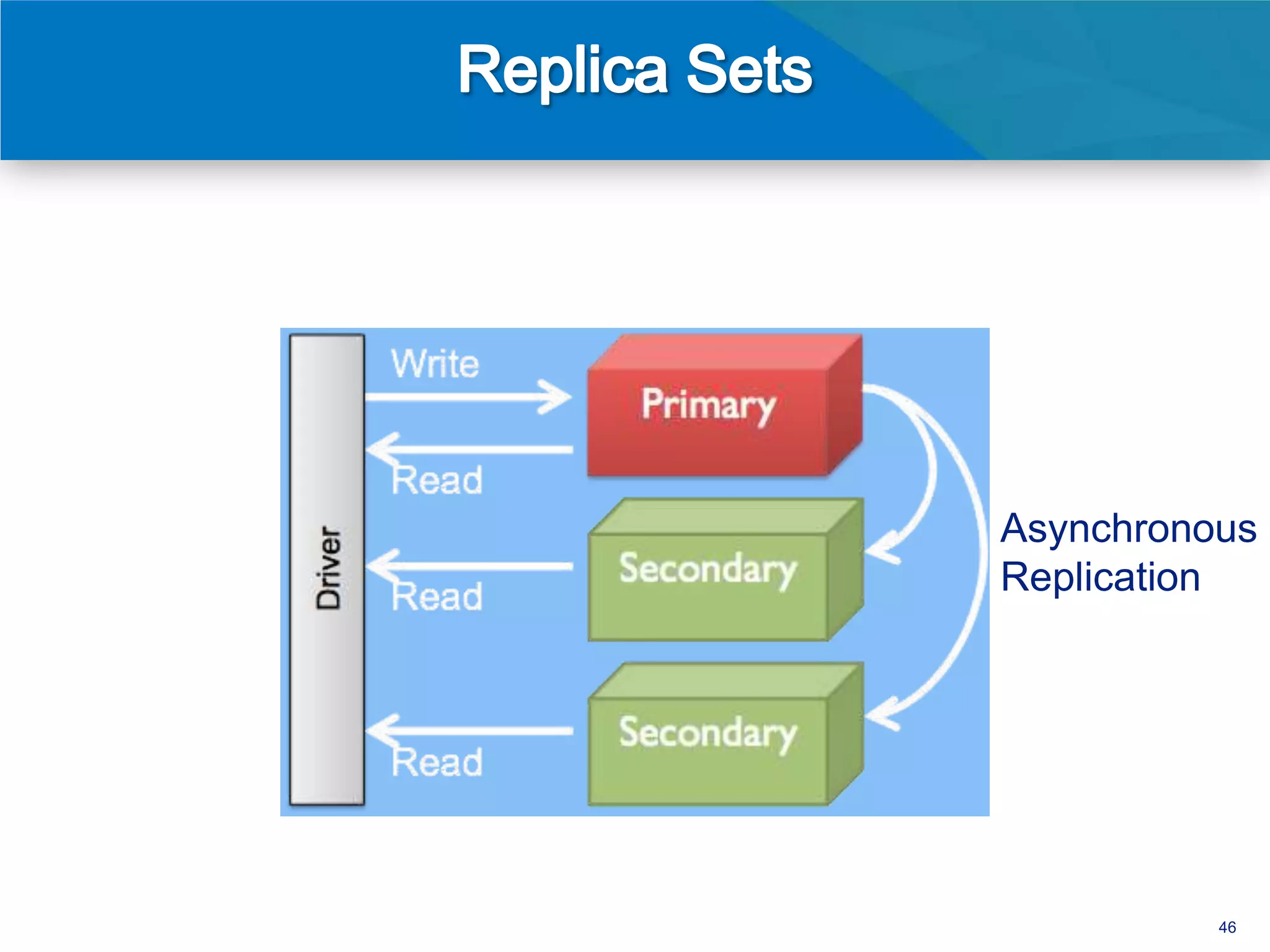
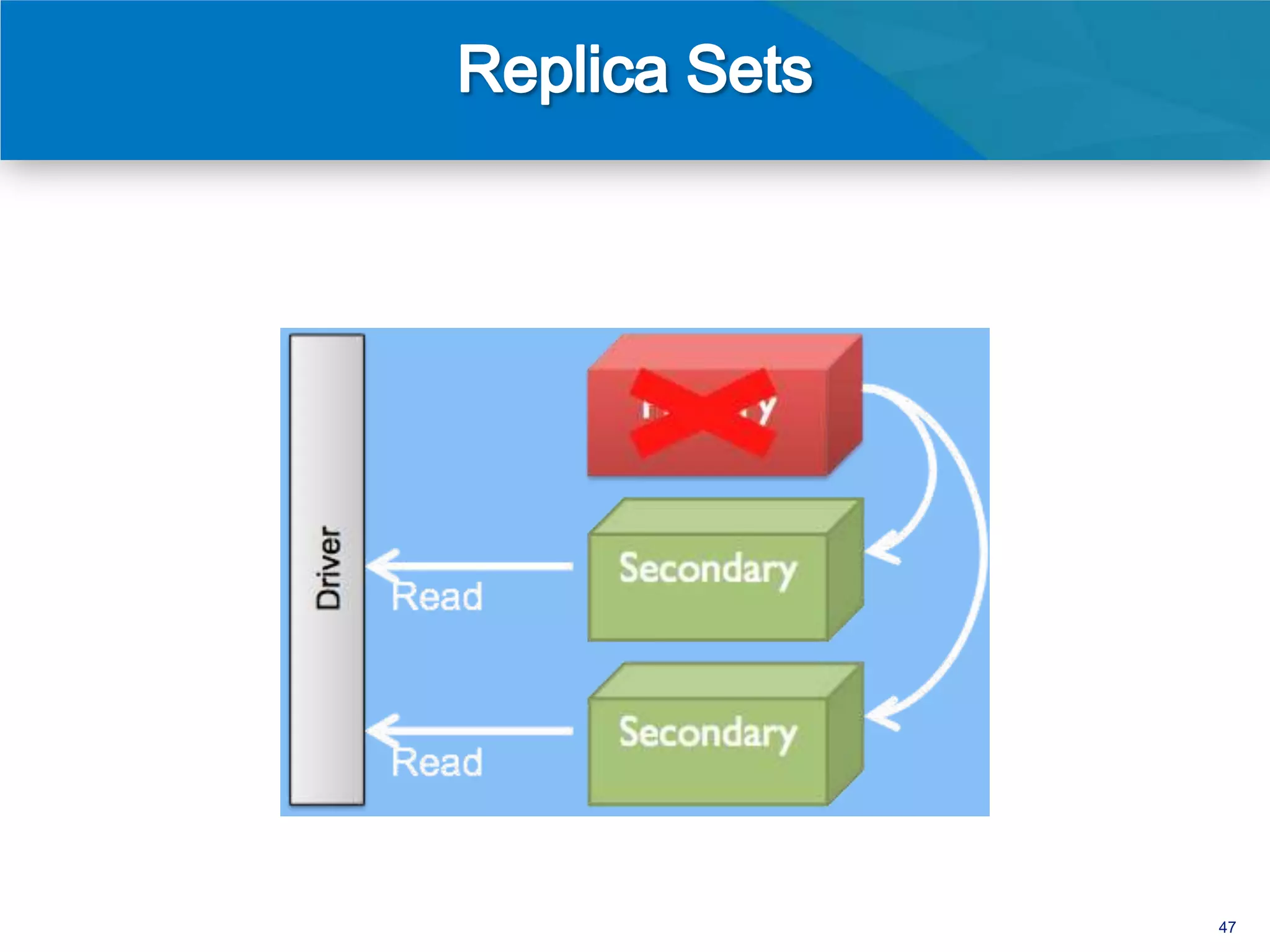
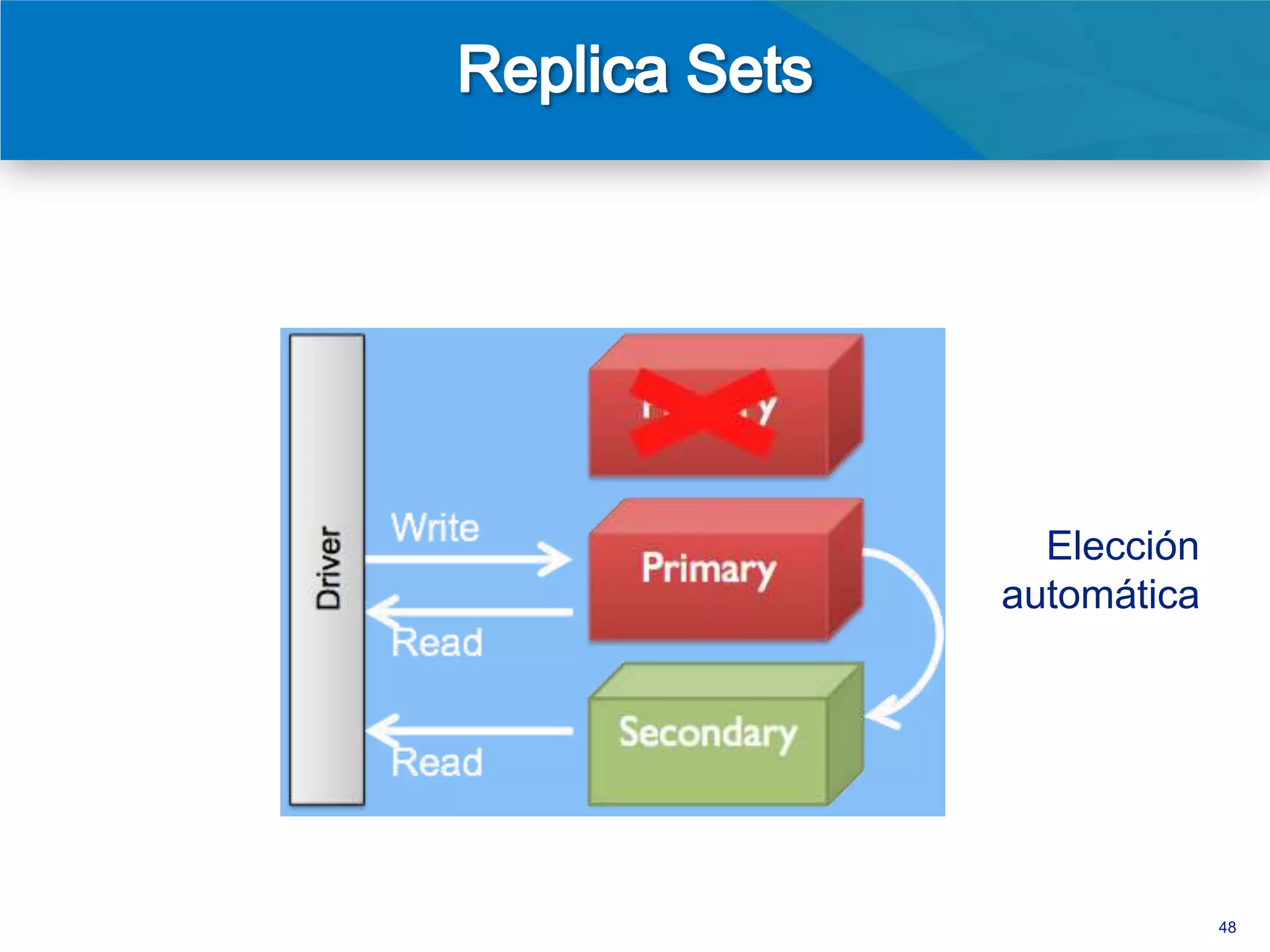
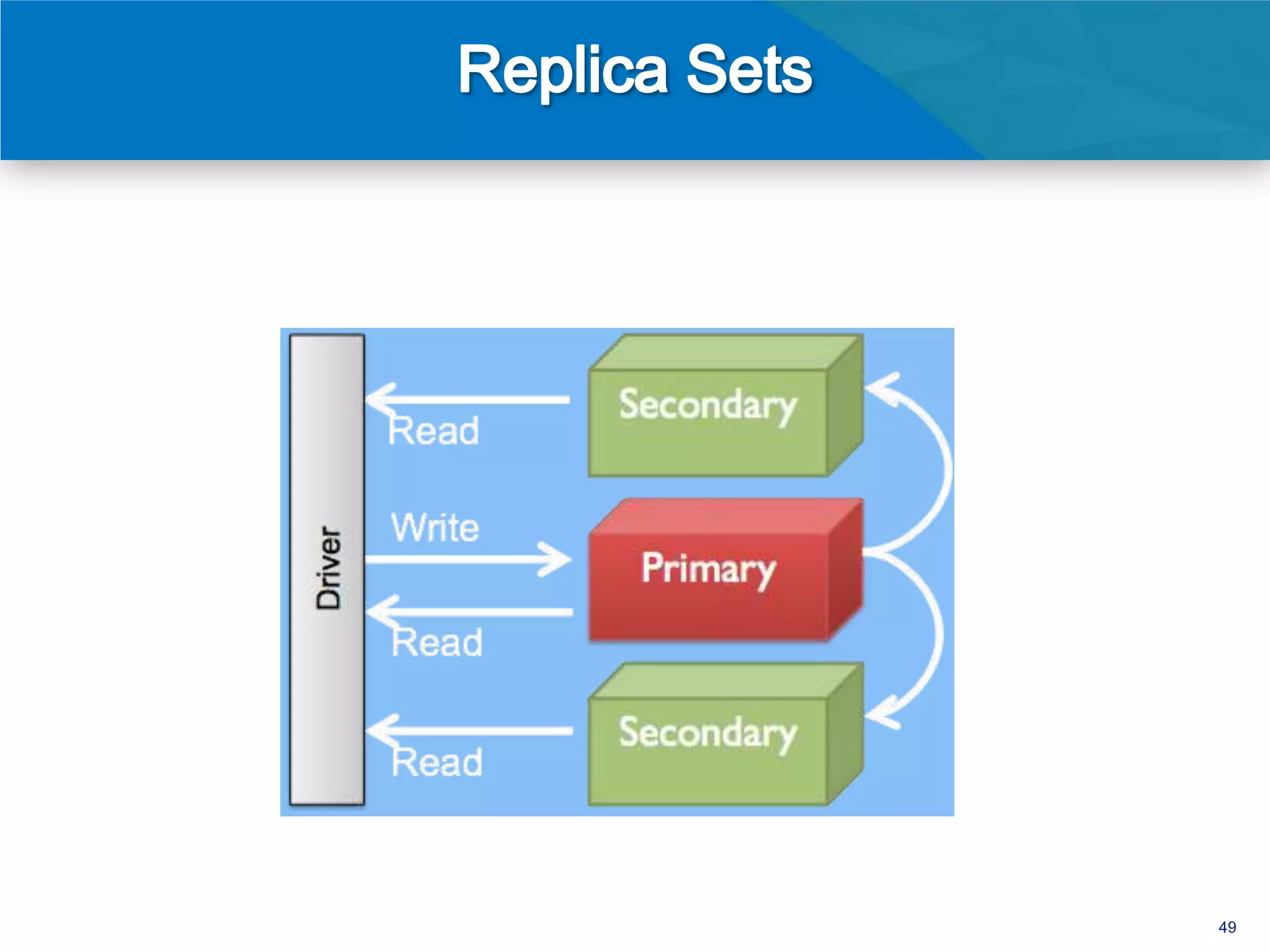
Conjunto de réplicas (replica sets)
• Alta disponibilidad/transferencia automática
• Redundancia de los datos
• Recuperación en caso de desastre
• Transparente a la aplicación
• Posibilidad de mantenimiento sin sacar la
  aplicación de servicio


                                                 42
Asynchronous
Replication


          43
Asynchronous
Replication


          44
Asynchronous
Replication


          45
46
Elección
automática


             47
48
• Incrementar capacidad sin sacar la
  aplicación de servicio
• Transparente a la aplicación


                                       49
• Incrementar capacidad sin sacar la
  aplicación de servicio
• Transparente a la aplicación
• Particiones basados en rangos de valores
• Particionamiento y balanceo automático


                                             50
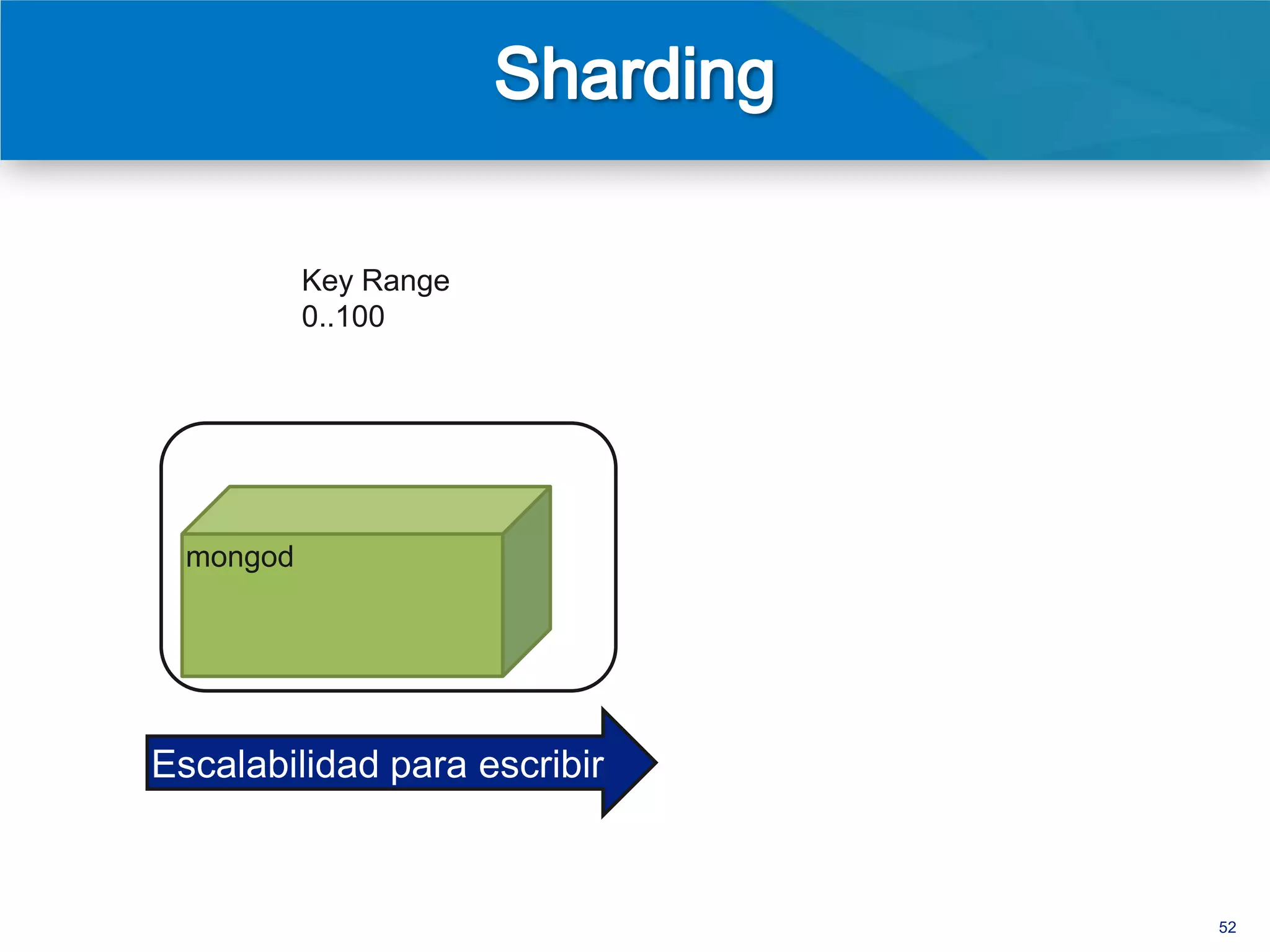
Key Range
           0..100


  mongod


Escalabilidad para escribir


                              51
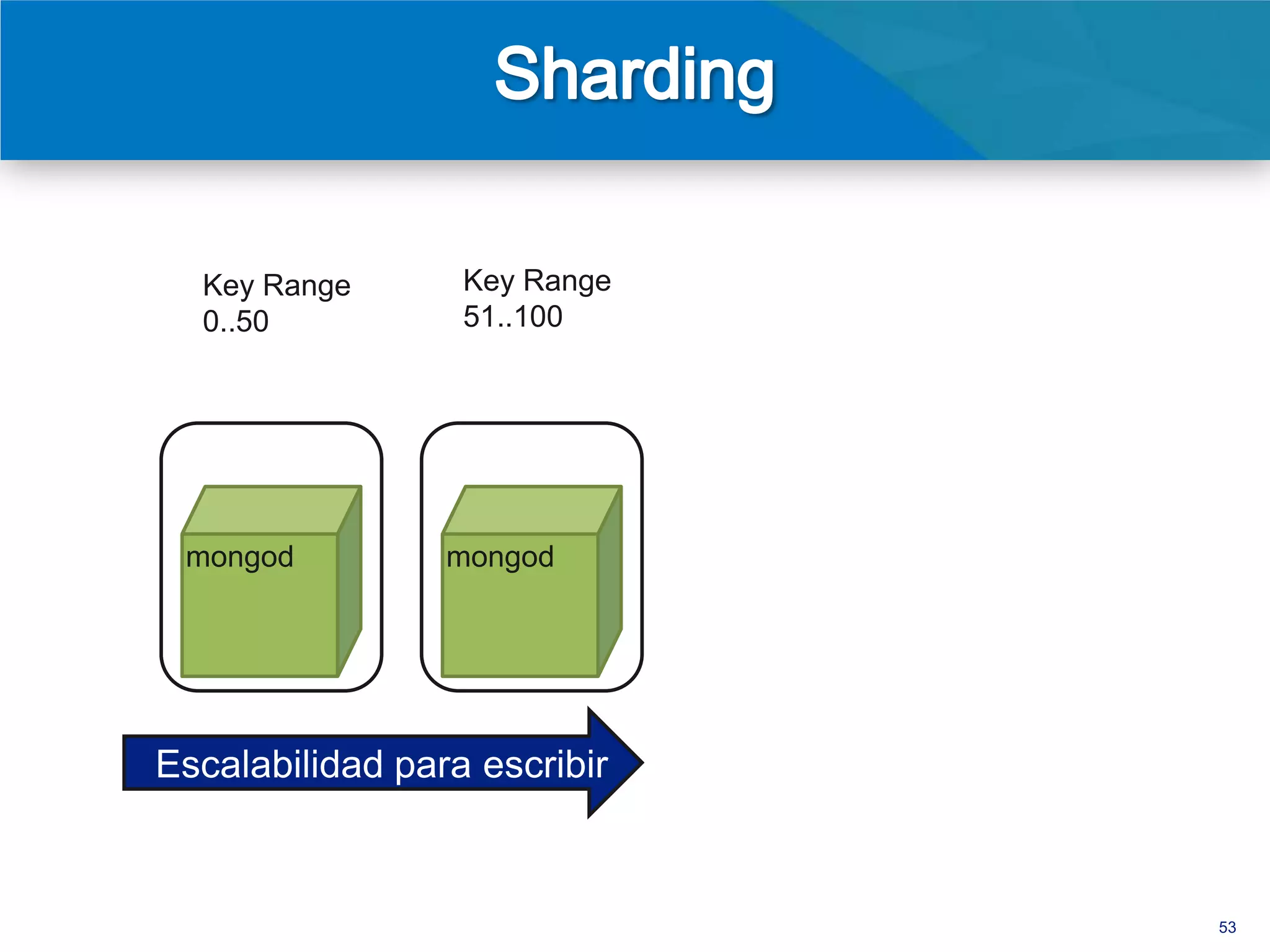
Key Range       Key Range
  0..50           51..100


 mongod          mongod


Escalabilidad para escribir


                              52
Key Range      Key Range   Key Range   Key Range
   0..25          26..50      51..75      76.. 100


  mongod         mongod
                              mongod      mongod


Escalabilidad para escribir


                                                      53
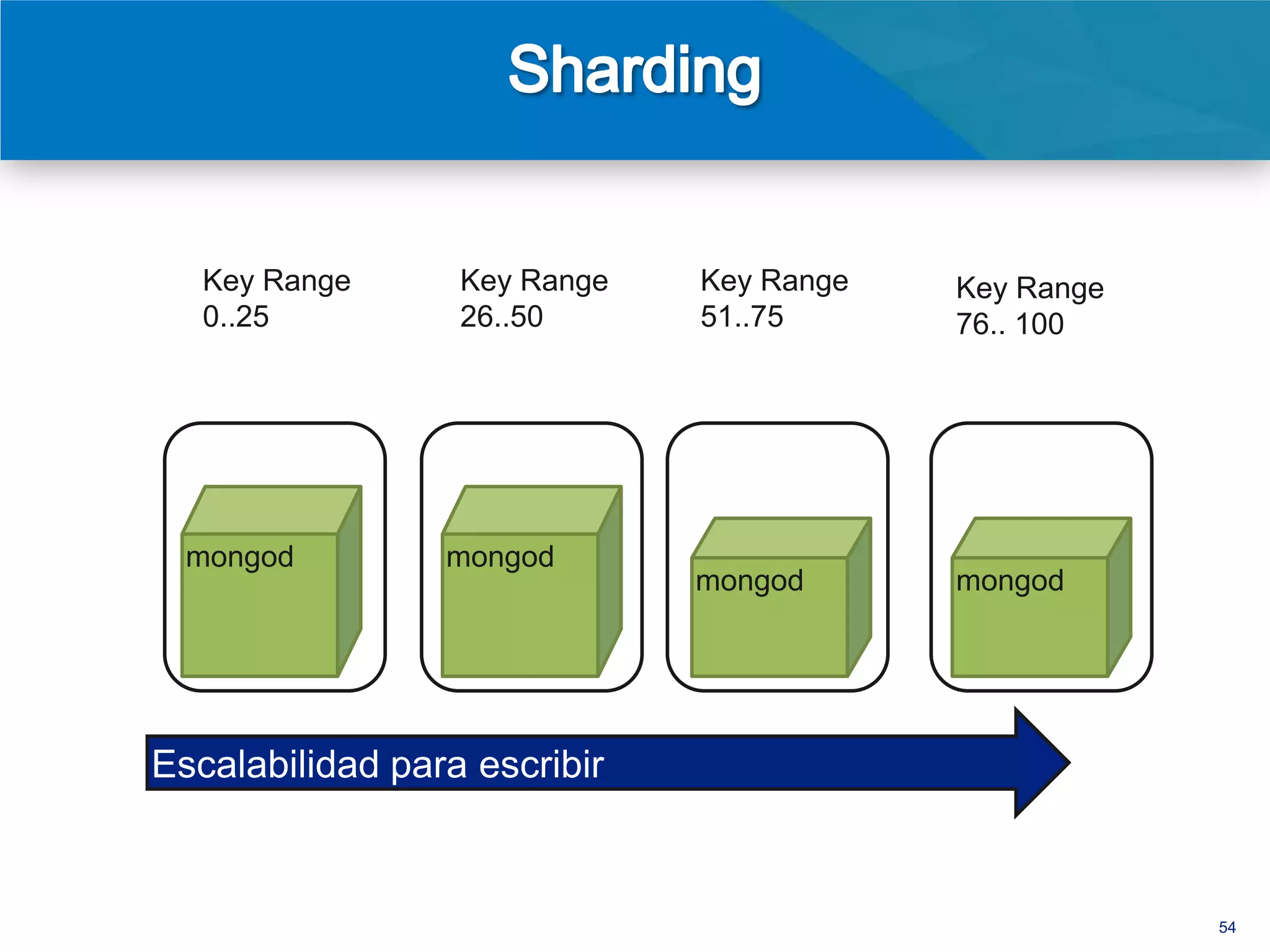
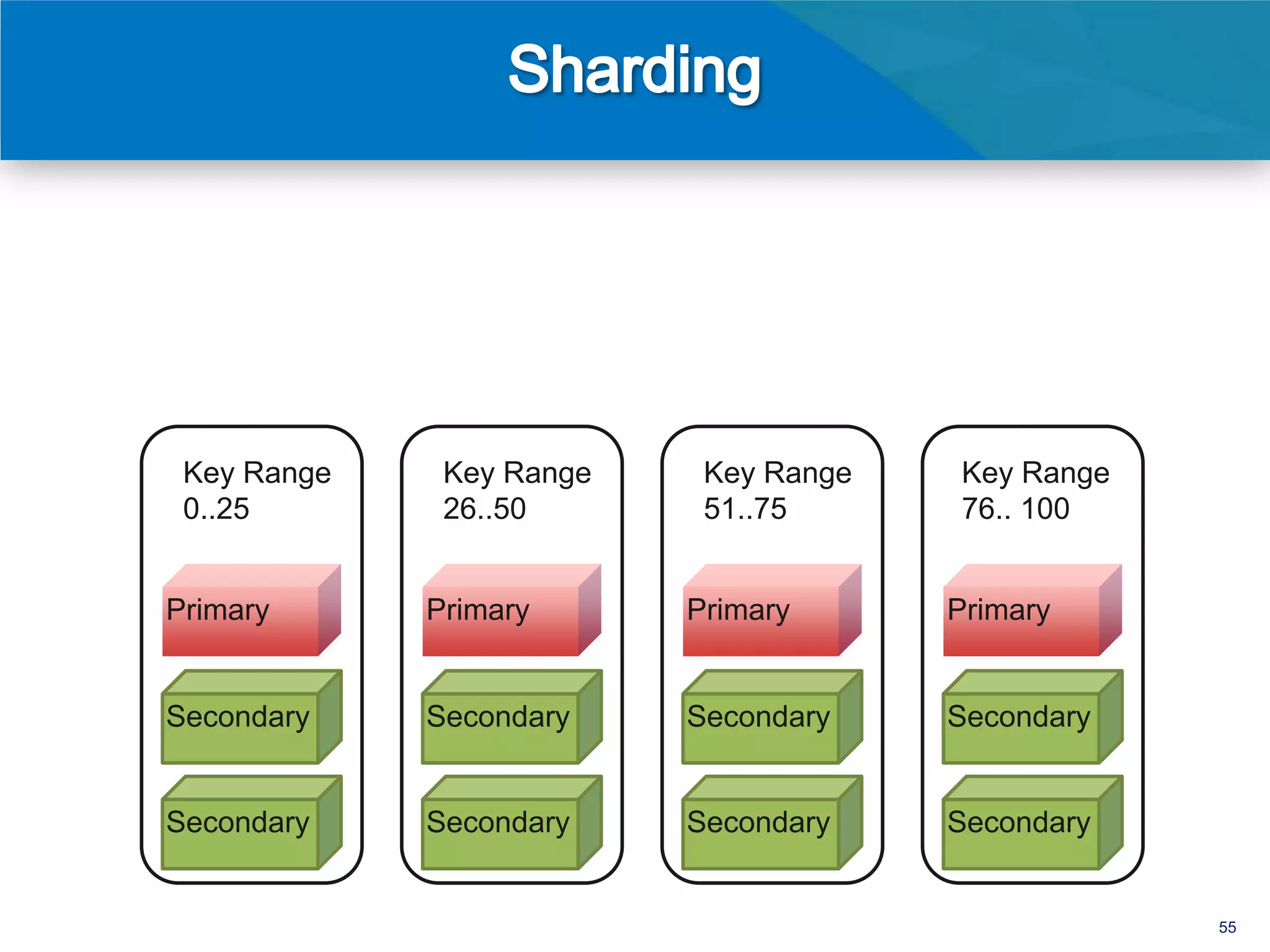
Key Range    Key Range    Key Range   Key Range
 0..25        26..50       51..75      76.. 100


Primary      Primary      Primary      Primary


Secondary    Secondary    Secondary    Secondary


Secondary    Secondary    Secondary    Secondary


                                                   54
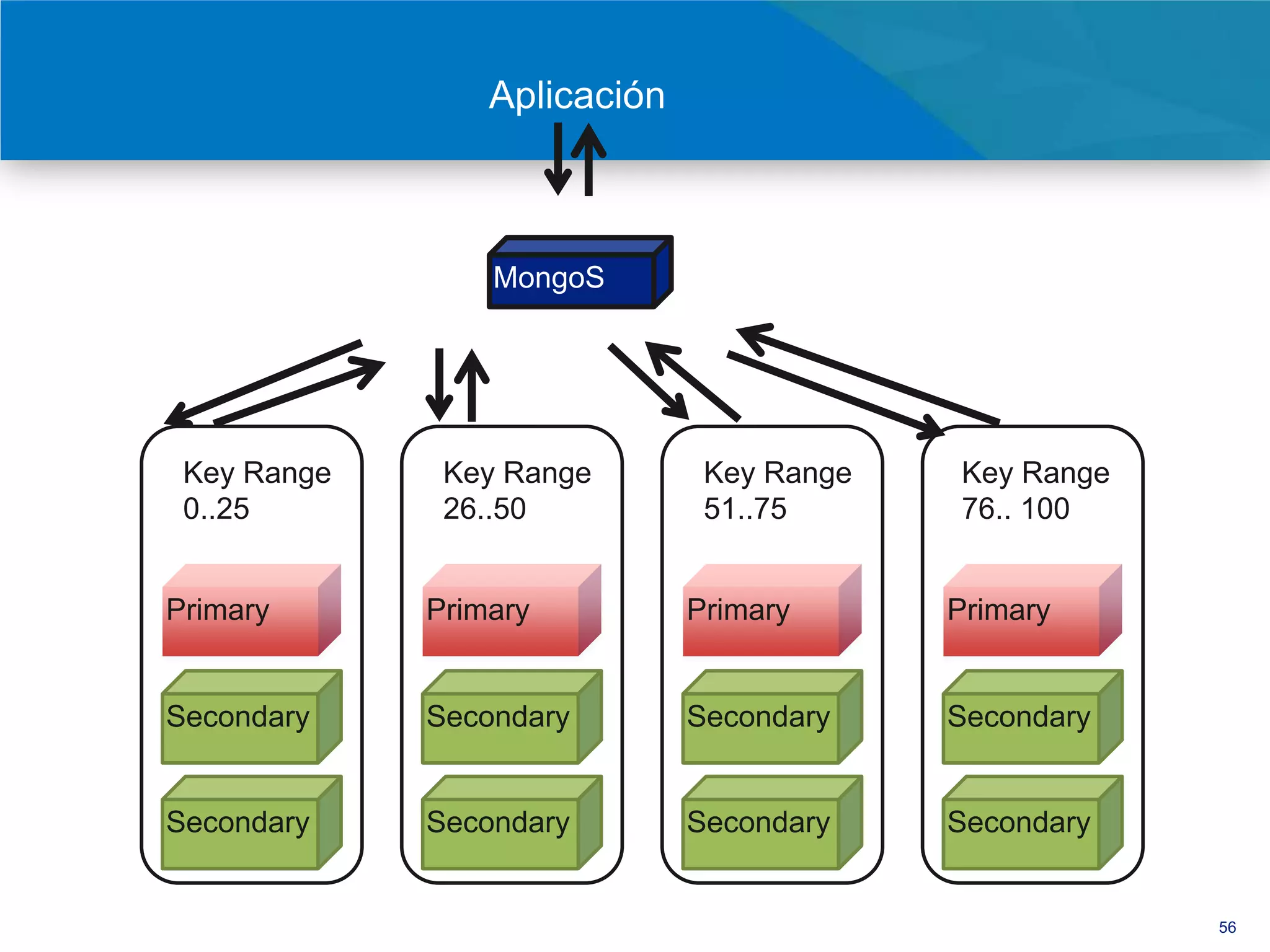
Aplicación


                 MongoS


 Key Range    Key Range        Key Range   Key Range
 0..25        26..50           51..75      76.. 100


Primary      Primary          Primary      Primary


Secondary    Secondary        Secondary    Secondary


Secondary    Secondary        Secondary    Secondary


                                                       55
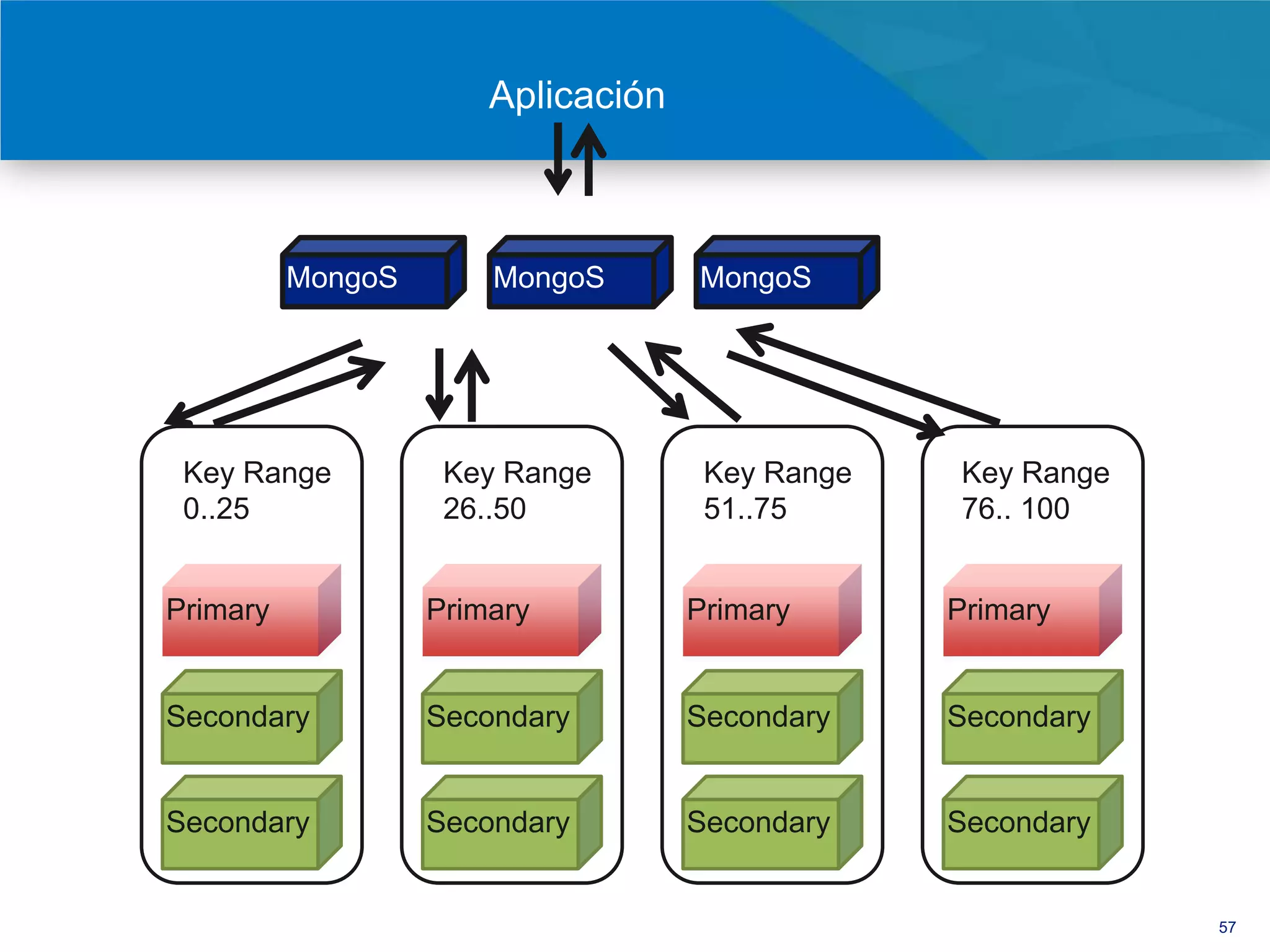
Aplicación


          MongoS       MongoS       MongoS


 Key Range          Key Range        Key Range   Key Range
 0..25              26..50           51..75      76.. 100


Primary            Primary          Primary      Primary


Secondary          Secondary        Secondary    Secondary


Secondary          Secondary        Secondary    Secondary


                                                             56
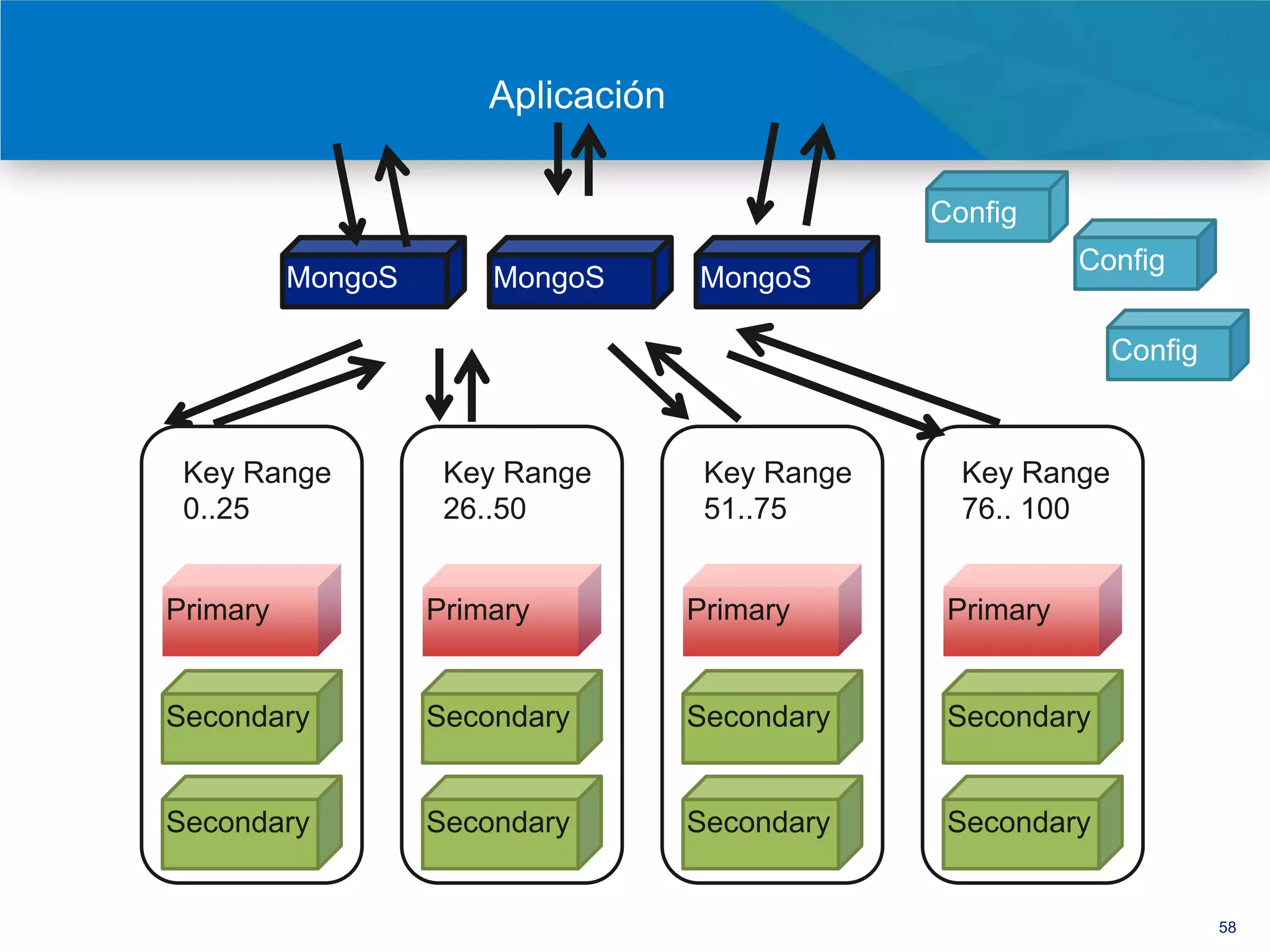
Aplicación

                                                 Config
                                                            Config
          MongoS       MongoS       MongoS

                                                               Config


 Key Range          Key Range        Key Range     Key Range
 0..25              26..50           51..75        76.. 100


Primary            Primary          Primary       Primary


Secondary          Secondary        Secondary     Secondary


Secondary          Secondary        Secondary     Secondary


                                                                        57
• Pocas opciones para configurar
• La configuración estándar funciona bien
• Fácil de instalar y administrar


                                            58
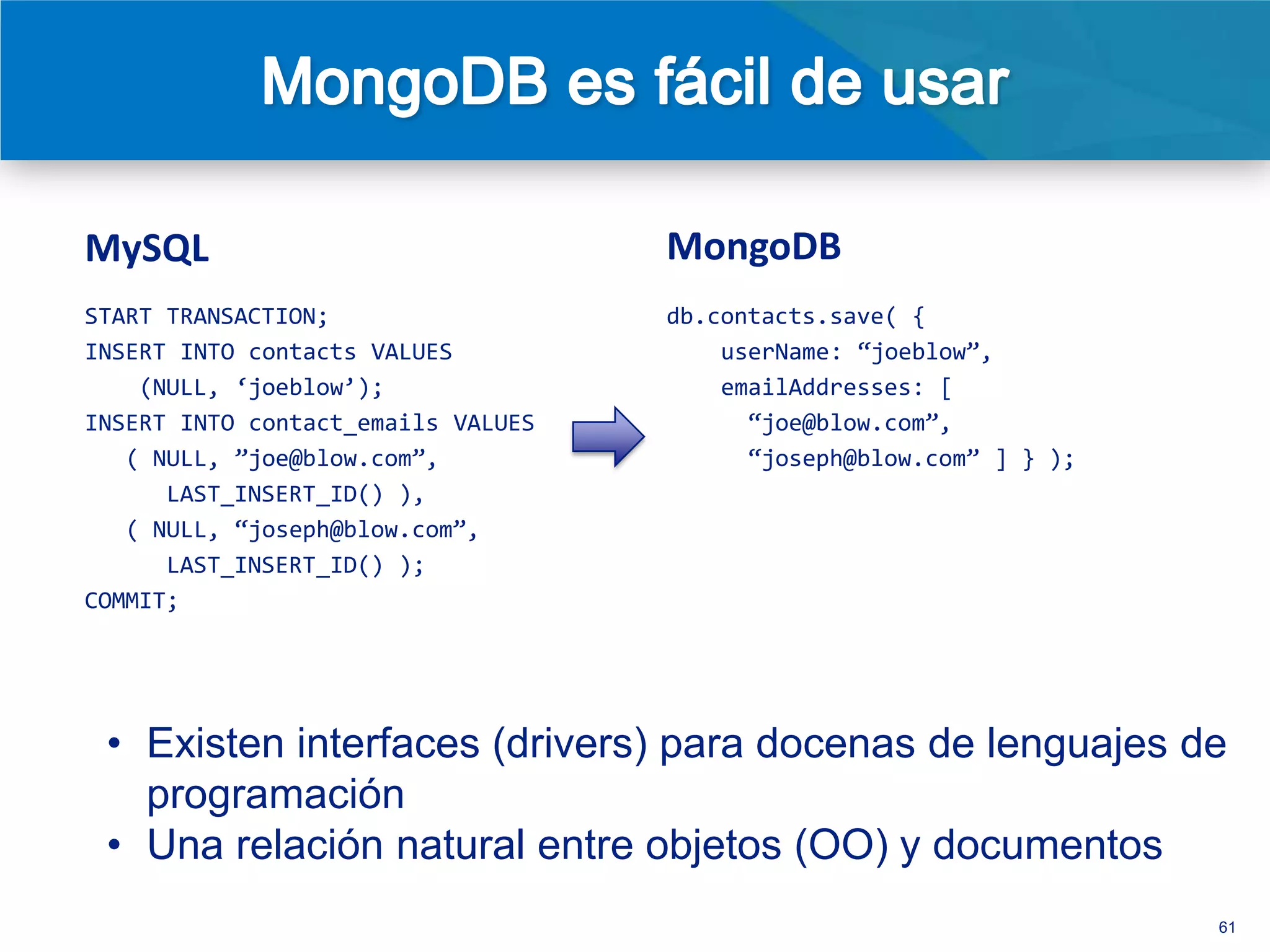
MySQL                               MongoDB
START TRANSACTION;                  db.contacts.save( {
INSERT INTO contacts VALUES             userName: ‚joeblow‛,
    (NULL, ‘joeblow’);                  emailAddresses: [
INSERT INTO contact_emails VALUES         ‚joe@blow.com‛,
   ( NULL, ‛joe@blow.com‛,                ‚joseph@blow.com‛ ] } );
      LAST_INSERT_ID() ),
   ( NULL, ‚joseph@blow.com‛,
      LAST_INSERT_ID() );
COMMIT;


                                                                     59
MySQL                               MongoDB
START TRANSACTION;                  db.contacts.save( {
INSERT INTO contacts VALUES             userName: ‚joeblow‛,
    (NULL, ‘joeblow’);                  emailAddresses: [
INSERT INTO contact_emails VALUES         ‚joe@blow.com‛,
   ( NULL, ‛joe@blow.com‛,                ‚joseph@blow.com‛ ] } );
      LAST_INSERT_ID() ),
   ( NULL, ‚joseph@blow.com‛,
      LAST_INSERT_ID() );
COMMIT;


 • Existen interfaces (drivers) para docenas de lenguajes de
   programación
 • Una relación natural entre objetos (OO) y documentos
                                                                     60
MongoDB ejemplos de uso


                          61
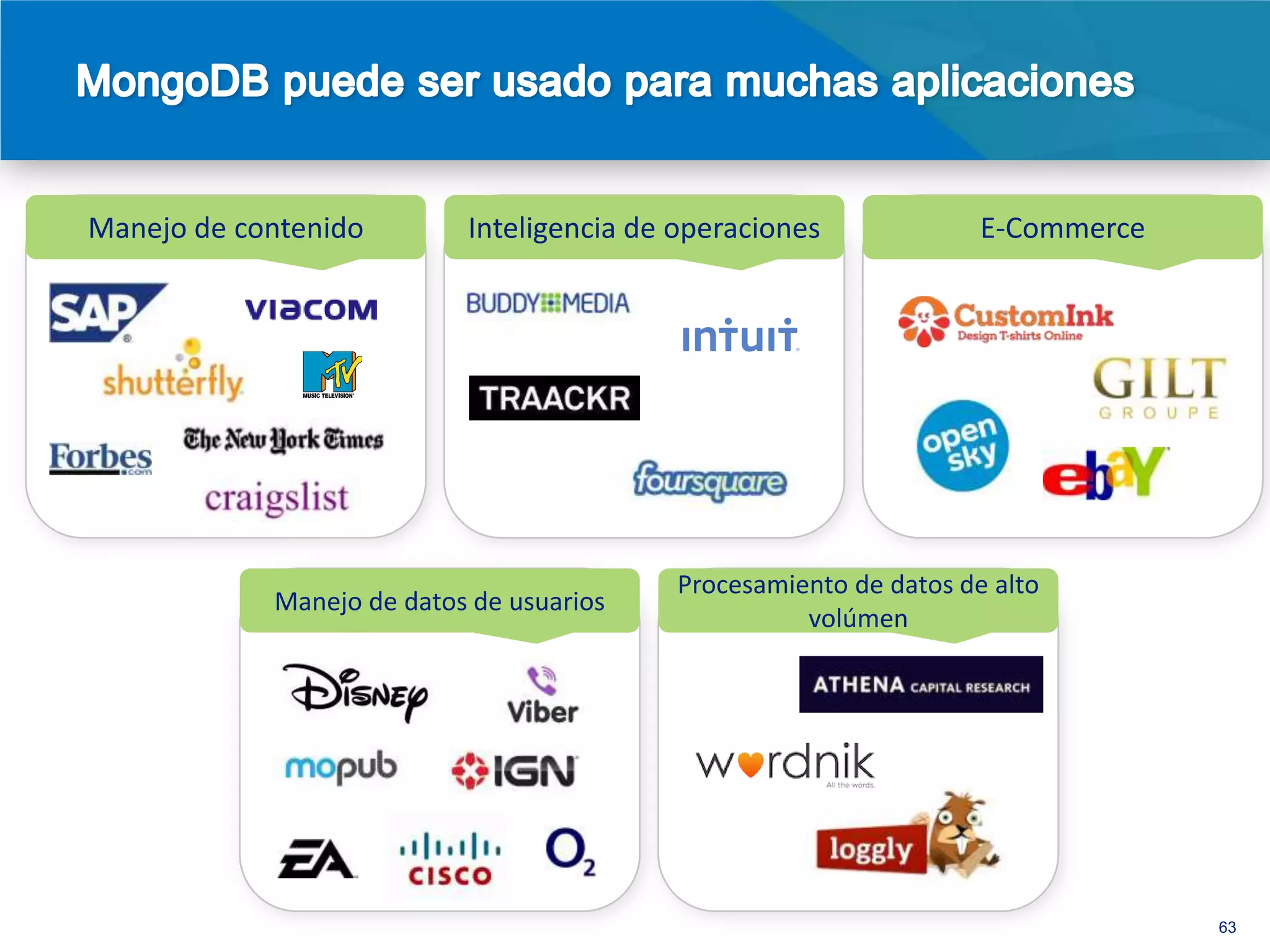
Manejo de contenido        Inteligencia de operaciones              E-Commerce


                                           Procesamiento de datos de alto
            Manejo de datos de usuarios
                                                     volúmen


                                                                                 62
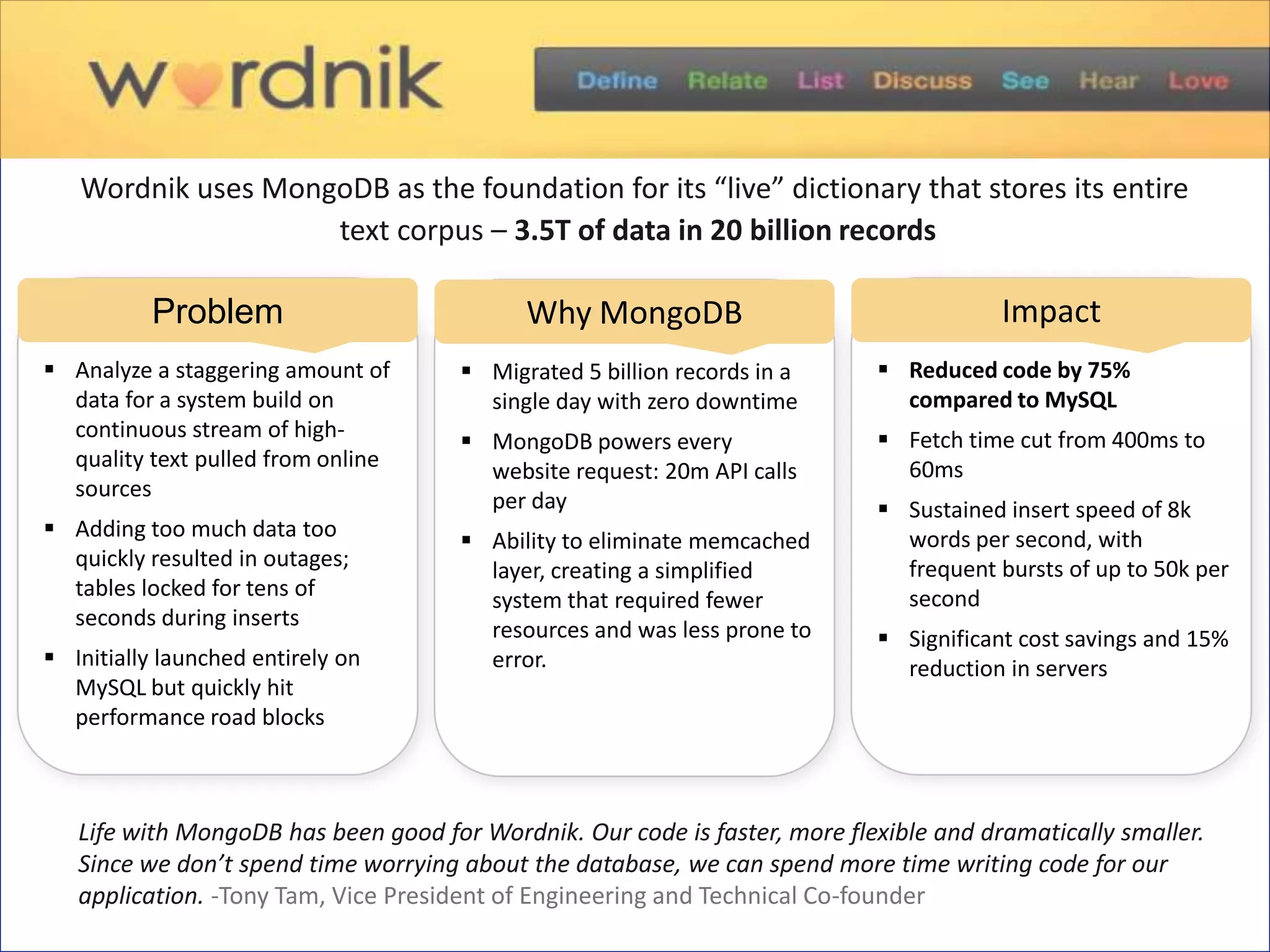
Wordnik uses MongoDB as the foundation for its “live” dictionary that stores its entire
                    text corpus – 3.5T of data in 20 billion records

          Problem                           Why MongoDB                                 Impact
 Analyze a staggering amount of       Migrated 5 billion records in a      Reduced code by 75%
  data for a system build on            single day with zero downtime         compared to MySQL
  continuous stream of high-           MongoDB powers every                 Fetch time cut from 400ms to
  quality text pulled from online       website request: 20m API calls        60ms
  sources                               per day                              Sustained insert speed of 8k
 Adding too much data too             Ability to eliminate memcached        words per second, with
  quickly resulted in outages;          layer, creating a simplified          frequent bursts of up to 50k per
  tables locked for tens of             system that required fewer            second
  seconds during inserts                resources and was less prone to      Significant cost savings and 15%
 Initially launched entirely on        error.                                reduction in servers
  MySQL but quickly hit
  performance road blocks


   Life with MongoDB has been good for Wordnik. Our code is faster, more flexible and dramatically smaller.
   Since we don’t spend time worrying about the database, we can spend more time writing code for our
   application. -Tony Tam, Vice President of Engineering and Technical Co-founder
                                                                                                              63
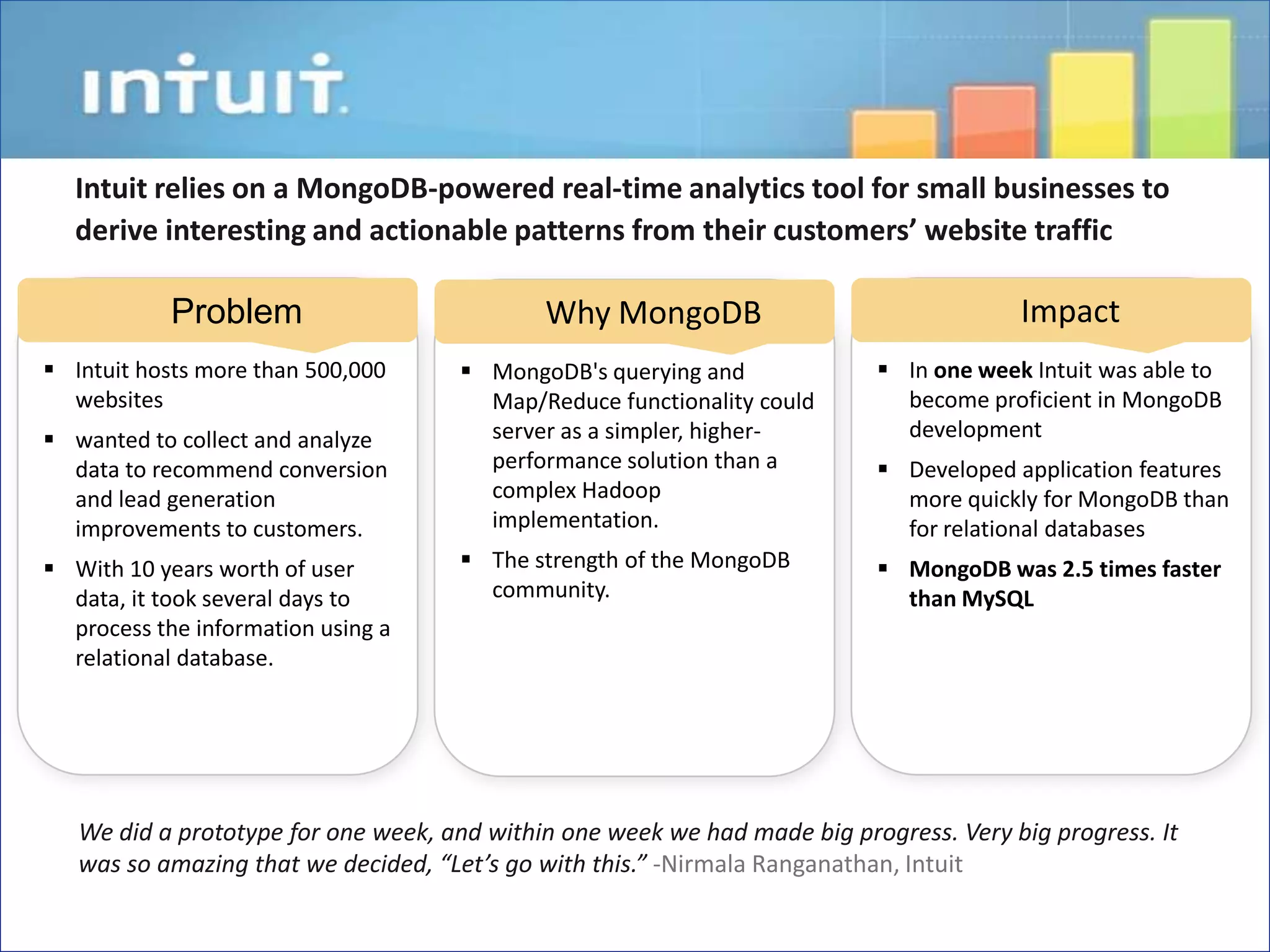
Intuit relies on a MongoDB-powered real-time analytics tool for small businesses to
   derive interesting and actionable patterns from their customers’ website traffic

            Problem                          Why MongoDB                                Impact
 Intuit hosts more than 500,000      MongoDB's querying and               In one week Intuit was able to
  websites                             Map/Reduce functionality could        become proficient in MongoDB
 wanted to collect and analyze        server as a simpler, higher-          development
  data to recommend conversion         performance solution than a          Developed application features
  and lead generation                  complex Hadoop                        more quickly for MongoDB than
  improvements to customers.           implementation.                       for relational databases
 With 10 years worth of user         The strength of the MongoDB          MongoDB was 2.5 times faster
  data, it took several days to        community.                            than MySQL
  process the information using a
  relational database.


   We did a prototype for one week, and within one week we had made big progress. Very big progress. It
   was so amazing that we decided, “Let’s go with this.” -Nirmala Ranganathan, Intuit

                                                                                                          64
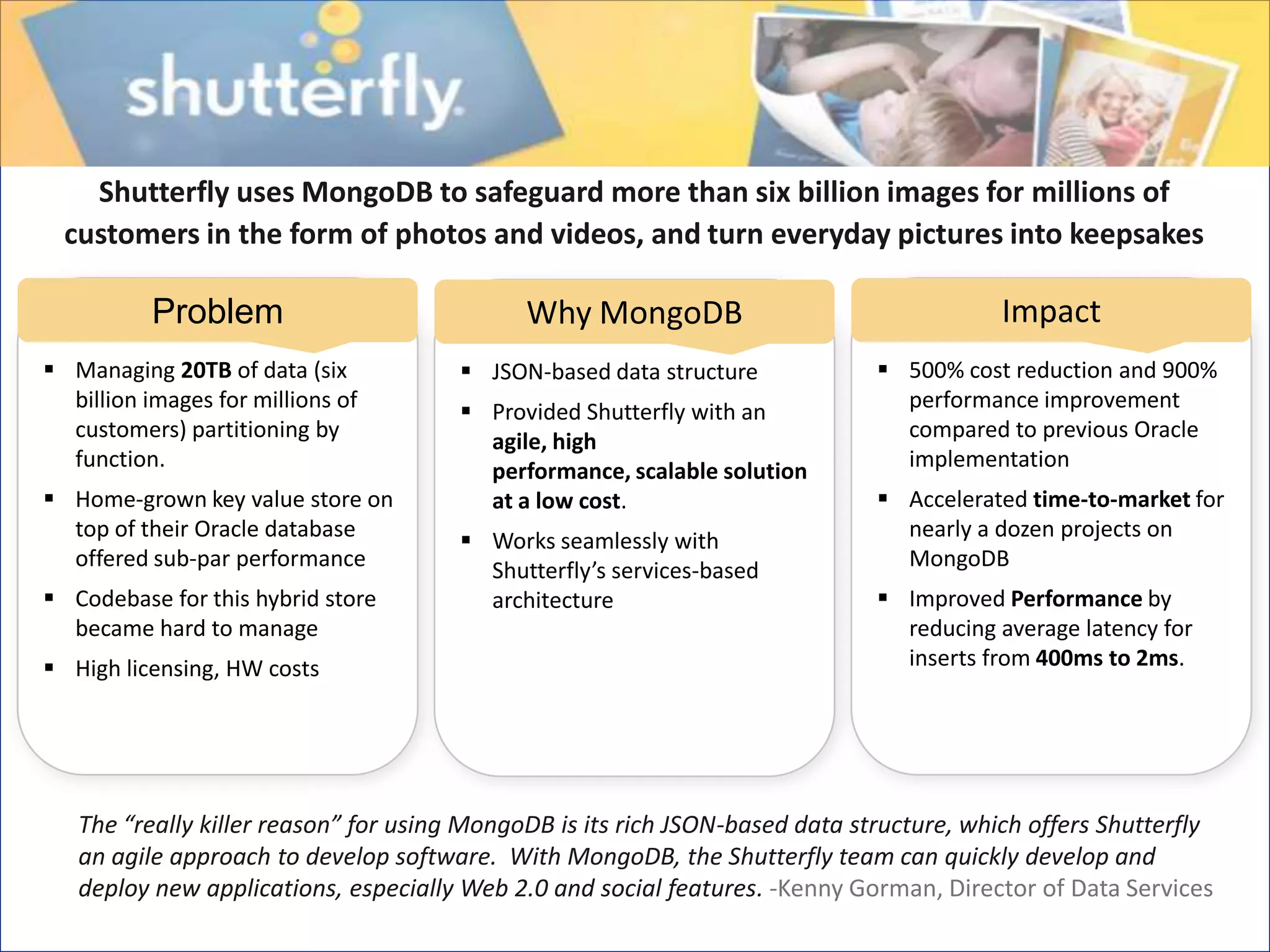
Shutterfly uses MongoDB to safeguard more than six billion images for millions of
  customers in the form of photos and videos, and turn everyday pictures into keepsakes

           Problem                           Why MongoDB                                  Impact
 Managing 20TB of data (six            JSON-based data structure             500% cost reduction and 900%
  billion images for millions of        Provided Shutterfly with an            performance improvement
  customers) partitioning by             agile, high                            compared to previous Oracle
  function.                              performance, scalable solution         implementation
 Home-grown key value store on          at a low cost.                        Accelerated time-to-market for
  top of their Oracle database          Works seamlessly with                  nearly a dozen projects on
  offered sub-par performance            Shutterfly’s services-based            MongoDB
 Codebase for this hybrid store         architecture                          Improved Performance by
  became hard to manage                                                         reducing average latency for
 High licensing, HW costs                                                      inserts from 400ms to 2ms.


   The “really killer reason” for using MongoDB is its rich JSON-based data structure, which offers Shutterfly
   an agile approach to develop software. With MongoDB, the Shutterfly team can quickly develop and
   deploy new applications, especially Web 2.0 and social features. -Kenny Gorman, Director of Data Services
                                                                                                                 65
66
Una base de datos de código abierto y de alto
               rendimiento


                                                67

Introducción a NoSQL y MongoDB Webinar

  • 1.
    Introducción al NoSQL y MongoDB 13 de septiembre, 2012 Robert Stam 1
  • 2.
    • 1970's Aparecenlas bases de datos relacionales – El almacenamiento es costoso – Los datos se normalizan – El almacenamiento es abstraído de la aplicación 2
  • 3.
    • 1970's Aparecenlas bases de datos relacionales – El almacenamiento es caro – Los datos se normalizan – El almacenamiento es abstraído de la aplicación • 1980's Aparecen versiones comerciales de las RDBMS – Modelo cliente/servidor – SQL emerge como estándar 3
  • 4.
    • 1970's Aparecenlas bases de datos relacionales – El almacenamiento es caro – Los datos se normalizan – El almacenamiento es abstraído de la aplicación • 1980's Aparecen versiones comerciales de las RDBMS – Modelo cliente/servidor – SQL emerge como estándar • 1990's Las cosas empiezan a cambiar – Cliente/servidor => arquitectura 3-niveles – Aparecen el internet y la web 4
  • 5.
    • 2000's Web2.0 – Aparece "Social Media" – Aceptación de E-Commerce – Continuan bajando precios de HW – Incremento masivo de datos coleccionados 5
  • 6.
    • 2000's Web2.0 – Aparece "Social Media" – Aceptación de E-Commerce – Continuan bajando precios de HW – Increment masivo de datos coleccionados • Resultado – Requerimiento continuo para escalar dramáticamente – ¿Cómo podemos escalar? 6
  • 7.
    + transacciones complejas + datos tabulares + consultas ad hoc - O<->R mapeo es difícil - problemas de velocidad y escalabilidad - no es muy ágil BI / OLTP / reporting operational 7
  • 8.
    + transacciones complejas +consultas ad hoc + datos tabulares + SQL como protocolo + consultas ad hoc estándar entre clientes y - O<->R mapeo es difícil servidores - problemas de velocidad y + crece horizontalmente escalabilidad mejor que las bases de - no es muy ágil datos operacionales - algunos limites de escalabilidad BI / OLTP / - esquemas rígidos - no es en tiempo reporting operational real, pero funciona bien con cargas masivas en horas de la madrugada 8
  • 9.
    + transacciones complejas +consultas ad hoc + datos tabulares + SQL como protocolo + consultas ad hoc estándar entre clientes y - O<->R mapeo es difícil servidores - problemas de velocidad y + crece horizontalmente escalabilidad mejor que las bases de - no es muy ágil datos operacionales - algunos limites de escalabilidad BI / OLTP / - esquemas rígidos - no es tiempo real, pero reporting operational funciona bien con cargas masivas en horas de la madrugada Menos problemas aquí 9
  • 10.
    + transacciones complejas +consultas ad hoc + datos tabulares + SQL como protocolo + consultas ad hoc estándar entre clientes y - O<->R mapeo es difícil servidores - problemas de velocidad y + crece horizontalmente escalabilidad mejor que las bases de - no es muy ágil datos operacionales - algunos limites de escalabilidad BI / OLTP / - esquemas rígidos - no es tiempo real, pero reporting operational funciona bien con cargas masivas en horas de la madrugada Menos problemas aquí Más problemas aquí 10
  • 11.
    + transacciones complejas +consultas ad hoc + datos tabulares + SQL como protocolo + consultas ad hoc estándar entre clientes y - O<->R mapeo es difícil servidores - problemas de velocidad y + crece horizontalmente escalabilidad mejor que las bases de - no es muy ágil datos operacionales - algunos limites de escalabilidad BI / OLTP / - esquemas rígidos - no es tiempo real, pero reporting operational cacheo funciona bien con cargas masivas en horas de la madrugada Particionamiento Archivos planos al nivel de la aplicación map/reduce 11
  • 12.
    • Metodología dedesarrollo ágil • Ciclos de desarrollo cortos • Constante evolución de requerimientos • Flexibilidad de diseño 12
  • 13.
    • Metodología dedesarrollo ágil • Ciclos de desarrollo cortos • Constante evolución de requerimientos • Flexibilidad de diseño • Esquema relacional • Difícil de evolucionar • Migraciones lentas y difíciles • En sincronía con la aplicación • Pocos desarrolladores interactúan directamente con la base de datos 13
  • 14.
  • 15.
  • 16.
    Escalabilidad horizontal • Más resultados en tiempo real • Desarrollo más veloz • Modelo de datos flexible • Bajo costo inicial • Bajo costo de operación 16
  • 17.
    ¿Qué es NoSQL? Relacional vs No-relacional 17
  • 18.
    + velocidad yescalabilidad - consultas ad hoc limitadas - no son muy transaccionales - no usan SQL/no hay estándares + se acoplan bien al model OO Escalable + ágiles BI / no-relacional reporting (“nosql”) OLTP / operational 18
  • 19.
    La próxima generaciónde bases de datos no-relacionales Una colección de productos muy diferentes • Diferentes modelos de datos (no-relacionales) • La mayoría no usan SQL para las consultas • No requieren un esquema predefinido • Algunos permiten estructuras de datos flexibles 19
  • 20.
    • Relacional • Key-Value • Documentos • XML • Grafos • Columnas 20
  • 21.
    • Relacional • Key-Value • Documentos • XML • Grafos • Columnas • ACID • BASE • (atomicity, consistency, isol • (basically available, soft ation, durability) state, eventual consistency) 21
  • 22.
    • Relacional • Key-Value • Documentos • XML • Grafos • Columnas • ACID • BASE • Confirmación en 2 fases • Transacciones atómicas (two-phase commit) al nivel de documentos 22
  • 23.
    • Relacional • Key-Value • Documentos • XML • Grafos • Columnas • ACID • BASE • Confirmación en 2 fases • Transacciones atómicas (two-phase commit) al nivel de documentos • Uniones (joins) • No hay uniones (joins) 23
  • 24.
  • 25.
    • Cantidad de transacciones • Confiabilidad • Mantenimiento • Facilidad de uso • Escalabilidad • Costo 25
  • 26.
  • 27.
    • Diseñado ydesarrollado por los fundadores de DoubleClick, ShopWiki, GILT Groupe, etc… • Programación empieza a fines del 2007 • Primer sitio en producción: marzo 2008 businessinsider.com • Código abierto – AGPL, escrito en C++ • Versión 0.8 – primera versión oficial febrero 2009 • Versión 1.0 – agosto 2009 • Versión 2.0 – septiembre 2011 • Versión 2.2 – agosto 2012 27
  • 28.
  • 29.
  • 30.
    • Orientado adocumentos • Basado en documentos JSON • Esquema flexible • Arquitectura escalable • Auto-sharding • Replicación y alta disponibilidad • Características importantes • Índices secundarios • Lenguaje de consulta (consultas ad hoc) • Map/Reduce (agregación) 30
  • 31.
    • Modelo dedatos poderoso y flexible • Conversión transparente de objetos en la aplicación (OO) a documentos JSON • Flexibilidad para datos dinámicos • Mejor localidad de datos 31
  • 32.
  • 33.
    { _id : ObjectId("4e2e3f92268cdda473b628f6"), title : “Too Big to Fail”, when : Date(“2011-07-26”), author : “joe”, text : “blah” } 33
  • 34.
    { _id : ObjectId("4e2e3f92268cdda473b628f6"), title : “Too Big to Fail”, when : Date(“2011-07-26”), author : “joe”, text : “blah”, tags : [“business”, “news”, “north america”] } > db.posts.find( { tags : “news” } ) 34
  • 35.
    { _id : ObjectId("4e2e3f92268cdda473b628f6"), title : “Too Big to Fail”, when : Date(“2011-07-26”), author : “joe”, text : “blah”, tags : [“business”, “news”, “north america”], votes : 3, voters : [“dmerr”, “sj”, “jane” ] } 35
  • 36.
    { _id : ObjectId("4e2e3f92268cdda473b628f6"), title : “Too Big to Fail”, when : Date(“2011-07-26”), author : “joe”, text : “blah”, tags : [“business”, “news”, “north america”], votes : 3, voters : [“dmerr”, “sj”, “jane” ], comments : [ { by : “tim157”, text : “great story” }, { by : “gora”, text : “i don’t think so” }, { by : “dmerr”, text : “also check out...” } ] } 36
  • 37.
    { _id : ObjectId("4e2e3f92268cdda473b628f6"), title : “Too Big to Fail”, when : Date(“2011-07-26”), author : “joe”, text : “blah”, tags : [“business”, “news”, “north america”], votes : 3, voters : [“dmerr”, “sj”, “jane” ], comments : [ { by : “tim157”, text : “great story” }, { by : “gora”, text : “i don’t think so” }, { by : “dmerr”, text : “also check out...” } ] } > db.posts.find( { “comments.by” : “gora” } ) > db.posts.ensureIndex( { “comments.by” : 1 } ) 37
  • 38.
    Búsqueda = 5+ms Lectura = súper rápido Post Comment Author 38
  • 39.
    Post Author Comment Comment Comment Comment Comment 39
  • 40.
    Índices secundarios • Consultas dinámicas • Orden de los resultados (sort) • Operaciones poderosas: update, upsert • Funciones para agregaciones • Viable como almacenamiento primario 40
  • 41.
    • Escalabilidad lineal •Alta disponibilidad • Incrementar capacidad sin sacar la aplicación de servicio • Transparente a la aplicación 41
  • 42.
    Conjunto de réplicas(replica sets) • Alta disponibilidad/transferencia automática • Redundancia de los datos • Recuperación en caso de desastre • Transparente a la aplicación • Posibilidad de mantenimiento sin sacar la aplicación de servicio 42
  • 43.
  • 44.
  • 45.
  • 46.
  • 47.
  • 48.
  • 49.
    • Incrementar capacidadsin sacar la aplicación de servicio • Transparente a la aplicación 49
  • 50.
    • Incrementar capacidadsin sacar la aplicación de servicio • Transparente a la aplicación • Particiones basados en rangos de valores • Particionamiento y balanceo automático 50
  • 51.
    Key Range 0..100 mongod Escalabilidad para escribir 51
  • 52.
    Key Range Key Range 0..50 51..100 mongod mongod Escalabilidad para escribir 52
  • 53.
    Key Range Key Range Key Range Key Range 0..25 26..50 51..75 76.. 100 mongod mongod mongod mongod Escalabilidad para escribir 53
  • 54.
    Key Range Key Range Key Range Key Range 0..25 26..50 51..75 76.. 100 Primary Primary Primary Primary Secondary Secondary Secondary Secondary Secondary Secondary Secondary Secondary 54
  • 55.
    Aplicación MongoS Key Range Key Range Key Range Key Range 0..25 26..50 51..75 76.. 100 Primary Primary Primary Primary Secondary Secondary Secondary Secondary Secondary Secondary Secondary Secondary 55
  • 56.
    Aplicación MongoS MongoS MongoS Key Range Key Range Key Range Key Range 0..25 26..50 51..75 76.. 100 Primary Primary Primary Primary Secondary Secondary Secondary Secondary Secondary Secondary Secondary Secondary 56
  • 57.
    Aplicación Config Config MongoS MongoS MongoS Config Key Range Key Range Key Range Key Range 0..25 26..50 51..75 76.. 100 Primary Primary Primary Primary Secondary Secondary Secondary Secondary Secondary Secondary Secondary Secondary 57
  • 58.
    • Pocas opcionespara configurar • La configuración estándar funciona bien • Fácil de instalar y administrar 58
  • 59.
    MySQL MongoDB START TRANSACTION; db.contacts.save( { INSERT INTO contacts VALUES userName: ‚joeblow‛, (NULL, ‘joeblow’); emailAddresses: [ INSERT INTO contact_emails VALUES ‚joe@blow.com‛, ( NULL, ‛joe@blow.com‛, ‚joseph@blow.com‛ ] } ); LAST_INSERT_ID() ), ( NULL, ‚joseph@blow.com‛, LAST_INSERT_ID() ); COMMIT; 59
  • 60.
    MySQL MongoDB START TRANSACTION; db.contacts.save( { INSERT INTO contacts VALUES userName: ‚joeblow‛, (NULL, ‘joeblow’); emailAddresses: [ INSERT INTO contact_emails VALUES ‚joe@blow.com‛, ( NULL, ‛joe@blow.com‛, ‚joseph@blow.com‛ ] } ); LAST_INSERT_ID() ), ( NULL, ‚joseph@blow.com‛, LAST_INSERT_ID() ); COMMIT; • Existen interfaces (drivers) para docenas de lenguajes de programación • Una relación natural entre objetos (OO) y documentos 60
  • 61.
  • 62.
    Manejo de contenido Inteligencia de operaciones E-Commerce Procesamiento de datos de alto Manejo de datos de usuarios volúmen 62
  • 63.
    Wordnik uses MongoDBas the foundation for its “live” dictionary that stores its entire text corpus – 3.5T of data in 20 billion records Problem Why MongoDB Impact  Analyze a staggering amount of  Migrated 5 billion records in a  Reduced code by 75% data for a system build on single day with zero downtime compared to MySQL continuous stream of high-  MongoDB powers every  Fetch time cut from 400ms to quality text pulled from online website request: 20m API calls 60ms sources per day  Sustained insert speed of 8k  Adding too much data too  Ability to eliminate memcached words per second, with quickly resulted in outages; layer, creating a simplified frequent bursts of up to 50k per tables locked for tens of system that required fewer second seconds during inserts resources and was less prone to  Significant cost savings and 15%  Initially launched entirely on error. reduction in servers MySQL but quickly hit performance road blocks Life with MongoDB has been good for Wordnik. Our code is faster, more flexible and dramatically smaller. Since we don’t spend time worrying about the database, we can spend more time writing code for our application. -Tony Tam, Vice President of Engineering and Technical Co-founder 63
  • 64.
    Intuit relies ona MongoDB-powered real-time analytics tool for small businesses to derive interesting and actionable patterns from their customers’ website traffic Problem Why MongoDB Impact  Intuit hosts more than 500,000  MongoDB's querying and  In one week Intuit was able to websites Map/Reduce functionality could become proficient in MongoDB  wanted to collect and analyze server as a simpler, higher- development data to recommend conversion performance solution than a  Developed application features and lead generation complex Hadoop more quickly for MongoDB than improvements to customers. implementation. for relational databases  With 10 years worth of user  The strength of the MongoDB  MongoDB was 2.5 times faster data, it took several days to community. than MySQL process the information using a relational database. We did a prototype for one week, and within one week we had made big progress. Very big progress. It was so amazing that we decided, “Let’s go with this.” -Nirmala Ranganathan, Intuit 64
  • 65.
    Shutterfly uses MongoDBto safeguard more than six billion images for millions of customers in the form of photos and videos, and turn everyday pictures into keepsakes Problem Why MongoDB Impact  Managing 20TB of data (six  JSON-based data structure  500% cost reduction and 900% billion images for millions of  Provided Shutterfly with an performance improvement customers) partitioning by agile, high compared to previous Oracle function. performance, scalable solution implementation  Home-grown key value store on at a low cost.  Accelerated time-to-market for top of their Oracle database  Works seamlessly with nearly a dozen projects on offered sub-par performance Shutterfly’s services-based MongoDB  Codebase for this hybrid store architecture  Improved Performance by became hard to manage reducing average latency for  High licensing, HW costs inserts from 400ms to 2ms. The “really killer reason” for using MongoDB is its rich JSON-based data structure, which offers Shutterfly an agile approach to develop software. With MongoDB, the Shutterfly team can quickly develop and deploy new applications, especially Web 2.0 and social features. -Kenny Gorman, Director of Data Services 65
  • 66.
  • 67.
    Una base dedatos de código abierto y de alto rendimiento 67

Notas del editor

  • #2 Intro – dozen years in RDBMS space, OLTP (transactional systems), OLAP (datawarehousing), etc. Now noSQL - at 10gen, MongoDB company (developed MongoDB and provides support, consulting, training for MongoDB)
  • #3 No redundant data, complex ERDs, OLTP vs OLAP, 1980&apos;s indexing invented/published, becomes standard.late 1990&apos;s – learned how to scale web via load balancers, etc. but one DB behind it all.Static content distributed and &quot;hosted&quot; near the edge but what about writes?
  • #4 No redundant data, complex ERDs, OLTP vs OLAP, 1980&apos;s indexing invented/published, becomes standard.late 1990&apos;s – learned how to scale web via load balancers, etc. but one DB behind it all.Static content distributed and &quot;hosted&quot; near the edge but what about writes?
  • #5 No redundant data, complex ERDs, OLTP vs OLAP, 1980&apos;s indexing invented/published, becomes standard.late 1990&apos;s – learned how to scale web via load balancers, etc. but one DB behind it all.Static content distributed and &quot;hosted&quot; near the edge but what about writes?
  • #6 Social media: writes start to catch up to the reads.also mobile/PDAs, large data projects like genome, space, clickstream analysis, logsBI comes of ageTraditional RDBMS cannot handle the volumecache data in-memorymanual sharding/partitioningreplication
  • #7 Social media: writes start to catch up to the reads.also mobile/PDAs, large data projects like genome, space, clickstream analysis, logsBI comes of ageTraditional RDBMS cannot handle the volumecache data in-memorymanual sharding/partitioningreplication
  • #13 Developers interact with ORM layer, lose visibility of relational data model – unintuitive, many unfamiliar with performance implications
  • #14 Developers interact with ORM layer, lose visibility of relational data model – unintuitive, many unfamiliar with performance implications
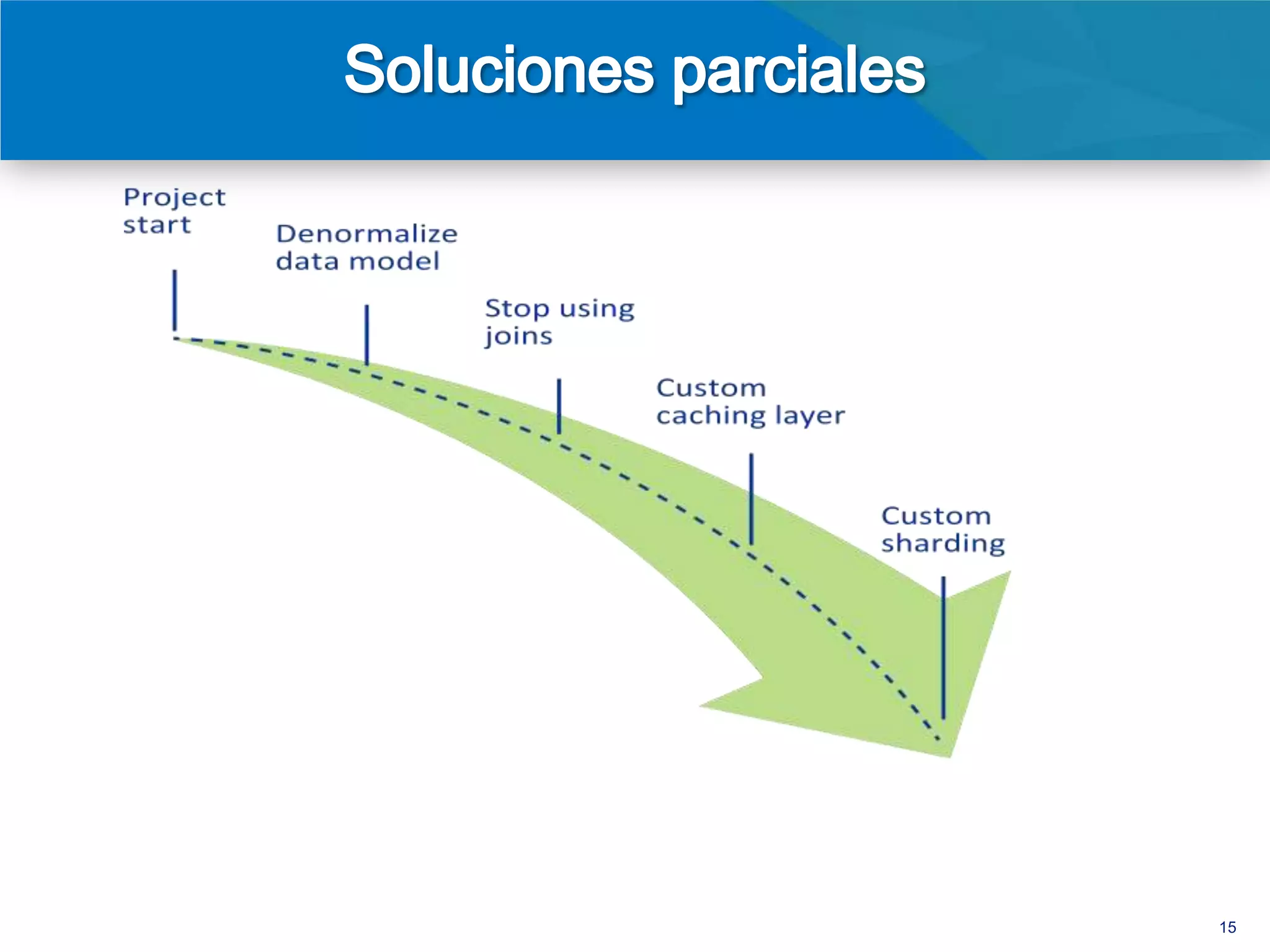
  • #15 Developers started coming up with work-arounds:Denormalize dataAvoid joins and long running transactions Custom cachesApplication Level PartitioningDistributed Caches
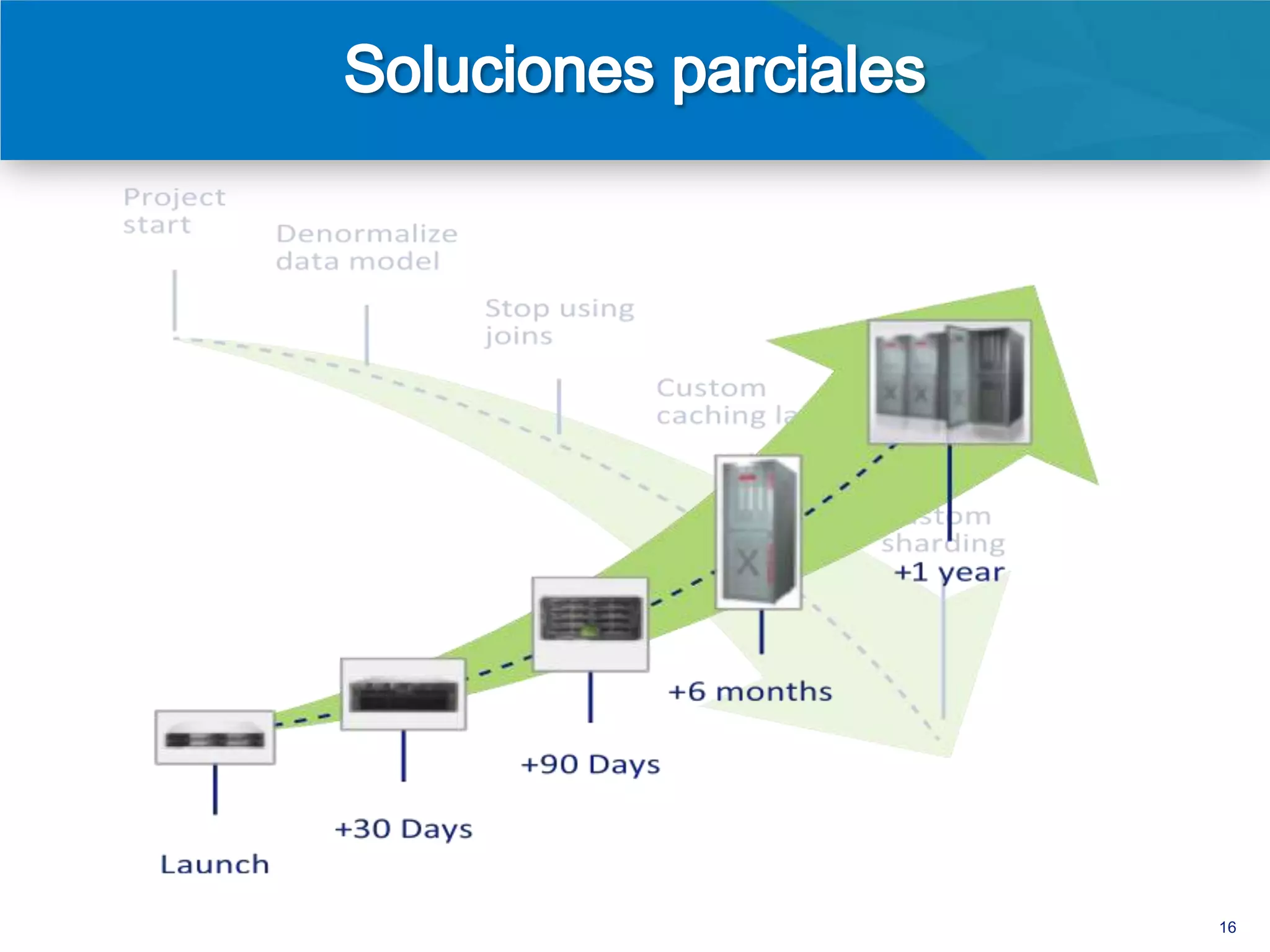
  • #16 Developers started coming up with work-arounds:Denormalize dataAvoid joins and long running transactions Custom caches Require more RAM!Application Level PartitioningDistributed Caches lose ability to do joins, long running transactions
  • #17 today&apos;s apps need: low and predictable response timesscalability &quot;on demand&quot; (high peak times, cloud deployment)HA for reads AND writesmulti data center distribution
  • #18 Maybe no SQL or maybe not only SQL
  • #19 trade off some of less critical components for speed, scale, and ease of use.some have no ad hoc queries, some limited way of reading or updating the data.
  • #20 NoSQL = Non-relational next generation operation data stores and databasesown query language or simple fetch by keyNo SQL as query languageDoes not give ACID guarantees (transactions limited to single item)Distributed fault-tolerant architecture
  • #21 Eventual Consistency (but with strong ability to distribute and high availability)no joins +light transactional semantics = horizontally scalable architectures
  • #22 Eventual Consistency (but with strong ability to distribute and high availability)no joins +light transactional semantics = horizontally scalable architectures
  • #23 Eventual Consistency (but with strong ability to distribute and high availability)no joins +light transactional semantics = horizontally scalable architectures
  • #24 Eventual Consistency (but with strong ability to distribute and high availability)no joins +light transactional semantics = horizontally scalable architectures
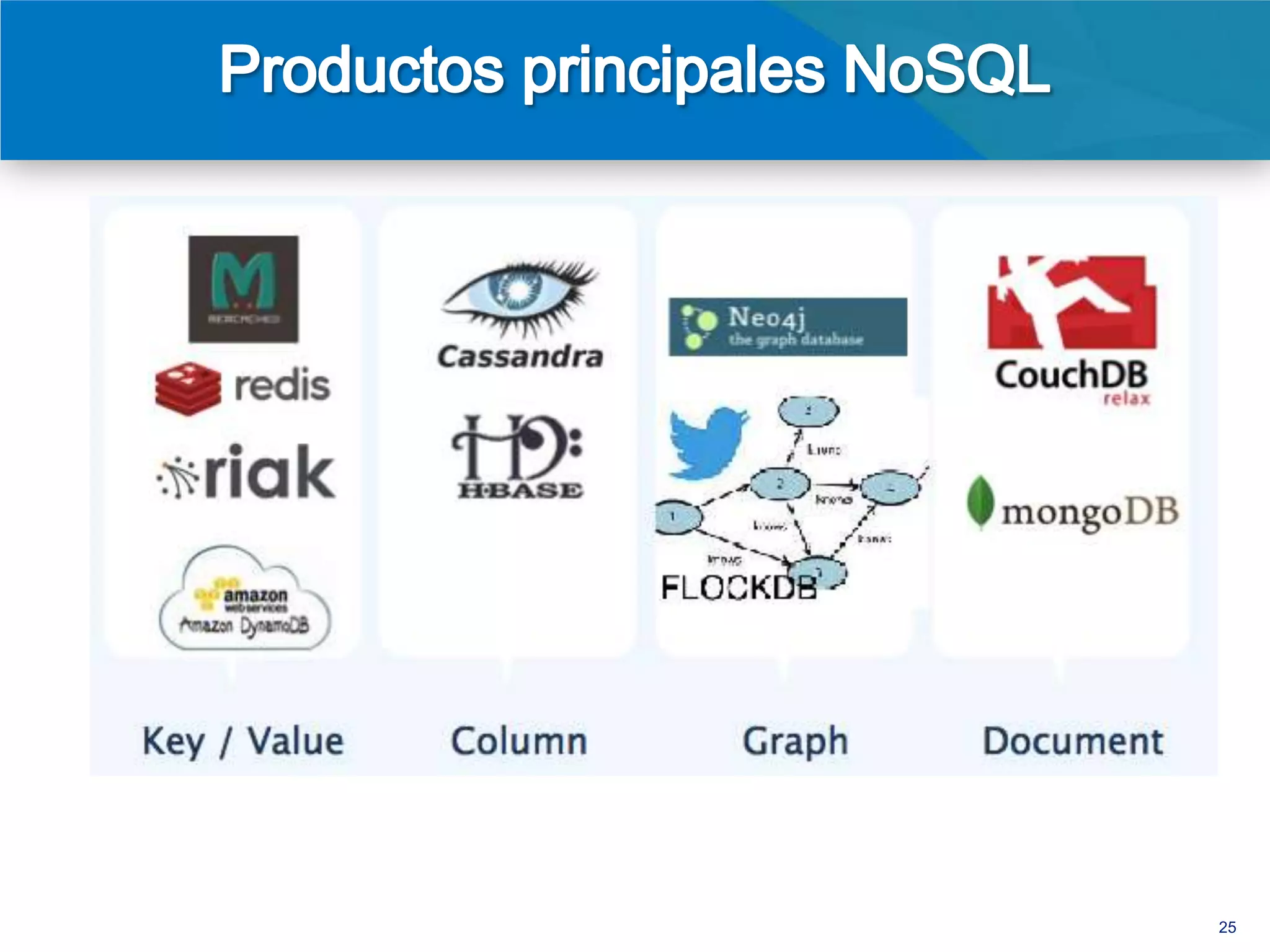
  • #25 K/V stores: PNUTS(Yahoo), Dynamo (by Amazon),Voldemort (originally by LinkedIn), bigtable – google (BigTable – column stores)pnuts – yahoo (key value store)Dynamo (amazon), cassandra (Facebook) similar to BigTable, riak (Basho), membaseNeo4jcouchdb/couchbase
  • #26 How much data do you have? Reads? Writes? Types of queries?How important is it not to ever lose data? (too bad, all systems can lose data)How easy to maintain? Pages in the middle of the night?EASE OF USE – represents your data intuitively?
  • #28 Founders founder of Double-click, Shop-wiki, GILT groupe, biz insider running into the same problems over and over.originally working on platform for the cloud (like google apps)Application stack that would scale out easily
  • #30 Maintain richness and depth of functionality of RDBMS combined with performance and scalability of in-memory key-value stores.
  • #31 Documents: richer than flat structures
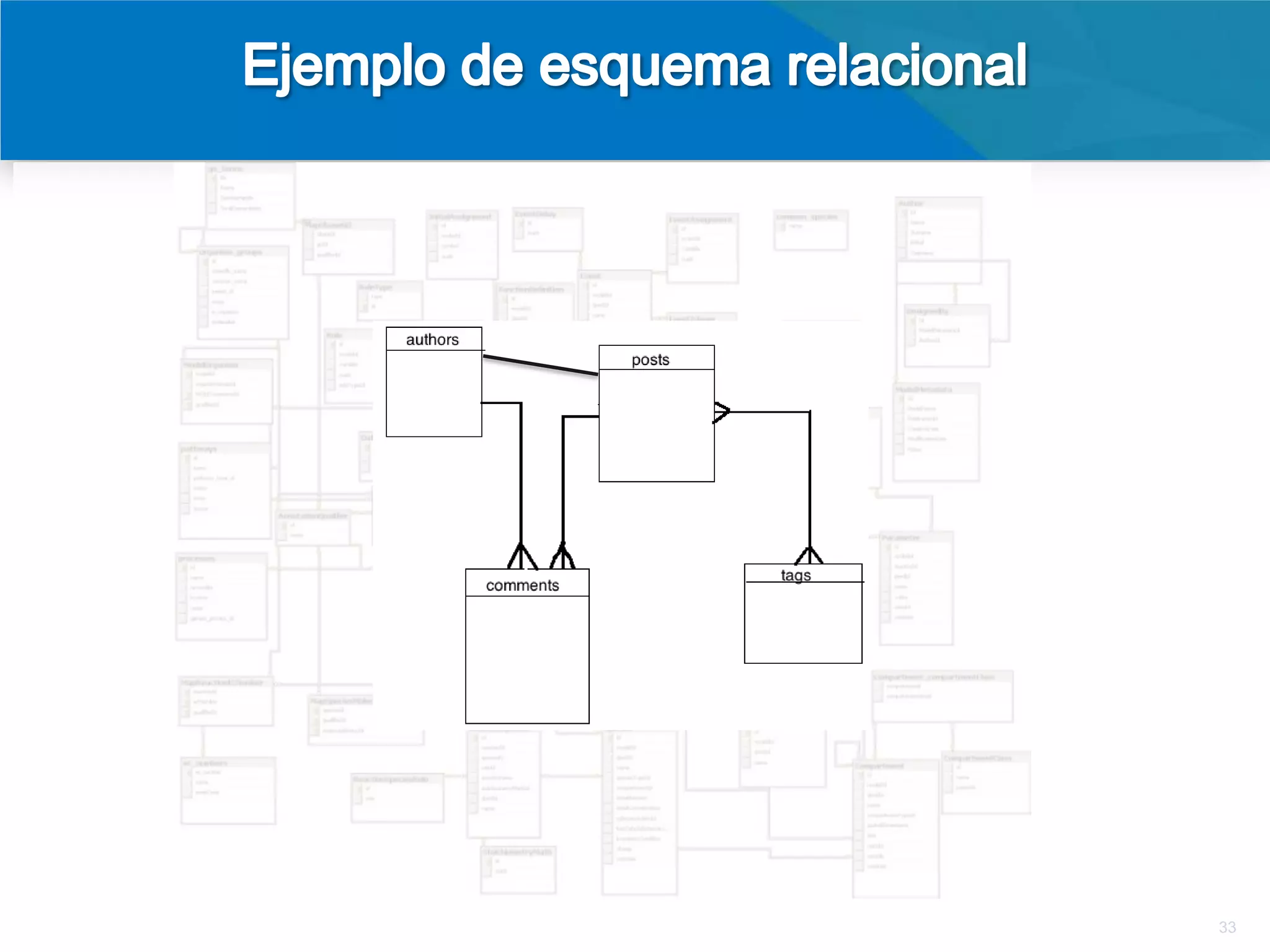
  • #32 let&apos;s look at a simple data model for blog posts, with authors, comments, tags, votes.
  • #33 author/post/comments/tags
  • #34 JSON document – contains key value pairs, different types, values can also be arrays and other documents
  • #36 ----- Meeting Notes (6/19/12 13:12) -----because of the way MongoDB lets you update documents atomically we can be sure totals and list of voters will stay in sync
  • #37 comments is an array of JSON documentswe can query by fields inside embedded documents as well as array members.
  • #38 secondary indexes, compound indexes, multikey indexes.----- Meeting Notes (6/19/12 13:12) -----why is it important to have all of document together?
  • #39 seeks take long, reads less so.this is why joins are expensive!
  • #43 REPLICA SETS
  • #44 Horizonal scaling, automatically managed by MongoDB to partition the data across large number of servers transparently to the application.
  • #45 Horizonal scaling, automatically managed by MongoDB to partition the data across large number of servers transparently to the application.
  • #48 Language drivers are replica set aware and keep a list of replica set members (and can query via isMaster to determine which is master).
  • #55 Full deployment. As many mongoS processes as you have app servers (for example); Config DBs are small but hold the critical information about where ranges of data are located on disk/shards.
  • #56 Special sharding router process, to apps looks just like a stand-alone MongoD.
  • #57 Full deployment. As many mongoS processes as you have app servers (for example); Config DBs are small but hold the critical information about where ranges of data are located on disk/shards.
  • #58 Full deployment. As many mongoS processes as you have app servers (for example); Config DBs are small but hold the critical information about where ranges of data are located on disk/shards.