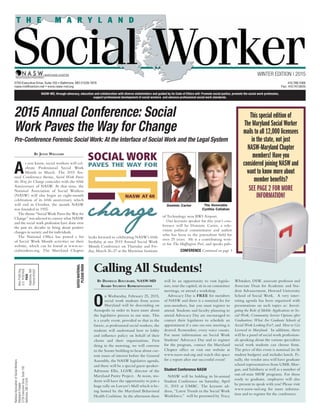
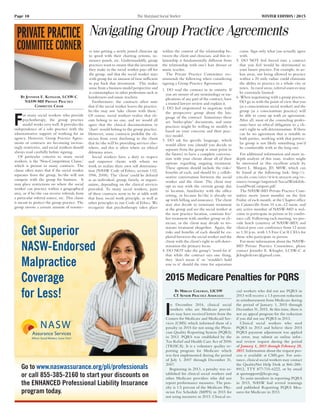
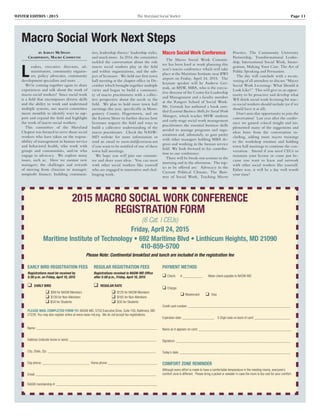
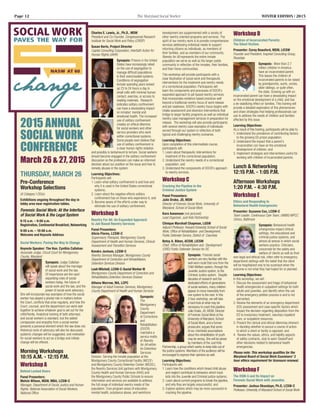
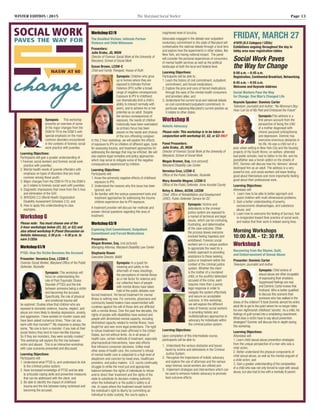
2015 Annual Conference: Social
Work Paves the Way for Change
Pre-Conference Forensic Social Work: At the Interface of Social Work and the Legal System
By Jenni Williams
A
s you know, social workers will cel-
ebrate Professional Social Work
Month in March. The 2015 An-
nual Conference theme, Social Work Paves
the Way for Change coincides with the 60th
Anniversary of NASW. At that time, the
National Association of Social Workers
(NASW) will also begin an eight-month
celebration of its 60th anniversary which
will end in October, the month NASW
was founded in 1955.
The theme “Social Work Paves the Way for
Change” was selected to convey what NASW
and the social work profession have done over
the past six decades to bring about positive
changes in society and for individuals.
The National Office has posted a list
of Social Work Month activities on their
website, which can be found at www.so-
cialworkers.org. The Maryland Chapter
looks forward to celebrating NASW’s 60th
birthday at our 2015 Annual Social Work
Month Conference on Thursday and Fri-
day, March 26-27 at the Maritime Institute
of Technology near BWI Airport.
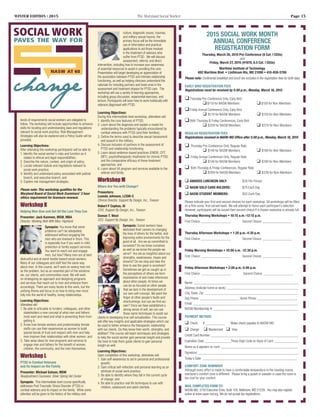
Our keynote speaker for this year’s con-
ference will be Dominic Carter, a tele-
vision political commentator and author
who has been in the journalism field for
over 25 years. He is a contributing writ-
er for The Huffington Post, and speaks pub-
5750 Executive Drive, Suite 100 • Baltimore, MD 21228-1979				 410.788.1066
nasw.md@verizon.net • www.nasw-md.org							 Fax: 410.747.0635
NASW-MD, through advocacy, education and collaboration with diverse stakeholders and guided by its Code of Ethics will: Promote social justice, promote the social work profession,
support professional development of social workers and advance professional social work standards.
WINTER EDITION | 2015
NationalAssociationofSocialWorkers
MarylandChapter
5750ExecutiveDrive,Suite100
Baltimore,MD21228
Non-ProfitOrg.
U.S.POSTAGE
PAID
Baltimore,MD
Permit#5507
datedmateriaL
pleaserush
This special edition of
The Maryland Social Worker
mails to all 12,000 licensees
in the state, not just
NASW-Maryland Chapter
members! Have you
considered joining NASW and
want to know more about
member benefits?
See page 2 for more
information!
CONFERENCE Continued on page 3
Dominic Carter The Honorable
Cynthia Callahan
Calling All Students!
By Danielle Bouchard, NASW-MD
Board Student Representative
O
n Wednesday, February 25, 2015,
social work students from across
Maryland will be descending on
Annapolis in order to learn more about
the legislative process in our state. This
is a yearly event, provided so that in the
future, as professional social workers, the
students will understand how to lobby
and influence policy on behalf of their
clients and their organizations. First
thing in the morning, we will convene
in the Senate building to hear about cur-
rent issues of interest before the General
Assembly, the NASW legislative agenda,
and there will be a special guest speaker-
Adrienne Ellis, LGSW, director of the
Maryland Parity Project. At noon, stu-
dents will have the opportunity to join a
huge rally on Lawyer’s Mall which is be-
ing hosted by the Maryland Behavioral
Health Coalition. In the afternoon there
will be an opportunity to visit legisla-
tors, tour the capitol, sit in on committee
meetings, or attend a workshop.
Advocacy Day is free for members
of NASW and there is a nominal fee for
non-members, but you must register to
attend. Students and faculty planning to
attend Advocacy Day are encouraged to
contact their legislators to schedule an
appointment if a one-on-one meeting is
desired. Remember, every voice counts.
For more information on Social Work
Students’ Advocacy Day and to register
for the program, contact the Maryland
Chapter office or visit our website at
www.nasw-md.org and watch this space
for a report after our successful event!
Student Conference NASW
NASW will be holding its bi-annual
Student Conference on Saturday, April
11, 2015 at UMBC. The keynote ad-
dress, “Latest Trends in the Social Work
Workforce,” will be presented by Tracy
Whitaker, DSW, associate professor and
Associate Dean for Academic and Stu-
dent Advancement, Howard University
School of Social Work.  A very inter-
esting agenda has been organized with
presentations on such topics as: Investi-
gating the Role of Mobile Applications in So-
cial Work; Community Service Options after
Graduation; What Are Graduate Schools of
Social Work Looking For?; and How to Get
Licensed in Maryland. In addition, there
will be a panel of social work profession-
als speaking about the various specialties
social work students can choose from.
The price of this event is nominal (to fit
student budgets) and includes lunch. Fi-
nally, the vendor area will have graduate
school representatives from UMB, Mor-
gan, and Salisbury as well as a number of
out-of-state MSW programs. For those
ready to graduate, employers will also
be present to speak with you! Please visit
www.nasw-md.org for more informa-
tion and to register for the conference.
Page 2	 The Maryland Social Worker	 WINTER EDITION | 2015
Paving the Way
for Change
W
ow, the month of January flew by
and I am finally getting used to
writing 2015 instead of 2014! All
of our committees are meeting, our annual
conference is planned, and Advocacy Day
is right around the corner. It is just the
second week of the legislative session and
I have already been to Annapolis twice to
represent you. It appears that 2015 is going
to be no less eventful and busy than 2014.
There is much we do at the chapter of-
fice which remains the same year after year.
From January through April we represent
you at the General Assembly and train stu-
dents in Legislative Advocacy. During
March we celebrate “Professional Social
Work Month” through a public relations
blitz, our annual awards ceremony, and
our annual conference. In May we make
the rounds of social work schools to con-
gratulate the graduates and welcome them
into the profession. Throughout the year
we offer continuing education to help you
earn your CEUs, we track the Board of
Social Work Examiners and attend meet-
ings and workgroups to represent your in-
terests, and our practice committees keep
abreast of the ever-changing landscape of
our profession. During the summer, as the
meetings slow down a little, we make our
preparations for fall when we return with a
full schedule of continuing education and
conferences.
Though many activities continue from
year to year, it is important to look ahead
each January and prepare for any chang-
es. This year we have some major changes
in Annapolis and inevitably those changes
will affect you and your clients. First, we
have had a change in leadership with Gov-
ernor Hogan coming to the helm. He has
been busy naming his cabinet and replac-
ing most of the state agency heads. Second,
the state has a budget deficit and that means
in addition to the administrative changes,
there will be significant cuts to many of
the programs the state funds. Governor
O’Malley began the cutting, and we should
expect more to follow from Governor Ho-
gan. Inevitably, this will mean less money
for many of the programs which our clients
depend on. Since many of us work for the
state in one capacity or another, this kind
of change can cause anxiety and concern.
While many of the administrative changes
are the prerogative of the governor, they
must be approved by the legislature, along
with the budget. Our legislative commit-
tee and our lobbyists will be keeping track
of what is happening in Annapolis, but we
are also dependent on YOU to let us know
what you are hearing and experiencing
at the local level. Please call our office if
you want to make us aware of budget bills
and other legislation of concern to you.
NASW is your voice in Annapolis. We can
make a bigger (and louder) impact when
we speak together. Watch your email for
legislative alerts and prepare to make your
voice heard!
Please feel free to contact me at any time
with other suggestions of how NASW-
MD can better serve you: nasw.md@ve-
rizon.net or 410-788-1066 ext. 16. And by
the way, Happy New Year!
Happy New Year!
2
015 promises to be an exciting year
for NASW and the NASW-Maryland
Chapter. The National Office of
NASW is exploring possible restructuring
proposals for the association, and this month
the National NASW Board of Directors will
vote on recommendations from a board-
appointed modernization task force. We
will keep members apprised of these matters
as they develop, and will share more infor-
mation when it is available.
Leaders focus on the future, and as the
President of the Maryland Chapter, I’m
already focused on the Chapter elections
which will take place in May. The Chap-
ter needs YOU to serve on the board. We
are looking to complete our slate of candi-
dates soon, and are seeking individuals in-
terested in running for the positions (see
complete list on page 8) on the Chapter’s
board of directors.
If you are interested, please contact:
Daphne McClellan (nasw.md@veri-
zon.net) or Cherie Cannon, CNLI Chair
(cheriecannon@verizon.net).
Finally, March is Social Work Month,
and the theme this year is “Social Work
Paves the Way for Change.” I love this
theme as I feel it speaks to the work each of
us does daily as agents-of-positive change
in the lives of our clients and communi-
ties, as well as the work we do in both pol-
icy and macro settings. We have much to
be proud of, and a wonderful conference
to look forward to. In fact, I look forward
to greeting you at our 2015 Annual Social
Work Month Conference at the Maritime
Institute on March 26 and 27, 2015. To-
gether with an amazing planning commit-
tee and NASW-Maryland Chapter staff,
we plan a rewarding and enriching confer-
ence with robust CEU programming. See
you in March!
Executive
Director’s
Report
By Daphne McClellan,
Ph.D., MSW
NASW-MD
Board of Directors
CHristine garland
President
LLEWELLYN CORNELIUS, Ph.D.
Vice President
erin walton
Treasurer
sandra pelzer
Recording Secretary
open
Southern MD Representative
ANITA ROZAS
Western MD Representative
lisa connors
devon hyde
Suburban MD Representatives
rebecca demattia
angela blake
Eastern Shore Representatives
Anthony Estreet, Ph.D
DONNA WELLS
jody tripple
Metro Baltimore Representatives
danielle bouchard
Undergraduate Student Representative
NASW-MD
Office Staff
Daphne McClellan, Ph.D.
Executive Director
jenni williams
Director of Communications
and Continuing Education
President’s
Report
By Chris Garland, MSW
N
ASW provides career protection for
members and is working to provide
even more opportunities for af-
fordable professional development. With
the support and engagement of NASW
Maryland members, we’ve gained state
legislative wins to protect the profession
and the clients we serve. We’ve also add-
ed new low-cost ways to earn CEUs, net-
work, and obtain better personal liability
insurance than ever before.
A few ways NASW Maryland serves
members and social workers include:
Successfully Advocating
for Your Protection
• Your Executive Director and Profes-
sional Standards Committee work hard
to protect and expand your professional
privileges and scope of practice.
• In addition…the Legislative Committee
supports, testifies for, and introduces
legislation that is good for social work-
ers and our clients.
Providing More Free CEUs
• Now, NASW members can get many
CEUs free using a combination of we-
binars and free in-person workshops
provided by NASW National and
NASW Maryland.
Helping You Build Your Network
• Getting involved with NASW Mary-
land through branch meetings, com-
mittee meetings, CEUs and net-
working events can help you build
connections to other social workers and
organizations for resource building or
job hunting.
FREE Members-Only
Consultation Services
• Maryland chapter has a mentoring pro-
gram to help you professionally as you
move through all stages of your career.
• National Office provides phone consul-
tations related to professional/ethical
concerns for all members.
Covering You Personally
Purchasing your own professional li-
ability coverage means you’ll be cov-
ered, even if your employer requires you
to reimburse them for damages, or if you
change jobs. Liability insurance through
NASW is deeply discounted, and also
comes with access to a free legal consul-
tation hotline staffed by attorneys.
Remember, with NASW member-
ship, you are also getting “Career In-
surance.” Without a strong NASW in
Maryland our profession will lose ground
to individuals with non-social work de-
grees, because we know everyone thinks
they can do social work. Your continued
support as an NASW member assures a
strong Maryland Chapter that is here to
fight for you.
So please join or rejoin today! Go to
www.socialworkers.org/join or call
(800)742-4089. Contact the Maryland
Chapter by email at nasw.md@verizon.
net or by phone at (410) 788-1066 ext. 16
for help and information.
JOIN
NASWLearn more
about NASW
Membership
TODAY!
WINTER EDITION | 2015	 The Maryland Social Worker	 Page 3
JoinUs
inBeing
SOCIALWorkers!
To see our usernames
for these sites, go to our webpage:
www.nasw-md.org
and check out the
links to our profiles.
Be on the lookout for more tagging,
tweeting, posting and updating.
licly across the country on the subjects of
child abuse and foster care. He is a survivor
of abuse and was also in foster care, and
writes about them in his memoir No Mom-
ma's Boy, which recounts his life as a child
growing up with an abusive mother. The
book takes the reader through his strug-
gling childhood growing up in the NYC
housing projects all the way to his career
as a successful political journalist. Domi-
nic believes the future of America and
the world lies in the hands of our youth.
It is important to provide the best educa-
tion and to give back whenever possible.
Dominic, who lives in New York with his
wife and two children, says he went into
television journalism to be a “voice for the
voiceless.” We are honored to have him as
our keynoter speaker this year, and look
forward to hearing his message.
This year’s pre-conference day focuses on
forensic social work and is entitled, Foren-
sic Social Work: At the Interface of Social Work
and the Legal System. The keynote speaker
for Thursday will be The Honorable Cyn-
thia Callahan, Associate Judge of the Cir-
cuit Court for Montgomery County, who
will speak on the marriage of social work
and the law in her keynote address entitled,
Social Workers: Paving the Way to Change.
After the keynote, attendees will choose
from a variety of ten different workshops
and panel discussions throughout the day (for
a total of 6 Cat I CEUs), including: Behind
Closed Doors (panel); Reentry for All: An Ex-
panded Approach to Jail Based Reentry Services
(panel); Cracking the pipeline to the Criminal Jus-
tice System (panel); Children of Incarcerated Par-
ents: The Silent Victims; Ethics and Responding
to Behavioral Health Emergencies; The DSM-5
and Its Impact on Forensic Work with Juveniles;
PTSD: How the Victim Becomes the Accused;
The Smallest Victims: Intimate Partner Violence
and Child Witnesses; Exploring Civil Commit-
ment, Outpatient Commitment, and Forced Medi-
cations; and a Holistic Advocacy Panel Discussion.
On Friday, our Annual Conference fea-
tures a fantastic lineup of 13 workshops (for
a total of 6.5 CEUs) which focus on issues
relevant to all social workers: Recovering from
the Shame, Guilt, and Embarrassment of Sexu-
al Abuse; Meeting the Challenges of the Aging
Boomer Generation; Spirituality as a Resource for
Mental Health and Wellness; Structuring the En-
vironment: DBT Interventions for Parents; Care
Committees: Power for Patients, Support for Care-
givers; Collaborating Across Disciplines, Profes-
sions, and Theoretical Orientations: A Commu-
nication Approach; Kaleidoscope of Play Therapy
Techniques; Motivational Interviewing; Compan-
ioning the Dying: Ethical Dilemmas; Impact of
Laws and Regulations on Social Work Practice:
What You Don’t Know CAN Hurt You; Help-
ing Men Give and Get All the Love They Can;
PTSD In Combat Veterans and its Impact on the
Family; and Where are You With Change?
As always, our highlight on Friday will
be the annual award ceremony presentation
during lunch, where we will honor fellow
social workers and a public citizen from
Maryland who have made outstanding
contributions to the field of social work.
We look forward to seeing you at this
year’s conference! For the complete sched-
ule and registration form, please go to the
center pages of this paper.
■ conference from page 1
NOMINATE NOW FOR THE
2015 NASW-MD ANNUAL AWARDS!
Recognize Your Fellow Social Workers and a Local Citizen
I
t’s time again to recognize and honor your fellow Maryland Chapter members, student members, and a local citizen
who have made outstanding contributions to the profession or the community. The awards, which will be presented
at NASW-MD’s Annual Social Work Month conference to be held on March 27, 2015, include Social Worker of the
Year, MSW and BSW Social Work Students of the Year, Social Work Educator of the Year, the Social Work Lifetime
Achievement Award, the Public Citizen Award, and Social Work Field Instructor of the Year. Please note that, with the
exception of the Public Citizen Award, nominees must be a current member in good standing with NASW-Maryland
Chapter (it is okay if they join now). Don’t miss this opportunity to say thanks and lift up colleagues who have done so
much for the profession and their communities!
Awards Criteria
➽ Nominees for the 2015 Social
Worker of the Year Award, Lifetime
Achievement Award, and Social Work
Students (BSW & MSW) of the Year
Awards must have made significant
and outstanding contributions to the
profession of social work, displayed
leadership in the profession, earned
the respect of fellow social workers
and represented well the professional
ethics of social work.
➽ Lifetime Achievement Award
nominees should, additionally, be in-
dividuals who have a significant span
of achievement over his/her career
that distinguishes them and a long leg-
acy of commitment to the profession.
➽ Nominees for the 2015 Social
Work Educator of the Year and So-
cial Work Field Instructor of the
Year must educate the public
about the unique qualifications
and diverse professional activi-
ties of social workers and must
support high standards for training in
social work education. The Educa-
tor of the Year must advance the body
of social work knowledge through re-
search and publication.
➽ Nominees for Social Work Field
Instructor of the Year should be in-
dividuals who have demonstrated an
outstanding adeptness at providing
the professional support, mentorship,
and knowledge necessary to ensure
field experiences which contribute to
the development of able, efficient, and
well-versed future social work profes-
sionals, and who have made the field
experience a meaningful one.
➽ Nominees for the 2015 Maryland
Citizen of the Year cannot be members
of the social work profession. Indi-
viduals nominated must have made
specific outstanding contributions
to the human services field and have
personally represented ethics compat-
ible with those defined in the NASW
Code of Ethics.
Please visit our website, www.nasw-
md.org, for the nomination form or
contact Daphne McClellan, at 410-788-
1066, ext. 16 (or nasw.md@verizon.
net), to request a nomination form or
further information. Please include a
statement of 350 words or less telling us
why you believe your nominee deserves
the award, and those contributions the
individual has made that makes him or
her unique. Attach additional sheets to
the form, if necessary.
Please be sure to include
a current resume for your nominee.
HURRY! Deadline for submission of nominations is WEDNESday, February 11 at 5 P.M.!
I
NOMINATE
YOU!
NASW-MD
Film Festival
Planned for
2015–We Need
Your Input
By Jenni Williams
We are still in the planning stages of
hosting an all-day film festival and discus-
sion in 2015 at UMBC. We are waiting on
approval for a fall date, and the festival will
either be on a Saturday or Sunday. We are
hoping to make use of two different theater
style rooms for viewing films. Please con-
tact us with your suggestions for movies as
well as discussion facilitators. Films should
be relevant to social workers, and up to 6
CEUs will be offered. The day will include
2-6 movies (shorts or feature length) and
will span over a 6-8 hour timeframe.
Please contact Jenni at
jwnasw.md@verizon.net
with all suggestions, and look
for the details in our July
issue or online.
Page 4	 The Maryland Social Worker	 WINTER EDITION | 2015
An Overview of Mobile Crisis Services
On Maryland’s Eastern Shore
By Angela Blake, LCSW-C
NASW-MD Eastern Shore
Board Representative
A
ccess to mental health services is not
only a problem across our nation, but
also right in our back yard. As social
workers, our goal is to help those who need
it. One of the ways we help people is by be-
ing an advocate and a resource guide. For
those readers who are not familiar with East-
ern Shore resources, here are just two ex-
amples of mental health resources available. 
The mental health system for the Eastern
Shore is still rather new. It has taken a lot of
time, energy, and talents from the various
professionals to make these services avail-
able for our vast and rural population. One
of these systems is The Mid Shore Men-
tal Health Systems (MSMHS), a nonprof-
it 501(C)(3), which manages and moni-
tors a variety of services and programs for
the Eastern Shore’s most vulnerable citi-
zens.  MSMHS’ mission is to effectively co-
ordinate mental health services with quality
assuranceandcosteffectivenessthatmeetthe
needs of the rural community.  With the ad-
dition of the Eastern Shore Crisis Response
and Resource Helpline in 2010, MSMHS
has brought a model rural mental health de-
livery system with a continuum of mental
health services door to door.  These servic-
es ensure consumer, family, and individual
empowerment and are developed to assist
consumers to live to their optimal potential.  
The Eastern Shore Crisis Response and Re-
source Helpline has two components that
work parallel to ensure safety and wellness. 
The first component is the hotline
which is managed directly by MSMHS,
and is the Eastern Shore Operations Cen-
ter (ESOC) (phone:1-888-407-8018).
This number serves as the behavioral
health emergency, urgent, and informa-
tion and referral call center for all nine
counties of the Eastern Shore:  Caroline,
Cecil, Dorchester, Kent, Queen Anne’s,
Somerset, Talbot, Wicomico and Worces-
ter Counties.  The ESOC is available 24
hours a day, seven days a week to assess
and respond to calls from consumers,
family members, community members,
businesses, and human services agen-
cies.   ESOC staff provides links to com-
munity resources through referral to all
appropriate and existing behavioral health
and human services. In addition, the call
center assesses the call and for emotional
crisis or emergencies a mobile crisis team
is assigned. http://msmhs.org
The second component is the Mobile
Crisis Teams (MCT), which is managed
by the Affiliate Santé Group.  Affiliate
Santé Group roots date back nearly 40
years to the founding of the Rock Creek
Foundation (RCF). That entity, which
remains part of The Affiliated Santé
Group today, pioneered the community-
based treatment of individuals with both
psychiatric needs and developmental dis-
abilities, employing values-based treat-
ment services. The organization’s de-
sire to deepen its capabilities and serve
a broader array of people led to the cre-
ation, in 1992, of Affiliated Santé Group
and Santé Medical Associates. The Affili-
ated Santé Group remains as the umbrella
organization that defines Santé today.
Four regional Mobile Crisis Teams
(MCT) cover eight of the nine counties
on the Eastern Shore. Worcester Coun-
ty is not included. Mobile Crisis Team
members intervene with callers referred
from the ESOC who are experienc-
ing a mental health emergency. “A cri-
sis/emergency is generally defined as
any mental and/or emotional state and/
or behavior that endangers life or safe-
ty.”  Mobile Crisis Teams assist law en-
forcement and emergency responders,
providing behavioral health crisis con-
sultation and intervention to stabilize
the consumer in the least restrictive en-
vironment through a range of servic-
es including: assessment, crisis interven-
tion, supportive counseling, information
and referrals, linkage with appropriate
community based mental health servic-
es for ongoing treatment, and follow up.
Trained licensed mental health profes-
sionals make up the MCT, offering the
benefit of quality comprehensive servic-
es.  Staff are able to assist in making di-
rect referrals to treatment centers, men-
tal health providers, and when necessary,
an emergency petition directly to the lo-
cal hospital for a psychiatric evaluation. 
MCT often utilizes urgent care appoint-
ments, offering the consumer in crisis a
mental health appointment with a mental
health provider within 48 hours.  Urgent
care appointments are available in all nine
counties on the Eastern Shore through
mental health clinics. These appoint-
ments are available to anyone not cur-
rently linked to mental health services.
MCT follows the consumer until they
are fully linked to appropriate services. 
MCT makes every effort to involve fam-
ily members, other agencies, community
members, and others who the consumer
deems supportive to their mental well-
being. This service is minimizing the
gaps between crisis and service.  Its core
function not only assists consumers in cri-
sis, but it also decreases hospitalizations
and engagement with law enforcement.
SOCIAL WORK ACROSS THE STATE: BRANCHING OUT
American Society of Group
Psychotherapy and Psychodrama
73RD
A N N U A L
C O N F E R E N C E
FOR ADDITIONAL INFORMATION, CONTACT:
ASGPP / 301 N. Harrison Street, Suite 508, Princeton, NJ 08540
(609) 737-8500 / asgpp@ASGPP.org / www.ASGPP.org
April 9 - 12, 2015
Sonesta Hotel Philadelphia, Philadelphia, PA
Pre-Conference Training Institutes / Over 20 Daily Workshops
In Group Psychotherapy, Psychodrama, Sociometry, Sociodrama and Creative Arts Therapies;
the use of action methods in a wide variety of applications.
SATURDAY KEYNOTE SPEAKER:
Sociometry and Congress: Creating change in the conserve one word at a time
DOUG WALTER, JD
Doug Walter is the Associate Executive Director for Government Relations for the American Psychological
Association Practice Organization and a leading mental health advocate in Washington, DC. He was a
principle negotiator in discussions leading to Congressional passage of the Mental Health Parity and
Addiction Equity Act and the Affordable Care Act. A principal privacy advocate, he helped formulate
patient privacy protections in the HIPAA Privacy Rule and HITECH Act.
FRIDAY OPENING PLENARY SPEAKER:
The Art of Connecting
ANN E. HALE, MSLIS, MA, TEP
Credit Hours / CEs
CEs for Psychologists (APA); Social Workers (ASWB); Counselors (NBCC);
Addiction Professionals (NAADAC); Florida, California, Ohio and Texas Board Approvals;
National Registry of Certified Group Psychotherapists.
log on. Learn more. nasw-md.org
WINTER EDITION | 2015	 The Maryland Social Worker	 Page 5
RESIDENTIAL
ASSESSMENT PROGRAM
Our Residential Assessment
Program provides insight into the
complicated interplay between
addictive and co-occurring
disorders. This enables our
clinical team to make appropriate
treatment recommendations.
HIGHLY
CREDENTIALED STAFF
Our full-time, on-site
multidisciplinary specialists
embrace an integrative model
of care, addressing all physical,
psychological, and spiritual
barriers to recovery.
RECOVERY IS
THE BOTTOM LINE
As a non-profit, our mission is
to make quality treatment more
accessible by accepting out-of-
network insurance and providing
patients in need with scholarships
totaling more than $16 million
last year.2
You have a seat at the table
when you partner with Caron
Caron.org/psychologists/my-seat
Call to discuss your patient’s needs with a certified
admissions specialist: 855.623.4673.
When you refer your patient to Caron Treatment Centers, you’ll be consulted
throughout the recovery process. Partnerships like these enhance our ability to treat
complex addictions and drive our 93% completion rate1
for inpatient treatment.
1
Caron electronic patient record, 4th quarter of 2013-2014 fiscal year.2
Caron 2012-2013 Annual Report: July 1, 2012-June 30, 2013
©2014 Caron Treatment Centers
Page 6	 The Maryland Social Worker	 WINTER EDITION | 2015
T
here is an old saying that behind every
great man there is a great woman. Clare
Britton was an English social worker
who fits this bill. Her name is not widely
known in this country, but she was the sec-
ond wife of pediatrician and psychoanalyst
Donald Winnicott.
Winnicott is well known in this country,
especially for his modifications of Kleini-
an Object Relations Theory to emphasize
that personality develops in relation to the
persons in their situation. Some terms con-
nected with him are “the holding environ-
ment” which is associated with the concept
of “the good enough mother,” and the “true
and false self” which is connected to ideas
of “inferiority and growth,” and “transitional
object” (which refers to things children are
attached to and always keep with them).
The question is, what does Clare Britton
have to do with this? Joel Kanter (Kanter
2005) has written an article that answers
this question.
Clare and Donald met when he was a
consultant at an institution for difficult
children who had been evacuated during
WWII. Winnicott was not particularly ef-
fective in this place, but he did meet Clare,
and out of this meeting grew a highly suc-
cessful collaboration. She was well equipped
to be his collaborator and more. Even before
she went to school, her first jobs were social
work oriented. In 1938, she completed the
Social Science Course at the London School
of Economics. After that, she worked with
troubled youth. During the war in 1941, she
returned to the London School of Econom-
ics, where she completed the Mental Health
Course. She went to work with evacuated
and troubled children. Winnicott was a con-
sultant at the agency. Her boss described the
place as ‘a mess’, and Winnicott as a person
who came once a week but didn’t believe in
social work so he wanted to do it all himself.
Clare’s job was to straighten everything out.
The staff complained that Winnicott didn’t
tell them what to do, so she said, “Tell him
what to do and see if he has any comment.”
In one amusing incident, she described how
the staff looked up to him and saved good
food for him when he came. She informed
him that he was eating the children’s butter
ration for the week.
Their collaboration began quickly and
soon they were coauthoring articles. Kant-
er, in commenting on this relationship,
says, “…the jointly authored articles clearly
delineate Clare’s leadership role in direct-
ing the hostel scheme and Donald’s second-
ary role as consultant; in no way could this
relationship be described as one of clinical
supervision (Kanter 2005, p. 463).” Kanter
is meticulous in documenting her writing
concepts, such as the holding environment,
which later tends to be attributed solely to
Winnicott. He says, “While Donald cer-
tainly acquainted Clare with the funda-
mentals of object relations theory, Clare
brought her own creative powers to the
work in Oxfordshire, using aspects of this
theory in a practice setting quite different
from the analytic consulting room (Kanter
2005, p. 468).”
After the war (1947-1958), she direct-
ed the Child Care Course at the London
School of Economics. She also became a
major figure in English social work. Her
collaboration with Winnicott continued.
In 1958, the course was merged in a ge-
neric Applied Social Studies Course. They
both objected. Kanter cites an unpublished
paper by Winnicott, “He argued that it
was naïve to believe that a year’s non-spe-
cialized training adequately prepares social
workers to function in child care, proba-
tion, medical, and psychiatric social work
(Kanter 2005, p. 469).” The debate about
when to specialize continues today.
Their collaboration was reflected in the
mutual influence they had on each other.
Winnicott became involved in the world
of social work, and both taught social
workers and published in social work jour-
nals. Kanter notes that even though Winn-
icott was open about his connection to so-
cial work, psychoanalytic scholars seldom
cited this. Clare became involved in psy-
choanalysis. With many of the key ideas
attributed to Winnicott it is hard to dis-
tinguish which one postulated the notion
first. Kanter starts his concluding para-
graph by writing, “Decades ahead of their
colleagues both in social work and in psy-
choanalysis, Clare and Donald used clinical
data rarely found in psychoanalysis proper
to explore how ‘facilitating environments’
enhance ‘maturational processes.’ This in-
tegrative approach challenges us today as
many practitioners are more comfortable
focusing either on the environment or
the psyche, but not both together (Kanter
2005, p. 480).” This is a rich article and the
brief summary provided here hardly does
it justice. Kanter has a deep knowledge of
the Winnicotts and their ideas. He has also
edited a book on Clare Winnicott (Kant-
er 2004). Kanter is not alone in seeing her
as being both influential in Donald Win-
nicott’s work and in English social work.
He begins the article by citing others who
have the same opinion. This raises an inter-
esting thought. While Donald Winnicott’s
work is fairly well known in this country,
American social work has taken almost no
notice of Clare Britton Winnicott. Perhaps
American social work has a cultural blind-
ness that could be cured by looking at ideas
and service delivery systems in other parts
of the world and integrating what is useful
into American practice.
The
History
Column
By Harris Chaiklin
Clare Britton,
Social Worker
References
Kanter, J., Ed. (2004). Face to face
with children: The life and work of CLare
Winnicott. London, Karnac.
Kanter, J. (2005). “ ‘Let’s never ask
him what to do’: Clare Britton’s trans-
formative impact on Donald Winn-
icott.” American Imago 61 (4): 457-481.
The National Association of Social Workers Maryland Chapter
presents the
Tenth Annual Clinical Conference
September 24-25, 2015
The Maritime Institute of Technology
692 Maritime Boulevard
Linthicum Heights, MD 21090
Applicants must be graduate level professionals,
preferably social workers.
Instructors should submit the following:
• Completed application form
• A one page description of the proposed presentation (no more than 350 words)
including an overview and educational objectives. Please include a breakdown/outline of
the presentation
• A vitae or resume (if two presenters are jointly presenting, please submit a resume
for both). Please make note of previous workshops you have presented, including
workshop topic, date, and sponsoring organization.
Name(s): __________________________________________________
Degrees/Designations: __________________________________________
Presentation Title: _____________________________________________
Job Title: __________________________________________________
Employer: __________________________________________________
Work Phone: __________________ Home/Cell Phone: _________________
Home Address: ______________________________________________
Email Address: ______________________________________________
State the workshop’s relevance to the practice of Clinical Social Work:
(Use additional sheet if necessary)
Workshop Duration: 	 ❑ Three Hours 	 ❑ Six Hours
Program Level: 		 ❑ Intermediate 	 ❑ Advanced
Workshop Time Preference: 	❑ Thursday AM 	❑ Thursday PM
(Check all that apply)	 ❑ Friday AM 	 ❑ Friday PM 	 ❑ No Preference
	 	
Please list at least two references:
1.
2.
Audio-Visual Requirements*
Will you be bringing your own laptop? 	 ❑ Yes 		 ❑ No
If so, is it a:					 ❑ PC		 ❑ Mac
*Each room is provided with internet connection, LCD projector, a white board, and a flip chart.
Return this form to:
Jenni Williams, Director of Communications & Continuing Education
NASW-MD Chapter, 5750 Executive Drive, Suite 100, Baltimore, MD 21228
(410-788-1066, ext. 13) or email submissions to: jwnasw.md@verizon.net
Please return by May 11, 2015
APPLICATION FORM
CALL FORPRESENTATIONS
WINTER EDITION | 2015	 The Maryland Social Worker	 Page 7
Introducing
Memory Care
at Charlestown
10312409
New Memory Care will open soon at Charlestown. Our
experienced team focuses on more than your client’s medical
needs. We care for their emotional, mental, and spiritual
needs too.
Now accepting reservations. Call 410-737-8922
for more information.
You don’t have to be a Charlestown resident to come here for care.
709 Maiden Choice Lane, Catonsville, MD 21228
EricksonLiving.com
UM SSW Enters Partnership with CASE,
Others to Improve Nation’s Adoption Outcomes
T
he University of Maryland School
of Social Work (SSW) has entered
a partnership with the Center for
Adoption Support and Education (CASE)
to better prepare the nation’s child welfare
and mental health services workforce to
help adoptive parents and children.
The U.S. Department of Health and
Human Services’ Children’s Bureau, an of-
fice of the Administration for Children and
Families, has awarded a $9 million grant
to CASE for the National Adoption Com-
petency Mental Health Training Initiative
(NTI). As a partner on the five-year proj-
ect, the SSW has a subcontract worth more
than $2.5 million for the period.
The intent is to find additional ways to
train child welfare staff, supervisors, and
community-based practitioners endeavor-
ing to help families with adopted children.
Research has shown a higher likelihood
that an adopted child will need exceptional
assistance to meet typical standards of suc-
cess. “Many will struggle with behavior-
al health and educational problems,” said
SSW Dean Richard P. Barth, PhD, MSW,
who has studied adoption outcomes for
more than three decades.
“Developmental science is clear; there is
a greater variability for outcomes among
adopted children than among non-adop-
tees,” he said. “In time, a better trained
mental health services workforce will ease
the path for adoptive parents and children
and ensure that more adoptions meet ex-
pectations.”
Among the SSW faculty and staff mem-
bers, in addition to Barth, who will con-
tribute to the NTI are the SSW’s princi-
pal investigator Marlene Matarese, PhD,
MSW; Meredith Waudby, MSW, project
director; and Bethany Lee, PhD, MSW,
the SSW associate dean for research who
is the initiative’s research director. Also
participating is Michelle Zabel, MSW, di-
rector of The Institute for Innovation and
Implementation, which was instrumental
in securing the NTI opportunity for the
School.
Barth stated: “My colleagues and I at the
University Of Maryland School Of Social
Work are delighted that the Children’s Bu-
reau has recognized the need for a more
competent mental health workforce to as-
sist adoptive families.
“We are thrilled to have the opportuni-
ty to work with Debbie Riley and CASE,
the nation’s leader in the development and
delivery of competency-based adoption
training,” he said.
As chief executive officer of CASE,
Debbie Riley, LCMFT, is NTI’s principal
investigator. “We have spent the past sev-
en years at CASE building the framework
for the delivery of an evidenced informed
adoption competency training program,”
she said. “Now through this federal co-
operative agreement, with the Children’s
Bureau and our national partners, we will
be able to enhance the skills of child wel-
fare staff and mental health profession-
als to meet the diverse and complex men-
tal health needs of the foster and adoption
community.
“We have engaged many of the top lead-
ers in the field to help guide this process,
lending expertise to this critical initiative
that will have far reaching impact in our
field for years to come,” she said. Riley re-
cently spoke about the initiative in a video
interview with CenterMaryland.
The national center involves, principally,
identification of treatment competencies,
followed by on-line training and ongoing
consultation, and support.  Significant ef-
fort and expertise will be applied to ensure
that the training is being delivered with fi-
delity and the adoption-competent services
are being delivered faithfully. 
Matarese expressed gratitude to the
Children’s Bureau for “prioritizing this
very important initiative.”
“The emotional experiences of children
and their families during the adoption pro-
cess can be simultaneously joyful and ex-
asperating, which creates challenges for
these new families,” she said. “Having pro-
fessionals trained to best meet the unique
needs of these loving families is critical
in ensuring that they receive the highest
quality of care.”
 Other entities collaborating on the ini-
tiative include the University of Southern
California School of Social Work (USC);
the National Indian Child Welfare Associ-
ation; Northwestern University; the Alli-
ance of Children and Families; and Lilliput
Children’s Services (LCS). 
Leaders of NTI recently gathered to
launch the training Initiative. They in-
cluded Barth, Lee, Matarese, and Mere-
dith Waudby, all of the SSW; Riley, Sarah
Greenblatt, Valerie Kunsman, and Les-
lie Savary, all of CASE; Edythe Swidler
of LCS; Anne Atkinson of Policy Works;
adoption consultant Susan Livingston
Smith; and associate professor Devon
Brooks of USC.
The University of Maryland is home to
the Graduate School and schools of dentist-
ry, law, medicine, nursing, pharmacy, and
social work and is the founding campus of
the University System of Maryland.
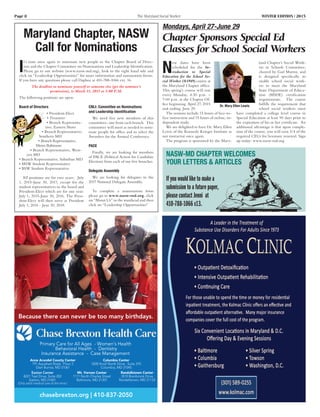
Leaders of NTI recently gathered to launch the training initiative. Back row, left to right: Sarah Greenblatt of CASE, director, NTI; Devon Brooks,
associate professor at USC; SSW Dean Richard P. Barth; Leslie Savary, CASE; and Meredith Waudby, SSW’s project director for NTI.
Front row, left to right: Edythe Swidler, Lilliput Children’s Services; Bethany Lee, SSW associate dean for research and research director for NTI;
adoption consultant Susan Livingston Smith, professor emeritus, Illinois State University; CASE CEO Debbie Riley, principal investigator for NTI;
Anne Atkinson, PolicyWorks; Marlene Matarese, SSW’s principal investigator for NTI; and Valerie Kunsman, CASE.
Get involvedunteer
To inquire about, or join a committee call Daphne at 410-788-1066 x16
Page 8	 The Maryland Social Worker	 WINTER EDITION | 2015
chasebrexton.org | 410-837-2050
Mt. Vernon Center
1111 North Charles Street
Baltimore, MD 21201
Randallstown Center
3510 Brenbrook Drive
Randallstown, MD 21133
Columbia Center
5500 Knoll North Drive, Suite 370
Columbia, MD 21045
Anne Arundel County Center
791 Aquahart Road, Floor 2
Glen Burnie, MD 21061
Easton Center
8221 Teal Drive, Suite 202
Easton, MD 21601
(Only adult medical care at this time.)
Primary Care for All Ages - Women’s Health
Behavioral Health - Dentistry
Insurance Assistance - Case Management
Because there can never be too many birthdays.
Maryland Chapter, NASW
Call for Nominations
I
t’s time once again to nominate new people to the Chapter Board of Direc-
tors and the Chapter Committee on Nominations and Leadership Identification.
Please go to our website (www.nasw-md.org), look to the right hand side and
click on “Leadership Opportunities” for more information and nomination forms.
If you have any questions please call Daphne at 410-788-1066 ext. 16.
The deadline to nominate yourself or someone else (get the nominee’s
permission), is March 15, 2015 at 5:00 P.M.
The following positions are open:
Board of Directors
• President-Elect
• Treasurer	
• Branch Representa-
tive, Eastern Shore
• Branch Representative,
Southern MD 	
• Branch Representative,
Metro Baltimore
• Branch Representative, West-
ern MD
• Branch Representative, Suburban MD	
• MSW Student Representative
• BSW Student Representative
All positions are for two years: July
1, 2015-June 30, 2017, except for the
student representatives to the board and
President-Elect which are for one year:
July 1, 2015-June 30, 2016. The Presi-
dent-Elect will then serve as President
July 1, 2016 - June 30, 2018.
CNLI: Committee on Nominations
and Leadership Identification
We need five new members of this
committee- one from each branch. This
committee will meet as needed to nom-
inate people for office and to select the
Awardees for the Annual Conference.
PACE
Finally, we are looking for members
of PACE (Political Action for Candidate
Election) from each of our five branches.
Delegate Assembly
We are looking for delegates to the
2017 National Delegate Assembly.
To complete a nominations form
please go to www.nasw-md.org, click
on “About Us” in the masthead and then
click on “Leadership Opportunities”
Mondays, April 27-June 29
Chapter Sponsors Special Ed
Classes for School Social Workers
N
ew dates have been
scheduled for the In-
troduction to Special
Education for the School So-
cial Worker (#1949) course at
the Maryland Chapter office.
This spring’s course will run
every Monday, 4:30 p.m. –
7:00 p.m. at the Chapter Of-
fice beginning April 27, 2015
and ending June 29.
The sessions include 15 hours of face-to-
face instruction and 15 hours of online, in-
dependent study.
We are delighted to have Dr. Mary Ellen
Lewis of the Kennedy Krieger Institute as
our instructor once again.
The program is sponsored by the Mary-
land Chapter’s Social Work-
ers in Schools Committee,
chaired by Gail Martin, and
is designed specifically to
enable school social work-
ers to meet the Maryland
State Department of Educa-
tion (MSDE) certification
requirements. The course
fulfills the requirement that
school social workers must
have completed a college level course in
Special Education at least 90 days prior to
the expiration of his or her certificate. An
additional advantage is that upon comple-
tion of the course, you will earn 3/4 of the
required CEUs for licensure renewal. Sign
up today: www.nasw-md.org
Dr. Mary Ellen Lewis
Nasw-md chapter welcomes
your letters & articles
If you would like to make a
submission to a future paper,
please contact Jenni at
410-788-1066 x13.
WINTER EDITION | 2015	 The Maryland Social Worker	 Page 9
Maryland Chapter Receives Grant
The John A. Hartford Foundation Awards NASW
Grant to Bolster Services to Older Adults
NASW will use grant to improve supervisory and leadership skills, expand gerontological knowledge
T
he John A. Hartford Foundation
has awarded the National Associ-
ation of Social Workers (NASW)
Foundation a $1 million, three-year
grant that will be used to launch a pro-
gram through NASW chapters in New
York City, Maryland, Illinois and Flori-
da to improve the delivery of health care
and social services to older adults.
“Older adults, especially those age 80
and over, often do not get the social ser-
vices they need to remain independent
and maintain their health,” NASW CEO
Angelo McClain, PhD, LICSW, said.
“This grant will allow NASW to train
more social work supervisors who are
specialized in care to older adults, en-
hance social work leadership in the ge-
rontological field, and expand knowledge
on aging services so more social workers
have the skills to improve the quality of
life of this often vulnerable population.”
The John A. Hartford Foundation was
created in 1929 with a mission to improve
the health of older adults in the United
States.
The NASW pro-
gram, Superviso-
ry Leaders in Aging,
will establish sustain-
able gerontological
social work supervi-
sion training programs
in the four NASW
chapters and an on-
going practice excel-
lence network among
its graduates. The
program will provide
a 10-module train-
ing, addressing both
gerontological social
work and supervisory
and leadership skills,
to 160 master’s-level
social workers (MSWs) who supervise
staff serving older adults. NASW then
plans to expand the program nationally,
based on the lessons learned with these
first four chapters.
NASW projects these 160 supervisors
will train about 1,280 staff to work with
older adults. These
staff members, in turn,
are expected to serve
more than 115,000
clients each year.
The NASW pro-
gram is based on pi-
lot projects in New
York City funded by
the Florence Burden
Foundation and un-
dertaken in 2014 by
the Helen Rehr Cen-
ter for Social Work
Practice. The program
model — including a
peer support network
— was developed by
NASW Social Work
Pioneer®
Dr. Barbara Silverstone, partner
in SBW Partners. Supervisory Leaders in
Aging will benefit from the involvement
of Dr. Silverstone and her Associate, Dr.
Dan Kaplan, who will collaborate with
NASW, and direct the project’s National
Coordinating Center.
“NASW hopes this program will fill
a gap in the services social workers pro-
vide,” said Joan Levy Zlotnik, PhD,
ACSW, director of NASW’s Social Work
Policy Institute and Principal Investiga-
tor of Supervisory Leaders in Aging. “So-
cial workers are some of the key provid-
ers of health and mental health services
to older Americans. However, like nurses
and doctors, many can benefit from best
practices and enhanced training to better
serve older adults.”
The National Association of Social Workers
(NASW), in Washington, DC, is the largest
membership organization of professional social
workers with 130,000 members. It promotes,
develops, and protects the practice of social
work and social workers. NASW also seeks to
enhance the well-being of individuals, families,
and communities through its advocacy.
The National Association of Social Worers
Foundation (NASWF) is a charitable orga-
nization created to enhance the well-being of
individuals, families, and communities through
the advancement of social work practice.
Welfare Advocates Holds 35th Annual Conference
W
elfare Advocates (WA), Mary-
land’s statewide coalition of com-
munity-based organizations, ad-
vocacy groups, faith communities and
consumers, held its 35th Annual Confer-
ence on November 20, 2014 at the North
Baltimore Plaza Hotel in Timonium, Md.
The day-long program consisted of a key-
note address, morning and afternoon
workshops and an afternoon plenary en-
titled “The Power of Storytelling.” Michael
Reisch, PhD, Daniel Thursz Distinguished
Professor of Social Justice at the University
of Maryland, School of Social Work ren-
dered the keynote address on the confer-
ence theme, Flip the Script.
Inspired by WA members’ collective
concern that vulnerable citizens and the
programs that serve them too often are
negatively stereotyped and diminished in
value by the media, policy makers, and the
general public, the conference theme was
a call to action. Morning and afternoon
workshops were presented as demonstra-
tions of how service providers might alter
their inclination for addressing perceived
client need by working from a stance that
takes into account clients’ own perspec-
tives about their needs.
During his keynote address, Dr. Reisch
challenged social workers and allied pro-
fessionals to make certain that policy-mak-
ers and others “get the facts right” about
our mission of advocacy, bridge-building,
and service.
He spoke passionately on the points
paraphrased here:
• Refuse to allow those who do not share
our values and concerns to set our agenda.
• Address the root causes of poverty, ana-
lyzing the underlying political-econom-
ic and ideological forces that impact the
lives of the poor and near-poor.
• Disseminate the facts and results of our
work and develop a clear message on ev-
ery issue.
• When addressing policy-makers and
politicians, frame policy issues not only
within a fiscal context, but identify and
clarify actual and potential social costs of
action or inaction, using everyday terms.
• Reframe the language and symbols used
by our adversaries who seem motivated
to criticize and punish those we serve
and the services provided to them.
• Put a face on every issue, but connect ev-
ery issue to a specific policy solution.
•	Cultivate autonomous sources of politi-
cal and financial support. Locate new
or scarcely tapped revenue sources and
funding streams.
• Flipping the script requires us to broaden
our base of support. We must make our
arguments more appealing in the broader
political arena.
• Take a long view of change … consisten-
cy and constancy in our advocacy leads
to greater effectiveness over time. Our
goal is both to change current policies
and change the environment in which
future policy debates will occur.
The highlight of the conference oc-
curred during the afternoon plenary when
one woman and three men who had been
aided in some way by a service organiza-
tion, each told a personal story of triumph
over adversity, with training from Laura
Wexler of Baltimore’s acclaimed Stoop Sto-
rytelling Series. Following the storytelling,
three panelists talked about the impor-
tance of and their experiences with listen-
ing to stories as a key skill in their line of
work. They were: The Honorable Mary
Washington, PhD, Maryland House of
Delegates; Yvonne Wenger, City Hall Re-
porter, Baltimore Sun; and Greg Kaufmann,
Senior Fellow of the Center for American
Progress and editor of TalkPoverty.org.
The panelists concurred that the skill of
listening to stories allows them to be better
informed about matters of importance to
their constituencies.
Lisa Klingenmaier of Catholic Charities
Baltimore was Chair of the Welfare Ad-
vocates Conference Committee. She noted
that the 2014 conference was attended by
over 175 frontline staff, social service pro-
viders, faith community members, gov-
ernment agencies, students, and low-in-
come Marylanders. Conference attendees
appreciated the conference theme Flip the
Script, and the opportunity presented to re-
frame, rethink, and recommit to tackling
the vital issues vulnerable Marylanders face
each day. Overall, the conference was an
opportunity to discuss, plan, and advocate
for social change in Maryland, and every-
one at the conference was a contributor to
that collective effort.
Workshop presenters were representa-
tives from these organizations: Maryland
Benefits Center, Maryland Department of
Human Resources, St. Mary’s County De-
partment of Social Services, Health Care
for the Homeless in Baltimore, Homeless
Persons Representation Project, Com-
munity Speaks, LLC, 100 Black Men of
Maryland, Inc., University of Maryland-
Baltimore County, Public Policy Partners,
the Center for Law and Social Policy, the
Center on Budget and Policy Priorities,
the Esperanza Center, and the Public Jus-
tice Center.
Submitted by Jeanne D. Cooper, LCSW
Policy Analyst, Maryland DHR
Inspired by WA members’ collective concern that vulnerable citizens and
the programs that serve them too often are negatively stereotyped and
diminished in value by the media, policy makers, and the general public,
the conference theme was a call to action.
Page 10	 The Maryland Social Worker	 WINTER EDITION | 2015
Navigating Group Practice Agreements
By Jennifer E. Klingler, LCSW-C
NASW-MD Private Practice
Committee Chair
F
or many social workers who provide
psychotherapy, the group practice
model works very well. It provides the
independence of a solo practice with the
administrative support of working for an
agency. However, Group Practice Agree-
ments or contracts are becoming increas-
ingly restrictive, and social workers should
always read carefully before signing.
Of particular concern to many social
workers, is the ‘Non-Competition Clause,’
which is present in many contracts. The
clause often states that if the social worker
separates from the group, he/she will not
compete with the group for business. It
may place restrictions on where the social
worker can practice within a geographical
area, or if he/she can receive referrals from
a particular referral source, etc. This clause
is meant to protect the group practice. The
group invests a certain amount of resourc-
es into getting a newly joined clinician up
to speed with their charting systems, in-
surance panels, etc. Understandably, group
practices want to ensure that the investment
they make in the social worker pays off for
the group, and that the social worker stays
with group for an amount of time sufficient
to pay back that investment. This makes
sense from a business model perspective and
is commonplace in other professions such as
hairdressers and music teachers.
Furthermore, the contracts often state
that if the social worker leaves the practice,
he/she may not ‘take clients with them.’
Of course, social workers realize that cli-
ents belong to no one, and we would all
agree that the clinical documentation or
‘chart’ would belong to the group practice.
However, some contracts prohibit the cli-
nician from even disclosing to the client
that he/she will be providing services else-
where, and this is often where an ethical
dilemma arises.
Social workers have a duty to respect
and empower clients with whom we
work to realize their own self determina-
tion (NASW Code of Ethics, section 1.02,
1996, 2008). The ‘client’ could be defined
as an individual, group, family, or organi-
zation, depending on the clinical services
provided. To many social workers, parts
of these contracts seem to be at odds with
that basic social work principle, as well as
other principles in our Code of Ethics. We
recognize that psychotherapy takes place
within the context of the relationship be-
tween the client and clinician, and this re-
lationship is fundamentally different from
the relationship with one’s hair dresser or
music teacher.
The Private Practice Committee rec-
ommends the following when considering
signing a Group Practice Agreement:
1. DO read the contract in its entirety. If
you are unsure of any terminology or im-
plications of any part of the contract, have
a trusted lawyer review and explain it.
2. DO feel empowered to negotiate with
the prospective group about the lan-
guage of the contract. Sometimes these
are ‘boiler-plate’ documents, and some
practices might be willing to modify it
based on your concerns and their prac-
tice model.
3. DO ask for specific language, which
would allow you (should you decide to
separate from the group at some point in
the future) to have a complete conversa-
tion with your clients about all of their
options regarding ongoing treatment.
These options should include the risks/
benefits of each, and should be a collab-
orative conversation between the social
worker and the client. The client may
opt to stay with the current group due
to location, familiarity with the office
setting, or because he/she is already set
up with billing and insurance. The client
may also decide to terminate treatment
at the group and see the social worker at
the new practice location, continue his/
her treatment with another group or cli-
nician, or the client may decide to ter-
minate treatment altogether. Again, the
risks and benefits of each should be ex-
plored between the social worker and the
client with the client’s right to self-deter-
mination the primary focus.
4. DO NOT take the group’s ‘word for it’
that while the contract says one thing,
they ‘don’t mean it’ or ‘wouldn’t hold
you to it’ should the time for separation
come. Sign only what you actually agree
with.
5. DO NOT feel forced into a contract
that you feel would be detrimental to
your future practice. For example, in ur-
ban areas, not being allowed to practice
within a 20 mile radius could eliminate
the ability to practice in a whole city or
town. In rural areas, referral sources may
be extremely limited.
6. When negotiating with a group practice,
DO go in with the point of view that you
(as a conscientious social worker) and the
group (as a conscientious practice) will
be able to come up with an agreement.
After all, most of the counseling profes-
sions have an ethical obligation to a cli-
ent’s right to self-determination. If there
can be no agreement that is suitable to
both parties, working with that particu-
lar group is not likely something you’d
be comfortable with in the long run.
For additional information and more in-
depth analysis of this issue, readers might
be interested in this excellent article by
Sherri L. Morgan, JD, MSW, which can
be found at the following link: http://c.
ymcdn.com/sites/www.utnasw.org/re-
source/resmgr/imported/SocialWorkEth-
icsandNonCompete.pdf
The NASW-MD Private Practice Com-
mittee meets (most months) on the first
Friday of each month, at the Chapter office
in Catonsville from 10 a.m.-12 noon, and
any active member of NASW-MD is wel-
come to participate in person or by confer-
ence call. Following each meeting, we pro-
vide lunch (courtesy of NASW-MD) and
clinical peer case conference from 12 noon
to 1:30 p.m. with 1.5 Free Cat II CEUs for
those who participate in person.
For more information about the NASW-
MD Private Practice Committee, please
contact Jennifer E. Klingler, LCSW-C at
jklinglerlcswc@gmail.com.
2015 Medicare Penalties for PQRS
By Mirean Coleman, LICSW
CT Senior Practice Associate
I
n December 2014, clinical social
workers who are Medicare provid-
ers may have received letters from the
Centers for Medicare and Medicaid Ser-
vices (CMS) which informed them of a
penalty in 2015 for not using the Physi-
cian Quality Reporting System (PQRS)
in 2013. PQRS was established by the
Tax Relief and Health Care Act of 2006
(TRHCA). It is a voluntary quality re-
porting program for Medicare which
was first implemented during the period
of July 1, 2007 through December 31,
2007.
Beginning in 2013, a penalty was es-
tablished for clinical social workers and
other Medicare providers who did not
report performance measures. The pen-
alty is 1.5 percent of the Medicare Phy-
sician Fee Schedule (MPFS) in 2015 for
not using measures in 2013. Clinical so-
cial workers who did not use PQRS in
2013 will receive a 1.5 percent reduction
in reimbursement from Medicare during
the period of January 1, 2015 through
December 31, 2015. At this time, there is
not an appeal program for the reduction
if you did not use PQRS in 2013.
Clinical social workers who used
PQRS in 2013 and believe their 2015
PQRS payment adjustment was applied
in error, may submit an online infor-
mal review request during the period
of January 1, 2015 through February 28,
2015. Information about the request pro-
cess is available at CMS.gov. For assis-
tance, clinical social workers may contact
the QualityNet Help Desk at 866-288-
8912, TTY 877-715-6222, or by email
at qnetsupport@hcqis.org.
To assist members in reporting PQRS
in 2013, NASW had several trainings
and published Reporting PQRS Mea-
sures for Medicare in 2013.
PrivatePractice
CommitteeCorner
Get Superior
NASW-Endorsed
Malpractice
Coverage
for Less!
Get Superior
NASW-Endorsed
Malpractice
Coverage
Go to www.naswassurance.org/pli/professionals
or call 855-385-2160 to start your discounts on
the ENHANCED Professional Liability Insurance
program today.
WINTER EDITION | 2015	 The Maryland Social Worker	 Page 11
Macro Social Work Next Steps
by Ashley McSwain
Chairperson, Macro Committee
L
eaders, executive directors, ad-
ministrators, community organiz-
ers, policy advocates, community
development specialists and more …
We’re coming together again to share
experiences and talk about the work of
macro social workers! Since social work
is a field that encompasses diverse skills
and the ability to work and understand
multiple systems, our macro committee
meets monthly to identify ways to sup-
port and expand the field and highlight
the work of macro social workers.
This committee of the Maryland
Chapter was formed to serve those social
workers who have taken on the respon-
sibility of management in human service
and behavioral health, who work with
groups and communities, and/or who
engage in advocacy. We explore many
issues, such as: How we mentor new
managers; the challenges and rewards
of moving from clinician to manager;
nonprofit finance; building communi-
ties; leadership theory/ leadership styles,
and much more. In 2014, the committee
tackled the conversation about the role
macro social workers play in the field
and within organizations, and the sub-
ject of licensure. We held our first town
hall meeting at the chapter office in De-
cember which brought together multiple
views and began to build a communi-
ty of macro practitioners with a collec-
tive perspective about the needs in the
field. We plan to hold more town hall
meetings this year, specifically in Mont-
gomery County, Hagerstown, and on
the Eastern Shore to further discuss how
licensure impacts the field and ways to
build a collective understanding of the
macro practitioner. Check the NASW-
MD website for more information or
send an email to nasw.md@verizon.net
if you want to be notified of one of these
town hall meetings.
We hope you will join our commit-
tee and share your ideas. You can meet
with other social workers like yourself
who are engaged in innovative and chal-
lenging work.
Macro Social Work Conference
The Macro Social Work Commit-
tee has been hard at work planning this
year’s macro conference which will take
place at the Maritime Institute near BWI
airport on Friday, April 24, 2015. The
keynote speaker will be Andrew Ger-
mak, an MSW, MBA, who is the execu-
tive director of the Center for Leadership
and Management and a faculty member
at the Rutgers School of Social Work.
Mr. Germak has authored a book enti-
tled Essential Business Skills for Social Work
Managers, which teaches MSW students
and early-stage social work management
practitioners the essential business skills
needed to manage programs and orga-
nizations and, ultimately, to gain parity
with other managers holding MBA de-
grees and working in the human service
field. We look forward to his contribu-
tion to our conference.
There will be break-out sessions in the
morning and in the afternoon. The top-
ics to be offered are: Advocacy in the
Current Political Climate, The Busi-
ness of Social Work, Teaching Macro
Practice, The Community University
Partnership, Transformational Leader-
ship, International Social Work, Immi-
gration, Making Your Case: The Art of
Public Speaking and Persuasion.
The day will conclude with a recon-
vening of all attendees to discuss “Macro
Social Work Licensing- What Should it
Look Like?” This will give us an oppor-
tunity to be proactive and develop what
WE think social work licensing for mac-
ro social workers should include (or if we
should have it at all).
Don’t miss this opportunity to join the
conversation! Last year after the confer-
ence we gained critical insight and im-
plemented many of the suggestions and
ideas born from the conversation in-
cluding, adding more macro trainings
to the workshop rotation and holding
town hall meetings to continue the con-
versation. Attend if you need CEUs to
maintain your license or come just be-
cause you want to learn and network
with other social workers like yourself.
Either way, it will be a day well worth
your time!
2015 MACRO SOCIAL WORK CONFERENCE
REGISTRATION FORM
(6 Cat. I CEUs)
Friday, April 24, 2015
Maritime Institute of Technology • 692 Maritime Blvd • Linthicum Heights, MD 21090
410-859-5700
Please Note: Continental breakfast and lunch are included in the registration fee
EARLY BIRD REGISTRATION FEES
Registrations must be received by
5:00 p.m. on Friday, April 10, 2015
			
❑ Early Bird
	 ❑ $99 for NASW Members
	 ❑ $139 for Non-Members
	 ❑ $50 for Students
REGULAR REGISTRATION FEES
Registrations received in NASW-MD Office
after 5:00 p.m., Friday, April 10, 2015
❑ Regular Rate
	 ❑ $120 for NASW Members
	 ❑ $165 for Non-Members
	 ❑ $50 for Students
Please mail completed form to: NASW-MD, 5750 Executive Drive, Suite 100, Baltimore, MD
21228. You may also register online at www.nasw-md.org. We do not accept fax registrations.
Name: _____________________________________________________________
Address (indicate home or work): ____________________________________________
City, State, Zip: _______________________________________________________
Day phone: ________________________ Home phone: _________________________
Email: _____________________________________________________________
NASW membership #: ___________________________________________________
PAYMENT METHOD
❑ Check: 	 # __________ Make check payable to NASW-MD
❑ Charge:	
	 ❑ Mastercard 	 ❑ Visa
Credit card number: ____________________________________________________
Expiration date: ________________ 3-Digit code on back of card: __________________
Name as it appears on card: _______________________________________________
Signature: __________________________________________________________
Today’s date: ________________________________________________________
Comfort Zone Reminder
Although every effort is made to have a comfortable temperature in the meeting rooms, everyone’s
comfort zone is different. Please bring a jacket or sweater in case the room is too cool for your comfort.
Page 12	 The Maryland Social Worker	 WINTER EDITION | 2015
2015 Annual
Social Work
Conference
March 26 & 27, 2015
Thursday, March 26
Pre-Conference
Workshop Selections
(6 Category I CEUs)
Exhibitions ongoing throughout the day in
lobby area near registration tables.
Forensic Social Work: At the Interface
of Social Work & the Legal System
8:15 a.m. – 9:00 a.m.
Registration, Continental Breakfast, Networking
9:00 a.m. – 10:00 a.m.
Welcome and Keynote Address
Social Workers: Paving the Way to Change
Keynote Speaker: The Hon. Cynthia Callahan 	
Associate Judge, Circuit Court for Montgomery 	
County, Maryland
Synopsis: Judge Callahan
will speak about the marriage
of social work and the law. 
Of importance are the vast/
expanding roles of social
workers today, the future of
social work and the law, and the
power of social work advocacy. 
She will incorporate key examples of how the social
worker has played a pivotal role in matters before
the Court, conflicts that arise regularly, and how the
Court, counsel, and the department can work well
together to achieve whatever goal is set out for the
child/family. Analytical training of both attorneys
and social workers is standard, but the added
compassion and empathy from a social worker
presents a personal element which the law does not. 
Historical roots of advocacy will also be discussed,
systemic changes will be suggested, and motivation
for social workers to act as a bridge and initiate
change will be offered.
Morning Workshops
10:15 a.m. - 12:15 p.m.
Workshop A	
Behind Locked Doors
Panel Presenters:	
Melvin Wilson, MSW, MBA, LCSW-C 	
Manager, Department of Social Justice and Human
Rights, National Association of Social Workers, 	
National Office
Charles E. Lewis, Jr., Ph.D., MSW
President and Co-Founder, Congressional Research
Institute for Social Work and Policy (CRISP)
Susan Kerin, Project Director
Capital Consulting Corporation, Interfaith Action for
Human Rights (IAHR)
Synopsis: Prisons in the United
States have increasingly relied
on the use of segregation to
manage difficult populations
in their overcrowded systems.
Conditions of segregation
include spending years locked
up 23 to 24 hours a day in
small cells with minimal human
contact, exercise, or access to
reading materials.  Research
indicates solitary confinement
can have a devastating impact
on inmates’ mental and
emotional health. The increased
use of solitary confinement
creates an ethical dilemma
for social workers and other
service providers who work
within correctional systems. 
Some people even believe that
use of solitary confinement is
a clear human rights violation
and possibly is tantamount to torture. Social workers
should become engaged in the solitary confinement
discussion so the profession can make an informed
decision about our position on the issue and how to
remedy abuses in the system.
Learning Objectives:
Participants will:
1. Learn what solitary confinement is and how and
why it is used in the United States correctional
systems;
2. Learn about the negative effects solitary
confinement has on those who experience it; and
3. Become aware of the efforts under way to
eliminate the use of solitary confinement.
	
Workshop B
Reentry For All: An Expanded Approach
to Jail-Based Reentry Services
Panel Presenters:	
Alicia Flores, LCSW-C
Supervisory Therapist, Montgomery County
Department of Health and Human Services, Clinical
Assessment and Transition Services
Kendra Jochum, LCSW-C
Reentry Services Manager, Montgomery County
Department of Correction and Rehabilitation,
Detention Services Division
Leah Mitchell, LCSW-C-Social Worker III
Montgomery County Department of Correction and
Rehabilitation,Detention Services Division
Athena Morrow, MA, LCPC
Manager of Adult Forensic Services, Montgomery
County Department of Health and Human Services
Synopsis:
The
Montgomery
County
Department
of Corrections
and
Rehabilitation
(DOCR)
maintains a
service motto
of Reentry
for All within
its Detention
Services
Division. Serving the Inmate population at the
Montgomery County Correctional Facility (MCCF)
and Montgomery County Detention Center (MCDC),
the Reentry Services Unit partners with Montgomery
County Health and Human Services (HHS) and
the Montgomery County Public Schools to ensure
information and services are available to address
the full range of individual reentry needs of the
population. Core program areas of education,
mental health, substance abuse, and workforce
development are supplemented with a variety of
other reentry oriented programs and services. The
spirit of our reentry work is to provide comprehensive
services addressing individual needs to support
returning citizens as individuals, as members of
their families, and as members of our community. 
Reentry for All represents the entire inmate
population we serve as well as the larger public
community in reflection of the inmates, their families,
and their home communities.
This workshop will provide participants with a
clear illustration of social work and therapeutic
interventions for the treatment and reentry needs
of a correctional population. Participants will
learn the components and processes of DOCR’s
expanded approach to jail-based reentry services
that incorporates evidence based practices well
beyond a traditional reentry focus of work release
and job readiness. DOCR’s reentry focus begins with
intake assessment and diversion interventions that
bridge to larger facility programs as well as individual
reentry case management services in preparation for
release.  The workshop will also provide participants
with several reentry case examples of individuals
served through our system in reflection of both
typical and challenging reentry scenarios.
Learning Objectives:
Upon completion of this intermediate course,
participants will:
1. Learn about therapeutic interventions for
treatment of the correctional population;
2. Understand the reentry needs of a correctional
population; and
3. Understand the components of DOCR’s approach
to reentry services.
	
Workshop C
Cracking the Pipeline to the
Criminal Justice System
Panel Presenters:	
Julie Drake, JD, MSW
Director of Forensic Social Work, University of
Maryland, School of Social Work
Kara Aanenson (not pictured)
Lead Organizer, Just Kids Partnership
Clinique Marshall Chapman, LGSW
Adjunct Professor, Howard University School of Social
Work; Office of Rehabilitation and Development, 	
Public Defender Service, District of 	Columbia
Betsy A. Biben, ACSW, LICSW
Chief, Office of Rehabilitation and 	Development
(ORD) Public Defender Service for DC
Synopsis: Forensic social
workers are very familiar with the
well-worn route that runs from the
Child Welfare system, through the
Juvenile Justice system, to the
Criminal Justice system. Despite
decades of research and the
dedicated efforts of generations
of social workers, many children
appear to move inexorably from
one system to the next. In this
3 hour workshop, we will take
a hard look at what may be
necessary to crack this pipeline.
Julie Drake, JD, MSW, Director
of Forensic Social Work at the
University of Maryland, School
of Social Work, and a former
prosecutor, argues that some
of our cherished assumptions
about the rehabilitation of youth
may be wrong. She will be joined
by members of the Just Kids
Partnership, a group which works to keep kids out of
the justice systems. Members of the audience will be
encouraged to express their opinions as well.
Learning Objectives:
Participants will:
1. Learn how the conditions which breed child abuse
and neglect contribute to behaviors which track
kids into the Juvenile and Criminal justice systems;
2. Learn about current programs to break the pipeline,
and why they are largely unsuccessful; and
3. Explore options which may be more successful in
cracking the pipeline.
Workshop D
Children of Incarcerated Parents:
The Silent Victims
Presenter: Corey Beauford, MSW, LICSW
Founder and President, Inspired Consulting Group,
Riverdale
Synopsis: More than 2.7
million children in America
have an incarcerated parent.
This leaves the children of
incarcerated parents to be raised
by grandparents, aunts, uncles,
older siblings, or quite often,
the state. Growing up with an
incarcerated parent can have a devastating impact
on the emotional development of a child, and has
a de-stabilizing effect on families. This training will
provide a detailed exploration of this phenomenon
and share strategies that helping professionals can
use to address the needs of children and families
affected by this issue.
Learning Objectives:
As a result of this training, participants will be able to:
1. Understand the prevalence of contributing factors
to the growing US prison population;
2. Understand the impact that a parent’s
incarceration can have on the emotional
development of children; and
3. Implement strategies and interventions useful for
working with children of incarcerated parents.
Lunch & Networking
12:15 p.m. - 1:05 P.M.
Afternoon Workshops
1:20 p.m. - 4:30 P.M.
Workshop E
Ethics and Responding to
Behavioral Health Emergencies
Presenter: Suzanne Cox, LCSW-C
Team Leader, Continuous Care Team, UMMS/WPCC
Clinics, Baltimore
Synopsis: Behavioral health
emergencies impact clinical
settings, the educational and
criminal justice systems, and
almost all arenas in which social
workers practice. Clinicians,
concerned for the safety and
welfare of clients as well as their
own legal and ethical risk, often refer to emergency
department settings with the belief that the client
will be hospitalized only to be surprised when the
outcome is not what they had hoped for or planned.
Learning Objectives:
In this workshop, we will:
1. Discuss the assessment and triage of behavioral
health emergencies in outpatient settings for both
adults and juveniles, and identify when the use
of the emergency petition process is and is not
warranted;
2. Review the elements of an emergency department
(ED) assessment and case-specific factors which
impact the decision regarding disposition from the
ED to involuntary treatment, voluntary inpatient
care, or outpatient resources;
3. Present the clinical and ethical dilemmas inherent
in deciding whether to pursue a course of action
to which a client or family is opposed; and
4. Review the values, ethics, and liability aspects
of safety contracts, duty to warn-Tarasoff and
other decisions related to behavioral health
emergencies.
Please note: This workshop qualifies for the
Maryland Board of Social Work Examiners’ 3
hour ethics requirement for licensure renewal.
Workshop F
The DSM-5 and Its Impact on
Forensic Social Work with Juveniles
Presenter: Joshua Okundaye, Ph.D, LCSW-C
Professor, University of Maryland School of Social Work
WINTER EDITION | 2015	 The Maryland Social Worker	 Page 13
Synopsis: 	 This workshop
presents an overview of some
of the major changes from the
DSM IV-TR to the DSM 5 with
special emphasis on the most
common disorders encountered
in the contexts of forensic social
work practice with juveniles.  
Learning Objectives:
Participants will gain a greater understanding of:
1.Forensic social workers and forensic social work
practice with juveniles;
2. Mental health needs of juvenile offenders with
emphasis on types of disorders that are most
common among these youth;
3. Major changes from the DSM IV-TR to the DSM 5
as it relates to forensic social work with juveniles;
4. Diagnostic impressions that move from the 5 Axis
and elimination of the GAF;
5. WHODAS 2.0 (World Health Organization
Disability Assessment Schedule 2.0); and
6. How to apply this understanding to case
examples.
Workshop G
Please note: You must choose one of the
2-hour workshops below (G1, G2, or G3) and
also attend workshop H (Panel Discussion on
Holistic Advocacy), 3:30 p.m. – 4:30 p.m. to
earn 3 CEUs
Workshop G1/H
PTSD: How the Victim Becomes the Accused
Presenter: Veronica Cruz, LCSW-C
Forensic Social Worker, Maryland Office of the Public 	
Defender, Rockville
Synopsis: This workshop will
focus on understanding the
role of Post-Traumatic Stress
Disorder (PTSD) and the link
between someone being a victim
and becoming the accused. 
Specifically, the role of physical
and emotional trauma will
be explored. Studies show that children who are
exposed to domestic violence, trauma, neglect, and
abuse are more likely to develop depression, anxiety,
and aggression. I have worked on murder cases and
have been asked numerous times, “How can you
work with that monster?” My response is always the
same, “No one is born a monster; if you look at their
social history they tend to have horrible traumas.
So if they are monsters, they were socially created.”
This workshop will explore the thin line between
victim and abuser.  This is an interactive workshop
with case scenarios presented and discussed.
Learning Objectives:
Participants will:
1. Understand what PTSD is, and understand its link
to the criminal justice system;
2. Have increased knowledge of PTSD and be able
to articulate coping skills and preventive measures
that can be addressed with the client; and
3. Be able to identify the impact of childhood
trauma and the link between being victimized and
becoming the accused. 
Workshop G2/H
The Smallest Victims: Intimate Partner
Violence and Child Witnesses
Presenters:	
Julie Drake, JD, MSW
Director of Forensic Social Work at the University of
Maryland, School of Social Work
Susan Brown, LCSW-C
Child and Family Therapist, House of Ruth
Synopsis: Children who grow
up in homes where they are
exposed to Intimate Partner
Violence (IPV) suffer a broad
range of negative consequences.
Exposure to IPV in childhood
can dramatically limit a child’s
ability to interact normally with
peers, and to achieve his or her
potential as an adult. Despite
the serious consequences of
exposure, the needs of children
historically have been overlooked
as primary focus has been
placed on the needs and choices
of the non-offending caregiver.
In this 2 hour workshop, we will explore the effects
of exposure to IPV on children of different ages, tools
for assessing trauma, and treatment approaches for
addressing the damage that may be inflicted. We will
also explore legal remedies and policy approaches
which may serve to mitigate some of the negative
consequences experienced by children.
Learning Objectives:
Participants will:
1. Know the extremely negative effects of childhood
exposure to IPV;
2. Understand the reasons why this issue has been
ignored; and
3. Be familiar with the various assessment tools and
treatment approaches for addressing the trauma
children experience due to IPV exposure.
A treatment provider will discuss her methods and
answer clinical questions regarding this area of
treatment.
Workshop G3/H
Exploring Civil Commitment, Outpatient
Commitment and Forced Medications
Presenters:	
Megan Bremer, Esq. (not pictured)
Managing Attorney, Maryland Disability Law Center
Stephanie Rosen
Executive Director, NAMI	
Synopsis: In a quest for
meaning and safety in the
aftermath of mass shootings,
the perceptions of mental illness
as a risk factor for violence and
our collective fears of people
with mental illness have taken
hold of the public debates over
forced treatment. Yet forced treatment for mental
illness is nothing new. For centuries, physicians and
community-based healers have experimented with
curatives against the will of those who are afflicted
with a mental illness. Over the past few decades, the
rights of people with disabilities have evolved and
people with diminished mental capacity, including
diminished capacity related to mental illness, have
fought for and won more legal protections. The right
to refuse treatment has been affirmed in the United
States, but not without limits. As in all areas of
health care, certain methods of treatment, especially
pharmaceutical interventions, have side effects
that influence consumer decisions. Unlike most
other areas of health care, the consumer's refusal
of mental health care is subjected to a high level of
skepticism and coercion by loved ones, healthcare
providers, and policy makers. U.S. courts continually
struggle to strike the most just and appropriate
balance between the rights of individuals to refuse
and/or direct their treatment and the rights of the
state to substitute its decision-making authority
when the individual's or the public's safety is at
risk. In cases where the treatment would restrict
the individual's right to liberty by committing an
individual to state custody, the courts apply a
heightened level of scrutiny.
Advocates engaged in the debate over outpatient
involuntary commitment in the state of Maryland will
contextualize the national debate through a local lens
and explore how the experiments in other states, like
New York, are having national impact. The panel
will consider the personal experiences of consumers
of mental health services as well as the political
landscape at both the local and federal level.
Learning Objectives:
Participants will be able to:
1. Learn the history of civil commitment, outpatient
commitment, and forced medications;
2. Explore the pros and cons of forced medications
through the eyes of the mental health consumers
and providers alike; and
3. Understand the current local and national debate
on civil commitment/outpatient commitment. In
particular exploring Maryland’s current position as
it relates to other states.
Workshop H
Holistic Advocacy	
Please note: This workshop is to be taken in
conjunction with workshop G1, G2, or G3 ONLY
Panel Presenters:	
Julie Drake, JD, MSW
Director of Forensic Social Work at the University of
Maryland, School of Social Work
Megan Bremer, Esq. (not pictured)
Maryland Disability Law Center
Veronica Cruz, LCSW-C
Office of the Public Defender, Rockville
Mary Annette Wegner, LCSW-C
Office of the Public Defender, Anne Arundel County
Betsy A. Biben, ACSW, LICSW
Chief, Office of Rehabilitation and Development
(ORD), Public Defender Service for DC
Synopsis: Victims and
defendants in the criminal
justice system are exposed to
a myriad of technical and legal
issues, which can be confusing,
frustrating, and determinative
of the case outcome. Often
the process leaves everyone
involved feeling hopeless and
embittered. Forensic social
workers are in a unique position
to appreciate the need for a
holistic approach to providing
assistance to those seeking
justice or treatment within the
context of the criminal justice
system. Whether the client
is the mother of a murdered
child, or the youthful defendant
accused of the crime, each
requires more than a purely
legal response in order to
navigate the system effectively
and secure an acceptable
outcome. In this workshop,
we will explore the different
roles of forensic social workers
in providing holistic and
multidisciplinary approaches to
advocacy for individuals within
the criminal justice system.
Learning Objectives:
Upon completion of this intermediate course,
participants will be able to:
1. Understand the various obstacles and issues
faced by victims and defendants in the Criminal
Justice System;
2. Recognize the importance of holistic advocacy
and explore the use of attorneys and the various
ways forensic social workers are utilized;and
3. Implement strategies and interventions which can
be used to enhance holistic advocacy to promote
best outcome efforts.
FRIday, March 27
#1970 (6.5 Category I CEUs)
Exhibitions ongoing throughout the day in
lobby area near registration tables
Social Work Paves
the Way for Change
8:00 a.m. – 8:45 a.m.
Registration, Continental Breakfast, Networking
8:45 a.m. – 9:55 a.m.
Welcome and Keynote Address
Social Workers Pave the Way
for Change: One Man’s Changed Life
Keynote Speaker: Dominic Carter
Television Journalist and Author, “No Momma's Boy:
How I Let Go of My Past and Embraced the Future”
Synopsis:This address is a
first person account from the
perspective of being the child
of a mother diagnosed with
chronic paranoid schizophrenia
and depression. Dominic has
overcome enormous obstacles in
his life. He was a child out of a
poor urban setting in New York City and the housing
projects of the South Bronx; on welfare; attended
bad public schools; had no father in his life; and his
grandfather was a heroin addict on the streets of
NYC. Dominic will discuss how his ‘demons’ almost
destroyed him as an adult. The address is a very
powerful one, and social workers will leave feeling
good about themselves and more importantly feeling
good about their professional work.
Learning Objectives:
Attendees will:
1. Learn how to be able to better approach and
assist children with multi-dimensional problems;
2. Gain a better understanding of poverty,
socioeconomic disadvantages, and substance
abuse; and
3. Learn how to overcome the feeling of burnout, feel
re-invigorated toward their practice of social work,
and realize that their work is indeed saving lives.
Morning Workshops
10:00 a.m. - 12: 30 p.m.
Workshop A
Recovering from the Shame, Guilt,
and Embarrassment of Sexual Abuse
Presenter: Dominic Carter
Television Journalist and Author
Synopsis: Child victims of
sexual abuse are often incapable
of expressing their emotions.
Suppressed feelings are real,
and Dominic Carter knows that
firsthand. Who is better qualified
to discuss this scenario than
someone who has walked in the
shoes of the children? It took Dominic almost his entire
adult life to get to the point where he no longer hides
his own nightmarish childhood ‘secrets’. As a child, his
feelings of guilt turned into a smoldering resentment.
What does a victim have to say about prevention
strategies? Dominic will discuss this in-depth during
this workshop.
Learning Objectives:
Attendees will:
1. Learn child sexual abuse prevention strategies
from the unique perspective of a man who was a
child victim;
2. Better understand the physical components of
child sexual abuse, as well as the mental anguish of
a child victim; and
3. Gain a greater understanding of the complexities
of a child who was not only forced to cope with sexual
abuse, but also had to live with a mentally ill parent.
Page 14	 The Maryland Social Worker	 WINTER EDITION | 2015
Workshop B
Meeting the Challenges of the
Aging Boomer Generation
Panel Presenters:	
Mary Faith Ferretto, LCSW-C, C-ASWCM
Ferretto Eldercare Consulting, Inc.
Judi Welsh, MS/CDP
Resident Services Coordinator, Charlestown
Retirement Community
Nancy Kusmaul, Ph.D., LMSW 			
Undergraduate Social Work Program, University of
Maryland, Baltimore County
Synopsis: Our country is
currently experiencing the
largest ever influx into the
senior demographic due to
the aging of the baby boomer
generation. What does this
group look like? What are their
needs? What services can
social workers provide? Marsha
Ansel, LCSW-C, will moderate
a panel of experts who will be
discussing these questions.
Learning Objectives:
Participants will:
1. Identify the demographic
profile and service needs of the
Baby Boom Generation;
2. Learn about interventions that
support positive aging; and
3. Be able to describe the
assessment process for baby
boomers with chronic illness.
Workshop C
Spirituality as a Resource
for Mental Health and Wellness
Presenter: Catherine D. Nugent, LCPC, TEP
Private Practice; Adjunct Professor, Johns Hopkins,
University	
Synopsis: Over the past few
decades, researchers in diverse
fields have begun to study the
contribution spirituality can
make to physical and mental
health. In this workshop, we will
identify ways that spirituality can
be a resource for mental health
and wellness, as well as how spiritual beliefs can
sometimes function as a barrier to mental health.
Participants will have the opportunity to explore their
personal understanding of spirituality and how this
can be a resource in their work and their lives. The
workshop will be highly interactive and experiential,
using psychodramatic role-play and related action
methods to explore the topics discussed.
Learning Objectives:
Participants will:
1. Discuss current research findings regarding the
effects of spirituality on mental health problems,
including potential positive and negative effects on
mental health;
2. Clarify their own spiritual beliefs and values
and identify major influences on their spiritual
development; and
3. Identify ways that spiritual beliefs and practices
can provide support and strength in their lives and
those of their clients.
Workshop D
Structuring the Environment:
DBT Interventions for Parents
Presenter: Pat Harvey, LCSW-C
DBT Coach, Trainer, Consultant
Synopsis: DBT is an evidence
based practice that has been
researched and found effective
in helping adolescents and
young adults who have emotion
dysregulation to safely manage
painful emotions and the high
risk and challenging behaviors
that result. One aspect of the treatment is structuring
the environment so parents can provide a natural
environment that reinforces healthy, adaptive
behaviors to replace the unsafe, unhealthy, or
problematic behaviors that their adolescents have
been using to help themselves feel less emotional
pain. Parents can benefit themselves from learning
the DBT concepts and skills to help them parent
more effectively and less emotionally. This workshop
will provide a brief overview of DBT concepts,
principles, and skills; specifically addressing the
ways those principles and skills can be used to
engage parents and help them make the changes
necessary in themselves and their environment that
will enable and foster positive behavior changes in
their adolescents and young adults. The workshop
will be presented by a clinician with many years of
practice focused on using DBT with the parents of
adolescents and young adults, and will use case
examples and interactions with the participants
within the presentation.
Learning Objectives:
Participants will be able to:
1. State and explain the three parent-adolescent
dialectical dilemmas;
2. Understand the role and function of the parent
coach;
3. Explain the biosocial theory of pervasive emotion
dysregulation; and
4. Use at least three skills to help parents structure
the environment to help adolescents and young
adults learn and use healthier behaviors.
Workshop E
Care Committees: Power for
Patients, Support for Caregivers
Presenter: Diana Rein, M.Ed., MSW, LGSW
Consultant, Choice Consulting and Training, Easton
Synopsis: This course,
designed specifically for
social workers and other
professionals, will be an
overview of strategies for
creating and maintaining a Care
Committee. Attendees will learn
to facilitate Care Committee
creation; empowering  patients as they choose
their committee members, working cooperatively
with members who bring varied skills to the
endeavor, and supporting caregivers in challenging
situations. Care Committees in a systematic,
organized fashion reflect the wants and needs
of the seriously ill, chronically ill, or aging patient
by building  a supportive network of multiple,
cooperative caregivers.
Learning Objectives:
Participants will:
1. Review caregiver demographics, issues, and care
committee appropriate situations;
2. Discuss patient, family and member fears and
benefits;
3. Apply the 7 key Share the Care principles; and
4. Discuss Care Committee information and
organizational systems.
Workshop F
Collaborating Across Disciplines,
Professions, and Theoretical Orientations:
A Communication Approach
Presenter: James A. Forte, Ph.D., MSW
Professor, Salisbury State University, Salisbury
Synopsis: Skillful theorizing
and adept knowledge translation
are critical to social work
collaboration with colleagues
from diverse backgrounds.
However, contemporary
approaches to practice expertise
fail to specify the theorizing
competencies and translation methods necessary
to excellent collaboration. The presenter will identify
21 core theorizing skills, 8 advanced skills, and
a framework for collaborative theory critique,
deconstruction, and reconstruction. The presenter
will also introduce a model for communication
across professional and theoretical languages, a set
of tools (major terms, maps, marks of excellence,
metaphors, middle-range theories, and role models),
and a set of guidelines for translating scientific
knowledge and for facilitating productive exchanges
with partners from different disciplinary, professional,
role, and theoretical backgrounds. Progress toward
theorizing and translation expertise will equip the
practitioner for commerce in trading zones including
varied knowledge of creators and users.
Learning Objectives:
Participants will learn:
1. Five communication barriers to cooperation on
teams including members from varied disciplines,
professionals, theoretical, and role specialty
backgrounds;
2. A conceptual model derived from translation
science for understanding and using knowledge
generated by colleagues affiliated with
universities, research centers, or practice settings;
3. Seven research-supported guidelines for effective
dialogue with partners socialized in different
disciplinary, professional, theoretical traditions, or
role specialties;
4. A “knowledge exchange” approach for
communication with diverse colleagues inspired
by the Society for Psychotherapy Integration’s
“Clinical Exchange” method; and
5. Three skills for respectful and constructive interaction
with colleagues speaking different “languages”
a. listening for and identifying the assumptions
of stakeholders in collaborative projects,
b. listening for and grasping the root
metaphors anchoring partners’ approaches to
collective helping projects;
c. learning the major terms of the disciplinary,
professional, and theoretical vocabularies of
collaborators.
Luncheon & Social Work
Month Awards Presentation
12:30 p.m. - 2:00 P.M.
Presiding: Christine Garland
NASW-MD Chapter President
Afternoon Workshops
2:00 P.m. - 5:00 p.m.
Workshop G
Kaleidoscope of Play Therapy 	Techniques
Presenter: Sonia Hinds, APRN-BC, RPT
Founder & Director, Chesapeake Beach Professional
Seminars, Chesapeake Beach
Synopsis: This workshop
will introduce the play therapy
process to include non-directive
as well as directive play therapy
techniques. Directive techniques
to build self-esteem, help
children identify and tolerate
various feelings, deal with anger,
and manage ADHD symptoms will be demonstrated.
Learning Objectives:
Upon completion of this workshop, participants will
be able to:
1. Define Play Therapy;
2. Identify important contributors to the field of Play
Therapy;
3. Discuss the tenets of Child Centered Play Therapy
or non-directive play; and
4. Demonstrate at least five Directive Play Therapy
techniques.
Workshop H
Motivational Interviewing
Presenter: Suzanne Cox, LCSW-C
Team Leader, Continuous Care Team, UMMS/WPCC
Clinics, Baltimore
Synopsis: Motivational
interviewing (MI) is a person-
centered, directive method of
communication for enhancing
intrinsic motivation to change
by exploring and resolving
ambivalence. It allows
clinicians to develop effective,
collaborative working relationships with clients and
helps guide them toward more desirable behavior.
Motivational interviewing is an essential tool for the
therapist “toolbox,” an evidenced-based practice,
and is effective for work with individuals, families,
and groups.
Learning Objectives:
Workshop participants will:
1. Become familiar with the ‘spirit,’ basic principles,
and stages of MI;
2. Identify what motivates people to change, and
how to use the clinical relationship to enhance this
natural motivation; and
3. Learn to use MI to recognize and problem-solve
common impediments to progress in treatment.
Workshop I
Companioning the Dying: Ethical Dilemmas
Presenter: Mary Card, LCSW-C
Hospice Social Worker, Heartland 		
Hospice of Baltimore, Catonsville
Synopsis: Hospice practitioners
face many ethical and legal
dilemmas as they work with
patients who are nearing the
end of life. These dilemmas
often evoke strong personal
feelings and give rise to social
and political controversy. The
presenter will describe six of those dilemmas with
case examples and helpful interventions, following
the guiding principle: ‘We must join patients on their
personal journey; not attempt to set the itinerary,
determine the pace of the journey, or the number of
layovers.’
Learning Objectives:
Upon completion of this course, participants will be
able to:
1. Describe ethical dilemmas encountered in hospice
work;
2. Get in touch with clients’ emotional reactions
to each dilemma by drawing on personal and
professional experiences; and
3. Identify appropriate interventions when
encountering these dilemmas.
Please note: This workshop qualifies for the
Maryland Board of Social Work Examiners’ 3
hour ethics requirement for licensure renewal.
Workshop J
Impact of Laws and Regulations on Social Work
Practice: What You Don’t know Can Hurt You
Presenter:	
Gisele Ferretto, MSW, LCSW-C
Clinical Instructor, University of Maryland School of
Social Work
Synopsis: To fully navigate and
understand the ‘person in the
environment’ it is necessary for
social workers to be aware of
the various laws and regulations
that impact clinical and macro
practice. This workshop will
explore the context and various
WINTER EDITION | 2015	 The Maryland Social Worker	 Page 15
kinds of requirements social workers are obligated to
follow. The workshop will include opportunities to enhance
skills for locating and understanding laws and regulations
relevant to social work practice. Risk Management
Strategies will also be explored and a Policy Guide will be
provided.
Learning Objectives:
After attending this workshop participants will be able to:
1. Identify the social worker’s roles and function as it
relates to ethical and legal responsibilities;
2. Describe the nature, context, and origin of policy;
3. Locate relevant statute and regulations relevant to
social work practice;
4. Identify and understand policy associated with judicial
branch, and executive branch; and
5. Explore risk management strategies.
Please note: This workshop qualifies for the
Maryland Board of Social Work Examiners’ 3 hour
ethics requirement for licensure renewal.
Workshop K
Helping Men Give and Get All the Love They Can
Presenter: Jack Kammer, MSW, MBA
Director, Working Well With Men, Highland
Synopsis: You know that some
problems can't be adequately
addressed without engaging the
men who are involved in them. This
is especially true if you work in child
protection or family support services.
You want to reach out and engage
men, but how? Many men are at best
distrustful and at worst hostile toward social workers.
Many of our colleagues and staff feel the same way
about men. In this course, we'll work on seeing men not
as the problem, but as an essential part of the solutions
we, our clients, and communities need. We will work
on strategizing an approach and designing programs
and services that reach out to men and embrace them
accordingly. There are many facets to this work, but the
unifying theme and focus is on how to bring men more
fully into the world of healthy, loving relationships.
Learning Objectives:
Attendees will:
1. Be able to articulate to funders, colleagues, and other
stakeholders a new concept of what men and fathers
most want and need and what is preventing them from
getting it;
2. Know how female workers and predominately female
staffs can use their experiences as women to build
special bonds of trust and respect with men and help
men improve their relationships with other women; and
3. Take away ideas for new programs and services to
engage men and fathers for the benefit of women,
children, the community, and the men themselves.
Workshop L
PTSD in Combat Veterans
and Its Impact on the Family
Presenter: Michael Gatson, MSW	
Readjustment Counselor, Silver Spring Vet Center
Synopsis: This intermediate level course specifically
addresses Post Traumatic Stress Disorder (PTSD) in
combat veterans and its impact on the family. While some
attention will be given to the history of the military and
culture, diagnostic issues, traumas,
and military sexual trauma, the
primary focus will be the immediate
use of information and practical
applications to aid those involved
in the treatment of veterans who
suffer from PTSD. We will discuss
assessment, referral, and direct
intervention, including how to increase your awareness
of essential resources to assist in providing this care.
Presentation will target developing an appreciation of
the association between PTSD and intimate relationship
functioning, as well as helping clinicians understand the
rationale for including partners and loved ones in the
assessment and treatment phases for PTSD care. The
workshop will use a variety of learning approaches,
including group discussion, experiential exercises, and
lecture. Participants will learn how to work holistically with
veterans diagnosed with PTSD.
Learning Objectives:
During this intermediate level workshop, attendees will:
1. Identify the core features of PTSD;
2. Learn about the diagnosis and explain a model for
understanding the problems typically encountered by
combat veterans with PTSD (and their families);
3. Define the terms used to describe sexual harassment
and assault in the military;
4. Discuss inclusion of partners in the assessment of
PTSD and relationship functioning;
5. Learn about evidence-based practices (EMDR, CPT,
DBT), psychotherapeutic treatments for chronic PTSD,
and the comparative efficacy of these treatment
approaches; and
6. Learn about VA program and services available to the
veteran and family.
Workshop M
Where Are You with Change?
Presenters:	
Luanda Johnson, LCSW-C
Clinical Director, Support By Design, Inc., Towson
Robert F Cephas, III
COO, Support By Design, Inc., Towson
Damon T. West
CEO, Support By Design, Inc., Towson
Synopsis: Social workers have
dedicated their careers to changing
the lives of others for the better, and
improving entire environments for the
good of all. Are we as committed to
ourselves? Do we know ourselves
as well as we know the people we
serve? Are we as insightful about our
strengths, weaknesses, hopes and
dreams? Do we stop and take the
time to see the good in ourselves?
Sometimes we get so caught up in
the perceptions of others we form
impressions of and make inferences
about other people. At times we
can be so focused on other people
that we lack in the development of
our own self-concept. We point the
finger at other people’s faults and
shortcomings, but can we find our
own? Once we have established a
strong sense of self, we can use
these same techniques to assist our
clients in developing true self-actualization. This course
will offer key insights and applicable strategies which can
be used to better enhance the therapeutic relationship
with our clients. Do they know their worth, strengths, and
abilities? This course will teach techniques and strategies
to help the social worker gain personal insight and provide
the tools to help them guide clients to gain personal
insight as well. 	
Learning Objectives:
Upon completion of this workshop, attendees will:
1. Gain self-awareness to aid in personal and professional
growth;
2. Gain critical self-reflection and personal learning as an
attribute of social work practice;
3. Be able to identify where they fall in the current cycle
of change; and
4. Be able to practice real life techniques to use with
children, adolescent and adult clientele.
2015 SOCIAL WORK MONTH
ANNUAL CONFERENCE
REGISTRATION FORM
Thursday, March 26, 2015 Pre-Conference (6 Cat. I CEUs)
and
Friday, March 27, 2015 (#1970, 6.5 Cat. I CEUs)
Maritime Institute of Technology
692 Maritime Blvd  • Linthicum Hts, MD 21090 • 410-859-5700
Please note: Continental breakfast and lunch are included in the registration fees for both days
EARLY BIRD REGISTRATION FEES
Registrations must be received by 5:00 p.m., Monday, March 16, 2015
❑Thursday Pre-Conference Only, Early Bird
	 ❑ $119 for NASW Members		 ❑ $159 for Non-Members
❑Friday Annual Conference Only, Early Bird
	 ❑ $119 for NASW Members		 ❑ $159 for Non-Members
❑Both Thursday & Friday Conferences, Early Bird
	 ❑ $209 for NASW Members		 ❑ $279 for Non-Members
REGULAR REGISTRATION FEES
Registrations received in NASW-MD Office after 5:00 p.m., Monday, March 16, 2015
❑ Thursday Pre-Conference Only, Regular Rate
	 ❑ $149 for NASW Members		 ❑ $189 for Non-Members
❑ Friday Annual Conference Only, Regular Rate
	 ❑ $149 for NASW Members		 ❑ $189 for Non-Members
❑ Both Thursday & Friday Conferences, Regular Rate
	 ❑ $269 for NASW Members		 ❑ $339 for Non-Members
❑ AWARDS LUNCHEON ONLY:		 $30 Per Person
❑ NASW GOLD CARD HOLDERS:	 $75 Each Day
❑ NASW STUDENT MEMBERS:	 $55 Each Day
Please indicate your first and second choices for each workshop. All workshops will be filled
on a first-come, first-served basis. We will attempt to honor each participant’s selection.
However, participants will be issued their second choice if a chosen workshop is already full.
Thursday Morning Workshops • 10:15 a.m.–12:15 p.m.
First Choice: _______________	 Second Choice: _______________
Thursday Afternoon Workshops • 1:20 p.m.-4:30 p.m.
First Choice: _______________	 Second Choice: _______________
Friday Morning Workshops • 10:00 a.m. -12:30 p.m.
First Choice: _______________ 	 Second Choice: _______________
Friday Afternoon Workshops • 2:00 p.m.-5:00 p.m.
First Choice: _______________ 	 Second Choice: _______________
Name: _____________________________________________________
Address (indicate home or work): ____________________________________
City, State, Zip: _______________________________________________
Day Phone: ____________________ Home Phone: ____________________
Email: _____________________________________________________
NASW Membership #: ___________________________________________
PAYMENT METHOD
❑ Check 	 # __________ Make check payable to NASW-MD
❑ Charge:	 ❑ Mastercard ❑ Visa
Credit Card Number: ____________________________________________
Expiration Date: _____________Three-Digit Code on Back of Card: ____________
Name as it appears on card: _______________________________________
Signature: ___________________________________________________
Today’s Date: ________________________________________________
Comfort Zone Reminder
Although every effort is made to have a comfortable temperature in the meeting rooms,
everyone’s comfort zone is different. Please bring a jacket or sweater in case the room is
too cool for your comfort.
Mail completed form to:
NASW-MD, 5750 Executive Drive, Suite 100, Baltimore, MD 21228. You may also register
online at www.nasw-md.org. We do not accept fax registrations.
Page 16	 The Maryland Social Worker	 WINTER EDITION | 2015
NASW-MD Sponsored Continuing Education
WINTER 2015
Additional courses may be scheduled. Check the continuing education link on the chapter website for updates.
You save $20 per 3-hour workshop as a NASW member!
REGISTER ONLINE!
SAVE TIME & POSTAGE EXPENSES
NASW-MD offers secure, online
registration for continuing education
courses. Go to www.nasw-md.org
and click on the Continuing Education
button for more information.
Renewal of a social worker’s license is contingent
on completion and receipt by the Board of Social
Work Examiners of an application attesting to
completion, within the previous 2-year period,
of 40 credit hours of continuing education in
programs and categories approved by the Board.
At least 20 of those hours must be Category
I, with at least three credit hours in ethics
and professional conduct.
NASW-MD welcomes your suggestions for
future workshops and locations.
Abbreviations
CE 	 =	 Continuing Education
Cat. 	 =	 Category
Cost 	 =	 NASW Member cost/
Non-member cost. Prices include certificate
for continuing education credits.
continuing education policies
■■ NASW-MD will not honor fax registrations
You may register online, by mail or by phone.
Registrations are made on a first come-
first-served basis. You can pay for your
registration by check, MasterCard or VISA.
■■ Registrations received less than 2 business
days/48 hours prior to the program date will
be admitted as space allows for an additional
$10 late charge.  (One-week prior registration
is required for programs providing lunch, with
the late fee in effect of $20 for registrations
less than one week in advance).
REFUND POLICIES
■■ NASW-MD will only refund registrations
for cancellations made at least 2 business
days/48 hours in advance of the workshops,
minus a $10 administrative processing
fee. If lunch or continental breakfast is
provided, cancellations must be made at
least one week in advance and there will
be a $20 administrative processing fee per
cancellation.
■■ NASW-MD is not responsible for refunds
if registrants do not attend a program and
do not immediately follow-up for refund
information or to switch to another course; if
registrants do not follow-up on an absence,
no refund or switch will be allowed.
■■ Please note that continuing education credits
are granted based on participation, NOT on
payment.  All workshop participants arriving
late will receive a reduction in credit units
granted.
■■ If you would like e-mail confirmation of
workshop registration, please include your
e-mail address on the registration form.
■■ NASW-MD reserves the right to cancel
workshops due to poor registration.
inclement weather policY
n	 In the event of inclement weather, please
call 410-788-1066, ext. 13, for information
on cancellation. In general, if schools are
two hours late or closed in the area where
the event is to take place, the event will be
rescheduled. Please notify the chapter office
if a refund is preferred.
accommodations
If you require special accommodations to permit
your attendance or participation, please provide
a written request along with a completed
registration form and conference payment at
least 30 days prior to the registration deadline for
the workshop or conference. Requests received
after this deadline may not be received in time to
process or be fulfilled in time for the activity. 	
Directions
Directions to all workshop locations can be found
under the Continuing Ed tab on our website: www.
nasw-md.org
SOUTHERN MD
Calvert, Charles, and St. Mary’s Counties
#1932 		 Compassion Fatigue: An Ethical Framework
Date:		 Saturday, May 2, 2015; 9:45 a.m. – 1:00 p.m.
Location:		 Charlotte Hall Veterans Home
		 29449 Charlotte Hall Road
		 Charlotte Hall, MD 20622
Presenter:		 Sue Cox, LCSW-C
		 Team Leader, Continuous Care Team, UMMS/WPCC Clinics, Baltimore
Synopsis: Compassion fatigue, or secondary traumatic stress, is a common and unfortunate side-effect of
caring too much. Clinicians are exposed to and work hard to help heal individuals, families, and groups that
have been wronged (sometimes deeply) by circumstances beyond their control in an environment with too few
resources. Regrettably, the outcome of not being proactive or responding to compassion fatigue can lead to
affected individuals caring less or not at all over time.
Learning Objectives: Upon completion of this course, participants will be able to:
1. Determine the causes and develop a working personal definition of compassion fatigue
2. Self-assess and examine the potential impact of compassion fatigue on both professional and personal relationships
3. Discuss the impact of compassion fatigue on professional practice and relate compassion fatigue to an
increased risk of judgment distortions and potential ethical violations; and
4. Consider possible responses to identifying compassion fatigue in ourselves, colleagues as well as the
support systems of our clients.
CE:		 3 Category I
Cost:		 $45 for members; $65 for non-members
Please note: This workshop qualifies for the Maryland Board of Social Work Examiners’ 3-hour
ethics requirement for licensure renewal.
Register for one of both workshops and attend lunch as our guest!
#1933 		 Ethics and Responding to Behavioral Health Emergencies
Date:		 Saturday, May 2, 2015; 1:50 p.m. – 5:00 p.m.
Location:		 Charlotte Hall Veterans Home
		 29449 Charlotte Hall Road
		 Charlotte Hall, MD 20622
Presenter:		 Sue Cox, LCSW-C
		 Team Leader, Continuous Care Team, UMMS/WPCC Clinics, Baltimore
Synopsis: Behavioral health emergencies impact clinical settings, the educational and criminal justice systems and
almost all arenas in which social workers practice. Clinicians, concerned for the safety and welfare of clients as well
as their own legal and ethical risk, often refer to emergency department settings with the belief that the client will be
hospitalized only to be surprised when the outcome is not what they had hoped for or planned.
Learning Objectives: In this workshop, we will:
1. Discuss the assessment and triage of behavioral health emergencies in outpatient settings for both adults
and juveniles, and identify when the use of the emergency petition process is and is not warranted;
2. Review the elements of an emergency department (ED) assessment and case-specific factors which
impact the decision regarding disposition from the ED to involuntary treatment, voluntary inpatient care, or
outpatient resources;
3. Present the clinical and ethical dilemmas inherent in deciding whether to pursue a course of action to which
a client or family is opposed; and
4. Review the value, ethics, and liability aspects of “safety contracts”, “duty to warn”/Tarasoff and other
decisions related to behavioral health emergencies.
CE:		 3 Category I
Cost:		 $45 for members; $65 for non-members
Please note: This workshop qualifies for the Maryland Board of Social Work Examiners’ 3-hour
ethics requirement for licensure renewal.
WESTERN MD
Garrett, Allegany, Washington, and Frederick Counties
#1954		Hugs, Texts, and Tweets: Navigating Ethical Dilemmas in a New Millenium
Date:		 Saturday, April 25, 2015; 9:45 a.m. – 1:00 p.m.
Location:		 All Saint’s Episcopal Church (Great Hall)
		 106 West Church Street
		 Frederick, MD 21701
Presenter:		 Rhegina Sinozich, MSW, LCSW-C
		 Psychotherapist in private practice and director/founder of Balloon to the Moon®
Synopsis: Navigating the ever-growing field of ethical dilemmas is one of our most challenging tasks. As
social boundaries relax and personal information is available at the touch of a button, it is imperative that we
learn how to deal with potential ethical landmines, so we can continue to provide the best care possible to our
clients. Knowing how to foresee and leverage ethical dilemmas can make the difference between average and
superlative clinical work. In this relaxed, experiential workshop, you will learn techniques for dealing with and
avoiding the real life ethical dilemmas that face us in this new age of texts, tweets, and pins.
Learning Objectives: Upon completion of this intermediate course, participants will be able to:
1. Identify ethical dilemmas and treatment implications around self-disclosure and self-discovery;
2. Discuss treatment implications of client disclosure of information vs. clinician’s discovery of such information;
3. Explore the potential value and risks of intentional and unintentional transparency;
4. Apply diagnostic information in the process of their ethical decision making; and
5. Discuss and implement a step by step process for evaluating potential ethical dilemmas.
CE:	 	 3 Cat. I
Cost:		 $45 for members; $65 for non-members
Please note: This workshop qualifies for the Maryland Board of Social Work Examiners’ 3-hour
ethics requirement for licensure renewal.
Register for one of both workshops and attend lunch as our guest!
 
 #1955		 Stress Busting: Hands On, Experiential Techniques for Addressing Our 		
		 Clients’ Ever Increasing Stress Levels
Date:		 Saturday, April 25, 2015; 1:50 p.m. – 5:00 p.m.
Location:		 All Saint’s Episcopal Church (Great Hall)
		 106 West Church Street
		 Frederick, MD 21701
Presenter:		 Rhegina Sinozich, MSW, LCSW-C
		 Psychotherapist in private practice and director/founder of Balloon to the Moon®
Synopsis: Stress is a biochemically measurable phenomenon that affects every area of our clients’ lives.
When our clients are in stress mode they have less access to their whole brain functioning and therefore often
make poor choices, have less access to physical and emotional healing, etc. Stress becomes a perpetual
trigger for more stress. In this experiential workshop, we will begin by exploring the nature of stress and its
impact on physical and emotional health. We will then learn and practice simple, hands-on techniques for
countering stress in ourselves and our clients.
Learning Objectives: Participants will:
1. Explore the nature of stress and its effects on psychological and physical functioning in the long and short term;
2. Understand the effects of clients’ stress on treatment outcomes;
3. Discover the power of interrupting the stress cycle; and
4. Learn and be able to use a number of simple, experiential tools for decreasing stress.
CE:		 3 Cat I
Cost:		 $45 for members; $65 for non-members
CONTINUING ED Continued on page 17
WINTER EDITION | 2015	 The Maryland Social Worker	 Page 17
#1926		 Ethical Practice: The Necessity for Awareness of Self and Unconscious 		
		Biases in Clinical Practice
Date:		 Friday, June 5, 2015; 12:00 p.m. – 3:15 p.m.
Please note: NASW-MD Chapter will provide lunch before the workshop from 11:15 a.m. - 12:00
p.m. Join us, and enjoy the opportunity to network with your professional peers, and meet your
Western Maryland board representative!
Location:		 Allegany College of Maryland
		 12401 Willowbrook Road
		 Cumberland, MD 21502	
Presenter:		 Rachael Wallace, LCSW-C
		 Managing Director and Psychotherapist, Maryland Group Faculty Practice, LLC, Baltimore
Synopsis: This workshop offers a forum in which to review ethical mandates as they relate to competent
practice. Participants will be presented with, share and discuss challenging cases and consider their personal
affective responses or bias. A self-awareness exercise will be offered to promote cognitive awareness
and strategies for processing affective responses. Further exploration of multiple perspectives related to
interventions and outcomes will be discussed.
Learning Objectives: Participants will:
1. Review and discuss ethical guidelines governing Social Work Practice;
2. Expand knowledge and awareness of challenging cases or unusual circumstances;
3. Increase awareness and self and personal bias affecting practice; and
4. Have the opportunity for peer discussion in contemplating action in ambivalent or complex cases.
CE:		 3 Category I
Cost:		 $45 for members; $65 for non-members
Please note: This workshop qualifies for the Maryland Board of Social Work Examiners’ 3-hour
ethics requirement for licensure renewal.
SUBURBAN MD
Montgomery and Prince George’s Counties
#1920		Giving and Receiving Feedback
Date:		 Sunday, March 15, 2015; 1:45 p.m. – 5:00 p.m.
Location:		 The Professional and Community Education Center at Holy Cross Hospital
		 1500 Forest Glen Road
		 Silver Spring, MD 20910
		Please note: Holy Cross Hospital charges parking fees on weekends.
		 Please be prepared to pay $5-$6.
Presenter:		 Marsha Stein, LCSW-C
		 Licensed Psychotherapist, Corporate Communications Trainer
Synopsis: This workshop uses principles of coaching for effective ‘feed forward’ that empowers and
increases accountability. By stating feedback in behaviorally specific terms, we increase buy in and
collaboration. We will also look at coaching principles and demonstrate how to give feedback to leaders and
take responsibility for eliciting feedback. We will take the learning “off the page with case scenarios, group
exercises and action simulations.
Learning Objectives: Participants will learn how to:
1. Build and maintain a climate of trust where daily feedback can occur;
2. Convert vague and abstract feedback to behaviorally specific feedback;
3. Recognize individual differences in how people prefer to receive positive reinforcement and reward;
4. Give feedback to leaders;
5. Demonstrate ways to encourage and receive feedback as a leader; and
6. Practice using active listening in feedback conversations.
CE:		 3 Cat I
Cost:		 $45 for members; $65 for non-members
#1883 	 An Introduction to Child-Centered Play Therapy
Date: 	 Sunday, March 22, 2015; 1:45 p.m. – 5:00 p.m.
Location:		 The Professional and Community Education Center at Holy Cross Hospital
		 1500 Forest Glen Road
		 Silver Spring, MD 20910
		Please note: Holy Cross Hospital charges parking fees on weekends.
		 Please be prepared to pay $5-$6.
Presenter:		 Rob Scuka, Ph.D., MSW, LCSW-C
Synopsis: Child-Centered Play Therapy (CCPT) is the method of play therapy developed by Virginia Axline,
an associate of Carl Rogers.  It follows the client-centered principle of creating a non-judgmental, emotionally
supportive therapeutic atmosphere while also providing clear boundaries that encourage the child to learn
emotional and behavioral self-regulation.  Research has validated this to be a powerful method for decreasing
a wide range of child emotional problems as well as for building self-esteem and more mature, pro-social
behaviors.  CCPT is based on eight clear-cut principles applied in a systematic way that equip the therapist
with a method uniquely capable of handling the many challenges of playing therapeutically with children
and achieving predictably positive results.  This workshop is recommended for all clinicians who work with
children as well as school counselors and child-welfare personnel.
Learning Objectives: By the conclusion of the class, participants will be able to:
1. Quickly establish rapport and a strong therapeutic relationship with the child;
2. Create the recommended therapeutic atmosphere to encourage the child to engage in self-exploration and
engagement with his/her play environment and the therapist;
3. Facilitate the child's mastery of thoughts and feelings to help eliminate symptomatic behaviors; and
4. Set and enforce limits in an effective and therapeutic way.
CE:		 3 Cat I
Cost:		 $45 for members; $65 for non-members
#1951 	 Intimate Partner Violence
Date: 	 Sunday, April 12, 2015; 1:45 p.m. – 5:00 p.m.
Location:		 The Professional and Community Education Center at Holy Cross Hospital
		 1500 Forest Glen Road
		 Silver Spring, MD 20910
		Please Note: Holy Cross Hospital charges parking fees on weekends. 		
		 Please be prepared to pay $5-$6.
Presenters:		 Dionne Brown-Bushrod, LCSW-C
		 Owner/ Psychotherapist, Prosperity Redefined LLC, Private Practice
		 Robert L. Rhodes, LCSW-C
		 School Social Worker, Baltimore City Public Schools
Synopsis: Recent news events highlight the crises of intimate partner violence (IPV) taking many forms.
What the media rarely examines is the long-term cycle of torment that a victim faces. From hiding the abuse
to deciding to leave, the helping professional is part of a system of support. This workshop will address
statistics in this work and will closely focus on clinical considerations of IPV across dynamics of relationships.
Learning Objectives: Participants will gain an understanding of:
1. Definitions of Intimate Partner Violence across various populations;
2. Prevalence of IPV;
3. Clinical considerations of IPV; and
4. Services and resources for IPV.
CE:		 3 Cat I
Cost:		 $45 for members; $65 for non-members
#1952 	 Critical Cultural Competence with LGBT People of Color
Date: 	 Sunday, April 26, 2015; 1:45 p.m. – 5:00 p.m.
Location:		 The Professional and Community Education Center at Holy Cross Hospital
		 1500 Forest Glen Road
		 Silver Spring, MD 20910
		Please note: Holy Cross Hospital charges parking fees on weekends. 		
		 Please be prepared to pay $5-$6.
Presenter:		 Laurens Van Sluytman, Ph.D.
		 Psychotherapist in Private Practice and Associate Professor, Morgan State University 	
		 School of Social Work
Synopsis: This workshop is a group-level training, organized around interactive, experiential learning and
reflexive thinking sessions. This training is designed for health workers committed to excellence through
science, ethics, and operations. The training supports team work and partnership with multiple communities
to meet the evolving needs of stakeholders and collaborators, build respect for diversity and cultural
differences, and improve accountability through measurement, reporting, and ongoing improvement. It
intends to enhance the ability of participants to share their experiences with colleagues and community
members while valuing community and population diversity.
Learning Objectives: Upon completion of this workshop, attendees will:
1. Increase awareness of cultural differences and similarities of the population;
2. Develop critical consciousness about the existing prevailing social practices that marginalize communities;
3. Participate in meaningful changes in the prevailing social practices that marginalize communities; and
4. Acknowledge centrality of race, gender, and sexual orientation.
CE:		 3 Cat I
Cost:		 $45 for members; $65 for non-members
#1967		 Ethical Practice: The Necessity for Awareness of Self and Unconscious 		
		Biases in Clinical Practice
Date:		 Sunday, May 3, 2015; 1:45 p.m. – 5:00p.m.
Location:		 The Professional and Community Education Center at Holy Cross Hospital
		 1500 Forest Glen Road
		 Silver Spring, MD 20910
		Please note: Holy Cross Hospital charges parking fees on weekends. 		
		 Please be prepared to pay $5-$6.	
Presenter:		 Rachael Wallace, LCSW-C
		 Managing Director and Psychotherapist, Maryland Group Faculty Practice, LLC, Baltimore
Synopsis: This workshop offers a forum in which to review ethical mandates as they relate to competent
practice. Participants will be presented with, share and discuss challenging cases and consider their personal
affective responses or bias. A self-awareness exercise will be offered to promote cognitive awareness
and strategies for processing affective responses. Further exploration of multiple perspectives related to
interventions and outcomes will be discussed.
Learning Objectives: Participants will be able to:
1. Review and discuss of ethical guidelines governing Social Work Practice;
2. Expand knowledge and awareness of challenging cases or unusual circumstances;
3. Increase awareness and self and personal bias affecting practice; and
4. Have the opportunity for peer discussion in contemplating action in ambivalent or complex cases.
CE:		 3 Category I
Cost:		 $45 for members; $65 for non-members
Please note: This workshop qualifies for the Maryland Board of Social Work Examiners’ 3-hour
ethics requirement for licensure renewal.
#1943 	 Strengthening Your Effectiveness as a Leader
Date:		 Sunday, May 3, 2015; 1:45 p.m. – 5:00 p.m.
Location:		 The Professional and Community Education Center at Holy Cross Hospital
		 1500 Forest Glen Road
		 Silver Spring, MD 20910
		Please note: Holy Cross Hospital charges parking fees on weekends. 		
		 Please be prepared to pay $5-$6.
Presenter:		 Ashley McSwain, MSW, MSOD
		 President, Consultants for Change, Inc.
Synopsis: This workshop responds to the strong call for leaders with the capability to lead in ever-changing
business environments with clear vision and to foster a motivated, productive workforce committed to
achieving the organizations’ competitive advantage.
Learning Objectives: Participants will be introduced to:
1. Effective leadership practices, including the ability to create a shared vision;
2. Differing leadership styles and sources of leadership power;
3. Processes that deepen awareness of beliefs, assumptions and perceptions to influence leadership, and
common obstacles to effective leadership; and
4. Ways to identify and discuss tools to remove obstacles to effective leadership.
CE:		 3 Cat I
Cost:		 $45 for members; $65 for non-members
CONTINUING ED Continued on page 18
Please note
new location
Page 18	 The Maryland Social Worker	 WINTER EDITION | 2015
Please note
new location
#1965 	 It’s Complicated: What Social Workers Need to Know about Ethics and HIV/AIDS
Date:	 	Friday, May 8, 2015; 10:30 a.m. – 1:45 p.m.
		 Please note: Lunch will not be provided, but you may bring a bagged lunch.
Location:		 Prince Georges County Library- Bowie Branch (Auditorium)
		 15210 Annapolis Road
		 Bowie, MD 20715
Presenter:		 Jeronda Burley, Ph.D.		
		 Assistant Professor, Coppin State University
		 Adjunct Professor, Bowie State University
Synopsis: This workshop will provide an in depth discussion of the ethical issues raised by HIV/AIDS. Focus
will be on the social worker response to navigating ethical concerns while employing tested models of ethical
decision-making to address questionable scenarios.
Learning Objectives:Upon completion of this intermediate course, attendees will be able to:
1. Understand ethical dimensions of HIV/AIDS;
2. Recognize ethical concerns with HIV testing; and
3. Discuss models of ethical decision-making. 
CE:		 3 Cat I
Cost:		 $45 for members; $65 for non-members
Please note: This workshop qualifies for the Maryland Board of Social Work Examiners’ 3-hour
ethics requirement for licensure renewal.
Please note: This workshop qualifies for the 3-hour HIV/AIDS requirement for the DC Board of
Social Work
#1948 		 What are YOUth “Twerking” With?: Sex, Pregnancy, and HIV/AIDS Among 	
		Today’s Youth
Date:		 Sunday, May 17, 2015; 1:45 p.m. – 5:00 p.m.
Location:		 The Professional and Community Education Center at Holy Cross Hospital
		 1500 Forest Glen Road
		 Silver Spring, MD 20910
		Please note: Holy Cross Hospital charges parking fees on weekends. 		
		 Please be prepared to pay $5-$6.
Presenter: 		 Jeronda Burley, Ph.D.
		 Assistant Professor, Coppin State University, Adjunct Professor, Bowie State University
Synopsis: This workshop will examine how our values impact social work practice with youth around
issues of sex, pregnancy, STIs, and HIV/AIDS. Presenter will discuss how social workers can help clients to
break the cycle of teen pregnancy. Session will include a discussion of sexual risks and protective factors.
Workshop will examine at risk groups and prevention strategies to assist these vulnerable youth populations.
Cultural factors, prevention strategies, and barriers will be discussed. In small groups, participants will share
challenges and successes within social work practice for youth populations. The workshop will conclude with
a discussion of best practices to be implemented with youth.
Learning Objectives: Upon completion of this intermediate course, participants will:
1. Understand the prevalence of unwanted pregnancies, HIV/AIDS and other STIs among youth in the United States;
2. Understand sexual risk factors and HIV prevention strategies for working with youth; and
3. Gain ideas on ways to implement best practices within vulnerable youth populations.
CE:		 3 Cat I
Cost:		 $45 for members; $65 for non-members
Please note: This workshop qualifies for the 3-hour HIV/AIDS requirement for the DC Board of
Social Work
#1927 	 Ethics and Risk Management in the New Era of Social Work
Date: 	 Sunday, June 7, 2015; 1:45 p.m. – 5:00 p.m.
Location:		 The Professional and Community Education Center at Holy Cross Hospital
		 1500 Forest Glen Road
		 Silver Spring, MD 20910
		Please note: Holy Cross Hospital charges parking fees on weekends. 		
		 Please be prepared to pay $5-$6.
Presenter:		 Bonnie Conti-Lawrence
		 Program Manager, NASW Assurance Services, Inc.
Synopsis: This session, developed especially for social workers, is sponsored by the NASW Assurance
Services (ASI) of Frederick, Md., and describes the most significant malpractice risks in social work today
and numerous methods of mitigating and reducing one’s risk of being sued for malpractice.
The presentation is intended for social workers in all settings and positions, not just the clinical, therapeutic
mental health setting. The session will cover key concepts in risk management, such as confidentiality and
its exceptions, duty to warn, and informed consent. The seminar will reveal the major reasons why social
workers are sued and what you can do about those risks. We will define what constitutes a malpractice case
and emphasize important recordkeeping issues, guidelines for supervision, special tips for clinical and private
practitioners, and brief you about your malpractice insurance, its special features and implications for your
practice. A free attendee toolkit will be distributed at the workshop which contains information about ASI, the
workshop presenters, resources for managing your malpractice risk, insurance FAQs, and more.
Learning Objectives: After attending this workshop, participants will:
1. Understand the current ethical issues and risks faced by the profession, including common ethical
dilemmas, mistakes, and violations;
2. Know the key concepts that will reduce your risk of being sued for malpractice and the triggers that
constitute malpractice; and
3. Become aware of strategies and understand the resources to avoid ethical violations and manage risks.
CE:		 3 Cat I
Cost:		 $45 for members; $65 for non-members
Please note: This workshop qualifies for the Maryland Board of Social Work Examiners’ 3-hour
ethics requirement for licensure renewal.
#1928 	 Mindfulness: Developing a Mindfulness Symptom Management Group for 	
		 Psychiatrically Ill Patients
Date: 	 Sunday, June 14, 2015; 1:45 p.m. – 5:00 p.m.
Location:		 The Professional and Community Education Center at Holy Cross Hospital
		 1500 Forest Glen Road
		 Silver Spring, MD 20910
		Please note: Holy Cross Hospital charges parking fees on weekends. 		
		 Please be prepared to pay $5-$6.
Presenter:		 Ed Geraty, LCSW-C
		 Psychotherapist, Union Memorial Hospital, Baltimore
Synopsis: A Mindfulness-based symptom management group teaches tools for reducing symptoms
of depression, anxiety, pain, and chronic illness. By utilizing a combination of meditation and cognitive
behavioral therapy, participants learn to change old, distressing patterns of thinking and feeling in order to
live more fully in the present. Although clients may have little control of the causes of stress in their lives,
we can help them cultivate a different attitude toward these events. They can learn to replace old habitual
patterns with more creative, productive responses which support rather than undermine them.
Learning Objectives: Participants will:
1. Learn what mindfulness practice is;
2. Learn how to develop a mindfulness-based symptom management group for psychiatric patients with
depression and anxiety; and
3. Be introduced to the literature concerning mindfulness practice in psychiatric practice.
CE:		 3 Cat I
Cost:		 $45 for members; $65 for non-members
EASTERN SHORE
Cecil, Kent, Queen Anne’s, Caroline, Talbot, Dorchester, Wicomico, Somerset, and Worcester Counties
#1969		 Sunday Matinee: Featuring the Film Extremely Loud and Incredibly Close
Date:		 Sunday, April 19, 2015; 1:45 p.m. – 5:00 p.m.
Location:		 University of MD Shore Medical Center (Chestertown Hospital)
		 Second Floor Conference Center
		 100 Brown Street
		 Chestertown, MD 21620
Facilitator:		 Rebecca DeMattia, LCSW-C
		 Psychotherapist, Bridges Behavioral Health & Wellness
Synopsis: Attendees will watch a feature length movie followed by a discussion which will focus on autism,
trauma, and grief. Extremely Loud and Incredibly Close: A nine-year-old amateur inventor, jewelry designer,
astrophysicist, tambourine player, and pacifist searches New York for the lock that matches a mysterious key
left by his father who he was killed in the September 11 attacks. Starring: Tom Hanks, Sandra Bullock, John
Goodman. Warner Bros.; Directed by Stephen Daldry. Rated PG-13; 129 minutes; 2012
CE:		 3 Cat I
Cost:		 $25 for members; $35 for non-members; $10 guest (no CEUs)
#1923		 Social Work Exam Prep
Date:		 Friday, May 8, 2015; 9:30 a.m. – 4:30 p.m.
		Lunch on your own from 12:30 p.m. – 1:20 p.m.
Location:		 Eastern Shore Hospital Center, English Hall
		 5262 Woods Road
		 Cambridge, MD 21613
Presenter:		 Jennifer Fitzpatrick, LCSW-C
		 Founder, Jenerations Health Education, Inc.
Synopsis: This highly focused one day session will concentrate on study skills and preparation necessary
to pass all levels (LBSW, LGSW, LCSW, LCSW-C) of the ASWB social work licensing exam. Participants will
practice test questions individually and in small groups in the following areas of social work practice: Ethics,
Research, Diagnosing and Assessments, Diversity, Clinical Practice, Communication, Supervision, Human
Behavior, and Social Policy.
Learning Objectives: This course enables the attendee to:
1. Identify ASWB testing strengths and weaknesses;
2. Prioritize study time;
3. Learn best practices for passing the social work licensing exam; and
4. Learn effective ways to reduce text anxiety.
CE:		 5.5 Category I
Cost:		 $45 for members; $130 for non-members
#1960		Boundaries and Ethics with Adults who have Experienced Trauma
Date:		 Saturday, May 9, 2015; 9:45 a.m. – 1:00 p.m.
Location:		 Eastern Shore Hospital Center, English Hall
		 5262 Woods Road
		 Cambridge, MD 21613
Presenter:		 Lesa Lee, MSW, LCSW-C
		 Clinical Director, For All Seasons, Inc.
Synopsis: In this intermediate course, participants will gain a better understanding of the importance of
clear boundaries with people who have experienced trauma. Those who have experienced trauma often
struggle with trust and relationships in general. As social workers we adhere to relationship building and self-
determination, which is different for people who have experienced trauma. We will spend time discussing
how to navigate these stormy waters.
Learning Objectives: Upon completion of this intermediate course, participants will:
1. Identify the purpose of reviewing boundaries (NASW Code of Ethics);
2. Gain an understanding of Ethical Principles (COMAR); and
3. Identify boundary violations by the therapist and client.
CE:		 3 Category I
Cost:		 $45 for members; $65 for non-members
Please note: This workshop qualifies for the Maryland Board of Social Work Examiners 3-hour
ethics requirement for licensure renewal.
Register for one or both workshops and attend lunch as our guest, for an NASW-MD meet and
greet with your Eastern Shore board representatives.
#1961		 Working with Shame
Date:		 Saturday, May 9, 2015; 1:50 p.m. – 5:00 p.m.
Location:		 Eastern Shore Hospital Center, English Hall
		 5262 Woods Road
		 Cambridge, MD 21613
Presenter:		 Lesa Lee, MSW, LCSW-C
		 Clinical Director, For All Seasons, Inc.
CONTINUING ED Continued on page 19
WINTER EDITION | 2015	 The Maryland Social Worker	 Page 19
Synopsis: Many people enter treatment in shame states, which can be difficult to understand and work with.
The goal of this interactive workshop will be to gain a better understanding of individuals who are in a shame
state and how to work with them in the treatment process. This can be challenging at times, because of how
the shame can present and how it impacts us as clinicians. We will work on grounding ourselves as clinicians
so we can remain empathic but firm with our clients.
Learning Objectives: This course enables the attendee to:
1. Identify what shame is and how someone would present in treatment; and
2. Understand what causes shame and how it impacts people.
Begin to have a better understanding of how to work with shame in the treatment process.
CE:		 3 Category I
Cost:		 $45 for members; $65 for non-members
#1925		 Compassion Fatigue: An Ethical Framework
Date:		 Friday, May 29, 2015; 9:45 a.m. – 1:00 p.m.
Location:		 University of MD Shore Medical Center (Chestertown Hospital)
		 Second Floor Conference Center
		 100 Brown Street
		 Chestertown, MD 21620
Presenter:		 Sue Cox, LCSW-C
		 Team Leader, Continuous Care Team, UMMS/WPCC Clinics, Baltimore
Synopsis: Compassion fatigue, or secondary traumatic stress, is a common and unfortunate side-effect of
caring too much. Clinicians are exposed to and work hard to help heal individuals, families, and groups that
have been wronged (sometimes deeply) by circumstances beyond their control in an environment with too few
resources. Regrettably, the outcome of not being proactive or responding to compassion fatigue can lead to
affected individuals caring less or not at all over time.
Learning Objectives: Participants will:
1. Explore the causes and develop a working personal definition of compassion fatigue;
2. Self-assess and examine the potential impact of compassion fatigue on both professional and personal relationships;
3. Discuss the impact of compassion fatigue on professional practice and relate compassion fatigue to an
increased risk of judgment distortions and potential ethical violations; and
4. Consider possible responses to identifying compassion fatigue in ourselves, colleagues, as well as the
support systems of our clients.
CE:		 3 Category I
Cost:		 $45 for members; $65 for non-members
Please note: This workshop qualifies for the Maryland Board of Social Work Examiners’ 3-hour
ethics requirement for licensure renewal.
#1934		 Care Committees: Power for Patients, Support for Caregivers
Date:		 Friday, June 19, 2015; 9:15 a.m. – 4:15 p.m.
		 Lunch on your own from 12:00 p.m. – 12:50 p.m.
Location:		 Eastern Shore Hospital Center, English Hall
		 5262 Woods Road
		 Cambridge, MD 21613
Presenter:		 Diana Rein, M.Ed., MSW, LGSW
		 Consultant, Choice Consulting and Training, Easton
Synopsis: In this course designed for family and friends, social workers, and other professionals, a strategy
for creating and maintaining a Care Committee will be presented. Care Committees reflect the wants
and needs of the seriously ill, chronically ill, or aging patient by building a supportive network of multiple,
cooperative caregivers. Committees are an effective strategy to facilitate individualized care for patients and
provide support to caregivers. The development of a Care Committee is an effective strategy for individuals
without family supports as well as for family caregivers struggling to balance other life demands. Such
committees empower patients as they choose their committee members and work cooperatively with
members who bring their varied skills to the endeavor.
Learning Objectives: This course enables the participant to:
1. Review caregiver demographics and issues;
2. Lay the groundwork for use of the Care Committee model using the “Share to Care” 7 key principles;
3. Participate in the simulated creation of a Care Committee; and
4. Plan the implementation of a Care Committee in a personal case example.
CE:		 6 Category I
Cost:		 $90 for members; $130 for non-members
METRO BALTIMORE
Anne Arundel, Baltimore, Carroll, Harford, and Howard Counties, and Baltimore City
#1892		 First Sunday Matinee: Featuring the Film The Fault in Our Stars
Date:		 Sunday, March 1, 2015; 1:45 p.m. – 5:00 p.m.
Location:		 UMBC/ENG Building Room 027
		 1000 Hilltop Circle
		 Baltimore, MD 21250
Facilitator:		 Kristen Caminiti, LICSW, LCSW-C
Synopsis: Attendees will watch a feature length movie followed by a discussion. The discussion will focus
on adolescent relationships and terminal illness. The Fault in Our Stars: Hazel and Gus are two teenagers
who share an acerbic wit, a disdain for the conventional, and a love that sweeps them on a journey. Their
relationship is all the more miraculous given that Hazel's other constant companion is an oxygen tank, Gus
jokes about his prosthetic leg, and they met and fell in love at a cancer support group. Director: Josh Boone.
Length: 125 min. Year: 2014. Distributor: 20th Century Fox Film Corp (FOX). Audience: (PG-13) Cast:
Shailene Woodley, Ansel Elgort, Willem Dafoe, Laura Dern, Nat Wolff, Lotte Verbeek, Emily Peachey, Sam
Trammell. Writers: John Green (novel), Scott Neustadter (screenplay)
CE:		 3 Cat I
Cost:		 $25 for members; $35 for non-members; 10 for guests (no CEUs for guests)
#1964		Understanding Military Sexual Trauma
Date:		 Friday, March 13, 2015; 9:45 a.m. – 1:00 p.m.
Location:		 NASW-MD Office
		 5750 Executive Drive Suite 100
		 Baltimore, MD 21228
Presenter:		 Paula Wolff, LCSW-C
		 Team Leader, Baltimore County Vet Center
Synopsis: This presentation will provide an overview of Military Sexual Trauma (MST) in today’s active duty
military and veteran population. Participants will learn how to define MST and gain an understanding of the
impact sexual trauma has on servicemen and women, veterans, and their family members. The presenter will
use case examples of clinical issues that can arise during treatment and review various therapeutic treatment
modalities and resources for MST clients and providers.
Learning Objectives: Attendees will:
1. Learn the definition of MST as it relates to active duty military and veterans;
2. Be able to identify at least three clinical issues that may occur as a barrier to MST treatment; and
3. Learn two treatment modalities and two resources for treating military sexual trauma.
CE:		 3 Category I
Cost:		 $45 for members; $65 for non-members
#1964		 Ethical Challenges in Social Work Practice
Date:		 Friday, March 20, 2015; 9:45 a.m. – 1:00 p.m.
Location:		 Baltimore County Public Library – Catonsville Branch
		 1100 Frederick Road
		 Baltimore, MD 21228
Presenter:		 Rachael Wallace, LCSW-C
		 Managing Director and Psychotherapist, Maryland Group Faculty Practice, LLC, Baltimore
Synopsis: It is no surprise to social workers that contemporary practice offers both challenges and rewards to
the dedicated providers working every day with individuals, groups, and families. The expressed needs and goals
of individuals, organizations, and the social worker may or may not fall easily into alignment. This workshop will
present an integrative perspective within we can work with clients and offer a forum to discuss related current
ethical challenges and address them in accordance with our profession’s ethical framework.
Learning Objectives: At the end of this workshop, attendees will:
1. Be able to identify ethical challenges;
2. Understand and consider an integrative treatment model; and
3. Have an opportunity for open and frank exploration of contemporary ethical challenges and effective solutions.
CE:		 3 Category I
Cost:		 $45 for members; $65 for non-members
Please note: This workshop qualifies for the Maryland Board of Social Work Examiners 3-hour
ethics requirement for licensure renewal.
#1902		 Integrating Problem Gamblers into a System of Care
Date:		 Friday, April 10, 2015; 9:45 a.m. – 1:00 p.m.
Location:		 NASW-MD Office
		 5750 Executive Drive Suite 100
		 Baltimore, MD 21228
Presenters:		 Loreen Rugle, Ph.D, NCGC II
		 Program Director for the Maryland Center of Excellence on Problem Gambling
		 Michael Rosen, MSW, LGSW  
		 Network Development and Helpline Coordinator, Maryland Center of Excellence on 	
		 Problem Gambling
Synopsis: This workshop will provide participants with information on and practice with problem gambling
integrated screening and assessment tools and strategies. Speakers will present a paradigm for brief motivational
strategies to address the impact of gambling on recovery for clients seeking treatment for substance use and
mental health disorders. Participants will also have the opportunity to learn and practice skills for engaging
and retaining clients with gambling disorders (particularly through addressing financial and family issues), and
participants will be presented with resources to support problem gambling treatment and recovery.
Learning Objectives: Upon completion of this workshop, participants will be able to:
1. Identify at least three ways to integrate the topic of problem gambling and impact of gambling into existing
intake, screening, and assessment protocols;
2. Practice utilizing brief motivational and referral strategies to address potential gambling and problem
gambling issues in clients in substance use and mental health treatment;
3. Identify at least two common issues involving finances and family issues and strategies to address those to
aid in engagement and retention of clients; and
4. Identify a range of resources to help address the impact of gambling and problem gambling in their clients.
CE:		 3 Category I
Cost:		 $45 for members; $65 for non-members
#1915		 Sunday Matinee: Featuring the Film A Beautiful Mind
Date:		Sunday, April 12, 2015; 1:45 p.m. – 5:00 p.m.
Location:		 UMBC/ENG Building Room 027
		 1000 Hilltop Circle
		 Baltimore, MD 21250
Facilitator:		 Veronica Cruz, LCSW-C
		 Forensic Social Worker, MD Office of the Public Defender, Rockville
Synopsis: Attendees will watch a feature length movie followed by a discussion. Group discussion to focus
on: understanding schizophrenia, enhancing medication compliance, medication side effects and exploring
reality testing. A Beautiful Mind: The true story of prominent mathematician John Forbes Nash Jr. is the subject
of this biographical drama from director Ron Howard. Russell Crowe stars as the brilliant but arrogant and
conceited professor Nash. The prof seems guaranteed a rosy future in the early '50s after he marries beautiful
student Alicia (Jennifer Connelly) and makes a remarkable advancement in the foundations of "game theory,"
which carries him to the brink of international acclaim. Soon after, John is visited by Agent William Parcher (Ed
Harris), from the CIA, who wants to recruit him for code-breaking activities. But evidence suggests that Nash's
perceptions of reality are cloudy at best; he is struggling to maintain his tenuous hold on sanity, and Alicia
suspects a diagnosis of paranoid schizophrenia. Battling decades of illness with the loyal Alicia by his side, Nash
is ultimately able to gain some control over his mental state, and eventually goes on to triumphantly win the
Nobel Prize. Based loosely on the book of the same name by Sylvia Nasar, A Beautiful Mind (2001) co-stars Paul
Bettany, Adam Goldberg, Anthony Rapp, Christopher Plummer, and Judd Hirsch. Author: Karl Williams.
CE:		 3 Cat I
Cost:		 $25 for members; $35 for non-members; 10 for guests (no CEUs for guests)
#1953		 Critical Shared Decision Making: A Model for Ethical Practice with LGBT Youth
Date:		 Friday, April 17, 2015; 9:45 a.m. – 1:00 p.m.
Location:		 Baltimore County Public Library – Catonsville Branch
		 1100 Frederick Road
		 Baltimore, MD 21228
Presenter:		 Laurens Van Sluytman, Ph.D.
		 Psychotherapist in Private Practice and Associate Professor, Morgan State University 	
		 School of Social Work
CONTINUING ED Continued on page 20
Page 20	 The Maryland Social Worker	 WINTER EDITION | 2015
Synopsis: This course employs shared decision making to achieve ethical practice with lesbian, gay, bisexual
and transgender (LGBT) youth. The training defines ethical practice, in accordance with NASW’s Code of
Ethics, as services designed to respect individuals, ensure confidentiality, increase access to supportive
services, and client inclusion in decision making. The training utilizes a three step model of shared decision
making: introducing choices; describing/exploring options; and making decisions. The course relies on
developing a deeper awareness of LGBT identities, families, health and mental challenges, and issues of
political advocacy. We will employ these intersecting elements of client biographies to raise awareness that
ethical decision making and processes of deliberation should be influenced by exploring and respecting what
matters most to clients as individuals and members of diverse communities. The workshop will include
presentations, discussions, and case studies.
Learning Objectives: At the conclusion of this workshop, attendees will:
1. Establish expectations for social work practices and services with LGBT youth;
2. Ensure that social works practice with LGBT youth is guided by the NASW Code of Ethics;
3. Provide a basis for advocating for LGBT youths’ rights to be treated with respect and dignity, have their
confidentiality protected, have access to supportive services, and have appropriate inclusion in decision
making; and
4. Encourage social workers providing services to LGBT youth to participate in the development and
refinement of public policy at the local, state, and federal levels to support client success.
CE:		 3 Category I
Cost:		 $45 for members; $65 for non-members
Please note: This workshop qualifies for the Maryland Board of Social Work Examiners’ 3-hour
ethics requirement for licensure renewal.
#1949		 Introduction to Special Education for School Social Workers
Date: 		 Every Monday from April 27, 2015 through Monday, June 29, 2015; 4:30 p.m. – 7:00 p.m.
		Face to Face: April 27, May 4, 11, 18; June 1, 8, 15, 22, and 29
		Online Classes: May 26; June 9, 23
Location: 		 NASW-MD Office
		 5750 Executive Drive Suite 100
		 Baltimore, MD 21228
Presenter:		 Mary Ellen Lewis, Ed.D.
		 Senior Director, Education Projects, Kennedy Krieger Institute
Synopsis: This class presents the scope of special education services, the collaborative nature of special
educators with related service providers and general educators, and the challenges of implementing
instruction for children and adolescents with special needs in the era of IDEA, NCLB, and the Common Core. 
Included in the course will be a session dedicated to ethics and social workers as they provide services in
school settings.  The hybrid nature of the course allows the participants to learn at their own pace while
having class sessions designed to draw all course content together.  It is approved by MSDE for three
continuing professional development credits toward certification or renewal of certification.
CE:		 15 Cat I and 15 Cat II
Cost:		 $300 for NASW members; $400 for non-members
Ethics Hours note: Successful completion of all 15 hours of the face-to-face classes also yields
the 3-hours Category I ethics requirement of the BSWE.
#1966		 A Framework for Thinking Ethically
Date:		 Friday, May 1, 2015; 9:45 a.m. – 1:00 p.m.
Location: 		 Baltimore County Public Library – Catonsville Branch
		 1100 Frederick Road
		 Baltimore, MD 21228
Presenter:		 Ed Geraty, LCSW-C
		 Psychotherapist, Union Memorial Hospital
Synopsis: Have you ever had an ethical dilemma? Have you ever wondered if you made the right ethical decision?
Is ethics just a way of thinking to use in professional practice or a way of life? When do individuals begin to think
ethically? Defining what ethics is and is not in daily practice can be difficult for the practicing social worker.
Sometimes ethical decisions have to be made quickly. This workshop focuses on a variety of processes to help
us define what ethics is and is not, reviews the sources used to determine an ethical point of reference, as well as
proposes a series of questions to help determine ethical responses to daily decision making.
Learning Objectives: Participants will be able to:
1. Define what ethics is and is not;
2. Learn the sources generally used to determine an ethical point of reference;
3. Learn the stages of moral development; and
4. Create a process for ethical decision-making in daily life.
CE:		 3 Cat I
Cost:		 $45 for members; $65 for non-members
Please note: This workshop qualifies for the Maryland Board of Social Work Examiners’ 3-hour
ethics requirement for licensure renewal.
#1893		 First Sunday Matinee: Featuring the Film Mary and Martha
Date:		 Sunday, May 3, 2015; 1:45 p.m. – 5:00 p.m.
Location:		 UMBC/ENG Building Room 027
		 1000 Hilltop Circle
		 Baltimore, MD 21250
Facilitator:		 Giana Davis, MSSW, LCSW-C, LCADAS
Synopsis: Mary and Martha: Hilary Swank stars as Mary and Brenda Blethyn stars as Martha, an American
interior designer and British housewife who have little in common apart from the one thing they wish they
didn't. When malaria strikes, the lives of these very different women change forever. They forge a deep
friendship and embark on an epic journey of self-discovery to Africa, dedicating themselves to the cause of
malaria prevention. Beginning to rebuild their lives, they show how ordinary people can make a difference and
inspire positive change in the process. Enlisting the help of Mary's estranged father, a former politico, the two
women beseech both the powers that be and ordinary people to get involved, realizing a shared responsibility
to all the world's children.
CE:		 3 Cat I
Cost:		 $25 for members; $35 for non-members; 10 for guests (no CEUs for guests)
#1956		Beyond Cutting: An In-Depth Look at Self Harm
Date:		 Friday, May 8, 2015; 9:30 a.m. – 4:45 p.m.
		 Lunch on your own from 12:30 – 1:20
Location:		 NASW-MD Chapter Office
		 5750 Executive Drive Suite 100
		 Baltimore, MD 21228
Presenter:		 Veronica Cruz, LCSW-C
		 Forensic Social Worker, MD Office of the Public Defender, Rockville
Synopsis: This workshop will examine the various forms of self-injurious behavior that go beyond cutting.
It is estimated that two million people in the United States injure themselves in some way. Self-injury,
which is also known as self-harm or self-mutilation, refers to individuals who intentionally and repeatedly
harm themselves. The methods most often implored are cutting, but can also include such things as: hair
pulling (trichotillomania), banging and interfering with wound healing (dermatillomania). Various issues will
be discussed including but not limited to propensity, forms of injury, risk factors, brain development, co-
morbidity, non-suicidal self-injury diagnosis, and treatment modalities. This is an interactive workshop with
case scenarios which will be presented and discussed.
Learning Objectives: Participants will:
1. Define what self-injurious behavior is, beyond the traditional cutting methods;
2. Explore propensity, risk factors, and brain development and how to integrate these variables into the
treatment plan;
3. Increase their knowledge of various treatment modalities, including psychopharmacology and talk therapy;
4. Understand the connection between self-injury and co-morbidity. Analyzing the new diagnosis of non-
suicidal self-injury; and
5. Articulate essential clinical skills needed to work with clients who engage in self-injury.
CE:		 3 Cat I
Cost:		 $90 for members; $130 for non-members
#1922		 Enlivening Your Psychotherapy Practice with Psychodrama & Related Action 	
		Methods
Date:		 Friday, May 15, 2015: 9:30 a.m. – 4:45 p.m.
		 Lunch on your own from 12:30 – 1:20
Location:		 NASW-MD Chapter Office
		 5750 Executive Drive Suite 100
		 Baltimore, MD 21228
Presenter:		 Catherine D. Nugent, LCPC, TEP
		 Private Practice; Adjunct Professor, Johns Hopkins University
Synopsis: Go beyond talking with your clients and learn how to put their strengths, concerns, challenges,
and successes into action with psychodramatic methods. In this intermediate level experiential workshop,
we’ll explore action structures suited to a variety of clinical tasks, such as building group cohesion, facilitating
access to personal strengths, identifying and exploring problems and challenges, and resolving unfinished
emotional issues—all within a framework of safety and containment. Participants will experience a variety of
action structures they can apply in their practice settings.
Learning Objectives: Upon completion of this intermediate workshop attendees will be able to:
1. Discuss Moreno’s spontaneity/creativity theory underlying the practice of psychodrama;
2. Explain at least one action method for building group cohesion;
3. Explain the following psychodramatic methods: soliloquy, double, role taking, role reversal;
4. Describe two uses of the timeline and understand how to put into action;
5. Describe the paper-and-pencil and action social network diagram (social atom) and how it can be applied
to different issues and populations and at different stages in the therapeutic process; and
6. Observe and/or participate in a variety of limited psychodramatic structures they can apply in their back-
home settings.
CE:		 6 Cat I
Cost:		 $90 for members; $130 for non-members
#1905		 Social Work Exam Prep
Date:		 Thursday, May 28, 2015; 9:30 a.m. – 4:30 p.m.
		 Lunch on your own from 12:30 p.m. – 1:20 p.m.
Location:		 NASW-MD Chapter Office
		 5750 Executive Drive Suite 100
		 Baltimore, MD 21228
Presenter:		 Jennifer Fitzpatrick, LCSW-C
		 Founder, Jenerations Health Education, Inc.
Synopsis: This highly focused one day session will concentrate on study skills and preparation necessary
to pass all levels (LBSW, LGSW, LCSW, LCSW-C) of the ASWB social work licensing exam. Participants will
practice test questions individually and in small groups in the following areas of social work practice: Ethics,
Research, Diagnosing and Assessments, Diversity, Clinical Practice, Communication, Supervision, Human
Behavior, and Social Policy.
Learning Objectives: This course enables the attendee to:
1. Identify ASWB testing strengths and weaknesses;
2. Prioritize study time;
3. Learn best practices for passing the social work licensing exam; and
4. Learn effective ways to reduce text anxiety.
CE:		 5.5 Category I
Cost:		 $45 for members; $130 for non-members
#1962		 Emotional Care and Legacy Building with Dying Children
Date:		 Friday, May 29, 2015; 9:45 a.m. – 1:00 p.m.
Location:		 NASW-MD Chapter Office
		 5750 Executive Drive Suite 100
		 Baltimore, MD 21228
Presenter:		 Kristen Caminiti, LICSW, LCSW-C
Synopsis: The importance of legacy building for dying adults is well documented. However, it is rarely
discussed and minimally, and only recently documented in the literature regarding its importance for children
and adolescents. Using a review of the (limited literature) and two in depth case examples (a 6 year-old and
a 16 year-old), based on my own work, I will discuss the importance of and the meaningful impact legacy
building can have for dying children and their families.
Learning Objectives: This course enables the attendee to:
1. Discuss the effective assessment of the emotional needs of dying children at various developmental stages;
2. Develop an understanding of the dying child’s need to build a legacy;
3. Increase knowledge of what strategies can be used at home or in a hospital setting to assist dying children
in building their legacy; and 
4. Develop strategies to encourage family members (parents, siblings) to participate in the legacy building
process with their children.
CE:		 3 Cat I
Cost:		 $45 for members; $65 for non-members
CONTINUING ED Continued on page 21
WINTER EDITION | 2015	 The Maryland Social Worker	 Page 21
#1894		 First Sunday Matinee: Featuring the Film Girl, Interrupted
Date:		 Sunday, June 7, 2015; 1:45 p.m. – 5:00 p.m.
Location:		 UMBC/ENG Building Room 027
		 1000 Hilltop Circle
		 Baltimore, MD 21250
Facilitator:		 Veronica Cruz, LCSW-C
		 Forensic Social Worker, MD Office of the Public Defender, Rockville
Synopsis: Attendees will watch a feature length film followed by a discussion. Group discussion to
focus on: understanding personality disorders (in particular Borderline Personality Disorder), exploring
diagnosing, symptom management, and treatment and medication compliance. Girl, Interrupted: In
1967, 19-year-old Susanna (Winona Ryder) feels that "reality is becoming too dense" and is diagnosed
with Borderline Personality Disorder. The doctor suggests to her parents that she be committed to the
Claymore Hospital, and she spends the next 18 months struggling with her troubled psyche and the
bizarre world of the institution. Susanna bonds with several other patients, including Lisa (Angelina Jolie),
Polly (Elizabeth Moss), and Georgina (Clea DuVall). As she realizes that Lisa is potentially dangerous and
truly needs help, Susanna begins to work harder with her psychiatrist (Vanessa Redgrave) and the nurse
on the ward (Whoopi Goldberg). But Susanna soon learns that getting out of the hospital is not as easy
as getting in. Girl, Interrupted was based on the autobiography of Susanna Kaysen, who really did spend
a year-and-a-half in the McLean Psychiatric Hospital in Belmont, Massachusetts. Author: Mark Deming.
Cast: Winona Ryder, Angelina Jolie, Whoopi Goldberg, Vanessa Redgrave, Brittany Murphy, Jared Leto
CE:		 3 Cat I
Cost:		 $25 for members; $35 for non-members; 10 for guests (no CEUs for guests)
#1950 	 It’s Complicated: What Social Workers Need to Know about Ethics and HIV/AIDS
Date:	 	 Friday, June 12, 2015; 9:45 a.m. – 1:00 p.m.
Location:		 Baltimore County Public Library- Catonsville Branch
		 1100 Frederick Road
		 Baltimore, MD 21228
Presenter:		 Jeronda Burley, Ph.D
		 Assistant Professor, Coppin State University; Adjunct Professor, Bowie State University
Synopsis: This workshop will provide an in depth discussion of the ethical issues raised by
HIV/AIDS. Focus will be on the social worker response to navigating ethical concerns while employing
tested models of ethical decision-making to address questionable scenarios.
Learning Objectives: Upon completion of this intermediate course, attendees will be able to:
1. Understand ethical dimensions of HIV/AIDS;
2. Recognize ethical concerns with HIV testing; and
3. Discuss models of ethical decision-making. 
CE:		 3 Cat I
Cost:		 $45 for members; $65 for non-members
Please note: This workshop qualifies for the Maryland Board of Social Work Examiners’
3-hour ethics requirement for licensure renewal.
Please Note: This workshop qualifies for the 3-hour HIV/AIDS requirement for the DC Board of
Social Work
#1929 	 Strengthening Your Effectiveness as a Leader
Date:		 Friday, June 19, 2015; 9:45 a.m. – 1:00 p.m.
Location:		 NASW-MD Chapter Office
		 5750 Executive Drive Suite 100
		 Baltimore, MD 21228
Presenter: 	 Ashley McSwain, MSW, MSOD
	 President, Consultants for Change, Inc.
Synopsis: This workshop responds to the strong call for leaders with the capability to lead in ever-
changing business environments with clear vision and to foster a motivated, productive workforce
committed to achieving the organizations’ competitive advantage.
Learning Objectives: This workshop will introduce emerging and experienced leaders to:
1. Effective leadership practices, including the ability to create a shared vision;
2. Differing leadership styles and sources of leadership power;
3. Processes that deepen awareness of beliefs, assumptions and perceptions to influence leadership,
and common obstacles to effective leadership; and
4. Identify and discuss tools to remove obstacles to effective leadership.
CE:		 3 Cat I
Cost:		 $45 for members; $65 for non-members
#1963 	The Use of Positive Triggers in Psychotherapy: Accessing Powerful 		
		 Physical and Emotional States
Date:		 Friday, June 26, 2015; 9:30 a.m. – 4:45p.m.
		 Lunch on your own from 12:30 p.m.-1:20 p.m.
Location:		 NASW-MD Chapter Office
		 5750 Executive Drive Suite 100
		 Baltimore, MD 21228
Presenter:		 Rhegina Sinozich, MSW, LCSW-C
		 Psychotherapist in private practice and director/founder of Balloon to the Moon®
	
Synopsis: Mind, body, and spirit are inextricably connected. Physical and emotional pain cause
measurable shifts and changes in the body. With the increased sophistication of medical technology
we have been able to map changes in the biochemistry of the brain as a result of trauma with a big “T”
and trauma with a little “t”. The Body Keeps the Score cautions Bessel Van der Kolk in his latest book.
Indeed our bodies do remember. In a millisecond a train whistle or the snap of a belt can send some of
our clients into a hellish free fall. It is visceral. It is real. It is biochemically measurable. In this experiential
workshop we will explore the use of positive triggers in psychotherapy and how they can be used to
enhance and strengthen the healing journey of our clients.
Learning Objectives: Participants will:
1. Learn about triggers (positive and negative) and their impact on the emotional and physical states of
our clients;
2. Explore the storing of memories and how dominant memories become magnetic;
3. Understand the amount of “positive” visceral experience needed to override “negative” visceral
experiences and the implications for treatment therein; and
4. Be able to use at least one hand’s on technique for helping clients access positive triggers.
CE:		 6 Cat I
Cost:		 $90 for members; $130 for non-members
Please note that we do not accept fax registrations. Thank you for your
cooperation. NASW-MD reserves the right to cancel workshops due to low registration.
Please print legibly
Name: ____________________________________________________
Cell Phone: _________________ Day Phone: ______________________
Address: ___________________________________________ ZIP______
Email________________________________________ (required for receipt)
NASW#: ___________________________________________________
Total $_______ Check amt. $_______ (Make check payable to NASW-MD Chapter)
Credit card payment:	  Mastercard	  Visa	  Discover
Credit card number: ____________________________________________
CVV Code (three numbers on back of card):_____________________________
Expiration date: ___________________
Name as it appears on the card: ____________________________________
Signature: _____________________________ Today’s date: ___________
Registration Form Winter 2015
Please mail this form with your check made payable to NASW-MD, 5750 Executive Drive, Suite 100,
Baltimore, MD 21228. Lunch is not provided for day-long workshops unless otherwise stated. If you would
like to receive an email confirmation of your registration, please include your email address on this registration
form. NASW-MD reserves the right to cancel any workshop for poor registration. Refunds for workshops
canceled by NASW-MD shall be mailed within three weeks. Registrations MUST be received two business
days/48 hours prior to program date or a late fee of $10 will be charged. Please see full refund/cancellation
polices on the first page of the continuing education schedule. Workshop fee includes certificate.
$_____ 1883 An Introduction to Play Therapy (Silver Spring)
$_____ 1892 First Sunday Matinee: The Fault in Our Stars (Baltimore)
$_____ 1893 First Sunday Matinee: Mary and Martha (Baltimore)
$_____ 1894 First Sunday Matinee: Girl, Interrupted (Baltimore)
$_____ 1902 Integrating Problem Gamblers into A System of Care (Baltimore)
$_____ 1905 Social Work Exam Prep (Baltimore)
$_____ 1915 Sunday Matinee: A Beautiful Mind (Baltimore)
$_____ 1920 Giving and Receiving Feedback (Silver Spring)
$_____ 1922 Enlivening Your Psychotherapy Practice with Psychodrama and Related… (Baltimore)
$_____ 1923 Social Work Exam Prep (Cambridge)
$_____ 1925 Compassion Fatigue: An Ethical Framework (Chestertown)
$_____ 1926 Ethical Practice: The Necessity of Self and Unconcious Biases in Clinical (Cumberland)
$_____ 1927 Ethics and Risk Management in The New Era of Social Work (Silver Spring)
$_____ 1928 Mindfulness: Developing a Mindfulness Symptom Management Palan (Holy Cross)
$_____ 1929 Strengthening Your Effectiveness as a Leader (Baltimore)
$_____ 1932 Compassion Fatigue: An Ethical Framework (Charlotte Hall)
$_____ 1933 Ethics and Responding to Behavioral Health Emergencies (Charlotte Hall)
$_____ 1934 Care Committees (Cambridge)
$_____ 1943 Strengthening Your Effectiveness as a Leader (Silver Spring)
$_____ 1948 What are YOUth “Twerking” With? - Sex, Pregnancy, HIV/AIDS…(Silver Spring)
$_____ 1949 Introduction to Special Education for School Social Workers (Baltimore)
$_____ 1950 It’s Complicated: What SW’s Need to Know about Ethics and HIV/AIDS (Catonsville)
$_____ 1951 Intimate Partner Violence (Silver Spring)
$_____ 1952 Critical Cultural Competence with LGBT People of Color (Silver Spring)
$_____ 1953 Critical Shared Decision Making: A Model for Ethical Practice/LGBT Youth (Baltimore)
$_____ 1954 Hugs, Texts, and Tweets: Navigating Ethical Dilemmas (Frederick)
$_____ 1955 Stress Busting (Frederick)
$_____ 1956 Beyond Cutting: An In-Depth Look at Self Harm (Baltimore)
$_____ 1959 Ethical Challenges in Social Work Practice (Baltimore)
$_____ 1960 Boundaries and Ethics with Adults Who Have Experienced Trauma (Cambridge)
$_____ 1961 Working With Shame (Cambridge)
$_____ 1962 Emotional Care and Legacy Building with Dying Children (Baltimore)
$_____ 1963 Use of Positive Triggers in Psychotherapy (Baltimore)
$_____ 1964 Understanding Military Sexual Trauma (Baltimore)
$_____ 1965 It’s Complicated: What Social Workers Need to Know about Ethics and HIV/AIDS (Bowie)
$_____ 1966 A Framework for Thinking Ethically (Baltimore)
$_____ 1967 Ethical Practice: The Necessity for Awareness of Self … (Silver Spring)
$_____ 1969 Sunday Movie/Discussion: Extremely Loud and Incredibly Close (Chestertown)
REGISTER ONLINE–SAVE TIME & POSTAGE: NASW-MD offers a secure online registration procedure
for its continuing education courses! Go to www.nasw-md.org and click on Continuing Education for
more information or the Register Online icon on our homepage which will take you directly to the 123
Sign-up online registration area. Directions to workshops can be found online as well.
REMEMBER: You are ethically responsible for accurately reporting the number of continuing
education hours that you have earned. If you are attending a NASW-MD workshop and you are late, or
have to leave early you are responsible for notifying the workshop coordinator. Your CE certificate will
be adjusted to reflect the actual hours of attendance. Completing this registration form implies that you
have been informed of this policy and your responsibility.
QUestions concerning registration? Call 410-788-1066
Page 22	 The Maryland Social Worker	 WINTER EDITION | 2015
Do you, or someone you love, find it difficult to use
the phone? The Maryland Accessible Telecommunica-
tions (MAT) program, which is a service of the Maryland
Department of Information Technology, provides
assistive devices free to qualified applicants. Free
training may be available upon request.
Featured equipment includes:
• Amplified phones • VCO phones
• Ring signalers • Captioned Telephones*
• TTYs • And more!
Visit mdrelay.org to download an application, or call
800-552-7724 (Voice/TTY) or 443-453-5970 (VP)
for more information.
301 W. Preston Street, Suite 1008A
Baltimore, MD 21201
*Availabletoqualifiedapplicants
withtraditionallandlineserviceonly.
Connecting you to
what MATters most.
The MAT program from Maryland Relay
Katharine LeVeque, NASW-MD Member, Social Services Worker, Anti-War Group Member
The Maryland Chapter of NASW ex-
tends our condolences to the family of Katha-
rine LeVeque, who passed away on January 1,
2015 at the age of 82. Katharine was a long
standing, 32-year member of NASW-MD
Chapter, and she will be sorely missed. Below
is her obituary, which was printed in The Bal-
timore Sun on January 12, 2015.
By Joe Burris, The Baltimore Sun
K
atharine LeVeque, a Baltimore resi-
dent for more than 50 years and an
anti-war activist, died of conges-
tive heart failure Jan. 1. She was 82.
Noted for community and outreach
work, Ms. LeVeque was born Katha-
rine Tunstall Williams on May 17, 1932,
in Asheville, N.C. Her family moved
to Florida shortly thereafter, where Ms.
LeVeque attended grade school.
Ms. LeVeque attended Rosary College
(now Dominican University) in Riv-
er Forest, Ill. There she met James R.
LeVeque, who was a student at the Uni-
versity in Chicago. They were married
when he completed seminary in 1955,
and he went on to become an Episcopal
priest and mathematics instructor. The
couple was married for 57 years until his
death in December 2012.
The couple moved to Baltimore in
1958, two children in tow, and
had three more children after
they arrived. Katharine went
on to work for the Baltimore
Department of Social Services.
She earned a master’s degree
in social work from the Uni-
versity of Maryland School of
Social Work in 1977 and also
worked at a YWCA women’s
shelter at the University of
Maryland Medical Center ma-
ternity ward.
Ms. LeVeque was a member of Wom-
en in Black, an informal peace advoca-
cy group that formed after the Sept. 11,
2001, terrorist attacks.
Known for their black-clad attire, group
members hold weekly vigils throughout
Baltimore. In 2013, the group won a civ-
il rights lawsuit with the American Civ-
il Liberties Union against the Baltimore
police. City officials approved a $98,000
payment to the ACLU to settle the case
and agreed to loosen restrictions on when
and where demonstrations can take place.
The lawsuit stemmed from an incident
in 2003 at the start of the Iraq War; mem-
bers of the Women in Black say that while
protesting the war they were instructed
by Baltimore police to move along. Some
of them agreed to sign on to a federal
lawsuit that the ACLU filed in
their behalf.
As part of the settlement the
city implemented new rules al-
lowing groups of up to 30 peo-
ple to protest or pass out fliers
without obtaining a permit at
all city parks and 10 designat-
ed locations, including down-
town McKeldin Square.
Ms. LeVeque was also a
member of the Cathedral of
the Incarnation in Baltimore
and took part in a church event that me-
morialized city children killed in vio-
lence, lighting a candle for each child.
In a 2004 Baltimore Sun article,
LeVeque was quoted on why the memo-
rial included 18- and 19-year-olds.
“They seem like such kids,” Ms.
LeVeque said. “They’re really not grown-
ups, even if they are technically. They’re
so young. It’s so sad. I think about my
grandchildren, who are about those ages.”
“Katharine demonstrated for every-
thing involving injustice,” said Ani-
ta Marshall of Baltimore, who said she
worked with Ms. LeVeque in the Depart-
ment of Social Services. “She was always
in that space. The most impressive thing
about Katharine was that she had abso-
lutely no prejudice. She was always there
for people. She never ignored people;
they were not invisible to her.”
Ms. LeVeque’s daughter Mary Anne
LeVeque of Takoma Park said that her
mother received a distinguished alum-
na award from Dominican Universi-
ty in 1994, and in 1996 was appointed a
member of the Baltimore Commission
for Women. She said her mother worked
with teenage mothers and provided such
services as surgery preparation and smok-
ing cessation therapy.
Ms. LeVeque lived in Charles Village
from 1966 until two years ago. She died
in hospice care at the Gilchrist Center in
Towson, Mary Anne LeVeque said.
Ms. LeVeque is also survived by her
sister, Elinor Price Smith, of Asheville,
N.C.; daughters Mary Marthe LeVeque
Worley of Marshall, N.C., Mary Eliza-
beth LeVeque of Baltimore, and sons Ste-
phen Gregory Williams LeVeque of Bal-
timore and Joseph Paul Tunstall LeVeque
of Parkville.
Ms. LeVeque is also survived by nine
grandchildren and four great grandchildren.
A service of burial will be held Feb. 7 at
St. Luke’s Episcopal Church in Asheville,
N.C., where Ms. LeVeque was baptized.
joe.burris@baltsun.com
Copyright © 2015, The Baltimore Sun
In Memoriam
WINTER EDITION | 2015	 The Maryland Social Worker	 Page 23
HELP WANTED
Sinai Hospital of Baltimore
Hospital Social Worker
Job Description: Part of LifeBridge Health, Sinai Hospital
of Baltimore features state-of-the-art facilities and
renowned Centers of Excellence some with national and
international acclaim. As the largest community hospital
and the third largest teaching hospital in Maryland,
Sinai Hospitals mission is to provide quality patient care,
educate medical students and residents, and engage
in research to improve the lives of people all over the
world. Sinai Hospital is a smoke-free workplace. As a
member of the Care Management team, the Inpatient
Social Worker, in collaboration with the clinical team and
medical provider, provides patient and family advocacy,
discharge planning coordination, and psychosocial
intervention for the high risk inpatient. The Social Worker
strives to promote patient and family wellness, improved
care outcomes, and access to appropriate hospital and
community resources among a patient population with
complex health needs. Sinai Hospital offers a competitive
salary and benefits package, including free parking
and a 403 (b) retirement plan with employer match.
Visit www.lifejobs.org to learn more and apply. EOE/
M/F/V/D. Job Requirements: Seasoned professional
knowledge; equivalent to a Master's degree; knowledge
in more than one discipline. LCSW/LCSW-C preferred.
MSW required. For candidates currently employed by
LifeBridge as a Social Worker, this requirement will be
lifted. 3-5 years of experience. MD Social Work License
per level of education. Demonstrates the ability to follow
verbal instructions, as well as the ability to communicate
effectively both verbally and in writing. Apply Here:
http://www.Click2Apply.net/pmh6qpw
Mental Health Counselor,
Attractive FT Schedule!
Sheppard Pratt Health System's acclaimed Center for
Eating Disorders is a progressive resource for patients
and their families who need counseling and nutritional
guidance that lasts a lifetime. We are seeking an
additional qualified Therapist. In the Baltimore/Towson
area, we're offering a unique schedule of (4) 10-hour
days per week. Our team serves children, adolescents
and adults with complex eating disorders using the
expertise of psychiatrists, nurses, social workers,
registered dieticians and expressive arts therapists. The
new counselor supports patients at the inpatient, partial
hospitalization and outpatient stages; participates
in individualized and group treatment sessions; and
documents patient progress. Candidates must have a
Master's degree and 1+ year of experience in a hospital
or similar clinical setting. Clinical experience with
patients who have eating disorders is strongly preferred.
Strong individual therapy background, CBT and DBT
beneficial. LGPC and LGSW will be considered. We
offer a very attractive compensation plan and dynamic
work setting. See job details and apply at: www.
sheppardpratt.org. EOE
Nonprofit Widow Care
is seeking an Intake and Assessment Volunteer to assist
in connecting widowed persons to desperately needed
resources. Flexible opportunity, 5-8 hrs monthly.
Contact 301-917-4741.
Domestic Violence Offenders
Intervention Groups
Part time Group Leader for structured 22-week
program. LCSW-C, LGSW, or LCPC. Domestic
violence experience preferred. Spanish speaking a
plus. Evenings/weekends. Email resume to bilek.raffi@
jeassociates.com
The Care Group at Safe Harbor
is seeking qualified LCSW-C candidates to work
with children, adults and seniors at various locations
throughout Baltimore Metro. Flexible hours, all billing
services, electronic medical record, and full office
staff support provided for clinicians. Send resume to
Kenguise@safeharbor1.com or erik@safeharbor1.com
or inquire by phone to Erik Sundquist at 410-371-8933.
www.thecaregroupllc.com.
MedStar Good Samaritan Nursing Center
Baltimore, MD
The MedStar Good Samaritan Nursing Center provides
care to both short term and long term geriatric and
rehabilitation patients. Our social workers are a critical
link to providing the best services to our residents while
they are with us, and in planning for discharge and
resources at home. The Center is located next to the
main hospital campus.
SOCIAL WORK CARE MANAGER, BSW
The BSW Care Manager processes inquiries and
admissions and coordinates marketing and community
relations matters. EDUCATION: Bachelor's degree
in Social Work or related field. EXPERIENCE: 2 years
related long-term-care experience. LICENSE/CERT/
REG: Social Worker license in the State of Maryland.
SOCIAL WORK CARE MANAGER, MSW
The MSW Care Manager assesses, plans, and
coordinates services and resources for patients and
families to meet needs and/or provide for timely
discharge. EDUCATION: Master's degree in Social Work.
EXPERIENCE: 1 year social work or related experience,
preferably in a medical/health setting. LICENSE/CERT/
REG: Social Worker license in the State of Maryland.
As a network of ten hospitals in the Baltimore/
Washington, DC area's largest health system, MedStar
Health employs over 30,000 highly-qualified individuals.
Join some of the best and brightest in their fields as
you help support one of the most innovative and
dependable health care systems in the country. You'll
enjoy a comprehensive benefits package and the unique
satisfaction of knowing that you are making a difference
to the health of thousands of patients. Please apply
online at: www.medstarjobs.org/Baltimore. EOE
Social Worker, LCSW-C
Leisure World of Maryland, a private, age-restricted
community is seeking a FT LCSW-C who participates in
planning and delivering a comprehensive social service
program made available to all residents. 4 plus years of
experience, MS Office Suite, excellent communication
and interpersonal skills, must be able to work in a senior
community environment. apply at www.lwmc.com or
http://lwmc.iapplicants.com
University of Maryland Upper
Chesapeake Health
Seeking a career-driven Social Worker with experience
in psycho-social assessments, treatment planning and
coordinating and implementing discharge services for
the Comprehensive CARE Center. Your work may involve
psychotherapy, crisis stabilization, cognitive behavioral
techniques and education. Requires a MSW, LCSW or
LCSW-C, and training in working with acute/chronic/
aggressive patients. Knowledge of Care Management,
Utilization Management and insurance eligibility details
preferred. Attractive compensation/benefits. Email:
ddixon@uchs.org or apply at www.uchs.org. EOE
Part of LifeBridge Health, Levindale
Hebrew Geriatric Center and Hospital
has been carrying out its vision for nearly 125 years
to provide quality health care and forward-looking
programs for people who are elderly or disabled. It
was the first facility in Maryland to implement the Eden
Alternative program for elder care. Levindale is a smoke-
free workplace. Levindale Hebrew Geriatric Center and
Hospital seeks a Psychotherapist. Psychotherapist will
provide comprehensive outpatient evaluative, counseling
and therapy services to patients at the Outpatient Mental
Health clinic located at Levindale. Levindale offers a
competitive salary and benefits package, including
free parking, a 403 (b) retirement plan with employer
match and a discounted health club membership. Visit
www.lifejobs.org to learn more and apply. EOE/M/F/
V/D Seasoned professional knowledge; equivalent to a
Master’s degree; knowledge in more than one discipline;
MSW or PsyD or PhD; 1-3 years experience; American
Heart Association CPR Certification; LCSW-C; Microsoft
Office Suite; Basic computer skills; Healthstream;
Standard Office Equipment; Medical terminology;
Critical thinking skills; Demonstrates the ability to
communicate effectively in writing. Apply Here: http://
www.Click2Apply.net/7ntp82y
Medical Social Worker
Union Hospital of Cecil County in Northeast MD seeks
a Social Worker with patient discharge experience to
assist with psycho-social counseling/ life adjustment
topics, and arrange for post-acute services after
they exit the hospital. Must have MSW and relevant
experience. Attractive compensation/benefits. Please
email: mtwum-danso@uhcc.com. EOE
FT/PT LCSW-C
Southern MD and Anne Arundel County
Searching for experienced, licensed therapists for well-
established private practice. Full administrative support,
including credentialing, scheduling, billing and obtaining
preauths. Located in an area underserved for mental
health needs. Fax your resume to Phylis @ 410-286-
2834
FOR RENT
Linthicum
Near BWI, convenient to 695, 295, and 97. Renovated,
furnished office available on hourly or monthly basis.
Pictures available at waypointwellnesscenter.com.
Contact Dr. Tana Clarke attanalclarke@gmail.com or
410-449-0563.
Columbia, near Mall
Fully furnished office with waiting room in secure,
modern building. Ample free parking. Easy access to
95 & 29. By hour or day. Call Cathy Nugent: 410-746-
7251.
Fully furnished psychiatry/
psychotherapy office
in Roland Park, Baltimore, a view, separate waiting
room, free parking, secure building, available 3 days a
week. Contact: officerolandpark@gmail.com
Bright, attractively furnished
therapist's office
with adjoining waiting room for sublet in Mt. Washington.
Designated fax. Kitchen. Secure, modern building with
parking. By the hour or full time. Reasonable rates. Call
Charles Oseroff,M.D. 443-604-3198.
PIKESVILLE
Attractive Psychotherapists office spaces for rent in
an upscale, handicap accessible building, with ample
parking. Private, quiet environment, available 7 days
a week. Single office suites start at $350/month and
three room suites at $1400. Includes heat, a/c, and
electric.Call Mary 410-484-7000
ELLICOTT CITY
Full time (unfurnished) and part-time (attractively
furnished) offices in established, multi-disciplinary
mental health suite. Ample parking and handicapped
access. Expansive, welcoming waiting rooms with
pleasant music throughout. Private staff bathrooms,
full-size staff kitchen with refrigerator, microwave,
dishwasher, Keurig coffees and teas. Staff workroom
with mailboxes, photocopier, fax machine, secondary
refrigerator and microwave. Wireless internet access
available. Plenty of networking and cross-referral
opportunities with colleagues who enjoy creating
a relaxed and congenial professional atmosphere.
Convenient to routes 40, 29, 70 and 695. Contact Dr.
Mike Boyle at (410) 465-2500.
  
SERVICES
CLINICAL SUPERVISION
Montgomery County toward advanced licensure for
social workers. 20+ yrs experience, individuals,
groups, mental health, child welfare, prison, etc. Much
experience with substance abuse, and trauma.
Lynn Siegfried, LCSW-C, 443-414-6641.
Clinical Supervision
in Howard County- Clinical Supervision toward advanced
licensure available for Interns and Social Workers. Over
10+ years experience with children and families in
schools & outpatient counseling, Private Practice Owner.
Hourly rates. Contact Emily Greenberger, LCSW-C (443)
546-4000 Emily@collaborativecounselingcenter.com
New Lifestyles
is a clinically rigorous real-life transitional program for
emerging adults, 18 and over, in the college town setting
of Winchester, VA.Our specialized clinical staff:
• Provide individual, group, and family psychotherapy.
• Supervise/train paraprofessional staff members.
• Attend and present at professional conferences.
• Communicate with referring professionals.
• Develop and deliver relevant research-based
presentations at professional conferences.
Apply to Dr. Kenneth Cuave at drkcuave@newlifestyles.net
ClassifiedsPublication of an advertisement does not constitute endorsement or approval of any product or service advertised, or any point of view, standard, or
opinion presented therein. The Maryland Chapter-NASW is not responsible for any claims made in an advertisement appearing in its publications.
The Social Work Career Center is a robust career Web site for social workers, where you
can search national job listings and find professional development and career resources.
Visit the Social Work Career Center today to:
• Post your résumé to reach social work employers
• Search and apply for social work job postings nationwide
• Receive e-mail alerts when a new job has been posted
• Learn about social work salary trends, publications, social work practice areas,
licensing, and much more
• Subscribe to our “Career News” e-newsletter.
Page 24	 The Maryland Social Worker	 WINTER EDITION | 2015
NASW-MD Calendar FEBRUARY-APRIL 2015
All meetings scheduled for the Chapter office unless otherwise noted
FEBRUARY
3rd 	 5:00 p.m 	 Committee on Aging
	 5:30 p.m. 	 Behavioral Health Committee
4th 	 6:00 p.m. 	 Legislative Comm. Conference Call		
6th 	 10:00 a.m. 	 Private Practice Committee
	 Noon 		 PP Peer Consultation
11th 	 6:00 p.m. 	 Executive Committee
13th 			 Board of Social Work Examiners (BSWE) Mtg. at DHMH
16th 			 OFFICE CLOSED, President’s Day
	 6:00 p.m.		 Children, Youth & Family Committee (CYF)
18th 	 4:30 p.m. 	 Social Work in Schools (SWIS) Committee
	 6:00 p.m. 	 Legislative Comm. Conference Call
23rd	 6:00 p.m. 	 Macro Committee	
25th 	 ALL DAY		 Student Advocacy Day, Annapolis
	
MARCH – SOCIAL WORK MONTH
3rd 	 5:00 p.m 	 Committee on Aging
4th 	 6:00 p.m. 	 Legislative Comm. Conference Call		
6th 	 10:00 a.m. 	 Private Practice Committee
	 Noon 		 PP Peer Consultation
	 1:00 p.m. 	 Chapter Ethics Committee
11th 	 6:00 p.m. 	 Executive Committee
13th 			 Board of Social Work Examiners (BSWE) Mtg. at DHMH
18th 	 4:30 p.m. 	 Social Work in Schools (SWIS) Committee
	 6:00 p.m. 	 Legislative Comm. Conference Call
23rd	 6:00 p.m. 	 Macro Committee	
26th 	 ALL DAY		 Forensic Social Work Day
			 Social Work Month Pre-Conference, Maritime Institute, Linthicum
27th 	 ALL DAY		 Annual Conference, Maritime Institute, Linthicum
APRIL
1st 	 6:00 p.m. 	 Legislative Committee Conference Call	
3rd 			 OFFICE CLOSED
	 10:00 a.m. 	 Private Practice Committee
	 Noon 		 PP Peer Consultation
7th 	 5:00 p.m. 	 Committee on Aging 	
10th 			 Board of Social Work Examiners (BSWE) Mtg. at DHMH
11th 	 ALL DAY		 Student Conference at UMBC	
13th 			 Sine Die: Last Day of Legislative Session
15th 	 4:30 p.m. 	 Social Work in Schools (SWIS) Committee
	 6:00 p.m. 	 Macro Committee
18th 	 9:00 a.m. 	 Board of Directors Meeting
24th 	 ALL DAY		 Macro Conference, Maritime Institute, Linthicum
Welcome New Members! WINTER 2015
SOUTHERN MARYLAND
Claudelia Davis
Brittany Dillon
Rachel Honig
Savannah Jennings
Michelle Northam
Janet Scott
WESTERN MARYLAND
Jennifer Barker-Frey
Sara Cohick
Sally Jornlin
Kathy McKenzie
Patricia O'Bryan
Kelsey Shutt
Tara Stack
Jessica Thornton
SURBURBAN MARYLAND
Muisat Abujade
Damilola Akinkuowo
Candace Ali
Susan Baker
Laura Begosh
Arlene Berger
Madeline Bertin
Iraina Briganty
Tia Brooks
Melanie Choc
Lark Claassen
Robert Cosby
Ana Dasilva
Theresa Delaney
Tory Dorfman
Joanna Fils-Aime
Jacqueline Flores
Debra Francis-Thomas
Catharine Gamboa Sweet
Laura Gardner
Gail Groboski
Jennifer Hackler
Heidi Hartz
Alysse Joseph
Gesireth Mariscal
Rebecca Marr
Daniela Matz
Sharon McKinley
Delverene Mills
Terry Morris
Wendy Myseros
Sade Nesby
Edna Odae
Loveth Okoh
Erikan Okon
Jivwe Partridge
Burton Pearman
Lacie Pleasants
Nicola Rankin-Ortiz
Kayla Rorie
Amy Salmon
Karina Sanchez
Cherre Sanders
Stephanie Scates
Rebecca Shesser
Dunrick Sogie-Thomas
Stephanie Stallings
Michael Stromberg
Anna Tavakolian
Karen Thomas
Taylor Wallace
Nicolas Weiner
Christine Whitaker
Gail Woods-Waller
Leslie Worley
Yvette Young
EASTERN SHORE
Jennifer Brandt
Sandra Brown
Amanda Hill
Melissa Lord
Diane Mason
Randall Minteer
Nicole Osborne
Amanda Sullivan
METRO BALTIMORE
Diari Banigo
Lauren Bathgate
Joanne Boyle
James Byun
Katherine Cernak
Linda Chelleh
Ashley Christensen
Stacy Cofield
Kawana Cole
Thea Davis
Jewel Duncan
Joshua Dupre
Duane Eggerman
Jayme Engel
Tracy Fader
Sandra Falconer
Joy Fitz
Megan Freter
Emily Gebhart
Katherine Giuriceo
Rachael Glick
Annamay Graham
Valerie Green
Erin Greenberg
Veronica Griffin
Allison Hall
Doncella Hampton
Ana Hervada
Brandee Johnson
Luanda Johnson
Formka Johnson
Brittany Johnson
Dorian Lanni
Stacy Laubach
Lisa Le
Philip Lembo
Susanna Lewis
Jacquelin Lynott
Sequean Zev Mahnke
Jessica Marshall
Omar Matthews
Britta Mullany
Carolyn Peterkin
Hannah Pfeifer
Darnell Pratt
Jennifer Putnam
Katelyn Raab
Chekana Reid
Lacresha Reid-White
Nikole Schiavone
Lindsay Schwartz
Tiffaney Schwartzberg
Saundra Scott
Matthew Scott
Alisa Seidel
Joey Sheffield
Brian Shird
Stephanie Smack
Shamell Smith
Marci Smith
Sophie Sterling
Ellen Suski
Lise Tonle Mafodong
Lisa Vilar
Jesse Waterman
George Wilbur
Denise Williams
Phyllis Willis
Nancy Winston
• Medical and Nursing Services

• Social Services Psychiatric and Mental Health Services • Physical and
Occupational Therapy • Meals • Arts and Crafts • Field Trips
1025 West Nursery Road • Suite 112!! Linthicum, MD 21090!
(410) 789-7772!
www.foundationsgroup.net!
Medicaid and Private Pay accepted.!
Licensed by the Office of Health Care Quality

(division of the Maryland Department of Health and Mental Hygiene) !
Serving the Greater Baltimore Community for over 10 Years!!
MEDICALADULT DAY SERVICES!
Assisting you in caring for your loved one !
8:00 a.m. to 4:30 p.m. daily !
PSYCHIATRIC REHABILITATION PROGRAM !
Assisting adults in achieving independence !
Monday - Friday: 8:00 a.m. to 4:30 p.m.
On the first Sunday of each month you can attend
a movie/discussion and earn 3 CEUs.
This is a low cost and enjoyable way to spend a Sunday afternoon.
Check the Continuing Ed Schedule Beginning on Page 16
Join Us for First Sunday Matinees

Maryland Conference - Dominic Carter

  • 1.
    2015 Annual Conference:Social Work Paves the Way for Change Pre-Conference Forensic Social Work: At the Interface of Social Work and the Legal System By Jenni Williams A s you know, social workers will cel- ebrate Professional Social Work Month in March. The 2015 An- nual Conference theme, Social Work Paves the Way for Change coincides with the 60th Anniversary of NASW. At that time, the National Association of Social Workers (NASW) will also begin an eight-month celebration of its 60th anniversary which will end in October, the month NASW was founded in 1955. The theme “Social Work Paves the Way for Change” was selected to convey what NASW and the social work profession have done over the past six decades to bring about positive changes in society and for individuals. The National Office has posted a list of Social Work Month activities on their website, which can be found at www.so- cialworkers.org. The Maryland Chapter looks forward to celebrating NASW’s 60th birthday at our 2015 Annual Social Work Month Conference on Thursday and Fri- day, March 26-27 at the Maritime Institute of Technology near BWI Airport. Our keynote speaker for this year’s con- ference will be Dominic Carter, a tele- vision political commentator and author who has been in the journalism field for over 25 years. He is a contributing writ- er for The Huffington Post, and speaks pub- 5750 Executive Drive, Suite 100 • Baltimore, MD 21228-1979 410.788.1066 nasw.md@verizon.net • www.nasw-md.org Fax: 410.747.0635 NASW-MD, through advocacy, education and collaboration with diverse stakeholders and guided by its Code of Ethics will: Promote social justice, promote the social work profession, support professional development of social workers and advance professional social work standards. WINTER EDITION | 2015 NationalAssociationofSocialWorkers MarylandChapter 5750ExecutiveDrive,Suite100 Baltimore,MD21228 Non-ProfitOrg. U.S.POSTAGE PAID Baltimore,MD Permit#5507 datedmateriaL pleaserush This special edition of The Maryland Social Worker mails to all 12,000 licensees in the state, not just NASW-Maryland Chapter members! Have you considered joining NASW and want to know more about member benefits? See page 2 for more information! CONFERENCE Continued on page 3 Dominic Carter The Honorable Cynthia Callahan Calling All Students! By Danielle Bouchard, NASW-MD Board Student Representative O n Wednesday, February 25, 2015, social work students from across Maryland will be descending on Annapolis in order to learn more about the legislative process in our state. This is a yearly event, provided so that in the future, as professional social workers, the students will understand how to lobby and influence policy on behalf of their clients and their organizations. First thing in the morning, we will convene in the Senate building to hear about cur- rent issues of interest before the General Assembly, the NASW legislative agenda, and there will be a special guest speaker- Adrienne Ellis, LGSW, director of the Maryland Parity Project. At noon, stu- dents will have the opportunity to join a huge rally on Lawyer’s Mall which is be- ing hosted by the Maryland Behavioral Health Coalition. In the afternoon there will be an opportunity to visit legisla- tors, tour the capitol, sit in on committee meetings, or attend a workshop. Advocacy Day is free for members of NASW and there is a nominal fee for non-members, but you must register to attend. Students and faculty planning to attend Advocacy Day are encouraged to contact their legislators to schedule an appointment if a one-on-one meeting is desired. Remember, every voice counts. For more information on Social Work Students’ Advocacy Day and to register for the program, contact the Maryland Chapter office or visit our website at www.nasw-md.org and watch this space for a report after our successful event! Student Conference NASW NASW will be holding its bi-annual Student Conference on Saturday, April 11, 2015 at UMBC. The keynote ad- dress, “Latest Trends in the Social Work Workforce,” will be presented by Tracy Whitaker, DSW, associate professor and Associate Dean for Academic and Stu- dent Advancement, Howard University School of Social Work.  A very inter- esting agenda has been organized with presentations on such topics as: Investi- gating the Role of Mobile Applications in So- cial Work; Community Service Options after Graduation; What Are Graduate Schools of Social Work Looking For?; and How to Get Licensed in Maryland. In addition, there will be a panel of social work profession- als speaking about the various specialties social work students can choose from. The price of this event is nominal (to fit student budgets) and includes lunch. Fi- nally, the vendor area will have graduate school representatives from UMB, Mor- gan, and Salisbury as well as a number of out-of-state MSW programs. For those ready to graduate, employers will also be present to speak with you! Please visit www.nasw-md.org for more informa- tion and to register for the conference.
  • 2.
    Page 2 TheMaryland Social Worker WINTER EDITION | 2015 Paving the Way for Change W ow, the month of January flew by and I am finally getting used to writing 2015 instead of 2014! All of our committees are meeting, our annual conference is planned, and Advocacy Day is right around the corner. It is just the second week of the legislative session and I have already been to Annapolis twice to represent you. It appears that 2015 is going to be no less eventful and busy than 2014. There is much we do at the chapter of- fice which remains the same year after year. From January through April we represent you at the General Assembly and train stu- dents in Legislative Advocacy. During March we celebrate “Professional Social Work Month” through a public relations blitz, our annual awards ceremony, and our annual conference. In May we make the rounds of social work schools to con- gratulate the graduates and welcome them into the profession. Throughout the year we offer continuing education to help you earn your CEUs, we track the Board of Social Work Examiners and attend meet- ings and workgroups to represent your in- terests, and our practice committees keep abreast of the ever-changing landscape of our profession. During the summer, as the meetings slow down a little, we make our preparations for fall when we return with a full schedule of continuing education and conferences. Though many activities continue from year to year, it is important to look ahead each January and prepare for any chang- es. This year we have some major changes in Annapolis and inevitably those changes will affect you and your clients. First, we have had a change in leadership with Gov- ernor Hogan coming to the helm. He has been busy naming his cabinet and replac- ing most of the state agency heads. Second, the state has a budget deficit and that means in addition to the administrative changes, there will be significant cuts to many of the programs the state funds. Governor O’Malley began the cutting, and we should expect more to follow from Governor Ho- gan. Inevitably, this will mean less money for many of the programs which our clients depend on. Since many of us work for the state in one capacity or another, this kind of change can cause anxiety and concern. While many of the administrative changes are the prerogative of the governor, they must be approved by the legislature, along with the budget. Our legislative commit- tee and our lobbyists will be keeping track of what is happening in Annapolis, but we are also dependent on YOU to let us know what you are hearing and experiencing at the local level. Please call our office if you want to make us aware of budget bills and other legislation of concern to you. NASW is your voice in Annapolis. We can make a bigger (and louder) impact when we speak together. Watch your email for legislative alerts and prepare to make your voice heard! Please feel free to contact me at any time with other suggestions of how NASW- MD can better serve you: nasw.md@ve- rizon.net or 410-788-1066 ext. 16. And by the way, Happy New Year! Happy New Year! 2 015 promises to be an exciting year for NASW and the NASW-Maryland Chapter. The National Office of NASW is exploring possible restructuring proposals for the association, and this month the National NASW Board of Directors will vote on recommendations from a board- appointed modernization task force. We will keep members apprised of these matters as they develop, and will share more infor- mation when it is available. Leaders focus on the future, and as the President of the Maryland Chapter, I’m already focused on the Chapter elections which will take place in May. The Chap- ter needs YOU to serve on the board. We are looking to complete our slate of candi- dates soon, and are seeking individuals in- terested in running for the positions (see complete list on page 8) on the Chapter’s board of directors. If you are interested, please contact: Daphne McClellan (nasw.md@veri- zon.net) or Cherie Cannon, CNLI Chair (cheriecannon@verizon.net). Finally, March is Social Work Month, and the theme this year is “Social Work Paves the Way for Change.” I love this theme as I feel it speaks to the work each of us does daily as agents-of-positive change in the lives of our clients and communi- ties, as well as the work we do in both pol- icy and macro settings. We have much to be proud of, and a wonderful conference to look forward to. In fact, I look forward to greeting you at our 2015 Annual Social Work Month Conference at the Maritime Institute on March 26 and 27, 2015. To- gether with an amazing planning commit- tee and NASW-Maryland Chapter staff, we plan a rewarding and enriching confer- ence with robust CEU programming. See you in March! Executive Director’s Report By Daphne McClellan, Ph.D., MSW NASW-MD Board of Directors CHristine garland President LLEWELLYN CORNELIUS, Ph.D. Vice President erin walton Treasurer sandra pelzer Recording Secretary open Southern MD Representative ANITA ROZAS Western MD Representative lisa connors devon hyde Suburban MD Representatives rebecca demattia angela blake Eastern Shore Representatives Anthony Estreet, Ph.D DONNA WELLS jody tripple Metro Baltimore Representatives danielle bouchard Undergraduate Student Representative NASW-MD Office Staff Daphne McClellan, Ph.D. Executive Director jenni williams Director of Communications and Continuing Education President’s Report By Chris Garland, MSW N ASW provides career protection for members and is working to provide even more opportunities for af- fordable professional development. With the support and engagement of NASW Maryland members, we’ve gained state legislative wins to protect the profession and the clients we serve. We’ve also add- ed new low-cost ways to earn CEUs, net- work, and obtain better personal liability insurance than ever before. A few ways NASW Maryland serves members and social workers include: Successfully Advocating for Your Protection • Your Executive Director and Profes- sional Standards Committee work hard to protect and expand your professional privileges and scope of practice. • In addition…the Legislative Committee supports, testifies for, and introduces legislation that is good for social work- ers and our clients. Providing More Free CEUs • Now, NASW members can get many CEUs free using a combination of we- binars and free in-person workshops provided by NASW National and NASW Maryland. Helping You Build Your Network • Getting involved with NASW Mary- land through branch meetings, com- mittee meetings, CEUs and net- working events can help you build connections to other social workers and organizations for resource building or job hunting. FREE Members-Only Consultation Services • Maryland chapter has a mentoring pro- gram to help you professionally as you move through all stages of your career. • National Office provides phone consul- tations related to professional/ethical concerns for all members. Covering You Personally Purchasing your own professional li- ability coverage means you’ll be cov- ered, even if your employer requires you to reimburse them for damages, or if you change jobs. Liability insurance through NASW is deeply discounted, and also comes with access to a free legal consul- tation hotline staffed by attorneys. Remember, with NASW member- ship, you are also getting “Career In- surance.” Without a strong NASW in Maryland our profession will lose ground to individuals with non-social work de- grees, because we know everyone thinks they can do social work. Your continued support as an NASW member assures a strong Maryland Chapter that is here to fight for you. So please join or rejoin today! Go to www.socialworkers.org/join or call (800)742-4089. Contact the Maryland Chapter by email at nasw.md@verizon. net or by phone at (410) 788-1066 ext. 16 for help and information. JOIN NASWLearn more about NASW Membership TODAY!
  • 3.
    WINTER EDITION |2015 The Maryland Social Worker Page 3 JoinUs inBeing SOCIALWorkers! To see our usernames for these sites, go to our webpage: www.nasw-md.org and check out the links to our profiles. Be on the lookout for more tagging, tweeting, posting and updating. licly across the country on the subjects of child abuse and foster care. He is a survivor of abuse and was also in foster care, and writes about them in his memoir No Mom- ma's Boy, which recounts his life as a child growing up with an abusive mother. The book takes the reader through his strug- gling childhood growing up in the NYC housing projects all the way to his career as a successful political journalist. Domi- nic believes the future of America and the world lies in the hands of our youth. It is important to provide the best educa- tion and to give back whenever possible. Dominic, who lives in New York with his wife and two children, says he went into television journalism to be a “voice for the voiceless.” We are honored to have him as our keynoter speaker this year, and look forward to hearing his message. This year’s pre-conference day focuses on forensic social work and is entitled, Foren- sic Social Work: At the Interface of Social Work and the Legal System. The keynote speaker for Thursday will be The Honorable Cyn- thia Callahan, Associate Judge of the Cir- cuit Court for Montgomery County, who will speak on the marriage of social work and the law in her keynote address entitled, Social Workers: Paving the Way to Change. After the keynote, attendees will choose from a variety of ten different workshops and panel discussions throughout the day (for a total of 6 Cat I CEUs), including: Behind Closed Doors (panel); Reentry for All: An Ex- panded Approach to Jail Based Reentry Services (panel); Cracking the pipeline to the Criminal Jus- tice System (panel); Children of Incarcerated Par- ents: The Silent Victims; Ethics and Responding to Behavioral Health Emergencies; The DSM-5 and Its Impact on Forensic Work with Juveniles; PTSD: How the Victim Becomes the Accused; The Smallest Victims: Intimate Partner Violence and Child Witnesses; Exploring Civil Commit- ment, Outpatient Commitment, and Forced Medi- cations; and a Holistic Advocacy Panel Discussion. On Friday, our Annual Conference fea- tures a fantastic lineup of 13 workshops (for a total of 6.5 CEUs) which focus on issues relevant to all social workers: Recovering from the Shame, Guilt, and Embarrassment of Sexu- al Abuse; Meeting the Challenges of the Aging Boomer Generation; Spirituality as a Resource for Mental Health and Wellness; Structuring the En- vironment: DBT Interventions for Parents; Care Committees: Power for Patients, Support for Care- givers; Collaborating Across Disciplines, Profes- sions, and Theoretical Orientations: A Commu- nication Approach; Kaleidoscope of Play Therapy Techniques; Motivational Interviewing; Compan- ioning the Dying: Ethical Dilemmas; Impact of Laws and Regulations on Social Work Practice: What You Don’t Know CAN Hurt You; Help- ing Men Give and Get All the Love They Can; PTSD In Combat Veterans and its Impact on the Family; and Where are You With Change? As always, our highlight on Friday will be the annual award ceremony presentation during lunch, where we will honor fellow social workers and a public citizen from Maryland who have made outstanding contributions to the field of social work. We look forward to seeing you at this year’s conference! For the complete sched- ule and registration form, please go to the center pages of this paper. ■ conference from page 1 NOMINATE NOW FOR THE 2015 NASW-MD ANNUAL AWARDS! Recognize Your Fellow Social Workers and a Local Citizen I t’s time again to recognize and honor your fellow Maryland Chapter members, student members, and a local citizen who have made outstanding contributions to the profession or the community. The awards, which will be presented at NASW-MD’s Annual Social Work Month conference to be held on March 27, 2015, include Social Worker of the Year, MSW and BSW Social Work Students of the Year, Social Work Educator of the Year, the Social Work Lifetime Achievement Award, the Public Citizen Award, and Social Work Field Instructor of the Year. Please note that, with the exception of the Public Citizen Award, nominees must be a current member in good standing with NASW-Maryland Chapter (it is okay if they join now). Don’t miss this opportunity to say thanks and lift up colleagues who have done so much for the profession and their communities! Awards Criteria ➽ Nominees for the 2015 Social Worker of the Year Award, Lifetime Achievement Award, and Social Work Students (BSW & MSW) of the Year Awards must have made significant and outstanding contributions to the profession of social work, displayed leadership in the profession, earned the respect of fellow social workers and represented well the professional ethics of social work. ➽ Lifetime Achievement Award nominees should, additionally, be in- dividuals who have a significant span of achievement over his/her career that distinguishes them and a long leg- acy of commitment to the profession. ➽ Nominees for the 2015 Social Work Educator of the Year and So- cial Work Field Instructor of the Year must educate the public about the unique qualifications and diverse professional activi- ties of social workers and must support high standards for training in social work education. The Educa- tor of the Year must advance the body of social work knowledge through re- search and publication. ➽ Nominees for Social Work Field Instructor of the Year should be in- dividuals who have demonstrated an outstanding adeptness at providing the professional support, mentorship, and knowledge necessary to ensure field experiences which contribute to the development of able, efficient, and well-versed future social work profes- sionals, and who have made the field experience a meaningful one. ➽ Nominees for the 2015 Maryland Citizen of the Year cannot be members of the social work profession. Indi- viduals nominated must have made specific outstanding contributions to the human services field and have personally represented ethics compat- ible with those defined in the NASW Code of Ethics. Please visit our website, www.nasw- md.org, for the nomination form or contact Daphne McClellan, at 410-788- 1066, ext. 16 (or nasw.md@verizon. net), to request a nomination form or further information. Please include a statement of 350 words or less telling us why you believe your nominee deserves the award, and those contributions the individual has made that makes him or her unique. Attach additional sheets to the form, if necessary. Please be sure to include a current resume for your nominee. HURRY! Deadline for submission of nominations is WEDNESday, February 11 at 5 P.M.! I NOMINATE YOU! NASW-MD Film Festival Planned for 2015–We Need Your Input By Jenni Williams We are still in the planning stages of hosting an all-day film festival and discus- sion in 2015 at UMBC. We are waiting on approval for a fall date, and the festival will either be on a Saturday or Sunday. We are hoping to make use of two different theater style rooms for viewing films. Please con- tact us with your suggestions for movies as well as discussion facilitators. Films should be relevant to social workers, and up to 6 CEUs will be offered. The day will include 2-6 movies (shorts or feature length) and will span over a 6-8 hour timeframe. Please contact Jenni at jwnasw.md@verizon.net with all suggestions, and look for the details in our July issue or online.
  • 4.
    Page 4 TheMaryland Social Worker WINTER EDITION | 2015 An Overview of Mobile Crisis Services On Maryland’s Eastern Shore By Angela Blake, LCSW-C NASW-MD Eastern Shore Board Representative A ccess to mental health services is not only a problem across our nation, but also right in our back yard. As social workers, our goal is to help those who need it. One of the ways we help people is by be- ing an advocate and a resource guide. For those readers who are not familiar with East- ern Shore resources, here are just two ex- amples of mental health resources available.  The mental health system for the Eastern Shore is still rather new. It has taken a lot of time, energy, and talents from the various professionals to make these services avail- able for our vast and rural population. One of these systems is The Mid Shore Men- tal Health Systems (MSMHS), a nonprof- it 501(C)(3), which manages and moni- tors a variety of services and programs for the Eastern Shore’s most vulnerable citi- zens.  MSMHS’ mission is to effectively co- ordinate mental health services with quality assuranceandcosteffectivenessthatmeetthe needs of the rural community.  With the ad- dition of the Eastern Shore Crisis Response and Resource Helpline in 2010, MSMHS has brought a model rural mental health de- livery system with a continuum of mental health services door to door.  These servic- es ensure consumer, family, and individual empowerment and are developed to assist consumers to live to their optimal potential.   The Eastern Shore Crisis Response and Re- source Helpline has two components that work parallel to ensure safety and wellness.  The first component is the hotline which is managed directly by MSMHS, and is the Eastern Shore Operations Cen- ter (ESOC) (phone:1-888-407-8018). This number serves as the behavioral health emergency, urgent, and informa- tion and referral call center for all nine counties of the Eastern Shore:  Caroline, Cecil, Dorchester, Kent, Queen Anne’s, Somerset, Talbot, Wicomico and Worces- ter Counties.  The ESOC is available 24 hours a day, seven days a week to assess and respond to calls from consumers, family members, community members, businesses, and human services agen- cies.   ESOC staff provides links to com- munity resources through referral to all appropriate and existing behavioral health and human services. In addition, the call center assesses the call and for emotional crisis or emergencies a mobile crisis team is assigned. http://msmhs.org The second component is the Mobile Crisis Teams (MCT), which is managed by the Affiliate Santé Group.  Affiliate Santé Group roots date back nearly 40 years to the founding of the Rock Creek Foundation (RCF). That entity, which remains part of The Affiliated Santé Group today, pioneered the community- based treatment of individuals with both psychiatric needs and developmental dis- abilities, employing values-based treat- ment services. The organization’s de- sire to deepen its capabilities and serve a broader array of people led to the cre- ation, in 1992, of Affiliated Santé Group and Santé Medical Associates. The Affili- ated Santé Group remains as the umbrella organization that defines Santé today. Four regional Mobile Crisis Teams (MCT) cover eight of the nine counties on the Eastern Shore. Worcester Coun- ty is not included. Mobile Crisis Team members intervene with callers referred from the ESOC who are experienc- ing a mental health emergency. “A cri- sis/emergency is generally defined as any mental and/or emotional state and/ or behavior that endangers life or safe- ty.”  Mobile Crisis Teams assist law en- forcement and emergency responders, providing behavioral health crisis con- sultation and intervention to stabilize the consumer in the least restrictive en- vironment through a range of servic- es including: assessment, crisis interven- tion, supportive counseling, information and referrals, linkage with appropriate community based mental health servic- es for ongoing treatment, and follow up. Trained licensed mental health profes- sionals make up the MCT, offering the benefit of quality comprehensive servic- es.  Staff are able to assist in making di- rect referrals to treatment centers, men- tal health providers, and when necessary, an emergency petition directly to the lo- cal hospital for a psychiatric evaluation.  MCT often utilizes urgent care appoint- ments, offering the consumer in crisis a mental health appointment with a mental health provider within 48 hours.  Urgent care appointments are available in all nine counties on the Eastern Shore through mental health clinics. These appoint- ments are available to anyone not cur- rently linked to mental health services. MCT follows the consumer until they are fully linked to appropriate services.  MCT makes every effort to involve fam- ily members, other agencies, community members, and others who the consumer deems supportive to their mental well- being. This service is minimizing the gaps between crisis and service.  Its core function not only assists consumers in cri- sis, but it also decreases hospitalizations and engagement with law enforcement. SOCIAL WORK ACROSS THE STATE: BRANCHING OUT American Society of Group Psychotherapy and Psychodrama 73RD A N N U A L C O N F E R E N C E FOR ADDITIONAL INFORMATION, CONTACT: ASGPP / 301 N. Harrison Street, Suite 508, Princeton, NJ 08540 (609) 737-8500 / asgpp@ASGPP.org / www.ASGPP.org April 9 - 12, 2015 Sonesta Hotel Philadelphia, Philadelphia, PA Pre-Conference Training Institutes / Over 20 Daily Workshops In Group Psychotherapy, Psychodrama, Sociometry, Sociodrama and Creative Arts Therapies; the use of action methods in a wide variety of applications. SATURDAY KEYNOTE SPEAKER: Sociometry and Congress: Creating change in the conserve one word at a time DOUG WALTER, JD Doug Walter is the Associate Executive Director for Government Relations for the American Psychological Association Practice Organization and a leading mental health advocate in Washington, DC. He was a principle negotiator in discussions leading to Congressional passage of the Mental Health Parity and Addiction Equity Act and the Affordable Care Act. A principal privacy advocate, he helped formulate patient privacy protections in the HIPAA Privacy Rule and HITECH Act. FRIDAY OPENING PLENARY SPEAKER: The Art of Connecting ANN E. HALE, MSLIS, MA, TEP Credit Hours / CEs CEs for Psychologists (APA); Social Workers (ASWB); Counselors (NBCC); Addiction Professionals (NAADAC); Florida, California, Ohio and Texas Board Approvals; National Registry of Certified Group Psychotherapists. log on. Learn more. nasw-md.org
  • 5.
    WINTER EDITION |2015 The Maryland Social Worker Page 5 RESIDENTIAL ASSESSMENT PROGRAM Our Residential Assessment Program provides insight into the complicated interplay between addictive and co-occurring disorders. This enables our clinical team to make appropriate treatment recommendations. HIGHLY CREDENTIALED STAFF Our full-time, on-site multidisciplinary specialists embrace an integrative model of care, addressing all physical, psychological, and spiritual barriers to recovery. RECOVERY IS THE BOTTOM LINE As a non-profit, our mission is to make quality treatment more accessible by accepting out-of- network insurance and providing patients in need with scholarships totaling more than $16 million last year.2 You have a seat at the table when you partner with Caron Caron.org/psychologists/my-seat Call to discuss your patient’s needs with a certified admissions specialist: 855.623.4673. When you refer your patient to Caron Treatment Centers, you’ll be consulted throughout the recovery process. Partnerships like these enhance our ability to treat complex addictions and drive our 93% completion rate1 for inpatient treatment. 1 Caron electronic patient record, 4th quarter of 2013-2014 fiscal year.2 Caron 2012-2013 Annual Report: July 1, 2012-June 30, 2013 ©2014 Caron Treatment Centers
  • 6.
    Page 6 TheMaryland Social Worker WINTER EDITION | 2015 T here is an old saying that behind every great man there is a great woman. Clare Britton was an English social worker who fits this bill. Her name is not widely known in this country, but she was the sec- ond wife of pediatrician and psychoanalyst Donald Winnicott. Winnicott is well known in this country, especially for his modifications of Kleini- an Object Relations Theory to emphasize that personality develops in relation to the persons in their situation. Some terms con- nected with him are “the holding environ- ment” which is associated with the concept of “the good enough mother,” and the “true and false self” which is connected to ideas of “inferiority and growth,” and “transitional object” (which refers to things children are attached to and always keep with them). The question is, what does Clare Britton have to do with this? Joel Kanter (Kanter 2005) has written an article that answers this question. Clare and Donald met when he was a consultant at an institution for difficult children who had been evacuated during WWII. Winnicott was not particularly ef- fective in this place, but he did meet Clare, and out of this meeting grew a highly suc- cessful collaboration. She was well equipped to be his collaborator and more. Even before she went to school, her first jobs were social work oriented. In 1938, she completed the Social Science Course at the London School of Economics. After that, she worked with troubled youth. During the war in 1941, she returned to the London School of Econom- ics, where she completed the Mental Health Course. She went to work with evacuated and troubled children. Winnicott was a con- sultant at the agency. Her boss described the place as ‘a mess’, and Winnicott as a person who came once a week but didn’t believe in social work so he wanted to do it all himself. Clare’s job was to straighten everything out. The staff complained that Winnicott didn’t tell them what to do, so she said, “Tell him what to do and see if he has any comment.” In one amusing incident, she described how the staff looked up to him and saved good food for him when he came. She informed him that he was eating the children’s butter ration for the week. Their collaboration began quickly and soon they were coauthoring articles. Kant- er, in commenting on this relationship, says, “…the jointly authored articles clearly delineate Clare’s leadership role in direct- ing the hostel scheme and Donald’s second- ary role as consultant; in no way could this relationship be described as one of clinical supervision (Kanter 2005, p. 463).” Kanter is meticulous in documenting her writing concepts, such as the holding environment, which later tends to be attributed solely to Winnicott. He says, “While Donald cer- tainly acquainted Clare with the funda- mentals of object relations theory, Clare brought her own creative powers to the work in Oxfordshire, using aspects of this theory in a practice setting quite different from the analytic consulting room (Kanter 2005, p. 468).” After the war (1947-1958), she direct- ed the Child Care Course at the London School of Economics. She also became a major figure in English social work. Her collaboration with Winnicott continued. In 1958, the course was merged in a ge- neric Applied Social Studies Course. They both objected. Kanter cites an unpublished paper by Winnicott, “He argued that it was naïve to believe that a year’s non-spe- cialized training adequately prepares social workers to function in child care, proba- tion, medical, and psychiatric social work (Kanter 2005, p. 469).” The debate about when to specialize continues today. Their collaboration was reflected in the mutual influence they had on each other. Winnicott became involved in the world of social work, and both taught social workers and published in social work jour- nals. Kanter notes that even though Winn- icott was open about his connection to so- cial work, psychoanalytic scholars seldom cited this. Clare became involved in psy- choanalysis. With many of the key ideas attributed to Winnicott it is hard to dis- tinguish which one postulated the notion first. Kanter starts his concluding para- graph by writing, “Decades ahead of their colleagues both in social work and in psy- choanalysis, Clare and Donald used clinical data rarely found in psychoanalysis proper to explore how ‘facilitating environments’ enhance ‘maturational processes.’ This in- tegrative approach challenges us today as many practitioners are more comfortable focusing either on the environment or the psyche, but not both together (Kanter 2005, p. 480).” This is a rich article and the brief summary provided here hardly does it justice. Kanter has a deep knowledge of the Winnicotts and their ideas. He has also edited a book on Clare Winnicott (Kant- er 2004). Kanter is not alone in seeing her as being both influential in Donald Win- nicott’s work and in English social work. He begins the article by citing others who have the same opinion. This raises an inter- esting thought. While Donald Winnicott’s work is fairly well known in this country, American social work has taken almost no notice of Clare Britton Winnicott. Perhaps American social work has a cultural blind- ness that could be cured by looking at ideas and service delivery systems in other parts of the world and integrating what is useful into American practice. The History Column By Harris Chaiklin Clare Britton, Social Worker References Kanter, J., Ed. (2004). Face to face with children: The life and work of CLare Winnicott. London, Karnac. Kanter, J. (2005). “ ‘Let’s never ask him what to do’: Clare Britton’s trans- formative impact on Donald Winn- icott.” American Imago 61 (4): 457-481. The National Association of Social Workers Maryland Chapter presents the Tenth Annual Clinical Conference September 24-25, 2015 The Maritime Institute of Technology 692 Maritime Boulevard Linthicum Heights, MD 21090 Applicants must be graduate level professionals, preferably social workers. Instructors should submit the following: • Completed application form • A one page description of the proposed presentation (no more than 350 words) including an overview and educational objectives. Please include a breakdown/outline of the presentation • A vitae or resume (if two presenters are jointly presenting, please submit a resume for both). Please make note of previous workshops you have presented, including workshop topic, date, and sponsoring organization. Name(s): __________________________________________________ Degrees/Designations: __________________________________________ Presentation Title: _____________________________________________ Job Title: __________________________________________________ Employer: __________________________________________________ Work Phone: __________________ Home/Cell Phone: _________________ Home Address: ______________________________________________ Email Address: ______________________________________________ State the workshop’s relevance to the practice of Clinical Social Work: (Use additional sheet if necessary) Workshop Duration: ❑ Three Hours ❑ Six Hours Program Level: ❑ Intermediate ❑ Advanced Workshop Time Preference: ❑ Thursday AM ❑ Thursday PM (Check all that apply) ❑ Friday AM ❑ Friday PM ❑ No Preference Please list at least two references: 1. 2. Audio-Visual Requirements* Will you be bringing your own laptop? ❑ Yes ❑ No If so, is it a: ❑ PC ❑ Mac *Each room is provided with internet connection, LCD projector, a white board, and a flip chart. Return this form to: Jenni Williams, Director of Communications & Continuing Education NASW-MD Chapter, 5750 Executive Drive, Suite 100, Baltimore, MD 21228 (410-788-1066, ext. 13) or email submissions to: jwnasw.md@verizon.net Please return by May 11, 2015 APPLICATION FORM CALL FORPRESENTATIONS
  • 7.
    WINTER EDITION |2015 The Maryland Social Worker Page 7 Introducing Memory Care at Charlestown 10312409 New Memory Care will open soon at Charlestown. Our experienced team focuses on more than your client’s medical needs. We care for their emotional, mental, and spiritual needs too. Now accepting reservations. Call 410-737-8922 for more information. You don’t have to be a Charlestown resident to come here for care. 709 Maiden Choice Lane, Catonsville, MD 21228 EricksonLiving.com UM SSW Enters Partnership with CASE, Others to Improve Nation’s Adoption Outcomes T he University of Maryland School of Social Work (SSW) has entered a partnership with the Center for Adoption Support and Education (CASE) to better prepare the nation’s child welfare and mental health services workforce to help adoptive parents and children. The U.S. Department of Health and Human Services’ Children’s Bureau, an of- fice of the Administration for Children and Families, has awarded a $9 million grant to CASE for the National Adoption Com- petency Mental Health Training Initiative (NTI). As a partner on the five-year proj- ect, the SSW has a subcontract worth more than $2.5 million for the period. The intent is to find additional ways to train child welfare staff, supervisors, and community-based practitioners endeavor- ing to help families with adopted children. Research has shown a higher likelihood that an adopted child will need exceptional assistance to meet typical standards of suc- cess. “Many will struggle with behavior- al health and educational problems,” said SSW Dean Richard P. Barth, PhD, MSW, who has studied adoption outcomes for more than three decades. “Developmental science is clear; there is a greater variability for outcomes among adopted children than among non-adop- tees,” he said. “In time, a better trained mental health services workforce will ease the path for adoptive parents and children and ensure that more adoptions meet ex- pectations.” Among the SSW faculty and staff mem- bers, in addition to Barth, who will con- tribute to the NTI are the SSW’s princi- pal investigator Marlene Matarese, PhD, MSW; Meredith Waudby, MSW, project director; and Bethany Lee, PhD, MSW, the SSW associate dean for research who is the initiative’s research director. Also participating is Michelle Zabel, MSW, di- rector of The Institute for Innovation and Implementation, which was instrumental in securing the NTI opportunity for the School. Barth stated: “My colleagues and I at the University Of Maryland School Of Social Work are delighted that the Children’s Bu- reau has recognized the need for a more competent mental health workforce to as- sist adoptive families. “We are thrilled to have the opportuni- ty to work with Debbie Riley and CASE, the nation’s leader in the development and delivery of competency-based adoption training,” he said. As chief executive officer of CASE, Debbie Riley, LCMFT, is NTI’s principal investigator. “We have spent the past sev- en years at CASE building the framework for the delivery of an evidenced informed adoption competency training program,” she said. “Now through this federal co- operative agreement, with the Children’s Bureau and our national partners, we will be able to enhance the skills of child wel- fare staff and mental health profession- als to meet the diverse and complex men- tal health needs of the foster and adoption community. “We have engaged many of the top lead- ers in the field to help guide this process, lending expertise to this critical initiative that will have far reaching impact in our field for years to come,” she said. Riley re- cently spoke about the initiative in a video interview with CenterMaryland. The national center involves, principally, identification of treatment competencies, followed by on-line training and ongoing consultation, and support.  Significant ef- fort and expertise will be applied to ensure that the training is being delivered with fi- delity and the adoption-competent services are being delivered faithfully.  Matarese expressed gratitude to the Children’s Bureau for “prioritizing this very important initiative.” “The emotional experiences of children and their families during the adoption pro- cess can be simultaneously joyful and ex- asperating, which creates challenges for these new families,” she said. “Having pro- fessionals trained to best meet the unique needs of these loving families is critical in ensuring that they receive the highest quality of care.”  Other entities collaborating on the ini- tiative include the University of Southern California School of Social Work (USC); the National Indian Child Welfare Associ- ation; Northwestern University; the Alli- ance of Children and Families; and Lilliput Children’s Services (LCS).  Leaders of NTI recently gathered to launch the training Initiative. They in- cluded Barth, Lee, Matarese, and Mere- dith Waudby, all of the SSW; Riley, Sarah Greenblatt, Valerie Kunsman, and Les- lie Savary, all of CASE; Edythe Swidler of LCS; Anne Atkinson of Policy Works; adoption consultant Susan Livingston Smith; and associate professor Devon Brooks of USC. The University of Maryland is home to the Graduate School and schools of dentist- ry, law, medicine, nursing, pharmacy, and social work and is the founding campus of the University System of Maryland. Leaders of NTI recently gathered to launch the training initiative. Back row, left to right: Sarah Greenblatt of CASE, director, NTI; Devon Brooks, associate professor at USC; SSW Dean Richard P. Barth; Leslie Savary, CASE; and Meredith Waudby, SSW’s project director for NTI. Front row, left to right: Edythe Swidler, Lilliput Children’s Services; Bethany Lee, SSW associate dean for research and research director for NTI; adoption consultant Susan Livingston Smith, professor emeritus, Illinois State University; CASE CEO Debbie Riley, principal investigator for NTI; Anne Atkinson, PolicyWorks; Marlene Matarese, SSW’s principal investigator for NTI; and Valerie Kunsman, CASE. Get involvedunteer To inquire about, or join a committee call Daphne at 410-788-1066 x16
  • 8.
    Page 8 TheMaryland Social Worker WINTER EDITION | 2015 chasebrexton.org | 410-837-2050 Mt. Vernon Center 1111 North Charles Street Baltimore, MD 21201 Randallstown Center 3510 Brenbrook Drive Randallstown, MD 21133 Columbia Center 5500 Knoll North Drive, Suite 370 Columbia, MD 21045 Anne Arundel County Center 791 Aquahart Road, Floor 2 Glen Burnie, MD 21061 Easton Center 8221 Teal Drive, Suite 202 Easton, MD 21601 (Only adult medical care at this time.) Primary Care for All Ages - Women’s Health Behavioral Health - Dentistry Insurance Assistance - Case Management Because there can never be too many birthdays. Maryland Chapter, NASW Call for Nominations I t’s time once again to nominate new people to the Chapter Board of Direc- tors and the Chapter Committee on Nominations and Leadership Identification. Please go to our website (www.nasw-md.org), look to the right hand side and click on “Leadership Opportunities” for more information and nomination forms. If you have any questions please call Daphne at 410-788-1066 ext. 16. The deadline to nominate yourself or someone else (get the nominee’s permission), is March 15, 2015 at 5:00 P.M. The following positions are open: Board of Directors • President-Elect • Treasurer • Branch Representa- tive, Eastern Shore • Branch Representative, Southern MD • Branch Representative, Metro Baltimore • Branch Representative, West- ern MD • Branch Representative, Suburban MD • MSW Student Representative • BSW Student Representative All positions are for two years: July 1, 2015-June 30, 2017, except for the student representatives to the board and President-Elect which are for one year: July 1, 2015-June 30, 2016. The Presi- dent-Elect will then serve as President July 1, 2016 - June 30, 2018. CNLI: Committee on Nominations and Leadership Identification We need five new members of this committee- one from each branch. This committee will meet as needed to nom- inate people for office and to select the Awardees for the Annual Conference. PACE Finally, we are looking for members of PACE (Political Action for Candidate Election) from each of our five branches. Delegate Assembly We are looking for delegates to the 2017 National Delegate Assembly. To complete a nominations form please go to www.nasw-md.org, click on “About Us” in the masthead and then click on “Leadership Opportunities” Mondays, April 27-June 29 Chapter Sponsors Special Ed Classes for School Social Workers N ew dates have been scheduled for the In- troduction to Special Education for the School So- cial Worker (#1949) course at the Maryland Chapter office. This spring’s course will run every Monday, 4:30 p.m. – 7:00 p.m. at the Chapter Of- fice beginning April 27, 2015 and ending June 29. The sessions include 15 hours of face-to- face instruction and 15 hours of online, in- dependent study. We are delighted to have Dr. Mary Ellen Lewis of the Kennedy Krieger Institute as our instructor once again. The program is sponsored by the Mary- land Chapter’s Social Work- ers in Schools Committee, chaired by Gail Martin, and is designed specifically to enable school social work- ers to meet the Maryland State Department of Educa- tion (MSDE) certification requirements. The course fulfills the requirement that school social workers must have completed a college level course in Special Education at least 90 days prior to the expiration of his or her certificate. An additional advantage is that upon comple- tion of the course, you will earn 3/4 of the required CEUs for licensure renewal. Sign up today: www.nasw-md.org Dr. Mary Ellen Lewis Nasw-md chapter welcomes your letters & articles If you would like to make a submission to a future paper, please contact Jenni at 410-788-1066 x13.
  • 9.
    WINTER EDITION |2015 The Maryland Social Worker Page 9 Maryland Chapter Receives Grant The John A. Hartford Foundation Awards NASW Grant to Bolster Services to Older Adults NASW will use grant to improve supervisory and leadership skills, expand gerontological knowledge T he John A. Hartford Foundation has awarded the National Associ- ation of Social Workers (NASW) Foundation a $1 million, three-year grant that will be used to launch a pro- gram through NASW chapters in New York City, Maryland, Illinois and Flori- da to improve the delivery of health care and social services to older adults. “Older adults, especially those age 80 and over, often do not get the social ser- vices they need to remain independent and maintain their health,” NASW CEO Angelo McClain, PhD, LICSW, said. “This grant will allow NASW to train more social work supervisors who are specialized in care to older adults, en- hance social work leadership in the ge- rontological field, and expand knowledge on aging services so more social workers have the skills to improve the quality of life of this often vulnerable population.” The John A. Hartford Foundation was created in 1929 with a mission to improve the health of older adults in the United States. The NASW pro- gram, Superviso- ry Leaders in Aging, will establish sustain- able gerontological social work supervi- sion training programs in the four NASW chapters and an on- going practice excel- lence network among its graduates. The program will provide a 10-module train- ing, addressing both gerontological social work and supervisory and leadership skills, to 160 master’s-level social workers (MSWs) who supervise staff serving older adults. NASW then plans to expand the program nationally, based on the lessons learned with these first four chapters. NASW projects these 160 supervisors will train about 1,280 staff to work with older adults. These staff members, in turn, are expected to serve more than 115,000 clients each year. The NASW pro- gram is based on pi- lot projects in New York City funded by the Florence Burden Foundation and un- dertaken in 2014 by the Helen Rehr Cen- ter for Social Work Practice. The program model — including a peer support network — was developed by NASW Social Work Pioneer® Dr. Barbara Silverstone, partner in SBW Partners. Supervisory Leaders in Aging will benefit from the involvement of Dr. Silverstone and her Associate, Dr. Dan Kaplan, who will collaborate with NASW, and direct the project’s National Coordinating Center. “NASW hopes this program will fill a gap in the services social workers pro- vide,” said Joan Levy Zlotnik, PhD, ACSW, director of NASW’s Social Work Policy Institute and Principal Investiga- tor of Supervisory Leaders in Aging. “So- cial workers are some of the key provid- ers of health and mental health services to older Americans. However, like nurses and doctors, many can benefit from best practices and enhanced training to better serve older adults.” The National Association of Social Workers (NASW), in Washington, DC, is the largest membership organization of professional social workers with 130,000 members. It promotes, develops, and protects the practice of social work and social workers. NASW also seeks to enhance the well-being of individuals, families, and communities through its advocacy. The National Association of Social Worers Foundation (NASWF) is a charitable orga- nization created to enhance the well-being of individuals, families, and communities through the advancement of social work practice. Welfare Advocates Holds 35th Annual Conference W elfare Advocates (WA), Mary- land’s statewide coalition of com- munity-based organizations, ad- vocacy groups, faith communities and consumers, held its 35th Annual Confer- ence on November 20, 2014 at the North Baltimore Plaza Hotel in Timonium, Md. The day-long program consisted of a key- note address, morning and afternoon workshops and an afternoon plenary en- titled “The Power of Storytelling.” Michael Reisch, PhD, Daniel Thursz Distinguished Professor of Social Justice at the University of Maryland, School of Social Work ren- dered the keynote address on the confer- ence theme, Flip the Script. Inspired by WA members’ collective concern that vulnerable citizens and the programs that serve them too often are negatively stereotyped and diminished in value by the media, policy makers, and the general public, the conference theme was a call to action. Morning and afternoon workshops were presented as demonstra- tions of how service providers might alter their inclination for addressing perceived client need by working from a stance that takes into account clients’ own perspec- tives about their needs. During his keynote address, Dr. Reisch challenged social workers and allied pro- fessionals to make certain that policy-mak- ers and others “get the facts right” about our mission of advocacy, bridge-building, and service. He spoke passionately on the points paraphrased here: • Refuse to allow those who do not share our values and concerns to set our agenda. • Address the root causes of poverty, ana- lyzing the underlying political-econom- ic and ideological forces that impact the lives of the poor and near-poor. • Disseminate the facts and results of our work and develop a clear message on ev- ery issue. • When addressing policy-makers and politicians, frame policy issues not only within a fiscal context, but identify and clarify actual and potential social costs of action or inaction, using everyday terms. • Reframe the language and symbols used by our adversaries who seem motivated to criticize and punish those we serve and the services provided to them. • Put a face on every issue, but connect ev- ery issue to a specific policy solution. • Cultivate autonomous sources of politi- cal and financial support. Locate new or scarcely tapped revenue sources and funding streams. • Flipping the script requires us to broaden our base of support. We must make our arguments more appealing in the broader political arena. • Take a long view of change … consisten- cy and constancy in our advocacy leads to greater effectiveness over time. Our goal is both to change current policies and change the environment in which future policy debates will occur. The highlight of the conference oc- curred during the afternoon plenary when one woman and three men who had been aided in some way by a service organiza- tion, each told a personal story of triumph over adversity, with training from Laura Wexler of Baltimore’s acclaimed Stoop Sto- rytelling Series. Following the storytelling, three panelists talked about the impor- tance of and their experiences with listen- ing to stories as a key skill in their line of work. They were: The Honorable Mary Washington, PhD, Maryland House of Delegates; Yvonne Wenger, City Hall Re- porter, Baltimore Sun; and Greg Kaufmann, Senior Fellow of the Center for American Progress and editor of TalkPoverty.org. The panelists concurred that the skill of listening to stories allows them to be better informed about matters of importance to their constituencies. Lisa Klingenmaier of Catholic Charities Baltimore was Chair of the Welfare Ad- vocates Conference Committee. She noted that the 2014 conference was attended by over 175 frontline staff, social service pro- viders, faith community members, gov- ernment agencies, students, and low-in- come Marylanders. Conference attendees appreciated the conference theme Flip the Script, and the opportunity presented to re- frame, rethink, and recommit to tackling the vital issues vulnerable Marylanders face each day. Overall, the conference was an opportunity to discuss, plan, and advocate for social change in Maryland, and every- one at the conference was a contributor to that collective effort. Workshop presenters were representa- tives from these organizations: Maryland Benefits Center, Maryland Department of Human Resources, St. Mary’s County De- partment of Social Services, Health Care for the Homeless in Baltimore, Homeless Persons Representation Project, Com- munity Speaks, LLC, 100 Black Men of Maryland, Inc., University of Maryland- Baltimore County, Public Policy Partners, the Center for Law and Social Policy, the Center on Budget and Policy Priorities, the Esperanza Center, and the Public Jus- tice Center. Submitted by Jeanne D. Cooper, LCSW Policy Analyst, Maryland DHR Inspired by WA members’ collective concern that vulnerable citizens and the programs that serve them too often are negatively stereotyped and diminished in value by the media, policy makers, and the general public, the conference theme was a call to action.
  • 10.
    Page 10 TheMaryland Social Worker WINTER EDITION | 2015 Navigating Group Practice Agreements By Jennifer E. Klingler, LCSW-C NASW-MD Private Practice Committee Chair F or many social workers who provide psychotherapy, the group practice model works very well. It provides the independence of a solo practice with the administrative support of working for an agency. However, Group Practice Agree- ments or contracts are becoming increas- ingly restrictive, and social workers should always read carefully before signing. Of particular concern to many social workers, is the ‘Non-Competition Clause,’ which is present in many contracts. The clause often states that if the social worker separates from the group, he/she will not compete with the group for business. It may place restrictions on where the social worker can practice within a geographical area, or if he/she can receive referrals from a particular referral source, etc. This clause is meant to protect the group practice. The group invests a certain amount of resourc- es into getting a newly joined clinician up to speed with their charting systems, in- surance panels, etc. Understandably, group practices want to ensure that the investment they make in the social worker pays off for the group, and that the social worker stays with group for an amount of time sufficient to pay back that investment. This makes sense from a business model perspective and is commonplace in other professions such as hairdressers and music teachers. Furthermore, the contracts often state that if the social worker leaves the practice, he/she may not ‘take clients with them.’ Of course, social workers realize that cli- ents belong to no one, and we would all agree that the clinical documentation or ‘chart’ would belong to the group practice. However, some contracts prohibit the cli- nician from even disclosing to the client that he/she will be providing services else- where, and this is often where an ethical dilemma arises. Social workers have a duty to respect and empower clients with whom we work to realize their own self determina- tion (NASW Code of Ethics, section 1.02, 1996, 2008). The ‘client’ could be defined as an individual, group, family, or organi- zation, depending on the clinical services provided. To many social workers, parts of these contracts seem to be at odds with that basic social work principle, as well as other principles in our Code of Ethics. We recognize that psychotherapy takes place within the context of the relationship be- tween the client and clinician, and this re- lationship is fundamentally different from the relationship with one’s hair dresser or music teacher. The Private Practice Committee rec- ommends the following when considering signing a Group Practice Agreement: 1. DO read the contract in its entirety. If you are unsure of any terminology or im- plications of any part of the contract, have a trusted lawyer review and explain it. 2. DO feel empowered to negotiate with the prospective group about the lan- guage of the contract. Sometimes these are ‘boiler-plate’ documents, and some practices might be willing to modify it based on your concerns and their prac- tice model. 3. DO ask for specific language, which would allow you (should you decide to separate from the group at some point in the future) to have a complete conversa- tion with your clients about all of their options regarding ongoing treatment. These options should include the risks/ benefits of each, and should be a collab- orative conversation between the social worker and the client. The client may opt to stay with the current group due to location, familiarity with the office setting, or because he/she is already set up with billing and insurance. The client may also decide to terminate treatment at the group and see the social worker at the new practice location, continue his/ her treatment with another group or cli- nician, or the client may decide to ter- minate treatment altogether. Again, the risks and benefits of each should be ex- plored between the social worker and the client with the client’s right to self-deter- mination the primary focus. 4. DO NOT take the group’s ‘word for it’ that while the contract says one thing, they ‘don’t mean it’ or ‘wouldn’t hold you to it’ should the time for separation come. Sign only what you actually agree with. 5. DO NOT feel forced into a contract that you feel would be detrimental to your future practice. For example, in ur- ban areas, not being allowed to practice within a 20 mile radius could eliminate the ability to practice in a whole city or town. In rural areas, referral sources may be extremely limited. 6. When negotiating with a group practice, DO go in with the point of view that you (as a conscientious social worker) and the group (as a conscientious practice) will be able to come up with an agreement. After all, most of the counseling profes- sions have an ethical obligation to a cli- ent’s right to self-determination. If there can be no agreement that is suitable to both parties, working with that particu- lar group is not likely something you’d be comfortable with in the long run. For additional information and more in- depth analysis of this issue, readers might be interested in this excellent article by Sherri L. Morgan, JD, MSW, which can be found at the following link: http://c. ymcdn.com/sites/www.utnasw.org/re- source/resmgr/imported/SocialWorkEth- icsandNonCompete.pdf The NASW-MD Private Practice Com- mittee meets (most months) on the first Friday of each month, at the Chapter office in Catonsville from 10 a.m.-12 noon, and any active member of NASW-MD is wel- come to participate in person or by confer- ence call. Following each meeting, we pro- vide lunch (courtesy of NASW-MD) and clinical peer case conference from 12 noon to 1:30 p.m. with 1.5 Free Cat II CEUs for those who participate in person. For more information about the NASW- MD Private Practice Committee, please contact Jennifer E. Klingler, LCSW-C at jklinglerlcswc@gmail.com. 2015 Medicare Penalties for PQRS By Mirean Coleman, LICSW CT Senior Practice Associate I n December 2014, clinical social workers who are Medicare provid- ers may have received letters from the Centers for Medicare and Medicaid Ser- vices (CMS) which informed them of a penalty in 2015 for not using the Physi- cian Quality Reporting System (PQRS) in 2013. PQRS was established by the Tax Relief and Health Care Act of 2006 (TRHCA). It is a voluntary quality re- porting program for Medicare which was first implemented during the period of July 1, 2007 through December 31, 2007. Beginning in 2013, a penalty was es- tablished for clinical social workers and other Medicare providers who did not report performance measures. The pen- alty is 1.5 percent of the Medicare Phy- sician Fee Schedule (MPFS) in 2015 for not using measures in 2013. Clinical so- cial workers who did not use PQRS in 2013 will receive a 1.5 percent reduction in reimbursement from Medicare during the period of January 1, 2015 through December 31, 2015. At this time, there is not an appeal program for the reduction if you did not use PQRS in 2013. Clinical social workers who used PQRS in 2013 and believe their 2015 PQRS payment adjustment was applied in error, may submit an online infor- mal review request during the period of January 1, 2015 through February 28, 2015. Information about the request pro- cess is available at CMS.gov. For assis- tance, clinical social workers may contact the QualityNet Help Desk at 866-288- 8912, TTY 877-715-6222, or by email at qnetsupport@hcqis.org. To assist members in reporting PQRS in 2013, NASW had several trainings and published Reporting PQRS Mea- sures for Medicare in 2013. PrivatePractice CommitteeCorner Get Superior NASW-Endorsed Malpractice Coverage for Less! Get Superior NASW-Endorsed Malpractice Coverage Go to www.naswassurance.org/pli/professionals or call 855-385-2160 to start your discounts on the ENHANCED Professional Liability Insurance program today.
  • 11.
    WINTER EDITION |2015 The Maryland Social Worker Page 11 Macro Social Work Next Steps by Ashley McSwain Chairperson, Macro Committee L eaders, executive directors, ad- ministrators, community organiz- ers, policy advocates, community development specialists and more … We’re coming together again to share experiences and talk about the work of macro social workers! Since social work is a field that encompasses diverse skills and the ability to work and understand multiple systems, our macro committee meets monthly to identify ways to sup- port and expand the field and highlight the work of macro social workers. This committee of the Maryland Chapter was formed to serve those social workers who have taken on the respon- sibility of management in human service and behavioral health, who work with groups and communities, and/or who engage in advocacy. We explore many issues, such as: How we mentor new managers; the challenges and rewards of moving from clinician to manager; nonprofit finance; building communi- ties; leadership theory/ leadership styles, and much more. In 2014, the committee tackled the conversation about the role macro social workers play in the field and within organizations, and the sub- ject of licensure. We held our first town hall meeting at the chapter office in De- cember which brought together multiple views and began to build a communi- ty of macro practitioners with a collec- tive perspective about the needs in the field. We plan to hold more town hall meetings this year, specifically in Mont- gomery County, Hagerstown, and on the Eastern Shore to further discuss how licensure impacts the field and ways to build a collective understanding of the macro practitioner. Check the NASW- MD website for more information or send an email to nasw.md@verizon.net if you want to be notified of one of these town hall meetings. We hope you will join our commit- tee and share your ideas. You can meet with other social workers like yourself who are engaged in innovative and chal- lenging work. Macro Social Work Conference The Macro Social Work Commit- tee has been hard at work planning this year’s macro conference which will take place at the Maritime Institute near BWI airport on Friday, April 24, 2015. The keynote speaker will be Andrew Ger- mak, an MSW, MBA, who is the execu- tive director of the Center for Leadership and Management and a faculty member at the Rutgers School of Social Work. Mr. Germak has authored a book enti- tled Essential Business Skills for Social Work Managers, which teaches MSW students and early-stage social work management practitioners the essential business skills needed to manage programs and orga- nizations and, ultimately, to gain parity with other managers holding MBA de- grees and working in the human service field. We look forward to his contribu- tion to our conference. There will be break-out sessions in the morning and in the afternoon. The top- ics to be offered are: Advocacy in the Current Political Climate, The Busi- ness of Social Work, Teaching Macro Practice, The Community University Partnership, Transformational Leader- ship, International Social Work, Immi- gration, Making Your Case: The Art of Public Speaking and Persuasion. The day will conclude with a recon- vening of all attendees to discuss “Macro Social Work Licensing- What Should it Look Like?” This will give us an oppor- tunity to be proactive and develop what WE think social work licensing for mac- ro social workers should include (or if we should have it at all). Don’t miss this opportunity to join the conversation! Last year after the confer- ence we gained critical insight and im- plemented many of the suggestions and ideas born from the conversation in- cluding, adding more macro trainings to the workshop rotation and holding town hall meetings to continue the con- versation. Attend if you need CEUs to maintain your license or come just be- cause you want to learn and network with other social workers like yourself. Either way, it will be a day well worth your time! 2015 MACRO SOCIAL WORK CONFERENCE REGISTRATION FORM (6 Cat. I CEUs) Friday, April 24, 2015 Maritime Institute of Technology • 692 Maritime Blvd • Linthicum Heights, MD 21090 410-859-5700 Please Note: Continental breakfast and lunch are included in the registration fee EARLY BIRD REGISTRATION FEES Registrations must be received by 5:00 p.m. on Friday, April 10, 2015 ❑ Early Bird ❑ $99 for NASW Members ❑ $139 for Non-Members ❑ $50 for Students REGULAR REGISTRATION FEES Registrations received in NASW-MD Office after 5:00 p.m., Friday, April 10, 2015 ❑ Regular Rate ❑ $120 for NASW Members ❑ $165 for Non-Members ❑ $50 for Students Please mail completed form to: NASW-MD, 5750 Executive Drive, Suite 100, Baltimore, MD 21228. You may also register online at www.nasw-md.org. We do not accept fax registrations. Name: _____________________________________________________________ Address (indicate home or work): ____________________________________________ City, State, Zip: _______________________________________________________ Day phone: ________________________ Home phone: _________________________ Email: _____________________________________________________________ NASW membership #: ___________________________________________________ PAYMENT METHOD ❑ Check: # __________ Make check payable to NASW-MD ❑ Charge: ❑ Mastercard ❑ Visa Credit card number: ____________________________________________________ Expiration date: ________________ 3-Digit code on back of card: __________________ Name as it appears on card: _______________________________________________ Signature: __________________________________________________________ Today’s date: ________________________________________________________ Comfort Zone Reminder Although every effort is made to have a comfortable temperature in the meeting rooms, everyone’s comfort zone is different. Please bring a jacket or sweater in case the room is too cool for your comfort.
  • 12.
    Page 12 TheMaryland Social Worker WINTER EDITION | 2015 2015 Annual Social Work Conference March 26 & 27, 2015 Thursday, March 26 Pre-Conference Workshop Selections (6 Category I CEUs) Exhibitions ongoing throughout the day in lobby area near registration tables. Forensic Social Work: At the Interface of Social Work & the Legal System 8:15 a.m. – 9:00 a.m. Registration, Continental Breakfast, Networking 9:00 a.m. – 10:00 a.m. Welcome and Keynote Address Social Workers: Paving the Way to Change Keynote Speaker: The Hon. Cynthia Callahan Associate Judge, Circuit Court for Montgomery County, Maryland Synopsis: Judge Callahan will speak about the marriage of social work and the law.  Of importance are the vast/ expanding roles of social workers today, the future of social work and the law, and the power of social work advocacy.  She will incorporate key examples of how the social worker has played a pivotal role in matters before the Court, conflicts that arise regularly, and how the Court, counsel, and the department can work well together to achieve whatever goal is set out for the child/family. Analytical training of both attorneys and social workers is standard, but the added compassion and empathy from a social worker presents a personal element which the law does not.  Historical roots of advocacy will also be discussed, systemic changes will be suggested, and motivation for social workers to act as a bridge and initiate change will be offered. Morning Workshops 10:15 a.m. - 12:15 p.m. Workshop A Behind Locked Doors Panel Presenters: Melvin Wilson, MSW, MBA, LCSW-C Manager, Department of Social Justice and Human Rights, National Association of Social Workers, National Office Charles E. Lewis, Jr., Ph.D., MSW President and Co-Founder, Congressional Research Institute for Social Work and Policy (CRISP) Susan Kerin, Project Director Capital Consulting Corporation, Interfaith Action for Human Rights (IAHR) Synopsis: Prisons in the United States have increasingly relied on the use of segregation to manage difficult populations in their overcrowded systems. Conditions of segregation include spending years locked up 23 to 24 hours a day in small cells with minimal human contact, exercise, or access to reading materials.  Research indicates solitary confinement can have a devastating impact on inmates’ mental and emotional health. The increased use of solitary confinement creates an ethical dilemma for social workers and other service providers who work within correctional systems.  Some people even believe that use of solitary confinement is a clear human rights violation and possibly is tantamount to torture. Social workers should become engaged in the solitary confinement discussion so the profession can make an informed decision about our position on the issue and how to remedy abuses in the system. Learning Objectives: Participants will: 1. Learn what solitary confinement is and how and why it is used in the United States correctional systems; 2. Learn about the negative effects solitary confinement has on those who experience it; and 3. Become aware of the efforts under way to eliminate the use of solitary confinement. Workshop B Reentry For All: An Expanded Approach to Jail-Based Reentry Services Panel Presenters: Alicia Flores, LCSW-C Supervisory Therapist, Montgomery County Department of Health and Human Services, Clinical Assessment and Transition Services Kendra Jochum, LCSW-C Reentry Services Manager, Montgomery County Department of Correction and Rehabilitation, Detention Services Division Leah Mitchell, LCSW-C-Social Worker III Montgomery County Department of Correction and Rehabilitation,Detention Services Division Athena Morrow, MA, LCPC Manager of Adult Forensic Services, Montgomery County Department of Health and Human Services Synopsis: The Montgomery County Department of Corrections and Rehabilitation (DOCR) maintains a service motto of Reentry for All within its Detention Services Division. Serving the Inmate population at the Montgomery County Correctional Facility (MCCF) and Montgomery County Detention Center (MCDC), the Reentry Services Unit partners with Montgomery County Health and Human Services (HHS) and the Montgomery County Public Schools to ensure information and services are available to address the full range of individual reentry needs of the population. Core program areas of education, mental health, substance abuse, and workforce development are supplemented with a variety of other reentry oriented programs and services. The spirit of our reentry work is to provide comprehensive services addressing individual needs to support returning citizens as individuals, as members of their families, and as members of our community.  Reentry for All represents the entire inmate population we serve as well as the larger public community in reflection of the inmates, their families, and their home communities. This workshop will provide participants with a clear illustration of social work and therapeutic interventions for the treatment and reentry needs of a correctional population. Participants will learn the components and processes of DOCR’s expanded approach to jail-based reentry services that incorporates evidence based practices well beyond a traditional reentry focus of work release and job readiness. DOCR’s reentry focus begins with intake assessment and diversion interventions that bridge to larger facility programs as well as individual reentry case management services in preparation for release.  The workshop will also provide participants with several reentry case examples of individuals served through our system in reflection of both typical and challenging reentry scenarios. Learning Objectives: Upon completion of this intermediate course, participants will: 1. Learn about therapeutic interventions for treatment of the correctional population; 2. Understand the reentry needs of a correctional population; and 3. Understand the components of DOCR’s approach to reentry services. Workshop C Cracking the Pipeline to the Criminal Justice System Panel Presenters: Julie Drake, JD, MSW Director of Forensic Social Work, University of Maryland, School of Social Work Kara Aanenson (not pictured) Lead Organizer, Just Kids Partnership Clinique Marshall Chapman, LGSW Adjunct Professor, Howard University School of Social Work; Office of Rehabilitation and Development, Public Defender Service, District of Columbia Betsy A. Biben, ACSW, LICSW Chief, Office of Rehabilitation and Development (ORD) Public Defender Service for DC Synopsis: Forensic social workers are very familiar with the well-worn route that runs from the Child Welfare system, through the Juvenile Justice system, to the Criminal Justice system. Despite decades of research and the dedicated efforts of generations of social workers, many children appear to move inexorably from one system to the next. In this 3 hour workshop, we will take a hard look at what may be necessary to crack this pipeline. Julie Drake, JD, MSW, Director of Forensic Social Work at the University of Maryland, School of Social Work, and a former prosecutor, argues that some of our cherished assumptions about the rehabilitation of youth may be wrong. She will be joined by members of the Just Kids Partnership, a group which works to keep kids out of the justice systems. Members of the audience will be encouraged to express their opinions as well. Learning Objectives: Participants will: 1. Learn how the conditions which breed child abuse and neglect contribute to behaviors which track kids into the Juvenile and Criminal justice systems; 2. Learn about current programs to break the pipeline, and why they are largely unsuccessful; and 3. Explore options which may be more successful in cracking the pipeline. Workshop D Children of Incarcerated Parents: The Silent Victims Presenter: Corey Beauford, MSW, LICSW Founder and President, Inspired Consulting Group, Riverdale Synopsis: More than 2.7 million children in America have an incarcerated parent. This leaves the children of incarcerated parents to be raised by grandparents, aunts, uncles, older siblings, or quite often, the state. Growing up with an incarcerated parent can have a devastating impact on the emotional development of a child, and has a de-stabilizing effect on families. This training will provide a detailed exploration of this phenomenon and share strategies that helping professionals can use to address the needs of children and families affected by this issue. Learning Objectives: As a result of this training, participants will be able to: 1. Understand the prevalence of contributing factors to the growing US prison population; 2. Understand the impact that a parent’s incarceration can have on the emotional development of children; and 3. Implement strategies and interventions useful for working with children of incarcerated parents. Lunch & Networking 12:15 p.m. - 1:05 P.M. Afternoon Workshops 1:20 p.m. - 4:30 P.M. Workshop E Ethics and Responding to Behavioral Health Emergencies Presenter: Suzanne Cox, LCSW-C Team Leader, Continuous Care Team, UMMS/WPCC Clinics, Baltimore Synopsis: Behavioral health emergencies impact clinical settings, the educational and criminal justice systems, and almost all arenas in which social workers practice. Clinicians, concerned for the safety and welfare of clients as well as their own legal and ethical risk, often refer to emergency department settings with the belief that the client will be hospitalized only to be surprised when the outcome is not what they had hoped for or planned. Learning Objectives: In this workshop, we will: 1. Discuss the assessment and triage of behavioral health emergencies in outpatient settings for both adults and juveniles, and identify when the use of the emergency petition process is and is not warranted; 2. Review the elements of an emergency department (ED) assessment and case-specific factors which impact the decision regarding disposition from the ED to involuntary treatment, voluntary inpatient care, or outpatient resources; 3. Present the clinical and ethical dilemmas inherent in deciding whether to pursue a course of action to which a client or family is opposed; and 4. Review the values, ethics, and liability aspects of safety contracts, duty to warn-Tarasoff and other decisions related to behavioral health emergencies. Please note: This workshop qualifies for the Maryland Board of Social Work Examiners’ 3 hour ethics requirement for licensure renewal. Workshop F The DSM-5 and Its Impact on Forensic Social Work with Juveniles Presenter: Joshua Okundaye, Ph.D, LCSW-C Professor, University of Maryland School of Social Work
  • 13.
    WINTER EDITION |2015 The Maryland Social Worker Page 13 Synopsis: This workshop presents an overview of some of the major changes from the DSM IV-TR to the DSM 5 with special emphasis on the most common disorders encountered in the contexts of forensic social work practice with juveniles.   Learning Objectives: Participants will gain a greater understanding of: 1.Forensic social workers and forensic social work practice with juveniles; 2. Mental health needs of juvenile offenders with emphasis on types of disorders that are most common among these youth; 3. Major changes from the DSM IV-TR to the DSM 5 as it relates to forensic social work with juveniles; 4. Diagnostic impressions that move from the 5 Axis and elimination of the GAF; 5. WHODAS 2.0 (World Health Organization Disability Assessment Schedule 2.0); and 6. How to apply this understanding to case examples. Workshop G Please note: You must choose one of the 2-hour workshops below (G1, G2, or G3) and also attend workshop H (Panel Discussion on Holistic Advocacy), 3:30 p.m. – 4:30 p.m. to earn 3 CEUs Workshop G1/H PTSD: How the Victim Becomes the Accused Presenter: Veronica Cruz, LCSW-C Forensic Social Worker, Maryland Office of the Public Defender, Rockville Synopsis: This workshop will focus on understanding the role of Post-Traumatic Stress Disorder (PTSD) and the link between someone being a victim and becoming the accused.  Specifically, the role of physical and emotional trauma will be explored. Studies show that children who are exposed to domestic violence, trauma, neglect, and abuse are more likely to develop depression, anxiety, and aggression. I have worked on murder cases and have been asked numerous times, “How can you work with that monster?” My response is always the same, “No one is born a monster; if you look at their social history they tend to have horrible traumas. So if they are monsters, they were socially created.” This workshop will explore the thin line between victim and abuser.  This is an interactive workshop with case scenarios presented and discussed. Learning Objectives: Participants will: 1. Understand what PTSD is, and understand its link to the criminal justice system; 2. Have increased knowledge of PTSD and be able to articulate coping skills and preventive measures that can be addressed with the client; and 3. Be able to identify the impact of childhood trauma and the link between being victimized and becoming the accused.  Workshop G2/H The Smallest Victims: Intimate Partner Violence and Child Witnesses Presenters: Julie Drake, JD, MSW Director of Forensic Social Work at the University of Maryland, School of Social Work Susan Brown, LCSW-C Child and Family Therapist, House of Ruth Synopsis: Children who grow up in homes where they are exposed to Intimate Partner Violence (IPV) suffer a broad range of negative consequences. Exposure to IPV in childhood can dramatically limit a child’s ability to interact normally with peers, and to achieve his or her potential as an adult. Despite the serious consequences of exposure, the needs of children historically have been overlooked as primary focus has been placed on the needs and choices of the non-offending caregiver. In this 2 hour workshop, we will explore the effects of exposure to IPV on children of different ages, tools for assessing trauma, and treatment approaches for addressing the damage that may be inflicted. We will also explore legal remedies and policy approaches which may serve to mitigate some of the negative consequences experienced by children. Learning Objectives: Participants will: 1. Know the extremely negative effects of childhood exposure to IPV; 2. Understand the reasons why this issue has been ignored; and 3. Be familiar with the various assessment tools and treatment approaches for addressing the trauma children experience due to IPV exposure. A treatment provider will discuss her methods and answer clinical questions regarding this area of treatment. Workshop G3/H Exploring Civil Commitment, Outpatient Commitment and Forced Medications Presenters: Megan Bremer, Esq. (not pictured) Managing Attorney, Maryland Disability Law Center Stephanie Rosen Executive Director, NAMI Synopsis: In a quest for meaning and safety in the aftermath of mass shootings, the perceptions of mental illness as a risk factor for violence and our collective fears of people with mental illness have taken hold of the public debates over forced treatment. Yet forced treatment for mental illness is nothing new. For centuries, physicians and community-based healers have experimented with curatives against the will of those who are afflicted with a mental illness. Over the past few decades, the rights of people with disabilities have evolved and people with diminished mental capacity, including diminished capacity related to mental illness, have fought for and won more legal protections. The right to refuse treatment has been affirmed in the United States, but not without limits. As in all areas of health care, certain methods of treatment, especially pharmaceutical interventions, have side effects that influence consumer decisions. Unlike most other areas of health care, the consumer's refusal of mental health care is subjected to a high level of skepticism and coercion by loved ones, healthcare providers, and policy makers. U.S. courts continually struggle to strike the most just and appropriate balance between the rights of individuals to refuse and/or direct their treatment and the rights of the state to substitute its decision-making authority when the individual's or the public's safety is at risk. In cases where the treatment would restrict the individual's right to liberty by committing an individual to state custody, the courts apply a heightened level of scrutiny. Advocates engaged in the debate over outpatient involuntary commitment in the state of Maryland will contextualize the national debate through a local lens and explore how the experiments in other states, like New York, are having national impact. The panel will consider the personal experiences of consumers of mental health services as well as the political landscape at both the local and federal level. Learning Objectives: Participants will be able to: 1. Learn the history of civil commitment, outpatient commitment, and forced medications; 2. Explore the pros and cons of forced medications through the eyes of the mental health consumers and providers alike; and 3. Understand the current local and national debate on civil commitment/outpatient commitment. In particular exploring Maryland’s current position as it relates to other states. Workshop H Holistic Advocacy Please note: This workshop is to be taken in conjunction with workshop G1, G2, or G3 ONLY Panel Presenters: Julie Drake, JD, MSW Director of Forensic Social Work at the University of Maryland, School of Social Work Megan Bremer, Esq. (not pictured) Maryland Disability Law Center Veronica Cruz, LCSW-C Office of the Public Defender, Rockville Mary Annette Wegner, LCSW-C Office of the Public Defender, Anne Arundel County Betsy A. Biben, ACSW, LICSW Chief, Office of Rehabilitation and Development (ORD), Public Defender Service for DC Synopsis: Victims and defendants in the criminal justice system are exposed to a myriad of technical and legal issues, which can be confusing, frustrating, and determinative of the case outcome. Often the process leaves everyone involved feeling hopeless and embittered. Forensic social workers are in a unique position to appreciate the need for a holistic approach to providing assistance to those seeking justice or treatment within the context of the criminal justice system. Whether the client is the mother of a murdered child, or the youthful defendant accused of the crime, each requires more than a purely legal response in order to navigate the system effectively and secure an acceptable outcome. In this workshop, we will explore the different roles of forensic social workers in providing holistic and multidisciplinary approaches to advocacy for individuals within the criminal justice system. Learning Objectives: Upon completion of this intermediate course, participants will be able to: 1. Understand the various obstacles and issues faced by victims and defendants in the Criminal Justice System; 2. Recognize the importance of holistic advocacy and explore the use of attorneys and the various ways forensic social workers are utilized;and 3. Implement strategies and interventions which can be used to enhance holistic advocacy to promote best outcome efforts. FRIday, March 27 #1970 (6.5 Category I CEUs) Exhibitions ongoing throughout the day in lobby area near registration tables Social Work Paves the Way for Change 8:00 a.m. – 8:45 a.m. Registration, Continental Breakfast, Networking 8:45 a.m. – 9:55 a.m. Welcome and Keynote Address Social Workers Pave the Way for Change: One Man’s Changed Life Keynote Speaker: Dominic Carter Television Journalist and Author, “No Momma's Boy: How I Let Go of My Past and Embraced the Future” Synopsis:This address is a first person account from the perspective of being the child of a mother diagnosed with chronic paranoid schizophrenia and depression. Dominic has overcome enormous obstacles in his life. He was a child out of a poor urban setting in New York City and the housing projects of the South Bronx; on welfare; attended bad public schools; had no father in his life; and his grandfather was a heroin addict on the streets of NYC. Dominic will discuss how his ‘demons’ almost destroyed him as an adult. The address is a very powerful one, and social workers will leave feeling good about themselves and more importantly feeling good about their professional work. Learning Objectives: Attendees will: 1. Learn how to be able to better approach and assist children with multi-dimensional problems; 2. Gain a better understanding of poverty, socioeconomic disadvantages, and substance abuse; and 3. Learn how to overcome the feeling of burnout, feel re-invigorated toward their practice of social work, and realize that their work is indeed saving lives. Morning Workshops 10:00 a.m. - 12: 30 p.m. Workshop A Recovering from the Shame, Guilt, and Embarrassment of Sexual Abuse Presenter: Dominic Carter Television Journalist and Author Synopsis: Child victims of sexual abuse are often incapable of expressing their emotions. Suppressed feelings are real, and Dominic Carter knows that firsthand. Who is better qualified to discuss this scenario than someone who has walked in the shoes of the children? It took Dominic almost his entire adult life to get to the point where he no longer hides his own nightmarish childhood ‘secrets’. As a child, his feelings of guilt turned into a smoldering resentment. What does a victim have to say about prevention strategies? Dominic will discuss this in-depth during this workshop. Learning Objectives: Attendees will: 1. Learn child sexual abuse prevention strategies from the unique perspective of a man who was a child victim; 2. Better understand the physical components of child sexual abuse, as well as the mental anguish of a child victim; and 3. Gain a greater understanding of the complexities of a child who was not only forced to cope with sexual abuse, but also had to live with a mentally ill parent.
  • 14.
    Page 14 TheMaryland Social Worker WINTER EDITION | 2015 Workshop B Meeting the Challenges of the Aging Boomer Generation Panel Presenters: Mary Faith Ferretto, LCSW-C, C-ASWCM Ferretto Eldercare Consulting, Inc. Judi Welsh, MS/CDP Resident Services Coordinator, Charlestown Retirement Community Nancy Kusmaul, Ph.D., LMSW Undergraduate Social Work Program, University of Maryland, Baltimore County Synopsis: Our country is currently experiencing the largest ever influx into the senior demographic due to the aging of the baby boomer generation. What does this group look like? What are their needs? What services can social workers provide? Marsha Ansel, LCSW-C, will moderate a panel of experts who will be discussing these questions. Learning Objectives: Participants will: 1. Identify the demographic profile and service needs of the Baby Boom Generation; 2. Learn about interventions that support positive aging; and 3. Be able to describe the assessment process for baby boomers with chronic illness. Workshop C Spirituality as a Resource for Mental Health and Wellness Presenter: Catherine D. Nugent, LCPC, TEP Private Practice; Adjunct Professor, Johns Hopkins, University Synopsis: Over the past few decades, researchers in diverse fields have begun to study the contribution spirituality can make to physical and mental health. In this workshop, we will identify ways that spirituality can be a resource for mental health and wellness, as well as how spiritual beliefs can sometimes function as a barrier to mental health. Participants will have the opportunity to explore their personal understanding of spirituality and how this can be a resource in their work and their lives. The workshop will be highly interactive and experiential, using psychodramatic role-play and related action methods to explore the topics discussed. Learning Objectives: Participants will: 1. Discuss current research findings regarding the effects of spirituality on mental health problems, including potential positive and negative effects on mental health; 2. Clarify their own spiritual beliefs and values and identify major influences on their spiritual development; and 3. Identify ways that spiritual beliefs and practices can provide support and strength in their lives and those of their clients. Workshop D Structuring the Environment: DBT Interventions for Parents Presenter: Pat Harvey, LCSW-C DBT Coach, Trainer, Consultant Synopsis: DBT is an evidence based practice that has been researched and found effective in helping adolescents and young adults who have emotion dysregulation to safely manage painful emotions and the high risk and challenging behaviors that result. One aspect of the treatment is structuring the environment so parents can provide a natural environment that reinforces healthy, adaptive behaviors to replace the unsafe, unhealthy, or problematic behaviors that their adolescents have been using to help themselves feel less emotional pain. Parents can benefit themselves from learning the DBT concepts and skills to help them parent more effectively and less emotionally. This workshop will provide a brief overview of DBT concepts, principles, and skills; specifically addressing the ways those principles and skills can be used to engage parents and help them make the changes necessary in themselves and their environment that will enable and foster positive behavior changes in their adolescents and young adults. The workshop will be presented by a clinician with many years of practice focused on using DBT with the parents of adolescents and young adults, and will use case examples and interactions with the participants within the presentation. Learning Objectives: Participants will be able to: 1. State and explain the three parent-adolescent dialectical dilemmas; 2. Understand the role and function of the parent coach; 3. Explain the biosocial theory of pervasive emotion dysregulation; and 4. Use at least three skills to help parents structure the environment to help adolescents and young adults learn and use healthier behaviors. Workshop E Care Committees: Power for Patients, Support for Caregivers Presenter: Diana Rein, M.Ed., MSW, LGSW Consultant, Choice Consulting and Training, Easton Synopsis: This course, designed specifically for social workers and other professionals, will be an overview of strategies for creating and maintaining a Care Committee. Attendees will learn to facilitate Care Committee creation; empowering  patients as they choose their committee members, working cooperatively with members who bring varied skills to the endeavor, and supporting caregivers in challenging situations. Care Committees in a systematic, organized fashion reflect the wants and needs of the seriously ill, chronically ill, or aging patient by building  a supportive network of multiple, cooperative caregivers. Learning Objectives: Participants will: 1. Review caregiver demographics, issues, and care committee appropriate situations; 2. Discuss patient, family and member fears and benefits; 3. Apply the 7 key Share the Care principles; and 4. Discuss Care Committee information and organizational systems. Workshop F Collaborating Across Disciplines, Professions, and Theoretical Orientations: A Communication Approach Presenter: James A. Forte, Ph.D., MSW Professor, Salisbury State University, Salisbury Synopsis: Skillful theorizing and adept knowledge translation are critical to social work collaboration with colleagues from diverse backgrounds. However, contemporary approaches to practice expertise fail to specify the theorizing competencies and translation methods necessary to excellent collaboration. The presenter will identify 21 core theorizing skills, 8 advanced skills, and a framework for collaborative theory critique, deconstruction, and reconstruction. The presenter will also introduce a model for communication across professional and theoretical languages, a set of tools (major terms, maps, marks of excellence, metaphors, middle-range theories, and role models), and a set of guidelines for translating scientific knowledge and for facilitating productive exchanges with partners from different disciplinary, professional, role, and theoretical backgrounds. Progress toward theorizing and translation expertise will equip the practitioner for commerce in trading zones including varied knowledge of creators and users. Learning Objectives: Participants will learn: 1. Five communication barriers to cooperation on teams including members from varied disciplines, professionals, theoretical, and role specialty backgrounds; 2. A conceptual model derived from translation science for understanding and using knowledge generated by colleagues affiliated with universities, research centers, or practice settings; 3. Seven research-supported guidelines for effective dialogue with partners socialized in different disciplinary, professional, theoretical traditions, or role specialties; 4. A “knowledge exchange” approach for communication with diverse colleagues inspired by the Society for Psychotherapy Integration’s “Clinical Exchange” method; and 5. Three skills for respectful and constructive interaction with colleagues speaking different “languages” a. listening for and identifying the assumptions of stakeholders in collaborative projects, b. listening for and grasping the root metaphors anchoring partners’ approaches to collective helping projects; c. learning the major terms of the disciplinary, professional, and theoretical vocabularies of collaborators. Luncheon & Social Work Month Awards Presentation 12:30 p.m. - 2:00 P.M. Presiding: Christine Garland NASW-MD Chapter President Afternoon Workshops 2:00 P.m. - 5:00 p.m. Workshop G Kaleidoscope of Play Therapy Techniques Presenter: Sonia Hinds, APRN-BC, RPT Founder & Director, Chesapeake Beach Professional Seminars, Chesapeake Beach Synopsis: This workshop will introduce the play therapy process to include non-directive as well as directive play therapy techniques. Directive techniques to build self-esteem, help children identify and tolerate various feelings, deal with anger, and manage ADHD symptoms will be demonstrated. Learning Objectives: Upon completion of this workshop, participants will be able to: 1. Define Play Therapy; 2. Identify important contributors to the field of Play Therapy; 3. Discuss the tenets of Child Centered Play Therapy or non-directive play; and 4. Demonstrate at least five Directive Play Therapy techniques. Workshop H Motivational Interviewing Presenter: Suzanne Cox, LCSW-C Team Leader, Continuous Care Team, UMMS/WPCC Clinics, Baltimore Synopsis: Motivational interviewing (MI) is a person- centered, directive method of communication for enhancing intrinsic motivation to change by exploring and resolving ambivalence. It allows clinicians to develop effective, collaborative working relationships with clients and helps guide them toward more desirable behavior. Motivational interviewing is an essential tool for the therapist “toolbox,” an evidenced-based practice, and is effective for work with individuals, families, and groups. Learning Objectives: Workshop participants will: 1. Become familiar with the ‘spirit,’ basic principles, and stages of MI; 2. Identify what motivates people to change, and how to use the clinical relationship to enhance this natural motivation; and 3. Learn to use MI to recognize and problem-solve common impediments to progress in treatment. Workshop I Companioning the Dying: Ethical Dilemmas Presenter: Mary Card, LCSW-C Hospice Social Worker, Heartland Hospice of Baltimore, Catonsville Synopsis: Hospice practitioners face many ethical and legal dilemmas as they work with patients who are nearing the end of life. These dilemmas often evoke strong personal feelings and give rise to social and political controversy. The presenter will describe six of those dilemmas with case examples and helpful interventions, following the guiding principle: ‘We must join patients on their personal journey; not attempt to set the itinerary, determine the pace of the journey, or the number of layovers.’ Learning Objectives: Upon completion of this course, participants will be able to: 1. Describe ethical dilemmas encountered in hospice work; 2. Get in touch with clients’ emotional reactions to each dilemma by drawing on personal and professional experiences; and 3. Identify appropriate interventions when encountering these dilemmas. Please note: This workshop qualifies for the Maryland Board of Social Work Examiners’ 3 hour ethics requirement for licensure renewal. Workshop J Impact of Laws and Regulations on Social Work Practice: What You Don’t know Can Hurt You Presenter: Gisele Ferretto, MSW, LCSW-C Clinical Instructor, University of Maryland School of Social Work Synopsis: To fully navigate and understand the ‘person in the environment’ it is necessary for social workers to be aware of the various laws and regulations that impact clinical and macro practice. This workshop will explore the context and various
  • 15.
    WINTER EDITION |2015 The Maryland Social Worker Page 15 kinds of requirements social workers are obligated to follow. The workshop will include opportunities to enhance skills for locating and understanding laws and regulations relevant to social work practice. Risk Management Strategies will also be explored and a Policy Guide will be provided. Learning Objectives: After attending this workshop participants will be able to: 1. Identify the social worker’s roles and function as it relates to ethical and legal responsibilities; 2. Describe the nature, context, and origin of policy; 3. Locate relevant statute and regulations relevant to social work practice; 4. Identify and understand policy associated with judicial branch, and executive branch; and 5. Explore risk management strategies. Please note: This workshop qualifies for the Maryland Board of Social Work Examiners’ 3 hour ethics requirement for licensure renewal. Workshop K Helping Men Give and Get All the Love They Can Presenter: Jack Kammer, MSW, MBA Director, Working Well With Men, Highland Synopsis: You know that some problems can't be adequately addressed without engaging the men who are involved in them. This is especially true if you work in child protection or family support services. You want to reach out and engage men, but how? Many men are at best distrustful and at worst hostile toward social workers. Many of our colleagues and staff feel the same way about men. In this course, we'll work on seeing men not as the problem, but as an essential part of the solutions we, our clients, and communities need. We will work on strategizing an approach and designing programs and services that reach out to men and embrace them accordingly. There are many facets to this work, but the unifying theme and focus is on how to bring men more fully into the world of healthy, loving relationships. Learning Objectives: Attendees will: 1. Be able to articulate to funders, colleagues, and other stakeholders a new concept of what men and fathers most want and need and what is preventing them from getting it; 2. Know how female workers and predominately female staffs can use their experiences as women to build special bonds of trust and respect with men and help men improve their relationships with other women; and 3. Take away ideas for new programs and services to engage men and fathers for the benefit of women, children, the community, and the men themselves. Workshop L PTSD in Combat Veterans and Its Impact on the Family Presenter: Michael Gatson, MSW Readjustment Counselor, Silver Spring Vet Center Synopsis: This intermediate level course specifically addresses Post Traumatic Stress Disorder (PTSD) in combat veterans and its impact on the family. While some attention will be given to the history of the military and culture, diagnostic issues, traumas, and military sexual trauma, the primary focus will be the immediate use of information and practical applications to aid those involved in the treatment of veterans who suffer from PTSD. We will discuss assessment, referral, and direct intervention, including how to increase your awareness of essential resources to assist in providing this care. Presentation will target developing an appreciation of the association between PTSD and intimate relationship functioning, as well as helping clinicians understand the rationale for including partners and loved ones in the assessment and treatment phases for PTSD care. The workshop will use a variety of learning approaches, including group discussion, experiential exercises, and lecture. Participants will learn how to work holistically with veterans diagnosed with PTSD. Learning Objectives: During this intermediate level workshop, attendees will: 1. Identify the core features of PTSD; 2. Learn about the diagnosis and explain a model for understanding the problems typically encountered by combat veterans with PTSD (and their families); 3. Define the terms used to describe sexual harassment and assault in the military; 4. Discuss inclusion of partners in the assessment of PTSD and relationship functioning; 5. Learn about evidence-based practices (EMDR, CPT, DBT), psychotherapeutic treatments for chronic PTSD, and the comparative efficacy of these treatment approaches; and 6. Learn about VA program and services available to the veteran and family. Workshop M Where Are You with Change? Presenters: Luanda Johnson, LCSW-C Clinical Director, Support By Design, Inc., Towson Robert F Cephas, III COO, Support By Design, Inc., Towson Damon T. West CEO, Support By Design, Inc., Towson Synopsis: Social workers have dedicated their careers to changing the lives of others for the better, and improving entire environments for the good of all. Are we as committed to ourselves? Do we know ourselves as well as we know the people we serve? Are we as insightful about our strengths, weaknesses, hopes and dreams? Do we stop and take the time to see the good in ourselves? Sometimes we get so caught up in the perceptions of others we form impressions of and make inferences about other people. At times we can be so focused on other people that we lack in the development of our own self-concept. We point the finger at other people’s faults and shortcomings, but can we find our own? Once we have established a strong sense of self, we can use these same techniques to assist our clients in developing true self-actualization. This course will offer key insights and applicable strategies which can be used to better enhance the therapeutic relationship with our clients. Do they know their worth, strengths, and abilities? This course will teach techniques and strategies to help the social worker gain personal insight and provide the tools to help them guide clients to gain personal insight as well. Learning Objectives: Upon completion of this workshop, attendees will: 1. Gain self-awareness to aid in personal and professional growth; 2. Gain critical self-reflection and personal learning as an attribute of social work practice; 3. Be able to identify where they fall in the current cycle of change; and 4. Be able to practice real life techniques to use with children, adolescent and adult clientele. 2015 SOCIAL WORK MONTH ANNUAL CONFERENCE REGISTRATION FORM Thursday, March 26, 2015 Pre-Conference (6 Cat. I CEUs) and Friday, March 27, 2015 (#1970, 6.5 Cat. I CEUs) Maritime Institute of Technology 692 Maritime Blvd  • Linthicum Hts, MD 21090 • 410-859-5700 Please note: Continental breakfast and lunch are included in the registration fees for both days EARLY BIRD REGISTRATION FEES Registrations must be received by 5:00 p.m., Monday, March 16, 2015 ❑Thursday Pre-Conference Only, Early Bird ❑ $119 for NASW Members ❑ $159 for Non-Members ❑Friday Annual Conference Only, Early Bird ❑ $119 for NASW Members ❑ $159 for Non-Members ❑Both Thursday & Friday Conferences, Early Bird ❑ $209 for NASW Members ❑ $279 for Non-Members REGULAR REGISTRATION FEES Registrations received in NASW-MD Office after 5:00 p.m., Monday, March 16, 2015 ❑ Thursday Pre-Conference Only, Regular Rate ❑ $149 for NASW Members ❑ $189 for Non-Members ❑ Friday Annual Conference Only, Regular Rate ❑ $149 for NASW Members ❑ $189 for Non-Members ❑ Both Thursday & Friday Conferences, Regular Rate ❑ $269 for NASW Members ❑ $339 for Non-Members ❑ AWARDS LUNCHEON ONLY: $30 Per Person ❑ NASW GOLD CARD HOLDERS: $75 Each Day ❑ NASW STUDENT MEMBERS: $55 Each Day Please indicate your first and second choices for each workshop. All workshops will be filled on a first-come, first-served basis. We will attempt to honor each participant’s selection. However, participants will be issued their second choice if a chosen workshop is already full. Thursday Morning Workshops • 10:15 a.m.–12:15 p.m. First Choice: _______________ Second Choice: _______________ Thursday Afternoon Workshops • 1:20 p.m.-4:30 p.m. First Choice: _______________ Second Choice: _______________ Friday Morning Workshops • 10:00 a.m. -12:30 p.m. First Choice: _______________ Second Choice: _______________ Friday Afternoon Workshops • 2:00 p.m.-5:00 p.m. First Choice: _______________ Second Choice: _______________ Name: _____________________________________________________ Address (indicate home or work): ____________________________________ City, State, Zip: _______________________________________________ Day Phone: ____________________ Home Phone: ____________________ Email: _____________________________________________________ NASW Membership #: ___________________________________________ PAYMENT METHOD ❑ Check # __________ Make check payable to NASW-MD ❑ Charge: ❑ Mastercard ❑ Visa Credit Card Number: ____________________________________________ Expiration Date: _____________Three-Digit Code on Back of Card: ____________ Name as it appears on card: _______________________________________ Signature: ___________________________________________________ Today’s Date: ________________________________________________ Comfort Zone Reminder Although every effort is made to have a comfortable temperature in the meeting rooms, everyone’s comfort zone is different. Please bring a jacket or sweater in case the room is too cool for your comfort. Mail completed form to: NASW-MD, 5750 Executive Drive, Suite 100, Baltimore, MD 21228. You may also register online at www.nasw-md.org. We do not accept fax registrations.
  • 16.
    Page 16 TheMaryland Social Worker WINTER EDITION | 2015 NASW-MD Sponsored Continuing Education WINTER 2015 Additional courses may be scheduled. Check the continuing education link on the chapter website for updates. You save $20 per 3-hour workshop as a NASW member! REGISTER ONLINE! SAVE TIME & POSTAGE EXPENSES NASW-MD offers secure, online registration for continuing education courses. Go to www.nasw-md.org and click on the Continuing Education button for more information. Renewal of a social worker’s license is contingent on completion and receipt by the Board of Social Work Examiners of an application attesting to completion, within the previous 2-year period, of 40 credit hours of continuing education in programs and categories approved by the Board. At least 20 of those hours must be Category I, with at least three credit hours in ethics and professional conduct. NASW-MD welcomes your suggestions for future workshops and locations. Abbreviations CE = Continuing Education Cat. = Category Cost = NASW Member cost/ Non-member cost. Prices include certificate for continuing education credits. continuing education policies ■■ NASW-MD will not honor fax registrations You may register online, by mail or by phone. Registrations are made on a first come- first-served basis. You can pay for your registration by check, MasterCard or VISA. ■■ Registrations received less than 2 business days/48 hours prior to the program date will be admitted as space allows for an additional $10 late charge.  (One-week prior registration is required for programs providing lunch, with the late fee in effect of $20 for registrations less than one week in advance). REFUND POLICIES ■■ NASW-MD will only refund registrations for cancellations made at least 2 business days/48 hours in advance of the workshops, minus a $10 administrative processing fee. If lunch or continental breakfast is provided, cancellations must be made at least one week in advance and there will be a $20 administrative processing fee per cancellation. ■■ NASW-MD is not responsible for refunds if registrants do not attend a program and do not immediately follow-up for refund information or to switch to another course; if registrants do not follow-up on an absence, no refund or switch will be allowed. ■■ Please note that continuing education credits are granted based on participation, NOT on payment.  All workshop participants arriving late will receive a reduction in credit units granted. ■■ If you would like e-mail confirmation of workshop registration, please include your e-mail address on the registration form. ■■ NASW-MD reserves the right to cancel workshops due to poor registration. inclement weather policY n In the event of inclement weather, please call 410-788-1066, ext. 13, for information on cancellation. In general, if schools are two hours late or closed in the area where the event is to take place, the event will be rescheduled. Please notify the chapter office if a refund is preferred. accommodations If you require special accommodations to permit your attendance or participation, please provide a written request along with a completed registration form and conference payment at least 30 days prior to the registration deadline for the workshop or conference. Requests received after this deadline may not be received in time to process or be fulfilled in time for the activity. Directions Directions to all workshop locations can be found under the Continuing Ed tab on our website: www. nasw-md.org SOUTHERN MD Calvert, Charles, and St. Mary’s Counties #1932 Compassion Fatigue: An Ethical Framework Date: Saturday, May 2, 2015; 9:45 a.m. – 1:00 p.m. Location: Charlotte Hall Veterans Home 29449 Charlotte Hall Road Charlotte Hall, MD 20622 Presenter: Sue Cox, LCSW-C Team Leader, Continuous Care Team, UMMS/WPCC Clinics, Baltimore Synopsis: Compassion fatigue, or secondary traumatic stress, is a common and unfortunate side-effect of caring too much. Clinicians are exposed to and work hard to help heal individuals, families, and groups that have been wronged (sometimes deeply) by circumstances beyond their control in an environment with too few resources. Regrettably, the outcome of not being proactive or responding to compassion fatigue can lead to affected individuals caring less or not at all over time. Learning Objectives: Upon completion of this course, participants will be able to: 1. Determine the causes and develop a working personal definition of compassion fatigue 2. Self-assess and examine the potential impact of compassion fatigue on both professional and personal relationships 3. Discuss the impact of compassion fatigue on professional practice and relate compassion fatigue to an increased risk of judgment distortions and potential ethical violations; and 4. Consider possible responses to identifying compassion fatigue in ourselves, colleagues as well as the support systems of our clients. CE: 3 Category I Cost: $45 for members; $65 for non-members Please note: This workshop qualifies for the Maryland Board of Social Work Examiners’ 3-hour ethics requirement for licensure renewal. Register for one of both workshops and attend lunch as our guest! #1933 Ethics and Responding to Behavioral Health Emergencies Date: Saturday, May 2, 2015; 1:50 p.m. – 5:00 p.m. Location: Charlotte Hall Veterans Home 29449 Charlotte Hall Road Charlotte Hall, MD 20622 Presenter: Sue Cox, LCSW-C Team Leader, Continuous Care Team, UMMS/WPCC Clinics, Baltimore Synopsis: Behavioral health emergencies impact clinical settings, the educational and criminal justice systems and almost all arenas in which social workers practice. Clinicians, concerned for the safety and welfare of clients as well as their own legal and ethical risk, often refer to emergency department settings with the belief that the client will be hospitalized only to be surprised when the outcome is not what they had hoped for or planned. Learning Objectives: In this workshop, we will: 1. Discuss the assessment and triage of behavioral health emergencies in outpatient settings for both adults and juveniles, and identify when the use of the emergency petition process is and is not warranted; 2. Review the elements of an emergency department (ED) assessment and case-specific factors which impact the decision regarding disposition from the ED to involuntary treatment, voluntary inpatient care, or outpatient resources; 3. Present the clinical and ethical dilemmas inherent in deciding whether to pursue a course of action to which a client or family is opposed; and 4. Review the value, ethics, and liability aspects of “safety contracts”, “duty to warn”/Tarasoff and other decisions related to behavioral health emergencies. CE: 3 Category I Cost: $45 for members; $65 for non-members Please note: This workshop qualifies for the Maryland Board of Social Work Examiners’ 3-hour ethics requirement for licensure renewal. WESTERN MD Garrett, Allegany, Washington, and Frederick Counties #1954 Hugs, Texts, and Tweets: Navigating Ethical Dilemmas in a New Millenium Date: Saturday, April 25, 2015; 9:45 a.m. – 1:00 p.m. Location: All Saint’s Episcopal Church (Great Hall) 106 West Church Street Frederick, MD 21701 Presenter: Rhegina Sinozich, MSW, LCSW-C Psychotherapist in private practice and director/founder of Balloon to the Moon® Synopsis: Navigating the ever-growing field of ethical dilemmas is one of our most challenging tasks. As social boundaries relax and personal information is available at the touch of a button, it is imperative that we learn how to deal with potential ethical landmines, so we can continue to provide the best care possible to our clients. Knowing how to foresee and leverage ethical dilemmas can make the difference between average and superlative clinical work. In this relaxed, experiential workshop, you will learn techniques for dealing with and avoiding the real life ethical dilemmas that face us in this new age of texts, tweets, and pins. Learning Objectives: Upon completion of this intermediate course, participants will be able to: 1. Identify ethical dilemmas and treatment implications around self-disclosure and self-discovery; 2. Discuss treatment implications of client disclosure of information vs. clinician’s discovery of such information; 3. Explore the potential value and risks of intentional and unintentional transparency; 4. Apply diagnostic information in the process of their ethical decision making; and 5. Discuss and implement a step by step process for evaluating potential ethical dilemmas. CE: 3 Cat. I Cost: $45 for members; $65 for non-members Please note: This workshop qualifies for the Maryland Board of Social Work Examiners’ 3-hour ethics requirement for licensure renewal. Register for one of both workshops and attend lunch as our guest!    #1955 Stress Busting: Hands On, Experiential Techniques for Addressing Our Clients’ Ever Increasing Stress Levels Date: Saturday, April 25, 2015; 1:50 p.m. – 5:00 p.m. Location: All Saint’s Episcopal Church (Great Hall) 106 West Church Street Frederick, MD 21701 Presenter: Rhegina Sinozich, MSW, LCSW-C Psychotherapist in private practice and director/founder of Balloon to the Moon® Synopsis: Stress is a biochemically measurable phenomenon that affects every area of our clients’ lives. When our clients are in stress mode they have less access to their whole brain functioning and therefore often make poor choices, have less access to physical and emotional healing, etc. Stress becomes a perpetual trigger for more stress. In this experiential workshop, we will begin by exploring the nature of stress and its impact on physical and emotional health. We will then learn and practice simple, hands-on techniques for countering stress in ourselves and our clients. Learning Objectives: Participants will: 1. Explore the nature of stress and its effects on psychological and physical functioning in the long and short term; 2. Understand the effects of clients’ stress on treatment outcomes; 3. Discover the power of interrupting the stress cycle; and 4. Learn and be able to use a number of simple, experiential tools for decreasing stress. CE: 3 Cat I Cost: $45 for members; $65 for non-members CONTINUING ED Continued on page 17
  • 17.
    WINTER EDITION |2015 The Maryland Social Worker Page 17 #1926 Ethical Practice: The Necessity for Awareness of Self and Unconscious Biases in Clinical Practice Date: Friday, June 5, 2015; 12:00 p.m. – 3:15 p.m. Please note: NASW-MD Chapter will provide lunch before the workshop from 11:15 a.m. - 12:00 p.m. Join us, and enjoy the opportunity to network with your professional peers, and meet your Western Maryland board representative! Location: Allegany College of Maryland 12401 Willowbrook Road Cumberland, MD 21502 Presenter: Rachael Wallace, LCSW-C Managing Director and Psychotherapist, Maryland Group Faculty Practice, LLC, Baltimore Synopsis: This workshop offers a forum in which to review ethical mandates as they relate to competent practice. Participants will be presented with, share and discuss challenging cases and consider their personal affective responses or bias. A self-awareness exercise will be offered to promote cognitive awareness and strategies for processing affective responses. Further exploration of multiple perspectives related to interventions and outcomes will be discussed. Learning Objectives: Participants will: 1. Review and discuss ethical guidelines governing Social Work Practice; 2. Expand knowledge and awareness of challenging cases or unusual circumstances; 3. Increase awareness and self and personal bias affecting practice; and 4. Have the opportunity for peer discussion in contemplating action in ambivalent or complex cases. CE: 3 Category I Cost: $45 for members; $65 for non-members Please note: This workshop qualifies for the Maryland Board of Social Work Examiners’ 3-hour ethics requirement for licensure renewal. SUBURBAN MD Montgomery and Prince George’s Counties #1920 Giving and Receiving Feedback Date: Sunday, March 15, 2015; 1:45 p.m. – 5:00 p.m. Location: The Professional and Community Education Center at Holy Cross Hospital 1500 Forest Glen Road Silver Spring, MD 20910 Please note: Holy Cross Hospital charges parking fees on weekends. Please be prepared to pay $5-$6. Presenter: Marsha Stein, LCSW-C Licensed Psychotherapist, Corporate Communications Trainer Synopsis: This workshop uses principles of coaching for effective ‘feed forward’ that empowers and increases accountability. By stating feedback in behaviorally specific terms, we increase buy in and collaboration. We will also look at coaching principles and demonstrate how to give feedback to leaders and take responsibility for eliciting feedback. We will take the learning “off the page with case scenarios, group exercises and action simulations. Learning Objectives: Participants will learn how to: 1. Build and maintain a climate of trust where daily feedback can occur; 2. Convert vague and abstract feedback to behaviorally specific feedback; 3. Recognize individual differences in how people prefer to receive positive reinforcement and reward; 4. Give feedback to leaders; 5. Demonstrate ways to encourage and receive feedback as a leader; and 6. Practice using active listening in feedback conversations. CE: 3 Cat I Cost: $45 for members; $65 for non-members #1883 An Introduction to Child-Centered Play Therapy Date: Sunday, March 22, 2015; 1:45 p.m. – 5:00 p.m. Location: The Professional and Community Education Center at Holy Cross Hospital 1500 Forest Glen Road Silver Spring, MD 20910 Please note: Holy Cross Hospital charges parking fees on weekends. Please be prepared to pay $5-$6. Presenter: Rob Scuka, Ph.D., MSW, LCSW-C Synopsis: Child-Centered Play Therapy (CCPT) is the method of play therapy developed by Virginia Axline, an associate of Carl Rogers.  It follows the client-centered principle of creating a non-judgmental, emotionally supportive therapeutic atmosphere while also providing clear boundaries that encourage the child to learn emotional and behavioral self-regulation.  Research has validated this to be a powerful method for decreasing a wide range of child emotional problems as well as for building self-esteem and more mature, pro-social behaviors.  CCPT is based on eight clear-cut principles applied in a systematic way that equip the therapist with a method uniquely capable of handling the many challenges of playing therapeutically with children and achieving predictably positive results.  This workshop is recommended for all clinicians who work with children as well as school counselors and child-welfare personnel. Learning Objectives: By the conclusion of the class, participants will be able to: 1. Quickly establish rapport and a strong therapeutic relationship with the child; 2. Create the recommended therapeutic atmosphere to encourage the child to engage in self-exploration and engagement with his/her play environment and the therapist; 3. Facilitate the child's mastery of thoughts and feelings to help eliminate symptomatic behaviors; and 4. Set and enforce limits in an effective and therapeutic way. CE: 3 Cat I Cost: $45 for members; $65 for non-members #1951 Intimate Partner Violence Date: Sunday, April 12, 2015; 1:45 p.m. – 5:00 p.m. Location: The Professional and Community Education Center at Holy Cross Hospital 1500 Forest Glen Road Silver Spring, MD 20910 Please Note: Holy Cross Hospital charges parking fees on weekends. Please be prepared to pay $5-$6. Presenters: Dionne Brown-Bushrod, LCSW-C Owner/ Psychotherapist, Prosperity Redefined LLC, Private Practice Robert L. Rhodes, LCSW-C School Social Worker, Baltimore City Public Schools Synopsis: Recent news events highlight the crises of intimate partner violence (IPV) taking many forms. What the media rarely examines is the long-term cycle of torment that a victim faces. From hiding the abuse to deciding to leave, the helping professional is part of a system of support. This workshop will address statistics in this work and will closely focus on clinical considerations of IPV across dynamics of relationships. Learning Objectives: Participants will gain an understanding of: 1. Definitions of Intimate Partner Violence across various populations; 2. Prevalence of IPV; 3. Clinical considerations of IPV; and 4. Services and resources for IPV. CE: 3 Cat I Cost: $45 for members; $65 for non-members #1952 Critical Cultural Competence with LGBT People of Color Date: Sunday, April 26, 2015; 1:45 p.m. – 5:00 p.m. Location: The Professional and Community Education Center at Holy Cross Hospital 1500 Forest Glen Road Silver Spring, MD 20910 Please note: Holy Cross Hospital charges parking fees on weekends. Please be prepared to pay $5-$6. Presenter: Laurens Van Sluytman, Ph.D. Psychotherapist in Private Practice and Associate Professor, Morgan State University School of Social Work Synopsis: This workshop is a group-level training, organized around interactive, experiential learning and reflexive thinking sessions. This training is designed for health workers committed to excellence through science, ethics, and operations. The training supports team work and partnership with multiple communities to meet the evolving needs of stakeholders and collaborators, build respect for diversity and cultural differences, and improve accountability through measurement, reporting, and ongoing improvement. It intends to enhance the ability of participants to share their experiences with colleagues and community members while valuing community and population diversity. Learning Objectives: Upon completion of this workshop, attendees will: 1. Increase awareness of cultural differences and similarities of the population; 2. Develop critical consciousness about the existing prevailing social practices that marginalize communities; 3. Participate in meaningful changes in the prevailing social practices that marginalize communities; and 4. Acknowledge centrality of race, gender, and sexual orientation. CE: 3 Cat I Cost: $45 for members; $65 for non-members #1967 Ethical Practice: The Necessity for Awareness of Self and Unconscious Biases in Clinical Practice Date: Sunday, May 3, 2015; 1:45 p.m. – 5:00p.m. Location: The Professional and Community Education Center at Holy Cross Hospital 1500 Forest Glen Road Silver Spring, MD 20910 Please note: Holy Cross Hospital charges parking fees on weekends. Please be prepared to pay $5-$6. Presenter: Rachael Wallace, LCSW-C Managing Director and Psychotherapist, Maryland Group Faculty Practice, LLC, Baltimore Synopsis: This workshop offers a forum in which to review ethical mandates as they relate to competent practice. Participants will be presented with, share and discuss challenging cases and consider their personal affective responses or bias. A self-awareness exercise will be offered to promote cognitive awareness and strategies for processing affective responses. Further exploration of multiple perspectives related to interventions and outcomes will be discussed. Learning Objectives: Participants will be able to: 1. Review and discuss of ethical guidelines governing Social Work Practice; 2. Expand knowledge and awareness of challenging cases or unusual circumstances; 3. Increase awareness and self and personal bias affecting practice; and 4. Have the opportunity for peer discussion in contemplating action in ambivalent or complex cases. CE: 3 Category I Cost: $45 for members; $65 for non-members Please note: This workshop qualifies for the Maryland Board of Social Work Examiners’ 3-hour ethics requirement for licensure renewal. #1943 Strengthening Your Effectiveness as a Leader Date: Sunday, May 3, 2015; 1:45 p.m. – 5:00 p.m. Location: The Professional and Community Education Center at Holy Cross Hospital 1500 Forest Glen Road Silver Spring, MD 20910 Please note: Holy Cross Hospital charges parking fees on weekends. Please be prepared to pay $5-$6. Presenter: Ashley McSwain, MSW, MSOD President, Consultants for Change, Inc. Synopsis: This workshop responds to the strong call for leaders with the capability to lead in ever-changing business environments with clear vision and to foster a motivated, productive workforce committed to achieving the organizations’ competitive advantage. Learning Objectives: Participants will be introduced to: 1. Effective leadership practices, including the ability to create a shared vision; 2. Differing leadership styles and sources of leadership power; 3. Processes that deepen awareness of beliefs, assumptions and perceptions to influence leadership, and common obstacles to effective leadership; and 4. Ways to identify and discuss tools to remove obstacles to effective leadership. CE: 3 Cat I Cost: $45 for members; $65 for non-members CONTINUING ED Continued on page 18 Please note new location
  • 18.
    Page 18 TheMaryland Social Worker WINTER EDITION | 2015 Please note new location #1965 It’s Complicated: What Social Workers Need to Know about Ethics and HIV/AIDS Date: Friday, May 8, 2015; 10:30 a.m. – 1:45 p.m. Please note: Lunch will not be provided, but you may bring a bagged lunch. Location: Prince Georges County Library- Bowie Branch (Auditorium) 15210 Annapolis Road Bowie, MD 20715 Presenter: Jeronda Burley, Ph.D. Assistant Professor, Coppin State University Adjunct Professor, Bowie State University Synopsis: This workshop will provide an in depth discussion of the ethical issues raised by HIV/AIDS. Focus will be on the social worker response to navigating ethical concerns while employing tested models of ethical decision-making to address questionable scenarios. Learning Objectives:Upon completion of this intermediate course, attendees will be able to: 1. Understand ethical dimensions of HIV/AIDS; 2. Recognize ethical concerns with HIV testing; and 3. Discuss models of ethical decision-making.  CE: 3 Cat I Cost: $45 for members; $65 for non-members Please note: This workshop qualifies for the Maryland Board of Social Work Examiners’ 3-hour ethics requirement for licensure renewal. Please note: This workshop qualifies for the 3-hour HIV/AIDS requirement for the DC Board of Social Work #1948 What are YOUth “Twerking” With?: Sex, Pregnancy, and HIV/AIDS Among Today’s Youth Date: Sunday, May 17, 2015; 1:45 p.m. – 5:00 p.m. Location: The Professional and Community Education Center at Holy Cross Hospital 1500 Forest Glen Road Silver Spring, MD 20910 Please note: Holy Cross Hospital charges parking fees on weekends. Please be prepared to pay $5-$6. Presenter: Jeronda Burley, Ph.D. Assistant Professor, Coppin State University, Adjunct Professor, Bowie State University Synopsis: This workshop will examine how our values impact social work practice with youth around issues of sex, pregnancy, STIs, and HIV/AIDS. Presenter will discuss how social workers can help clients to break the cycle of teen pregnancy. Session will include a discussion of sexual risks and protective factors. Workshop will examine at risk groups and prevention strategies to assist these vulnerable youth populations. Cultural factors, prevention strategies, and barriers will be discussed. In small groups, participants will share challenges and successes within social work practice for youth populations. The workshop will conclude with a discussion of best practices to be implemented with youth. Learning Objectives: Upon completion of this intermediate course, participants will: 1. Understand the prevalence of unwanted pregnancies, HIV/AIDS and other STIs among youth in the United States; 2. Understand sexual risk factors and HIV prevention strategies for working with youth; and 3. Gain ideas on ways to implement best practices within vulnerable youth populations. CE: 3 Cat I Cost: $45 for members; $65 for non-members Please note: This workshop qualifies for the 3-hour HIV/AIDS requirement for the DC Board of Social Work #1927 Ethics and Risk Management in the New Era of Social Work Date: Sunday, June 7, 2015; 1:45 p.m. – 5:00 p.m. Location: The Professional and Community Education Center at Holy Cross Hospital 1500 Forest Glen Road Silver Spring, MD 20910 Please note: Holy Cross Hospital charges parking fees on weekends. Please be prepared to pay $5-$6. Presenter: Bonnie Conti-Lawrence Program Manager, NASW Assurance Services, Inc. Synopsis: This session, developed especially for social workers, is sponsored by the NASW Assurance Services (ASI) of Frederick, Md., and describes the most significant malpractice risks in social work today and numerous methods of mitigating and reducing one’s risk of being sued for malpractice. The presentation is intended for social workers in all settings and positions, not just the clinical, therapeutic mental health setting. The session will cover key concepts in risk management, such as confidentiality and its exceptions, duty to warn, and informed consent. The seminar will reveal the major reasons why social workers are sued and what you can do about those risks. We will define what constitutes a malpractice case and emphasize important recordkeeping issues, guidelines for supervision, special tips for clinical and private practitioners, and brief you about your malpractice insurance, its special features and implications for your practice. A free attendee toolkit will be distributed at the workshop which contains information about ASI, the workshop presenters, resources for managing your malpractice risk, insurance FAQs, and more. Learning Objectives: After attending this workshop, participants will: 1. Understand the current ethical issues and risks faced by the profession, including common ethical dilemmas, mistakes, and violations; 2. Know the key concepts that will reduce your risk of being sued for malpractice and the triggers that constitute malpractice; and 3. Become aware of strategies and understand the resources to avoid ethical violations and manage risks. CE: 3 Cat I Cost: $45 for members; $65 for non-members Please note: This workshop qualifies for the Maryland Board of Social Work Examiners’ 3-hour ethics requirement for licensure renewal. #1928 Mindfulness: Developing a Mindfulness Symptom Management Group for Psychiatrically Ill Patients Date: Sunday, June 14, 2015; 1:45 p.m. – 5:00 p.m. Location: The Professional and Community Education Center at Holy Cross Hospital 1500 Forest Glen Road Silver Spring, MD 20910 Please note: Holy Cross Hospital charges parking fees on weekends. Please be prepared to pay $5-$6. Presenter: Ed Geraty, LCSW-C Psychotherapist, Union Memorial Hospital, Baltimore Synopsis: A Mindfulness-based symptom management group teaches tools for reducing symptoms of depression, anxiety, pain, and chronic illness. By utilizing a combination of meditation and cognitive behavioral therapy, participants learn to change old, distressing patterns of thinking and feeling in order to live more fully in the present. Although clients may have little control of the causes of stress in their lives, we can help them cultivate a different attitude toward these events. They can learn to replace old habitual patterns with more creative, productive responses which support rather than undermine them. Learning Objectives: Participants will: 1. Learn what mindfulness practice is; 2. Learn how to develop a mindfulness-based symptom management group for psychiatric patients with depression and anxiety; and 3. Be introduced to the literature concerning mindfulness practice in psychiatric practice. CE: 3 Cat I Cost: $45 for members; $65 for non-members EASTERN SHORE Cecil, Kent, Queen Anne’s, Caroline, Talbot, Dorchester, Wicomico, Somerset, and Worcester Counties #1969 Sunday Matinee: Featuring the Film Extremely Loud and Incredibly Close Date: Sunday, April 19, 2015; 1:45 p.m. – 5:00 p.m. Location: University of MD Shore Medical Center (Chestertown Hospital) Second Floor Conference Center 100 Brown Street Chestertown, MD 21620 Facilitator: Rebecca DeMattia, LCSW-C Psychotherapist, Bridges Behavioral Health & Wellness Synopsis: Attendees will watch a feature length movie followed by a discussion which will focus on autism, trauma, and grief. Extremely Loud and Incredibly Close: A nine-year-old amateur inventor, jewelry designer, astrophysicist, tambourine player, and pacifist searches New York for the lock that matches a mysterious key left by his father who he was killed in the September 11 attacks. Starring: Tom Hanks, Sandra Bullock, John Goodman. Warner Bros.; Directed by Stephen Daldry. Rated PG-13; 129 minutes; 2012 CE: 3 Cat I Cost: $25 for members; $35 for non-members; $10 guest (no CEUs) #1923 Social Work Exam Prep Date: Friday, May 8, 2015; 9:30 a.m. – 4:30 p.m. Lunch on your own from 12:30 p.m. – 1:20 p.m. Location: Eastern Shore Hospital Center, English Hall 5262 Woods Road Cambridge, MD 21613 Presenter: Jennifer Fitzpatrick, LCSW-C Founder, Jenerations Health Education, Inc. Synopsis: This highly focused one day session will concentrate on study skills and preparation necessary to pass all levels (LBSW, LGSW, LCSW, LCSW-C) of the ASWB social work licensing exam. Participants will practice test questions individually and in small groups in the following areas of social work practice: Ethics, Research, Diagnosing and Assessments, Diversity, Clinical Practice, Communication, Supervision, Human Behavior, and Social Policy. Learning Objectives: This course enables the attendee to: 1. Identify ASWB testing strengths and weaknesses; 2. Prioritize study time; 3. Learn best practices for passing the social work licensing exam; and 4. Learn effective ways to reduce text anxiety. CE: 5.5 Category I Cost: $45 for members; $130 for non-members #1960 Boundaries and Ethics with Adults who have Experienced Trauma Date: Saturday, May 9, 2015; 9:45 a.m. – 1:00 p.m. Location: Eastern Shore Hospital Center, English Hall 5262 Woods Road Cambridge, MD 21613 Presenter: Lesa Lee, MSW, LCSW-C Clinical Director, For All Seasons, Inc. Synopsis: In this intermediate course, participants will gain a better understanding of the importance of clear boundaries with people who have experienced trauma. Those who have experienced trauma often struggle with trust and relationships in general. As social workers we adhere to relationship building and self- determination, which is different for people who have experienced trauma. We will spend time discussing how to navigate these stormy waters. Learning Objectives: Upon completion of this intermediate course, participants will: 1. Identify the purpose of reviewing boundaries (NASW Code of Ethics); 2. Gain an understanding of Ethical Principles (COMAR); and 3. Identify boundary violations by the therapist and client. CE: 3 Category I Cost: $45 for members; $65 for non-members Please note: This workshop qualifies for the Maryland Board of Social Work Examiners 3-hour ethics requirement for licensure renewal. Register for one or both workshops and attend lunch as our guest, for an NASW-MD meet and greet with your Eastern Shore board representatives. #1961 Working with Shame Date: Saturday, May 9, 2015; 1:50 p.m. – 5:00 p.m. Location: Eastern Shore Hospital Center, English Hall 5262 Woods Road Cambridge, MD 21613 Presenter: Lesa Lee, MSW, LCSW-C Clinical Director, For All Seasons, Inc. CONTINUING ED Continued on page 19
  • 19.
    WINTER EDITION |2015 The Maryland Social Worker Page 19 Synopsis: Many people enter treatment in shame states, which can be difficult to understand and work with. The goal of this interactive workshop will be to gain a better understanding of individuals who are in a shame state and how to work with them in the treatment process. This can be challenging at times, because of how the shame can present and how it impacts us as clinicians. We will work on grounding ourselves as clinicians so we can remain empathic but firm with our clients. Learning Objectives: This course enables the attendee to: 1. Identify what shame is and how someone would present in treatment; and 2. Understand what causes shame and how it impacts people. Begin to have a better understanding of how to work with shame in the treatment process. CE: 3 Category I Cost: $45 for members; $65 for non-members #1925 Compassion Fatigue: An Ethical Framework Date: Friday, May 29, 2015; 9:45 a.m. – 1:00 p.m. Location: University of MD Shore Medical Center (Chestertown Hospital) Second Floor Conference Center 100 Brown Street Chestertown, MD 21620 Presenter: Sue Cox, LCSW-C Team Leader, Continuous Care Team, UMMS/WPCC Clinics, Baltimore Synopsis: Compassion fatigue, or secondary traumatic stress, is a common and unfortunate side-effect of caring too much. Clinicians are exposed to and work hard to help heal individuals, families, and groups that have been wronged (sometimes deeply) by circumstances beyond their control in an environment with too few resources. Regrettably, the outcome of not being proactive or responding to compassion fatigue can lead to affected individuals caring less or not at all over time. Learning Objectives: Participants will: 1. Explore the causes and develop a working personal definition of compassion fatigue; 2. Self-assess and examine the potential impact of compassion fatigue on both professional and personal relationships; 3. Discuss the impact of compassion fatigue on professional practice and relate compassion fatigue to an increased risk of judgment distortions and potential ethical violations; and 4. Consider possible responses to identifying compassion fatigue in ourselves, colleagues, as well as the support systems of our clients. CE: 3 Category I Cost: $45 for members; $65 for non-members Please note: This workshop qualifies for the Maryland Board of Social Work Examiners’ 3-hour ethics requirement for licensure renewal. #1934 Care Committees: Power for Patients, Support for Caregivers Date: Friday, June 19, 2015; 9:15 a.m. – 4:15 p.m. Lunch on your own from 12:00 p.m. – 12:50 p.m. Location: Eastern Shore Hospital Center, English Hall 5262 Woods Road Cambridge, MD 21613 Presenter: Diana Rein, M.Ed., MSW, LGSW Consultant, Choice Consulting and Training, Easton Synopsis: In this course designed for family and friends, social workers, and other professionals, a strategy for creating and maintaining a Care Committee will be presented. Care Committees reflect the wants and needs of the seriously ill, chronically ill, or aging patient by building a supportive network of multiple, cooperative caregivers. Committees are an effective strategy to facilitate individualized care for patients and provide support to caregivers. The development of a Care Committee is an effective strategy for individuals without family supports as well as for family caregivers struggling to balance other life demands. Such committees empower patients as they choose their committee members and work cooperatively with members who bring their varied skills to the endeavor. Learning Objectives: This course enables the participant to: 1. Review caregiver demographics and issues; 2. Lay the groundwork for use of the Care Committee model using the “Share to Care” 7 key principles; 3. Participate in the simulated creation of a Care Committee; and 4. Plan the implementation of a Care Committee in a personal case example. CE: 6 Category I Cost: $90 for members; $130 for non-members METRO BALTIMORE Anne Arundel, Baltimore, Carroll, Harford, and Howard Counties, and Baltimore City #1892 First Sunday Matinee: Featuring the Film The Fault in Our Stars Date: Sunday, March 1, 2015; 1:45 p.m. – 5:00 p.m. Location: UMBC/ENG Building Room 027 1000 Hilltop Circle Baltimore, MD 21250 Facilitator: Kristen Caminiti, LICSW, LCSW-C Synopsis: Attendees will watch a feature length movie followed by a discussion. The discussion will focus on adolescent relationships and terminal illness. The Fault in Our Stars: Hazel and Gus are two teenagers who share an acerbic wit, a disdain for the conventional, and a love that sweeps them on a journey. Their relationship is all the more miraculous given that Hazel's other constant companion is an oxygen tank, Gus jokes about his prosthetic leg, and they met and fell in love at a cancer support group. Director: Josh Boone. Length: 125 min. Year: 2014. Distributor: 20th Century Fox Film Corp (FOX). Audience: (PG-13) Cast: Shailene Woodley, Ansel Elgort, Willem Dafoe, Laura Dern, Nat Wolff, Lotte Verbeek, Emily Peachey, Sam Trammell. Writers: John Green (novel), Scott Neustadter (screenplay) CE: 3 Cat I Cost: $25 for members; $35 for non-members; 10 for guests (no CEUs for guests) #1964 Understanding Military Sexual Trauma Date: Friday, March 13, 2015; 9:45 a.m. – 1:00 p.m. Location: NASW-MD Office 5750 Executive Drive Suite 100 Baltimore, MD 21228 Presenter: Paula Wolff, LCSW-C Team Leader, Baltimore County Vet Center Synopsis: This presentation will provide an overview of Military Sexual Trauma (MST) in today’s active duty military and veteran population. Participants will learn how to define MST and gain an understanding of the impact sexual trauma has on servicemen and women, veterans, and their family members. The presenter will use case examples of clinical issues that can arise during treatment and review various therapeutic treatment modalities and resources for MST clients and providers. Learning Objectives: Attendees will: 1. Learn the definition of MST as it relates to active duty military and veterans; 2. Be able to identify at least three clinical issues that may occur as a barrier to MST treatment; and 3. Learn two treatment modalities and two resources for treating military sexual trauma. CE: 3 Category I Cost: $45 for members; $65 for non-members #1964 Ethical Challenges in Social Work Practice Date: Friday, March 20, 2015; 9:45 a.m. – 1:00 p.m. Location: Baltimore County Public Library – Catonsville Branch 1100 Frederick Road Baltimore, MD 21228 Presenter: Rachael Wallace, LCSW-C Managing Director and Psychotherapist, Maryland Group Faculty Practice, LLC, Baltimore Synopsis: It is no surprise to social workers that contemporary practice offers both challenges and rewards to the dedicated providers working every day with individuals, groups, and families. The expressed needs and goals of individuals, organizations, and the social worker may or may not fall easily into alignment. This workshop will present an integrative perspective within we can work with clients and offer a forum to discuss related current ethical challenges and address them in accordance with our profession’s ethical framework. Learning Objectives: At the end of this workshop, attendees will: 1. Be able to identify ethical challenges; 2. Understand and consider an integrative treatment model; and 3. Have an opportunity for open and frank exploration of contemporary ethical challenges and effective solutions. CE: 3 Category I Cost: $45 for members; $65 for non-members Please note: This workshop qualifies for the Maryland Board of Social Work Examiners 3-hour ethics requirement for licensure renewal. #1902 Integrating Problem Gamblers into a System of Care Date: Friday, April 10, 2015; 9:45 a.m. – 1:00 p.m. Location: NASW-MD Office 5750 Executive Drive Suite 100 Baltimore, MD 21228 Presenters: Loreen Rugle, Ph.D, NCGC II Program Director for the Maryland Center of Excellence on Problem Gambling Michael Rosen, MSW, LGSW   Network Development and Helpline Coordinator, Maryland Center of Excellence on Problem Gambling Synopsis: This workshop will provide participants with information on and practice with problem gambling integrated screening and assessment tools and strategies. Speakers will present a paradigm for brief motivational strategies to address the impact of gambling on recovery for clients seeking treatment for substance use and mental health disorders. Participants will also have the opportunity to learn and practice skills for engaging and retaining clients with gambling disorders (particularly through addressing financial and family issues), and participants will be presented with resources to support problem gambling treatment and recovery. Learning Objectives: Upon completion of this workshop, participants will be able to: 1. Identify at least three ways to integrate the topic of problem gambling and impact of gambling into existing intake, screening, and assessment protocols; 2. Practice utilizing brief motivational and referral strategies to address potential gambling and problem gambling issues in clients in substance use and mental health treatment; 3. Identify at least two common issues involving finances and family issues and strategies to address those to aid in engagement and retention of clients; and 4. Identify a range of resources to help address the impact of gambling and problem gambling in their clients. CE: 3 Category I Cost: $45 for members; $65 for non-members #1915 Sunday Matinee: Featuring the Film A Beautiful Mind Date: Sunday, April 12, 2015; 1:45 p.m. – 5:00 p.m. Location: UMBC/ENG Building Room 027 1000 Hilltop Circle Baltimore, MD 21250 Facilitator: Veronica Cruz, LCSW-C Forensic Social Worker, MD Office of the Public Defender, Rockville Synopsis: Attendees will watch a feature length movie followed by a discussion. Group discussion to focus on: understanding schizophrenia, enhancing medication compliance, medication side effects and exploring reality testing. A Beautiful Mind: The true story of prominent mathematician John Forbes Nash Jr. is the subject of this biographical drama from director Ron Howard. Russell Crowe stars as the brilliant but arrogant and conceited professor Nash. The prof seems guaranteed a rosy future in the early '50s after he marries beautiful student Alicia (Jennifer Connelly) and makes a remarkable advancement in the foundations of "game theory," which carries him to the brink of international acclaim. Soon after, John is visited by Agent William Parcher (Ed Harris), from the CIA, who wants to recruit him for code-breaking activities. But evidence suggests that Nash's perceptions of reality are cloudy at best; he is struggling to maintain his tenuous hold on sanity, and Alicia suspects a diagnosis of paranoid schizophrenia. Battling decades of illness with the loyal Alicia by his side, Nash is ultimately able to gain some control over his mental state, and eventually goes on to triumphantly win the Nobel Prize. Based loosely on the book of the same name by Sylvia Nasar, A Beautiful Mind (2001) co-stars Paul Bettany, Adam Goldberg, Anthony Rapp, Christopher Plummer, and Judd Hirsch. Author: Karl Williams. CE: 3 Cat I Cost: $25 for members; $35 for non-members; 10 for guests (no CEUs for guests) #1953 Critical Shared Decision Making: A Model for Ethical Practice with LGBT Youth Date: Friday, April 17, 2015; 9:45 a.m. – 1:00 p.m. Location: Baltimore County Public Library – Catonsville Branch 1100 Frederick Road Baltimore, MD 21228 Presenter: Laurens Van Sluytman, Ph.D. Psychotherapist in Private Practice and Associate Professor, Morgan State University School of Social Work CONTINUING ED Continued on page 20
  • 20.
    Page 20 TheMaryland Social Worker WINTER EDITION | 2015 Synopsis: This course employs shared decision making to achieve ethical practice with lesbian, gay, bisexual and transgender (LGBT) youth. The training defines ethical practice, in accordance with NASW’s Code of Ethics, as services designed to respect individuals, ensure confidentiality, increase access to supportive services, and client inclusion in decision making. The training utilizes a three step model of shared decision making: introducing choices; describing/exploring options; and making decisions. The course relies on developing a deeper awareness of LGBT identities, families, health and mental challenges, and issues of political advocacy. We will employ these intersecting elements of client biographies to raise awareness that ethical decision making and processes of deliberation should be influenced by exploring and respecting what matters most to clients as individuals and members of diverse communities. The workshop will include presentations, discussions, and case studies. Learning Objectives: At the conclusion of this workshop, attendees will: 1. Establish expectations for social work practices and services with LGBT youth; 2. Ensure that social works practice with LGBT youth is guided by the NASW Code of Ethics; 3. Provide a basis for advocating for LGBT youths’ rights to be treated with respect and dignity, have their confidentiality protected, have access to supportive services, and have appropriate inclusion in decision making; and 4. Encourage social workers providing services to LGBT youth to participate in the development and refinement of public policy at the local, state, and federal levels to support client success. CE: 3 Category I Cost: $45 for members; $65 for non-members Please note: This workshop qualifies for the Maryland Board of Social Work Examiners’ 3-hour ethics requirement for licensure renewal. #1949 Introduction to Special Education for School Social Workers Date: Every Monday from April 27, 2015 through Monday, June 29, 2015; 4:30 p.m. – 7:00 p.m. Face to Face: April 27, May 4, 11, 18; June 1, 8, 15, 22, and 29 Online Classes: May 26; June 9, 23 Location: NASW-MD Office 5750 Executive Drive Suite 100 Baltimore, MD 21228 Presenter: Mary Ellen Lewis, Ed.D. Senior Director, Education Projects, Kennedy Krieger Institute Synopsis: This class presents the scope of special education services, the collaborative nature of special educators with related service providers and general educators, and the challenges of implementing instruction for children and adolescents with special needs in the era of IDEA, NCLB, and the Common Core.  Included in the course will be a session dedicated to ethics and social workers as they provide services in school settings.  The hybrid nature of the course allows the participants to learn at their own pace while having class sessions designed to draw all course content together.  It is approved by MSDE for three continuing professional development credits toward certification or renewal of certification. CE: 15 Cat I and 15 Cat II Cost: $300 for NASW members; $400 for non-members Ethics Hours note: Successful completion of all 15 hours of the face-to-face classes also yields the 3-hours Category I ethics requirement of the BSWE. #1966 A Framework for Thinking Ethically Date: Friday, May 1, 2015; 9:45 a.m. – 1:00 p.m. Location: Baltimore County Public Library – Catonsville Branch 1100 Frederick Road Baltimore, MD 21228 Presenter: Ed Geraty, LCSW-C Psychotherapist, Union Memorial Hospital Synopsis: Have you ever had an ethical dilemma? Have you ever wondered if you made the right ethical decision? Is ethics just a way of thinking to use in professional practice or a way of life? When do individuals begin to think ethically? Defining what ethics is and is not in daily practice can be difficult for the practicing social worker. Sometimes ethical decisions have to be made quickly. This workshop focuses on a variety of processes to help us define what ethics is and is not, reviews the sources used to determine an ethical point of reference, as well as proposes a series of questions to help determine ethical responses to daily decision making. Learning Objectives: Participants will be able to: 1. Define what ethics is and is not; 2. Learn the sources generally used to determine an ethical point of reference; 3. Learn the stages of moral development; and 4. Create a process for ethical decision-making in daily life. CE: 3 Cat I Cost: $45 for members; $65 for non-members Please note: This workshop qualifies for the Maryland Board of Social Work Examiners’ 3-hour ethics requirement for licensure renewal. #1893 First Sunday Matinee: Featuring the Film Mary and Martha Date: Sunday, May 3, 2015; 1:45 p.m. – 5:00 p.m. Location: UMBC/ENG Building Room 027 1000 Hilltop Circle Baltimore, MD 21250 Facilitator: Giana Davis, MSSW, LCSW-C, LCADAS Synopsis: Mary and Martha: Hilary Swank stars as Mary and Brenda Blethyn stars as Martha, an American interior designer and British housewife who have little in common apart from the one thing they wish they didn't. When malaria strikes, the lives of these very different women change forever. They forge a deep friendship and embark on an epic journey of self-discovery to Africa, dedicating themselves to the cause of malaria prevention. Beginning to rebuild their lives, they show how ordinary people can make a difference and inspire positive change in the process. Enlisting the help of Mary's estranged father, a former politico, the two women beseech both the powers that be and ordinary people to get involved, realizing a shared responsibility to all the world's children. CE: 3 Cat I Cost: $25 for members; $35 for non-members; 10 for guests (no CEUs for guests) #1956 Beyond Cutting: An In-Depth Look at Self Harm Date: Friday, May 8, 2015; 9:30 a.m. – 4:45 p.m. Lunch on your own from 12:30 – 1:20 Location: NASW-MD Chapter Office 5750 Executive Drive Suite 100 Baltimore, MD 21228 Presenter: Veronica Cruz, LCSW-C Forensic Social Worker, MD Office of the Public Defender, Rockville Synopsis: This workshop will examine the various forms of self-injurious behavior that go beyond cutting. It is estimated that two million people in the United States injure themselves in some way. Self-injury, which is also known as self-harm or self-mutilation, refers to individuals who intentionally and repeatedly harm themselves. The methods most often implored are cutting, but can also include such things as: hair pulling (trichotillomania), banging and interfering with wound healing (dermatillomania). Various issues will be discussed including but not limited to propensity, forms of injury, risk factors, brain development, co- morbidity, non-suicidal self-injury diagnosis, and treatment modalities. This is an interactive workshop with case scenarios which will be presented and discussed. Learning Objectives: Participants will: 1. Define what self-injurious behavior is, beyond the traditional cutting methods; 2. Explore propensity, risk factors, and brain development and how to integrate these variables into the treatment plan; 3. Increase their knowledge of various treatment modalities, including psychopharmacology and talk therapy; 4. Understand the connection between self-injury and co-morbidity. Analyzing the new diagnosis of non- suicidal self-injury; and 5. Articulate essential clinical skills needed to work with clients who engage in self-injury. CE: 3 Cat I Cost: $90 for members; $130 for non-members #1922 Enlivening Your Psychotherapy Practice with Psychodrama & Related Action Methods Date: Friday, May 15, 2015: 9:30 a.m. – 4:45 p.m. Lunch on your own from 12:30 – 1:20 Location: NASW-MD Chapter Office 5750 Executive Drive Suite 100 Baltimore, MD 21228 Presenter: Catherine D. Nugent, LCPC, TEP Private Practice; Adjunct Professor, Johns Hopkins University Synopsis: Go beyond talking with your clients and learn how to put their strengths, concerns, challenges, and successes into action with psychodramatic methods. In this intermediate level experiential workshop, we’ll explore action structures suited to a variety of clinical tasks, such as building group cohesion, facilitating access to personal strengths, identifying and exploring problems and challenges, and resolving unfinished emotional issues—all within a framework of safety and containment. Participants will experience a variety of action structures they can apply in their practice settings. Learning Objectives: Upon completion of this intermediate workshop attendees will be able to: 1. Discuss Moreno’s spontaneity/creativity theory underlying the practice of psychodrama; 2. Explain at least one action method for building group cohesion; 3. Explain the following psychodramatic methods: soliloquy, double, role taking, role reversal; 4. Describe two uses of the timeline and understand how to put into action; 5. Describe the paper-and-pencil and action social network diagram (social atom) and how it can be applied to different issues and populations and at different stages in the therapeutic process; and 6. Observe and/or participate in a variety of limited psychodramatic structures they can apply in their back- home settings. CE: 6 Cat I Cost: $90 for members; $130 for non-members #1905 Social Work Exam Prep Date: Thursday, May 28, 2015; 9:30 a.m. – 4:30 p.m. Lunch on your own from 12:30 p.m. – 1:20 p.m. Location: NASW-MD Chapter Office 5750 Executive Drive Suite 100 Baltimore, MD 21228 Presenter: Jennifer Fitzpatrick, LCSW-C Founder, Jenerations Health Education, Inc. Synopsis: This highly focused one day session will concentrate on study skills and preparation necessary to pass all levels (LBSW, LGSW, LCSW, LCSW-C) of the ASWB social work licensing exam. Participants will practice test questions individually and in small groups in the following areas of social work practice: Ethics, Research, Diagnosing and Assessments, Diversity, Clinical Practice, Communication, Supervision, Human Behavior, and Social Policy. Learning Objectives: This course enables the attendee to: 1. Identify ASWB testing strengths and weaknesses; 2. Prioritize study time; 3. Learn best practices for passing the social work licensing exam; and 4. Learn effective ways to reduce text anxiety. CE: 5.5 Category I Cost: $45 for members; $130 for non-members #1962 Emotional Care and Legacy Building with Dying Children Date: Friday, May 29, 2015; 9:45 a.m. – 1:00 p.m. Location: NASW-MD Chapter Office 5750 Executive Drive Suite 100 Baltimore, MD 21228 Presenter: Kristen Caminiti, LICSW, LCSW-C Synopsis: The importance of legacy building for dying adults is well documented. However, it is rarely discussed and minimally, and only recently documented in the literature regarding its importance for children and adolescents. Using a review of the (limited literature) and two in depth case examples (a 6 year-old and a 16 year-old), based on my own work, I will discuss the importance of and the meaningful impact legacy building can have for dying children and their families. Learning Objectives: This course enables the attendee to: 1. Discuss the effective assessment of the emotional needs of dying children at various developmental stages; 2. Develop an understanding of the dying child’s need to build a legacy; 3. Increase knowledge of what strategies can be used at home or in a hospital setting to assist dying children in building their legacy; and  4. Develop strategies to encourage family members (parents, siblings) to participate in the legacy building process with their children. CE: 3 Cat I Cost: $45 for members; $65 for non-members CONTINUING ED Continued on page 21
  • 21.
    WINTER EDITION |2015 The Maryland Social Worker Page 21 #1894 First Sunday Matinee: Featuring the Film Girl, Interrupted Date: Sunday, June 7, 2015; 1:45 p.m. – 5:00 p.m. Location: UMBC/ENG Building Room 027 1000 Hilltop Circle Baltimore, MD 21250 Facilitator: Veronica Cruz, LCSW-C Forensic Social Worker, MD Office of the Public Defender, Rockville Synopsis: Attendees will watch a feature length film followed by a discussion. Group discussion to focus on: understanding personality disorders (in particular Borderline Personality Disorder), exploring diagnosing, symptom management, and treatment and medication compliance. Girl, Interrupted: In 1967, 19-year-old Susanna (Winona Ryder) feels that "reality is becoming too dense" and is diagnosed with Borderline Personality Disorder. The doctor suggests to her parents that she be committed to the Claymore Hospital, and she spends the next 18 months struggling with her troubled psyche and the bizarre world of the institution. Susanna bonds with several other patients, including Lisa (Angelina Jolie), Polly (Elizabeth Moss), and Georgina (Clea DuVall). As she realizes that Lisa is potentially dangerous and truly needs help, Susanna begins to work harder with her psychiatrist (Vanessa Redgrave) and the nurse on the ward (Whoopi Goldberg). But Susanna soon learns that getting out of the hospital is not as easy as getting in. Girl, Interrupted was based on the autobiography of Susanna Kaysen, who really did spend a year-and-a-half in the McLean Psychiatric Hospital in Belmont, Massachusetts. Author: Mark Deming. Cast: Winona Ryder, Angelina Jolie, Whoopi Goldberg, Vanessa Redgrave, Brittany Murphy, Jared Leto CE: 3 Cat I Cost: $25 for members; $35 for non-members; 10 for guests (no CEUs for guests) #1950 It’s Complicated: What Social Workers Need to Know about Ethics and HIV/AIDS Date: Friday, June 12, 2015; 9:45 a.m. – 1:00 p.m. Location: Baltimore County Public Library- Catonsville Branch 1100 Frederick Road Baltimore, MD 21228 Presenter: Jeronda Burley, Ph.D Assistant Professor, Coppin State University; Adjunct Professor, Bowie State University Synopsis: This workshop will provide an in depth discussion of the ethical issues raised by HIV/AIDS. Focus will be on the social worker response to navigating ethical concerns while employing tested models of ethical decision-making to address questionable scenarios. Learning Objectives: Upon completion of this intermediate course, attendees will be able to: 1. Understand ethical dimensions of HIV/AIDS; 2. Recognize ethical concerns with HIV testing; and 3. Discuss models of ethical decision-making.  CE: 3 Cat I Cost: $45 for members; $65 for non-members Please note: This workshop qualifies for the Maryland Board of Social Work Examiners’ 3-hour ethics requirement for licensure renewal. Please Note: This workshop qualifies for the 3-hour HIV/AIDS requirement for the DC Board of Social Work #1929 Strengthening Your Effectiveness as a Leader Date: Friday, June 19, 2015; 9:45 a.m. – 1:00 p.m. Location: NASW-MD Chapter Office 5750 Executive Drive Suite 100 Baltimore, MD 21228 Presenter: Ashley McSwain, MSW, MSOD President, Consultants for Change, Inc. Synopsis: This workshop responds to the strong call for leaders with the capability to lead in ever- changing business environments with clear vision and to foster a motivated, productive workforce committed to achieving the organizations’ competitive advantage. Learning Objectives: This workshop will introduce emerging and experienced leaders to: 1. Effective leadership practices, including the ability to create a shared vision; 2. Differing leadership styles and sources of leadership power; 3. Processes that deepen awareness of beliefs, assumptions and perceptions to influence leadership, and common obstacles to effective leadership; and 4. Identify and discuss tools to remove obstacles to effective leadership. CE: 3 Cat I Cost: $45 for members; $65 for non-members #1963 The Use of Positive Triggers in Psychotherapy: Accessing Powerful Physical and Emotional States Date: Friday, June 26, 2015; 9:30 a.m. – 4:45p.m. Lunch on your own from 12:30 p.m.-1:20 p.m. Location: NASW-MD Chapter Office 5750 Executive Drive Suite 100 Baltimore, MD 21228 Presenter: Rhegina Sinozich, MSW, LCSW-C Psychotherapist in private practice and director/founder of Balloon to the Moon® Synopsis: Mind, body, and spirit are inextricably connected. Physical and emotional pain cause measurable shifts and changes in the body. With the increased sophistication of medical technology we have been able to map changes in the biochemistry of the brain as a result of trauma with a big “T” and trauma with a little “t”. The Body Keeps the Score cautions Bessel Van der Kolk in his latest book. Indeed our bodies do remember. In a millisecond a train whistle or the snap of a belt can send some of our clients into a hellish free fall. It is visceral. It is real. It is biochemically measurable. In this experiential workshop we will explore the use of positive triggers in psychotherapy and how they can be used to enhance and strengthen the healing journey of our clients. Learning Objectives: Participants will: 1. Learn about triggers (positive and negative) and their impact on the emotional and physical states of our clients; 2. Explore the storing of memories and how dominant memories become magnetic; 3. Understand the amount of “positive” visceral experience needed to override “negative” visceral experiences and the implications for treatment therein; and 4. Be able to use at least one hand’s on technique for helping clients access positive triggers. CE: 6 Cat I Cost: $90 for members; $130 for non-members Please note that we do not accept fax registrations. Thank you for your cooperation. NASW-MD reserves the right to cancel workshops due to low registration. Please print legibly Name: ____________________________________________________ Cell Phone: _________________ Day Phone: ______________________ Address: ___________________________________________ ZIP______ Email________________________________________ (required for receipt) NASW#: ___________________________________________________ Total $_______ Check amt. $_______ (Make check payable to NASW-MD Chapter) Credit card payment:  Mastercard  Visa  Discover Credit card number: ____________________________________________ CVV Code (three numbers on back of card):_____________________________ Expiration date: ___________________ Name as it appears on the card: ____________________________________ Signature: _____________________________ Today’s date: ___________ Registration Form Winter 2015 Please mail this form with your check made payable to NASW-MD, 5750 Executive Drive, Suite 100, Baltimore, MD 21228. Lunch is not provided for day-long workshops unless otherwise stated. If you would like to receive an email confirmation of your registration, please include your email address on this registration form. NASW-MD reserves the right to cancel any workshop for poor registration. Refunds for workshops canceled by NASW-MD shall be mailed within three weeks. Registrations MUST be received two business days/48 hours prior to program date or a late fee of $10 will be charged. Please see full refund/cancellation polices on the first page of the continuing education schedule. Workshop fee includes certificate. $_____ 1883 An Introduction to Play Therapy (Silver Spring) $_____ 1892 First Sunday Matinee: The Fault in Our Stars (Baltimore) $_____ 1893 First Sunday Matinee: Mary and Martha (Baltimore) $_____ 1894 First Sunday Matinee: Girl, Interrupted (Baltimore) $_____ 1902 Integrating Problem Gamblers into A System of Care (Baltimore) $_____ 1905 Social Work Exam Prep (Baltimore) $_____ 1915 Sunday Matinee: A Beautiful Mind (Baltimore) $_____ 1920 Giving and Receiving Feedback (Silver Spring) $_____ 1922 Enlivening Your Psychotherapy Practice with Psychodrama and Related… (Baltimore) $_____ 1923 Social Work Exam Prep (Cambridge) $_____ 1925 Compassion Fatigue: An Ethical Framework (Chestertown) $_____ 1926 Ethical Practice: The Necessity of Self and Unconcious Biases in Clinical (Cumberland) $_____ 1927 Ethics and Risk Management in The New Era of Social Work (Silver Spring) $_____ 1928 Mindfulness: Developing a Mindfulness Symptom Management Palan (Holy Cross) $_____ 1929 Strengthening Your Effectiveness as a Leader (Baltimore) $_____ 1932 Compassion Fatigue: An Ethical Framework (Charlotte Hall) $_____ 1933 Ethics and Responding to Behavioral Health Emergencies (Charlotte Hall) $_____ 1934 Care Committees (Cambridge) $_____ 1943 Strengthening Your Effectiveness as a Leader (Silver Spring) $_____ 1948 What are YOUth “Twerking” With? - Sex, Pregnancy, HIV/AIDS…(Silver Spring) $_____ 1949 Introduction to Special Education for School Social Workers (Baltimore) $_____ 1950 It’s Complicated: What SW’s Need to Know about Ethics and HIV/AIDS (Catonsville) $_____ 1951 Intimate Partner Violence (Silver Spring) $_____ 1952 Critical Cultural Competence with LGBT People of Color (Silver Spring) $_____ 1953 Critical Shared Decision Making: A Model for Ethical Practice/LGBT Youth (Baltimore) $_____ 1954 Hugs, Texts, and Tweets: Navigating Ethical Dilemmas (Frederick) $_____ 1955 Stress Busting (Frederick) $_____ 1956 Beyond Cutting: An In-Depth Look at Self Harm (Baltimore) $_____ 1959 Ethical Challenges in Social Work Practice (Baltimore) $_____ 1960 Boundaries and Ethics with Adults Who Have Experienced Trauma (Cambridge) $_____ 1961 Working With Shame (Cambridge) $_____ 1962 Emotional Care and Legacy Building with Dying Children (Baltimore) $_____ 1963 Use of Positive Triggers in Psychotherapy (Baltimore) $_____ 1964 Understanding Military Sexual Trauma (Baltimore) $_____ 1965 It’s Complicated: What Social Workers Need to Know about Ethics and HIV/AIDS (Bowie) $_____ 1966 A Framework for Thinking Ethically (Baltimore) $_____ 1967 Ethical Practice: The Necessity for Awareness of Self … (Silver Spring) $_____ 1969 Sunday Movie/Discussion: Extremely Loud and Incredibly Close (Chestertown) REGISTER ONLINE–SAVE TIME & POSTAGE: NASW-MD offers a secure online registration procedure for its continuing education courses! Go to www.nasw-md.org and click on Continuing Education for more information or the Register Online icon on our homepage which will take you directly to the 123 Sign-up online registration area. Directions to workshops can be found online as well. REMEMBER: You are ethically responsible for accurately reporting the number of continuing education hours that you have earned. If you are attending a NASW-MD workshop and you are late, or have to leave early you are responsible for notifying the workshop coordinator. Your CE certificate will be adjusted to reflect the actual hours of attendance. Completing this registration form implies that you have been informed of this policy and your responsibility. QUestions concerning registration? Call 410-788-1066
  • 22.
    Page 22 TheMaryland Social Worker WINTER EDITION | 2015 Do you, or someone you love, find it difficult to use the phone? The Maryland Accessible Telecommunica- tions (MAT) program, which is a service of the Maryland Department of Information Technology, provides assistive devices free to qualified applicants. Free training may be available upon request. Featured equipment includes: • Amplified phones • VCO phones • Ring signalers • Captioned Telephones* • TTYs • And more! Visit mdrelay.org to download an application, or call 800-552-7724 (Voice/TTY) or 443-453-5970 (VP) for more information. 301 W. Preston Street, Suite 1008A Baltimore, MD 21201 *Availabletoqualifiedapplicants withtraditionallandlineserviceonly. Connecting you to what MATters most. The MAT program from Maryland Relay Katharine LeVeque, NASW-MD Member, Social Services Worker, Anti-War Group Member The Maryland Chapter of NASW ex- tends our condolences to the family of Katha- rine LeVeque, who passed away on January 1, 2015 at the age of 82. Katharine was a long standing, 32-year member of NASW-MD Chapter, and she will be sorely missed. Below is her obituary, which was printed in The Bal- timore Sun on January 12, 2015. By Joe Burris, The Baltimore Sun K atharine LeVeque, a Baltimore resi- dent for more than 50 years and an anti-war activist, died of conges- tive heart failure Jan. 1. She was 82. Noted for community and outreach work, Ms. LeVeque was born Katha- rine Tunstall Williams on May 17, 1932, in Asheville, N.C. Her family moved to Florida shortly thereafter, where Ms. LeVeque attended grade school. Ms. LeVeque attended Rosary College (now Dominican University) in Riv- er Forest, Ill. There she met James R. LeVeque, who was a student at the Uni- versity in Chicago. They were married when he completed seminary in 1955, and he went on to become an Episcopal priest and mathematics instructor. The couple was married for 57 years until his death in December 2012. The couple moved to Baltimore in 1958, two children in tow, and had three more children after they arrived. Katharine went on to work for the Baltimore Department of Social Services. She earned a master’s degree in social work from the Uni- versity of Maryland School of Social Work in 1977 and also worked at a YWCA women’s shelter at the University of Maryland Medical Center ma- ternity ward. Ms. LeVeque was a member of Wom- en in Black, an informal peace advoca- cy group that formed after the Sept. 11, 2001, terrorist attacks. Known for their black-clad attire, group members hold weekly vigils throughout Baltimore. In 2013, the group won a civ- il rights lawsuit with the American Civ- il Liberties Union against the Baltimore police. City officials approved a $98,000 payment to the ACLU to settle the case and agreed to loosen restrictions on when and where demonstrations can take place. The lawsuit stemmed from an incident in 2003 at the start of the Iraq War; mem- bers of the Women in Black say that while protesting the war they were instructed by Baltimore police to move along. Some of them agreed to sign on to a federal lawsuit that the ACLU filed in their behalf. As part of the settlement the city implemented new rules al- lowing groups of up to 30 peo- ple to protest or pass out fliers without obtaining a permit at all city parks and 10 designat- ed locations, including down- town McKeldin Square. Ms. LeVeque was also a member of the Cathedral of the Incarnation in Baltimore and took part in a church event that me- morialized city children killed in vio- lence, lighting a candle for each child. In a 2004 Baltimore Sun article, LeVeque was quoted on why the memo- rial included 18- and 19-year-olds. “They seem like such kids,” Ms. LeVeque said. “They’re really not grown- ups, even if they are technically. They’re so young. It’s so sad. I think about my grandchildren, who are about those ages.” “Katharine demonstrated for every- thing involving injustice,” said Ani- ta Marshall of Baltimore, who said she worked with Ms. LeVeque in the Depart- ment of Social Services. “She was always in that space. The most impressive thing about Katharine was that she had abso- lutely no prejudice. She was always there for people. She never ignored people; they were not invisible to her.” Ms. LeVeque’s daughter Mary Anne LeVeque of Takoma Park said that her mother received a distinguished alum- na award from Dominican Universi- ty in 1994, and in 1996 was appointed a member of the Baltimore Commission for Women. She said her mother worked with teenage mothers and provided such services as surgery preparation and smok- ing cessation therapy. Ms. LeVeque lived in Charles Village from 1966 until two years ago. She died in hospice care at the Gilchrist Center in Towson, Mary Anne LeVeque said. Ms. LeVeque is also survived by her sister, Elinor Price Smith, of Asheville, N.C.; daughters Mary Marthe LeVeque Worley of Marshall, N.C., Mary Eliza- beth LeVeque of Baltimore, and sons Ste- phen Gregory Williams LeVeque of Bal- timore and Joseph Paul Tunstall LeVeque of Parkville. Ms. LeVeque is also survived by nine grandchildren and four great grandchildren. A service of burial will be held Feb. 7 at St. Luke’s Episcopal Church in Asheville, N.C., where Ms. LeVeque was baptized. joe.burris@baltsun.com Copyright © 2015, The Baltimore Sun In Memoriam
  • 23.
    WINTER EDITION |2015 The Maryland Social Worker Page 23 HELP WANTED Sinai Hospital of Baltimore Hospital Social Worker Job Description: Part of LifeBridge Health, Sinai Hospital of Baltimore features state-of-the-art facilities and renowned Centers of Excellence some with national and international acclaim. As the largest community hospital and the third largest teaching hospital in Maryland, Sinai Hospitals mission is to provide quality patient care, educate medical students and residents, and engage in research to improve the lives of people all over the world. Sinai Hospital is a smoke-free workplace. As a member of the Care Management team, the Inpatient Social Worker, in collaboration with the clinical team and medical provider, provides patient and family advocacy, discharge planning coordination, and psychosocial intervention for the high risk inpatient. The Social Worker strives to promote patient and family wellness, improved care outcomes, and access to appropriate hospital and community resources among a patient population with complex health needs. Sinai Hospital offers a competitive salary and benefits package, including free parking and a 403 (b) retirement plan with employer match. Visit www.lifejobs.org to learn more and apply. EOE/ M/F/V/D. Job Requirements: Seasoned professional knowledge; equivalent to a Master's degree; knowledge in more than one discipline. LCSW/LCSW-C preferred. MSW required. For candidates currently employed by LifeBridge as a Social Worker, this requirement will be lifted. 3-5 years of experience. MD Social Work License per level of education. Demonstrates the ability to follow verbal instructions, as well as the ability to communicate effectively both verbally and in writing. Apply Here: http://www.Click2Apply.net/pmh6qpw Mental Health Counselor, Attractive FT Schedule! Sheppard Pratt Health System's acclaimed Center for Eating Disorders is a progressive resource for patients and their families who need counseling and nutritional guidance that lasts a lifetime. We are seeking an additional qualified Therapist. In the Baltimore/Towson area, we're offering a unique schedule of (4) 10-hour days per week. Our team serves children, adolescents and adults with complex eating disorders using the expertise of psychiatrists, nurses, social workers, registered dieticians and expressive arts therapists. The new counselor supports patients at the inpatient, partial hospitalization and outpatient stages; participates in individualized and group treatment sessions; and documents patient progress. Candidates must have a Master's degree and 1+ year of experience in a hospital or similar clinical setting. Clinical experience with patients who have eating disorders is strongly preferred. Strong individual therapy background, CBT and DBT beneficial. LGPC and LGSW will be considered. We offer a very attractive compensation plan and dynamic work setting. See job details and apply at: www. sheppardpratt.org. EOE Nonprofit Widow Care is seeking an Intake and Assessment Volunteer to assist in connecting widowed persons to desperately needed resources. Flexible opportunity, 5-8 hrs monthly. Contact 301-917-4741. Domestic Violence Offenders Intervention Groups Part time Group Leader for structured 22-week program. LCSW-C, LGSW, or LCPC. Domestic violence experience preferred. Spanish speaking a plus. Evenings/weekends. Email resume to bilek.raffi@ jeassociates.com The Care Group at Safe Harbor is seeking qualified LCSW-C candidates to work with children, adults and seniors at various locations throughout Baltimore Metro. Flexible hours, all billing services, electronic medical record, and full office staff support provided for clinicians. Send resume to Kenguise@safeharbor1.com or erik@safeharbor1.com or inquire by phone to Erik Sundquist at 410-371-8933. www.thecaregroupllc.com. MedStar Good Samaritan Nursing Center Baltimore, MD The MedStar Good Samaritan Nursing Center provides care to both short term and long term geriatric and rehabilitation patients. Our social workers are a critical link to providing the best services to our residents while they are with us, and in planning for discharge and resources at home. The Center is located next to the main hospital campus. SOCIAL WORK CARE MANAGER, BSW The BSW Care Manager processes inquiries and admissions and coordinates marketing and community relations matters. EDUCATION: Bachelor's degree in Social Work or related field. EXPERIENCE: 2 years related long-term-care experience. LICENSE/CERT/ REG: Social Worker license in the State of Maryland. SOCIAL WORK CARE MANAGER, MSW The MSW Care Manager assesses, plans, and coordinates services and resources for patients and families to meet needs and/or provide for timely discharge. EDUCATION: Master's degree in Social Work. EXPERIENCE: 1 year social work or related experience, preferably in a medical/health setting. LICENSE/CERT/ REG: Social Worker license in the State of Maryland. As a network of ten hospitals in the Baltimore/ Washington, DC area's largest health system, MedStar Health employs over 30,000 highly-qualified individuals. Join some of the best and brightest in their fields as you help support one of the most innovative and dependable health care systems in the country. You'll enjoy a comprehensive benefits package and the unique satisfaction of knowing that you are making a difference to the health of thousands of patients. Please apply online at: www.medstarjobs.org/Baltimore. EOE Social Worker, LCSW-C Leisure World of Maryland, a private, age-restricted community is seeking a FT LCSW-C who participates in planning and delivering a comprehensive social service program made available to all residents. 4 plus years of experience, MS Office Suite, excellent communication and interpersonal skills, must be able to work in a senior community environment. apply at www.lwmc.com or http://lwmc.iapplicants.com University of Maryland Upper Chesapeake Health Seeking a career-driven Social Worker with experience in psycho-social assessments, treatment planning and coordinating and implementing discharge services for the Comprehensive CARE Center. Your work may involve psychotherapy, crisis stabilization, cognitive behavioral techniques and education. Requires a MSW, LCSW or LCSW-C, and training in working with acute/chronic/ aggressive patients. Knowledge of Care Management, Utilization Management and insurance eligibility details preferred. Attractive compensation/benefits. Email: ddixon@uchs.org or apply at www.uchs.org. EOE Part of LifeBridge Health, Levindale Hebrew Geriatric Center and Hospital has been carrying out its vision for nearly 125 years to provide quality health care and forward-looking programs for people who are elderly or disabled. It was the first facility in Maryland to implement the Eden Alternative program for elder care. Levindale is a smoke- free workplace. Levindale Hebrew Geriatric Center and Hospital seeks a Psychotherapist. Psychotherapist will provide comprehensive outpatient evaluative, counseling and therapy services to patients at the Outpatient Mental Health clinic located at Levindale. Levindale offers a competitive salary and benefits package, including free parking, a 403 (b) retirement plan with employer match and a discounted health club membership. Visit www.lifejobs.org to learn more and apply. EOE/M/F/ V/D Seasoned professional knowledge; equivalent to a Master’s degree; knowledge in more than one discipline; MSW or PsyD or PhD; 1-3 years experience; American Heart Association CPR Certification; LCSW-C; Microsoft Office Suite; Basic computer skills; Healthstream; Standard Office Equipment; Medical terminology; Critical thinking skills; Demonstrates the ability to communicate effectively in writing. Apply Here: http:// www.Click2Apply.net/7ntp82y Medical Social Worker Union Hospital of Cecil County in Northeast MD seeks a Social Worker with patient discharge experience to assist with psycho-social counseling/ life adjustment topics, and arrange for post-acute services after they exit the hospital. Must have MSW and relevant experience. Attractive compensation/benefits. Please email: mtwum-danso@uhcc.com. EOE FT/PT LCSW-C Southern MD and Anne Arundel County Searching for experienced, licensed therapists for well- established private practice. Full administrative support, including credentialing, scheduling, billing and obtaining preauths. Located in an area underserved for mental health needs. Fax your resume to Phylis @ 410-286- 2834 FOR RENT Linthicum Near BWI, convenient to 695, 295, and 97. Renovated, furnished office available on hourly or monthly basis. Pictures available at waypointwellnesscenter.com. Contact Dr. Tana Clarke attanalclarke@gmail.com or 410-449-0563. Columbia, near Mall Fully furnished office with waiting room in secure, modern building. Ample free parking. Easy access to 95 & 29. By hour or day. Call Cathy Nugent: 410-746- 7251. Fully furnished psychiatry/ psychotherapy office in Roland Park, Baltimore, a view, separate waiting room, free parking, secure building, available 3 days a week. Contact: officerolandpark@gmail.com Bright, attractively furnished therapist's office with adjoining waiting room for sublet in Mt. Washington. Designated fax. Kitchen. Secure, modern building with parking. By the hour or full time. Reasonable rates. Call Charles Oseroff,M.D. 443-604-3198. PIKESVILLE Attractive Psychotherapists office spaces for rent in an upscale, handicap accessible building, with ample parking. Private, quiet environment, available 7 days a week. Single office suites start at $350/month and three room suites at $1400. Includes heat, a/c, and electric.Call Mary 410-484-7000 ELLICOTT CITY Full time (unfurnished) and part-time (attractively furnished) offices in established, multi-disciplinary mental health suite. Ample parking and handicapped access. Expansive, welcoming waiting rooms with pleasant music throughout. Private staff bathrooms, full-size staff kitchen with refrigerator, microwave, dishwasher, Keurig coffees and teas. Staff workroom with mailboxes, photocopier, fax machine, secondary refrigerator and microwave. Wireless internet access available. Plenty of networking and cross-referral opportunities with colleagues who enjoy creating a relaxed and congenial professional atmosphere. Convenient to routes 40, 29, 70 and 695. Contact Dr. Mike Boyle at (410) 465-2500.    SERVICES CLINICAL SUPERVISION Montgomery County toward advanced licensure for social workers. 20+ yrs experience, individuals, groups, mental health, child welfare, prison, etc. Much experience with substance abuse, and trauma. Lynn Siegfried, LCSW-C, 443-414-6641. Clinical Supervision in Howard County- Clinical Supervision toward advanced licensure available for Interns and Social Workers. Over 10+ years experience with children and families in schools & outpatient counseling, Private Practice Owner. Hourly rates. Contact Emily Greenberger, LCSW-C (443) 546-4000 Emily@collaborativecounselingcenter.com New Lifestyles is a clinically rigorous real-life transitional program for emerging adults, 18 and over, in the college town setting of Winchester, VA.Our specialized clinical staff: • Provide individual, group, and family psychotherapy. • Supervise/train paraprofessional staff members. • Attend and present at professional conferences. • Communicate with referring professionals. • Develop and deliver relevant research-based presentations at professional conferences. Apply to Dr. Kenneth Cuave at drkcuave@newlifestyles.net ClassifiedsPublication of an advertisement does not constitute endorsement or approval of any product or service advertised, or any point of view, standard, or opinion presented therein. The Maryland Chapter-NASW is not responsible for any claims made in an advertisement appearing in its publications. The Social Work Career Center is a robust career Web site for social workers, where you can search national job listings and find professional development and career resources. Visit the Social Work Career Center today to: • Post your résumé to reach social work employers • Search and apply for social work job postings nationwide • Receive e-mail alerts when a new job has been posted • Learn about social work salary trends, publications, social work practice areas, licensing, and much more • Subscribe to our “Career News” e-newsletter.
  • 24.
    Page 24 TheMaryland Social Worker WINTER EDITION | 2015 NASW-MD Calendar FEBRUARY-APRIL 2015 All meetings scheduled for the Chapter office unless otherwise noted FEBRUARY 3rd 5:00 p.m Committee on Aging 5:30 p.m. Behavioral Health Committee 4th 6:00 p.m. Legislative Comm. Conference Call 6th 10:00 a.m. Private Practice Committee Noon PP Peer Consultation 11th 6:00 p.m. Executive Committee 13th Board of Social Work Examiners (BSWE) Mtg. at DHMH 16th OFFICE CLOSED, President’s Day 6:00 p.m. Children, Youth & Family Committee (CYF) 18th 4:30 p.m. Social Work in Schools (SWIS) Committee 6:00 p.m. Legislative Comm. Conference Call 23rd 6:00 p.m. Macro Committee 25th ALL DAY Student Advocacy Day, Annapolis MARCH – SOCIAL WORK MONTH 3rd 5:00 p.m Committee on Aging 4th 6:00 p.m. Legislative Comm. Conference Call 6th 10:00 a.m. Private Practice Committee Noon PP Peer Consultation 1:00 p.m. Chapter Ethics Committee 11th 6:00 p.m. Executive Committee 13th Board of Social Work Examiners (BSWE) Mtg. at DHMH 18th 4:30 p.m. Social Work in Schools (SWIS) Committee 6:00 p.m. Legislative Comm. Conference Call 23rd 6:00 p.m. Macro Committee 26th ALL DAY Forensic Social Work Day Social Work Month Pre-Conference, Maritime Institute, Linthicum 27th ALL DAY Annual Conference, Maritime Institute, Linthicum APRIL 1st 6:00 p.m. Legislative Committee Conference Call 3rd OFFICE CLOSED 10:00 a.m. Private Practice Committee Noon PP Peer Consultation 7th 5:00 p.m. Committee on Aging 10th Board of Social Work Examiners (BSWE) Mtg. at DHMH 11th ALL DAY Student Conference at UMBC 13th Sine Die: Last Day of Legislative Session 15th 4:30 p.m. Social Work in Schools (SWIS) Committee 6:00 p.m. Macro Committee 18th 9:00 a.m. Board of Directors Meeting 24th ALL DAY Macro Conference, Maritime Institute, Linthicum Welcome New Members! WINTER 2015 SOUTHERN MARYLAND Claudelia Davis Brittany Dillon Rachel Honig Savannah Jennings Michelle Northam Janet Scott WESTERN MARYLAND Jennifer Barker-Frey Sara Cohick Sally Jornlin Kathy McKenzie Patricia O'Bryan Kelsey Shutt Tara Stack Jessica Thornton SURBURBAN MARYLAND Muisat Abujade Damilola Akinkuowo Candace Ali Susan Baker Laura Begosh Arlene Berger Madeline Bertin Iraina Briganty Tia Brooks Melanie Choc Lark Claassen Robert Cosby Ana Dasilva Theresa Delaney Tory Dorfman Joanna Fils-Aime Jacqueline Flores Debra Francis-Thomas Catharine Gamboa Sweet Laura Gardner Gail Groboski Jennifer Hackler Heidi Hartz Alysse Joseph Gesireth Mariscal Rebecca Marr Daniela Matz Sharon McKinley Delverene Mills Terry Morris Wendy Myseros Sade Nesby Edna Odae Loveth Okoh Erikan Okon Jivwe Partridge Burton Pearman Lacie Pleasants Nicola Rankin-Ortiz Kayla Rorie Amy Salmon Karina Sanchez Cherre Sanders Stephanie Scates Rebecca Shesser Dunrick Sogie-Thomas Stephanie Stallings Michael Stromberg Anna Tavakolian Karen Thomas Taylor Wallace Nicolas Weiner Christine Whitaker Gail Woods-Waller Leslie Worley Yvette Young EASTERN SHORE Jennifer Brandt Sandra Brown Amanda Hill Melissa Lord Diane Mason Randall Minteer Nicole Osborne Amanda Sullivan METRO BALTIMORE Diari Banigo Lauren Bathgate Joanne Boyle James Byun Katherine Cernak Linda Chelleh Ashley Christensen Stacy Cofield Kawana Cole Thea Davis Jewel Duncan Joshua Dupre Duane Eggerman Jayme Engel Tracy Fader Sandra Falconer Joy Fitz Megan Freter Emily Gebhart Katherine Giuriceo Rachael Glick Annamay Graham Valerie Green Erin Greenberg Veronica Griffin Allison Hall Doncella Hampton Ana Hervada Brandee Johnson Luanda Johnson Formka Johnson Brittany Johnson Dorian Lanni Stacy Laubach Lisa Le Philip Lembo Susanna Lewis Jacquelin Lynott Sequean Zev Mahnke Jessica Marshall Omar Matthews Britta Mullany Carolyn Peterkin Hannah Pfeifer Darnell Pratt Jennifer Putnam Katelyn Raab Chekana Reid Lacresha Reid-White Nikole Schiavone Lindsay Schwartz Tiffaney Schwartzberg Saundra Scott Matthew Scott Alisa Seidel Joey Sheffield Brian Shird Stephanie Smack Shamell Smith Marci Smith Sophie Sterling Ellen Suski Lise Tonle Mafodong Lisa Vilar Jesse Waterman George Wilbur Denise Williams Phyllis Willis Nancy Winston • Medical and Nursing Services
 • Social Services Psychiatric and Mental Health Services • Physical and Occupational Therapy • Meals • Arts and Crafts • Field Trips 1025 West Nursery Road • Suite 112!! Linthicum, MD 21090! (410) 789-7772! www.foundationsgroup.net! Medicaid and Private Pay accepted.! Licensed by the Office of Health Care Quality
 (division of the Maryland Department of Health and Mental Hygiene) ! Serving the Greater Baltimore Community for over 10 Years!! MEDICALADULT DAY SERVICES! Assisting you in caring for your loved one ! 8:00 a.m. to 4:30 p.m. daily ! PSYCHIATRIC REHABILITATION PROGRAM ! Assisting adults in achieving independence ! Monday - Friday: 8:00 a.m. to 4:30 p.m. On the first Sunday of each month you can attend a movie/discussion and earn 3 CEUs. This is a low cost and enjoyable way to spend a Sunday afternoon. Check the Continuing Ed Schedule Beginning on Page 16 Join Us for First Sunday Matinees