Comparison
Basic English Grammar
Comparative and Superlative
Adjectives
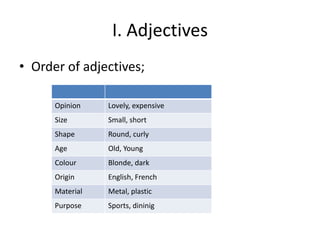
I. Adjectives
• Order of adjectives;
Opinion

Lovely, expensive

Size

Small, short

Shape

Round, curly

Age

Old, Young

Colour

Blonde, dark

Origin

English, French

Material

Metal, plastic

Purpose

Sports, dininig
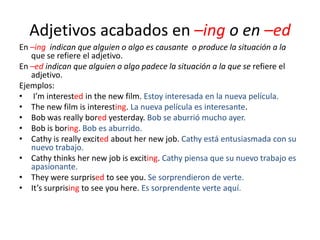
Adjetivos acabados en –ing o en –ed
En –ing indican que alguien o algo es causante o produce la situación a la
que se refiere el adjetivo.
En –ed indican que alguien o algo padece la situación a la que se refiere el
adjetivo.
Ejemplos:
• I’m interested in the new film. Estoy interesada en la nueva película.
• The new film is interesting. La nueva película es interesante.
• Bob was really bored yesterday. Bob se aburrió mucho ayer.
• Bob is boring. Bob es aburrido.
• Cathy is really excited about her new job. Cathy está entusiasmada con su
nuevo trabajo.
• Cathy thinks her new job is exciting. Cathy piensa que su nuevo trabajo es
apasionante.
• They were surprised to see you. Se sorprendieron de verte.
• It’s surprising to see you here. Es sorprendente verte aquí.
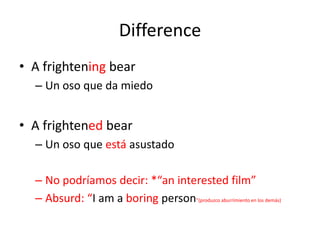
Difference
• A frightening bear
– Un oso que da miedo

• A frightened bear
– Un oso que está asustado
– No podríamos decir: *“an interested film”
– Absurd: “I am a boring person”(produzco aburrimiento en los demás)
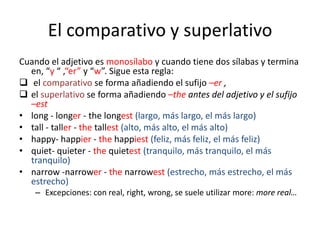
El comparativo y superlativo
Cuando el adjetivo es monosílabo y cuando tiene dos sílabas y termina
en, “y “ ,“er” y “w”. Sigue esta regla:
 el comparativo se forma añadiendo el sufijo –er ,
 el superlativo se forma añadiendo –the antes del adjetivo y el sufijo
–est
• long - longer - the longest (largo, más largo, el más largo)
• tall - taller - the tallest (alto, más alto, el más alto)
• happy- happier - the happiest (feliz, más feliz, el más feliz)
• quiet- quieter - the quietest (tranquilo, más tranquilo, el más
tranquilo)
• narrow -narrower - the narrowest (estrecho, más estrecho, el más
estrecho)
– Excepciones: con real, right, wrong, se suele utilizar more: more real…
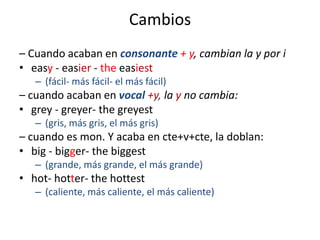
Cambios
– Cuando acaban en consonante + y, cambian la y por i
• easy - easier - the easiest
– (fácil- más fácil- el más fácil)

– cuando acaban en vocal +y, la y no cambia:
• grey - greyer- the greyest
– (gris, más gris, el más gris)

– cuando es mon. Y acaba en cte+v+cte, la doblan:
• big - bigger- the biggest
– (grande, más grande, el más grande)

• hot- hotter- the hottest
– (caliente, más caliente, el más caliente)
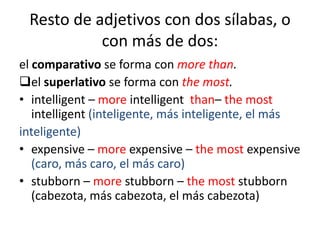
Resto de adjetivos con dos sílabas, o
con más de dos:
el comparativo se forma con more than.
el superlativo se forma con the most.
• intelligent – more intelligent than– the most
intelligent (inteligente, más inteligente, el más
inteligente)
• expensive – more expensive – the most expensive
(caro, más caro, el más caro)
• stubborn – more stubborn – the most stubborn
(cabezota, más cabezota, el más cabezota)
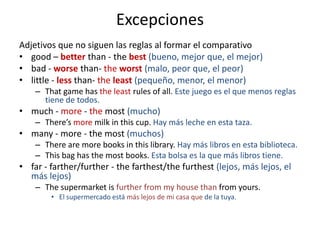
Excepciones
Adjetivos que no siguen las reglas al formar el comparativo
• good – better than - the best (bueno, mejor que, el mejor)
• bad - worse than- the worst (malo, peor que, el peor)
• little - less than- the least (pequeño, menor, el menor)
– That game has the least rules of all. Este juego es el que menos reglas
tiene de todos.

• much - more - the most (mucho)
– There’s more milk in this cup. Hay más leche en esta taza.

• many - more - the most (muchos)
– There are more books in this library. Hay más libros en esta biblioteca.
– This bag has the most books. Esta bolsa es la que más libros tiene.

• far - farther/further - the farthest/the furthest (lejos, más lejos, el
más lejos)
– The supermarket is further from my house than from yours.
• El supermercado está más lejos de mi casa que de la tuya.
Comparison

Comparison

  • 1.
  • 2.
    I. Adjectives • Orderof adjectives; Opinion Lovely, expensive Size Small, short Shape Round, curly Age Old, Young Colour Blonde, dark Origin English, French Material Metal, plastic Purpose Sports, dininig
  • 3.
    Adjetivos acabados en–ing o en –ed En –ing indican que alguien o algo es causante o produce la situación a la que se refiere el adjetivo. En –ed indican que alguien o algo padece la situación a la que se refiere el adjetivo. Ejemplos: • I’m interested in the new film. Estoy interesada en la nueva película. • The new film is interesting. La nueva película es interesante. • Bob was really bored yesterday. Bob se aburrió mucho ayer. • Bob is boring. Bob es aburrido. • Cathy is really excited about her new job. Cathy está entusiasmada con su nuevo trabajo. • Cathy thinks her new job is exciting. Cathy piensa que su nuevo trabajo es apasionante. • They were surprised to see you. Se sorprendieron de verte. • It’s surprising to see you here. Es sorprendente verte aquí.
  • 4.
    Difference • A frighteningbear – Un oso que da miedo • A frightened bear – Un oso que está asustado – No podríamos decir: *“an interested film” – Absurd: “I am a boring person”(produzco aburrimiento en los demás)
  • 5.
    El comparativo ysuperlativo Cuando el adjetivo es monosílabo y cuando tiene dos sílabas y termina en, “y “ ,“er” y “w”. Sigue esta regla:  el comparativo se forma añadiendo el sufijo –er ,  el superlativo se forma añadiendo –the antes del adjetivo y el sufijo –est • long - longer - the longest (largo, más largo, el más largo) • tall - taller - the tallest (alto, más alto, el más alto) • happy- happier - the happiest (feliz, más feliz, el más feliz) • quiet- quieter - the quietest (tranquilo, más tranquilo, el más tranquilo) • narrow -narrower - the narrowest (estrecho, más estrecho, el más estrecho) – Excepciones: con real, right, wrong, se suele utilizar more: more real…
  • 6.
    Cambios – Cuando acabanen consonante + y, cambian la y por i • easy - easier - the easiest – (fácil- más fácil- el más fácil) – cuando acaban en vocal +y, la y no cambia: • grey - greyer- the greyest – (gris, más gris, el más gris) – cuando es mon. Y acaba en cte+v+cte, la doblan: • big - bigger- the biggest – (grande, más grande, el más grande) • hot- hotter- the hottest – (caliente, más caliente, el más caliente)
  • 7.
    Resto de adjetivoscon dos sílabas, o con más de dos: el comparativo se forma con more than. el superlativo se forma con the most. • intelligent – more intelligent than– the most intelligent (inteligente, más inteligente, el más inteligente) • expensive – more expensive – the most expensive (caro, más caro, el más caro) • stubborn – more stubborn – the most stubborn (cabezota, más cabezota, el más cabezota)
  • 8.
    Excepciones Adjetivos que nosiguen las reglas al formar el comparativo • good – better than - the best (bueno, mejor que, el mejor) • bad - worse than- the worst (malo, peor que, el peor) • little - less than- the least (pequeño, menor, el menor) – That game has the least rules of all. Este juego es el que menos reglas tiene de todos. • much - more - the most (mucho) – There’s more milk in this cup. Hay más leche en esta taza. • many - more - the most (muchos) – There are more books in this library. Hay más libros en esta biblioteca. – This bag has the most books. Esta bolsa es la que más libros tiene. • far - farther/further - the farthest/the furthest (lejos, más lejos, el más lejos) – The supermarket is further from my house than from yours. • El supermercado está más lejos de mi casa que de la tuya.