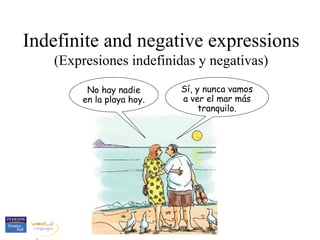
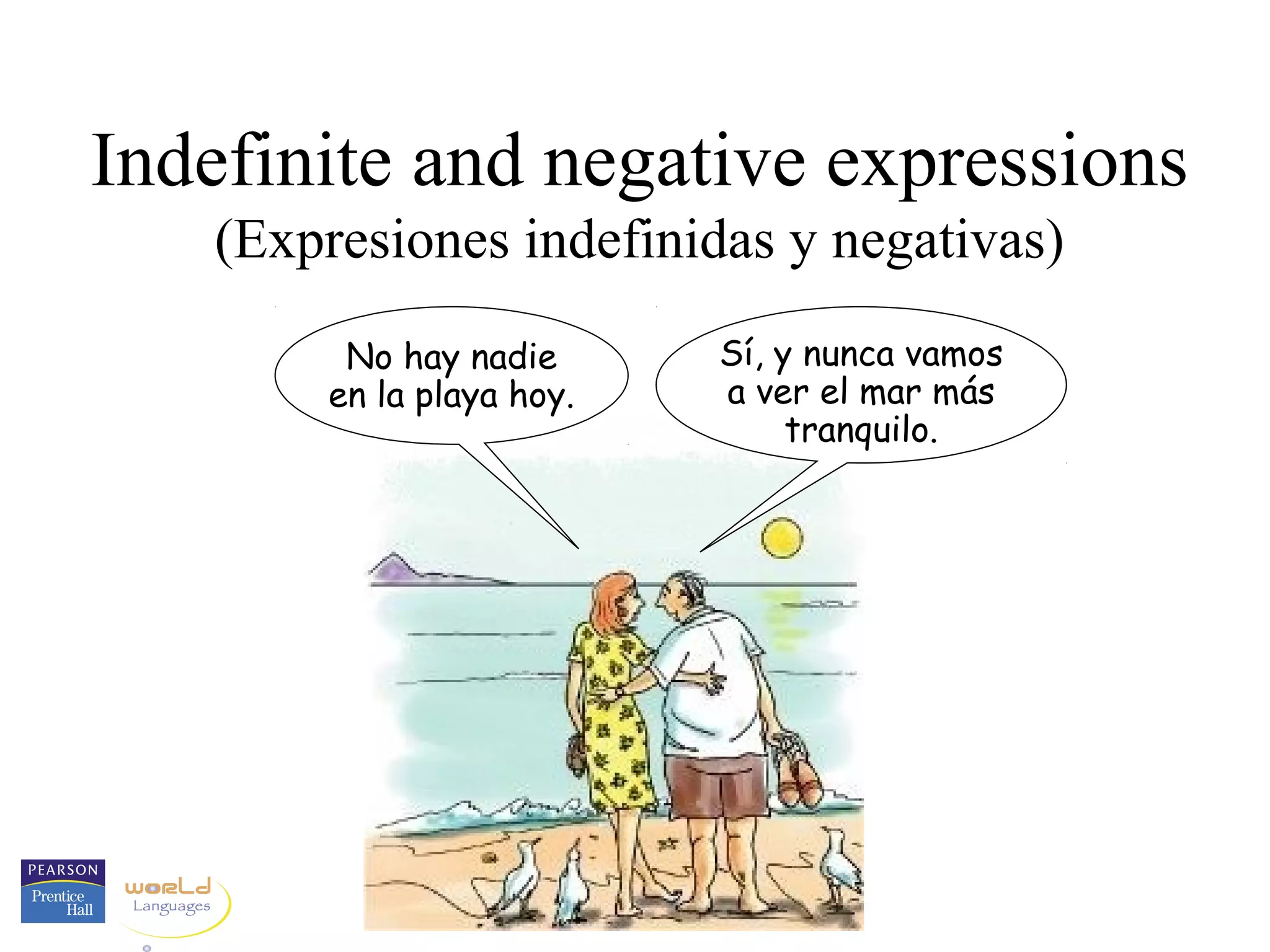
No hay nadie
en la playa hoy.
Sí, y nunca vamos
a ver el mar más
tranquilo.
Indefinite and negative expressions
(Expresiones indefinidas y negativas)
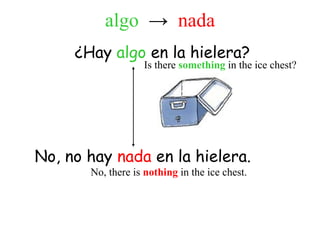
¿Hay algo en la hielera?
No, no hay nada en la hielera.
Is there something in the ice chest?
No, there is nothing in the ice chest.
algo → nada
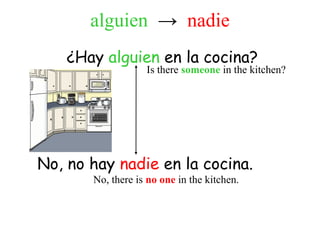
¿Hay alguien en la cocina?
No, no hay nadie en la cocina.
Is there someone in the kitchen?
No, there is no one in the kitchen.
alguien → nadie
alguien → nadie
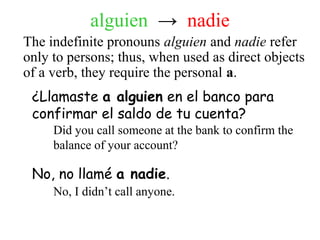
The indefinite pronouns alguien and nadie refer
only to persons; thus, when used as direct objects
of a verb, they require the personal a.
¿Llamaste a alguien en el banco para
confirmar el saldo de tu cuenta?
No, no llamé a nadie.
Did you call someone at the bank to confirm the
balance of your account?
No, I didn’t call anyone.
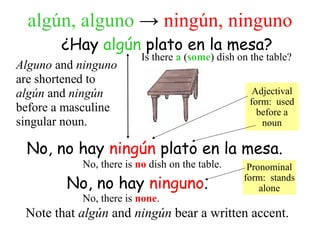
¿Hay algún plato en la mesa?
No, no hay ningún plato en la mesa.
Is there a (some) dish on the table?
No, there is no dish on the table.
No, no hay ninguno.
No, there is none.
algún, alguno → ningún, ninguno
Alguno and ninguno
are shortened to
algún and ningún
before a masculine
singular noun.
Adjectival
form: used
before a
noun
Pronominal
form: stands
alone
Note that algún and ningún bear a written accent.
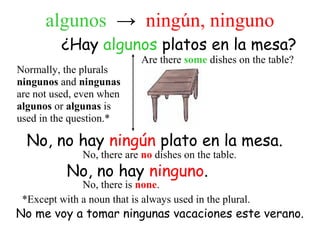
¿Hay algunos platos en la mesa?
No, no hay ningún plato en la mesa.
Are there some dishes on the table?
No, there are no dishes on the table.
No, no hay ninguno.
No, there is none.
algunos → ningún, ninguno
Normally, the plurals
ningunos and ningunas
are not used, even when
algunos or algunas is
used in the question.*
*Except with a noun that is always used in the plural.
No me voy a tomar ningunas vacaciones este verano.
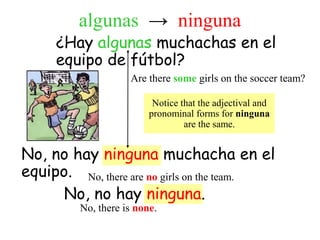
No, no hay ninguna muchacha en el
equipo.
No, no hay ninguna.
¿Hay algunas muchachas en el
equipo de fútbol?
Are there some girls on the soccer team?
No, there are no girls on the team.
No, there is none.
algunas → ninguna
Notice that the adjectival and
pronominal forms for ninguna
are the same.
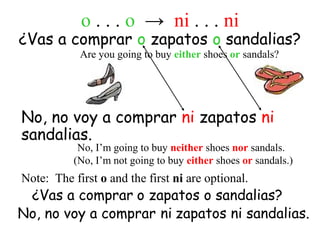
¿Vas a comprar o
No, no voy a comprar ni zapatos ni
sandalias.
o . . . o → ni . . . ni
¿Vas a comprar o zapatos o sandalias?
Are you going to buy either shoes or sandals?
No, I’m going to buy neither shoes nor sandals.
Note: The first o and the first ni are optional.
zapatos o sandalias?
ni zapatos ni sandalias.No, no voy a comprar
(No, I’m not going to buy either shoes or sandals.)
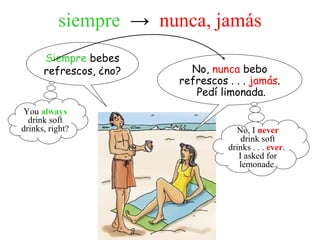
siempre → nunca, jamás
Siempre bebes
refrescos, ¿no? No, nunca bebo
refrescos . . . jamás.
Pedí limonada.
You always
drink soft
drinks, right? No, I never
drink soft
drinks . . . ever.
I asked for
lemonade.
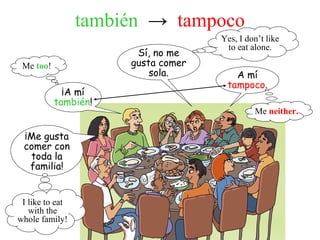
también → tampoco
¡Me gusta
comer con
toda la
familia!
¡A mí
también!
Sí, no me
gusta comer
sola. A mí
tampoco.
I like to eat
with the
whole family!
Me too!
Yes, I don’t like
to eat alone.
Me neither.
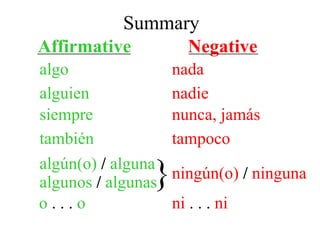
}
Summary
algo nada
alguien nadie
siempre nunca, jamás
también tampoco
algún(o) / alguna
algunos / algunas
ningún(o) / ninguna
o . . . o ni . . . ni
Affirmative Negative
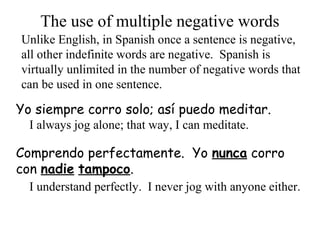
Yo siempre corro solo; así puedo meditar.
The use of multiple negative words
Unlike English, in Spanish once a sentence is negative,
all other indefinite words are negative. Spanish is
virtually unlimited in the number of negative words that
can be used in one sentence.
I always jog alone; that way, I can meditate.
Comprendo perfectamente. Yo nunca corro
con nadie tampoco.
I understand perfectly. I never jog with anyone either.
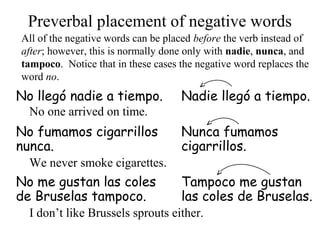
No llegó nadie a tiempo. Nadie llegó a tiempo.
No fumamos cigarrillos
nunca.
Nunca fumamos
cigarrillos.
No me gustan las coles
de Bruselas tampoco.
Tampoco me gustan
las coles de Bruselas.
Preverbal placement of negative words
All of the negative words can be placed before the verb instead of
after; however, this is normally done only with nadie, nunca, and
tampoco. Notice that in these cases the negative word replaces the
word no.
No one arrived on time.
We never smoke cigarettes.
I don’t like Brussels sprouts either.
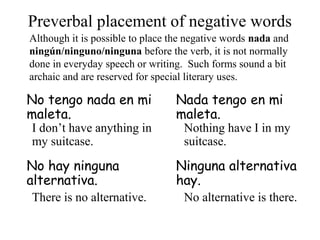
No tengo nada en mi
maleta.
Nada tengo en mi
maleta.
No hay ninguna
alternativa.
Ninguna alternativa
hay.
Preverbal placement of negative words
Although it is possible to place the negative words nada and
ningún/ninguno/ninguna before the verb, it is not normally
done in everyday speech or writing. Such forms sound a bit
archaic and are reserved for special literary uses.
I don’t have anything in
my suitcase.
Nothing have I in my
suitcase.
There is no alternative. No alternative is there.
FIN

Indefinite and Negative Expressions

  • 1.
    No hay nadie enla playa hoy. Sí, y nunca vamos a ver el mar más tranquilo. Indefinite and negative expressions (Expresiones indefinidas y negativas)
  • 2.
    ¿Hay algo enla hielera? No, no hay nada en la hielera. Is there something in the ice chest? No, there is nothing in the ice chest. algo → nada
  • 3.
    ¿Hay alguien enla cocina? No, no hay nadie en la cocina. Is there someone in the kitchen? No, there is no one in the kitchen. alguien → nadie
  • 4.
    alguien → nadie Theindefinite pronouns alguien and nadie refer only to persons; thus, when used as direct objects of a verb, they require the personal a. ¿Llamaste a alguien en el banco para confirmar el saldo de tu cuenta? No, no llamé a nadie. Did you call someone at the bank to confirm the balance of your account? No, I didn’t call anyone.
  • 5.
    ¿Hay algún platoen la mesa? No, no hay ningún plato en la mesa. Is there a (some) dish on the table? No, there is no dish on the table. No, no hay ninguno. No, there is none. algún, alguno → ningún, ninguno Alguno and ninguno are shortened to algún and ningún before a masculine singular noun. Adjectival form: used before a noun Pronominal form: stands alone Note that algún and ningún bear a written accent.
  • 6.
    ¿Hay algunos platosen la mesa? No, no hay ningún plato en la mesa. Are there some dishes on the table? No, there are no dishes on the table. No, no hay ninguno. No, there is none. algunos → ningún, ninguno Normally, the plurals ningunos and ningunas are not used, even when algunos or algunas is used in the question.* *Except with a noun that is always used in the plural. No me voy a tomar ningunas vacaciones este verano.
  • 7.
    No, no hayninguna muchacha en el equipo. No, no hay ninguna. ¿Hay algunas muchachas en el equipo de fútbol? Are there some girls on the soccer team? No, there are no girls on the team. No, there is none. algunas → ninguna Notice that the adjectival and pronominal forms for ninguna are the same.
  • 8.
    ¿Vas a compraro No, no voy a comprar ni zapatos ni sandalias. o . . . o → ni . . . ni ¿Vas a comprar o zapatos o sandalias? Are you going to buy either shoes or sandals? No, I’m going to buy neither shoes nor sandals. Note: The first o and the first ni are optional. zapatos o sandalias? ni zapatos ni sandalias.No, no voy a comprar (No, I’m not going to buy either shoes or sandals.)
  • 9.
    siempre → nunca,jamás Siempre bebes refrescos, ¿no? No, nunca bebo refrescos . . . jamás. Pedí limonada. You always drink soft drinks, right? No, I never drink soft drinks . . . ever. I asked for lemonade.
  • 10.
    también → tampoco ¡Megusta comer con toda la familia! ¡A mí también! Sí, no me gusta comer sola. A mí tampoco. I like to eat with the whole family! Me too! Yes, I don’t like to eat alone. Me neither.
  • 11.
    } Summary algo nada alguien nadie siemprenunca, jamás también tampoco algún(o) / alguna algunos / algunas ningún(o) / ninguna o . . . o ni . . . ni Affirmative Negative
  • 12.
    Yo siempre corrosolo; así puedo meditar. The use of multiple negative words Unlike English, in Spanish once a sentence is negative, all other indefinite words are negative. Spanish is virtually unlimited in the number of negative words that can be used in one sentence. I always jog alone; that way, I can meditate. Comprendo perfectamente. Yo nunca corro con nadie tampoco. I understand perfectly. I never jog with anyone either.
  • 13.
    No llegó nadiea tiempo. Nadie llegó a tiempo. No fumamos cigarrillos nunca. Nunca fumamos cigarrillos. No me gustan las coles de Bruselas tampoco. Tampoco me gustan las coles de Bruselas. Preverbal placement of negative words All of the negative words can be placed before the verb instead of after; however, this is normally done only with nadie, nunca, and tampoco. Notice that in these cases the negative word replaces the word no. No one arrived on time. We never smoke cigarettes. I don’t like Brussels sprouts either.
  • 14.
    No tengo nadaen mi maleta. Nada tengo en mi maleta. No hay ninguna alternativa. Ninguna alternativa hay. Preverbal placement of negative words Although it is possible to place the negative words nada and ningún/ninguno/ninguna before the verb, it is not normally done in everyday speech or writing. Such forms sound a bit archaic and are reserved for special literary uses. I don’t have anything in my suitcase. Nothing have I in my suitcase. There is no alternative. No alternative is there.
  • 15.