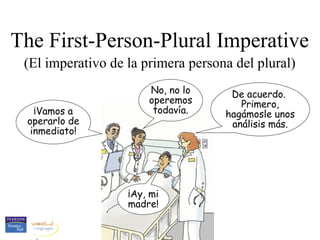
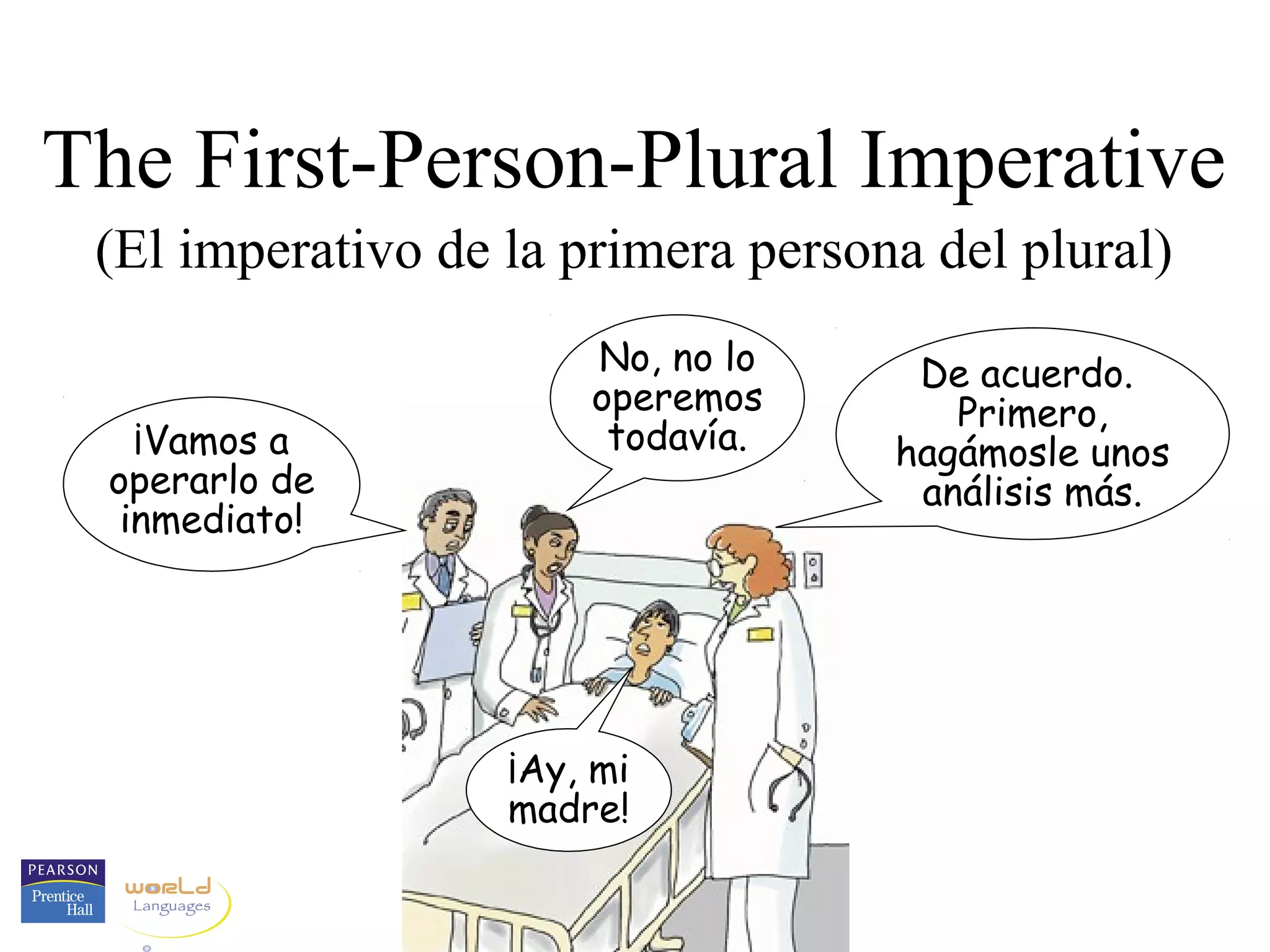
The First-Person-Plural Imperative
(El imperativo de la primera persona del plural)
¡Vamos a
operarlo de
inmediato!
No, no lo
operemos
todavía.
De acuerdo.
Primero,
hagámosle unos
análisis más.
¡Ay, mi
madre!
The imperative of nosotros
The expression “ir a” plus infinitive, as we
already know, generally indicates a future activity
that someone will engage in.
Los niños van a tener una fiesta
mañana.
The children are going to have a party
tomorrow.
However, one of the most common uses of the
nosotros form of this construction is to suggest that
some persons, including the speaker, do something
together.
¡Vamos a tener una fiesta mañana!
Let’s have a party tomorrow!
Notice that this usage is emphatic and is
often accompanied by exclamation marks
when expressed in writing.
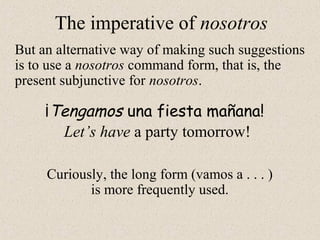
The imperative of nosotros
But an alternative way of making such suggestions
is to use a nosotros command form, that is, the
present subjunctive for nosotros.
¡Tengamos una fiesta mañana!
Let’s have a party tomorrow!
Curiously, the long form (vamos a . . . )
is more frequently used.
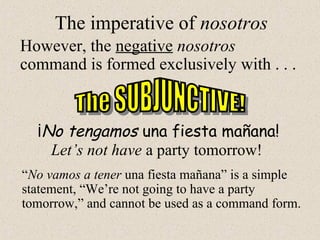
The imperative of nosotros
However, the negative nosotros
command is formed exclusively with . . .
¡No tengamos una fiesta mañana!
Let’s not have a party tomorrow!
“No vamos a tener una fiesta mañana” is a simple
statement, “We’re not going to have a party
tomorrow,” and cannot be used as a command form.
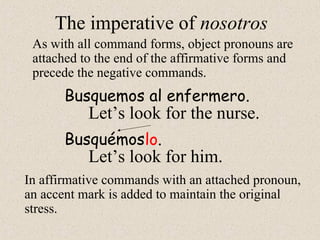
The imperative of nosotros
As with all command forms, object pronouns are
attached to the end of the affirmative forms and
precede the negative commands.
Busquemos al enfermero.
Let’s look for the nurse.
In affirmative commands with an attached pronoun,
an accent mark is added to maintain the original
stress.
Busquémos
Let’s look for him.
lo.
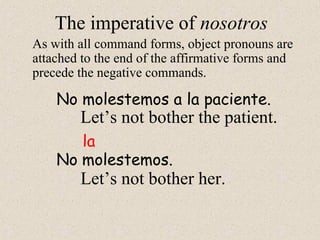
The imperative of nosotros
As with all command forms, object pronouns are
attached to the end of the affirmative forms and
precede the negative commands.
No molestemos a la paciente.
Let’s not bother the patient.
No
Let’s not bother her.
la
molestemos.
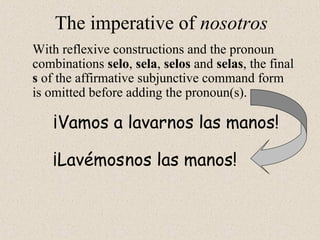
¡Lavémos
¡Vamos a lavarnos las manos!
The imperative of nosotros
With reflexive constructions and the pronoun
combinations selo, sela, selos and selas, the final
s of the affirmative subjunctive command form
is omitted before adding the pronoun(s).
nos las manos!
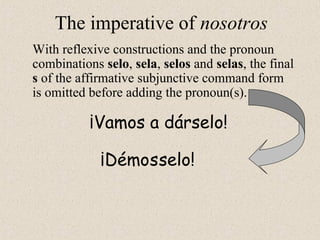
¡Démos
¡Vamos a dárselo!
The imperative of nosotros
selo!
With reflexive constructions and the pronoun
combinations selo, sela, selos and selas, the final
s of the affirmative subjunctive command form
is omitted before adding the pronoun(s).
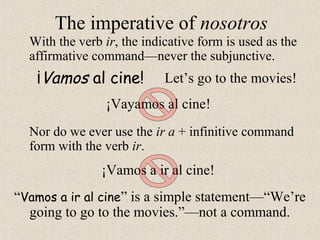
¡Vayamos al cine!
¡Vamos al cine!
The imperative of nosotros
With the verb ir, the indicative form is used as the
affirmative command—never the subjunctive.
¡Vamos a ir al cine!
Nor do we ever use the ir a + infinitive command
form with the verb ir.
“Vamos a ir al cine” is a simple statement—“We’re
going to go to the movies.”—not a command.
Let’s go to the movies!
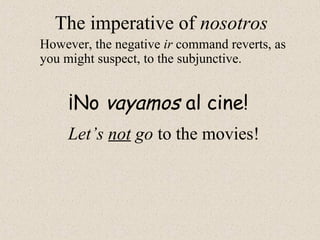
¡No vayamos al cine!
The imperative of nosotros
However, the negative ir command reverts, as
you might suspect, to the subjunctive.
Let’s not go to the movies!
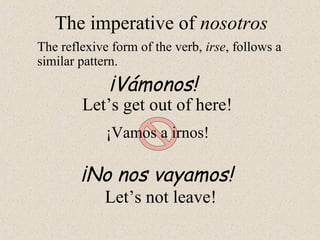
¡Vámonos!
The imperative of nosotros
The reflexive form of the verb, irse, follows a
similar pattern.
Let’s get out of here!
¡No nos vayamos!
Let’s not leave!
¡Vamos a irnos!
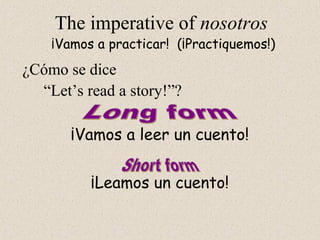
¡Vamos a leer un cuento!
¡Leamos un cuento!
The imperative of nosotros
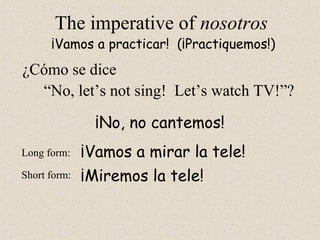
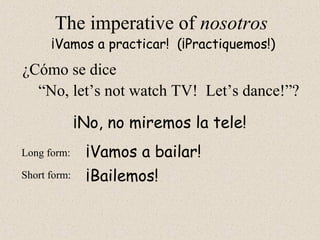
¡Vamos a practicar! (¡Practiquemos!)
¿Cómo se dice
“Let’s read a story!”?
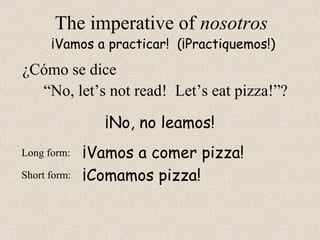
¡Comamos pizza!
The imperative of nosotros
“No, let’s not read! Let’s eat pizza!”?
¡Vamos a practicar! (¡Practiquemos!)
Long form:
Short form:
¡No, no leamos!
¡Vamos a comer pizza!
¿Cómo se dice
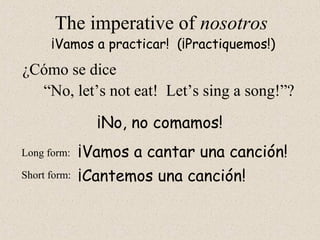
¡Cantemos una canción!
The imperative of nosotros
“No, let’s not eat! Let’s sing a song!”?
¡Vamos a practicar! (¡Practiquemos!)
Long form:
Short form:
¡No, no comamos!
¡Vamos a cantar una canción!
¿Cómo se dice
¡Miremos la tele!
The imperative of nosotros
“No, let’s not sing! Let’s watch TV!”?
¡Vamos a practicar! (¡Practiquemos!)
Long form:
Short form:
¡No, no cantemos!
¡Vamos a mirar la tele!
¿Cómo se dice
¡Bailemos!
The imperative of nosotros
“No, let’s not watch TV! Let’s dance!”?
¡Vamos a practicar! (¡Practiquemos!)
Long form:
Short form:
¡No, no miremos la tele!
¡Vamos a bailar!
¿Cómo se dice
¡Escribamos una carta!
The imperative of nosotros
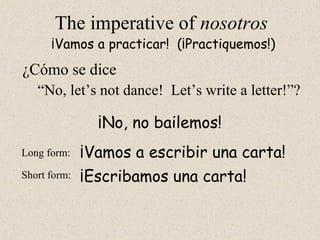
“No, let’s not dance! Let’s write a letter!”?
¡Vamos a practicar! (¡Practiquemos!)
Long form:
Short form:
¡No, no bailemos!
¡Vamos a escribir una carta!
¿Cómo se dice
¡Vámonos!
The imperative of nosotros
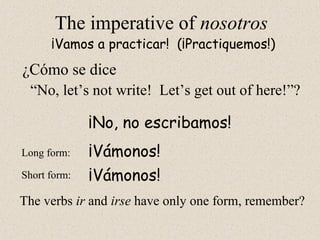
“No, let’s not write! Let’s get out of here!”?
¡Vamos a practicar! (¡Practiquemos!)
Long form:
Short form:
¡No, no escribamos!
¡Vámonos!
The verbs ir and irse have only one form, remember?
¿Cómo se dice
¡Estudiemos español!
The imperative of nosotros
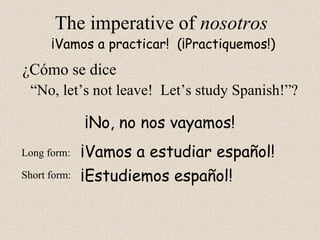
“No, let’s not leave! Let’s study Spanish!”?
¡Vamos a practicar! (¡Practiquemos!)
Long form:
Short form:
¡No, no nos vayamos!
¡Vamos a estudiar español!
¿Cómo se dice
FIN

Nosotros commands imperative

  • 1.
    The First-Person-Plural Imperative (Elimperativo de la primera persona del plural) ¡Vamos a operarlo de inmediato! No, no lo operemos todavía. De acuerdo. Primero, hagámosle unos análisis más. ¡Ay, mi madre!
  • 2.
    The imperative ofnosotros The expression “ir a” plus infinitive, as we already know, generally indicates a future activity that someone will engage in. Los niños van a tener una fiesta mañana. The children are going to have a party tomorrow.
  • 3.
    However, one ofthe most common uses of the nosotros form of this construction is to suggest that some persons, including the speaker, do something together. ¡Vamos a tener una fiesta mañana! Let’s have a party tomorrow! Notice that this usage is emphatic and is often accompanied by exclamation marks when expressed in writing. The imperative of nosotros
  • 4.
    The imperative ofnosotros But an alternative way of making such suggestions is to use a nosotros command form, that is, the present subjunctive for nosotros. ¡Tengamos una fiesta mañana! Let’s have a party tomorrow! Curiously, the long form (vamos a . . . ) is more frequently used.
  • 5.
    The imperative ofnosotros However, the negative nosotros command is formed exclusively with . . . ¡No tengamos una fiesta mañana! Let’s not have a party tomorrow! “No vamos a tener una fiesta mañana” is a simple statement, “We’re not going to have a party tomorrow,” and cannot be used as a command form.
  • 6.
    The imperative ofnosotros As with all command forms, object pronouns are attached to the end of the affirmative forms and precede the negative commands. Busquemos al enfermero. Let’s look for the nurse. In affirmative commands with an attached pronoun, an accent mark is added to maintain the original stress. Busquémos Let’s look for him. lo.
  • 7.
    The imperative ofnosotros As with all command forms, object pronouns are attached to the end of the affirmative forms and precede the negative commands. No molestemos a la paciente. Let’s not bother the patient. No Let’s not bother her. la molestemos.
  • 8.
    ¡Lavémos ¡Vamos a lavarnoslas manos! The imperative of nosotros With reflexive constructions and the pronoun combinations selo, sela, selos and selas, the final s of the affirmative subjunctive command form is omitted before adding the pronoun(s). nos las manos!
  • 9.
    ¡Démos ¡Vamos a dárselo! Theimperative of nosotros selo! With reflexive constructions and the pronoun combinations selo, sela, selos and selas, the final s of the affirmative subjunctive command form is omitted before adding the pronoun(s).
  • 10.
    ¡Vayamos al cine! ¡Vamosal cine! The imperative of nosotros With the verb ir, the indicative form is used as the affirmative command—never the subjunctive. ¡Vamos a ir al cine! Nor do we ever use the ir a + infinitive command form with the verb ir. “Vamos a ir al cine” is a simple statement—“We’re going to go to the movies.”—not a command. Let’s go to the movies!
  • 11.
    ¡No vayamos alcine! The imperative of nosotros However, the negative ir command reverts, as you might suspect, to the subjunctive. Let’s not go to the movies!
  • 12.
    ¡Vámonos! The imperative ofnosotros The reflexive form of the verb, irse, follows a similar pattern. Let’s get out of here! ¡No nos vayamos! Let’s not leave! ¡Vamos a irnos!
  • 13.
    ¡Vamos a leerun cuento! ¡Leamos un cuento! The imperative of nosotros ¡Vamos a practicar! (¡Practiquemos!) ¿Cómo se dice “Let’s read a story!”?
  • 14.
    ¡Comamos pizza! The imperativeof nosotros “No, let’s not read! Let’s eat pizza!”? ¡Vamos a practicar! (¡Practiquemos!) Long form: Short form: ¡No, no leamos! ¡Vamos a comer pizza! ¿Cómo se dice
  • 15.
    ¡Cantemos una canción! Theimperative of nosotros “No, let’s not eat! Let’s sing a song!”? ¡Vamos a practicar! (¡Practiquemos!) Long form: Short form: ¡No, no comamos! ¡Vamos a cantar una canción! ¿Cómo se dice
  • 16.
    ¡Miremos la tele! Theimperative of nosotros “No, let’s not sing! Let’s watch TV!”? ¡Vamos a practicar! (¡Practiquemos!) Long form: Short form: ¡No, no cantemos! ¡Vamos a mirar la tele! ¿Cómo se dice
  • 17.
    ¡Bailemos! The imperative ofnosotros “No, let’s not watch TV! Let’s dance!”? ¡Vamos a practicar! (¡Practiquemos!) Long form: Short form: ¡No, no miremos la tele! ¡Vamos a bailar! ¿Cómo se dice
  • 18.
    ¡Escribamos una carta! Theimperative of nosotros “No, let’s not dance! Let’s write a letter!”? ¡Vamos a practicar! (¡Practiquemos!) Long form: Short form: ¡No, no bailemos! ¡Vamos a escribir una carta! ¿Cómo se dice
  • 19.
    ¡Vámonos! The imperative ofnosotros “No, let’s not write! Let’s get out of here!”? ¡Vamos a practicar! (¡Practiquemos!) Long form: Short form: ¡No, no escribamos! ¡Vámonos! The verbs ir and irse have only one form, remember? ¿Cómo se dice
  • 20.
    ¡Estudiemos español! The imperativeof nosotros “No, let’s not leave! Let’s study Spanish!”? ¡Vamos a practicar! (¡Practiquemos!) Long form: Short form: ¡No, no nos vayamos! ¡Vamos a estudiar español! ¿Cómo se dice
  • 21.