@miquelduran
Magic and Science
Miquel DURAN
Càtedra de Cultura Científica i Comunicació Digital,
Universitat de Girona
miquel.duran@udg.edu
@miquelduran @quelet
http://magsci.eu @magsci #magsci
@miquelduran
What is magic?
• Magic is "the theatrical art of creating the
illusion of impossibility in an entertaining way"
(Charles Reynolds)
– (replace entertainment by science, knowledge, ...)
• Magic is “the theatrical art of wonder obtained
through complex means using natural science,
psychology, drama, specific principles, and
digital dexterity" (Roberto Giobbi)
• A conjuror is “an actor playing the part of a
magician” (Robert-Houdin"
@miquelduran
What is Science?
• The intellectual and practical activity
encompassing the systematic study of the
structure and behaviour of the physical and
natural world through observation and
experiment
• A systematic enterprise that builds and
organizes knowledge in the form of
testable explanations and predictions about
the universe
@miquelduran
The three levels of magic
• Timeline of magic effect:
– Surprise
– Astonishment
– Mistery
• Mystery is surprise that has evolved over
time. Surprise is the seed, mystery is the
flower (Andy J.)
@miquelduran
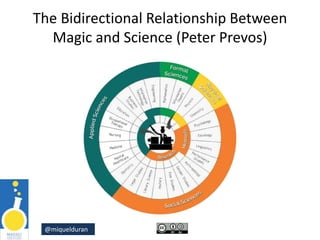
The Bidirectional Relationship Between
Magic and Science (Peter Prevos)
@miquelduran
The Bidirectional Relationship Between
Magic and Science (Peter Prevos)
• Magicians present theatrical illusions that seemingly
breach the laws of the physical sciences, but they often
deploy the principles of these and other sciences to
create these illusions. Scientists are interested in magic
because they seek to understand this unique
performance art better.
• The relationship between science and magic is thus bi-
directional. Magicians use science to create the illusion
of supernatural magic, while scientists study
magicians and their craft to learn more about the world
around us.
@miquelduran
The Science of Magic (Kuhn)
@miquelduran
Richard Wiseman
• Videos
• Books
• https://richardwiseman.wordpress.com/blog-2
@miquelduran
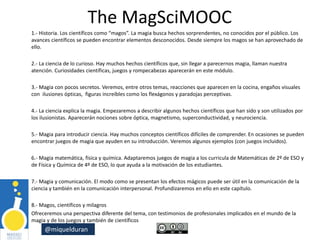
The MagSciMOOC
1.- Historia. Los científicos como “magos”. La magia busca hechos sorprendentes, no conocidos por el público. Los
avances científicos se pueden encontrar elementos desconocidos. Desde siempre los magos se han aprovechado de
ello.
2.- La ciencia de lo curioso. Hay muchos hechos científicos que, sin llegar a parecernos magia, llaman nuestra
atención. Curiosidades científicas, juegos y rompecabezas aparecerán en este módulo.
3.- Magia con pocos secretos. Veremos, entre otros temas, reacciones que aparecen en la cocina, engaños visuales
con ilusiones ópticas, figuras increíbles como los flexágonos y paradojas perceptivas.
4.- La ciencia explica la magia. Empezaremos a describir algunos hechos científicos que han sido y son utilizados por
los ilusionistas. Aparecerán nociones sobre óptica, magnetismo, superconductividad, y neurociencia.
5.- Magia para introducir ciencia. Hay muchos conceptos científicos difíciles de comprender. En ocasiones se pueden
encontrar juegos de magia que ayuden en su introducción. Veremos algunos ejemplos (con juegos incluidos).
6.- Magia matemática, física y química. Adaptaremos juegos de magia a los curricula de Matemáticas de 2º de ESO y
de Física y Química de 4º de ESO, lo que ayuda a la motivación de los estudiantes.
7.- Magia y comunicación. El modo como se presentan los efectos mágicos puede ser útil en la comunicación de la
ciencia y también en la comunicación interpersonal. Profundizaremos en ello en este capítulo.
8.- Magos, científicos y milagros
Ofreceremos una perspectiva diferente del tema, con testimonios de profesionales implicados en el mundo de la
magia y de los juegos y también de científicos
@miquelduran
Other references
@miquelduran
Alex Stone in “Fooling Houdini”
• There is a wealth of connections between
magic and science: psychology, neuroscience,
mathematics, physics [+ chemistry]
• The world of magic is filled with scientists and
the world of science is filled with magicians
• Scientists and magicians are people who take
an interest in mysteries
Alex Stone, “Fouling Houdini. Magicinas, Mentalists, Math Geeks and the
Hidden Power of the Mind”. Harper Collins, New York, 2012
@miquelduran
Teaching key Science terms
• Magic, when used wisely, is able to make
things more attractive
• Magic should be used cautiously: students
should remember the concept, rather that
the surprise the effect brings about
• Magic should be combined with other
motivational tools
@miquelduran
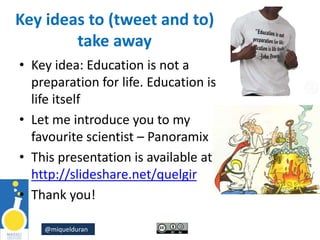
Key ideas to (tweet and to)
take away
• Key idea: Education is not a
preparation for life. Education is
life itself
• Let me introduce you to my
favourite scientist – Panoramix
• This presentation is available at
http://slideshare.net/quelgir
• Thank you!

Màgia i ciència

  • 1.
    @miquelduran Magic and Science MiquelDURAN Càtedra de Cultura Científica i Comunicació Digital, Universitat de Girona miquel.duran@udg.edu @miquelduran @quelet http://magsci.eu @magsci #magsci
  • 2.
    @miquelduran What is magic? •Magic is "the theatrical art of creating the illusion of impossibility in an entertaining way" (Charles Reynolds) – (replace entertainment by science, knowledge, ...) • Magic is “the theatrical art of wonder obtained through complex means using natural science, psychology, drama, specific principles, and digital dexterity" (Roberto Giobbi) • A conjuror is “an actor playing the part of a magician” (Robert-Houdin"
  • 3.
    @miquelduran What is Science? •The intellectual and practical activity encompassing the systematic study of the structure and behaviour of the physical and natural world through observation and experiment • A systematic enterprise that builds and organizes knowledge in the form of testable explanations and predictions about the universe
  • 4.
    @miquelduran The three levelsof magic • Timeline of magic effect: – Surprise – Astonishment – Mistery • Mystery is surprise that has evolved over time. Surprise is the seed, mystery is the flower (Andy J.)
  • 5.
    @miquelduran The Bidirectional RelationshipBetween Magic and Science (Peter Prevos)
  • 6.
    @miquelduran The Bidirectional RelationshipBetween Magic and Science (Peter Prevos) • Magicians present theatrical illusions that seemingly breach the laws of the physical sciences, but they often deploy the principles of these and other sciences to create these illusions. Scientists are interested in magic because they seek to understand this unique performance art better. • The relationship between science and magic is thus bi- directional. Magicians use science to create the illusion of supernatural magic, while scientists study magicians and their craft to learn more about the world around us.
  • 7.
  • 8.
    @miquelduran Richard Wiseman • Videos •Books • https://richardwiseman.wordpress.com/blog-2
  • 9.
    @miquelduran The MagSciMOOC 1.- Historia.Los científicos como “magos”. La magia busca hechos sorprendentes, no conocidos por el público. Los avances científicos se pueden encontrar elementos desconocidos. Desde siempre los magos se han aprovechado de ello. 2.- La ciencia de lo curioso. Hay muchos hechos científicos que, sin llegar a parecernos magia, llaman nuestra atención. Curiosidades científicas, juegos y rompecabezas aparecerán en este módulo. 3.- Magia con pocos secretos. Veremos, entre otros temas, reacciones que aparecen en la cocina, engaños visuales con ilusiones ópticas, figuras increíbles como los flexágonos y paradojas perceptivas. 4.- La ciencia explica la magia. Empezaremos a describir algunos hechos científicos que han sido y son utilizados por los ilusionistas. Aparecerán nociones sobre óptica, magnetismo, superconductividad, y neurociencia. 5.- Magia para introducir ciencia. Hay muchos conceptos científicos difíciles de comprender. En ocasiones se pueden encontrar juegos de magia que ayuden en su introducción. Veremos algunos ejemplos (con juegos incluidos). 6.- Magia matemática, física y química. Adaptaremos juegos de magia a los curricula de Matemáticas de 2º de ESO y de Física y Química de 4º de ESO, lo que ayuda a la motivación de los estudiantes. 7.- Magia y comunicación. El modo como se presentan los efectos mágicos puede ser útil en la comunicación de la ciencia y también en la comunicación interpersonal. Profundizaremos en ello en este capítulo. 8.- Magos, científicos y milagros Ofreceremos una perspectiva diferente del tema, con testimonios de profesionales implicados en el mundo de la magia y de los juegos y también de científicos
  • 10.
  • 11.
    @miquelduran Alex Stone in“Fooling Houdini” • There is a wealth of connections between magic and science: psychology, neuroscience, mathematics, physics [+ chemistry] • The world of magic is filled with scientists and the world of science is filled with magicians • Scientists and magicians are people who take an interest in mysteries Alex Stone, “Fouling Houdini. Magicinas, Mentalists, Math Geeks and the Hidden Power of the Mind”. Harper Collins, New York, 2012
  • 12.
    @miquelduran Teaching key Scienceterms • Magic, when used wisely, is able to make things more attractive • Magic should be used cautiously: students should remember the concept, rather that the surprise the effect brings about • Magic should be combined with other motivational tools
  • 13.
    @miquelduran Key ideas to(tweet and to) take away • Key idea: Education is not a preparation for life. Education is life itself • Let me introduce you to my favourite scientist – Panoramix • This presentation is available at http://slideshare.net/quelgir • Thank you!