Erika Priscila Prado Escobar Samantha Villalobos Grupo: 308 Turno: Vespertino Actualización Del Equipo De Computo
Pentium MMX Y SOCKET 7 Pentium de 100MHz por uno Pentium MMX para tener un rendimiento de 166MHz, Pentium de 90MHz por uno Pentium MMX con un rendimiento de 150MHz y finalmente el Pentium de 75MHz por un Pentium MMX con un rendimiento de 125MHzNombre: Socket 7 Pines: 296 LIF y 321 ZIF Voltajes: Split, STD, VR, VRE, VRT (2.5 - 3.3 V) Bus: 40, 50, 55, 60, 62, 66, 68, 75, 83, 90, 95, 100, 102, 112, 124 Multiplicadores:  1.5x - 6.0x Micros soportados: Pentium P45C (75~200 MHz) Pentium MMX P55C (166~266 MHz)
PENTIUM 2 Y SOCKET 8 32 KB de caché de primer nivel  512 KB de caché de segundo nivel  BUS a 100/133MHz  70 Nuevas instrucciones  ID (del que hablaremos más tarde)  Nombre: Socket 8 Pines: 387 LIF y 387 ZIF Voltajes: VID VRM (2.1 - 3.5 V) Bus: 60, 66, 75 MHz Multiplicadores:  2.0x - 8.0x Micros soportados: Pentium Pro (150-200 MHz) Pentium II OverDrive (300-333 MHz) Adaptadores soportados: Evergreen AcceleraPCI PowerLeap PL-Pro/II
PENTIUM 4 Y SOCKET 478 Características :Arquitectura:90 NM Caché:1 MB Bus Frontal:533 MHz Características Adicionales: Híper-ThreadingInterfaz : Socket 478 Velocidad de reloj:3.2 GHz Nombre: Socket 478 Pines: 478 ZIF Voltajes: VID VRM Bus: 100x4, 133x4, 200x4 MHz Multiplicadores:  12.0x - 28.0x Micros soportados: Celeron (Willamette, 1'7 - 1'8 GHz) Celeron (Norwood 1'6 - 2'8 GHz) Celeron D (Prescott 310/2'333 Ghz - 340/'2933 GHz) Pentium 4 (Willamette 1'4 - 2'0 GHz) Pentium 4 (Norwood 1'6A - 3'4C) Pentium 4 (Prescott, 2,26A - 3,4E GHz) Pentium 4 Extreme Edition (Gallatin, 3'2 - 3'4 GHz) Pentium M (Banias, 600 MHz - 1'7 GHz, con adaptador) Pentium M (Dothan, 600 MHz - 2'26 GHz, con adaptador)
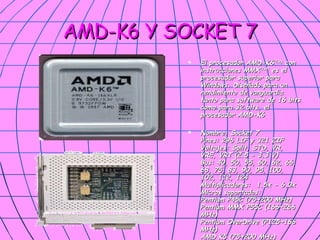
AMD-K6 Y SOCKET 7 El procesador AMD-K6 (TM)  con instrucciones MMX (TM)  es el procesador superior para Windows. Diseñado para un rendimiento de vanguardia tanto para software de 16 bits como para 32 bits, el procesador AMD-K6  Nombre: Socket 7 Pines: 296 LIF y 321 ZIF Voltajes: Split, STD, VR, VRE, VRT (2.5 - 3.3 V) Bus: 40, 50, 55, 60, 62, 66, 68, 75, 83, 90, 95, 100, 102, 112, 124 Multiplicadores:  1.5x - 6.0x Micros soportados: Pentium P45C (75~200 MHz) Pentium MMX P55C (166~266 MHz) Pentium OverDrive (P125~166 MHz) AMD K5 (75~200 MHz) K6 (166~300 MHz) K6-2 (266~570 MHz)
PENTIUM 3 Y SOCKET 370 32 KB de caché de primer nivel  512 KB de caché de segundo nivel  BUS a 100/133MHz  70 Nuevas instrucciones  ID (del que hablaremos más tarde)  Nombre: Socket 370 Pines: 370 ZIF Voltajes: VID VRM (1.05 - 2.1 V) Bus: 66, 100, 133 MHz Multiplicadores:  4.5x - 14.0x Micros soportados: Celeron (Mendocino, 300A - 533 MHz) Celeron (Coppermine (500A MHz - 1'1 GHz) Celeron (Tualatin, 900A MHz - 1'4 GHZ) Pentium III (Coopermine, 500E MHz - 1'13 GHZ) Pentium III (Coopermine-T, 866 MHz - 1'13 GHZ

Priscila

  • 1.
    Erika Priscila PradoEscobar Samantha Villalobos Grupo: 308 Turno: Vespertino Actualización Del Equipo De Computo
  • 2.
    Pentium MMX YSOCKET 7 Pentium de 100MHz por uno Pentium MMX para tener un rendimiento de 166MHz, Pentium de 90MHz por uno Pentium MMX con un rendimiento de 150MHz y finalmente el Pentium de 75MHz por un Pentium MMX con un rendimiento de 125MHzNombre: Socket 7 Pines: 296 LIF y 321 ZIF Voltajes: Split, STD, VR, VRE, VRT (2.5 - 3.3 V) Bus: 40, 50, 55, 60, 62, 66, 68, 75, 83, 90, 95, 100, 102, 112, 124 Multiplicadores:  1.5x - 6.0x Micros soportados: Pentium P45C (75~200 MHz) Pentium MMX P55C (166~266 MHz)
  • 3.
    PENTIUM 2 YSOCKET 8 32 KB de caché de primer nivel 512 KB de caché de segundo nivel BUS a 100/133MHz 70 Nuevas instrucciones ID (del que hablaremos más tarde) Nombre: Socket 8 Pines: 387 LIF y 387 ZIF Voltajes: VID VRM (2.1 - 3.5 V) Bus: 60, 66, 75 MHz Multiplicadores:  2.0x - 8.0x Micros soportados: Pentium Pro (150-200 MHz) Pentium II OverDrive (300-333 MHz) Adaptadores soportados: Evergreen AcceleraPCI PowerLeap PL-Pro/II
  • 4.
    PENTIUM 4 YSOCKET 478 Características :Arquitectura:90 NM Caché:1 MB Bus Frontal:533 MHz Características Adicionales: Híper-ThreadingInterfaz : Socket 478 Velocidad de reloj:3.2 GHz Nombre: Socket 478 Pines: 478 ZIF Voltajes: VID VRM Bus: 100x4, 133x4, 200x4 MHz Multiplicadores:  12.0x - 28.0x Micros soportados: Celeron (Willamette, 1'7 - 1'8 GHz) Celeron (Norwood 1'6 - 2'8 GHz) Celeron D (Prescott 310/2'333 Ghz - 340/'2933 GHz) Pentium 4 (Willamette 1'4 - 2'0 GHz) Pentium 4 (Norwood 1'6A - 3'4C) Pentium 4 (Prescott, 2,26A - 3,4E GHz) Pentium 4 Extreme Edition (Gallatin, 3'2 - 3'4 GHz) Pentium M (Banias, 600 MHz - 1'7 GHz, con adaptador) Pentium M (Dothan, 600 MHz - 2'26 GHz, con adaptador)
  • 5.
    AMD-K6 Y SOCKET7 El procesador AMD-K6 (TM) con instrucciones MMX (TM) es el procesador superior para Windows. Diseñado para un rendimiento de vanguardia tanto para software de 16 bits como para 32 bits, el procesador AMD-K6 Nombre: Socket 7 Pines: 296 LIF y 321 ZIF Voltajes: Split, STD, VR, VRE, VRT (2.5 - 3.3 V) Bus: 40, 50, 55, 60, 62, 66, 68, 75, 83, 90, 95, 100, 102, 112, 124 Multiplicadores:  1.5x - 6.0x Micros soportados: Pentium P45C (75~200 MHz) Pentium MMX P55C (166~266 MHz) Pentium OverDrive (P125~166 MHz) AMD K5 (75~200 MHz) K6 (166~300 MHz) K6-2 (266~570 MHz)
  • 6.
    PENTIUM 3 YSOCKET 370 32 KB de caché de primer nivel 512 KB de caché de segundo nivel BUS a 100/133MHz 70 Nuevas instrucciones ID (del que hablaremos más tarde) Nombre: Socket 370 Pines: 370 ZIF Voltajes: VID VRM (1.05 - 2.1 V) Bus: 66, 100, 133 MHz Multiplicadores:  4.5x - 14.0x Micros soportados: Celeron (Mendocino, 300A - 533 MHz) Celeron (Coppermine (500A MHz - 1'1 GHz) Celeron (Tualatin, 900A MHz - 1'4 GHZ) Pentium III (Coopermine, 500E MHz - 1'13 GHZ) Pentium III (Coopermine-T, 866 MHz - 1'13 GHZ