3.2 Possessive Adjectives

ANTE TODO
 Possessive adjectives, like descriptive adjectives,
  are words that are used to qualify people, places,
  or things.
 Possessive adjectives express the quality of
  ownership or possession.
3.2 Possessive Adjectives
            Forms of possessive adjectives

SINGULAR FORMS     PLURAL FORMS
mi                 mis             my
tu                 tus             your (fam.)
su                 sus             his, her, its, your (form.)
nuestro/a          nuestros/as     our
vuestro/a          vuestros/as     your (fam.)
su                 sus             their, your (form.)
3.2 Possessive Adjectives
           COMPARE & CONTRAST
 In English, possessive adjectives are invariable; that is, they do not
  agree in gender and number with the nouns they modify.

   my cousin    my cousins       my aunt          my aunts

 Spanish possessive adjectives, however, do agree in number with
  the nouns they modify.

   mi primo     mis primos       mi tía           mis tías

 The forms nuestro and vuestro agree in both gender and number
  with the nouns they modify.

   nuestro primo                 nuestra tía
   nuestros primos               nuestras tías
3.2 Possessive Adjectives

 Possessive adjectives are always placed before
  the nouns they modify.
  —¿Está tu novio aquí?
  Is your boyfriend here?

  —No, mi novio está en la biblioteca.
  No, my boyfriend is in the library.
3.2 Possessive Adjectives

 Because su and sus have multiple meanings (your, his, her,
  their, its), you can avoid confusion by using this construction
  instead: [article] + [noun] + de + [subject pronoun].

                      los parientes de él/ella       his/her relatives
sus parientes →       los parientes de Ud./Uds.      your relatives
                      los parientes de ellos/ellas   their relatives
3.2 Possessive Adjectives
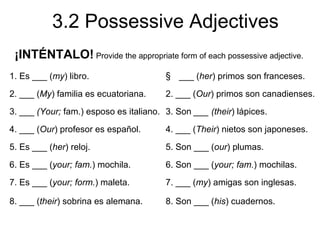
 ¡INTÉNTALO! Provide the appropriate form of each possessive adjective.
1. Es ___ (my) libro.                   § ___ (her) primos son franceses.

2. ___ (My) familia es ecuatoriana.     2. ___ (Our) primos son canadienses.
3. ___ (Your; fam.) esposo es italiano. 3. Son ___ (their) lápices.
4. ___ (Our) profesor es español.       4. ___ (Their) nietos son japoneses.
5. Es ___ (her) reloj.                  5. Son ___ (our) plumas.
6. Es ___ (your; fam.) mochila.         6. Son ___ (your; fam.) mochilas.
7. Es ___ (your; form.) maleta.         7. ___ (my) amigas son inglesas.

8. ___ (their) sobrina es alemana.      8. Son ___ (his) cuadernos.
3.2 Possessive Adjectives
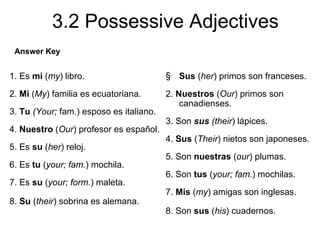
 Answer Key


1. Es mi (my) libro.                     § Sus (her) primos son franceses.

2. Mi (My) familia es ecuatoriana.       2. Nuestros (Our) primos son
                                             canadienses.
3. Tu (Your; fam.) esposo es italiano.
                                         3. Son sus (their) lápices.
4. Nuestro (Our) profesor es español.
                                         4. Sus (Their) nietos son japoneses.
5. Es su (her) reloj.
                                         5. Son nuestras (our) plumas.
6. Es tu (your; fam.) mochila.
                                         6. Son tus (your; fam.) mochilas.
7. Es su (your; form.) maleta.
                                         7. Mis (my) amigas son inglesas.
8. Su (their) sobrina es alemana.
                                         8. Son sus (his) cuadernos.

3.2 Possessive Adjectives

  • 1.
    3.2 Possessive Adjectives ANTETODO  Possessive adjectives, like descriptive adjectives, are words that are used to qualify people, places, or things.  Possessive adjectives express the quality of ownership or possession.
  • 2.
    3.2 Possessive Adjectives Forms of possessive adjectives SINGULAR FORMS PLURAL FORMS mi mis my tu tus your (fam.) su sus his, her, its, your (form.) nuestro/a nuestros/as our vuestro/a vuestros/as your (fam.) su sus their, your (form.)
  • 3.
    3.2 Possessive Adjectives COMPARE & CONTRAST  In English, possessive adjectives are invariable; that is, they do not agree in gender and number with the nouns they modify. my cousin my cousins my aunt my aunts  Spanish possessive adjectives, however, do agree in number with the nouns they modify. mi primo mis primos mi tía mis tías  The forms nuestro and vuestro agree in both gender and number with the nouns they modify. nuestro primo nuestra tía nuestros primos nuestras tías
  • 4.
    3.2 Possessive Adjectives Possessive adjectives are always placed before the nouns they modify. —¿Está tu novio aquí? Is your boyfriend here? —No, mi novio está en la biblioteca. No, my boyfriend is in the library.
  • 5.
    3.2 Possessive Adjectives Because su and sus have multiple meanings (your, his, her, their, its), you can avoid confusion by using this construction instead: [article] + [noun] + de + [subject pronoun]. los parientes de él/ella his/her relatives sus parientes → los parientes de Ud./Uds. your relatives los parientes de ellos/ellas their relatives
  • 6.
    3.2 Possessive Adjectives ¡INTÉNTALO! Provide the appropriate form of each possessive adjective. 1. Es ___ (my) libro. § ___ (her) primos son franceses. 2. ___ (My) familia es ecuatoriana. 2. ___ (Our) primos son canadienses. 3. ___ (Your; fam.) esposo es italiano. 3. Son ___ (their) lápices. 4. ___ (Our) profesor es español. 4. ___ (Their) nietos son japoneses. 5. Es ___ (her) reloj. 5. Son ___ (our) plumas. 6. Es ___ (your; fam.) mochila. 6. Son ___ (your; fam.) mochilas. 7. Es ___ (your; form.) maleta. 7. ___ (my) amigas son inglesas. 8. ___ (their) sobrina es alemana. 8. Son ___ (his) cuadernos.
  • 7.
    3.2 Possessive Adjectives Answer Key 1. Es mi (my) libro. § Sus (her) primos son franceses. 2. Mi (My) familia es ecuatoriana. 2. Nuestros (Our) primos son canadienses. 3. Tu (Your; fam.) esposo es italiano. 3. Son sus (their) lápices. 4. Nuestro (Our) profesor es español. 4. Sus (Their) nietos son japoneses. 5. Es su (her) reloj. 5. Son nuestras (our) plumas. 6. Es tu (your; fam.) mochila. 6. Son tus (your; fam.) mochilas. 7. Es su (your; form.) maleta. 7. Mis (my) amigas son inglesas. 8. Su (their) sobrina es alemana. 8. Son sus (his) cuadernos.