6.3 Preterite tense of regular verbs
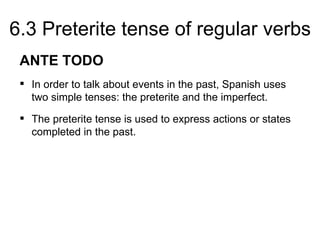
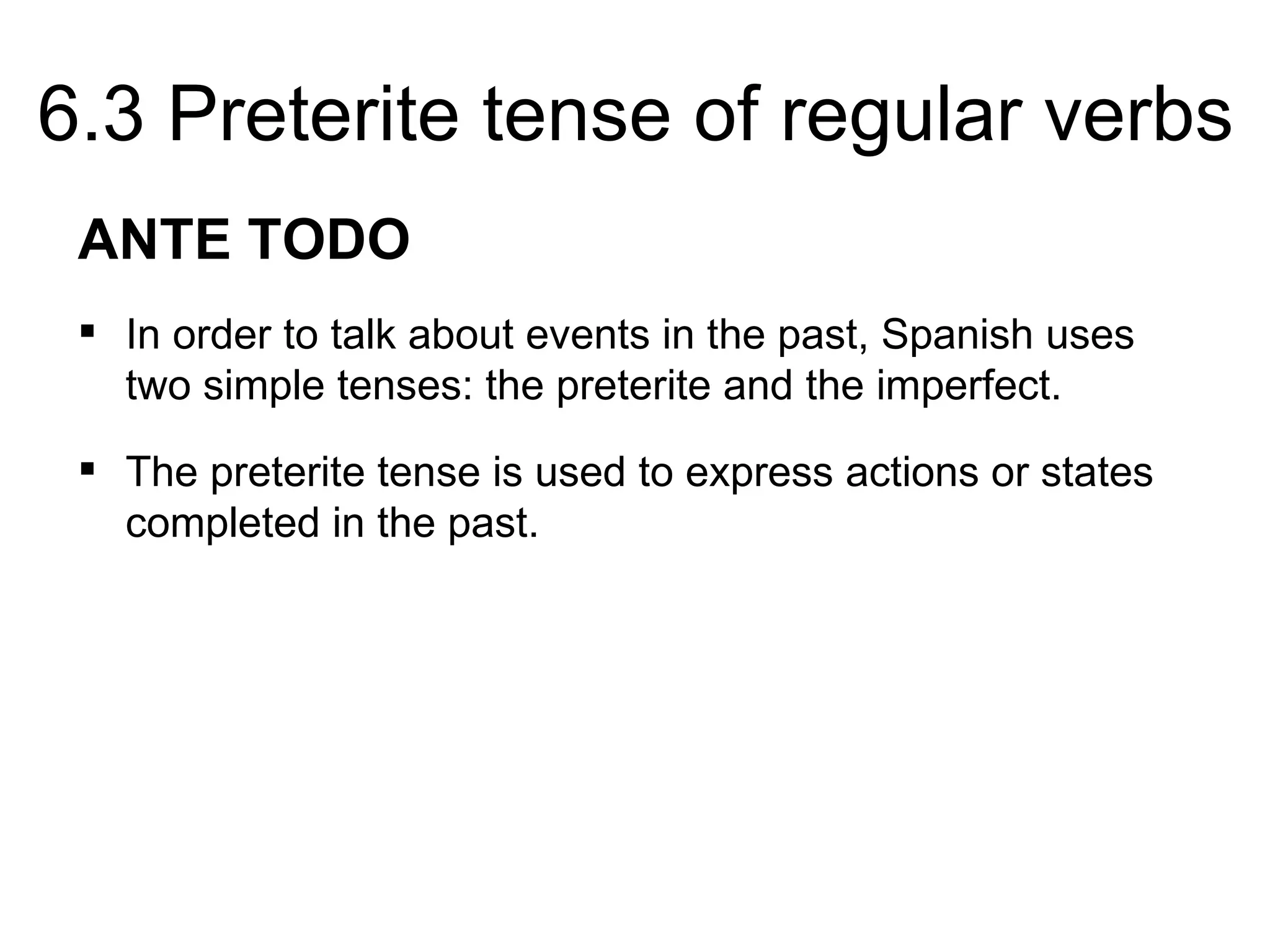
 ANTE TODO
  In order to talk about events in the past, Spanish uses
   two simple tenses: the preterite and the imperfect.
  The preterite tense is used to express actions or states
   completed in the past.
6.3 Preterite tense of regular verbs
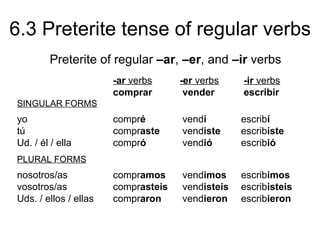
         Preterite of regular –ar, –er, and –ir verbs
                       -ar verbs     -er verbs    -ir verbs
                       comprar        vender      escribir
SINGULAR FORMS
yo                     compré        vendí        escribí
tú                     compraste     vendiste     escribiste
Ud. / él / ella        compró        vendió       escribió
PLURAL FORMS
nosotros/as            compramos     vendimos     escribimos
vosotros/as            comprasteis   vendisteis   escribisteis
Uds. / ellos / ellas   compraron     vendieron    escribieron
6.3 Preterite tense of regular verbs
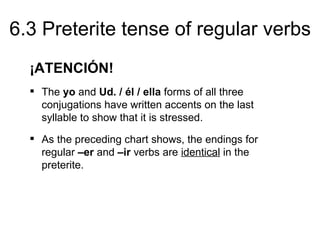
  ¡ATENCIÓN!
   The yo and Ud. / él / ella forms of all three
    conjugations have written accents on the last
    syllable to show that it is stressed.
   As the preceding chart shows, the endings for
    regular –er and –ir verbs are identical in the
    preterite.
6.3 Preterite tense of regular verbs
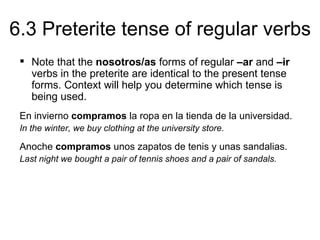
  Note that the nosotros/as forms of regular –ar and –ir
   verbs in the preterite are identical to the present tense
   forms. Context will help you determine which tense is
   being used.
 En invierno compramos la ropa en la tienda de la universidad.
 In the winter, we buy clothing at the university store.

 Anoche compramos unos zapatos de tenis y unas sandalias.
 Last night we bought a pair of tennis shoes and a pair of sandals.
6.3 Preterite tense of regular verbs
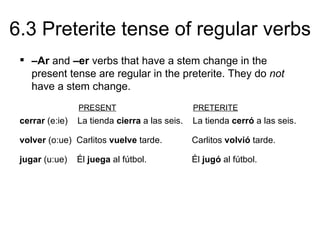
  –Ar and –er verbs that have a stem change in the
   present tense are regular in the preterite. They do not
   have a stem change.
                 PRESENT                        PRETERITE
 cerrar (e:ie)   La tienda cierra a las seis.   La tienda cerró a las seis.

 volver (o:ue) Carlitos vuelve tarde.           Carlitos volvió tarde.

 jugar (u:ue)    Él juega al fútbol.            Él jugó al fútbol.
6.3 Preterite tense of regular verbs
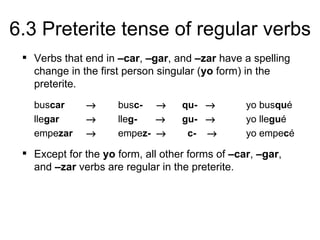
  Verbs that end in –car, –gar, and –zar have a spelling
   change in the first person singular (yo form) in the
   preterite.
   buscar     →      busc- →       qu- →         yo busqué
   llegar     →      lleg-  →      gu- →         yo llegué
   empezar    →      empez- →       c- →         yo empecé

  Except for the yo form, all other forms of –car, –gar,
   and –zar verbs are regular in the preterite.
6.3 Preterite tense of regular verbs
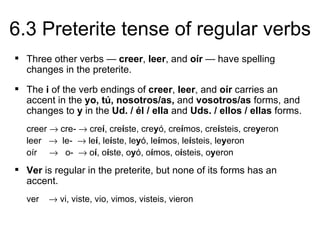
 Three other verbs — creer, leer, and oír — have spelling
  changes in the preterite.
 The i of the verb endings of creer, leer, and oír carries an
  accent in the yo, tú, nosotros/as, and vosotros/as forms, and
  changes to y in the Ud. / él / ella and Uds. / ellos / ellas forms.
  creer → cre- → creí, creíste, creyó, creímos, creísteis, creyeron
  leer → le- → leí, leíste, leyó, leímos, leísteis, leyeron
  oír → o- → oí, oíste, oyó, oímos, oísteis, oyeron
 Ver is regular in the preterite, but none of its forms has an
  accent.
  ver   → vi, viste, vio, vimos, visteis, vieron
6.3 Preterite tense of regular verbs
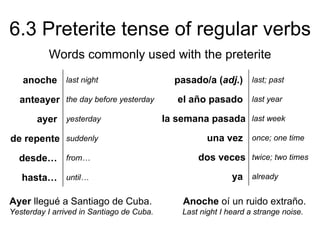
          Words commonly used with the preterite
   anoche last night                         pasado/a (adj.) last; past

  anteayer the day before yesterday           el año pasado last year

       ayer yesterday                      la semana pasada last week

de repente suddenly                                   una vez once; one time

  desde… from…                                     dos veces twice; two times

   hasta… until…                                             ya already

Ayer llegué a Santiago de Cuba.                Anoche oí un ruido extraño.
Yesterday I arrived in Santiago de Cuba.       Last night I heard a strange noise.
6.3 Preterite tense of regular verbs
  Acabar de + [infinitive] is used to say that something
   has just occurred.
  Note that acabar is in the present tense in this
   construction.
       Acabo de comprar una falda.
       I just bought a skirt.

       Acabas de ir de compras.
       You just went shopping.
6.3 Preterite tense of regular verbs
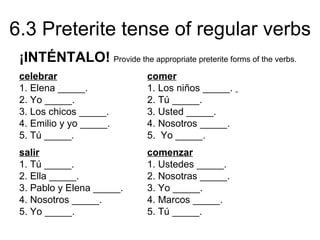
 ¡INTÉNTALO! Provide the appropriate preterite forms of the verbs.
 celebrar                     comer
 1. Elena _____.              1. Los niños _____.
 2. Yo _____.                 2. Tú _____.
 3. Los chicos _____.         3. Usted _____.
 4. Emilio y yo _____.        4. Nosotros _____.
 5. Tú _____.                 5. Yo _____.
 salir                        comenzar
 1. Tú _____.                 1. Ustedes _____.
 2. Ella _____.               2. Nosotras _____.
 3. Pablo y Elena _____.      3. Yo _____.
 4. Nosotros _____.           4. Marcos _____.
 5. Yo _____.                 5. Tú _____.
6.3 Preterite tense of regular verbs
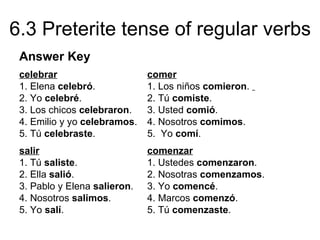
 Answer Key
 celebrar                     comer
 1. Elena celebró.            1. Los niños comieron.
 2. Yo celebré.               2. Tú comiste.
 3. Los chicos celebraron.    3. Usted comió.
 4. Emilio y yo celebramos.   4. Nosotros comimos.
 5. Tú celebraste.            5. Yo comí.
 salir                        comenzar
 1. Tú saliste.               1. Ustedes comenzaron.
 2. Ella salió.               2. Nosotras comenzamos.
 3. Pablo y Elena salieron.   3. Yo comencé.
 4. Nosotros salimos.         4. Marcos comenzó.
 5. Yo salí.                  5. Tú comenzaste.

6.3 Preterite tense of regular verbs

  • 1.
    6.3 Preterite tenseof regular verbs ANTE TODO  In order to talk about events in the past, Spanish uses two simple tenses: the preterite and the imperfect.  The preterite tense is used to express actions or states completed in the past.
  • 2.
    6.3 Preterite tenseof regular verbs Preterite of regular –ar, –er, and –ir verbs -ar verbs -er verbs -ir verbs comprar vender escribir SINGULAR FORMS yo compré vendí escribí tú compraste vendiste escribiste Ud. / él / ella compró vendió escribió PLURAL FORMS nosotros/as compramos vendimos escribimos vosotros/as comprasteis vendisteis escribisteis Uds. / ellos / ellas compraron vendieron escribieron
  • 3.
    6.3 Preterite tenseof regular verbs ¡ATENCIÓN!  The yo and Ud. / él / ella forms of all three conjugations have written accents on the last syllable to show that it is stressed.  As the preceding chart shows, the endings for regular –er and –ir verbs are identical in the preterite.
  • 4.
    6.3 Preterite tenseof regular verbs  Note that the nosotros/as forms of regular –ar and –ir verbs in the preterite are identical to the present tense forms. Context will help you determine which tense is being used. En invierno compramos la ropa en la tienda de la universidad. In the winter, we buy clothing at the university store. Anoche compramos unos zapatos de tenis y unas sandalias. Last night we bought a pair of tennis shoes and a pair of sandals.
  • 5.
    6.3 Preterite tenseof regular verbs  –Ar and –er verbs that have a stem change in the present tense are regular in the preterite. They do not have a stem change. PRESENT PRETERITE cerrar (e:ie) La tienda cierra a las seis. La tienda cerró a las seis. volver (o:ue) Carlitos vuelve tarde. Carlitos volvió tarde. jugar (u:ue) Él juega al fútbol. Él jugó al fútbol.
  • 6.
    6.3 Preterite tenseof regular verbs  Verbs that end in –car, –gar, and –zar have a spelling change in the first person singular (yo form) in the preterite. buscar → busc- → qu- → yo busqué llegar → lleg- → gu- → yo llegué empezar → empez- → c- → yo empecé  Except for the yo form, all other forms of –car, –gar, and –zar verbs are regular in the preterite.
  • 7.
    6.3 Preterite tenseof regular verbs  Three other verbs — creer, leer, and oír — have spelling changes in the preterite.  The i of the verb endings of creer, leer, and oír carries an accent in the yo, tú, nosotros/as, and vosotros/as forms, and changes to y in the Ud. / él / ella and Uds. / ellos / ellas forms. creer → cre- → creí, creíste, creyó, creímos, creísteis, creyeron leer → le- → leí, leíste, leyó, leímos, leísteis, leyeron oír → o- → oí, oíste, oyó, oímos, oísteis, oyeron  Ver is regular in the preterite, but none of its forms has an accent. ver → vi, viste, vio, vimos, visteis, vieron
  • 8.
    6.3 Preterite tenseof regular verbs Words commonly used with the preterite anoche last night pasado/a (adj.) last; past anteayer the day before yesterday el año pasado last year ayer yesterday la semana pasada last week de repente suddenly una vez once; one time desde… from… dos veces twice; two times hasta… until… ya already Ayer llegué a Santiago de Cuba. Anoche oí un ruido extraño. Yesterday I arrived in Santiago de Cuba. Last night I heard a strange noise.
  • 9.
    6.3 Preterite tenseof regular verbs  Acabar de + [infinitive] is used to say that something has just occurred.  Note that acabar is in the present tense in this construction. Acabo de comprar una falda. I just bought a skirt. Acabas de ir de compras. You just went shopping.
  • 10.
    6.3 Preterite tenseof regular verbs ¡INTÉNTALO! Provide the appropriate preterite forms of the verbs. celebrar comer 1. Elena _____. 1. Los niños _____. 2. Yo _____. 2. Tú _____. 3. Los chicos _____. 3. Usted _____. 4. Emilio y yo _____. 4. Nosotros _____. 5. Tú _____. 5. Yo _____. salir comenzar 1. Tú _____. 1. Ustedes _____. 2. Ella _____. 2. Nosotras _____. 3. Pablo y Elena _____. 3. Yo _____. 4. Nosotros _____. 4. Marcos _____. 5. Yo _____. 5. Tú _____.
  • 11.
    6.3 Preterite tenseof regular verbs Answer Key celebrar comer 1. Elena celebró. 1. Los niños comieron. 2. Yo celebré. 2. Tú comiste. 3. Los chicos celebraron. 3. Usted comió. 4. Emilio y yo celebramos. 4. Nosotros comimos. 5. Tú celebraste. 5. Yo comí. salir comenzar 1. Tú saliste. 1. Ustedes comenzaron. 2. Ella salió. 2. Nosotras comenzamos. 3. Pablo y Elena salieron. 3. Yo comencé. 4. Nosotros salimos. 4. Marcos comenzó. 5. Yo salí. 5. Tú comenzaste.