8.3 Comparisons and superlatives

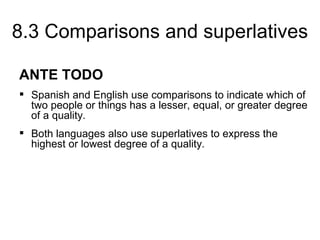
ANTE TODO
 Spanish and English use comparisons to indicate which of
  two people or things has a lesser, equal, or greater degree
  of a quality.
 Both languages also use superlatives to express the
  highest or lowest degree of a quality.
8.3 Comparisons and superlatives
                    COMPARISONS

menos interesante     más grande     tan sabroso como
less interesting      bigger         as delicious as


                    SUPERLATIVES

la / el mejor         la / el peor     la más alta
the best              the worst        the tallest
8.3 Comparisons and superlatives
            Comparisons of inequality
 Comparisons of inequality are formed by placing
  más (more) or menos (less) before adjectives,
  adverbs, and nouns and que (than) after them.

                      adjective

  más/menos   +       adverb      + que
                      noun
8.3 Comparisons and superlatives
           Comparisons of inequality

                       ADJECTIVES

   Los bistecs son más caros que el pollo.
   Steaks are more expensive than chicken.

   Estas uvas son menos sabrosas que esa pera.
   These grapes are less tasty than that pear.
8.3 Comparisons and superlatives
            Comparisons of inequality

                        ADVERBS

   Me acuesto más tarde que tú.
   I go to bed later than you (do).

   Mi hermano se despierta menos temprano que yo.
   My brother wakes up less early than I (do).
8.3 Comparisons and superlatives
         Comparisons of inequality

                        NOUNS

     Juan prepara más platos que José.
     Juan prepares more dishes than José (does).

     Susana come menos carne que Enrique.
     Susan eats less meat than Enrique (does).
8.3 Comparisons and superlatives
¡ATENCIÓN!
 Note that while English has a comparative form for short
  adjectives (taller), such forms do not exist in Spanish
  (más alto).

 When the comparison involves a numerical expression,
  de is used before the number instead of que.

   Hay más de cincuenta naranjas.
   Llego en menos de diez minutos.
8.3 Comparisons and superlatives
 With verbs, the following construction is used to make
  comparisons of inequality:

                [ verb ] + más/menos que


     Mis hermanos comen más que yo.
     My brothers eat more than I (do).

     Arturo duerme menos que su padre.
     Arturo sleeps less than his father (does).
8.3 Comparisons and superlatives
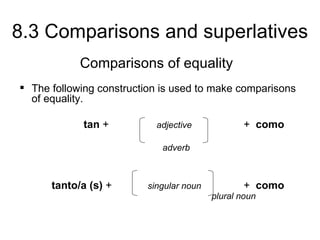
            Comparisons of equality
 The following construction is used to make comparisons
  of equality.

            tan +          adjective            + como

                            adverb


      tanto/a (s) +      singular noun          + como
                                         plural noun
8.3 Comparisons and superlatives
                Comparisons of equality
  Este plato es tan delicioso como aquél.
  This dish is as delicious as that one (is).

  Ustedes probaron tantos platos como ellos.
  You tried as many dishes as they did.
8.3 Comparisons and superlatives
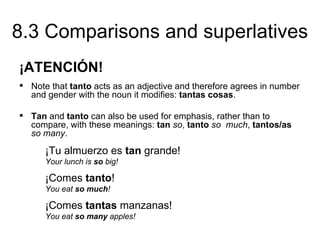
¡ATENCIÓN!
 Note that tanto acts as an adjective and therefore agrees in number
  and gender with the noun it modifies: tantas cosas.

 Tan and tanto can also be used for emphasis, rather than to
  compare, with these meanings: tan so, tanto so much, tantos/as
  so many.

      ¡Tu almuerzo es tan grande!
      Your lunch is so big!

      ¡Comes tanto!
      You eat so much!

      ¡Comes tantas manzanas!
      You eat so many apples!
8.3 Comparisons and superlatives
 Comparisons of equality with verbs are formed by
  placing tanto como after the verb.
 Note that in this construction tanto does not change in
  number or gender.

                     [ verb ] + tanto como

     No duermo tanto como mi tía.
     I don’t sleep as much as my aunt (does).

     Estudiamos tanto como ustedes.
     We study as much as you (do).
8.3 Comparisons and superlatives
                           Superlatives
 The following construction is used to form superlatives. Note
  that the noun is always preceded by a definite article and
  that de is equivalent to the English in or of.

   el / la / los / las + [ noun ] + más / menos + [ adjective ] + de

   Es el café más rico del país.
   It’s the most delicious coffee in the country.

   Es el menú menos caro de todos éstos.
   It is the least expensive menu of all of these.
8.3 Comparisons and superlatives
                     Superlatives
¡ATENCIÓN!
 While más alone means more, after el or la (or los or las),
  it means most.
8.3 Comparisons and superlatives
                         Superlatives
 The noun in a superlative construction can be omitted if
  the person, place, or thing referred to is clear.
   ¿El restaurante El Cráter?
   The El Cráter restaurant?

   Es el más elegante de la ciudad.
   It’s the most elegant (one) in the city.

   Recomiendo el pollo asado.
   I recommend the roast chicken.

   Es el más sabroso del menú.
   It’s the most delicious on the menu.
8.3 Comparisons and superlatives
   Irregular comparatives and superlatives
     Adjective    Comparative Form       Superlative Form

 bueno/a good      mejor better      el/la mejor (the) best

   malo/a bad       peor worse        el/la peor (the) worst

 grande/a big     mayor bigger       el/la mayor (the) biggest

pequeño/a small   menor smaller      el/la menor (the) smallest

    joven young   menor younger      el/la menor (the) youngest

   viejo/a old    mayor older        el/la mayor (the) oldest
8.3 Comparisons and superlatives
    Irregular comparatives and superlatives
 When grande and pequeño/a refer to age, the irregular
  comparative and superlative forms, mayor and menor,
  are used.
8.3 Comparisons and superlatives
    Irregular comparatives and superlatives
 However, when these adjectives refer to size, the regular forms,
  más grande and más pequeño/a, are used.
   Isabel es la mayor de su familia.
   Isabel is the eldest in her family.

   Tu ensalada es más grande que ésa.
   Your salad is bigger than that one.

   Yo soy menor que tú.
   I’m younger than you.

   Pedí el plato más pequeño del menú.
   I ordered the smallest dish on the menu.
8.3 Comparisons and superlatives
   Irregular comparatives and superlatives
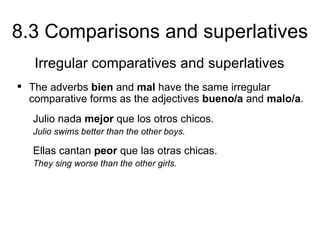
 The adverbs bien and mal have the same irregular
  comparative forms as the adjectives bueno/a and malo/a.
   Julio nada mejor que los otros chicos.
   Julio swims better than the other boys.

   Ellas cantan peor que las otras chicas.
   They sing worse than the other girls.
8.3 Comparisons and superlatives
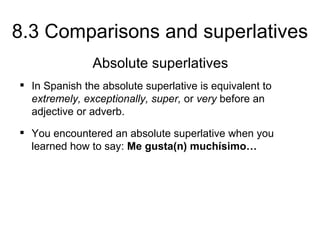
               Absolute superlatives
 In Spanish the absolute superlative is equivalent to
  extremely, exceptionally, super, or very before an
  adjective or adverb.
 You encountered an absolute superlative when you
  learned how to say: Me gusta(n) muchísimo…
8.3 Comparisons and superlatives
                       Absolute superlatives
 To form the absolute superlative of most adjectives and adverbs,
  drop the final vowel, if there is one, and add -ísimo/a(s).

malo → mal- → malísimo                   mucho → much- → muchísimo
¡El bistec está malísimo!               Comes muchísimo.
The steak is very bad!                  You eat a lot (very, very much).

difícil + -ísimo → dificilísimo          fácil + ísimo → facilísimo
Esta prueba es dificilísima.            Los exámenes son
  facilísimos.
This quiz is exceptionally difficult.   The tests are extremely easy.
8.3 Comparisons and superlatives
                 Absolute superlatives
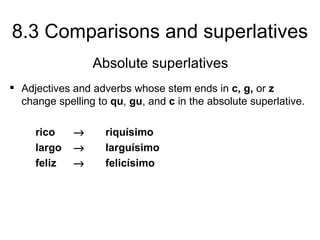
 Adjectives and adverbs whose stem ends in c, g, or z
  change spelling to qu, gu, and c in the absolute superlative.

     rico    →      riquísimo
     largo   →      larguísimo
     feliz   →      felicísimo
8.3 Comparisons and superlatives
                 Absolute superlatives
 Adjectives that end in –n or –r normally form the absolute
  superlative by adding -císimo.

     joven + -císimo → jovencísimo

     trabajador + -císimo → trabajadorcísimo
8.3 Comparisons and superlatives
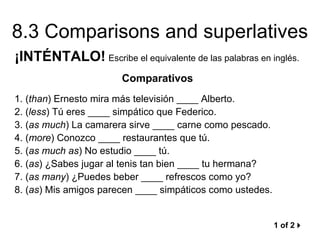
¡INTÉNTALO! Escribe el equivalente de las palabras en inglés.
                       Comparativos
1. (than) Ernesto mira más televisión ____ Alberto.
2. (less) Tú eres ____ simpático que Federico.
3. (as much) La camarera sirve ____ carne como pescado.
4. (more) Conozco ____ restaurantes que tú.
5. (as much as) No estudio ____ tú.
6. (as) ¿Sabes jugar al tenis tan bien ____ tu hermana?
7. (as many) ¿Puedes beber ____ refrescos como yo?
8. (as) Mis amigos parecen ____ simpáticos como ustedes.


                                                           1 of 2
8.3 Comparisons and superlatives
Answer Key
                       Comparativos
1. Ernesto mira más televisión que Alberto.
2. Tú eres menos simpático que Federico.
3. La camarera sirve tanta carne como pescado.
4. Conozco más restaurantes que tú.
5. No estudio tanto como tú.
6. ¿Sabes jugar al tenis tan bien como tu hermana?
7. ¿Puedes beber tantos refrescos como yo?
8. Mis amigos parecen tan simpáticos como ustedes.


                                                     1 of 2
8.3 Comparisons and superlatives
¡INTÉNTALO! Escribe el equivalente de las palabras en inglés.
                           Superlativos
1. (the most intelligent) Marisa es _____ de todas.
2. (the least boring) Ricardo y Tomás son _____ de la fiesta.
3. (the worst) Miguel y Antonio son _____ estudiantes de la clase.
4. (the oldest) Mi profesor de biología es _____ de la universidad.
5. (extremely delicious) El pollo de este supermercado es _____ .
6. (the youngest) Carlos es _____ de mis hermanos.
7. (the best) Este plato es _____ del restaurante.
8. (extremely tall) Sara es _____ .


                                                           2 of 2
8.3 Comparisons and superlatives
¡INTÉNTALO! Escribe el equivalente de las palabras en inglés.
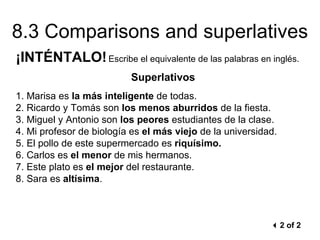
                          Superlativos
1. Marisa es la más inteligente de todas.
2. Ricardo y Tomás son los menos aburridos de la fiesta.
3. Miguel y Antonio son los peores estudiantes de la clase.
4. Mi profesor de biología es el más viejo de la universidad.
5. El pollo de este supermercado es riquísimo.
6. Carlos es el menor de mis hermanos.
7. Este plato es el mejor del restaurante.
8. Sara es altísima.


                                                           2 of 2

8.3 Comparisons and superlatives

  • 1.
    8.3 Comparisons andsuperlatives ANTE TODO  Spanish and English use comparisons to indicate which of two people or things has a lesser, equal, or greater degree of a quality.  Both languages also use superlatives to express the highest or lowest degree of a quality.
  • 2.
    8.3 Comparisons andsuperlatives COMPARISONS menos interesante más grande tan sabroso como less interesting bigger as delicious as SUPERLATIVES la / el mejor la / el peor la más alta the best the worst the tallest
  • 3.
    8.3 Comparisons andsuperlatives Comparisons of inequality  Comparisons of inequality are formed by placing más (more) or menos (less) before adjectives, adverbs, and nouns and que (than) after them. adjective más/menos + adverb + que noun
  • 4.
    8.3 Comparisons andsuperlatives Comparisons of inequality ADJECTIVES Los bistecs son más caros que el pollo. Steaks are more expensive than chicken. Estas uvas son menos sabrosas que esa pera. These grapes are less tasty than that pear.
  • 5.
    8.3 Comparisons andsuperlatives Comparisons of inequality ADVERBS Me acuesto más tarde que tú. I go to bed later than you (do). Mi hermano se despierta menos temprano que yo. My brother wakes up less early than I (do).
  • 6.
    8.3 Comparisons andsuperlatives Comparisons of inequality NOUNS Juan prepara más platos que José. Juan prepares more dishes than José (does). Susana come menos carne que Enrique. Susan eats less meat than Enrique (does).
  • 7.
    8.3 Comparisons andsuperlatives ¡ATENCIÓN!  Note that while English has a comparative form for short adjectives (taller), such forms do not exist in Spanish (más alto).  When the comparison involves a numerical expression, de is used before the number instead of que. Hay más de cincuenta naranjas. Llego en menos de diez minutos.
  • 8.
    8.3 Comparisons andsuperlatives  With verbs, the following construction is used to make comparisons of inequality: [ verb ] + más/menos que Mis hermanos comen más que yo. My brothers eat more than I (do). Arturo duerme menos que su padre. Arturo sleeps less than his father (does).
  • 9.
    8.3 Comparisons andsuperlatives Comparisons of equality  The following construction is used to make comparisons of equality. tan + adjective + como adverb tanto/a (s) + singular noun + como plural noun
  • 10.
    8.3 Comparisons andsuperlatives Comparisons of equality Este plato es tan delicioso como aquél. This dish is as delicious as that one (is). Ustedes probaron tantos platos como ellos. You tried as many dishes as they did.
  • 11.
    8.3 Comparisons andsuperlatives ¡ATENCIÓN!  Note that tanto acts as an adjective and therefore agrees in number and gender with the noun it modifies: tantas cosas.  Tan and tanto can also be used for emphasis, rather than to compare, with these meanings: tan so, tanto so much, tantos/as so many. ¡Tu almuerzo es tan grande! Your lunch is so big! ¡Comes tanto! You eat so much! ¡Comes tantas manzanas! You eat so many apples!
  • 12.
    8.3 Comparisons andsuperlatives  Comparisons of equality with verbs are formed by placing tanto como after the verb.  Note that in this construction tanto does not change in number or gender. [ verb ] + tanto como No duermo tanto como mi tía. I don’t sleep as much as my aunt (does). Estudiamos tanto como ustedes. We study as much as you (do).
  • 13.
    8.3 Comparisons andsuperlatives Superlatives  The following construction is used to form superlatives. Note that the noun is always preceded by a definite article and that de is equivalent to the English in or of. el / la / los / las + [ noun ] + más / menos + [ adjective ] + de Es el café más rico del país. It’s the most delicious coffee in the country. Es el menú menos caro de todos éstos. It is the least expensive menu of all of these.
  • 14.
    8.3 Comparisons andsuperlatives Superlatives ¡ATENCIÓN!  While más alone means more, after el or la (or los or las), it means most.
  • 15.
    8.3 Comparisons andsuperlatives Superlatives  The noun in a superlative construction can be omitted if the person, place, or thing referred to is clear. ¿El restaurante El Cráter? The El Cráter restaurant? Es el más elegante de la ciudad. It’s the most elegant (one) in the city. Recomiendo el pollo asado. I recommend the roast chicken. Es el más sabroso del menú. It’s the most delicious on the menu.
  • 16.
    8.3 Comparisons andsuperlatives Irregular comparatives and superlatives Adjective Comparative Form Superlative Form bueno/a good mejor better el/la mejor (the) best malo/a bad peor worse el/la peor (the) worst grande/a big mayor bigger el/la mayor (the) biggest pequeño/a small menor smaller el/la menor (the) smallest joven young menor younger el/la menor (the) youngest viejo/a old mayor older el/la mayor (the) oldest
  • 17.
    8.3 Comparisons andsuperlatives Irregular comparatives and superlatives  When grande and pequeño/a refer to age, the irregular comparative and superlative forms, mayor and menor, are used.
  • 18.
    8.3 Comparisons andsuperlatives Irregular comparatives and superlatives  However, when these adjectives refer to size, the regular forms, más grande and más pequeño/a, are used. Isabel es la mayor de su familia. Isabel is the eldest in her family. Tu ensalada es más grande que ésa. Your salad is bigger than that one. Yo soy menor que tú. I’m younger than you. Pedí el plato más pequeño del menú. I ordered the smallest dish on the menu.
  • 19.
    8.3 Comparisons andsuperlatives Irregular comparatives and superlatives  The adverbs bien and mal have the same irregular comparative forms as the adjectives bueno/a and malo/a. Julio nada mejor que los otros chicos. Julio swims better than the other boys. Ellas cantan peor que las otras chicas. They sing worse than the other girls.
  • 20.
    8.3 Comparisons andsuperlatives Absolute superlatives  In Spanish the absolute superlative is equivalent to extremely, exceptionally, super, or very before an adjective or adverb.  You encountered an absolute superlative when you learned how to say: Me gusta(n) muchísimo…
  • 21.
    8.3 Comparisons andsuperlatives Absolute superlatives  To form the absolute superlative of most adjectives and adverbs, drop the final vowel, if there is one, and add -ísimo/a(s). malo → mal- → malísimo mucho → much- → muchísimo ¡El bistec está malísimo! Comes muchísimo. The steak is very bad! You eat a lot (very, very much). difícil + -ísimo → dificilísimo fácil + ísimo → facilísimo Esta prueba es dificilísima. Los exámenes son facilísimos. This quiz is exceptionally difficult. The tests are extremely easy.
  • 22.
    8.3 Comparisons andsuperlatives Absolute superlatives  Adjectives and adverbs whose stem ends in c, g, or z change spelling to qu, gu, and c in the absolute superlative. rico → riquísimo largo → larguísimo feliz → felicísimo
  • 23.
    8.3 Comparisons andsuperlatives Absolute superlatives  Adjectives that end in –n or –r normally form the absolute superlative by adding -císimo. joven + -císimo → jovencísimo trabajador + -císimo → trabajadorcísimo
  • 24.
    8.3 Comparisons andsuperlatives ¡INTÉNTALO! Escribe el equivalente de las palabras en inglés. Comparativos 1. (than) Ernesto mira más televisión ____ Alberto. 2. (less) Tú eres ____ simpático que Federico. 3. (as much) La camarera sirve ____ carne como pescado. 4. (more) Conozco ____ restaurantes que tú. 5. (as much as) No estudio ____ tú. 6. (as) ¿Sabes jugar al tenis tan bien ____ tu hermana? 7. (as many) ¿Puedes beber ____ refrescos como yo? 8. (as) Mis amigos parecen ____ simpáticos como ustedes. 1 of 2
  • 25.
    8.3 Comparisons andsuperlatives Answer Key Comparativos 1. Ernesto mira más televisión que Alberto. 2. Tú eres menos simpático que Federico. 3. La camarera sirve tanta carne como pescado. 4. Conozco más restaurantes que tú. 5. No estudio tanto como tú. 6. ¿Sabes jugar al tenis tan bien como tu hermana? 7. ¿Puedes beber tantos refrescos como yo? 8. Mis amigos parecen tan simpáticos como ustedes. 1 of 2
  • 26.
    8.3 Comparisons andsuperlatives ¡INTÉNTALO! Escribe el equivalente de las palabras en inglés. Superlativos 1. (the most intelligent) Marisa es _____ de todas. 2. (the least boring) Ricardo y Tomás son _____ de la fiesta. 3. (the worst) Miguel y Antonio son _____ estudiantes de la clase. 4. (the oldest) Mi profesor de biología es _____ de la universidad. 5. (extremely delicious) El pollo de este supermercado es _____ . 6. (the youngest) Carlos es _____ de mis hermanos. 7. (the best) Este plato es _____ del restaurante. 8. (extremely tall) Sara es _____ . 2 of 2
  • 27.
    8.3 Comparisons andsuperlatives ¡INTÉNTALO! Escribe el equivalente de las palabras en inglés. Superlativos 1. Marisa es la más inteligente de todas. 2. Ricardo y Tomás son los menos aburridos de la fiesta. 3. Miguel y Antonio son los peores estudiantes de la clase. 4. Mi profesor de biología es el más viejo de la universidad. 5. El pollo de este supermercado es riquísimo. 6. Carlos es el menor de mis hermanos. 7. Este plato es el mejor del restaurante. 8. Sara es altísima. 2 of 2