7.4 Gustar and verbs like gustar

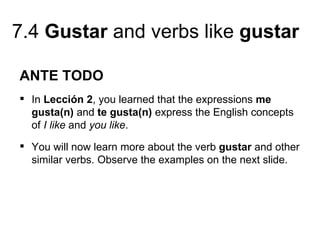
ANTE TODO
 In Lección 2, you learned that the expressions me
  gusta(n) and te gusta(n) express the English concepts
  of I like and you like.
 You will now learn more about the verb gustar and other
  similar verbs. Observe the examples on the next slide.
7.4 Gustar and verbs like gustar

                           ENGLISH EQUIVALENT
                           I like that shampoo.

Me gusta ese champú.       LITERAL MEANING
                           That shampoo is pleasing to me.

                           ENGLISH EQUIVALENT
                           Did you like the classes?
¿Te gustaron las clases?
                           LITERAL MEANING
                           Were the classes pleasing to you?
7.4 Gustar and verbs like gustar
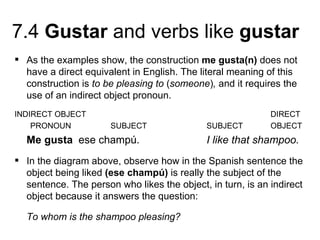
 As the examples show, the construction me gusta(n) does not
  have a direct equivalent in English. The literal meaning of this
  construction is to be pleasing to (someone), and it requires the
  use of an indirect object pronoun.
INDIRECT OBJECT                                             DIRECT
    PRONOUN           SUBJECT                SUBJECT        OBJECT
  Me gusta ese champú.                       I like that shampoo.
 In the diagram above, observe how in the Spanish sentence the
  object being liked (ese champú) is really the subject of the
  sentence. The person who likes the object, in turn, is an indirect
  object because it answers the question:

  To whom is the shampoo pleasing?
7.4 Gustar and verbs like gustar
 The forms most commonly used with gustar and similar
  verbs are the third person (singular and plural). When
  the object or person being liked is singular, the singular
  form gusta is used. When two or more objects or
  persons are being liked, the plural form gustan is used.

                             gusta      la película
  SINGULAR   me, te, le      gustó      el concierto


    PLURAL   nos, os, les    gustan     las vacaciones
                             gustaron   los museos de Lima
7.4 Gustar and verbs like gustar

 The construction a + [pronoun] (a mí, a ti, a usted, a él, etc.) is
  used to clarify or to emphasize who is pleased.

   A ella le gustan las toallas verdes, pero a él no le gustan.
   She likes green towels, but he doesn’t like them.

   A ti te gusta cenar en casa, pero a mí no me gusta.
   You like to eat dinner at home, but I don’t like to.
7.4 Gustar and verbs like gustar
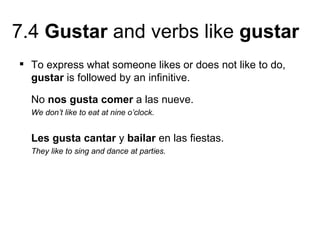
 To express what someone likes or does not like to do,
  gustar is followed by an infinitive.

  No nos gusta comer a las nueve.
  We don’t like to eat at nine o’clock.


  Les gusta cantar y bailar en las fiestas.
  They like to sing and dance at parties.
7.4 Gustar and verbs like gustar

¡ATENCIÓN!
 Mí (me) has an accent mark to distinguish it from the
  possessive adjective mi (my).
7.4 Gustar and verbs like gustar
 The construction a + [noun] can also be used before the
  indirect object pronoun to clarify or to emphasize who is
  pleased.

   A los turistas les gustó mucho Machu Picchu.
   The tourists liked Machu Picchu a lot.

   A Juanita le gustaron mucho los mercados al aire libre.
   Juanita liked the open-air markets a lot.
7.4 Gustar and verbs like gustar
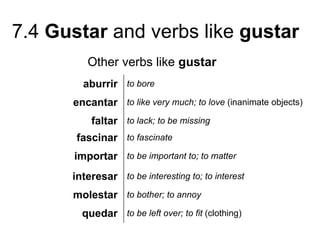
         Other verbs like gustar
        aburrir to bore
      encantar to like very much; to love (inanimate objects)
          faltar to lack; to be missing
       fascinar to fascinate
      importar to be important to; to matter
      interesar to be interesting to; to interest
      molestar to bother; to annoy
        quedar to be left over; to fit (clothing)
7.4 Gustar and verbs like gustar
¡ATENCIÓN!
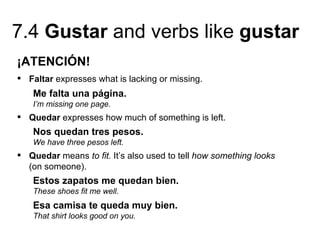
 Faltar expresses what is lacking or missing.
    Me falta una página.
    I’m missing one page.
 Quedar expresses how much of something is left.
    Nos quedan tres pesos.
    We have three pesos left.
 Quedar means to fit. It’s also used to tell how something looks
  (on someone).
    Estos zapatos me quedan bien.
    These shoes fit me well.
    Esa camisa te queda muy bien.
    That shirt looks good on you.
7.4 Gustar and verbs like gustar
¡INTÉNTALO! Indica el pronombre del objeto indirecto y la
forma del tiempo presente adecuados en cada frase.

                               gustar

  1. A él ____ viajar.              7. A mis padres ____ caminar.
  2. A mí ____ bailar.              8. A usted ____ jugar tenis.
  3. A nosotras ____ cantar.        9. A mi esposo y a mí ____ dormir.
  4. A ustedes ____ leer.         10. A Alberto ____ dibujar.
  5. A ti ____ correr.            11. A todos ____ opinar.
  6. A Pedro ____ gritar.         12. A Pili no ____ ir de compras.


                                                             1 of 2
7.4 Gustar and verbs like gustar
Answer Key


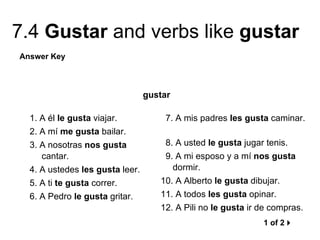
                                 gustar

  1. A él le gusta viajar.           7. A mis padres les gusta caminar.
  2. A mí me gusta bailar.
  3. A nosotras nos gusta            8. A usted le gusta jugar tenis.
     cantar.                         9. A mi esposo y a mí nos gusta
  4. A ustedes les gusta leer.         dormir.
  5. A ti te gusta correr.          10. A Alberto le gusta dibujar.
  6. A Pedro le gusta gritar.       11. A todos les gusta opinar.
                                    12. A Pili no le gusta ir de compras.
                                                              1 of 2
7.4 Gustar and verbs like gustar
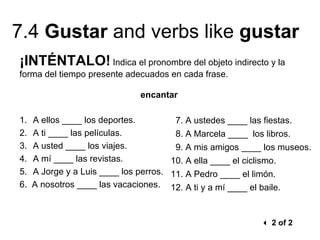
¡INTÉNTALO! Indica el pronombre del objeto indirecto y la
forma del tiempo presente adecuados en cada frase.

                               encantar

1.   A ellos ____ los deportes.         7. A ustedes ____ las fiestas.
2.   A ti ____ las películas.           8. A Marcela ____ los libros.
3.   A usted ____ los viajes.           9. A mis amigos ____ los museos.
4.   A mí ____ las revistas.           10. A ella ____ el ciclismo.
5.   A Jorge y a Luis ____ los perros. 11. A Pedro ____ el limón.
6.   A nosotros ____ las vacaciones. 12. A ti y a mí ____ el baile.


                                                             2 of 2
7.4 Gustar and verbs like gustar
Answer Key


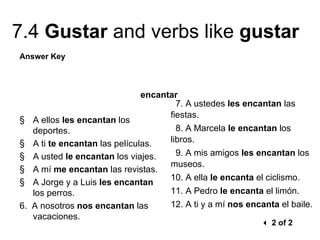
                            encantar
                                    7. A ustedes les encantan las
                                  fiestas.
§ A ellos les encantan los
   deportes.                          8. A Marcela le encantan los
§ A ti te encantan las películas.   libros.
§ A usted le encantan los viajes.    9. A mis amigos les encantan los
                                    museos.
§ A mí me encantan las revistas.
§ A Jorge y a Luis les encantan     10. A ella le encanta el ciclismo.
   los perros.                      11. A Pedro le encanta el limón.
6. A nosotros nos encantan las      12. A ti y a mí nos encanta el baile.
   vacaciones.
                                                            2 of 2

7.4 Verbs like gustar

  • 1.
    7.4 Gustar andverbs like gustar ANTE TODO  In Lección 2, you learned that the expressions me gusta(n) and te gusta(n) express the English concepts of I like and you like.  You will now learn more about the verb gustar and other similar verbs. Observe the examples on the next slide.
  • 2.
    7.4 Gustar andverbs like gustar ENGLISH EQUIVALENT I like that shampoo. Me gusta ese champú. LITERAL MEANING That shampoo is pleasing to me. ENGLISH EQUIVALENT Did you like the classes? ¿Te gustaron las clases? LITERAL MEANING Were the classes pleasing to you?
  • 3.
    7.4 Gustar andverbs like gustar  As the examples show, the construction me gusta(n) does not have a direct equivalent in English. The literal meaning of this construction is to be pleasing to (someone), and it requires the use of an indirect object pronoun. INDIRECT OBJECT DIRECT PRONOUN SUBJECT SUBJECT OBJECT Me gusta ese champú. I like that shampoo.  In the diagram above, observe how in the Spanish sentence the object being liked (ese champú) is really the subject of the sentence. The person who likes the object, in turn, is an indirect object because it answers the question: To whom is the shampoo pleasing?
  • 4.
    7.4 Gustar andverbs like gustar  The forms most commonly used with gustar and similar verbs are the third person (singular and plural). When the object or person being liked is singular, the singular form gusta is used. When two or more objects or persons are being liked, the plural form gustan is used. gusta la película SINGULAR me, te, le gustó el concierto PLURAL nos, os, les gustan las vacaciones gustaron los museos de Lima
  • 5.
    7.4 Gustar andverbs like gustar  The construction a + [pronoun] (a mí, a ti, a usted, a él, etc.) is used to clarify or to emphasize who is pleased. A ella le gustan las toallas verdes, pero a él no le gustan. She likes green towels, but he doesn’t like them. A ti te gusta cenar en casa, pero a mí no me gusta. You like to eat dinner at home, but I don’t like to.
  • 6.
    7.4 Gustar andverbs like gustar  To express what someone likes or does not like to do, gustar is followed by an infinitive. No nos gusta comer a las nueve. We don’t like to eat at nine o’clock. Les gusta cantar y bailar en las fiestas. They like to sing and dance at parties.
  • 7.
    7.4 Gustar andverbs like gustar ¡ATENCIÓN!  Mí (me) has an accent mark to distinguish it from the possessive adjective mi (my).
  • 8.
    7.4 Gustar andverbs like gustar  The construction a + [noun] can also be used before the indirect object pronoun to clarify or to emphasize who is pleased. A los turistas les gustó mucho Machu Picchu. The tourists liked Machu Picchu a lot. A Juanita le gustaron mucho los mercados al aire libre. Juanita liked the open-air markets a lot.
  • 9.
    7.4 Gustar andverbs like gustar Other verbs like gustar aburrir to bore encantar to like very much; to love (inanimate objects) faltar to lack; to be missing fascinar to fascinate importar to be important to; to matter interesar to be interesting to; to interest molestar to bother; to annoy quedar to be left over; to fit (clothing)
  • 10.
    7.4 Gustar andverbs like gustar ¡ATENCIÓN!  Faltar expresses what is lacking or missing. Me falta una página. I’m missing one page.  Quedar expresses how much of something is left. Nos quedan tres pesos. We have three pesos left.  Quedar means to fit. It’s also used to tell how something looks (on someone). Estos zapatos me quedan bien. These shoes fit me well. Esa camisa te queda muy bien. That shirt looks good on you.
  • 11.
    7.4 Gustar andverbs like gustar ¡INTÉNTALO! Indica el pronombre del objeto indirecto y la forma del tiempo presente adecuados en cada frase. gustar 1. A él ____ viajar. 7. A mis padres ____ caminar. 2. A mí ____ bailar. 8. A usted ____ jugar tenis. 3. A nosotras ____ cantar. 9. A mi esposo y a mí ____ dormir. 4. A ustedes ____ leer. 10. A Alberto ____ dibujar. 5. A ti ____ correr. 11. A todos ____ opinar. 6. A Pedro ____ gritar. 12. A Pili no ____ ir de compras. 1 of 2
  • 12.
    7.4 Gustar andverbs like gustar Answer Key gustar 1. A él le gusta viajar. 7. A mis padres les gusta caminar. 2. A mí me gusta bailar. 3. A nosotras nos gusta 8. A usted le gusta jugar tenis. cantar. 9. A mi esposo y a mí nos gusta 4. A ustedes les gusta leer. dormir. 5. A ti te gusta correr. 10. A Alberto le gusta dibujar. 6. A Pedro le gusta gritar. 11. A todos les gusta opinar. 12. A Pili no le gusta ir de compras. 1 of 2
  • 13.
    7.4 Gustar andverbs like gustar ¡INTÉNTALO! Indica el pronombre del objeto indirecto y la forma del tiempo presente adecuados en cada frase. encantar 1. A ellos ____ los deportes. 7. A ustedes ____ las fiestas. 2. A ti ____ las películas. 8. A Marcela ____ los libros. 3. A usted ____ los viajes. 9. A mis amigos ____ los museos. 4. A mí ____ las revistas. 10. A ella ____ el ciclismo. 5. A Jorge y a Luis ____ los perros. 11. A Pedro ____ el limón. 6. A nosotros ____ las vacaciones. 12. A ti y a mí ____ el baile.  2 of 2
  • 14.
    7.4 Gustar andverbs like gustar Answer Key encantar 7. A ustedes les encantan las fiestas. § A ellos les encantan los deportes. 8. A Marcela le encantan los § A ti te encantan las películas. libros. § A usted le encantan los viajes. 9. A mis amigos les encantan los museos. § A mí me encantan las revistas. § A Jorge y a Luis les encantan 10. A ella le encanta el ciclismo. los perros. 11. A Pedro le encanta el limón. 6. A nosotros nos encantan las 12. A ti y a mí nos encanta el baile. vacaciones.  2 of 2