March 20th 2015
By: Alondra Yarely Pérez Calderón
Curso de ingles básico.
La persona será capaz de identificar el tiempo to be presente, presente
simple, to be pasado, pasado simple, presente continuo y pasado
continuo con la finalidad de generar conocimiento y tengan
herramientas cuando viajen o algo por el estilo.
La enseñanza del ingles es importante
¿Por qué? ¿Cuándo lo ocupas? ¿Para que?
Para trabajar, para mas
educación e
información, es un
idioma es universal, por
otras culturas, para ir
de viaje, para
superación personal,
para arte y literatura,
etc.
Cuando salimos de
viaje, cuando una
persona extranjera esta
de visita, etc.
Para abrirnos mas a la
posibilidad de aprender
un nuevo idioma que
en algún futuro nos va
a servir de gran
manera.
 Greetings and farewells.
Hi Hola
Hello Hola
How are you? ¿Cómo estas?
See you Nos vemos
Bye Adiós
Good Bye Adiós
Greetings:
Farewells:
 I Yo Am
 You Tu Are
 He El Is
 She Ella Is
 It Eso/cosa Is
 You Ustedes Are
 They Ellos Are
 We Nosotros Are
Am
Are To be conjugado que significa “ser/estar”
Is
Personal pronoun
 Interrogative:
To be/ Personal pronoun/ Complement/ ?.
Is She Isabel?.
Is/ She/ Isabel/ ?.
¿Ella es Isabel?
Affirmative:
Personal pronoun/ To be/ Complement.
I am in the hause.
I / am/ in the hause.
Yo estoy en la casa.
Negative:
Personal pronoun/ To be/ Not/ Complement.
You are not handsome.
You / are / not/ handsome.
Tu no eres guapo.
 I Yo Do
 You Tu Do
 He El Does
 She Ella Does
 It Eso/cosa Does
 You Ustedes Do
 They Ellos Do
 We Nosotros Do
 Interrogative:
Do-Does/ Personal pronoun/ V.S.F/ complement/ ?
Does He cook in the kitchen of Laura?.
Does/ He/ cook/ in the kitchen of Laura/ ?.
¿El cosina en la cocina de Laura?
Affirmative:
Personal pronoun/ V.S.F./ Complement.
I play soccer with my best friend.
I/ play/ soccer with my best friend.
Yo juego futbol con mi amigo.
Negative:
Personal pronoun/ Do-Does +Not/ V.S.F./ Complement.
They don’t eat on the street.
They/ don’/ eat/ on the street.
Ellos no comen en la calle.
V.S.F.: verb in in simplest form
 I Yo Was
 You Tu Were
 He El Was
 She Ella Was
 It Eso/cosa Was
 You Ustedes Were
 They Ellos Were
 We Nosotros Were
Was
Were
To be conjugado en pasado que significa “era/estaba”
 Interrogative:
To be/ Personal pronoun/ Complement/?.
Is She the babysitter of Juan?.
Is/ She/ the babysitter of Juan?.
¿Ella es la niñera de Juan?
Affirmative:
Personal pronoun/ To be in past/ Complement.
I was in a park with my cousin.
I/ was/ in a park with my cousin.
Yo estaba en el parque con mi primo.
Negative:
Personal pronoun/ To be in past/ Not/ Complement.
We were not at the zoo.
We/ were/ not/ at the zoo.
Ustedes no estaban en el zoologico.
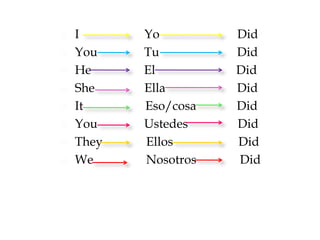
 I Yo Did
 You Tu Did
 He El Did
 She Ella Did
 It Eso/cosa Did
 You Ustedes Did
 They Ellos Did
 We Nosotros Did
 Interrogative:
Did/ Personal pronoun/ Complement/ ?.
Did You eat fish?.
Did/ You/ eat/ fish/ ?.
¿Comes pescado?
Affirmative:
Personal pronoun/ Verb in past/ Complement.
We ran in the field.
We/ ran/ in the field.
Nosotros estabamos corriendo en la cancha.
Negative:
Personal pronoun/ Did + Not/ V.S.F./ Complement.
I didn't go the weekend to school
I/ didn’t/ go/ the weekend to school.
Yo no fui el fin de semana a la escuela.
 Interrogative:
To be/ Personal pronoun/ Verb + ing/ Complement/ ?.
Is She planting a flower in a garden?.
Is/ She/ planting/ a flower in a garden?.
¿Ella esta plantando una planta en un jardín?
Affirmative:
Personal pronoun/ To be/ Verb + ing/ Complement.
I am doing homework.
I/ am/ doing/ homework.
Yo estoy haciendo la terea.
Negative:
Personal pronoun/ To be/ Not/ Verb + ing/ Complement.
She isn’t taking pictures
She/ is/ not/ tarlking/ pictures.
Ella no esta tomando fotos.
 Interrogative:
To be in past/ Personal pronoun/ Verb + ing/ Complement/ ?.
Were you watching TV at the home of Raul?.
Were/ You/ watching/ TV at the home of Raul?.
¿Estabas viendo la television en la casa de Raul?.
Affirmative:
Personal pronoun/ To be in past/ Verb + ing/ Complement.
I was singing in the bathroom.
I / was/ singing/ in the bathroom.
Yo estaba cantando en el baño.
Negative:
Personal pronoun/ To be in past/ Not/ Verb + ing/ Complement.
He wasn’t cleaning a window.
He/ was/ not/ cleaning/ a window.
El no estaba limpiando ventanas.

English basic curs

  • 1.
    March 20th 2015 By:Alondra Yarely Pérez Calderón Curso de ingles básico.
  • 2.
    La persona serácapaz de identificar el tiempo to be presente, presente simple, to be pasado, pasado simple, presente continuo y pasado continuo con la finalidad de generar conocimiento y tengan herramientas cuando viajen o algo por el estilo.
  • 3.
    La enseñanza delingles es importante ¿Por qué? ¿Cuándo lo ocupas? ¿Para que? Para trabajar, para mas educación e información, es un idioma es universal, por otras culturas, para ir de viaje, para superación personal, para arte y literatura, etc. Cuando salimos de viaje, cuando una persona extranjera esta de visita, etc. Para abrirnos mas a la posibilidad de aprender un nuevo idioma que en algún futuro nos va a servir de gran manera.
  • 4.
     Greetings andfarewells. Hi Hola Hello Hola How are you? ¿Cómo estas? See you Nos vemos Bye Adiós Good Bye Adiós Greetings: Farewells:
  • 5.
     I YoAm  You Tu Are  He El Is  She Ella Is  It Eso/cosa Is  You Ustedes Are  They Ellos Are  We Nosotros Are Am Are To be conjugado que significa “ser/estar” Is Personal pronoun
  • 6.
     Interrogative: To be/Personal pronoun/ Complement/ ?. Is She Isabel?. Is/ She/ Isabel/ ?. ¿Ella es Isabel? Affirmative: Personal pronoun/ To be/ Complement. I am in the hause. I / am/ in the hause. Yo estoy en la casa. Negative: Personal pronoun/ To be/ Not/ Complement. You are not handsome. You / are / not/ handsome. Tu no eres guapo.
  • 7.
     I YoDo  You Tu Do  He El Does  She Ella Does  It Eso/cosa Does  You Ustedes Do  They Ellos Do  We Nosotros Do
  • 8.
     Interrogative: Do-Does/ Personalpronoun/ V.S.F/ complement/ ? Does He cook in the kitchen of Laura?. Does/ He/ cook/ in the kitchen of Laura/ ?. ¿El cosina en la cocina de Laura? Affirmative: Personal pronoun/ V.S.F./ Complement. I play soccer with my best friend. I/ play/ soccer with my best friend. Yo juego futbol con mi amigo. Negative: Personal pronoun/ Do-Does +Not/ V.S.F./ Complement. They don’t eat on the street. They/ don’/ eat/ on the street. Ellos no comen en la calle. V.S.F.: verb in in simplest form
  • 9.
     I YoWas  You Tu Were  He El Was  She Ella Was  It Eso/cosa Was  You Ustedes Were  They Ellos Were  We Nosotros Were Was Were To be conjugado en pasado que significa “era/estaba”
  • 10.
     Interrogative: To be/Personal pronoun/ Complement/?. Is She the babysitter of Juan?. Is/ She/ the babysitter of Juan?. ¿Ella es la niñera de Juan? Affirmative: Personal pronoun/ To be in past/ Complement. I was in a park with my cousin. I/ was/ in a park with my cousin. Yo estaba en el parque con mi primo. Negative: Personal pronoun/ To be in past/ Not/ Complement. We were not at the zoo. We/ were/ not/ at the zoo. Ustedes no estaban en el zoologico.
  • 11.
     I YoDid  You Tu Did  He El Did  She Ella Did  It Eso/cosa Did  You Ustedes Did  They Ellos Did  We Nosotros Did
  • 12.
     Interrogative: Did/ Personalpronoun/ Complement/ ?. Did You eat fish?. Did/ You/ eat/ fish/ ?. ¿Comes pescado? Affirmative: Personal pronoun/ Verb in past/ Complement. We ran in the field. We/ ran/ in the field. Nosotros estabamos corriendo en la cancha. Negative: Personal pronoun/ Did + Not/ V.S.F./ Complement. I didn't go the weekend to school I/ didn’t/ go/ the weekend to school. Yo no fui el fin de semana a la escuela.
  • 13.
     Interrogative: To be/Personal pronoun/ Verb + ing/ Complement/ ?. Is She planting a flower in a garden?. Is/ She/ planting/ a flower in a garden?. ¿Ella esta plantando una planta en un jardín? Affirmative: Personal pronoun/ To be/ Verb + ing/ Complement. I am doing homework. I/ am/ doing/ homework. Yo estoy haciendo la terea. Negative: Personal pronoun/ To be/ Not/ Verb + ing/ Complement. She isn’t taking pictures She/ is/ not/ tarlking/ pictures. Ella no esta tomando fotos.
  • 14.
     Interrogative: To bein past/ Personal pronoun/ Verb + ing/ Complement/ ?. Were you watching TV at the home of Raul?. Were/ You/ watching/ TV at the home of Raul?. ¿Estabas viendo la television en la casa de Raul?. Affirmative: Personal pronoun/ To be in past/ Verb + ing/ Complement. I was singing in the bathroom. I / was/ singing/ in the bathroom. Yo estaba cantando en el baño. Negative: Personal pronoun/ To be in past/ Not/ Verb + ing/ Complement. He wasn’t cleaning a window. He/ was/ not/ cleaning/ a window. El no estaba limpiando ventanas.