El documento proporciona un resumen de varios temas gramaticales en inglés, incluyendo el presente simple, el imperativo, los verbos gustar, el pasado simple, el futuro, y más. Incluye ejemplos y explicaciones breves de cada tema.
88
El Present Simple 89
El imperativo 89
El verbo like + sustantivo 90
El verbo like + verbo + -ing 90
El Present Continuous 90
Contraste Present Simple / Present Continuous 91
Los verbos “estáticos” 91
El comparativo 91
Too ... / (not) ... enough 91
El superlativo 92
El Past Simple 92
Used to 93
Had better 93
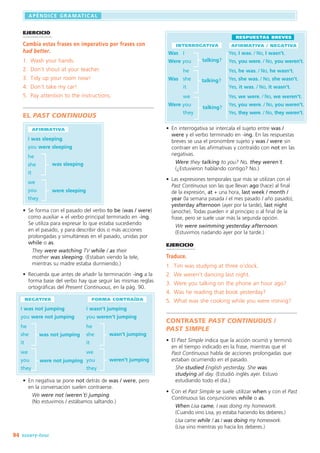
El Past Continuous 94
Contraste Past Continuous / Past Simple 94
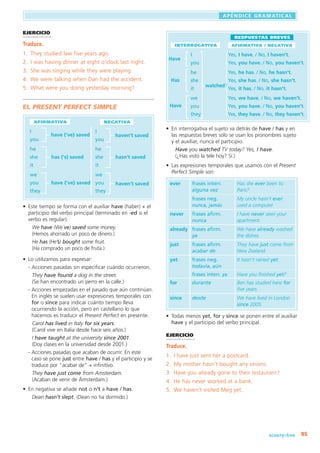
El Present Perfect Simple 95
Contraste Present Perfect Simple / Past Simple 96
El Present Perfect Continuous 96
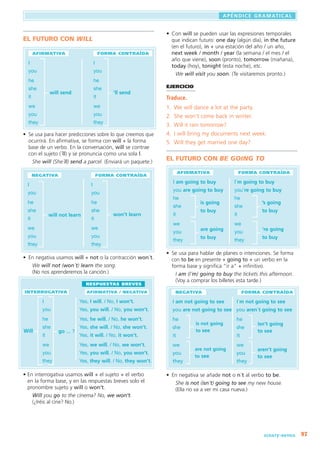
El futuro con will 97
El futuro con be going to 97
El Present Continuous con valor de futuro 98
Can, Must, Should 98
Contraste can / could 99
Have to 99
Mustn’t / Don’t have to 99
El primer condicional 100
El segundo condicional 100
El tercer condicional 100
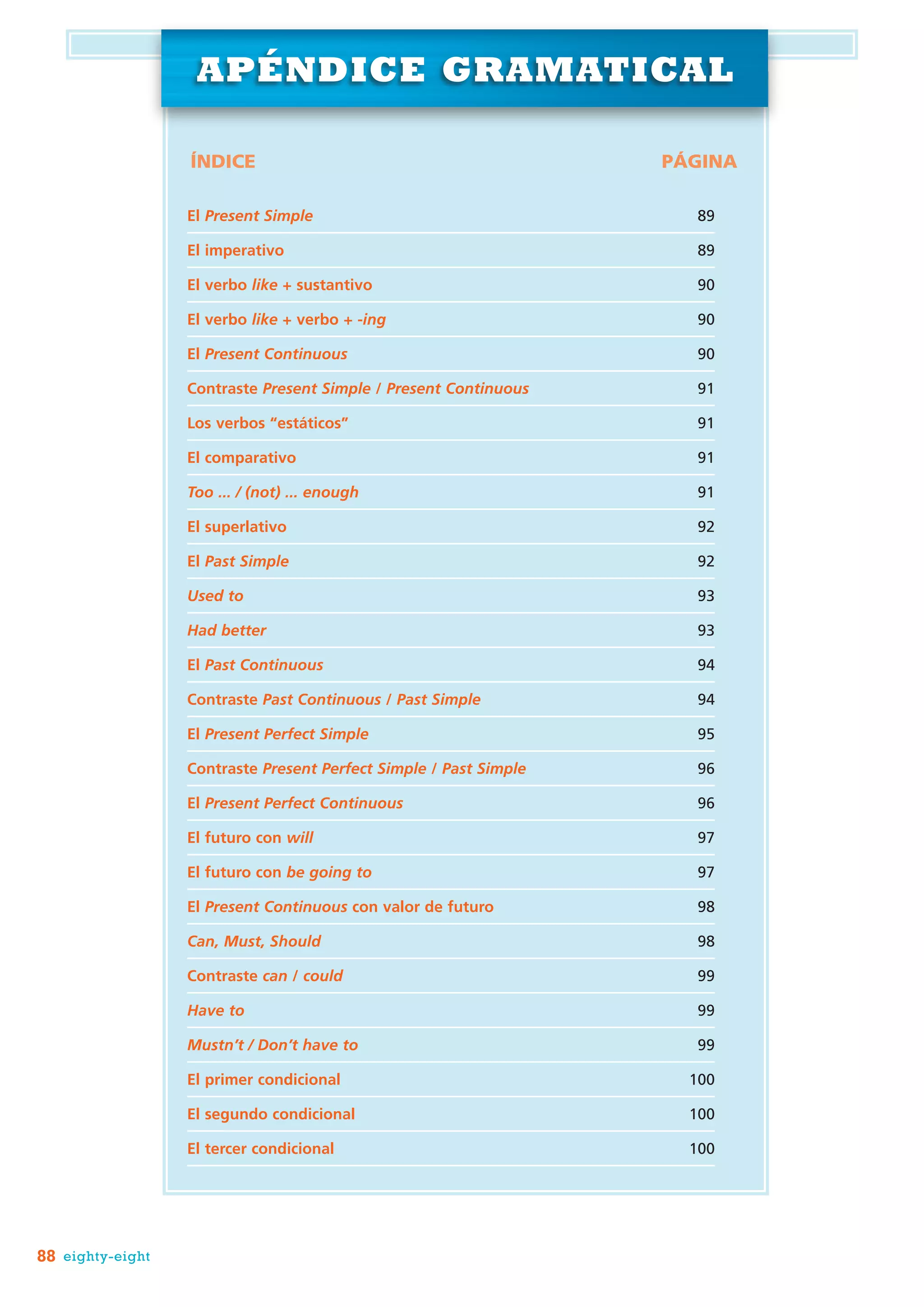
ÍNDICE PÁGINA
APÉNDICE GRAMATICAL
eighty-eight
2.
89
APENDICE GRAMATICAL
,
eighty-nine
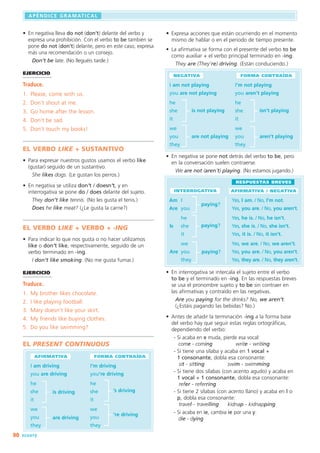
ELPRESENT SIMPLE
Afirmativa
I
you
he
she sings
it
we
you sing
they
TRADUCCIón
canto
cantas
él canta
ella canta
canta
cantamos
cantáis
cantan
sing
• Se usa para expresar hechos habituales, situaciones y
estados. Se forma poniendo el sujeto y el verbo en la
forma base, excepto en la 3ª persona del singular, a la
que se añade una -s al final.
Some people sing in the shower.
(Algunas personas cantan en la ducha.)
• Sin embargo, los siguientes verbos añaden -es:
- Los acabados en consonante + y, que además
cambian la y por i: study - studies.
- Los terminados en o, ch, ss, sh y x: do - does,
watch - watches, miss - misses, wash - washes,
mix - mixes.
NEGATIVA
I
you
he
she
it
we
you
they
FORMA CONTRAÍDA
I
you
he
she
it
we
you
they
do not work
does not work
do not work
don’t work
doesn’t work
don’t work
• En negativa necesita do / does + not o don’t / doesn’t
delante del verbo en la forma base.
We do not (don’t) work on Saturday.
(No trabajamos los sábados.)
• En la interrogativa se pone el auxiliar do / does delante
del sujeto y en las respuestas breves se repite detrás de él.
Does she speak French? No, she doesn’t.
(¿Ella habla francés? No.)
Preguntas con partículas interrogativas
• Para hacer preguntas con las partículas who, where,
what, when, how, etc., ponemos la partícula + do /
does + el sujeto + el verbo en la forma base.
Where do you go every afternoon? I go to
the gym. (¿Dónde vas todas las tardes? Voy al
gimnasio.)
• Recuerda que to be y have got no necesitan do / does
en interrogativa, así que tampoco en estas preguntas.
What has she got in her pocket?
(¿Qué tiene en el bolsillo?)
• El Present Simple suele ir acompañado de adverbios de
frecuencia que van delante del verbo principal, pero si
se trata del verbo to be se colocan detrás. Algunos de
estos adverbios son: always (siempre), never (nunca),
usually (normalmente), regularly (con regularidad),
frequently (con frecuencia), often (a menudo),
sometimes (a veces), seldom (casi nunca, rara vez).
I usually eat a lot of fruits and vegetables.
(Normalmente como mucha fruta y verdura.)
Tom is never at home. (Tom nunca está en casa.)
• También puede ir acompañado de expresiones
temporales que siempre van al principio o al final de
la frase. Algunas son at + una hora, at night (por la
noche), in the morning / afternoon / evening (por
la mañana / tarde / noche), on + un día de la semana,
every week / month / year (cada semana / mes / año),
once a week / month / year (una vez a la semana / al
mes / al año), how often ... ? (¿con qué frecuencia...?).
My children go to bed at nine o’clock.
(Mis hijos se van a la cama a las nueve en punto.)
I hold a party once a year.
(Hago una fiesta una vez al año.)
EJERCICIO
Traduce.
1. I go to the beach every day in the summer.
2. She doesn’t know my name.
3. Do you live in Manchester?
4. When do you usually go on holiday?
5. Does Paul work at the weekend?
EL IMPERATIVO
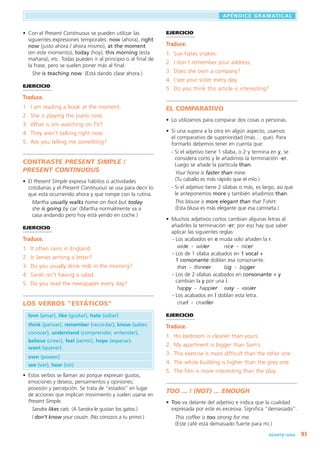
• Solo se usa en afirmativa y negativa. Nunca lleva sujeto
ni tiene forma interrogativa. Se construye con la forma
base del verbo y expresa órdenes e indicaciones.
Read the text, please. (Lee el texto, por favor.)
I
you
he
Does she
it
we
Do you
they
AFIRMATIVA / NEGATIVA
Yes, I do. / No, I don’t.
Yes, you do. / No, you don’t.
Yes, he does. / No, he doesn’t.
Yes, she does. / No, she doesn’t.
Yes, it does. / No, it doesn’t.
Yes, we do. / No, we don’t.
Yes, you do. / No, you don’t.
Yes, they do. / No, they don’t.
speak?
INTERROGATIVA
speak?
speak?
Respuestas breves
Do
3.
90
APENDICE GRAMATICAL
,
ninety
• Eninterrogativa se intercala el sujeto entre el verbo
to be y el terminado en -ing. En las respuestas breves
se usa el pronombre sujeto y to be sin contraer en
las afirmativas y contraído en las negativas.
Are you paying for the drinks? No, we aren’t.
(¿Estáis pagando las bebidas? No.)
• Antes de añadir la terminación -ing a la forma base
del verbo hay que seguir estas reglas ortográficas,
dependiendo del verbo:
- Si acaba en e muda, pierde esa vocal:
come - coming write - writing
- Si tiene una sílaba y acaba en 1 vocal +
1 consonante, dobla esa consonante:
sit - sitting swim - swimming
- Si tiene dos sílabas (con acento agudo) y acaba en
1 vocal + 1 consonante, dobla esa consonante:
refer - referring
- Si tiene 2 sílabas (con acento llano) y acaba en l o
p, dobla esa consonante:
travel - travelling kidnap - kidnapping
- Si acaba en ie, cambia ie por una y:
die - dying
• En negativa se pone not detrás del verbo to be, pero
en la conversación suelen contraerse.
We are not (aren´t) playing. (No estamos jugando.)
• En negativa lleva do not (don’t) delante del verbo y
expresa una prohibición. Con el verbo to be también se
pone do not (don’t) delante, pero en este caso, expresa
más una recomendación o un consejo.
Don’t be late. (No lleguéis tarde.)
EJERCICIO
Traduce.
1. Please, come with us.
2. Don’t shout at me.
3. Go home after the lesson.
4. Don’t be sad.
5. Don’t touch my books!
EL VERBO LIKE + SUSTANTIVO
• Para expresar nuestros gustos usamos el verbo like
(gustar) seguido de un sustantivo.
She likes dogs. (Le gustan los perros.)
• En negativa se utiliza don’t / doesn’t, y en
interrogativa se pone do / does delante del sujeto.
They don’t like tennis. (No les gusta el tenis.)
Does he like meat? (¿Le gusta la carne?)
EL VERBO LIKE + VERBO + -ING
• Para indicar lo que nos gusta o no hacer utilizamos
like o don’t like, respectivamente, seguido de un
verbo terminado en -ing.
I don’t like smoking. (No me gusta fumar.)
EJERCICIO
Traduce.
1. My brother likes chocolate.
2. I like playing football.
3. Mary doesn’t like your skirt.
4. My friends like buying clothes.
5. Do you like swimming?
EL PRESENT CONTINUOUS
Afirmativa
I am driving
you are driving
he
she
it
we
you
they
FORMA CONTRAÍDA
I’m driving
you’re driving
he
she
it
we
you
they
’re driving
’s driving
are driving
is driving
NEGATIVA
I am not playing
you are not playing
he
she
it
we
you
they
FORMA CONTRAÍDA
I’m not playing
you aren’t playing
he
she
it
we
you
they
aren’t playing
isn’t playing
are not playing
is not playing
• Expresa acciones que están ocurriendo en el momento
mismo de hablar o en el periodo de tiempo presente.
• La afirmativa se forma con el presente del verbo to be
como auxiliar + el verbo principal terminado en -ing.
They are (They’re) driving. (Están conduciendo.)
Am I
Are you
he
Is she
it
we
Are you
they
Yes, I am. / No, I’m not.
Yes, you are. / No, you aren’t.
Yes, he is. / No, he isn’t.
Yes, she is. / No, she isn’t.
Yes, it is. / No, it isn’t.
Yes, we are. / No, we aren’t.
Yes, you are. / No, you aren’t.
Yes, they are. / No, they aren’t.
paying?
paying?
paying?
afirmativa / negativa
Respuestas breves
INTERROGATIVA
4.
91
APENDICE GRAMATICAL
,
ninety-one
EJERCICIO
Traduce.
1. Sue hates snakes.
2. I don’t remember your address.
3. Does she own a company?
4. I see your sister every day.
5. Do you think this article is interesting?
EL COMPARATIVO
• Lo utilizamos para comparar dos cosas o personas.
• Si una supera a la otra en algún aspecto, usamos
el comparativo de superioridad (más ... que). Para
formarlo debemos tener en cuenta que:
- Si el adjetivo tiene 1 sílaba, o 2 y termina en y, se
considera corto y le añadimos la terminación -er.
Luego se añade la partícula than.
Your horse is faster than mine.
(Tu caballo es más rápido que el mío.)
- Si el adjetivo tiene 2 sílabas o más, es largo, así que
le anteponemos more y también añadimos than.
This blouse is more elegant than that T-shirt.
(Esta blusa es más elegante que esa camiseta.)
• Muchos adjetivos cortos cambian algunas letras al
añadirles la terminación -er; por eso hay que saber
aplicar las siguientes reglas:
- Los acabados en e muda solo añaden la r.
wide - wider nice - nicer
- Los de 1 sílaba acabados en 1 vocal +
1 consonante doblan esa consonante.
thin - thinner big - bigger
- Los de 2 sílabas acabados en consonante + y
cambian la y por una i.
happy - happier easy - easier
- Los acabados en l doblan esta letra.
cruel - crueller
EJERCICIO
Traduce.
1. His bedroom is cleaner than yours.
2. My apartment is bigger than Sam’s.
3. This exercise is more difficult than the other one.
4. The white building is higher than the grey one.
5. The film is more interesting than the play.
TOO ... / (NOT) ... ENOUGH
• Too va delante del adjetivo e indica que la cualidad
expresada por este es excesiva. Significa “demasiado”.
This coffee is too strong for me.
(Este café está demasiado fuerte para mí.)
• Con el Present Continuous se pueden utilizar las
siguientes expresiones temporales: now (ahora), right
now (justo ahora / ahora mismo), at the moment
(en este momento), today (hoy), this morning (esta
mañana), etc. Todas pueden ir al principio o al final de
la frase, pero se suelen poner más al final.
She is teaching now. (Está dando clase ahora.)
EJERCICIO
Traduce.
1. I am reading a book at the moment.
2. She is playing the piano now.
3. What is Jim watching on TV?
4. They aren’t talking right now.
5. Are you telling me something?
CONTRASTE Present Simple /
Present CONTINUOUS
• El Present Simple expresa hábitos o actividades
cotidianas y el Present Continuous se usa para decir lo
que está ocurriendo ahora y que rompe con la rutina.
Martha usually walks home on foot but today
she is going by car. (Martha normalmente va a
casa andando pero hoy está yendo en coche.)
EJERCICIO
Traduce.
1. It often rains in England.
2. Is James writing a letter?
3. Do you usually drink milk in the morning?
4. Sarah isn’t having a salad.
5. Do you read the newspaper every day?
LOS VERBOS ESTÁTICOS
love (amar), like (gustar), hate (odiar)
think (pensar), remember (recordar), know (saber,
conocer), understand (comprender, entender),
believe (creer), feel (sentir), hope (esperar),
want (querer)
own (poseer)
see (ver), hear (oír)
• Estos verbos se llaman así porque expresan gustos,
emociones y deseos; pensamientos y opiniones;
posesión y percepción. Se trata de “estados” en lugar
de acciones que implican movimiento y suelen usarse en
Present Simple.
Sandra likes cats. (A Sandra le gustan los gatos.)
I don’t know your cousin. (No conozco a tu primo.)
5.
92
APENDICE GRAMATICAL
,
ninety-two
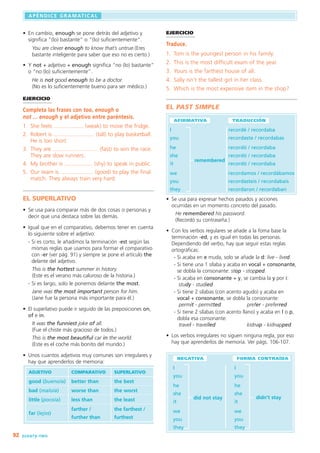
• Seusa para expresar hechos pasados y acciones
ocurridas en un momento concreto del pasado.
He remembered his password.
(Recordó su contraseña.)
• Con los verbos regulares se añade a la foma base la
terminación -ed, y es igual en todas las personas.
Dependiendo del verbo, hay que seguir estas reglas
ortográficas:
- Si acaba en e muda, solo se añade la d: live - lived.
- Si tiene una 1 sílaba y acaba en vocal + consonante,
se dobla la consonante: stop - stopped.
- Si acaba en consonante + y, se cambia la y por i:
study - studied
- Si tiene 2 sílabas (con acento agudo) y acaba en
vocal + consonante, se dobla la consonante:
permit - permitted prefer - preferred
- Si tiene 2 sílabas (con acento llano) y acaba en l o p,
dobla esa consonante:
travel - travelled kidnap - kidnapped
• Los verbos irregulares no siguen ninguna regla, por eso
hay que aprenderlos de memoria. Ver págs. 106-107.
NEGATIVA
I
you
he
she
it
we
you
they
FORMA CONTRAÍDA
I
you
he
she
it
we
you
they
did not stay didn’t stay
• En cambio, enough se pone detrás del adjetivo y
significa “(lo) bastante” o “(lo) suficientemente”.
You are clever enough to know that’s untrue.(Eres
bastante inteligente para saber que eso no es cierto.)
• Y not + adjetivo + enough significa “no (lo) bastante”
o “no (lo) suficientemente”.
He is not good enough to be a doctor.
(No es lo suficientemente bueno para ser médico.)
EJERCICIO
Completa las frases con too, enough o
not ... enough y el adjetivo entre paréntesis.
1. She feels ................... (weak) to move the fridge.
2. Robert is .......................... (tall) to play basketball.
He is too short.
3. They are ............................. (fast) to win the race.
They are slow runners.
4. My brother is .................. (shy) to speak in public.
5. Our team is ..................... (good) to play the final
match. They always train very hard.
EL SUPERLATIVO
• Se usa para comparar más de dos cosas o personas y
decir que una destaca sobre las demás.
• Igual que en el comparativo, debemos tener en cuenta
lo siguiente sobre el adjetivo:
- Si es corto, le añadimos la terminación -est según las
mismas reglas que usamos para formar el comparativo
con -er (ver pág. 91) y siempre se pone el artículo the
delante del adjetivo.
This is the hottest summer in history.
(Este es el verano más caluroso de la historia.)
- Si es largo, solo le ponemos delante the most.
Jane was the most important person for him.
(Jane fue la persona más importante para él.)
• El superlativo puede ir seguido de las preposiciones on,
of e in.
It was the funniest joke of all.
(Fue el chiste más gracioso de todos.)
This is the most beautiful car in the world.
(Este es el coche más bonito del mundo.)
• Unos cuantos adjetivos muy comunes son irregulares y
hay que aprenderlos de memoria:
Adjetivo Comparativo Superlativo
good (bueno/a) better than the best
bad (malo/a) worse than the worst
little (poco/a) less than the least
far (lejos)
farther /
further than
the farthest /
furthest
Afirmativa
I
you
he
she
it
we
you
they
TRADUCCIÓN
recordé / recordaba
recordaste / recordabas
recordó / recordaba
recordó / recordaba
recordó / recordaba
recordamos / recordábamos
recordasteis / recordabais
recordaron / recordaban
remembered
EJERCICIO
Traduce.
1. Tom is the youngest person in his family.
2. This is the most difficult exam of the year.
3. Yours is the farthest house of all.
4. Sally isn’t the tallest girl in her class.
5. Which is the most expensive item in the shop?
EL PAST SIMPLE
6.
93
APENDICE GRAMATICAL
,
She usedto wear flashy dresses.
(Solía llevar / Llevaba vestidos llamativos.)
Dan used to ride a motorbike but now he
drives a car. (Dan solía montar / montaba en
moto, pero ahora conduce un coche.)
• En negativa necesita did not, y como did ya es forma
de pasado, used pierde la d.
We didn’t use to go to the disco.
(No solíamos ir / íbamos a la discoteca.)
• En interrogativa ocurre lo mismo, pero ponemos did
al principio.
Did you use to play football? Yes, I did.
(¿Solías jugar / Jugabas al fútbol? Sí.)
EJERCICIO
Completa las siguientes frases con la forma correcta
de used to y el verbo entre paréntesis.
1. We ...................... (celebrate) Christmas with our
family.
2. Lilly ........................ (not go) to that school.
3. My mother ........................ (read) stories to me
when I was a child.
4. ....................... you ....................... (play) the
guitar?
5. My friends ........................... (not call) me every
day.
HAD BETTER
• Had better (o la contracción ’d better) se utiliza
para decir lo que creemos que se debería hacer, dar
un consejo o una opinión de forma muy coloquial.
Esta construcción no suele usarse en interrogativa. En
afirmativa, se pone el sujeto y después had better +
el verbo en la forma base. Significa “Es mejor que” +
un verbo en presente de subjuntivo.
You had better (You’d better) have a rest.
(Es mejor que te tomes un descanso.)
• En negativa, se pone had better + not + el verbo en
la forma base.
You had better (You’d better) not touch
those buttons.
(Es mejor que no toques esos botones.)
• Por otra parte, had better se utiliza también para
expresar una advertencia. En ese caso, equivale a
expresiones como “Será mejor que...”, “Más vale
que...”.
You had better (You’d better) make your bed
now! (¡Será mejor que hagas la cama ahora!)
You had better (You’d better) not lose your
watch! (¡Más vale que no pierdas el reloj!)
ninety-three
• En interrogativa se pone did delante del sujeto, y en
las respuestas breves el pronombre personal sujeto +
did / didn´t, sin repetir el verbo en la forma base.
Did you watch the film? Yes, we did.
(¿Visteis la película? Sí.)
• Con el Past Simple se pueden utilizar algunas
expresiones temporales que indican en qué momento
ocurrió la acción. Las más frecuentes son las que
llevan ago (hace) al final de la expresión, yesterday
(ayer), at + una hora, last night (anoche), on + un
día de la semana, in + un año, last week / month /
year (la semana pasada / el mes pasado / el año
pasado), in the past (en el pasado). Todas pueden ir
al principio o al final de la frase, pero se suele usar
más la segunda opción.
In the past, I went to school.
(En el pasado iba al colegio.)
We found a wallet two days ago.
(Encontramos una cartera hace dos días.)
EJERCICIO
Traduce.
1. They saw the new student an hour ago.
2. I didn’t find her house.
3. Did you watch TV last night?
4. Peter studied biology.
5. Did they meet their teacher yesterday?
USED TO
• Es una forma verbal que no tiene presente, sino solo
pasado; expresa costumbres y situaciones que eran
habituales en otro tiempo y ya no lo son. Se traduce por
“soler” en pretérito imperfecto, o no lo traducimos y
ponemos el verbo que lo sigue en pretérito imperfecto.
Interrogativa
I
you
he
she
it
we
you
they
aFIRMATIVA / NEGATIVA
Yes, I did. / No, I didn’t.
Yes, you did. / No, you didn’t.
Yes, he did. / No, he didn’t.
Yes, she did. / No, she didn’t.
Yes, it did. / No, it didn’t.
Yes, we did. / No, we didn’t.
Yes, you did. / No, you didn’t.
Yes, they did. / No, they didn’t.
watch?
Respuestas breves
Did
• En la negativa, todos los verbos llevan did not / didn´t
seguido del verbo en la forma base.
They did not (didn´t) stay at home.
(No se quedaron en casa.)
Pam did not (didn´t) keep the letter.
(Pam no guardó la carta.)
7.
94
APENDICE GRAMATICAL
,
ninety-four
• Eninterrogativa se intercala el sujeto entre was /
were y el verbo terminado en -ing. En las respuestas
breves se usa el pronombre sujeto y was / were sin
contraer en las afirmativas y contraído con not en las
negativas.
Were they talking to you? No, they weren´t.
(¿Estuvieron hablando contigo? No.)
• Las expresiones temporales que más se utilizan con el
Past Continuous son las que llevan ago (hace) al final
de la expresión, at + una hora, last week / month /
year (la semana pasada / el mes pasado / año pasado),
yesterday afternoon (ayer por la tarde), last night
(anoche). Todas pueden ir al principio o al final de la
frase, pero se suele usar más la segunda opción.
We were swimming yesterday afternoon.
(Estuvimos nadando ayer por la tarde.)
EJERCICIO
Traduce.
1. Tim was studying at three o’clock.
2. We weren’t dancing last night.
3. Were you talking on the phone an hour ago?
4. Was he reading that book yesterday?
5. What was she cooking while you were ironing?
CONTRASTE PAST CONTINUOUS /
PAST SIMPLE
• El Past Simple indica que la acción ocurrió y terminó
en el tiempo indicado en la frase, mientras que el
Past Continuous habla de acciones prolongadas que
estaban ocurriendo en el pasado.
She studied English yesterday. She was
studying all day. (Estudió inglés ayer. Estuvo
estudiando todo el día.)
• Con el Past Simple se suele utilizar when y con el Past
Continuous las conjunciones while o as.
When Lisa came, I was doing my homework.
(Cuando vino Lisa, yo estaba haciendo los deberes.)
Lisa came while / as I was doing my homework.
(Lisa vino mientras yo hacía los deberes.)
• Se forma con el pasado del verbo to be (was / were)
como auxiliar + el verbo principal terminado en -ing.
Se utiliza para expresar lo que estaba sucediendo
en el pasado, y para describir dos o más acciones
prolongadas y simultáneas en el pasado, unidas por
while o as.
They were watching TV while / as their
mother was sleeping. (Estaban viendo la tele,
mientras su madre estaba durmiendo.)
• Recuerda que antes de añadir la terminación -ing a la
forma base del verbo hay que seguir las mismas reglas
ortográficas del Present Continuous, en la pág. 90.
NEGATIVA
I was not jumping
you were not jumping
he
she
it
we
you
they
FORMA CONTRAÍDA
I wasn’t jumping
you weren’t jumping
he
she
it
we
you
they
weren’t jumping
wasn’t jumping
were not jumping
was not jumping
• En negativa se pone not detrás de was / were, pero
en la conversación suelen contraerse.
We were not (weren´t) jumping.
(No estuvimos / estábamos saltando.)
Afirmativa
I was sleeping
you were sleeping
he
she
it
we
you
they
were sleeping
was sleeping
EJERCICIO
Cambia estas frases en imperativo por frases con
had better.
1. Wash your hands.
2. Don’t shout at your teacher.
3. Tidy up your room now!
4. Don’t take my car!
5. Pay attention to the instructions.
EL PAST CONTINUOUS
Was I
Were you
he
Was she
it
we
Were you
they
talking?
talking?
talking?
Respuestas breves
afirmativa / negativaINTERROGATIVA
Yes, I was. / No, I wasn’t.
Yes, you were. / No, you weren’t.
Yes, he was. / No, he wasn’t.
Yes, she was. / No, she wasn’t.
Yes, it was. / No, it wasn’t.
Yes, we were. / No, we weren’t.
Yes, you were. / No, you weren’t.
Yes, they were. / No, they weren’t.
8.
95
APENDICE GRAMATICAL
,
ninety-five
EJERCICIO
Traduce.
1. They studied law five years ago.
2. I was having dinner at eight o'clock last night.
3. She was singing while they were playing.
4. We were talking when Dan had the accident.
5. What were you doing yesterday morning?
EL PRESENT PERFECT SIMPLE
Afirmativa
I
you
he
she has (‘s) saved
it
we
you have (‘ve) saved
they
I
you
he
she
it
we
you
they
NEGATIVA
have (‘ve) saved haven’t saved
haven’t saved
hasn’t saved
• Este tiempo se forma con el auxiliar have (haber) + el
participio del verbo principal (terminado en -ed si el
verbo es regular).
We have (We´ve) saved some money.
(Hemos ahorrado un poco de dinero.)
He has (He’s) bought some fruit.
(Ha comprado un poco de fruta.)
• Lo utilizamos para expresar:
- Acciones pasadas sin especificar cuándo ocurrieron.
They have found a dog in the street.
(Se han encontrado un perro en la calle.)
- Acciones empezadas en el pasado que aún continúan.
En inglés se suelen usar expresiones temporales con
for o since para indicar cuánto tiempo lleva
ocurriendo la acción, pero en castellano lo que
hacemos es traducir el Present Perfect en presente.
Carol has lived in Italy for six years.
(Carol vive en Italia desde hace seis años.)
I have taught at the university since 2001.
(Doy clases en la universidad desde 2001.)
- Acciones pasadas que acaban de ocurrir. En este
caso se pone just entre have / has y el participio y se
traduce por “acabar de” + infinitivo.
They have just come from Amsterdam.
(Acaban de venir de Ámsterdam.)
• En negativa se añade not o n’t a have / has.
Dean hasn’t slept. (Dean no ha dormido.)
Interrogativa
I
you
he
she
it
we
you
they
aFIRMATIVA / NEGATIVA
Yes, I have. / No, I haven’t.
Yes, you have. / No, you haven’t.
Yes, he has. / No, he hasn’t.
Yes, she has. / No, she hasn’t.
Yes, it has. / No, it hasn’t.
Yes, we have. / No, we haven’t.
Yes, you have. / No, you haven’t.
Yes, they have. / No, they haven’t.
Respuestas breves
watched?
Have
Has
Have
• En interrogativa el sujeto va detrás de have / has y en
las respuestas breves solo se usan los pronombres sujeto
y el auxiliar, nunca el participio.
Have you watched TV today? Yes, I have.
(¿Has visto la tele hoy? Sí.)
• Las expresiones temporales que usamos con el Present
Perfect Simple son:
ever frases interr.
alguna vez
Has she ever been to
Paris?
frases neg.
nunca, jamás
My uncle hasn’t ever
used a computer
never frases afirm.
nunca
I have never seen your
apartment.
already frases afirm.
ya
We have already washed
the dishes.
just frases afirm.
acabar de
They have just come from
New Zealand.
yet frases neg.
todavía, aún
It hasn’t rained yet.
frases interr. ya Have you finished yet?
for durante Ben has studied here for
five years.
since desde We have lived in London
since 2005.
• Todas menos yet, for y since se ponen entre el auxiliar
have y el participio del verbo principal.
EJERCICIO
Traduce.
1. I have just sent her a postcard.
2. My mother hasn’t bought any onions.
3. Have you already gone to their restaurant?
4. He has never worked at a bank.
5. We haven’t visited Meg yet.
9.
96
APENDICE GRAMATICAL
,
ninety-six
CONTRASTE PRESENTPERFECT SIMPLE /
PAST SIMPLE
• El Past Simple habla de acciones pasadas que ya
no afectan al momento actual e indica cuándo
ocurrieron. En cambio, el Present Perfect Simple indica
que lo ocurrido en el pasado guarda relación con el
presente y no dice cuándo sucedió.
We travelled to Poland last summer.
(Viajamos a Polonia el verano pasado.)
I have found my glasses.
(He encontrado las gafas.) [el resultado se ve ahora]
EJERCICIO
Traduce.
1. We bought a new mobile phone yesterday.
2. I have just finished my homework.
3. Did you meet Liam at the party?
4. Has she called her parents yet?
5. They didn't watch TV last night.
EL PRESENT PERFECT CONTINUOUS
Afirmativa
I
you
he
she has been trying
it
we
you have been trying
they
I
you
he
she
it
we
you
they
FORMA CONTRAÍDA
have been trying ’ve been trying
’ve been trying
’s been trying
• Se forma con el Present Perfect de to be + el verbo
principal terminado en -ing.
I have been trying to get here all day.
(He estado intentando llegar aquí todo el día.)
• Se utiliza para expresar:
- Acciones que empezaron en el pasado y aún
continúan. Además, se suele traducir por “llevar” +
gerundio.
We have been eating all morning.
(Llevamos comiendo toda la mañana.)
- Acciones recientes cuyos efectos se ven en el
presente.
I found my bag! I have been looking for it for
two hours. (¡He encontrado el bolso! He estado
buscándolo durante dos horas.)
• En negativa se añade not o n’t a have o has.
They haven’t been living in Greece all year.
(No han estado viviendo en Grecia todo el año.)
Interrogativa
I
you
he
she
it
we
you
they
aFIRMATIVA / NEGATIVA
Yes, I have. / No, I haven’t.
Yes, you have. / No, you haven’t.
Yes, he has. / No, he hasn’t.
Yes, she has. / No, she hasn’t.
Yes, it has. / No, it hasn’t.
Yes, we have. / No, we haven’t.
Yes, you have. / No, you haven’t.
Yes, they have. / No, they haven’t.
Respuestas breves
Have
Has
Have
been
cleaning?
• En interrogativa se empieza con have o has y en las
respuestas breves usamos el pronombre sujeto y se
repite el auxiliar.
Have you been cleaning your bedroom? No, I haven’t.
(¿Has estado limpiando tu habitación? No.)
• Las expresiones temporales más frecuentes con el
Present Perfect Continuous son: for (durante), since
(desde), all day / week / month / year (todo el día /
toda la semana / todo el mes / todo el año), etc.
He has been sleeping here all month.
(Lleva durmiendo aquí todo el mes.)
EJERCICIO
Traduce.
1. He’s been preparing lunch all morning.
2. They have been living in London for five years.
3. Have you been going to class all week?
4. I haven’t been working since last year.
5. Has your sister been travelling too much lately?
NEGativa
I
you
he
she
it
we
you
they
I
you
he
she
it
we
you
they
FORMA CONTRAÍDA
have not
been living
haven’t been
living
haven’t been
living
hasn’t been
living
has not been
living
have not been
living
10.
97
APENDICE GRAMATICAL
,
ninety-seven
• Con will se pueden usar las expresiones temporales
que indican futuro: one day (algún día), in the future
(en el futuro), in + una estación del año / un año,
next week / month / year (la semana / el mes / el
año que viene), soon (pronto), tomorrow (mañana),
today (hoy), tonight (esta noche), etc.
We will visit you soon. (Te visitaremos pronto.)
EJERCICIO
Traduce.
1. We will dance a lot at the party.
2. She won’t come back in winter.
3. Will it rain tomorrow?
4. I will bring my documents next week.
5. Will they get married one day?
EL FUTURO CON BE GOING TO
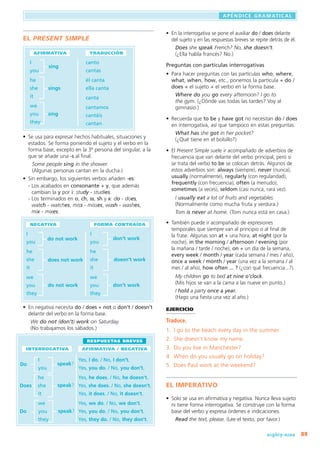
Afirmativa
I am going to buy
you are going to buy
he
she
it
we
you
they
FORMA CONTRAÍDa
I´m going to buy
you´re going to buy
he
she
it
we
you
they
are going
to buy
is going
to buy
’re going
to buy
’s going
to buy
• Se usa para hablar de planes o intenciones. Se forma
con to be en presente + going to + un verbo en la
forma base y significa “ir a” + infinitivo.
I am (I´m) going to buy the tickets this afternoon.
(Voy a comprar los billetes esta tarde.)
NEGATIVA FORMA CONTRAÍDA
I am not going to see I´m not going to see
you are not going to see you aren´t going to see
he he
she she
it it
we we
you you
they they
is not going
to see
are not going
to see
isn’t going
to see
aren’t going
to see
• En negativa se añade not o n´t al verbo to be.
She is not (isn´t) going to see my new house.
(Ella no va a ver mi casa nueva.)
EL FUTURO CON WILL
Afirmativa
I
you
he
she
it
we
you
they
FORMA CONTRAÍDa
I
you
he
she
it
we
you
they
will send ’ll send
• Se usa para hacer predicciones sobre lo que creemos que
ocurrirá. En afirmativa, se forma con will + la forma
base de un verbo. En la conversación, will se contrae
con el sujeto (´ll) y se pronuncia como una sola l.
She will (She´ll) send a parcel. (Enviará un paquete.)
NEGATIVA
I
you
he
she
it
we
you
they
FORMA CONTRAÍDa
I
you
he
she
it
we
you
they
will not learn won’t learn
• En negativa usamos will + not o la contracción won´t.
We will not (won´t) learn the song.
(No nos aprenderemos la canción.)
Interrogativa
I
you
he
she
it
we
you
they
aFIRMATIVA / NEGATIVA
Will go ... ?
Respuestas breves
• En interrogativa usamos will + el sujeto + el verbo
en la forma base, y en las respuestas breves solo el
pronombre sujeto y will o won’t.
Will you go to the cinema? No, we won’t.
(¿Iréis al cine? No.)
Yes, I will. / No, I won’t.
Yes, you will. / No, you won’t.
Yes, he will. / No, he won’t.
Yes, she will. / No, she won’t.
Yes, it will. / No, it won’t.
Yes, we will. / No, we won’t.
Yes, you will. / No, you won’t.
Yes, they will. / No, they won’t.
11.
98
APENDICE GRAMATICAL
,
ninety-eight
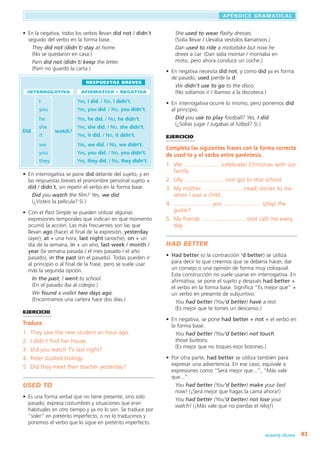
INTERROGATIVA
Am Igoing to run?
Are you going to run?
he
Is she
it
we
Are you
they
aFIRMATIVA / NEGATIVa
Yes, I am. / No, I’m not.
Yes, you are. / No, you aren’t.
Yes, he is. / No, he isn’t.
Yes, she is. / No, she isn’t.
Yes, it is. / No, it isn’t.
Yes, we are. / No, we aren’t.
Yes, you are. / No, you aren’t.
Yes, they are. / No, they aren’t.
going to
run?
going to
run?
Respuestas breves
• En interrogativa intercalamos el sujeto entre to be y
going to. En las respuestas breves usamos el pronombre
sujeto y to be, sin contraer en afirmativa y contraído
con not en negativa.
Are you going to run a marathon? Yes, I am.
(¿Vas a correr una maratón? Sí.)
• Con be going to suelen usarse expresiones temporales
que indican un futuro cercano: later (más tarde), soon
(pronto), tomorrow (mañana), today (hoy), tonight
(esta noche), next week / month / year / summer
(la semana / el mes / el año / el verano que viene),
on + un día de la semana, at + una hora, etc.
Is she going to drive your new car tomorrow?
No, she isn’t.
(¿Va a conducir ella tu coche nuevo mañana? No.)
EJERCICIO
Traduce.
1. We are going to bring her a bike soon.
2. Is she going to stay in London on Monday?
3. They aren’t going to travel by train.
4. Are they going to come next week?
5. It’s going to snow today.
EL PRESENT CONTINUOUS CON VALOR
DE FUTURO
• Ya se ha visto que el Present Continuous se usa para
expresar lo que está ocurriendo en el momento
de hablar y que se forma con to be + un verbo
terminado en -ing.
• Además, se usa con “valor de futuro” para anunciar
planes personales que ocurrirán en el futuro cercano
con seguridad, porque ya se han fijado de antemano.
Al hacerlo, hay que indicar cuándo va a ocurrir la acción
exactamente, si no parecerá un Present Continuous
normal. Usamos las mismas expresiones temporales
que con be going to.
I’m having lunch with Tim today. (Voy a comer con
Tim hoy.) [es un hecho seguro, no una intención]
EJERCICIO
Traduce.
1. They´re coming tomorrow.
2. We are skating later.
3. Ann is travelling to Bristol at the weekend.
4. My brother and I are having dinner at 7 o´clock.
5. He’s going to the party tonight.
CAN
• Se utiliza para expresar habilidad (saber), posibilidad
(poder) y, en preguntas, para pedir permiso o favores.
Es un verbo modal y por tanto especial, ya que no
añade -s en la 3ª persona del singular y siempre va
seguido de otro verbo en la forma base.
Paul can swim. (Paul sabe nadar.)
I can go out tonight. (Puedo salir esta noche.)
• En negativa solo se le añade not, sin separación
(cannot), o se usa la forma contraída can´t.
He cannot / can´t speak Russian.
(No sabe hablar ruso.)
• En las preguntas hay que poner can delante del sujeto
y en las respuestas breves se usa el pronombre sujeto
seguido de can o can´t.
Can I play on the computer? Yes, you can.
(¿Puedo jugar en el ordenador? Sí.)
EJERCICIO
Traduce.
1. Ted can cook very well.
2. They can’t talk to their friends.
3. Can you help me?
4. I can’t go to the beach.
5. Can you do me a favour?
MUST
• Must es otro verbo modal. Expresa la obligación o la
necesidad fuerte de hacer algo, pues significa “deber”.
Siempre va seguido de otro verbo en la forma base.
Children must go to school.
(Los niños deben ir al colegio.)
• En negativa le añadimos not, pero usamos más su forma
contraída, mustn’t. En este caso expresa prohibición,
lo que no está permitido, y también algo que no se
debe hacer porque no es conveniente o correcto.
Cars mustn’t stop here.
(Los coches no deben parar aquí.) [está prohibido]
You mustn’t lose that ticket.
(No debes perder esa entrada.) [no es conveniente]
12.
99
APENDICE GRAMATICAL
,
ninety-nine
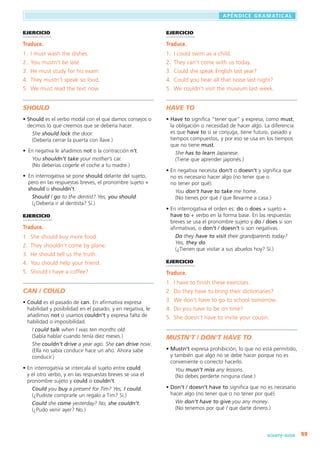
EJERCICIO
Traduce.
1. I could swim as a child.
2. They can’t come with us today.
3. Could she speak English last year?
4. Could you hear all that noise last night?
5. We couldn’t visit the museum last week.
HAVE TO
• Have to significa “tener que” y expresa, como must,
la obligación o necesidad de hacer algo. La diferencia
es que have to sí se conjuga, tiene futuro, pasado y
tiempos compuestos, y por eso se usa en los tiempos
que no tiene must.
She has to learn Japanese.
(Tiene que aprender japonés.)
• En negativa necesita don’t o doesn’t y significa que
no es necesario hacer algo (no tener que o
no tener por qué).
You don’t have to take me home.
(No tienes por qué / que llevarme a casa.)
• En interrogativa el orden es: do o does + sujeto +
have to + verbo en la forma base. En las respuestas
breves se usa el pronombre sujeto y do / does si son
afirmativas, o don’t / doesn’t si son negativas.
Do they have to visit their grandparents today?
Yes, they do.
(¿Tienen que visitar a sus abuelos hoy? Sí.)
EJERCICIO
Traduce.
1. I have to finish these exercises.
2. Do they have to bring their dictionaries?
3. We don’t have to go to school tomorrow.
4. Do you have to be on time?
5. She doesn’t have to invite your cousin.
MUSTN'T / DON'T HAVE TO
• Mustn’t expresa prohibición, lo que no está permitido,
y también que algo no se debe hacer porque no es
conveniente o correcto hacerlo.
You musn’t miss any lessons.
(No debes perderte ninguna clase.)
• Don’t / doesn’t have to significa que no es necesario
hacer algo (no tener que o no tener por qué).
We don’t have to give you any money.
(No tenemos por qué / que darte dinero.)
EJERCICIO
Traduce.
1. I must wash the dishes.
2. You mustn’t be late.
3. He must study for his exam.
4. They mustn’t speak so loud.
5. We must read the text now.
SHOULD
• Should es el verbo modal con el que damos consejos o
decimos lo que creemos que se debería hacer.
She should lock the door.
(Debería cerrar la puerta con llave.)
• En negativa le añadimos not o la contracción n’t.
You shouldn’t take your mother’s car.
(No deberías cogerle el coche a tu madre.)
• En interrogativa se pone should delante del sujeto,
pero en las respuestas breves, el pronombre sujeto +
should o shouldn’t.
Should I go to the dentist? Yes, you should.
(¿Debería ir al dentista? Sí.)
EJERCICIO
Traduce.
1. She should buy more food.
2. They shouldn’t come by plane.
3. He should tell us the truth.
4. You should help your friend.
5. Should I have a coffee?
CAN / COULD
• Could es el pasado de can. En afirmativa expresa
habilidad y posibilidad en el pasado, y en negativa, le
añadimos not o usamos couldn’t y expresa falta de
habilidad o imposibilidad.
I could talk when I was ten months old.
(Sabía hablar cuando tenía diez meses.)
She couldn’t drive a year ago. She can drive now.
(Ella no sabía conducir hace un año. Ahora sabe
conducir.)
• En interrogativa se intercala el sujeto entre could
y el otro verbo, y en las respuestas breves se usa el
pronombre sujeto y could o couldn’t.
Could you buy a present for Tim? Yes, I could.
(¿Pudiste comprarle un regalo a Tim? Sí.)
Could she come yesterday? No, she couldn’t.
(¿Pudo venir ayer? No.)
13.
100
APENDICE GRAMATICAL
,
one hundred
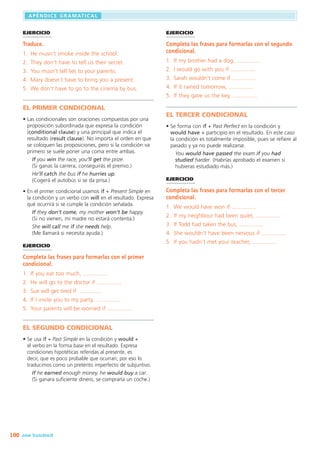
EJERCICIO
Traduce.
1. He musn’t smoke inside the school.
2. They don’t have to tell us their secret.
3. You musn’t tell lies to your parents.
4. Mary doesn’t have to bring you a present.
5. We don’t have to go to the cinema by bus.
EL PRIMER CONDICIONAL
• Las condicionales son oraciones compuestas por una
proposición subordinada que expresa la condición
(conditional clause) y una principal que indica el
resultado (result clause). No importa el orden en que
se coloquen las proposiciones, pero si la condición va
primero se suele poner una coma entre ambas.
If you win the race, you’ll get the prize.
(Si ganas la carrera, conseguirás el premio.)
He’ll catch the bus if he hurries up.
(Cogerá el autobús si se da prisa.)
• En el primer condicional usamos if + Present Simple en
la condición y un verbo con will en el resultado. Expresa
qué ocurrirá si se cumple la condición señalada.
If they don’t come, my mother won’t be happy.
(Si no vienen, mi madre no estará contenta.)
She will call me if she needs help.
(Me llamará si necesita ayuda.)
EJERCICIO
Completa las frases para formarlas con el primer
condicional.
1. If you eat too much, ...............
2. He will go to the doctor if ...............
3. Sue will get tired if ...............
4. If I invite you to my party, ...............
5. Your parents will be worried if ...............
EL SEGUNDO CONDICIONAL
• Se usa if + Past Simple en la condición y would +
el verbo en la forma base en el resultado. Expresa
condiciones hipotéticas referidas al presente, es
decir, que es poco probable que ocurran; por eso lo
traducimos como un pretérito imperfecto de subjuntivo.
If he earned enough money, he would buy a car.
(Si ganara suficiente dinero, se compraría un coche.)
EJERCICIO
Completa las frases para formarlas con el segundo
condicional.
1. If my brother had a dog, ...............
2. I would go with you if ...............
3. Sarah wouldn’t come if ...............
4. If it rained tomorrow, ...............
5. If they gave us the key, ...............
EL TERCER CONDICIONAL
• Se forma con if + Past Perfect en la condición y
would have + participio en el resultado. En este caso
la condición es totalmente imposible, pues se refiere al
pasado y ya no puede realizarse.
You would have passed the exam if you had
studied harder. (Habrías aprobado el examen si
hubieras estudiado más.)
EJERCICIO
Completa las frases para formarlas con el tercer
condicional.
1. We would have won if ...............
2. If my neighbour had been quiet, ...............
3. If Todd had taken the bus, ...............
4. She wouldn’t have been nervous if ...............
5. If you hadn’t met your teacher, ...............

![96
APENDICE GRAMATICAL
,
ninety-six
CONTRASTE PRESENT PERFECT SIMPLE /
PAST SIMPLE
• El Past Simple habla de acciones pasadas que ya
no afectan al momento actual e indica cuándo
ocurrieron. En cambio, el Present Perfect Simple indica
que lo ocurrido en el pasado guarda relación con el
presente y no dice cuándo sucedió.
We travelled to Poland last summer.
(Viajamos a Polonia el verano pasado.)
I have found my glasses.
(He encontrado las gafas.) [el resultado se ve ahora]
EJERCICIO
Traduce.
1. We bought a new mobile phone yesterday.
2. I have just finished my homework.
3. Did you meet Liam at the party?
4. Has she called her parents yet?
5. They didn't watch TV last night.
EL PRESENT PERFECT CONTINUOUS
Afirmativa
I
you
he
she has been trying
it
we
you have been trying
they
I
you
he
she
it
we
you
they
FORMA CONTRAÍDA
have been trying ’ve been trying
’ve been trying
’s been trying
• Se forma con el Present Perfect de to be + el verbo
principal terminado en -ing.
I have been trying to get here all day.
(He estado intentando llegar aquí todo el día.)
• Se utiliza para expresar:
- Acciones que empezaron en el pasado y aún
continúan. Además, se suele traducir por “llevar” +
gerundio.
We have been eating all morning.
(Llevamos comiendo toda la mañana.)
- Acciones recientes cuyos efectos se ven en el
presente.
I found my bag! I have been looking for it for
two hours. (¡He encontrado el bolso! He estado
buscándolo durante dos horas.)
• En negativa se añade not o n’t a have o has.
They haven’t been living in Greece all year.
(No han estado viviendo en Grecia todo el año.)
Interrogativa
I
you
he
she
it
we
you
they
aFIRMATIVA / NEGATIVA
Yes, I have. / No, I haven’t.
Yes, you have. / No, you haven’t.
Yes, he has. / No, he hasn’t.
Yes, she has. / No, she hasn’t.
Yes, it has. / No, it hasn’t.
Yes, we have. / No, we haven’t.
Yes, you have. / No, you haven’t.
Yes, they have. / No, they haven’t.
Respuestas breves
Have
Has
Have
been
cleaning?
• En interrogativa se empieza con have o has y en las
respuestas breves usamos el pronombre sujeto y se
repite el auxiliar.
Have you been cleaning your bedroom? No, I haven’t.
(¿Has estado limpiando tu habitación? No.)
• Las expresiones temporales más frecuentes con el
Present Perfect Continuous son: for (durante), since
(desde), all day / week / month / year (todo el día /
toda la semana / todo el mes / todo el año), etc.
He has been sleeping here all month.
(Lleva durmiendo aquí todo el mes.)
EJERCICIO
Traduce.
1. He’s been preparing lunch all morning.
2. They have been living in London for five years.
3. Have you been going to class all week?
4. I haven’t been working since last year.
5. Has your sister been travelling too much lately?
NEGativa
I
you
he
she
it
we
you
they
I
you
he
she
it
we
you
they
FORMA CONTRAÍDA
have not
been living
haven’t been
living
haven’t been
living
hasn’t been
living
has not been
living
have not been
living](https://image.slidesharecdn.com/grammarappendix-151007074632-lva1-app6891/85/Grammar-appendix-9-320.jpg)
![98
APENDICE GRAMATICAL
,
ninety-eight
INTERROGATIVA
Am I going to run?
Are you going to run?
he
Is she
it
we
Are you
they
aFIRMATIVA / NEGATIVa
Yes, I am. / No, I’m not.
Yes, you are. / No, you aren’t.
Yes, he is. / No, he isn’t.
Yes, she is. / No, she isn’t.
Yes, it is. / No, it isn’t.
Yes, we are. / No, we aren’t.
Yes, you are. / No, you aren’t.
Yes, they are. / No, they aren’t.
going to
run?
going to
run?
Respuestas breves
• En interrogativa intercalamos el sujeto entre to be y
going to. En las respuestas breves usamos el pronombre
sujeto y to be, sin contraer en afirmativa y contraído
con not en negativa.
Are you going to run a marathon? Yes, I am.
(¿Vas a correr una maratón? Sí.)
• Con be going to suelen usarse expresiones temporales
que indican un futuro cercano: later (más tarde), soon
(pronto), tomorrow (mañana), today (hoy), tonight
(esta noche), next week / month / year / summer
(la semana / el mes / el año / el verano que viene),
on + un día de la semana, at + una hora, etc.
Is she going to drive your new car tomorrow?
No, she isn’t.
(¿Va a conducir ella tu coche nuevo mañana? No.)
EJERCICIO
Traduce.
1. We are going to bring her a bike soon.
2. Is she going to stay in London on Monday?
3. They aren’t going to travel by train.
4. Are they going to come next week?
5. It’s going to snow today.
EL PRESENT CONTINUOUS CON VALOR
DE FUTURO
• Ya se ha visto que el Present Continuous se usa para
expresar lo que está ocurriendo en el momento
de hablar y que se forma con to be + un verbo
terminado en -ing.
• Además, se usa con “valor de futuro” para anunciar
planes personales que ocurrirán en el futuro cercano
con seguridad, porque ya se han fijado de antemano.
Al hacerlo, hay que indicar cuándo va a ocurrir la acción
exactamente, si no parecerá un Present Continuous
normal. Usamos las mismas expresiones temporales
que con be going to.
I’m having lunch with Tim today. (Voy a comer con
Tim hoy.) [es un hecho seguro, no una intención]
EJERCICIO
Traduce.
1. They´re coming tomorrow.
2. We are skating later.
3. Ann is travelling to Bristol at the weekend.
4. My brother and I are having dinner at 7 o´clock.
5. He’s going to the party tonight.
CAN
• Se utiliza para expresar habilidad (saber), posibilidad
(poder) y, en preguntas, para pedir permiso o favores.
Es un verbo modal y por tanto especial, ya que no
añade -s en la 3ª persona del singular y siempre va
seguido de otro verbo en la forma base.
Paul can swim. (Paul sabe nadar.)
I can go out tonight. (Puedo salir esta noche.)
• En negativa solo se le añade not, sin separación
(cannot), o se usa la forma contraída can´t.
He cannot / can´t speak Russian.
(No sabe hablar ruso.)
• En las preguntas hay que poner can delante del sujeto
y en las respuestas breves se usa el pronombre sujeto
seguido de can o can´t.
Can I play on the computer? Yes, you can.
(¿Puedo jugar en el ordenador? Sí.)
EJERCICIO
Traduce.
1. Ted can cook very well.
2. They can’t talk to their friends.
3. Can you help me?
4. I can’t go to the beach.
5. Can you do me a favour?
MUST
• Must es otro verbo modal. Expresa la obligación o la
necesidad fuerte de hacer algo, pues significa “deber”.
Siempre va seguido de otro verbo en la forma base.
Children must go to school.
(Los niños deben ir al colegio.)
• En negativa le añadimos not, pero usamos más su forma
contraída, mustn’t. En este caso expresa prohibición,
lo que no está permitido, y también algo que no se
debe hacer porque no es conveniente o correcto.
Cars mustn’t stop here.
(Los coches no deben parar aquí.) [está prohibido]
You mustn’t lose that ticket.
(No debes perder esa entrada.) [no es conveniente]](https://image.slidesharecdn.com/grammarappendix-151007074632-lva1-app6891/85/Grammar-appendix-11-320.jpg)