UNIDAD EDUCATIVA PRTICULAR MIXTA
JULIO MARIA MATOVELLE
INGLES
NAME: Edison Granja Martínez.
COURSE: Tercero de Bachillerato
TECHER: Sandra Aguilar.
SCOHOOL YEAR
2013-2014
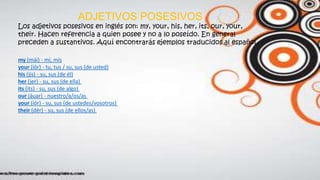
ADJETIVOS POSESIVOS
Los adjetivos posesivos en inglés son: my, your, his, her, its, our, your,
their. Hacen referencia a quien posee y no a lo poseído. En general
preceden a sustantivos. Aquí encontrarás ejemplos traducidos al español.
my (mái) - mi, mis
your (iór) - tu, tus / su, sus (de usted)
his (jis) - su, sus (de él)
her (jer) - su, sus (de ella)
its (its) - su, sus (de algo)
our (áuar) - nuestro/a/os/as
your (iór) - su, sus (de ustedes/vosotros)
their (dér) - su, sus (de ellos/as)
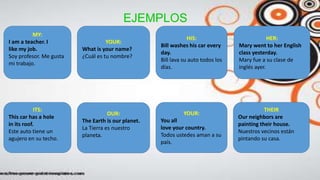
EJEMPLOS
MY:
I am a teacher. I
like my job.
Soy profesor. Me gusta
mi trabajo.
YOUR:
What is your name?
¿Cuál es tu nombre?
HIS:
Bill washes his car every
day.
Bill lava su auto todos los
días.
HER:
Mary went to her English
class yesterday.
Mary fue a su clase de
inglés ayer.
ITS:
This car has a hole
in its roof.
Este auto tiene un
agujero en su techo.
OUR:
The Earth is our planet.
La Tierra es nuestro
planeta.
YOUR:
You all
love your country.
Todos ustedes aman a su
país.
THEIR
Our neighbors are
painting their house.
Nuestros vecinos están
pintando su casa.
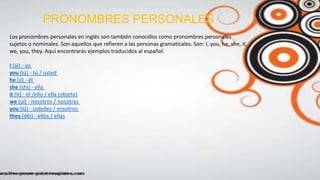
PRONOMBRES PERSONALES
Los pronombres personales en inglés son también conocidos como pronombres personales
sujetos o nominales. Son aquellos que refieren a las personas gramaticales. Son: I, you, he, she, it,
we, you, they. Aquí encontrarás ejemplos traducidos al español.
I (ái) - yo
you (iú) - tú / usted
he (jí) - él
she (shí) - ella
it (it) - él /ello / ella (objeto)
we (uí) - nosotros / nosotras
you (iú) - ustedes / vosotros
they (déi) - ellos / ellas
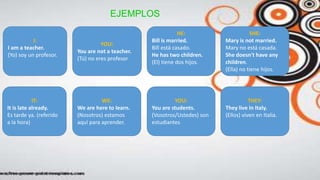
EJEMPLOS
I:
I am a teacher.
(Yo) soy un profesor.
YOU:
You are not a teacher.
(Tú) no eres profesor
SHE:
Mary is not married.
Mary no está casada.
She doesn't have any
children.
(Ella) no tiene hijos.
HE:
Bill is married.
Bill está casado.
He has two children.
(El) tiene dos hijos.
IT:
It is late already.
Es tarde ya. (referido
a la hora)
THEY:
They live in Italy.
(Ellos) viven en Italia.
WE:
We are here to learn.
(Nosotros) estamos
aquí para aprender.
YOU:
You are students.
(Vosotros/Ustedes) son
estudiantes
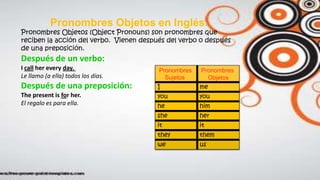
Pronombres Objetos en Inglés.
Pronombres Objetos (Object Pronouns) son pronombres que
reciben la acción del verbo. Vienen después del verbo o después
de una preposición.
Después de un verbo:
I call her every day.
Le llamo (a ella) todos los días.
Después de una preposición:
The present is for her.
El regalo es para ella.
Pronombres
Sujetos
Pronombres
Objetos
I me
you you
he him
she her
it it
they them
we us
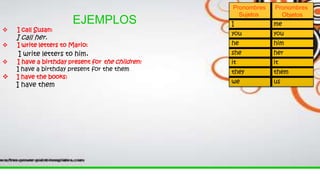
EJEMPLOS
 I call Susan:
I call her.
 I write letters to Mario:
I write letters to him.
 I have a birthday present for the children:
I have a birthday present for the them
 I have the books:
I have them
Pronombres
Sujetos
Pronombres
Objetos
I me
you you
he him
she her
it it
they them
we us
Gordiito!

Gordiito!

  • 1.
    UNIDAD EDUCATIVA PRTICULARMIXTA JULIO MARIA MATOVELLE INGLES NAME: Edison Granja Martínez. COURSE: Tercero de Bachillerato TECHER: Sandra Aguilar. SCOHOOL YEAR 2013-2014
  • 2.
    ADJETIVOS POSESIVOS Los adjetivosposesivos en inglés son: my, your, his, her, its, our, your, their. Hacen referencia a quien posee y no a lo poseído. En general preceden a sustantivos. Aquí encontrarás ejemplos traducidos al español. my (mái) - mi, mis your (iór) - tu, tus / su, sus (de usted) his (jis) - su, sus (de él) her (jer) - su, sus (de ella) its (its) - su, sus (de algo) our (áuar) - nuestro/a/os/as your (iór) - su, sus (de ustedes/vosotros) their (dér) - su, sus (de ellos/as)
  • 3.
    EJEMPLOS MY: I am ateacher. I like my job. Soy profesor. Me gusta mi trabajo. YOUR: What is your name? ¿Cuál es tu nombre? HIS: Bill washes his car every day. Bill lava su auto todos los días. HER: Mary went to her English class yesterday. Mary fue a su clase de inglés ayer. ITS: This car has a hole in its roof. Este auto tiene un agujero en su techo. OUR: The Earth is our planet. La Tierra es nuestro planeta. YOUR: You all love your country. Todos ustedes aman a su país. THEIR Our neighbors are painting their house. Nuestros vecinos están pintando su casa.
  • 4.
    PRONOMBRES PERSONALES Los pronombrespersonales en inglés son también conocidos como pronombres personales sujetos o nominales. Son aquellos que refieren a las personas gramaticales. Son: I, you, he, she, it, we, you, they. Aquí encontrarás ejemplos traducidos al español. I (ái) - yo you (iú) - tú / usted he (jí) - él she (shí) - ella it (it) - él /ello / ella (objeto) we (uí) - nosotros / nosotras you (iú) - ustedes / vosotros they (déi) - ellos / ellas
  • 5.
    EJEMPLOS I: I am ateacher. (Yo) soy un profesor. YOU: You are not a teacher. (Tú) no eres profesor SHE: Mary is not married. Mary no está casada. She doesn't have any children. (Ella) no tiene hijos. HE: Bill is married. Bill está casado. He has two children. (El) tiene dos hijos. IT: It is late already. Es tarde ya. (referido a la hora) THEY: They live in Italy. (Ellos) viven en Italia. WE: We are here to learn. (Nosotros) estamos aquí para aprender. YOU: You are students. (Vosotros/Ustedes) son estudiantes
  • 6.
    Pronombres Objetos enInglés. Pronombres Objetos (Object Pronouns) son pronombres que reciben la acción del verbo. Vienen después del verbo o después de una preposición. Después de un verbo: I call her every day. Le llamo (a ella) todos los días. Después de una preposición: The present is for her. El regalo es para ella. Pronombres Sujetos Pronombres Objetos I me you you he him she her it it they them we us
  • 7.
    EJEMPLOS  I callSusan: I call her.  I write letters to Mario: I write letters to him.  I have a birthday present for the children: I have a birthday present for the them  I have the books: I have them Pronombres Sujetos Pronombres Objetos I me you you he him she her it it they them we us