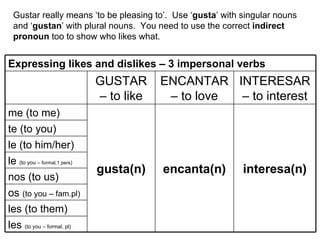
Gustar really means ‘to be pleasing to’.  Use ‘ gusta ’ with singular nouns and ‘ gustan ’ with plural nouns.  You need to use the correct  indirect pronoun  too to show who likes what. Expressing likes and dislikes – 3 impersonal verbs GUSTAR – to like ENCANTAR – to love INTERESAR – to interest me (to me) gusta(n) encanta(n) interesa(n) te (to you) le (to him/her) le  (to you –  formal,1 pers ) nos (to us) os  (to you – fam.pl) les (to them) les  (to you – formal, pl)
jugar al...
hacer/practicar el/la...
leer un libro descansar escuchar música mirar/ver la tele
2. Le __________ los libros GUSTA o GUSTAN 3. Nos __________ el tenis 1. Me __________ jugar al futbol 6. Les __________ beber agua con gas 5. Me __________ los conciertos 4. Le __________ el jugo 7. Me __________ la musica
2. _____ gusta jugar al futbol  (tú) GUSTA o GUSTAN (completa los pronombres) 3. _____ gusta jugar al futbol  (él, ella, usted) 1. Me gusta jugar al futbol  (yo) 6. _____ gusta jugar al futbol  (ellos, ustedes) 5. _____ gusta jugar al futbol  (vosotros) 4. _____ gusta jugar al futbol  (nosotros)
2. A Pedro y a mi _____ gusta    la musica A quien le gusta? 3. A mi _____ gustan los libros 1. A Juan _____ gusta jugar al futbol 6. A nosotros ____ gusta ver la tele 5. A ellos _____ gusta jugar al tenis 4. A Lola _____ gustan los conciertos 7. A ti _____ gusta ir al cine
2.  ¿A vosotros_____ interesa este tema? Completa las frases siguientes con el pronombre adecuado (me, te, le, nos, os, les). 3.  A mis amigos _____ encanta este parque. 1.  A nosotros no _____ gusta mucho bailar. 6.  A ti no _____ gusta X factor, pero a mí, sí. 5.  ¿A vosotros no _____ gusta vivir aquí? 4.  A Ana _____ gustan las clases de español. 8.  A tí no, pero a nosotros sí _____ apetece beber algo. 7.  ¿Tienes sed? ¿_____ apetece un refresco?

Gustar + actividades

  • 1.
    Gustar really means‘to be pleasing to’. Use ‘ gusta ’ with singular nouns and ‘ gustan ’ with plural nouns. You need to use the correct indirect pronoun too to show who likes what. Expressing likes and dislikes – 3 impersonal verbs GUSTAR – to like ENCANTAR – to love INTERESAR – to interest me (to me) gusta(n) encanta(n) interesa(n) te (to you) le (to him/her) le (to you – formal,1 pers ) nos (to us) os (to you – fam.pl) les (to them) les (to you – formal, pl)
  • 2.
  • 3.
  • 4.
    leer un librodescansar escuchar música mirar/ver la tele
  • 5.
    2. Le __________los libros GUSTA o GUSTAN 3. Nos __________ el tenis 1. Me __________ jugar al futbol 6. Les __________ beber agua con gas 5. Me __________ los conciertos 4. Le __________ el jugo 7. Me __________ la musica
  • 6.
    2. _____ gustajugar al futbol (tú) GUSTA o GUSTAN (completa los pronombres) 3. _____ gusta jugar al futbol (él, ella, usted) 1. Me gusta jugar al futbol (yo) 6. _____ gusta jugar al futbol (ellos, ustedes) 5. _____ gusta jugar al futbol (vosotros) 4. _____ gusta jugar al futbol (nosotros)
  • 7.
    2. A Pedroy a mi _____ gusta la musica A quien le gusta? 3. A mi _____ gustan los libros 1. A Juan _____ gusta jugar al futbol 6. A nosotros ____ gusta ver la tele 5. A ellos _____ gusta jugar al tenis 4. A Lola _____ gustan los conciertos 7. A ti _____ gusta ir al cine
  • 8.
    2. ¿Avosotros_____ interesa este tema? Completa las frases siguientes con el pronombre adecuado (me, te, le, nos, os, les). 3. A mis amigos _____ encanta este parque. 1. A nosotros no _____ gusta mucho bailar. 6. A ti no _____ gusta X factor, pero a mí, sí. 5. ¿A vosotros no _____ gusta vivir aquí? 4. A Ana _____ gustan las clases de español. 8. A tí no, pero a nosotros sí _____ apetece beber algo. 7. ¿Tienes sed? ¿_____ apetece un refresco?

Notas del editor

  • #2 Students have this in their grammar books but it would be useful to do some whiteboard practice at this point.
  • #3 Present the sports to elicit ‘me gusta/no me gusta + infinitive + sport.
  • #4 Do similar activities for these.