Verbs like 
GUSTAR
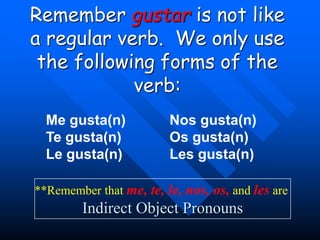
Remember gustar is not like 
a regular verb. We only use 
the following forms of the 
verb: 
Me gusta(n) Nos gusta(n) 
Te gusta(n) Os gusta(n) 
Le gusta(n) Les gusta(n) 
**Remember that me, te, le, nos, os, and les are 
Indirect Object Pronouns
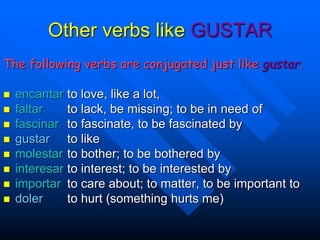
Other verbs like GUSTAR 
The following verbs are conjugated just like gustar. 
 encantar to love, like a lot, 
 faltar to lack, be missing; to be in need of 
 fascinar to fascinate, to be fascinated by 
 gustar to like 
 molestar to bother; to be bothered by 
 interesar to interest; to be interested by 
 importar to care about; to matter, to be important to 
 doler to hurt (something hurts me)
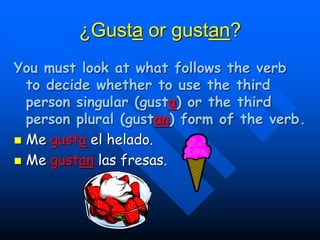
¿Gusta or gustan? 
You must look at what follows the verb 
to decide whether to use the third 
person singular (gusta) or the third 
person plural (gustan) form of the verb. 
 Me gusta el helado. 
 Me gustan las fresas.
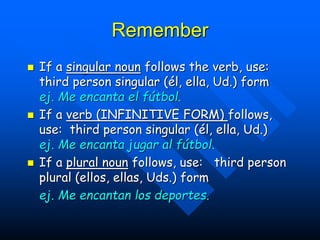
Remember 
 If a singular noun follows the verb, use: 
third person singular (él, ella, Ud.) form 
ej. Me encanta el fútbol. 
 If a verb (INFINITIVE FORM) follows, 
use: third person singular (él, ella, Ud.) 
ej. Me encanta jugar al fútbol. 
 If a plural noun follows, use: third person 
plural (ellos, ellas, Uds.) form 
ej. Me encantan los deportes.
Por ejemplo 
 (A mí) me gusta la fruta. 
Fruit is pleasing to me. 
(I like fruit) 
 (A mí) me importan las 
notas. 
My grades matter to me.
Más ejemplos: 
 A ella le duele la cabeza. 
 A ella le gustan las flores. 
 A los jóvenes les interesa acampar. 
 A ellas les fascinan las películas 
cómicas.
Ramón describe los gustos de 
varias personas. ¿Qué dice él? 
1. A mí / gustar/ la ropa de Gap 
A mí me gusta la ropa de Gap 
2. A nosotros / importar / buenas notas. 
A nosotros nos importan buenas notas. 
3. A ti / faltar / lápiz. 
A ti te falta el lápiz.
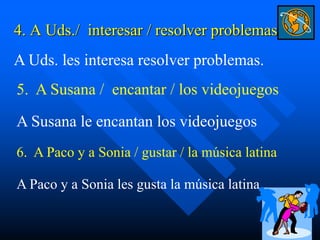
4. A Uds./ interesar / resolver problemas 
A Uds. les interesa resolver problemas. 
5. A Susana / encantar / los videojuegos 
A Susana le encantan los videojuegos 
6. A Paco y a Sonia / gustar / la música latina 
A Paco y a Sonia les gusta la música latina.
¿Cómo se dice en español? 
1. Cooking is interesting to me. 
2. My friends and I lack (are in need of) 
$10. 
3. Nature fascinates you. 
4. My brother bothers my sisters. 
5. Friends are important to Catalina.
¿Cómo se dice en español?: 
1. Cooking is interesting to me. 
(A mí) Me interesa cocinar.
¿Cómo se dice en español?: 
2. My friends and I lack (are in need of) 
$10. 
A mis amigos y a mí nos faltan diez 
dólares.
¿Cómo se dice en español?: 
3. Nature fascinates you. 
Te fascina la naturaleza.
¿Cómo se dice en español?: 
4. My brother bothers my sisters. 
(A mis hermanas) les molesta mi 
hermano.
¿Cómo se dice en español?: 
5. Friends are important to Catalina. 
A Catalina le importan los 
amigos.
 Fuente: 
 http://www.google.com/url?sa=t&rct=j&q 
=verbos%20como%20gustar%20&sour 
ce=web&cd=5&cad=rja&ved=0CEgQFj 
AE&url=http%3A%2F%2Fwww.shs.d21 
1.org%2FForeignLang%2Ffaculty%2FC 
3P%2FU1E2%2520Verbs%2520like%2 
520GUSTAR.ppt&ei=Yl6qUKKuEczfigL 
uu4GYBQ&usg=AFQjCNGmfA8tczyE1i 
Tzi3Jw-X16gnMi9g

Verbos como gustar - presentación

  • 1.
  • 2.
    Remember gustar isnot like a regular verb. We only use the following forms of the verb: Me gusta(n) Nos gusta(n) Te gusta(n) Os gusta(n) Le gusta(n) Les gusta(n) **Remember that me, te, le, nos, os, and les are Indirect Object Pronouns
  • 3.
    Other verbs likeGUSTAR The following verbs are conjugated just like gustar.  encantar to love, like a lot,  faltar to lack, be missing; to be in need of  fascinar to fascinate, to be fascinated by  gustar to like  molestar to bother; to be bothered by  interesar to interest; to be interested by  importar to care about; to matter, to be important to  doler to hurt (something hurts me)
  • 4.
    ¿Gusta or gustan? You must look at what follows the verb to decide whether to use the third person singular (gusta) or the third person plural (gustan) form of the verb.  Me gusta el helado.  Me gustan las fresas.
  • 5.
    Remember  Ifa singular noun follows the verb, use: third person singular (él, ella, Ud.) form ej. Me encanta el fútbol.  If a verb (INFINITIVE FORM) follows, use: third person singular (él, ella, Ud.) ej. Me encanta jugar al fútbol.  If a plural noun follows, use: third person plural (ellos, ellas, Uds.) form ej. Me encantan los deportes.
  • 6.
    Por ejemplo (A mí) me gusta la fruta. Fruit is pleasing to me. (I like fruit)  (A mí) me importan las notas. My grades matter to me.
  • 7.
    Más ejemplos: A ella le duele la cabeza.  A ella le gustan las flores.  A los jóvenes les interesa acampar.  A ellas les fascinan las películas cómicas.
  • 8.
    Ramón describe losgustos de varias personas. ¿Qué dice él? 1. A mí / gustar/ la ropa de Gap A mí me gusta la ropa de Gap 2. A nosotros / importar / buenas notas. A nosotros nos importan buenas notas. 3. A ti / faltar / lápiz. A ti te falta el lápiz.
  • 9.
    4. A Uds./interesar / resolver problemas A Uds. les interesa resolver problemas. 5. A Susana / encantar / los videojuegos A Susana le encantan los videojuegos 6. A Paco y a Sonia / gustar / la música latina A Paco y a Sonia les gusta la música latina.
  • 10.
    ¿Cómo se diceen español? 1. Cooking is interesting to me. 2. My friends and I lack (are in need of) $10. 3. Nature fascinates you. 4. My brother bothers my sisters. 5. Friends are important to Catalina.
  • 11.
    ¿Cómo se diceen español?: 1. Cooking is interesting to me. (A mí) Me interesa cocinar.
  • 12.
    ¿Cómo se diceen español?: 2. My friends and I lack (are in need of) $10. A mis amigos y a mí nos faltan diez dólares.
  • 13.
    ¿Cómo se diceen español?: 3. Nature fascinates you. Te fascina la naturaleza.
  • 14.
    ¿Cómo se diceen español?: 4. My brother bothers my sisters. (A mis hermanas) les molesta mi hermano.
  • 15.
    ¿Cómo se diceen español?: 5. Friends are important to Catalina. A Catalina le importan los amigos.
  • 16.
     Fuente: http://www.google.com/url?sa=t&rct=j&q =verbos%20como%20gustar%20&sour ce=web&cd=5&cad=rja&ved=0CEgQFj AE&url=http%3A%2F%2Fwww.shs.d21 1.org%2FForeignLang%2Ffaculty%2FC 3P%2FU1E2%2520Verbs%2520like%2 520GUSTAR.ppt&ei=Yl6qUKKuEczfigL uu4GYBQ&usg=AFQjCNGmfA8tczyE1i Tzi3Jw-X16gnMi9g