¿A tí te gustan los deportes? LOS DEPORTES
el fútbol
el golfo
el nétbol
el tenis
el criquet
el boxeo
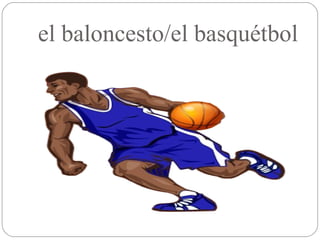
el baloncesto/el basquétbol
el ciclismo
el vóleibol
el béisbol
el hockey
el esquí Skiing
el patinaje  Skating
El salto de altura
la lucha
la vela
la gimnasia
la natación
la pista y el campo
la corrida de  torros  Bull fighting
El verbo “gustar” The verb “gustar” means “to be pleasing to” or “to please”. This verb is almost always conjugated in the 3 rd  persons singular and plural forms. It agrees with the thing that pleases, not the person who is pleased. In essence, the English object becomes the Spanish subject and if you like something plural, the verb takes the 3 rd  person plural form in Spanish. Examples: 1. A mí me  gusta  el atletismo. I like athletics. 2. A mí me  gustan  el atletismo y el tenis.  I like athletics and tennis.
Indirect object pronouns and “gustar” A mí me gusta   A usted le gusta A mí me gustan  I like A usted le gustan   You like A ti te gusta  A nosotros nos gusta  A ti te gustan  You like  A nosotros nos gustan  We like A él le gusta  A ellos /ellas les gusta A él le gustan  He likes A ellos/ellas les gustan   They like A ella le gusta A ustedes les gusta A ella le gustan   She likes A ustedes les gustan You like The  a mí, a ti… are used for emphasis. Now remember that the English subject becomes the indirect object in this context.
¿A tí te gustan los deportes? Do you like sports? Sí, a mí me gustan los deportes. Yes, I like sports. No , a mí  no  me gustan los deportes. No, I do not like sports. Note that in the second example uses the double negative. This is common in Spanish.
¿A tí te gustan los deportes? Another way of responding negatively to the question  ¿A tí te gustan los deportes?   is by using direct object pronouns and correct forms of the verb ‘detestar’ (to hate).   Los  detesto. I hate them. For the individual sports we may use ‘lo’,‘la’  ‘los’ or ‘las’ depending on their number and gender. ¿A tí te gusta la lucha? La  detesto. ¿A tí te gusta el fútbol? Lo  detesto. ¿A tí te gustan la natación y la gimnasia?  Las  detesto.
Preguntas para practicar Contesta estas preguntas en español. Usa frases completas. ¿A ti te gusta la lucha? ¿A ti te gusta el baloncesto? ¿A ti te gustan los deportes? ¿A ti te gusta el hockey? ¿A ti te gusta la natación? ¿Qué deportes practicas en tu escuela? ¿ Qué deportes juegas?
Points to remember The verb “gustar” means “to be pleasing to”, and it agrees with the thing (s) that please(s), not the person who is pleased.  “ Gustar” is used in the 3 rd  persons singular and plural verb forms. Indirect object pronouns (me te, le, nos, les) are used with this verbs. Also remember to put the emphasis! You can use the correct forms of the verb “detestar” with an object pronoun to express your distaste/dislike for a sport.

Los Deportes

  • 1.
    ¿A tí tegustan los deportes? LOS DEPORTES
  • 2.
  • 3.
  • 4.
  • 5.
  • 6.
  • 7.
  • 8.
  • 9.
  • 10.
  • 11.
  • 12.
  • 13.
  • 14.
    el patinaje Skating
  • 15.
  • 16.
  • 17.
  • 18.
  • 19.
  • 20.
    la pista yel campo
  • 21.
    la corrida de torros Bull fighting
  • 22.
    El verbo “gustar”The verb “gustar” means “to be pleasing to” or “to please”. This verb is almost always conjugated in the 3 rd persons singular and plural forms. It agrees with the thing that pleases, not the person who is pleased. In essence, the English object becomes the Spanish subject and if you like something plural, the verb takes the 3 rd person plural form in Spanish. Examples: 1. A mí me gusta el atletismo. I like athletics. 2. A mí me gustan el atletismo y el tenis. I like athletics and tennis.
  • 23.
    Indirect object pronounsand “gustar” A mí me gusta A usted le gusta A mí me gustan I like A usted le gustan You like A ti te gusta A nosotros nos gusta A ti te gustan You like A nosotros nos gustan We like A él le gusta A ellos /ellas les gusta A él le gustan He likes A ellos/ellas les gustan They like A ella le gusta A ustedes les gusta A ella le gustan She likes A ustedes les gustan You like The a mí, a ti… are used for emphasis. Now remember that the English subject becomes the indirect object in this context.
  • 24.
    ¿A tí tegustan los deportes? Do you like sports? Sí, a mí me gustan los deportes. Yes, I like sports. No , a mí no me gustan los deportes. No, I do not like sports. Note that in the second example uses the double negative. This is common in Spanish.
  • 25.
    ¿A tí tegustan los deportes? Another way of responding negatively to the question ¿A tí te gustan los deportes? is by using direct object pronouns and correct forms of the verb ‘detestar’ (to hate). Los detesto. I hate them. For the individual sports we may use ‘lo’,‘la’ ‘los’ or ‘las’ depending on their number and gender. ¿A tí te gusta la lucha? La detesto. ¿A tí te gusta el fútbol? Lo detesto. ¿A tí te gustan la natación y la gimnasia? Las detesto.
  • 26.
    Preguntas para practicarContesta estas preguntas en español. Usa frases completas. ¿A ti te gusta la lucha? ¿A ti te gusta el baloncesto? ¿A ti te gustan los deportes? ¿A ti te gusta el hockey? ¿A ti te gusta la natación? ¿Qué deportes practicas en tu escuela? ¿ Qué deportes juegas?
  • 27.
    Points to rememberThe verb “gustar” means “to be pleasing to”, and it agrees with the thing (s) that please(s), not the person who is pleased. “ Gustar” is used in the 3 rd persons singular and plural verb forms. Indirect object pronouns (me te, le, nos, les) are used with this verbs. Also remember to put the emphasis! You can use the correct forms of the verb “detestar” with an object pronoun to express your distaste/dislike for a sport.